Too Black to be French ?

Friday evening on the French/German television channel ARTE, random Black French citizens responded to Isabelle Boni-Claverie a French-Ivoirian screenwriter and film maker, “You know you are Black in France when…” Her latest documentary entitled “Trop noire pour être française ?” (Too Black to be French ?) mixed her personal story with these testimonies and interviews with philosopher Achille Mbembe, historian Pap Ndiaye, sociologist Eric Fassin, socio-demographer Patrick Simon and anthropologist Sylvie Chalaye to explore the experience of being a French Black citizen in the 21st century.

The urge to make this film came after the so-called “affaire Guerlain” in 2010, when renowned perfumer Jean Paul Guerlain explained on French public television how he created a perfume: “I worked like a nigger. I don’t know if niggers have always worked like that, but anyway.” Boni-Claverie was shocked by this comment. Apart from the strong reaction of Audrey Pulvar a “Black” French journalist, the overall press response showed that the remark was accepted as a verbal gaffe and nothing else.

She started an internet-based citizen movement and, along with other movements, organized demonstrations in front of Guerlain headquarter. The movement persisted and grew forcing Jean Paul Guerlain to face justice. He apologized in court saying that he was anything but racist; nevertheless he was convicted.

Boni-Claverie’s documentary explores the idea that his words are jokingly accepted because the stereotype has prevailed in the privacy of what is left of the imaginary of the colonial social construction of France and western countries. She uses her personal family story to untangle the colonial past and mythology that leads to what it means to be Black and French in the 21st century.

The underlying question of her documentary is the absence in France of ethnicity statistics, a necessary tool to see more clearly ethnic discriminations. The question still raises resistance for several reasons: one inherited from the resistance to ethnic murders of the Vichy government during World War II, and the other the belief that blindness to differences will guarantee equality, which is blatantly false.

Boni-Claverie’s personal story and inquiry is nourished with the love story of her grand parents, her grandmother a White law student from rural Tarn, in southwestern France, and her grandfather an Ivorian law student. They defied all stereotypes and laws and got married in 1931 both as French citizens.

France has its own stories to justify colonization, all of them based on the view of the colonized as children and thus not able to run their own lives (just as women). The story of a military defeat against Germany in 1870 also played a major role. As a result, France, a defeated empire, needed compensation in the “unknown lands”. The country sought to annex natural resources and labor force, including canon fodder in Africa as explains Achille Mbembe.

Thus, her grandfather born in 1909 in Ivory Coast, annexed by France, was an “indigene” and although the educative function of the colonies was part of the mythology, education was to be sought in France at the charge of the colonized.

Isabelle Boni-Claverie looks into the fantasizing civilizing mission of the colonizers that has fueled Nicolas Sarkozy’s declarations as a President of France. She replays parts of the infamous speech of Dakar, a slap to the Africans received on their soil. Sarkozy played on the mythologies of colonization to assert that “the African has not fully entered into history”, emphasizing the impossibility of the traditional African man to ever launch himself toward the future.

The “Guerlain affair” occurred during the Sarkozy years in power, with the creation of the national ministry of immigration and national identity, since removed by the Hollande administration. Boni-Claverie inserts a sequence on the role of stereotypes in the colonial construction and how they have persisted and evolved to justify inequalities that are suitable to the French elite and keep French Blacks in questionable citizenship.

In between sequences come the testimonies of anonymous citizens such as this particular one: “You know you are Black when as a member of the staff of a restaurant you must serve the meeting of Le Pen, and you see yourself afflicted with slurs, that you are called cheetah, nigger (negresse), that some throw sugar at you or other cookies and they ask you to pick them up.” This testimony is a reminder of the racist slurs toward Christiane Taubira, the Minister of Justice, and toward Najat Vallaud Belkacem, the Minister of Education.

Sociologist Eric Fassin then reminds viewers that to be French is a question of rights and should not be questioned, as it is written in Article 1 of the Constitution. Isabelle Boni-Claverie asks her relative from the Tarn region about her grandparents and her cousin concludes strongly: You are a Tarnaise! Yes she is in the majority and still…

Playing on the “alchemy of race and rights” the White socio-demographer and the sociologist ask: “Are the Whites ready to become White?” Patrick Simon reminds us that the surface identity is White, and the Whites define the other in comparison with them. He admitted that he questions his own identity, as a White heterosexual male.

At this moment in the documentary the interrogation flips: “You know you are White when a friend of yours goes through ID and is checked and nobody ever asks for your ID.”

Isabelle Boni-Claverie’s grandfather was the first French magistrate of African origin. She comes from a privileged background and yet class does not protect from discrimination, although, as she recognizes, class provides some entitlement if, and only if, one assimilates. Then the group remains “entre-soi”, “among friends”, a sort of homogeneity defined by class, race and gender. Otherwise the response is merciless. Paradoxically, privileged class is often the source of the most disguised but nasty racism, according to Boni-Claverie.

She demonstrates that the personal is political. Her grand parents lived together for 50 years, her grandmother passed first and her grandfather soon after. Boni-Claverie concludes that together they made themselves believe that the advent of a post racial society had happened. She ends by asking: How much time for that to be a reality for all?

Liberation opened a page for testimonies: “You know you are Black when…” The page filled quickly with important, must-read testimonies. The documentary will be distributed to associations to raise awareness; it came with a petition to promote the establishment of quantitative data on discrimination. It is the responsibility of the French State to have its principles written in its Constitution respected.


(Photo Credit: RFI)
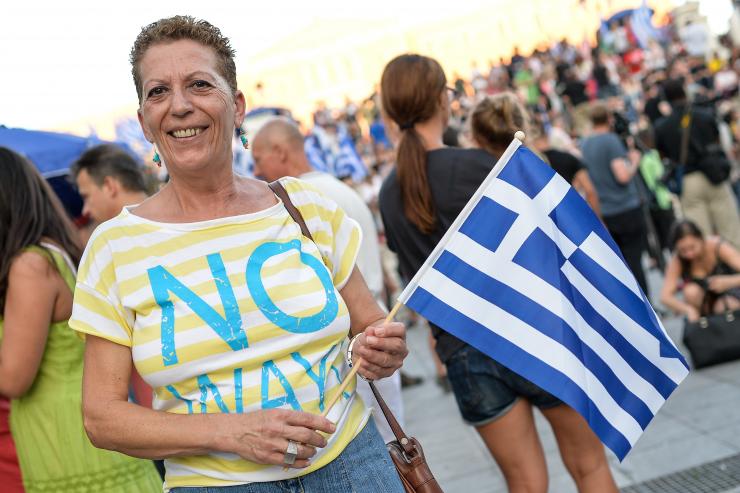
OXI! Greek women say NO to the Dictatorship of the Debt


For the last five years, Women In and Beyond the Global has maintained a series on Greek women, and women in Greece, during the ongoing `crisis’. These pieces have been written by Brigitte Marti, Sonia Mitralia, Dan Moshenberg. We’ve also provided translation for a video, Canaries in the Coalmine.

Given the weekend’s referendum, we thought it would be a good idea to put those pieces that focus exclusively on Greece together. The struggle continues!

Asylum-seeker Mandana Daneshnia and her daughter haunt democracy. Dan Moshenberg. October 24, 2010. http://www.womeninandbeyond.org/?p=710

We are all canaries in the coal mine. Brigitte Marti. December 4, 2013. http://www.womeninandbeyond.org/?p=6613

Deprivation in Greece … just an emotional issue??? Brigitte Marti. December 30, 2013. http://www.womeninandbeyond.org/?p=6670

Violence Against Women as a strategic weapon in a time of class war in Greece. Sonia Mitralia. January 3, 2014. http://www.womeninandbeyond.org/?p=6676

Women’s rights, labor rights did not cause the Greek mess. Brigitte Marti. February 2, 2014. http://www.womeninandbeyond.org/?p=7989

The urgency of an independent women’s movement against debt and austerity measures. Sonia Mitralia. February 4, 2014 http://www.womeninandbeyond.org/?p=8146

In Greece, from debt to prison to death. Brigitte Marti. March 30, 2014. http://www.womeninandbeyond.org/?p=11293

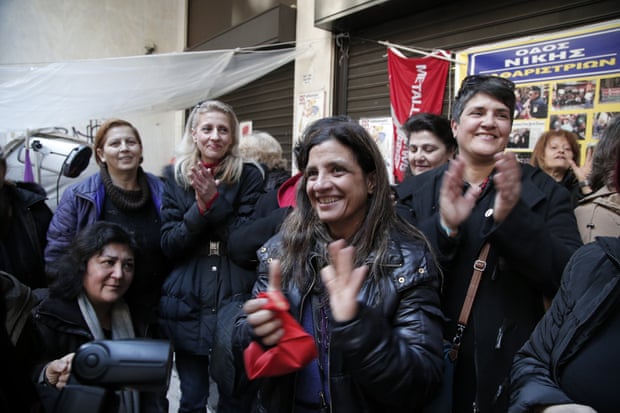
In Athens, women cleaners reject austerity’s mess. Brigitte Marti. April 6, 2014. http://www.womeninandbeyond.org/?p=11785

The people do not celebrate Greece’s return to the debt market. Brigitte Marti. April 21, 2014. http://www.womeninandbeyond.org/?p=12642

Greek cleaning women demand an end to austerity. Dan Moshenberg. June 14 2014. http://www.womeninandbeyond.org/?p=15727

Solidarity with Greek women cleaners against austerity! Brigitte Marti. July 7, 2014. http://www.womeninandbeyond.org/?p=15768

In Greece, austerity builds its own gulag. Dan Moshenberg. July 8, 2014. http://www.womeninandbeyond.org/?p=15772

Cleaners: A handful of women show the way! Sonia Mitralia. August 6, 2014. http://www.womeninandbeyond.org/?p=15831

The experiment continues, and we are all still canaries in the coal mine. Brigitte Marti. November 19, 2014. http://www.womeninandbeyond.org/?p=16064

A new beginning for Greece and for Europe starts today! Brigitte Marti. February 18, 2014. http://www.womeninandbeyond.org/?p=18325

Appeal to support the resisting Greek people and its Truth Commission on Public Debt. Sonia Mitralia. May 27, 2015 http://www.womeninandbeyond.org/?p=18751

Across Europe women campaign against the Dictatorship of the Debt. Brigitte Marti. June 15, 2015. http://www.womeninandbeyond.org/?p=18866

In Greece, the women cleaners show the way! Brigitte Marti. June 25, 2015. http://www.womeninandbeyond.org/?p=18914

#OXI! #GreeceIsTheWord!


(Photo Credit: Getty Images / Andreas Solaro)

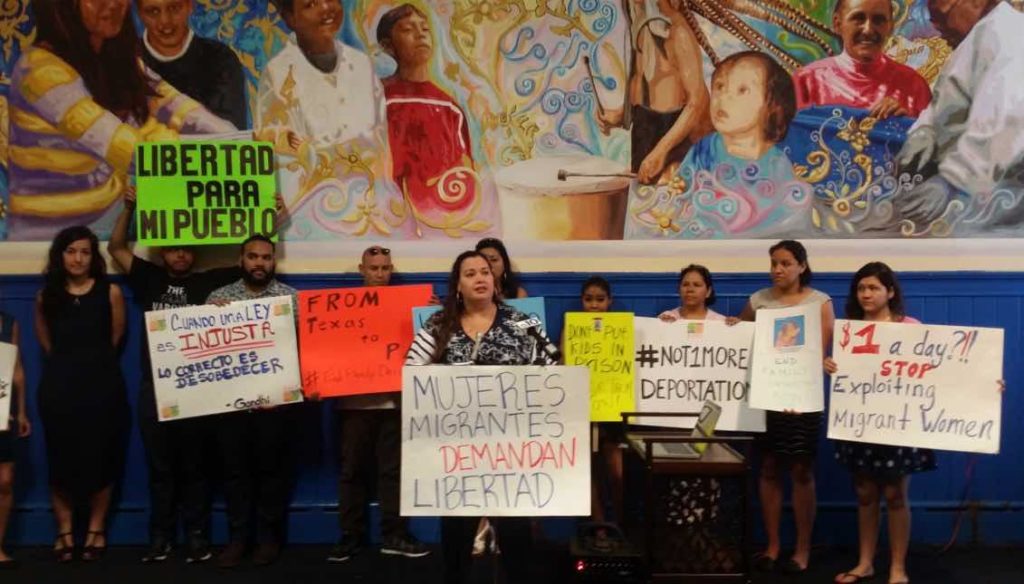
#ShutDownBerks: The mothers of Berks Family Detention Center demand justice now!


The United States built a special hell for immigrant women and children, Berks Family Detention Center. The only thing “family” about Berks are the lies the State promulgates: “U.S. Immigration and Customs Enforcement (“ICE”) established the Berks Family Residential Facility (“Berks”) in March 2001. Designed as a non-secure residential facility to accommodate the unique needs of undocumented children and their families, Berks became the first of its kind in the U.S. dedicated to keeping families and children together while undergoing immigration proceedings. Located in Leesport, PA, the eighty-five (85) bed facility that was once a nursing home is nestled in a quiet, small-town community. Berks … provides non-violent, non-criminal families with a variety of supportive services throughout their stay.” There is nothing supportive in or about Berks. That’s why the mothers of Berks Detention are on work strike. That’s why supporters will show up next Saturday, July 11, to demand the State shut it down … now.

While the U.S. immigration policy has swung back and forth between hang-em-high and hang-em-higher, the one constant since 2001 has been Berks Family Detention, and from the beginning it has been criticized for its inhumane treatment and general brutality towards its prison populations, largely women and children. Recently the women of Berks have been turning up the heat.

In April, seventeen mothers held, with their children, in Berks “camp” wrote a letter to ICE, demanding their release. ICE never responded. Cristina and her twelve-year-old son were held at Berks for 14 months: “When I started my journey to the US, all I could think about was keeping my son safe. But after several months locked up, my son didn’t even want to eat anymore. He cried all the time and kept telling me he wanted to leave, but he doesn’t understand the danger we’d face if we were sent back. He still wakes up shaking with nightmares from the trauma.” ICE continued to claim that Berks is top of the line.

On June 10, ten mothers launched a work strike. The women demand to be released and that Berks be shut down. They also demand the “free world” take responsibility for the systematic abuses taking place inside Berks: exploitation, harassment, violence. ICE continues to claim that Berks is top of the line … and perhaps it is, but it’s a line that must end today.

On Friday, June 19, at 3 a.m., one of the Mothers of Berks, 34-year-old Ana and her 12-year-old daughter were awakened and sent off to the airport, where they were whisked back to Guatemala. A judge has since ordered that Ana and her daughter be returned to the United States, citing a violation of “due process.” When Ana, in Guatemala, heard of the judge’s order, she responded, “I just want to come back.” Ana and her daughter. fled Guatemala because of partner domestic abuse. Ana and her daughter have already spent over a year in Berks.

The State tries to pass off “family detention centers” as an attempt to preserve the family, but the women and children inside those jails know better. They are prisons designed to punish immigrant women, overwhelmingly women of color, Latinas, indigenous from the Global South, for being women: “The treatment of immigrants … signals, both to immigrant communities, and to the neighbors and other citizens who observe them, that these families can be disrupted at will: children can be separated from their parents, parents can be deprived of their ability to care for or even to discipline their children without findings of inadequacy and without recourse. These families are in fact abjected: expelled from the community symbolically, before they are expelled concretely. They are reduced to beings for whom the quintessentially human imperatives of care and nurturance, and the possibilities of family formation and preservation, seem not to apply.”

As one mother inside Berks explained, “When I left the violence of my county, I never thought I would end up in a place like this. It is safer here, yes, but it is just as bad. I’m crying because I just want to leave. I don’t know when I will.” #ShutDownBerks. Do it now.

(Photo Credit: Al Día)

Mae Mallory. I #SayHerName

For all of my sisters involved in the work of organizing for justice and freedom, please, if you would, take a moment to read this as a favor to me because it’s too hard for me to hold alone this morning when I can’t stop thinking about freedom fighter, Mae Mallory, a leader of the Harlem 9, a radical Black organizer who pushed to end unfair conditions in New York’s segregated school, a woman who risked her life and freedom in supporting her friend, Robert F. Williams, leader of the North Carolina NAACP and staunch advocate for armed Black self-defense.

Ms. Mae, present when they executed Minister Malcolm, mentored a woman who would later mentor me, Yuri Kochiyama, and at dinner with my Godmother, Safiya Bandele, this week, she shared that when Ms. Mae was near death she said, “I gonna die a Black woman, fat, alone, unloved and unacknowledged.”

It wasn’t as true as she thought it was, but I know the feeling and I know women who have had this feeling, this sense, that their lives and their work will be unaccounted for, disremembered when not disparaged and dismissed. I see this happen in the work all the time and too often by people who say that they are our comrades in struggle, or in the very least, share our worldview.

This is not the only battle we need to engage, but it is one of the most important: ensuring that those who are doing the work and giving the world everything they have to make it more livable are not dismissed by louder, often snarkier voices. Mae Mallory. I #SayHerName.


(Photo Credit: http://zinnedproject.org) (Video Credit: Vimeo / Schomburg Center Black Freedom Studies)

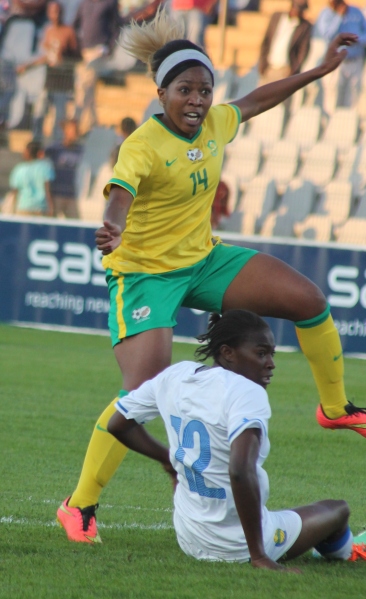
Confederation Of African Football Must Prioritise Women’s Football!

I’m of the opinion that an African country can win a women’s world cup but the only way they going to achieve this is with more assistance and support from the Confederation of African Football, the CAF, which rightfully must advance women’s football.

Women’s football in Africa is being given a raw deal with only the crumbs of the continent’s massive football budget being signed off for women in football. CAF must step up the game and demand advances to women’s participation in football, across the continent. It’s an injustice to humanity when sportswomen are discriminated against in resource and budget allocation. It’s a worse atrocity when talented, emerging players have no professional league in their country to pursue life as professional women footballers, as do their male counterparts.

Africa was represented at the 2015 women’s football world cup in Canada by Nigeria, Cameroon and Ivory Coast. Much was expected of African champions, Nigeria. The country found themselves drawn in the ‘group of death’ with Australia, USA and Sweden and never made it past the group stages.

2015 Women’s Football World Cup debutants got mixed results with Ivory Coast losing 10-nil to Germany in their opening match and never recovering thereafter. For first time performers, I thought Cameroon was very impressive; their performance in the last 16 of the competitive tournament proved the team’s prowess mixed with inexperience.

So what now for African women’s football? The three teams are back in Africa whilst the quarterfinals continue with no African representative. African women’s football will now prepare for the Rio Olympics qualifiers and the 2015 All African Games to be held in Congo in September.

As the controlling body for football on the African continent, CAF must prioritise women’s football. Girls and women’s participation is growing furiously and competitions must be increased to give the clubs and teams the best opportunities to participate and grow their football skills.

As African women’s football has shown in the Under 20 and Under 17 Women’s World Cups held over the past few years, African countries, especially Ghana and Nigeria, have excelled in these elite events and have medalled when competing with the world’s best in their age groups.

CAF must introduce a continental club competition featuring all national league winners. An African knockout championship for cup winners must also be looked at. Both these competitions will give impetus to clubs to perform regionally and win national titles to qualify to perform in Africa’s prestige women’s football events.

As Nigeria and Cameroon demonstrated at this year’s women’s football world cup, Africa countries are not far behind the top European, North American and Asian playing countries. Superbly talented young players like Nigeria’s Asisat Ashaolo spotlight Africa’s emerging women’s football talent. But Africa’s talented women footballers have to play football knowing they must get a contract to play out of Africa if they want to play professionally. When are professional leagues for women footballers going to take off in some African countries? By now Nigeria, Ghana and South Africa should have initiated women’s pro leagues.

Africa’s women’s national teams play on an ad hoc basis, as when qualifiers are coming up. There are not many qualifiers for Africa’s few continental championships. Players need to be operating competitively all year with small breaks in between. Women’s football is growing fast and development of the game from grassroots to international level is expanding around the world.

CAF has done much to improve and develop men’s and boys’ participation in league football and international matches. So why not for women? CAF cannot be allowed to discard and disregard women in football when the global game is played by both genders.

The struggle within CAF for women’s football to be prioritized, given much bigger budgets and expanded with more resource and people management is very real. CAF’s reluctance to advance women’s football, beyond its present state, impacts on emerging girl footballers, with them maybe never knowing their full talent and capabilities. This is an in justice to Africa’s girls and women in sport!

(An earlier version of this appeared on Cheryl’s blog. Thanks for the collaboration.)

(Photo Credit: AfricanWomanWarrior)

When you define a person by their diagnosis

On June 26, on the Iowa radio talk show “Mickelson in the Morning,” presidential candidate Mike Huckabee lashed out at the U.S. Supreme Court Chief Justice John Roberts for the logic of his opposition to marriage equality. While comparing same-sex marriage to polygamy, as Roberts did, begs for condemnation, Huckabee’s argument did more harm than good. In moving from his decision one day for the Affordable Care Act to his decision the next against marriage equality, Huckabee argued, Chief Justice Roberts showed that he “needs medication for schizophrenia.”

By exploiting a sensationalized and incorrect image of schizophrenia on public radio, Huckabee fuelled rampant misconceptions and stigmas that cause many of the estimated 2 million Americans who live with schizophrenia an unimaginable burden of hurt and suffering. Stigma is one of the reasons that nearly 70% of Americans with schizophrenia believe they are able to work and that a job would improve their lives, but only around 15% of them have a job.

Mary Giliberti, Executive Director of the National Alliance for Mental Illness (NAMI) called Huckabee out:

As political tactic, Governor Huckabee has exploited the stigma that traditionally has surrounded mental illness in order to attack the competence and credibility of someone with whom he disagrees … Such a remark would never be tolerated about needing chemotherapy for cancer or insulin for diabetes. It represents political ‘stigma-slinging’ at its worst. It doesn’t matter whether a person agrees or disagrees with the Supreme Court. It doesn’t matter whether a person is a Republican, Democrat or independent. To use mental illness as a metaphor to win political advantage does a terrible disservice to those who are diagnosed with this condition and often use medication as part of hard-won journeys to recovery. Stigma, perpetuated by any candidate’s statement, can lead to people’s reluctance to seek mental health care and devastating, even life threatening consequences … NAMI hopes that all the presidential candidates will speak out against stigma during the course of the 2016 election campaigns and will support policies to address the failing mental health system for those with schizophrenia and other serious mental health conditions.”

The media contributes to the stigma that surrounds schizophrenia in myriad ways. Apart from cheap laughs or ill-conceived parallels, as the one Huckabee tried to pull off, the media perpetuates misconceptions about mental illnesses in more subtle ways, for example by defining people who live with mental illness by their condition, as if that’s all they are.

Last August, the members of Fountain House, a New York based organization that works with and supports people with serious mental illnesses, called The New York Times to task for “often refer[ing] to people by outdated phrases such as `the mentally ill’ and `schizophrenics.’ Every time these careless labels are used, this language denies our human dignity and adds to the many challenges that people with mental illness already face. If you live with a mental health condition, or you know and love someone who does, you understand that words matter. When you define a person by their diagnosis, that person goes from being a brother, a writer, a sister, or a painter to being merely `the mentally ill’. It’s hurtful.”


(Image Credit: http://www.nami.org)

Sacrificing women asylum seekers on the altar of speed and convenience

Since 2003, those seeking asylum who come to the United Kingdom are greeted with what the State delicately refers to as the Detained Fast-Track Asylum System, or DFT. The only thing systematic in DFT is violence, and in particular violence against women. Two weeks ago, the High Court found the system unlawful and should be ended immediately. The State replied that stopping the system would be “inconvenient”, and the high court agreed, granting a stay on the order. Detention Action appealed the delay, and last Friday, the Court of Appeals agreed with them, meaning the system has to close down. The Home Office is in chaos.

The State loves throwing asylum seekers behind bars. In 2013, the latest figures available show 4,286 asylum seekers locked up, via DFT, in Yarl’s Wood, Colnbrook or Harmondsworth. 4,286 human beings seeking help and haven end up in cages. In 2012, Detained Fast Track sent 2,477 asylum seekers to Yarl’s Wood, Colnbrook and Harmondsworth. That’s an increase of 73% in one year. Cruelty and inhumanity are a growth industry.

This is the third time Detained Fast Track has been found unlawful. As Detention Action noted, “The High Court first ruled in July 2014 that the operation of the Detained Fast Track was at the time unlawful. Then, on 16th December 2014 the Court of Appeal found that the detention of asylum seekers who were not at risk of absconding whilst their appeals are pending was unlawful. Yet still the Fast Track continues.”

Now asylum seekers might be able to apply for bail. Having faced war, destitution, sexual violence in their home countries, and often in their homes, having made it to England only to be jailed, having often undergone further intimidation, brutality, including sexual violence, at the hands of the prison staff, these `dangers to society’ might be able to approach the shadowlands of due process. It’s not justice, but at least it’s due process.

The latest High Court trial was heard before High Court Justice Andrew Nicol, who concluded, “In my judgment the FTR [Fast Track Rules] do incorporate structural unfairness. They put the Appellant at a serious procedural disadvantage … What seems to me to make the FTR structurally unfair is the serious procedural disadvantage which comes from the abbreviated timetable and curtailed case management powers together with the imposition of this disadvantage on the appellant by the respondent to the appeal.”

Justice Nicol goes on to discuss what happens when `efficiency’ trumps justice:

“I recall that the SSHD [Secretary of State for the Home Department] opposed the TPC’s [Tribunal Procedure Committee] preliminary view that separate Fast Track Rules should be abolished and the Tribunal judiciary be left with discretion to shorten time limits either on an individual basis or through Practice Directions from the Chamber Presidents. As the TPC’s consultation document had said, `the Home Office is concerned that leaving procedures to the discretion of Tribunal Judges would not deliver the clear, consistent and truncated timetable that the current rules provide for.’

“From the perspective of an executive department that is a perfectly understandable objective, but it is not consistent with a procedural scheme which must give an element of priority to fairness and seeing that justice is done. On the contrary, it looks uncomfortably akin to what Sedley LJ in Refugee Legal Centre said should not happen, namely sacrificing fairness on the altar of speed and convenience.”

Fine words, and a good decision, but there is neither altar nor sacrifice in this tragedy. There was a determination that too many Black and Brown women – mostly African and Middle Eastern – would tip the boat, and so speed and `convenience’ justified the construction of a charnel-house network for those, and especially those women, “Black as if bereav’d of light,” whose only value is to enact death-in-life and then die, either behind bars or somewhere else. Shut it down. #SetHerFree

(Image Credit: Right To Remain)

Takbar Haddi’s hunger strike for her son and Saharawi independence

Takbar Haddi begins her hunger strike

For forty-one years, we have never known liberty,” says Takbar Haddi as she explains the brutal murder – assassination of her son, Mohamed Lamine Haidala, at the hands of Moroccan settlers. For thirty-six days, Takbar Haddi was on a hunger strike, sitting at the doorsteps of the Moroccan Consulate in Las Palmas, Gran Canarias, where she now lives in exile. She was demanding something as simple, complex, and powerful as simple justice. On June 19, at the insistence of doctors and supporters, she ended her individual hunger strike, but others have taken it up, and so now people across Spain are on one-day hunger strikes. The hunger strike continues.

On January 30, 2015, 21-year-old Mohamed Lamine Haidala came to the rescue of a woman, a neighbor, who was being harassed by five Moroccan settlers. According to many reports, later that night Mohamed Lamine Haidala was killed by those same five settlers, stabbed numerous times. Haidala, who lived in El Aaiun, the capital of occupied Western Sahara, was an activist for Saharawi independence.

Seriously injured, Mohamed Lamine Haidala was taken to hospital, where he was denied anesthesia and painkillers during the procedure; arrested; and hauled off to the police station, where he spent the night sleeping on the floor. He was released the next day.

His situation deteriorated. The family took him from one hospital to another, and each refused treatment. Finally, he was taken, by ambulance, to Agadir, almost 400 miles away, where, again, he was denied treatment repeatedly. On February 8, Mohamed Lamine Haidala died in a hospital waiting room.

The story of occupation continues. Police confiscated Mohamed Lamine Haidala’s body. As of now, authorities still hold his body, and no autopsy has been performed. Takbar Haddi returned to Western Sahara, to no avail. When Takbar Haddi entered into her hunger strike, she demanded that an independent body conduct an autopsy and that her son’s body be returned to the family, so that they might honor his life and memory properly.

During her hunger strike, Takbar Haddi received support and visits from Saharawi independence activists such as Hmad Hmad, Brahime Dahane and Aminatou Haidar. Takbar Haddi said her son visited her in a dream and said, “Mother, find justice for me, mother, find justice for my body.” She then went on to explain, “Every mother knows the pain that one must feel at losing a child and not even knowing where his body lies. My heart is breaking.”

Since Takbar Haddi ended her hunger strike, others have taken it up, beginning with Teresa Rodríguez, Regional Deputy for Podemos Andalucía. They are joining with Takbar Haddi in her pursuit of justice: “For 41 years, the Saharawi have had no right to justice, to life, to anything.”

It is time. It is way past time to listen to the women of Western Sahara and end the occupation and the reign of torture. It is time to break the silence surrounding the violence. How many more must die before we realize our part in the deaths? How many more sons and mothers must suffer torture before we realize our role in the commission of terror? How many more Saharawi women must endure State violence before we realize that we are that State?

What happened to Mohamed Lamine Haidala? Absolutely nothing out of the ordinary. Just another day in the occupation.


(Photo Credit: https://www.diagonalperiodico.net)

In Greece, the women cleaners show the way!

Ministry of Finance laid-off women cleaners react as they watch the new Greek Finance Minister Yanis Varoufakis announcing that the government will re-hire them, in Athens, on January 28, 2015

In Athens, the women cleaners of the Ministry of Finance knew that what was thrown in the trash was to be disappeared. When the Troika ordered that women like them be replaced by contracted workers in order to save Greece, they knew that their lives were supposed to end up in the trash cans. The women cleaners knew that the structural adjustment programs imposed on Greece with ice cold effrontery were as those that had been imposed catastrophically on many other emergent countries. The Preliminary Report of the Truth Committee on Public Debt has established enough elements to assert the dual role of the Troika: bail out the foreign banks; continue the destruction of public services.

The Troika was formed to extend and legitimize the neoliberal project of transferring private debt onto the public sector.

The public sector means us, and, among us, women are the most affected. The women cleaners knew that the crisis of the public debt was a way to bring ordinary people to their knees. They knew that corruption and fraud were being rewarded and aggravated with the memoranda of the Troika. They knew about the corporate media campaign to “portray the population as deservers of their own wrongdoing.”

Their action in front of the minister lasted until the election of Syriza, and epitomizes the resistance to the looting of Greece by this political system of debt. They already discovered the fictitious contracts with Siemens, German French and US banks and speculators. Thanks to bribes from armaments corporations like Thales, Greece boasted the highest expenditure on armaments of the EU countries, proportionate to the size of its economy. The State bought Leopard tanks without contracts and even bought F16 fighter jets from Lockheed Martin … without the engines.

The Olympic games of 2004 were overbilled using outrageous interest rates. Siemens “loaned” its security system, which never worked, and the list of fraudulent and deceitful contracts is long.

The Preliminary Report also describes the falsification of public deficit and public debt using financial techniques to inflate public debt in 2009. The illegal private contracts disappeared from view, and what was left was that people of Greece had to be punished for this dubious public debt. Déjà vu!

The preliminary report defines four types of debt: illegitimate, illegal, odious, and unsustainable. It concluded that Greece’s public debt was an assembly of the four. It infringed on the fundamental human rights of the Greek population. The Preliminary Report clearly established the impact of the measures, especially for women and migrants: “The crisis hit disproportionately women and migrants increasing involuntary part time work and unfair dismissals due to pregnancy.” The Troika made the world believe that it was moral to cut hospital and health care spending to honor military contracts; that it was moral to send people to their death for an economic shell game. The list of negative impacts of the “bail out” program on human rights is equally long.

The women cleaners knew that all along! They fought with courage to re humanize their lives along with the lives of many, our lives!

Let’s remind the creditor-embezzlers represented by the Troika that we are not fooled and they cannot deceive the civil population anymore, although they are still trying. The Truth Committee on Public Debt is an important process, which can only succeed with popular mobilization. The women cleaners of the Ministry of Finance showed the way.

Turn “Jeff Davis” into Arthur Ashe. Do it now!

IMG_3775

If you live in Virginia, North Carolina, South Carolina, Georgia, Alabama, Mississippi, Louisiana, Texas, New Mexico, California, or Washington, you might live near Jefferson Davis Memorial Highway. That’s right. From sea to shining sea, from the Rio Grande to the Canadian border, Jefferson Davis is “honored” and, presumably, you are honored to drive in his memory.

In 1913, the United Daughters of the Confederacy designed, planned and sponsored the Jefferson Davis Memorial Highway system, which was to extend from Washington, DC, to San Diego. Their plan was to overlay the Confederacy onto the map of the United States, an ocean-to-ocean highway that would compete with the Lincoln Highway. While the coordinated highway system no longer exists, in each of the states mentioned above, parts of it survive, and under the name Jefferson Davis Highway.

In 2002, when Washington State Representative Hans Dunshee proposed changing the name of Washington’s Jefferson Davis Memorial Highway, he ran into a whirlwind of opposition, because nothing says the Pacific Northwest like … the Confederacy and the war to preserve slavery. As Dunshee noted, “People are saying, ‘Oh, Jeff Davis was into roads for the Northwest.’ That’s their cover. But let’s be clear. This memorial was not put up by the AAA. It was put up to glorify the Confederacy.” The president of the United Daughters of the Confederacy weighed in, complaining that the change would “cause more hard feelings and certainly will not unify our country.”

When Dunshee first discovered the presence of the Confederacy in his home state, he said, “I was astonished that it was there. And then I was disgusted.” Disgust is a good response. Dunshee’s disgust only deepened, once he received calls telling him “to go back to Africa and take all of his kind with him.” Hans Dunshee’s “kind” would be German and Irish.

Nine years later, in 2011, in Arlington, Virginia, the Arlington County Board renamed a part called the Old Jefferson Davis Highway. It’s now the Long Bridge Drive. Why the name change? As then-County Board Chairman Chris Zimmerman explained, “I have a problem with ‘Jefferson Davis’ [in the road’s name]. There are aspects of our history I’m not particularly interested in celebrating.”

While the “Old Jefferson Davis Highway” was part of the original Jefferson Davis Memorial Highway, it wasn’t included in the Commonwealth’s 1922 designation of the Jefferson Davis Highway, and so Arlington County could change the name, once it convinced opponents that perhaps the real “importance of history” is not its repetition but rather its analysis and critique.

Meanwhile, the rest of Jefferson Davis Memorial Highway in Virginia falls under the Commonwealth administration, and so any change there must go through Richmond.

The lesson of history has to be that people can change their histories and themselves for the better; that we don’t happen upon progress, we make progress happen. From Washington, DC, to Charleston to Washington State, make freedom ring. Move from astonishment to disgust to astonishment. Tear down the flag; rewrite the name. In Virginia, turn “Jeff Davis” into Arthur Ashe, a proud son of Virginia of whom we are all proud. Do it now. It’s the least we can do.


(`Jeff Davis’ Photo Credit: author’s photo) (Arthur Ashe Photo Credit: Charles Tasnadi / Associated Press)