In Uganda, women say NO! to bride price violence against women


Women celebrate court ruling

Women celebrate court ruling

Yesterday, Uganda’s Supreme Court ruled that refunding a bride price when customary marriages end is unconstitutional and should be banned: “Refund of the bride price connotes that a woman is on loan and can be returned and money recovered. This compromises the dignity of a woman.” The judges unanimously agreed that referring to bridal gifts as bride price reduces its significance to market value. On the other hand, the judges decided that bride price itself is not (yet) unconstitutional. This victory for women’s rights, power and dignity emerges from the persistent organizing work of MIFUMI, a Uganda based women’s organization that, since its establishment in 1994, has focused on domestic violence and bride price, which, they argue, is a form of structural domestic violence.

In 2004 MIFUMI organized the first international conference on bride price, which produced the International Kampala Declaration on Bride Price. The Ugandan government responded by saying bride price belongs to customary laws and courts.

Undeterred, in 2007, MIFUMI petitioned Uganda’s Constitutional Court, seeking to have “bride prices” declared unconstitutional: “The payment of bride price by men for their wives as demanded by custom from several tribes in Uganda leads men to treat their women as mere possessions from whom maximum obedience is extracted, thus perpetuating conditions of inequality between men and women”. In 2010, the Constitutional Court overwhelming rejected MIFUMI’s petition. MIFUMI appealed to the Supreme Court.

In 2011, leading Ugandan feminist jurist Sylvia Tamale noted, “Strategic action litigation in the area of gender and sexuality is … in its infancy … Its process is brutal and controversial. Most women’s rights NGOs that engage this strategy take their cases to mainstream lawyers due to limited capacity and the fact that most female lawyers shy away from overly aggressive lawyering. This means that lawyers who argue such cases in court lack the requisite empathy with feminist issues and methods … This, for example, happened in the recent Ugandan case of Mifumi (U) Ltd. & 12 Others v. Attorney General & Another (Const. Petition No. 12 of 2010) where the women’s rights NGO, Mifumi unsuccessfully challenged the traditional practice of bridewealth, associating it with domestic violence. Instead of directly challenging the deeply entrenched practice per se, perhaps it may have been more strategic to focus on and argue against its oppressive aspect that requires a wife to `reimburse’ bride price in full in order to gain divorce from her abusive husband.”

A mere four years later, and here’s MIFUMI again, one step closer to full abolition. Leah Nabunnya, a spokeswoman for MIFUMI declared, “The court’s pronouncement is a win for us.” Solomy Awiidi, a legal officer with MIFUMI, agreed, “There are fathers and brothers of brides facing civil suit because they failed to return the bride price, while thousand if not millions of women across the country who have been abused because of failure to refund the bride price. This ruling will liberate many of them.” MIFUMI Director for Communications Evelyn Schiller added, “Women are no longer going to be chained in abusive marriages. They have been given a choice. This court declaration means that women can escape from a marriage if it is abusive without fear that I have to refund the price that was paid for me 20 years ago or that my father and brothers will pay the repercussions for this if I leave this marriage.”

Atika Turner, Executive Director of MIFUMI, concluded: “A woman is turned into an object that is not taken into account during those discussions, she does not have a say in how much is paid. The man feels he is entitled to his wife’s obedience, reproductive capacity and labor. So anytime she resists his demands, he feels he is entitled to mistreat her and this forces many women to endure violence.”

Yesterday’s court decision in Uganda demonstrates the real potential for women’s material liberation everywhere. Women are organizing in the streets, households, courts, conference halls, legislatures, and beyond. Undeterred by impediments, they study the situation, analyze the defeats, and hone their tools and weapons. Thanks to MIFUMI and their sisters everywhere, the struggle continues!


(Photo Credit: United in Beauty)
The gender of death: How (many) women die in jails

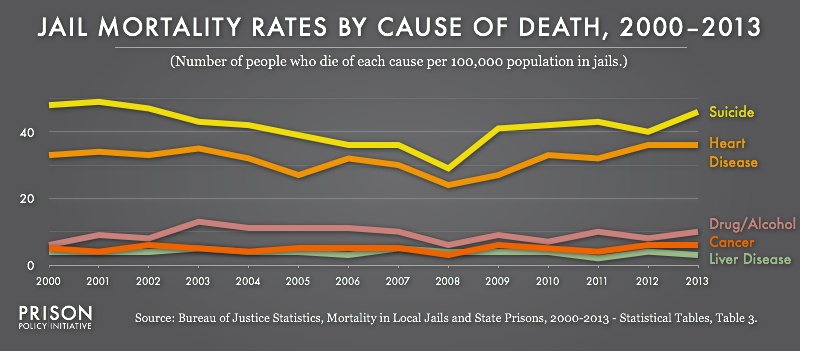
Yesterday, the U.S. Federal Bureau of Justice Statistics, or BJS, released a report, Mortality in Local Jails and State Prisons, 2000–2013 – Statistical Tables. Suicide is the leading cause of death in U.S. jails. Also yesterday, the Spokane County Jail, in Washington State, requested that the U.S. Department of Justice investigate its recent rash of prisoner suicides. Today, reluctantly and under pressure from the Federal government, the Los Angeles County Sheriff’s Department agreed to reforms in the L.A. County Jail that would finally begin to address “chronically poor treatment for mentally ill inmates and … years of abusive behavior by jailers.” Across much of the country, jurisdictions are finally beginning to focus on mental illness in jails.

From how one dies to how many ones die, jail deaths are gendered: “In 2013, a total of 967 jail inmates died while in the custody of local jails. The number of deaths increased from 958 deaths in 2012 to 967 in 2013, while the jail population decreased 4%. As a result, the overall mortality rate in local jails increased from 128 per 100,000 jail inmates in 2012 to 135 per 100,000 in 2013.”

Last year, a BJS report noted, “The number of deaths in local jails increased, from 889 in 2011 to 958 in 2012, which marked the first increase since 2009. The increase in deaths in local jails was primarily due to an increase in illness-related deaths (up 24%) … Suicide continued to be the leading cause of death in local jails”.

In 2000 and 2001, 91 women died in jail. In 2012, 122 women died in local jails; in 2013, 124. Starting in 2003, the number of women dying in local jails has never dipped below 110. More women are dying in jail, and women in jail are making up, year by year, a greater percentage of jail deaths, from 10.1% in 2000 to 12.8% in 2013.

From 2000 to 2013, 1630 women died in local jails. Of that number, 347 committed suicide.

On any average day in 2013, 100,000 women were in local jails. That’s up from 68,000 in 2000, and from 2000 to 2005, the numbers stayed well below 100,000. Today, 100,000 is the norm. Last year, the “good news” was that the suicide rate among women in jail had gone down from 30 out of 100,000 to 26 out of 100,000. In 2013, that rate rose to 30.

In a separate report, the BJS notes, “The female inmate population increased 18.1% between midyear 2010 and 2014, while the male population declined 3.2% … Males have made up at least 85% of the jail population since 2000. The female inmate population increased 18.1% (up 16,700 inmates) between midyear 2010 and 2014, while the male population declined 3.2% (down 20,900 inmates). The female jail population grew by an average of about 1.6% every year between 2005 and 2014. In comparison, the male jail population declined by 0.3% every year since 2005.” In 2000, 70, 987 women and girls were in jail; in 2014, 109,100. In 2000, women and girls made up 11.4% of the jail population; in 2014, 14.7%.

None of this is new. Girls end up in jail for status offenses; boys don’t. Women end up in jail, and dead, because they live with mental illnesses, and, when they need help, the police arrive. That’s the cruel and usual punishment of women in jails. How many more federal reports, scholarly studies, grieving families and dead women’s bodies are needed for the nation to act?


(Graph credit: Bureau of Justice Statistics / http://www.prisonpolicy.org)

The forgotten grave of Nadia Vera, Yesenia Quiroz, Nicole, Alejandra, Ruben Espinosa

Nadia Vera

On Friday, July 31, five people, four women and one man, were tortured and murdered, in the Narvarte neighborhood of Mexico City. The women were raped and tortured and then shot. The women are Yesenia Quiroz Alfaro, a student from Michoacan; Nicole, a Colombian activist; Olivia Alejandra Negrete, a domestic worker; and Nadia Vera, a human rights activist. The man was Ruben Espinosa, a photojournalist for Proceso, a leading news magazine. Both Espinosa and Vera were public in their investigations and critiques of the powerful in Veracruz, which is one reason they had both fled that state for the presumed safety of the Federal District. Because of the sexual violence and torture against the four women, the State may pursue a case of femicide.

Nadia Vera was a leading member of the Xalapa, Veracruz, section of the #YoSoy132 student and youth movement. She was a social anthropologist. A year ago, after having been beaten by the police and after receiving anonymous death threats, Nadia Vera left Veracruz. In Mexico City, she worked as a cultural promoter in a cultural center and was, by many accounts, “happy for the first time in a long time.” At the same time, she continued her social justice work. When Ruben Espinosa fled Xalapa, he went to stay with his friend and comrade, Nadia Vera.

Nadia Vera was happy, but she also knew that the State was responsible for the violence and death in Veracruz and would crush those who called it out. Eight months ago, she gave an interview with Rompeviento Televisión, which concluded with this statement, “I hold Javier Duarte, the governor of the state of Veracruz, and his entire Cabinet responsible for anything that happens to me and my family … I want to be absolutely clear that it is the responsibility of the State, not of the security forces, because it is the State that is directly responsible for sending them to repress us.”

It is the State that raped and butchered four women in Narvarte last Friday, and everyone knows that. As Vera said earlier in the same interview, “How many journalists have been assassinated, and absolutely nothing has been done? How many students? How many activists? How many human rights defenders have been assassinated or disappeared? We have an impressively high level of disappearances.” Nadia Vera went on to explain that in Xalapa, and in Veracruz generally, the State and the narcotraffickers worked hand in glove, and that journalists, students, activists, human rights defenders were trying to survive and thrive somewhere in the spaces between the State hand and the narco glove.

That interview was titled, “Veracruz: la fosa olvidada”. Veracruz: the forgotten grave. Five more people are being laid into that forgotten grave, four women, one man. I want to be absolutely clear that it is the responsibility of the State.

(Video Credits: Guardian / Rompimiento Televisión)

In the California Institution for Women, women are dropping like flies


Stephanie Feliz

Last week, California Department of Corrections officials “discovered” a crisis. In the past eighteen months, four women prisoners at the California Institution for Women, or CIW, in Chino killed themselves … or were killed by willful neglect. On February 17, 2015, 73-year-old Gui Fei Zhang killed herself a day after being released from suicide watch. Weeks later, on March 6, 2015, 34-year-old Stephanie Feliz hanged herself. Feliz had attempted suicide before and had sought emergency mental health the day she died, according to sister inmates and the California Coalition for Women Prisoners. A year earlier, on February 24, 2014, 31-year-old Alicia Thompson killed herself, and a few months later, on July 30, 23-year-old Margarita Murguia hanged herself. April Harris, a sister prisoner in CIW, explained Margarita Murguia’s death, “She was there for her own protection, not because she did something. Apparently her mom was dying of cancer and they refused to let her see her mom. She tried to kill herself with every denied request. She finally did it.”

She finally did it. A woman hanged herself that night? No, a woman was hanged. When does the count of women prisoner suicide reach crisis? What is California’s policy?

After Stephanie Feliz’s death, April Harris, a CIW prisoner, wrote, “We have women dropping like flies, and not one person has been questioned as to why … I have been down almost 20 years and I have never seen anything like this. Ever.”

California has touted its California Institution for Women as a model, because once, over a year ago, it received a passing grade for its mental health care provision. But that was, or may have been, then, and this is now. Now, CIW is overcrowded. Designed for 1398 prisoners, CIW houses 1833 women. According to the California Department of Corrections, CIW is at 131.1% capacity, down from a peak, in May, of 131.7% capacity. Its suicide rate is more than eight times the national rate for women prisoners and more than five times the rate for the entire California prison system.

Mental illness “haunts” women’s prisons, nationally as well as locally. According to some estimates, 60 to 70 percent of women prisoners, against 30 percent of men prisoners, have recently experienced mental illness. Prisons report that around 30 percent of women prisoners have been diagnosed with severe mental illness, and 30 to 60 percent are living with drug addictions. One third of women prisoners “experience recurrent thoughts of death, suicidal impulses, and to have made prior suicide attempts.” How do states respond to women’s high and higher levels of complex mental illness and suicidal impulses and attempts: “Women are less likely than men to receive psychiatric treatment in correctional settings, despite their high incidence of mental illnesses.”

Women prisoners and supporters, such as the California Coalition for Women Prisoners, know these numbers in their bones, and they have not been silent. They have continually and loudly denounced the conditions and called for a thorough overhaul, beginning with releasing most of the prisoners. When the women of the California Institution for Women participated in last July’s statewide hunger strike, they called attention, with their bodies, to the State assault on their bodies, minds and souls. They identified a crisis of health care and a crisis of caring in Chino, and the State looked the other way. How many women have died in State custody and how many more will die before the `crisis’ is `resolved’?

(Photo Credit: California Department of Corrections / AP)

Women in Tihar Jail say NO! to the State’s criminal neglect and abuse

612 women refused to accept death in life in Tihar Jail, New Delhi’s Central Jail. 612 women prisoners in Tihar Jail, South Asia’s largest prison, informed the State that they had been in prison awaiting trial for more than half of the maximum sentence for their various crimes. On Thursday, July 8, responding to a letter by Supreme Court Justice Kurian Joseph, the Delhi High Court decided to take over. Justice Joseph had written directly to the Delhi High Court Chief Justice G. Rohini, the High Court’s first woman Chief Justice, “earnestly” requesting her “to take up the matter appropriately so that the cry for justice is answered in accordance with law with the promptitude with which a mother responds to the cry of her child”.

In a plea to Justice Joseph, the 612 women in Tihar Jail described the cruel separation from their children six years and older; the severe overcrowding of the women’s jail; the insufferable delay in disposal of their cases; the unjust bail bonds conditions; the “lack of sympathy” from the jailhouse courts and doctors; and the inadequacy of legal aid made available to women prisoners.

The women asked to be released immediately on personal bond.

On Friday, July 9, testifying before the High Court, the Delhi government agreed: “Out of 622 inmates, 463 are undertrial prisoners, and there are only 159 convicts.” The Delhi government advocate noted that Jail No. 6, the women’s jail, was designed to hold a maximum of 400 women, and currently holds 622. Effectively, one State agency told another State agency it was time to let my non-people go.

From 1993 to 1995, Tihar Jail, under the direction of Kiran Bedi, was, as its current website still claims, a “harbinger of human rights of prisoners.” Kiran Bedi was dumped in 1995, and, twenty years later, here’s Tihar Jail today, or at least in 2013, the most recent accounting. Tihar Central Jail No. 6, the women’s jail, had a capacity of 400, and a population of 615. Of the 615, 471 were awaiting trial. 77 percent of the women in Tihar were remand prisoners, and in the following year it only worsened. 75 percent of the men in Tihar were also awaiting trial. Last year, The Indian Police Journal noted, “Overcrowding in jails has become a normal feature now. For instance, the latest report on India’s largest jail (Tihar Jail) reveals that it has at present anywhere between 9,000-10,000 inmates as against its total capacity to accommodate around 3,300 prisoners. Consequently, no correctional activities can be carried on successfully under such circumstances.”

Overcrowding and paralysis are the new norm for Tihar. The Ministry of Home Affairs 2013 data confirms this. It reports that, at the end of 2013, 45 remand women prisoners were in Tihar with 47 children: “1,252 women undertrials with their 1,518 children were lodged in various prisons in the country at the end of 2013 … A large number of women undertrials … were lodged in women jails.”

None of this is new. That prison is a special hell for women across India is common knowledge, as is the particular hell designed for “released women prisoners”. Why is Tihar Jail criminally overcrowded? The courts are to blame, along with the police and the general public who care for a second and then move on to more dramatic issues. 612 women in Tihar Jail said NO to all of that: the criminal and universal neglect, the violation of their human rights and dignity, the assault on them as women. In the largest prison comlex in the largest democracy in the world, women said YES to justice and women’s power.


(Photo Credit: http://indiatoday.intoday.in)

Roxana Orellana Santos said NO! to eating while Latina

Roxana Orellana Santos with her husband and son

In northern Maryland, the Frederick County Council is finally considering repeal of their English-only ordinance, in effect since 2012. Whatever they finally decide, we can all thank Roxana Orellana Santos for opening the door to inclusion and common decency. It all began in October 2008 … with lunch.

Roxana Orellana Santos was eating her lunch outside her workplace when two Frederick County sheriff’s deputies approached her and asked about her immigration status. The deputies had no other reason to question Roxana Orellana Santos. Other than being Brown skinned and Latina looking, she had committed no offense. Nevertheless, the deputies determined that there was an outstanding civil deportation warrant, and took her in. Roxana Orellana Santos was held for 37 days without any criminal charges, again other than being Latina.

Roxana Orellana Santos said NO! No to the indignity and no to the violation of her rights. As she put it, “To be honest, he arrested me because I was sitting there and eating bread. She sued the County Sheriff Chuck Jenkins and the two deputies. In 2001, the first court dismissed her case. In August 2013, a higher court agreed in large part with Roxana Orellana Santos. One of her attorneys Jose Perez explained, “It is apparent that the Frederick County deputies pre-textually stopped, questioned and detained Ms. Orellana Santos solely based upon her physical appearance at a time when the Fredrick County Sheriff was publicly trumpeting how many immigrants his office had arrested. This is the essence of racial profiling.”

Roxana Orellana Santos said, “I want this to end, once and for all. I want to be happy with my children. I want to go to the park with them and say `I am happy’ and know that no one will try to humiliate me.”

And now, seven years later, the Frederick County Council is rethinking an ordinance that targets and criminalizes those who speak languages other than English or who might prefer to speak in those languages, especially in high stress situations. And you know who was there, testifying at length? Roxana Orellana Santos. Thanks to her refusal to be discarded and thanks to her determination, we can all say, ¡A luta continua!


(Photo Credit: Milagros Meléndez-Vela / El Tiempo Latino)

In Georgia, for children with disabilities, school is a prison

Georgia continues its war on children living with disabilities. Once, Georgia public schools had “seclusion rooms”. The doors were double bolted on the outside. In 2004, Jonathan King, 13, hanged himself in one such room, a stark, 8-foot-by-8-foot “timeout” room in a Gainesville public school.” In 2010, six years later, Georgia finally passed a law that protects all students from seclusion and restraint.

Seclusion rooms continue in schools across the country. Just this year, Virginia finally passed a law limiting seclusion rooms and the use of force in restraining children. The Virginia legislature only passed this law after the story of the continued abuse, call it torture, of 10-year-old Carson Luke began circulating. Many state legislatures have yet to address seclusion rooms.

It’s been five years since Georgia outlawed seclusion rooms in public schools. So, how are children with disabilities being treated in Georgia’s schools? According to the U.S. Department of Justice, criminally. On July 15, the Department of Justice sent the Governor and Attorney General its Investigation of the Georgia Network for Educational and Therapeutic Support, twenty-one pages of pain and suffering applied to thousands of children.

The Georgia Network for Educational and Therapeutic Support, or GNETS, has been running since 1970. Jonathan King attended a GNETS school. Presently about 5000 children attend GNETS schools. There are 25 GNETS programs, costing about $70 million this year alone. Georgia doesn’t consider GNETS facilities “schools” but rather “special entities”. It doesn’t take much to get a child sent to GNETS: “Our review of records indicated, that their children were often immediately referred to the GNETS Program after one incident or several interrelated incidents associated with a single event or problem, such as using inappropriate language with a teacher on more than one occasion.”

GNETS is both separate but unequal Jim Crow and prison. First separate but unequal: “The State’s administration of the GNETS Program results in inequality of educational opportunities for students in the Program. Students in the GNETS Program generally do not receive grade-level instruction that meets Georgia’s State Standards like their peers in general education classrooms. Rather, particularly at the high school level, students in the GNETS Program often receive only computer-based instruction. By contrast, their peers in general education classrooms generally receive instruction from a teacher certified in the subject matter they are teaching, and in the case of students with disabilities, also from a teacher certified in special education. Students in the GNETS Program also often lack access to electives and extracurricular activities, such as after-school athletics or clubs … Many of the students in the GNETS Program attend school in inferior facilities in various states of disrepair that lack many of the features and amenities of general education schools, such as gymnasiums, cafeterias, libraries, science labs, music rooms, or playgrounds. Some GNETS Centers are located in poor-quality buildings that formerly served as schools for black students during de jure segregation, which have been repurposed to house the GNETS Program.”

How have these Jim Crow schools been “repurposed to house the GNETS Program”? “We visited the Flint Area GNETS Program, where over 40 students are placed in GNETS Classrooms in a segregated wing of a general education high school. Students in the GNETS Program have separate restrooms located within their wing. Although students in the GNETS Program eat lunch in the high school cafeteria, they have a separate lunch period, during which time no general education students are present. The GNETS Program wing has its own building entrance with a metal detector that GNETS Program students must pass through before entering the school building. By contrast, the general education students enter the school through the front door of the same large building, where there are no metal detectors. GNETS Program staff reported that none of the GNETS Program students have any interaction with their general education peers during the school day, even though they attend school in the same building. Similarly, our investigation found that a GNETS Classroom in the Northwest Georgia GNETS Program is located in the basement of a general education school with its own separate entrance. The students in this GNETS Classroom reportedly never leave the basement or interact with any other students during the school day. There is a large sign hanging at the front of this GNETS Classroom that says `DETENTION,’ because the Classroom is also used for detention outside regular school hours.”

Georgia has bypassed the school-to-prison pipeline in favor of the school-as-prison: “One student in the GNETS Program stated, `School is like prison where I am in the weird class.’ He attributes this in large part to isolation and distance from other students in the general education community … One parent stat[ed], `Once you are in GNETS you are considered a ‘bad kid.’ It’s a warehouse for kids the school system doesn’t want or know how to deal with.’ Several parents and students … compared the GNETS Program to prisons.”

The State “relocates” generations of children into inferior and destructive structures, warehouses, prisons, and calls it education? That’s not education. That’s apartheid. It’s war by another name. End the war on children living with disabilities. End the war on children. Do it now.

(Opening image credit: Ward Zwart / New York Times) (Closing image credit: http://revolutionarypaideia.com)

Sarah Lee Circle Bear died in agony, screaming and begging for care

Sarah Lee Circle Bear

On July 6, Sarah Lee Circle Bear was “found” unconscious in a holding cell in Brown County Jail in Aberdeen, South Dakota. Women’s bodies keep being “found” in jails across the United States. Police are killing Native American women, such as Christina Tahhahwah, at a staggering rate. Overrepresented in prisons and jails, Native Americans are beyond overrepresented in jail mortality rates. They are the dumped and “found”. Sarah Lee Circle Bear’s death is typical as is the excruciating pain and suffering she was forced to endure as she died in agony, screaming and begging for care.

Sarah Lee Circle Bear was 24 years old, a Lakota woman, the mother of two children, aged one and two. She was picked up for a bond violation, which is to say for not much. According to other prisoners, before being transferred to a holding cell, Sarah Lee Circle Bear told her jailers that she was suffering excruciating pain. The staff told her to “knock it off” and “quit faking”. Inmates called to the staff to help her. The staff came, picked Sarah Lee Circle Bear up off the floor, dragged her out of the cell, and transferred to a holding cell. Later, they “found” Sarah Lee Circle Bear “unresponsive.” Her family is now seeking justice.

Prisoners, and especially those in jails, die in agony, begging and screaming for care. From 2000 through 2012, close to 13,000 people died in local jails. The State lists “cause of death” but never includes the State among those. Sarah Lee Circle Bear died in agony, screaming and begging for help. Her fellow prisoners screamed as well.

This is Chuneice Patterson’s story. A prisoner in the Onondaga County Justice Center, in Syracuse, New York, Chuneice Patterson died, November 2, 2009, of ectopic pregnancy. She spent hours in agony begging for care. No one came. Amy Lynn Cowling died, in December 2010, in excruciating pain in the Gregg County Jail, in Texas. From coast to coast and border to border, a national community has built with the shrieks of women in jail, dying in excruciating pain and suffering, screaming and begging for care. No one comes or, worse, they come and drag her away. The dead who are “found” are “unresponsive”? It’s the other way around.

What happened to Sarah Lee Circle Bear? Nothing much. All part of the plan. Just another Native American woman dead in a jail somewhere in the United States.

(Photo Credit: Terrance Circle Bear, Sr. / Indian Country Today)

What happened to Christina Tahhahwah? Just another Native American jail death

On July 14, 53-year-old Choctaw activist Rexdale W. Henry was “found” dead in the Neshoba County Jail in Philadelphia, Mississippi. That’s the same day 18-year-old Kindra Chapman was “found” dead in her jail cell in Homewood, Alabama, and a day after Sandra Bland was “found” dead in her jail cell in Waller County, Texas. Like Sandra Bland, Rexdale Henry was arrested for a traffic violation, in this case non-payment of a fine. Mississippi was already investigating the death of Jonathan Sanders, a Black man who died at the hands of police in Clark County, Mississippi Jail a day before Henry was arrested. Four days after Rexdale Henry was “found”, Troy Goode was “found” dead in police custody. Goode was White. In dying in jail, Rexdale W. Henry joins more than this list of “mysterious” jailhouse morbidity and mortality. He joins a national list of Native Americans dying in jail and at the hands of police. He joins Christina Tahhahwah.

In Lawton, Oklahoma, Christina Tahhahwah lived with bi-polar disorder. When she stopped taking her medicines, her family called the police and asked them to take her to the hospital for medical care. She was at her grandparents’ house. When she refused to leave the property, the police arrested her for trespassing and took her off to jail. Not to the hospital, to jail. That was November 13, 2014.

On November 14, minutes after being handcuffed to the cell door, Christina Tahhahwah was “found” unresponsive. She was in cardiac arrest. She was transferred to the hospital, where she died. Her family was not notified of her heart attack nor of her transfer to the hospital. One family member says they only found out because a family friend, who works at the hospital, sent them a note via Facebook. The family went to the hospital and there heard that fellow jail inmates were saying that Christina Tahhahwah had been tasered for refusing to stop singing Comanche hymns. The Lawton police say no Tasers were used.

Tasers are not the issue. The issue is that Christina Tahhahwah is dead. Just another bipolar Native American woman “found” in jail. The Lawton Police have not said they treated or cared about the reports of her bipolar condition. The issue is justice.

Police are killing Native Americans at a staggering, and by and large unremarked upon, rate. Overrepresented in prisons and jails, Native Americans are beyond overrepresented in jail mortality rates. They are the nation of “found” bodies. What happened to Rexdale Henry? What happened to Christina Tahhahwah? Nothing out of the ordinary. Just another Native American death in a jail in the United States.

(Image Credit: Axis of Logic)

What happened to Kindra Chapman? The new normal for jails and prisons

Kindra Chapman

On Monday, July 13, #BlackLivesMatter activist and outspoken critic of police brutality Sandra Bland was “found” dead in a Texas jail. On Tuesday, July 14, in Homewood, Alabama, 18-year-old Black teenager Kindra Chapman was arrested, at 6:22 pm. At 7:50 pm, Kindra Chapman was found dead, hanging by a bed sheet in a holding cell.

While the case of Sandra Bland has attracted extensive and intensive attention, with one or two exceptions, the death of Kindra Chapman has not.

Suicide in jails and prisons, and in particular women’s jails and prisons, is the new normal, and not only in the United States. For example, just yesterday, it was reported that, in the United Kingdom, the number of people dying in police custody has reached its highest level for five years. We reported on this earlier in the year. The story’s the same in Italy.

Meanwhile, the jails of America are filling up to choking as the prisons are “releasing”, and women, and especially Black women, have been the principle actors, and targets, of this new phase of mass incarceration. And then there are the immigration detention centers. At Women In and Beyond the Global, we have been covering this trend for years. Here are just some of the individual women’s stories we’ve followed.

In 2007, in a Canadian prison, after years of mental health torment and begging for help through self-harm, 19-year-old Ashley Smith killed herself, on suicide watch, while seven guards followed orders, watched and did nothing. Now Ashley Smith haunts the Canadian Correctional Servicesor doesn’t.

In 2013, in England, Ms. K died. Her death was exemplary. A woman enters prison for the first time, a troublesome woman, and within weeks is found hanging in her cell. For the Ombudsman researchers, Ms K’s case is “one example” of the “failure” to “consider enhanced case review process” when a prisoner’s history suggests “wide ranging and deep seated problems.”

Last year, on Thursday, September 18, Megan Fritz hung herself. On Monday, September 22, Mary Knight did the same. Both women were incarcerated at Pennsylvania’s York County Prison when they committed suicide. Yet neither woman was on suicide watch. Why not?

Josefa Rauluni left the island nation of Fiji for Australia, where he applied for asylum, or “protection”. He was turned down. He was taken to Villawood Detention Centre, run by Serco. He continually appealed the decision, saying he feared for his life if he returned to Fiji. In response, the State told Josefa Rauluni that he would be deported on September 20, 2010. The night of September 19, Josefa Raulini sent two faxes to the Ministerial Intervention Unit at the Department of Immigration and Citizenship. They read, ”If you want to send me to Fiji, then send my dead body”. The State did nothing. On the morning of September 20, 2010, Josefa Raulini informed the guards, “I’m not going, if anyone goes near me, I will jump“. The guards did nothing for a while, and they they tried force. As they moved in, Josefa Raulini jumped from a first floor balcony railing. He dove, head first, hit the ground, and died. The State did nothing; the Villawood staff had no suicide prevention training.

On December 20th 2013 Lucia Vega Jimenez committed suicide, hanging herself in a shower stall of a bleak border facility at the Vancouver International Airport under the jurisdiction of Canada Border Services Agency, CBSA. She died eight days later in a hospital. She somehow found a rope and hanged herself. Who brought the rope and who tied the knot?

Lilian Yamileth Oliva Bardales, 19 years old, and her four-year-old son had been held in Karnes “Family Detention Center” from October to June. She had applied for asylum, explaining that she had fled Honduras to escape an abusive ex-partner, six years older than she, who had beaten her regularly since she was 13. Her application was denied. In early June, she locked herself in a bathroom and cut her wrists. She was removed from the bathroom, held for four days under medical “supervision” during which she was denied access to her attorneys, and then deported.

The line from Sandra Bland to Kindra Chapman is direct, a line of Black Women killed in police custody. The coroner’s report may say they hanged themselves, and they may have, but if there’s an epidemic of self harm and suicide and the State does nothing, that’s public policy, and it’s murder. Likewise the line between Canadian Ashley Smith and English Ms. K and Mary Fritz and Mary Knight and Kindra Chapman is direct, as is the line that binds asylum seekers and immigration detention prisoners Josefa Rauluni, Lucia Vega Jimenez, and Lilian Yamileth Oliva Bardales. These women, and men, are captives in jails and prisons in which there is no suicide prevention training or planning. Quite the contrary, prisoner suicide is part of the plan. #IfIDieinPoliceCustody say my name. If she dies in police custody, #SayHerName.


(Photo Credit: al.com)