Workers’ Radio Dignidad To Hit the Airwaves in Nashville

Workers Dignity

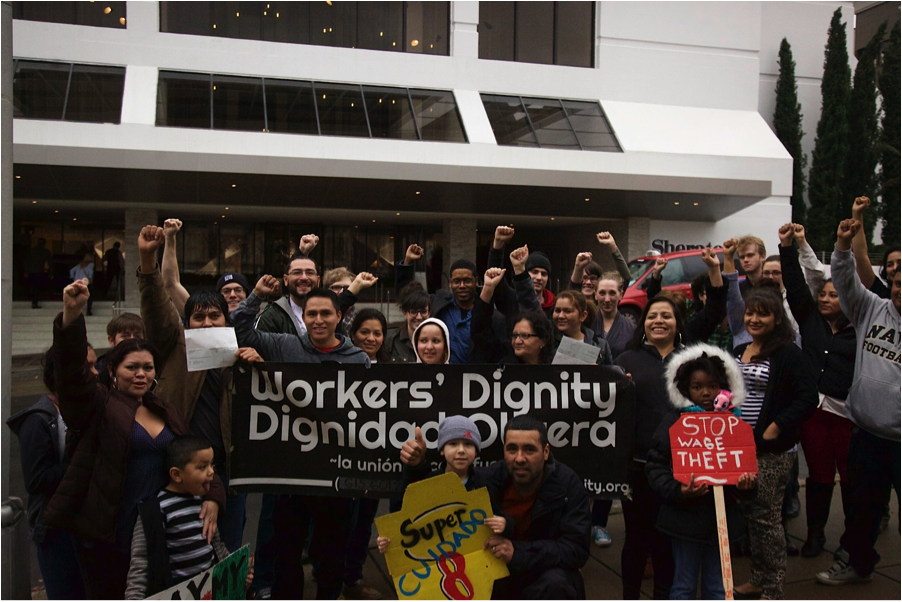
A worker-led, community radio station is coming to Nashville, Tennessee. Workers’ Dignity/Dignidad Obrera, a worker-led workers’ center based in Nashville, is currently fundraising to support Nashville’s first ever worker-led radio station, designed to be a mixtape of music and social justice, powered by the voices of those left out of Nashville’s recent rise to national prominence.

As low-wage workers continue to be priced out of their neighborhoods as a result of the massive development projects and gentrification occurring throughout Music City, it is important for outlets such as Radio Dignidad to exist so that our community does not lose sight of those struggling to survive in the quickly changing Nashville landscape.

Workers’ Dignity/Dignidad Obrera was founded in Nashville in 2010 in an effort to combat the epidemic of wage theft plaguing low-wage workers in Middle-Tennessee. Through organizing, fundraising, phone calls, visits to workplaces, and other acts of solidarity, Workers’ Dignity/Dignidad Obrera has helped workers recover over $200,000 in stolen wages.

Workers’ Dignity/Dignidad Obrera now has the opportunity to expand their efforts and ability to organize and empower low-wage workers in Nashville through their radio station. To do that, they need the support of the community and those in solidarity with workers. Workers’ Dignity/Dignidad Obrera plans to launch the radio station on 104.1 FM in 2016. They need to raise funds to purchase the expensive equipment needed to broadcast. Their current goal is to raise $10,000 by Thanksgiving. Together we can change the tide in Nashville, and bring power back to the voice of the people.

You can donate to their campaign here.


(Photo Credit: Workers’ Dignity/Dignidad Obrera) (Video Credit: Workers’ Dignity/Dignidad Obrera)


Radio WIBG: Najla Mulhondi: Linking feminist struggles and the debt system


Najla Mulhondi

At the plenary session of the summer university of the CADTM, Amina Amzil from Attac Morocco reminded the audience how the Structural Adjustment Programs SAPs have changed the development of emerging countries in the neoliberal global market and what it means for women.

SAPs are the austerity programs of the South. The World Bank with the FMI institutionalize the neoliberal measures of austerity in the “there is no alternative” dogma. The World Bank impeded any plans for development of public investments instead becoming an instrument of economic blackmail for developing countries disregarding human rights.

Amina Amzil explained that in Morocco 78% of the GDP is engulfed in the debt repayment, slimming budget for education and health care reducing public services. Women are particularly hit by these cuts. Still, 52% of women are illiterate compared to 33% of men. The World Bank ordered a drastic cut of 30% in public employment the traditional sector in which women find services and work. Now, women unemployment is higher in all sectors; in particular 25% of women with higher education diploma are unemployed while women constitute only 6.7% of higher education graduate. In addition, women suffer of lack of access to health care especially evident with a maternal mortality rate of 112/100000 one of the highest in the region. Finally, SAPs were completed with trade agreements that open the emerging countries to the rich countries rendering women vulnerable as perceived as docile and exploitable in informal sectors.

Being a member of the CADTM in Liege (Belgium), Najla Mulhondi would not miss its annual meeting.

For Najla, the agronomist, the public debt system meant globalization of agro-industry merchandize that works only because of the existence of inequalities. But this year, she said, she had to focus on the link between feminism and the public debt system. Realizing that inequalities are gendered, she attended the “feminist struggles” workshops of the CADTM.

We talked with her after the workshop moderated by Christine Vanden Daelen entitled “Some pedagogical tools to arm women against all kind of austerity.”

This workshop presented some educative tools for women, chiefly vulnerable women, to regain control over the neoliberal discourse and understand that they don’t owe anything on the contrary their work has been largely utilized for free. Najla makes the connection with the land grabbing and globalized markets that forced the farmers of the South to produce crops, roses etc, for the North.

In her interview in French, she mentioned the issue of “all these natural resources purloined from the South”, she said, “I don’t know how one/we will give back to the countries in the South, we’ll have to ponder.”

Clearly, in these unequal relationships feminist struggles bring about another solidarity to open what has been closed by this neoliberal order.

Listen to Najla who felt the need, “to spread this new openness.”

For a longer interview with Najla, in French:

(Photo Credit: 50-50 Magazine)

Fees must fall; now is the time! #FeesMustFall

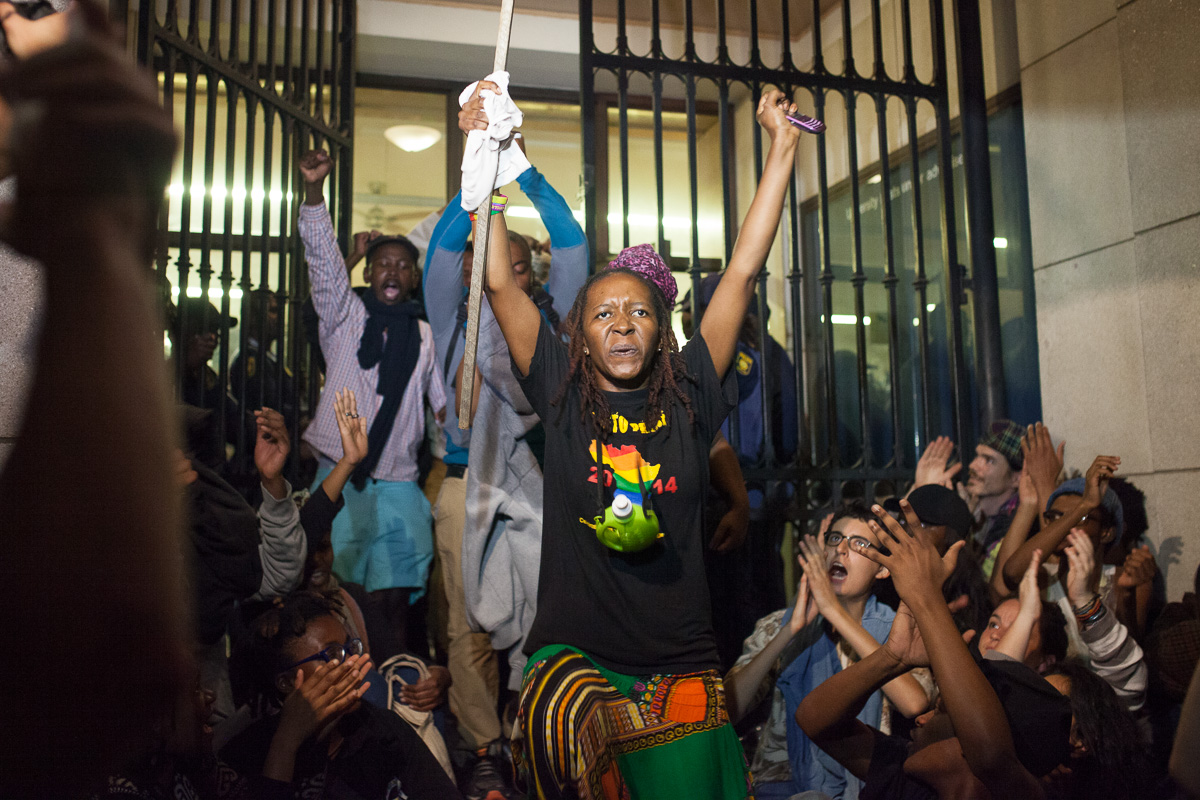
Fees Must Fall, or #FeesMustFall, has engaged so many from across South Africa and every spectrum imaginable. It has also forcefully brought out other issues, which have largely been cloaked, and for a long time. These include corruption and a bloated management system. The shut down of the University of Cape Town campus has also shut down engagement with students, and so now only management is talking to students.

The struggle around fees has simmered for years. For many years, the staff in Adult Education have tried to convince management that upfront fee payments and the administration of fees were burdensome and mapped out solutions. The fee system is punitive at UCT as you get punished by fines and interest charges if fees are not paid at the beginning and midyear. When we proposed alternative structures that would take in the economic reality of many of our students, we were rejected, without any real discussion or consultation.

Finally Higher Education is receiving national attention and students are linking broader issues with their own struggles like outsourcing, state corruption and neo-liberal politics. The current economic context has sharpened the plight. Undergrads experience it as well it. This is the right moment; now is the time!

Meanwhile, the struggle continues. Late last night, after being evicted from Bremner/Azania House, UCT students walked down the Main Road. And today … #FeesMustFall


(Photo Credits: The Daily Vox / Ashraf Hendricks)

Why do I say “No” to Carly Fiorina, even though I want a woman President?

Why am I not jumping with joy that a woman is finally among the long list of Republican contenders for the 2016 Presidency? The woman is Carly Fiorina, who was in the lower tier in the first Republican debate in August and was ushered into the first tier with the top boys in the second debate organized by CNN. She proved to be the right match for Donald Trump, making him wilt with her sharp tongue and business chic. Even though here was a woman who was smart, bold, fluent, at ease with her knowledge and public speaking skill, and made Trump look a few inches shorter by the end of the debate, I did not leap up to place her as my number 1 choice.

She peddled the same bad narrative about Planned Parenthood; yes, that story about Planned Parenthood engaging in fetal tissue donation, as seen in the secretly made, dubious video showing a fetus that was breathing and kicking. How could such a savvy businesswoman buy into false depictions and deliver them as facts in a debate? What’s more, a few days later, she accused politicians of being laissez faire with facts, unlike business people who are held accountable for their facts. Really? Is she describing herself, now a politician, as irresponsible about facts?!

I am wary of Fiorina’s neoliberal policies, especially as seen in her tenure as CEO of Hewlett-Packard. She sacked a huge number of employees—all of them were mere numbers to her; not faces, with real lives. They were collateral damage in her effort to save the firm. But her measures bore ill results—HP stocks plummeted and it merged with Compaq. In this era of CEOs running schools, are we now heading into the era of CEOs, not simply having a stake in the government, but now occupying and leading the country?

Even if I suspend my prejudice against CEOs running our country, Fiorina will not support any of the causes that will help and advance women’s lives. She does not believe in women’s right to choose abortion; she supports the unborn fetus over the mother; she does not believe women should have paid maternity leave; she is against (undocumented) immigrant women, even if they are part of the economic lifeline of this country, but she supports the Dream Act; she detests all the women’s causes that Hillary Clinton supports; she does not support Obamacare; she does not believe in expanding Medicare; she says she has fought for equal pay for women in her company, but this contradicts her sacking of 30,000 workers from HP.

And her views on foreign policy are frightening; she does not support the Iran nuclear deal; she wants to keep GITMO open; she advocates a strong military presence in the Middle East.

Does she think of the lives of women in the areas where she wants the U.S. military to be present?

Do I want Carly to be President because she is a woman? No, thank you. She may be a woman but she does not give a fig for women’s causes. Sadly, what we see is a woman who has internalized the whole hyper-patriarchal, capitalist ideology.

(Image Credit: carlyfiorina.org)

Domestic violence in South Africa: Make the police take responsibility!

One night in 2010 CN’s* husband hit her so hard that she lost consciousness. CN was taken to the hospital, where she spent the night. The day after she was discharged, she decided to lay criminal charges against her husband. And this is where CN’s story stops making sense. Within 24 hours of approaching the police for assistance, CN was herself arrested, detained and assaulted by the police.

First, CN was given the wrong advice by police officers on duty, and told that she needed a domestic violence protection order from a magistrates court before she could lay a criminal charge. The court simply sent her back. The inspector assigned to the assist CN asked her for her telephone numbers, which he then used to call her husband, to invite him to the charge office. When CN’s husband arrived the inspector first spoke to him alone, and then told CN that she must discuss the matter with her husband to see if they could resolve it. When CN reported to the inspector that their discussion had not resolved the issue, and that she wanted to proceed with a charge, the inspector discouraged her. He told her that her husband would similarly lay a charge against her “for slapping”, and if this were to happen she would also be liable to be arrested. The inspector then asked them to write down their statements, and once they had done so, the inspector arrested both CN and her husband. They were both charged and detained in separate police cells at the police station, where CN then stayed the night.

The following morning, another police officer came to CN’s cell and informed her that he had come to take her to court. As she was being escorted to a police van she asked the officer to allow her a moment in order to speak to a more senior officer. But the officer sternly ordered her to board the police van, and then forcibly flung her into the back of the police van.

CN was subjected to “a dreadful series of traumatic, humiliating, dehumanising and flagrant violations of her rights to dignity, freedom of the person and bodily integrity.” This series of events makes so little sense because it is almost the polar opposite to what the South African legal framework envisages for domestic violence cases.

The Domestic Violence Act of 1998, a well-known piece of legislation that has been on South Africa’s law books for almost 17 years, is very clear about the responsibility of police officers in South Africa. In fact, the legislature regards domestic violence so seriously, that any failure to comply with one’s police duties in terms of the Act constitutes misconduct for the purposes of disciplinary action. The Regulations to the Act go into further detail about the duties of police officers, and a National Instruction issued to all police officers in 1999 leaves nothing open to interpretation. South Africa also has a Victim’s Charter, implementation audit tools, and a host of cooperative structures at local, provincial and national level where domestic violence can be discussed.

And despite all this legal regulation, the South African Police Service has been coughing up a lot lately in civil court for not doing their job. While there are pockets of excellence within the South African Police Service, it is an open and disgraceful secret that our police, particularly in townships and far-flung poor areas, perform badly when it comes to assisting victims of domestic violence. Police officers’ treatment of victims at station level often causes secondary trauma: a refusal or inability to come when called, a failure to explain a victims’ rights and legal options, sending victims home to deal with it “in the family”, and a failure to even understand their own duties under the Domestic Violence Act, or to even have a copy of the Act readily available in their stations. We know this first-hand from women seeking help, we know this scientifically from research, and we even know it from the police themselves. And we have known it for a long time.

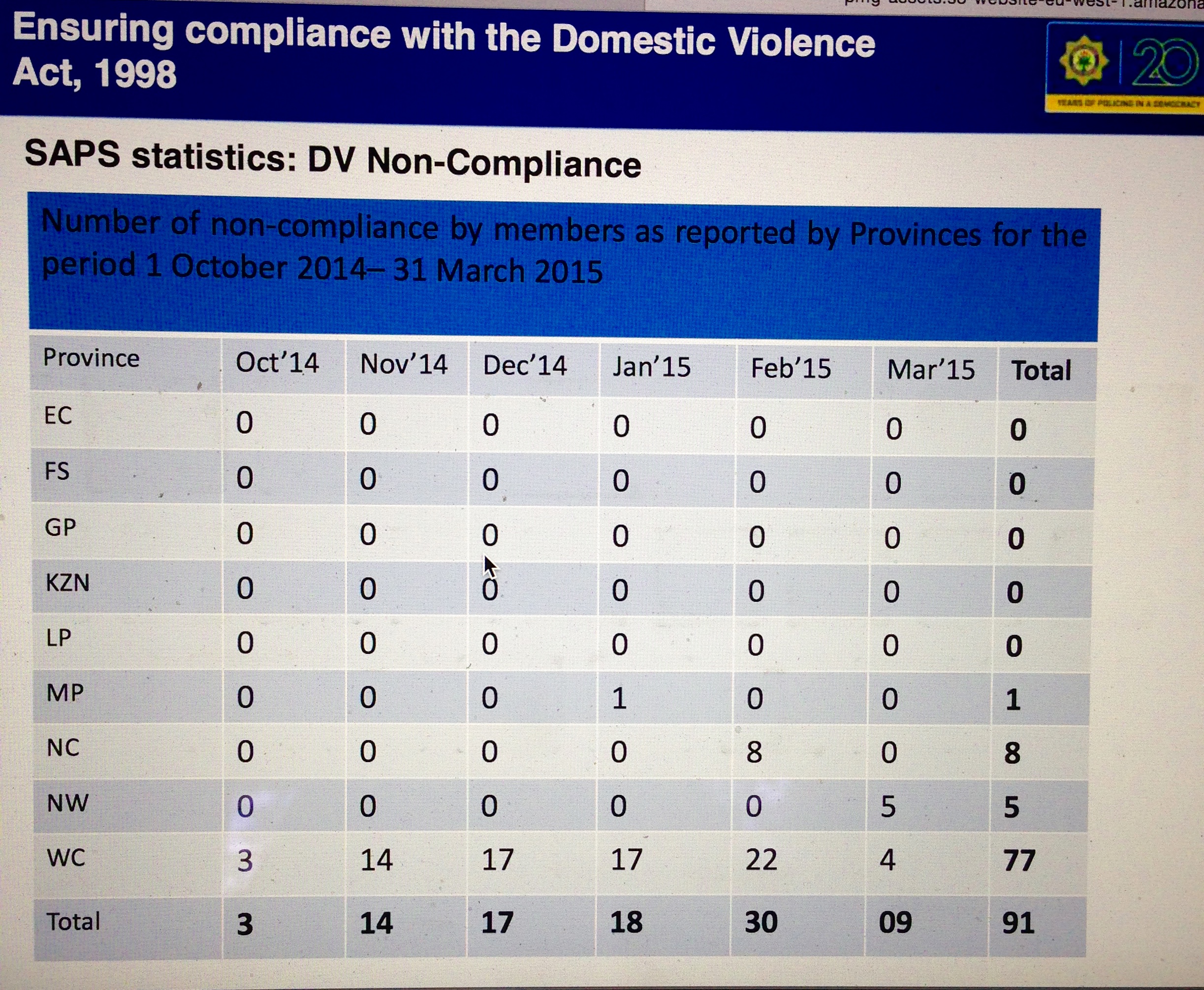
What is most concerning is not that our police are doing badly, but that there is no desire to be honest with themselves and the public about shortcomings, and no real commitment to improving the situation. In a briefing to the parliamentary Portfolio Committee of Police, the SAPS would have us believe that they are doing well, and that almost no officers failed to comply with the Domestic Violence Act between 1 October 2014 and 31 March 2015.

IMG_4089

Excerpt from presentation by the South African Police Service to Parliamentary Portfolio Committee for Police, on 18 August 2015.

They also reported that 100% of all 1 140 South African police stations were rendering “victim-friendly” services at the end of the first quarter of the 2015/16 financial year.

Which begs the question, why does the Women’s Legal Centre and other organisations continually deal with complaints, such as a recent case where a client, whose husband brandished and threatened her with a firearm on several occasions, had to approach three different police stations in her area before she could obtain police assistance? Why are there continued civil claims for damages against the police, for failing victims of domestic violence? Why is the Civilian Secretariat for Police reporting that only 1 of the 156 police stations audited in 2014 were fully compliant with the Domestic Violence Act? Why is it that women who are in possession of domestic violence protection orders, are still being abused and even killed by their partners?

There is no scarcity of recommendations for the police on improving their response to domestic violence, and thereby often preventing it. Civil society has, since the operationalisation of the Act, produced a multitude of research papers. Interest groups lobby relentlessly and women’s and men’s organisations clamour to be heard on the issue by various branches of government. We express the same concerns, and make the same arguments and appeals year in, and year out. In fact, even to those of us in the gender-based violence sector, we are starting to sound like broken records. In 2014, the Khayelitsha Commission of Inquiry heard extensive evidence about the handling of domestic violence cases by police. Community members testified about their experiences, the police released an unprecedented amount of internal data and documentation, and this in turn was analysed by various experts. The police themselves cooperated with the Commission, after initially refusing to take part, and ended up testifying frankly about their own challenges. And yet, the evidence-based recommendations (see Recommendation 14) which have national applicability have been rejected by the national Police Commissioner.

Police officers in South Africa can and must prevent domestic violence, through a quality response to victims. But there is complacency about ongoing police failure in this regard that seems to have set in, and it cannot be fixed by throwing more law or policy at it. Nor do civil claims seem to be driving home the message that the status quo is unacceptable.

The fact is that one station commander who cares about his station responding quickly and effectively to domestic violence, and takes responsibility for making it so, can do more good than ten policy documents and 20 reports to parliament. This is accountability. We should no longer be asking, “what must be done” but rather, “who is doing it”. Accountability means taking responsibility for what must be done, and it means real, personal consequences for failure to do your job.

(Image credit: Heinrich Böll Southern Africa)

In Chile, lunch ladies beaten and detained

Lunch ladies beaten and detained

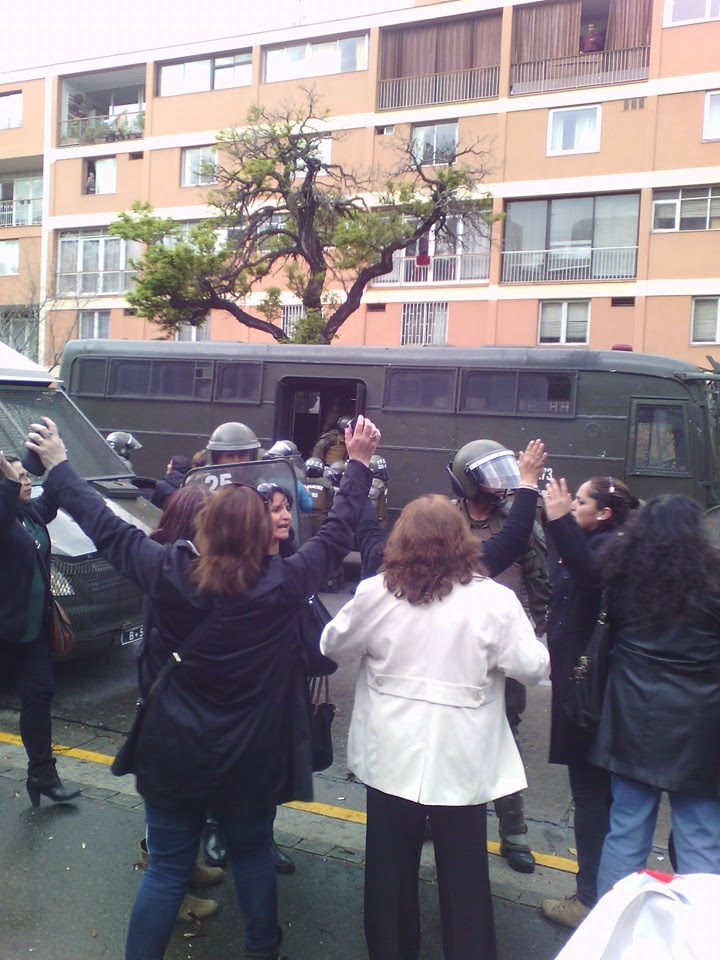
Last week women who work as manipuladoras de alimentos for public schools in Chile met with the government in Santiago to negotiate contract issues that have been going on for over a year.  To show support for the negotiators, manipuladoras from regions throughout Chile organized a peaceful demonstration outside the government offices.  Special forces showed up in buses wearing riot gear and sprayed the crowd with hoses.  They beat one woman for “blocking traffic” and detained her along with twelve others.

When the police hauled these twelve women away, the union leaders withdrew from negotiations until they were released.  At that point, the union was able to get the government to agree to an across-the-board salary increase to $300.000 CLP per month ($441 US per month for a full-time job — this in a nation that strives to attain “developed” status in the international economic community by 2020), and a yearly bonus of $67.500 CLP ($99 US).  Importantly, the union was also able to stop the government from reclassifying many of the manipuladoras as “maids” who would receive lower wages.

While the government is the target here, the manipuladoras have had to appeal to them because the private companies that actually employ the women have repeatedly broken their contractual agreements without recourse.  Some of these companies are under investigation for fraud, and one company that went out of business after a fraud investigation simply stopped paying the women.  Because their job is to provide food for children, they continued to show up for work for two months without being paid.

Now the government has made a splashy announcement that October 30 will be the national Dia de la Manipuladora.  The women are not impressed, and they vow to continue to fight for their own rights and protections:

“We will not give up!  We’re not just machines that generate profits to the national and foreign companies that have been sold the feeding of our students.  We’re not statistics, much less maids.  We are people and we are demanding what rightfully belongs to us.”

¡Arriba las que luchan!


(Photo Credit: Sandra Carola Olivares Martinez)

Predictably, the Taliban easily gained control of an Afghan Province


Last Monday Taliban launched a gruesome and sudden, but not unpredictable attack, on the Afghan provincial capital of Kunduz. The Interior Ministry’s spokesman, Sediq Sediqqi, stated that the insurgents had seized the main roundabout in the city and had made it to the prison where they freed more than 500 inmates, who flooded the streets of Kunduz.

Later in the day the Taliban leader, Mullah Akhtar Mohammad Mansour, issued a statement congratulating fighters for successfully taking over Kunduz, and urged them to keep the residents safe: “All mujahedeen (Taliban fighters) after taking over military targets and finishing the military operation should put their attention on keeping the lives, wealth and dignity of common people safe. Most of the times some opportunists and burglars misuse such opportunities to harm civilians and their wealth. Mujahedeen should be conscious and shouldn’t allow anyone to harm the lives and wealth of civilians and the public wealth.”

However, the Taliban did the exact opposite. Amnesty International reported mass murders, gang rapes and house-to-house searches by Taliban death squads according to the harrowing civilian testimonies emerging from Kunduz, as Afghan troops backed by US air strikes regained the control of key areas of the city. While losing control of Kunduz was a big jolt to the new Afghan government, it was even worse for the people of Kunduz who had run out of food supplies and water, being either afraid of leaving home or were prevented from leaving by the Taliban.

Allegedly the Taliban were using a “hit-list” with the names and photos of activists, journalists and civil servants based in Kunduz, to track down their targets. They also used young boys to conduct house-to-house searches to locate and abduct their targets. A woman’s rights activist who worked with the victims of domestic violence at the local women’s shelter told Amnesty International that she and other women had fled the city on foot, over rough terrain, to avoid the Taliban’s roadblocks on exit routes of the city. She claimed that a member of the Taliban had called her inquiring about the whereabouts of the women who lived in the shelter and when she had informed him that all the shelter had been evacuated and the women had escaped, he became very angry. Taliban had used their hit list to track down the women’s shelter staff and their families and had gang raped and killed several midwives for providing reproductive health services to women in the city. They also raped female relatives and killed family members of many local police commanders and soldiers and looted their belongings.

The recent growing power of the Taliban, and ISIS, in Afghanistan is not a myth to be unravelled. The constant meddling of neighbouring countries and the strategic importance of Afghanistan in international politics makes it vulnerable. The importance of Pakistan’s role should not be overlooked in this matter, because if Afghanistan is cleansed of the Taliban, given the good relations between Afghanistan and India, Pakistan will be sandwiched between two hostile countries.

Furthermore, Taliban are publicly grooming the youth, including young girls, in their madrassas (religious schools). The Afghan government is more concerned about whether or not the religious schools are registered. However, official registration makes little difference in terms of the curriculum.   According to the Ministry of Education, there are 1,300 unregistered, and 1,100 state-run madrassas operating in the country. Kunduz is one of the provinces with the most unregistered madrassas run by fundamentalists and the Taliban. One of the most controversial of all these is Ashraf-ul Madares, an all girls school with 6000 full time students who attend the school to solely study the Quran and the teachings of Prophet Mohammad. The students are radicalized by their male fundamentalist teachers who teach them from behind a wooden box, and are taught to shamelessly chastise other women and students over their un-Islamic dress code and call them “infidels” for not praying.

The Kunduz incident is another failure of the Afghan government, and devastatingly not unpredictable for Afghans. This was an incident that was bound to happen and can happen in many other Afghan provinces where Taliban or the Taliban-mentality is deeply rooted in the society. While the city is under the control of the government at the moment, sporadic clashes are still taking place in some areas while the Taliban intend to expand their fight from Kunduz to other provinces.


(Photo Credit: AFP / Getty / Amnesty International)

Collateral damage is a crime


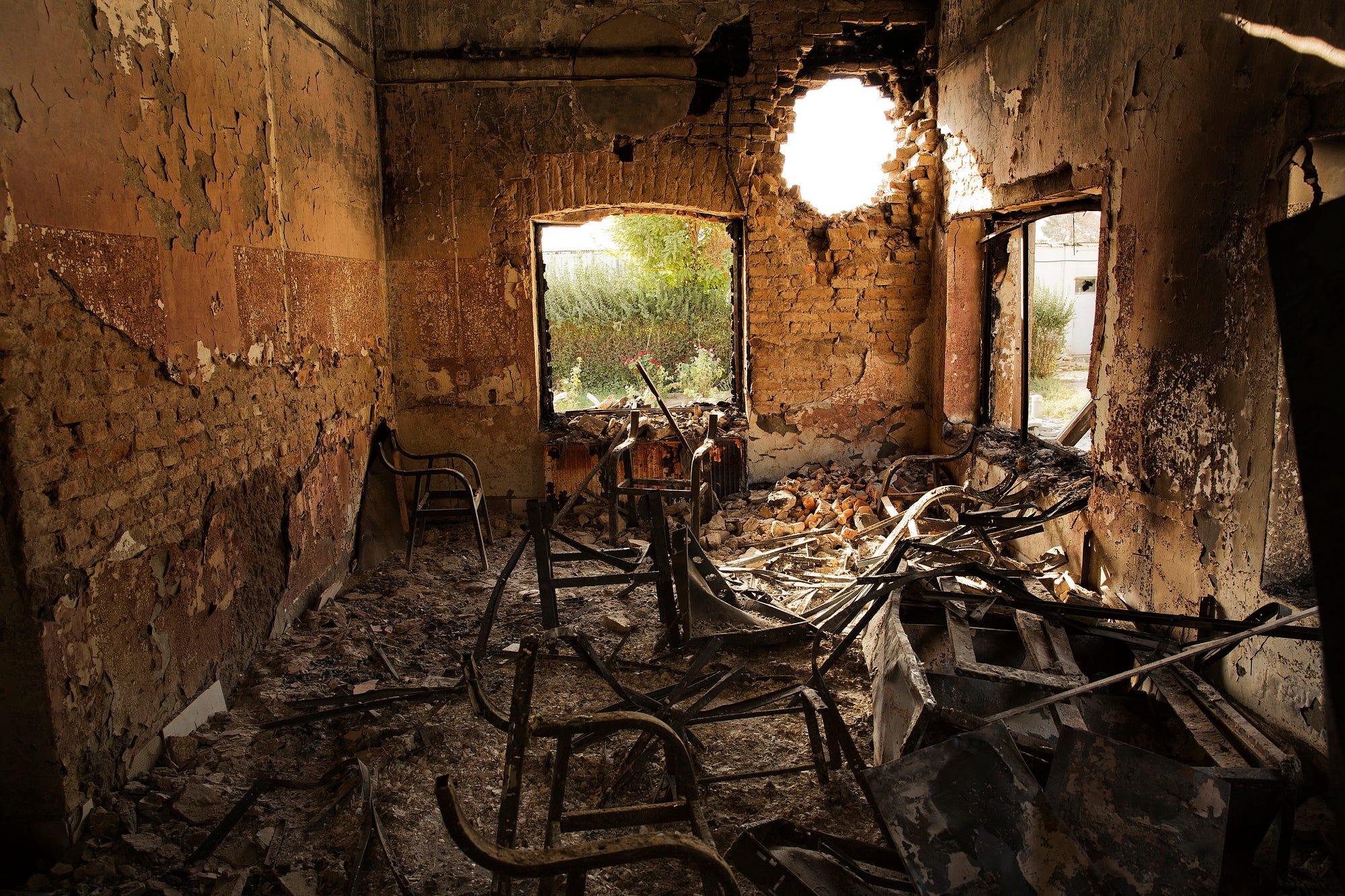
With the execution of Kelly Gissendaner recently in Georgia and many others waiting on death row, we are seeing executions being rushed, not only on the mainland but elsewhere. Death sentences were also rushed in Afghanistan on October 3d, with the bombing of an MSF hospital, killing 12 staff members and 10 patients, including children, and wounding 37 people. Both Kelly Gissendaner and the MSF hospital executions were justified under the same ideology.

It did not matter that this hospital in Kunduz was the only running hospital in the North East of the country. It was hectic at the hospital in the past weeks because of the battles between the Taliban forces and the Afghan military. Of course these battles sent many civilians, men, women and children to this hospital. MSF rightly treats everyone regardless of their origin: Taliban, military, and civilian casualties. This principle of equal treatment has been questioned in past decades with invasions, dehumanization campaigns and the criminalization of humane and compassionate actions.

The bombing of the MSF hospital by US Air Force is a moral failure and a crime, and yet the immediate response by US and Afghan authorities was to make it appear as normal collateral damage. They sent all their “thoughts and prayers” while asserting their legitimate role of deciding who may live and who must die, to borrow from Achille Mbembe.

At the time of the announced precise and clean war, the death toll of civilians, women, children and healers is rising. The drone program has already proven to be in the logic of an arbitrary decision of who may live and who must die. The collateral damages were in the hundreds and still unaccounted for; the drone program is the warrant of peace, they say.

This ideology that justifies these crimes runs on contradictions; it legitimates deterritorialization of arbitrary death sentences while claiming the restoration of peace.

Let’s bring a poem by Pramila Venkateswaran to examine this modern ethical and moral depravity:

Between Good and Evil

Dark blossoms wither on healthy soil,
indigo embracing light cannot be pried apart.

Ecological activists turn terrorists, good Samaritans-
turned-politicians walk off with money saved for the poor.

Peace lovers during war execute prisoners without trial.
We throw bombs, then food, on the same piece of land.

Violent Hindus desire a “pure” country of Hindus.
Each political party sounds like its rival.

Sense is nonsense is sense. Every exhortation
means its opposite and not: Morality is a crapshoot.


(Photo Credit: Medium / Victor J. Blue)

Pennsylvania built a special hell for Miriam White

Yesterday, Ellen Melchiondo reported on a visit to the Restricted Housing Unit in SCI-Muncy, a women’s prison in Pennsylvania. She noted, “In one of the pods is confined Miriam White, who in 1999, at the age of 11, stabbed a complete stranger to death in Philadelphia. Miriam was sent to various institutions before landing in Muncy. I could barely see Miriam through her window, because on it, she was finger painting with her feces, slowly, deliberately and trance-like.” Here is Miriam White’s story.

On August 20, 1999, eleven-year-old Miriam White argued with a cousin. Miriam then grabbed a knife and ran out of her South Philadelphia foster home. She ran down the street, passing some children, turned the corner, and saw Rosemary Knight, fifty-five years old. Miriam ran up to Rosemary Knight and stabbed her in the chest. Rosemary Knight died on the spot.

Rosemary Knight was a hairdresser and the principal wage earner in her household. August 20, 1999, was the twenty-seventh wedding anniversary of Rosemary and Jerome Knight. Miriam did not know Rosemary Knight.

Miriam White was a young “troubled” Black girl. Her infancy and earlier childhood was one of violence and abandonment, followed by a succession of institutionalization and foster homes. In February 1995, Michelle White Stevens took in the then-seven-year-old Miriam and her two younger siblings. In 1999, Stevens adopted the children. By all accounts, the house was a loving household.

Miriam White progressed and crashed, progressed and crashed. She has been diagnosed with severe mental illness and severe intellectual disability.

According to Miriam White, she wanted to hurt someone so that she would be sent back to a juvenile institution. She was careful not to attack children. After she stabbed Rosemary Knight, she ran to nearby hair salon, “trembling and begging for help because she had just stabbed someone.”

Up to this point, the story of Miriam White and Rosemary Knight, and all those around them, is tragic. Then it gets worse.

Pennsylvania is one of the few states in which anyone charged with first-degree murder must be tried as an adult. That includes eleven-year-old Miriam White. So Miriam White was placed in solitary in an adult jail while the adults tried and failed to figure something out. The judge tried and failed to find a compromise. The defense attorneys tried and failed to argue for reason. As her attorney argued, “Who, judge, at Muncy is going to take young Miriam through her first menstrual cycle. . . . The older, nurturing inmates?”

And so, in August 2007, Miriam White, eighteen years old, pleaded guilty in adult court to third-degree murder and possession of an instrument of crime, and was sentenced to 18 to 40 years. According to some legal scholars, it’s doubtful that Miriam White is competent to take a plea or anything else in court.

Miriam White’s “case” is littered with fine language. She “haunts” the criminal justice system. The initial judge’s ruling concluded, “I cannot exonerate Miriam just because I feel sorry for her. I cannot return Miriam to juvenile court just because her life story makes my heart weep. My oath as a judge requires that I decide this case on the basis of the proofs in court. The decertification petition is denied.” Miriam White’s case is “tragic” as it is “heartbreaking.”

That’s how the story is told, but not how the life is lived. Today, sixteen years and two months later, where is Miriam White? “I could barely see Miriam through her window, because on it, she was finger painting with her feces, slowly, deliberately and trance-like.” Justice is served, humanity denied.


(Image Credit: Martin Vargas / Solitary Watch)

Pennsylvania built a special hell for women: The Restricted Housing Unit of SCI-Muncy

Women serving time at SCI-Muncy Prison in Pennsylvania

The Commonwealth of Pennsylvania has two state prisons for women, Cambridge Springs and Muncy; both are named after the town in which they are located. Cambridge Springs is in the far northwest and Muncy in the central region; there is no such facility for the place where most prisoners come from, southeast, specifically, Philadelphia. That says a lot right there, but I will not be commenting on the hardship for visitation this places on family, friends, the potential for educational opportunities and advocacy, the lifeblood of the women. Muncy houses the prototypical prison within the prison: the Restricted Housing Unit (RHU), which I recently visited.

To enter the RHU, one goes through a locked gate before being buzzed inside. Upon entering, you immediately get a sense of being hermetically sealed: no sounds or smells from outside, no feeling of fresh air. There are four “pods” that are triangular shaped, two on each side of the wide, sterile hallway. From the center of the RHU and above is the interior Correctional Officers watchtower, or “bubble”. There is no long line of cells that would justify being called Death Row; Death Triangle would be more appropriate. However, the two capital cases are housed next door to each other, so there is a mini-death row within one RHU pod. The two women sentenced to death are no different in their crimes than some women serving life; they just had very different judges. Inside this pod is a small multipurpose room where only they can watch TV and do arts and crafts. There is a yard connected to each pod: it is concrete with a chain link roof, perhaps to provide shade. The RHU doesn’t have tables and chairs for the women to eat or socialize. Food is delivered through the wicket, and socializing is done by screaming through the doorjamb. There is one flat screen TV on the wall, which would be very difficult to view through the small, narrow window on the cell doors. Counseling is done inside of a phone booth size, wire mesh cage; the woman sits inside this cage to receive her therapy. Each woman is in a single, solitary cell. Visitation is used as a behavioral management tool. If they act up, visitation is withheld. If a woman is reluctant or refuses to leave her cell, the correctional officers have two choices: either leave her in the cell to suffer or forcibly remove her. The correctional officers usually take the path of least resistance and do nothing. If they do get a visit, or if they are allowed a visit, it is done behind plexiglass via a phone. After the visit, the women are strip searched. It has hard to imagine why the need for a strip-search; they wear an orange jumpsuit and are handcuffed and chained are around the feet.

One pod is completely empty. It houses the Young Adult Offenders, (YAO). It is currently being transitioned into a DTU: Diversionary Treatment Unit. It is no different than the RHU pods, except for a small fitness room and the tables and chairs in the center of the pod. I say leave it empty.

In one of the pods is confined Miriam White, who in 1999, at the age of 11, stabbed a complete stranger to death in Philadelphia. Miriam was sent to various institutions before landing in Muncy. I could barely see Miriam through her window, because on it, she was finger painting with her feces, slowly, deliberately and trance-like.

Long-term confinement can last many years in the RHU. It’s mind boggling why the prison system doesn’t realize that their methods and policies are failing the women. On this particular day, I saw no therapy being conducted. No visits were taking place. No activity was taking place outside of the cells. And that was no coincidence. Sadly, it was just another day in the RHU.

(For more information on the RHUs in Pennsylvania prisons, check here for the class action lawsuit that the Disabilities Rights Network of Pennsylvania filed and won. For results of the lawsuit and the Pennsylvania Department of Corrections response, check here. And here’s the Pennsylvania Department of Corrections Access to Mental Health Services Handbook.)


(Photo Credit: Let’s Get Free: The Women and Trans Prisoner Defense Committee)