Elegy for George Floyd

Elegy for George Floyd

Take a deep breath and sally forth
When taking three steps beyond your front door
If the breath flows predominantly through one nostril
Then take your first step with the corresponding foot
Your luck might be better 
If you believe in the old teachings

Because a human Life can be taken because of a pack of menthols 
And a counterfeit $20 bill
In god we trust still printed on its ersatz face

Is big face paper and poisonous tobacco more valuable 
Than a Human Life?
A Black Life?

Inhale, exhale 
Breath in, breath out
The whole world is watching 
Waiting 
Breathlessly
For a verdict.
How many camera angles does it take to get justice?

Breath entering our dust and we become living souls
Hong Sau, Hong Sau, Hong Sau, Hong Sau, So ‘ham
21,600 times a day 
Everyday
For 100 years
Or, until the day we die
And for every breath the heart Lub Dubs four times
How long can you effortlessly hold your breath?

8 minutes 46 seconds?
9 minutes 29 seconds?
Or until we are Genesis 7:22’ed?

Taking away what they could not give
George, You came  in like a Lion 
And went out like a lamb
To the slaughter 
Blue clad knee on a brown skinned neck
A perverse imitation of a vengeful god
Who was tired of all the rowdiness

A scapegoat baring all of our cultural sins
Lamb of god show us the sins of our world
Show us the of our world
Show us the sins of our world 
(I say beating my heart with my fist)

AAAAAAAAAAAAAAAAH take a deep breath
Ujjāyī — the breath of victory 
A baby’s first inhalation 
Before its first scream 
Before it can even know its  mother’s face 
Breath, stamp my story onto my spine 
And let me live it until it’s end!

Mother: first Guru and first lived embodied archetypical experience
Madonna and child
Being born 
Collecting the winds of the four cardinal directions 
Into the center of my being
My navel
Let crying out to you be my last earthly act, too, 
Mother
Whether I die with steel in my hand 
Or even under the knee of cowards 

Juxtapose the children baring the weight 
Of testifying on behalf of their Elder
Too young to appear in court 
But old enough to have witnessed atrocity
Sobs
Breaths of sadness
Breaths of tears

And 46 other types of breathing that typify our human existence 
All snuffed out as 
Your breath left your dust, George.

EEEEEEEEEEEEEEEEEE 
The last exhalation and the breath of leaving
George, Let your breath merge with all breaths
All breaths that have ever been sighed into the atmosphere 

Merge with hurricanes wrecking trailer parks
And Santa Anna winds feeding California fires, 
Merge with the tornado so that the world will notice your passing

Let Ọya‘s arms embrace you so that your face can be seen in the storm clouds
Your voice be heard in the thundering
And your eyes be seen in lightning flashing.

Blend with the sirocco
Zephyr
Pneuma
prāṇa with its five divisions
And the air that feeds household and sacrificial fires

Merge with Shekhinah

Blend with caressive springtime winds inciting 
The Johnny Jump Ups
Tulips
Hyacinths 
Crocus and cherry blossoms

Be the life of another 
And another
And another
A portion of you part of the first breath 
Of those newly born as you died

What is immortality if not this?

Be ¡presente! in the revolutionary voices of people crying out for justice
Who and what do they think they were trying to kill?
You would be seen see everywhere if people had hearts
Thousands of eyes
Thousands of heads arms and legs
And a spark from the light of one thousand suns.
Not other than that spark

But a blue clad knee controlled by cultural impurities saw you  as Other
Other than themselves 
Other than America
Other than one man one vote
Other than fully human
Beloved on sports fields 
And reviled on American city streets
Made menacing by your strength and size
A product of late 17th century plantation genetic engineering 
Frankenstein wasn’t the monster
He was the man who created the monster

But your promethean flame was not initially stolen
You were not a perverse imitation of life
And you weren’t a monster either
Your Flame stolen after the fact 
I take a spark of you and blow on it 
To bring a little light into this darkened world.

(By Heidi Lindemann and Michael Perry)

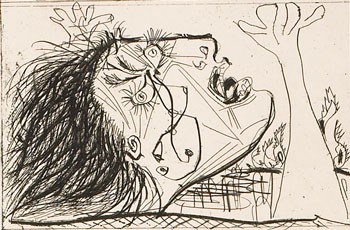
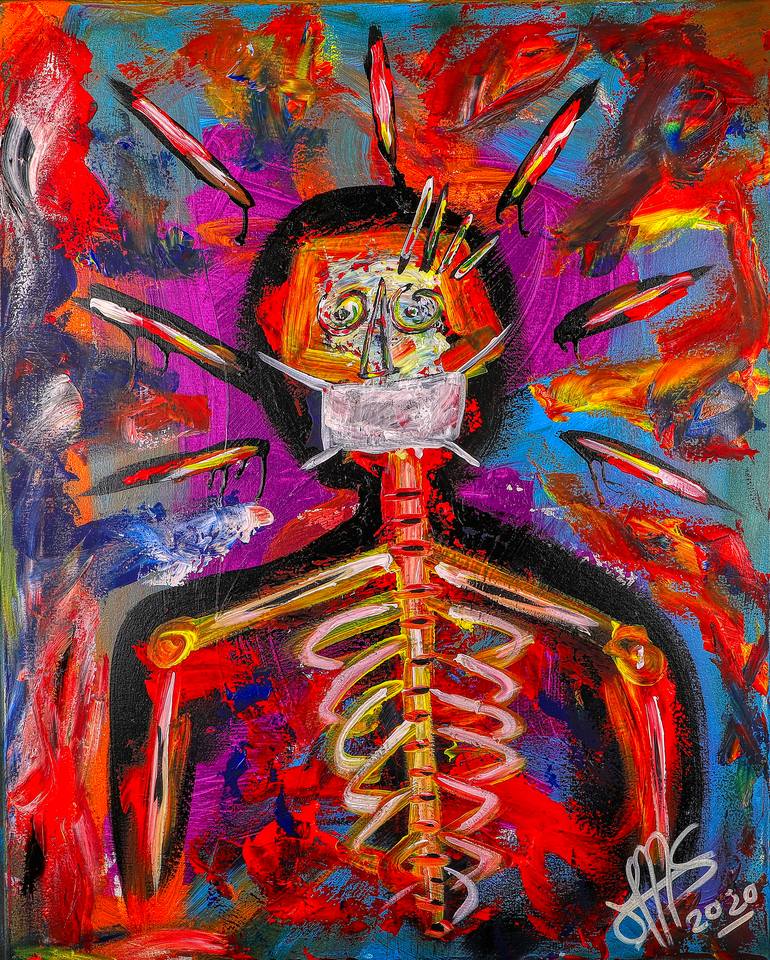
(Image Credit: Saatchi Art / Miguel Amortegui)
Not Your Yellow Fantasy: #StopAsianHate intersectionality

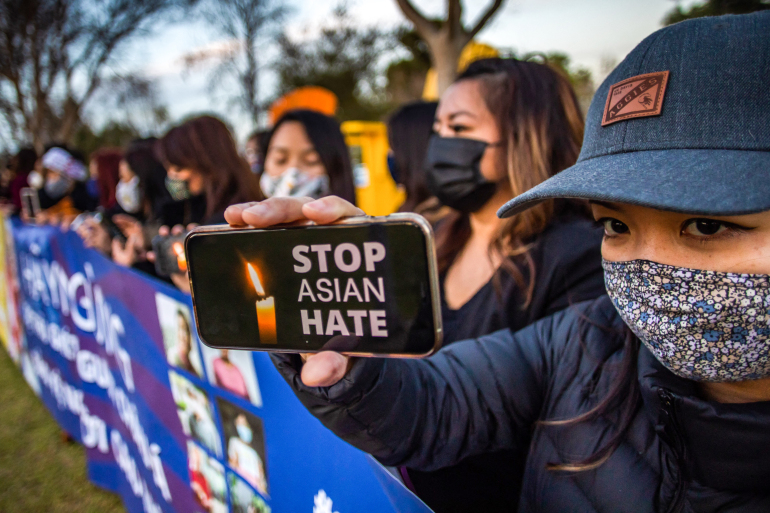
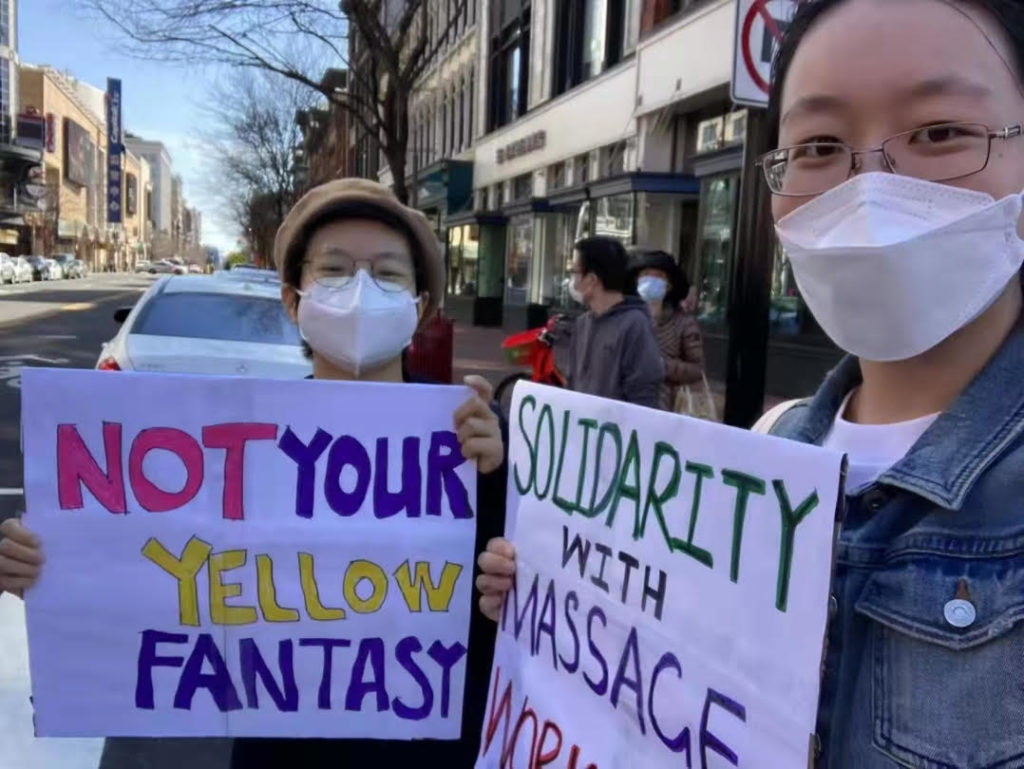
I went to the #StopAsianHate march in DC because I have experienced verbal and physical assault because of my Asian identity. After hearing of the shooting in Atlanta, I realized that the targeting towards Asian women was not accidental. My friend and I hoped to stress the intersectionality in the march by posting signs such as “Not Your Yellow Fantasy” and “Solidarity with Massage Worker.” I am glad to see the Asian community organizing and protesting, and hope the visibility in politics can last. 

Actually, the slogan “Not your yellow fantasy” is not my original idea. Last summer, I read about crowdfunding on Instagram to help publish a book written by a young Korean woman. In the book, she talks about her experiences being discriminated against and sexualized in the US. I donated some money for her, and in return, I can read her book chapters in advance through email. Through her emails sent to potential readers, I came to know that her book’s name changed from “Yellow Fantasy” to “Not Your Yellow Fantasy.”  So when brainstorming the signs with my friends, I immediately thought about her book’s name. The book, Not Your Yellow Fantasy: Deconstructing the Legacy of Asian Fetishization is now complete.  I have only read the Introduction but I will continue reading the whole book in the future.

(By Xiyuan Wu)

(Photo by Xiyuan Wu)


In Turkey, women refuse to go back: ‘It is women who will win this war’

Around the world, the past year has seen astronomical increases in the incidence of domestic violence. According to United Nations Under-Secretary-General and Executive Director of UN Women Phumzile Mlambo-Ngcuka, “Since the outbreak of Covid-19, emerging data and reports have shown that all types of violence against women and girls, particularly domestic violence, has intensified in what we have called the Shadow Pandemic.” While the explosion of violence against women and girls may be a shadow, around the world – from the Americas to Asia and Africa to Europe and beyond – women are refusing to be rendered shadows or specters, are organizing, militating, demonstrating and protesting, and demanding a just and better world. Women are the story. Remember that.

In Turkey, women have always organized against violence against women and girls, femicide, and silence. When women discovered that the Turkish government didn’t think the murder of women important enough to record, they set up their own platform, We Will Stop Femicide. Last summer, when yet another woman was brutally tortured to death, in this instance by her ex-boyfriend, women organized, insisting on justice for Pınar Gültekin, which justice would include contextualizing her death among the large number of women attacked, murdered, intimidated, harassed: “We are here Pınar, we will hold them accountable”. They used every means available, including famously Instagram, asking, “What is happening to women in Turkey? (and what is the Istanbul Convention?)”.

The Istanbul Convention is the Council of Europe Convention on preventing and combating violence against women and domestic violence. Last July, in the midst of rising and intensifying violence against women and girls, in Turkey as elsewhere, Turkey’s President Erdogan began making noises that he wanted to leave the Istanbul Convention, because leaving the one structure that actually addresses violence against women and girls seemed the most reasonable State response, given the Shadow Pandemic. 

Friday night, at midnight, the Turkish government issued a decree claiming to withdraw its membership in the Istanbul Convention. While the announcement was “a surprise”, it wasn’t surprising. Recall that last year, in May, Hungary’s Parliament refused to sign the Istanbul Convention, and then, in July, Poland threatened to pull out. While the move was “a surprise”, it wasn’t creative or original or clever. If anything, it was both predictable and trite. Poland passes more and more draconian laws outlawing and criminalizing abortion and reproductive rights more generally, Hungary goes after its LGBTIQ+ communities and individuals, and Turkey promotes violence against women. The pogrom is alive and well in Europe.

While the media largely focuses on the so-called Big Men, the real story here is that of the women of Turkey, mobilizing, organizing, militating as ever. The moment the decree appeared,  at midnight, women organized. Individual women and women’s organizations responded immediately. Feminist attorney Hülya Gülbahar was among many who noted, “It is not possible to withdraw from an international convention with a Presidential decree. You withdraw from a convention in the same way you became a party to it. The İstanbul Convention was unanimously approved at the Parliament. We call on the Parliament to reclaim its own will, the people’s will. Parliament to duty, to lay claim to İstanbul Convention”. Canan Güllü, the chair of the Federation of Women’s Associations of Turkey, added, “This is a consequence of the one-man regime. They put women on the table of politics. This means “Rape women, beat women, abuse children.” The next day, in demonstrations across the country, women chanted, “İstanbul Convention saves lives” and “We don’t recognize the one man’s decision”. Others chanted, “We are not scared, we are not afraid. We shall not obey.” One placard said it all, “It is women who will win this war.”

1956, South Africa, in response to State violence, the women chanted, ”Wathint’ abafazi, Strijdom! wathint’ abafazi,wathint’ imbokodo,uza kufa!” “Now you have touched the women you have struck a rock: you have dislodged a boulder: you will be crushed.” 2019, Chile, in response to State violence, the women pointed to the Supreme Court and chanted, “El violador eres tú!” “The rapist is you!” 2021, Turkey, in response to State violence, the women say, “It is women who will win this war!” Women are the center of this center.

(By Dan Moshenberg)

(Photo Credit: Bianet / Evrim Kepenek & Ayşegül Özbek)

No, Actually, This is Exactly Who We Are

Tuesday, a 21-year-old white man went on a killing spree, murdering 8 people in Georgia. His targets were mostly Asian American women, working in massage parlors across Cherokee County and in Atlanta.

He was arrested, alive. He was called a kid. He had had a bad day and was mentally ill with a sexual addiction. Apparently, the Captain decided to buy a shirt a year ago telling everyone that COVID came from “Chy-na”. 

Funny how, for men who have committed violent acts can use the mentally ill excuse. If we were really using violence as an indicator of mental illness and trauma women would have burned this entire country to the ground centuries ago. 

There must be something else to this story. 

Maybe the deaths of these women were a culmination of nearly two centuries of anti-Asian racism, policies that were designed to bar them from citizenship and deported them when they finished laboring out in the west. 

Maybe it was the continuing fetishization of Asian women, because it is not lost on me that massage parlors and happy endings are still somehow a joke that is acceptable to be shared. Maybe it’s the over-sexualization of Asian bodies, while simultaneously infantilizing them, fantasizing of raping Asian women, and seeing them as nothing more than objectified pieces for white male pleasure. 

Maybe it was the coronavirus, and an entire year of the president calling COVID-19 the China Virus, The China Flu, disparaging Chinese citizens as dirty, diseased, disgusting. 

I wonder, why the English virus hasn’t caught on (because of the COVID variant, and not the bubonic plague, or syphilis, or the many diseases that the English brought to America and wiped-out indigenous populations with) the same way all those amazing slogans above caught on. 

So, when I hear politicians or White Americans tell us this isn’t who we are…I’d like to remind them that this is exactly who we are. We spent a year blaming a group of people for “creating” a virus, when viruses do not have a race, an ethnicity, a nationality. We spent the Second World War interning Japanese Americans because of anti-Japanese racism; we’ve denied citizenship to Chinese because of anti-Chinese sentiment when they built the west; and we continue to other Asian Americans into the model minority to create tensions between other groups of people in this country. 

This is exactly who we are. This is how white supremacy works. The next shooter will still be a white man, and will be called a boy, and we’ll told he was mentally ill and just “snapped”. We’re not going to do much better until we reckon with our history. 

By Nichole Smith

(Photo Credit: AlJazeera)

Swirl: For Women’s History Month

Swirl: For Women’s  History Month

Princess Café au Lait Barbie and Prince Ginger Ken couldn’t do what we have done
United two families 
The day we were married and our hands met
We were Black and White touching
All these years together
And I have never written you a poem

Too busy loving — I guess — to write about it

But as I watch Meghan and Harry walk the tight wire between 
despair and disillusionment
I marvel at what we have done with the love that we have brought into this world
Revolutionary hearts beating revolutionary rhythms
And our breath exhaling revolutionary words
Revelatory hearts surviving the “for better and for worse’
Inhaling inspiration from the events of the day
And our own lives

As fearless as veteran warriors
And as ardent as midwives bringing new life into this world
We are not a prince and a princess
We are a King and a Queen

Think new thoughts by not eating the foods of childhood
From food you get mind
Both our families amazed because we make our pancakes from a mixture of five flours
Adding both cinnamon and ginger powder to the batter
The alchemy of mixing foods 
And of mixing peoples
Let your table be an altar and all foods be sacramental 
Because if you know how to mix
The outcome is always astonishing

We cooked mountains of vegetables from a Wisconsin garden  
And used more onion and garlic then either of our families had ever eaten at one time
Food cooked in houses that didn’t know 
The smell of clarified butter dancing with cumin and coriander
Brown and gold touching 
We watched our food disappear 

Everyone always asks for the recipes
But the alchemy of mixing is hard to learn 
And requires both artistry and skill

You have to cook the way you live
But Meghan and Harry didn’t cook their own food
And they planned for the wedding day but not for the marriage

Start the day with conversations and endless cups of chai
The only ritual we do daily, regularly, and sincerely 
Fresh ginger, peppercorns, cinnamon, cardamom, mint and black tea
Everyone always asks for the recipe
But the alchemy of mixing is hard to learn 
And requires both artistry and skill

Smash the cake into my face at the wedding party
Or, the women in my family will think you weak
You took me at my word 
Your Lucille Ball to my Desi Arnaz
Devils food cake covering my face as my Mothers laughed 
Punctuating their guffaws with
“Oh no she didn’t!”

They called you “Teena Marie” when you pierced your nose 
To commemorate your mother’s death
And my sister called you sister
Our revelatory hearts — again — surviving the better and worse

Maybe Meghan should have smashed cake into Harry’s face
You have to make space for yourself 
If you want to live unconventionally

So Swirl
Swirl down through the Middle Passage
And slavery
Swirl through “HAVE ME MANDINGO!”
Reconstruction
Through Birth of a Nation and the Klan
Swirl through JIm Crow
The Civil Rights Movement
And marches on Washington
Swirl through Blaxploitation Movies 
Through Black Macho and the Myth of the Superwoman
Through Baps, Bohos, and Buppies
Swirl through  Obama 
and through Kamala
Swirl through Black Lives Matter
Swirl through the Zoom age replacing words on the printed page

Marriage IS a political statement

Swirl Helen Pitts and Fredrick Douglas;
Jessie Walmisley and  Samuel Coleridge-Taylor;
Etta Terry Duryea and Jack Johnson 

Swirl Louisa Matthews and Louis George Gregory;
Josephine Baker and Jean Lion;
Ruth Williams and Seretse Khama 
You were Meghan and Harry before Meghan and Harry 
Were a gleam in their parents eyes

Swirl Pearl Bailey and Louie Bellson;
Mildred Jeter and Richard Loving — and thank you;

Swirl Grace Lee Boggs and and James Boggs;
Swirl Billy Porter and Adam Smith;
Swirl George Takei and Brad Altman Takei;

Swirl for the Wakandas that have already been and are yet to come
Love in Black and White
Love in Lavender
Rainbow Love
Black Love
Brown Love
And all The  loves that now dare to speak their names

This is for Hettie Cohen and her husband Leroi Jones before he became Amiri Baraka 
For Lena Horne and Lennie Hayton
Diana Ross, Robert Ellis Silberstein, and Arne Næess: 
Two scoops for Miss Ross!

And all of the other swirl couples too numerous to mention
Which is the point.

Walk seven times around the sacred fire with me and make a promise with each circumambulation
For earth, water, fire, air and space.
For self-actualization 
and for transcendence

Wed on the day winter becomes spring 
On a Venus’ day
And at the hour of the unconquerable
Our friends asked what the attire would be 
And we said:
Come as you will be for the rest of our lives 
And the lifetimes to come
Everyone always asks for the recipe
But the alchemy of mixing is hard to learn 
And requires both artistry and skill

Keep thinking:
It can be stopped at the border
Or with gated communities
It can be lynched out of existence
It can be gerrymandered
Or put into interment camps 
Or stifled by anti-miscegenation laws 
With 7 states still requiring racial disclosures on marriage certificates 

No one is coming to get you
We are you!

Red hair and creamy skin are genetically recessive 
Which is why they asked how dark the children would be
Meghan and Harry — a reversed living Bridgerton
AND HE BURNS FOR HER!

That the answers to our questions and concerns lie on a the path less traveled 
Is — perhaps — the greatest fear of people who think 
That salt, black pepper, and sugar 
Are the only spices there are.


By Heidi Lindemann and Michael Perry

(Image Credit: Sol Lewitt: “Swirl Platter”)

There isn’t a school

There isn’t a school

There isn’t a school
for protesting 

but there is
for police
and policing

There isn’t a school
for protesting or
for protesters

to learn the trade
to learn the skills

but there is
for police
and policing

There isn’t a school
Though we have 
plenty of schools

(who is schooled
who is educated)

There isn’t a school

When might there be

An afternoon SAFM radio presenter ponders the killing of a passer-by “caught in the cross-fire” by the country’s police in the Wits student protests, 11 March 2021, in South Africa’s Human Rights Month.

By David Kapp

(Photo Credit: News24 / AFP / Emmanuel Croset)

Landmark case: In South Africa, five sisters said NO! to the exclusion of women … and won!

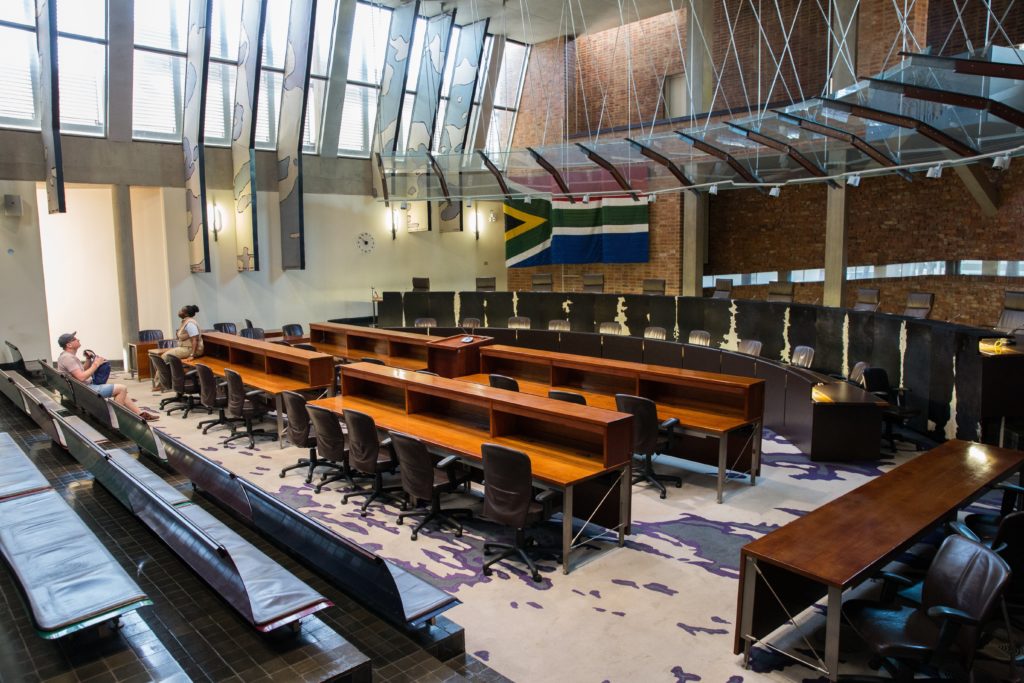
Constitutional Court

This is the story of Trudene Forword, Annelie Jordaan, Elna Slabber, Kalene Roux and Surina Serfontein, five women who refused to be denied their birthright, and In so doing affirmed, once again, that justice means justice for everyone. The story begins in 1902, in Oudtshoorn, in the Klein Karoo, in the Western Cape. Oudtshoorn is known for ostrich farms. Maybe now it will also be known as yet another cradle of democracy and justice for all. On November 28, 1902, Karel Johannes Cornelius de Jager and his wife, Catherine Dorothea de Jager formally signed their will, leaving some of their farms to their children, with one stipulation. The farms would pass from their children only to male generations until the third generation. But what if, at some point, the only direct descendants are women? Last month, South Africa’s Constitutional Court ruled on that question. 

In 1957, brothers Kalvyn, Cornelius and John de Jager inherited the property. John de Jager never had sons, and so when he died, his property was split between his two remaining brothers, Kalvyn and Cornelius. When Cornelius died, his sons – Albertus, Frederick, and Arnoldus – inherited his half share in the farms. In 2015, Kalvyn de Jager died. He had no sons, and he had five daughters: Trudene Forword, Annelie Jordaan, Elna Slabber, Kalene Roux and Surina Serfontein. Their male cousins claimed the property, noting that while the situation may smack of “unfair discrimination”, the law was the law, and a will was a will. The sisters didn’t buy that argument and went to court. Both the High Court and the Supreme Court of Appeals decided in favor of the male cousins. The sisters persisted and went to the Constitutional Court, the court of last resort, in this instance. Last month, the Constitutional Court decided in the sisters’ favor.

Acting Justice Margaret Victor explained, “The provisions of the preamble to the Equality Act make its nature and intended purpose clear. The consolidation of democracy requires the eradication of inequalities, especially those that are systemic in nature and which were generated in South Africa’s history by colonialism, apartheid and patriarchy. Inheritance laws sustain and legitimise the unequal distribution of wealth in societies thus enabling a handful of powerful families to remain economically privileged while the rest remain systematically deprived. In my view, this system entrenches inherited wealth along the male line. In applying this critique to the facts in this case our common law principle of freedom of testation is continuing to entrench a skewed gender bias in favour of men.”

The consolidation of democracy requires the eradication of inequalities, especially those that are systemic in nature and which were generated in history by colonialism, apartheid and patriarchy. What else is there to say?

By Dan Moshenberg

(Photo Credit: GroundUp / Ashraf Hendricks)

Holistic Medicine

Holistic Medicine

Find a beat that aligns with your drum
Matches your rhythm
And the pitch of your hum

Find a wind that lifts your wings
Billows your sails
And makes wind chimes sing

Find a notch to settle in
A perfect little crevice
A nestling nook
A cozy little place to call home 

Find where you belong
As everyone has their own little place 
In this world

For purpose gives us life
And purpose gives us strength
Purpose can suck the ilk and the ire 
Of pain

From the numerous struggles we are bound to face
And it is through purpose that our palpable mortality
Becomes peace

By Sierra Snead

(Image Credit: EventCombo)

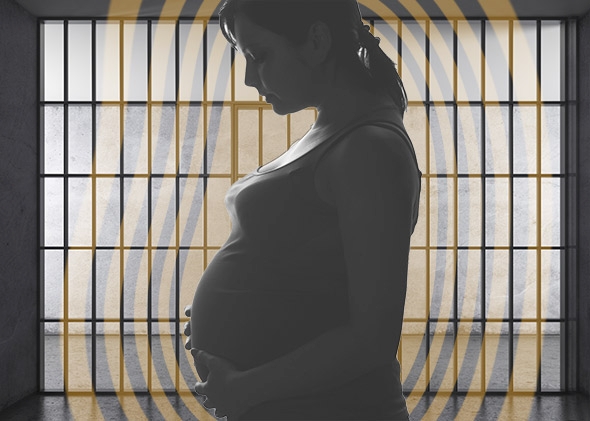
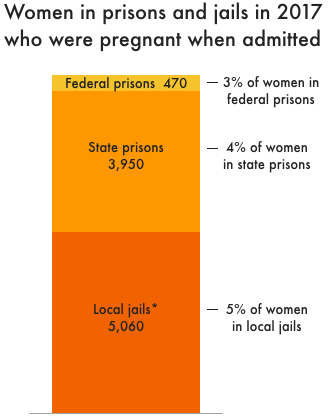
A woman was forced to give birth alone in a cell: Kelsey Love

It seems archaic that in this century, policies allowing pregnant women to deliver their children on concrete floors, completely alone, and without the supervision of medical staff still exist in the world, let alone in the United States

How many women in how many jails, in this country in this century, are delivering their children, completely alone, and not only without but deprived of the supervision of medical staff? Too many, and too many go uncounted, unreported. As we noted two years ago, when discussing the stories of Diana Sanchez, Tianna Laboy, Kenzi Dunn, all forced to give birth alone in their respective jail cells, “These are only the names we know. There is no national data base concerning prison or jail births … because, really, who cares?” Add Kelsey Love to the list of women who have been forced to undergo these `archaic’ conditions, this torture.

Kelsey Love is now 32 years old. On May 14, 2017, on Mother’s Day, Kelsey Love was eight months pregnant. She was driving her grandmother’s car when she was stopped by police officers in Frankfort, Kentucky. Initially, she was stopped because police thought she was driving erratically. Her grandmother had reported the car stolen. Love told police officers that, not too long before her being stopped, she had used methamphetamine and opioids. She also informed the officers she was eight months pregnant. Then she was booked into the Franklin County Regional Jail, where she was supposed to be monitored every ten minutes. That did not happen.

According to Kelsey Love’s report, on May 16, Kelsey Love began feeling intense pain. She screamed for help. Staff thought she was detoxing, and so left her alone, screaming, in pain. Finally, a female staff member came in. By that time, Love was on the floor, crying, and screaming for help. She asked to see a doctor. She said something was wrong, that the baby was coming out. The staff member asked if she was having contractions, and Kelsey Love said she was. The staff member called the jail call nurse, who said she would check in later and the staff should keep close watch. That did not happen.

Three hours later, the nurse arrived. When she and a staff member walked into the cell, the floor was covered in blood. Kelsey Love had given birth to a baby boy, chewed off the umbilical cord, ripped the mattress and crawled into the bed with her newborn child. That is what happened.

Kelsey Love sued the jail and some members of the staff. This week, she was awarded $200,000 in an out of court settlement. Kelsey Love has successfully completed drug rehabilitation treatment, has been clean and sober for two years, and is now working to regain custody of her children. The boy born on the floor of that jail cell will turn four in three months.

According to Kelsey Love’s attorney, “She’s doing great.” According to the same attorney, she “still has night terrors as a result of her ordeal.” What happened to Kelsey Love? She was abandoned, as so many women have been, left to give birth alone on the concrete floor of a jail cell in Kentucky, just like Tianna Laboy in Connecticut, Kenzi Dunn and before her Tamm Jackson in Florida, Diana Sanchez in Colorado, Jessica Preston in Michigan. Nicole Guerrero and  Autumn Miller in Texas. These are only the names we know. There is no national data base concerning prison or jail births … because, really, who cares? It’s not archaic. It’s torture, cruel and unfortunately altogether usual punishment.


by Dan Moshenberg

(Infographic: Prison Policy Initiative)

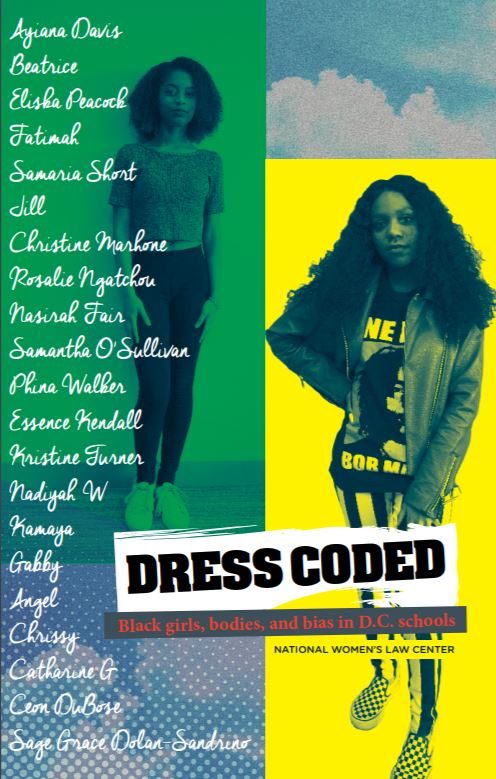
How School Dress Codes Disproportionately Target Black Women

The implementation of dress codes within American public schools has been used to police young women’s bodies in order to maintain power over them, impacting their psychological well-being. Dress code policies within American public schooling system aims to specifically target Black women, assigning them the negative consequences of promiscuity and over-sexualization, leading to a disproportionate psychological impact. The upkeep of these regulatory dress codes furthers systemic white privilege within American public schools. Research conducted by the National Women’s Law Center shows that “among 29 D.C. schools, majority-Black high schools on average [have] more dress code restrictions than other high schools”. Additionally,  “Black girls are much more likely than other girls to be cited for infractions such as dress code violations”. School dress codes typically enforce their ‘acceptable’ standards of dress from associations typically linked with the white middle class. This inherently promotes ideas linked with ‘whiteness’ and discourages ideas linked with ‘Blackness.’

Black women face double the judgement when met with these standards. Not only are their bodies deemed problematic simply because they are female, they are also deemed problematic for their Blackness. Black women have been assigned consequences through public schooling dress code policies which inherently and severely objectify and sexualize them: “Repeated exposure to sexual objectification experiences is linked to low self-esteem and high levels of anxiety, which affect women’s psychological well-being”. Black women are more prone to sexualization and objectification, as shown by the increased rate at which Black women in public schooling institutions receive dress code violations as well as by stereotypical media portrayals within popular culture. It is relatively easy to assume that Black women are then also more likely to experience the psychological downfalls associated with sexualization and objectification in response to these experiences. 

Dress codes which discriminate heavily against Black individuals also prohibit the flourishing of self-esteem within Black females, as well as in Black youth in general. The enforcement of these dressing policies cast a shadow on the ability for the individuals to obtain a strong positive association between their race and their identity, effecting their psychological well-being and self-value. Rather than regulating female bodies, school environments should teach self-control. Rather than regulating Blackness, school environments should provide a safe place for cultural differences and promote inclusivity with faculty that is diverse and representative. In order to eliminate the incessant focus on controlling Black female bodies, the code which heavily regulates them needs to be removed. These dress code guidelines distract from the importance of intellectual growth and learning for Black youth within our public schooling systems. Clothing is not an indicator for success or failure. As long as dress code policies continue to exist, Black women will continually be targeted and placed at a disadvantage. 


(Image credit: National Women’s Law Center)


By Molly Wilhelm

(Molly Wilhelm is a feminist and human rights activist based in Maryland.)