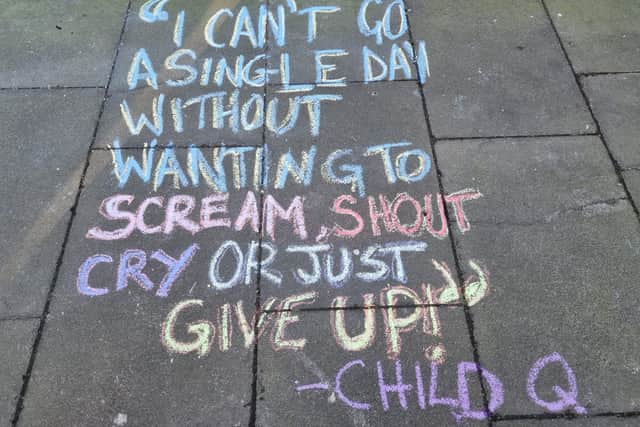
Five years ago, the United Kingdom public was “shocked” to learn the story of child Q, a 15-year-old Black girl in Hackney. Child Q was at school. She was “suspected” of having cannabis. The police were called. The police strip-searched the child. The child was menstruating. Of course, the police found no contraband: “A council report found that racism had been a likely factor in her treatment.” Child Q said, “Someone walked into the school, where I was supposed to feel safe, took me away from the people who were supposed to protect me and stripped me naked, while on my period. I can’t go a single day without wanting to scream, shout, cry or just give up. I don’t know if I’m going to feel normal again. But I do know this can’t happen to anyone else, ever again.” Today, Dame Rachel De Souza, the UK’s Children’s Commissioner, released a report, “Police powers and children – strip searching and use of force.” In the intervening five years, many children have been strip-searched. A disproportionate number of those children are Black.
On one hand, the number of reported strip-searches has dropped. That’s it for “good news”. On the other hand, “Children of Black ethnicity are more likely to be strip searched than children of other ethnicities …. Between July 2023 and June 2024, Black children were almost 8 times more likely to be strip searched than White children and around 5 times more likely than Asian children, meaning there has been no improvement to disproportionate strip searching of Black children since the last data collection period. Over a quarter (27%) of strip searches between July 2023 and June 2024 were of a child aged 15 years old or younger …. There are ethnic disparities in both the use of force and the contextual factors surrounding the use of force. Black children are over-represented in use of force incidents and higher proportions of Black children have their size, gender, or build listed as a contextual factor in the use of force report than their Asian, White and Mixed ethnicity counterparts.”
The report finds this State violence committed on the bodies, souls, minds and lives of Black children results from “adultification bias”: “The disproportionate use of force against Black children can be attributed to adultification bias where racialised children, particularly Black children, are perceived as older, more dangerous, and more guilty than their White peers. This bias shifts the police’s focus away from a child’s actual vulnerability and children are more likely to be treated with suspicion than raising safeguarding concerns.”
The police “saw” adults where there were children. Why? Because they were trained to. Trained as police officers, trained as adults, trained as people living in a racist society.
The report concludes, “The racial disproportionality in strip searching Black children has seen no signs of improvement.” Finally, the report notes that “the vast majority of children are still being searched for drugs, rather than weapons, where the risk of immediate harm is less clear.”
We live in an age in which children are disposed of like so much worthless garbage, largely because of the color of their skin. Remember the slaughter of 168 schoolgirls caused by the U.S. bombing of Shajareh Tayyebeh school in Iran? That was February 28,2026, less than eight weeks ago. Outside of the schoolgirls’ families and communities, who’s talking about that today? Where is the horror? What was “the risk of immediate harm”? How has it become so easy for adults to forget our responsibility to protect children from harm?
In June 2025, an Egyptian mother and her five children were arrested and thrown into Dilley detention center, in Texas. Her 18-year-old daughter, Habiba El-Gamal, wrote a letter which concluded, “This place broke something in us. Something that I don’t know if we will ever be able to fix.” That letter was read to the U.S. Senate Committee on the Judiciary, Wednesday, March 11, 2026. As of yesterday, the El-Gamal family were still held at Dilley.
Something has been broken, something in us, something that I don’t know if we will ever be able to fix. We have become the risk of immediate harm. Can we still say we do know this can’t happen to anyone else, ever again?
(By Dan Moshenberg)
(Photo Credit: London World)