The incandescent women of Marikana

The women of Marikana are marching tomorrow, Saturday, September 22. They have had enough, more than enough, and, as one reporter notes, they are beyond angry. They are incandescent with rage.

They will march as they have marched before, to create a space in which they will be heard, to create a space in which State violence against women, against poor working women, against poor working women’s communities, will end. They will march for peace, they will march for justice, they will march for the incandescent power of their own voices, stories, visions, songs, lives.

Paulina Masuhlo, also known as Pauline Masuthle, will not march with the women. It will be the first time she does not march with them. In the past month, Paulina Masuhlo was often the public face of the women of Marikana. She led the first women’s march after the Marikana massacre.

Masuhlo was an ANC Councillor. She took her job seriously. When the massacre broke out, she met with women in Nkaneng, a cluster of shacks close to Wonderkop. Masuhlo was meeting with women in Nkaneng, when the police swooped down and through the informal settlement. According to eyewitnesses, the police fired rubber bullets, indiscriminately and without provocation. It’s called `a police operation.’ Masuhlo was shot. She died in hospital on Wednesday. The ANC is `shocked’. Others find it `ironic’ that she was shot by the government she represents.

Masuhlo was shot because she was a woman talking with women in Marikana, where everyone is suspect.

This Saturday the women of Marikana will march. Testimony after testimony by Marikana women reveals the fear they live in, they swim and breathe in, as women in Marikana. That same testimony expresses the courage, commitment and organization it takes to tell one’s story … if one is a woman living in Marikana.

Tomorrow the women of Marikana will march, and perhaps incandescent rage will light a path away from death and murder, will light a path to justice.

(Photo Credit: Greg Marinovich/Daily Maverick)

End the war on children living with disabilities. End it now.

Over two years ago, we wrote about `seclusion rooms’. These are solitary confinement spaces in schools across the United States. More often than not, they’re closets or utility rooms, anything small and tight with a lock on the outside. That is not seclusion. That is torture.

And of course, `of course’, the subjects of this practice are overwhelmingly children living with disabilities. Children like Jonathan King, who, at 13, hanged himself in a Georgia seclusion room. Or the 12-year-old girl living with autism, or the seven-year-old girl living with autism and bipolar disorder.

Or, as described in yesterday’s New York Times, Rose, who, in kindergarten, was locked into seclusion rooms for hours … at five years of age. Her `problem’? Rose had `speech and language delays’. For which she was thrown into a closed, dark space for an hour or so at a time.

Rose’s father reports she was deeply traumatized. The school system, in Lexington, Massachusetts, has agreed, or been forced by a lawsuit settlement, to pay for Rose’s treatment.

Seclusion rooms, screaming rooms, school based solitary confinement can be found in Connecticut, Kentucky, New York, Florida, Ohio. Georgia banned seclusion rooms … `thanks’ to Jonathan King. How many children? How many children must suffer? How many children must then be given `the gift’ of post-traumatic treatment? For how long?

While this issue addresses all children, and all people, it strikes at the heart of citizenship for those living with disabilities. Billions of dollars of profit are generated every year from the care provided for those living with disabilities. Those who care for those living with disabilities are overworked, underpaid, and always under-esteemed. Billions are stolen from their labor and lives.

At the same time that billions of dollars of profit are generated, there isn’t enough money to provide decent, humane treatment? No. This is the production of vulnerability writ large on small bodies. In the United Kingdom, Ellen Clifford, of Disabled People Against the Cuts, DPAC, knows this lesson all too well. In Nigeria, Patience Ogolo, of Advocacy for Women with Disabilities Initiative, AWWDI, does as well. So does Marsha M. Linehan, a psychologist at the University of Washington who, as an adolescent, suffered and barely survived seclusion rooms. Only now, many decades later, can she finally share the stories of her life in the cells.

These women know that the State that treats any group as disposable is worse than a failed or a rogue state. It’s criminal.

The claim of State poverty as an alibi for physical, emotional and psychological harm against people living with disabilities is a crime. The suggestion that there isn’t enough money or resources is a lie and a crime. And the lie and the crime are framed within a political economy of vulnerability, in which it is presumed that the vulnerable cannot speak or act for themselves.

They can, and they do. And they know that the question of who lives and who dies has been taken over by the question of who lives well and who lives in hell, under constant attack.

End the war on children living with disabilities. End it now.


(Image Credit: Ward Zwart / New York Times)


The United States steals $450 billion a year from elder caregivers

Earlier this month, AARP launched a new ad campaign meant to address the situation of elder caregiving in the United States. The campaign is based on thousands of accounts, and on longstanding research, such as the report that AARP released last year, “Valuing the Invaluable: The Growing Contributions and Costs of Family Caregiving, 2011 Update.”

Much of that report is, sadly, unsurprising. Caregivers are largely unpaid, largely family members, generally overworked and overtaxed, isolated, at a loss, often confused emotionally as the stress mounts. As a consequence of all of this, and more, caregivers generally suffer declining and deteriorating health. The majority of these careworkers are women.

Here’s the news, and it’s staggering: “The estimated economic value of their unpaid contributions was approximately $450 billion in 2009, up from an estimated $375 billion in 2007.” As AARP poignantly notes, that’s not only a 21 percent increase in a mere two years. $450 billion is also “more than the total 2009 sales of Wal-Mart, America’s largest company, and more than the combined sales that year of the three largest publicly held auto companies (Toyota, Ford, Daimler).”

The stories told by individual caregivers are important, as are their lives. They are crucial, and we must listen to them and, even more, learn to act on what they’re saying and what we’re hearing. At the same time, those stories beg to be contextualized. In one year, the national economy stole $450 billion from US residents. Whether that labor was a labor of love or a labor of obligation, the value of that labor was stolen. And, as the years 2007 – 2009 demonstrate, it’s a growing market with a growing profit margin.

Caring Across Generations is one answer, an important and even crucial answer, to the problem. Of equal importance is re-creating a State that doesn’t regard its citizens and residents as clients and customers. In this year of high political rhetoric, one hears a great deal about the United States being `a wealthy nation.’ Wealth built on the predatory extraction of $45 billion dollars in a single year is not wealth. It’s poverty. Ask the women who care for their elders; ask the elders who are majority women as well. Ask yourself.

(Image Credit: AARP.org)

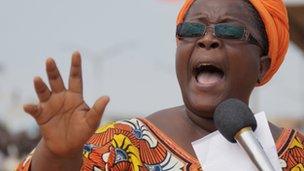
The Women of Togo call for Spring

Isabelle Améganvi

The women of Togo have had enough. Like the women of Sudan two months ago, the women of Togo have had more than enough. More than enough of the same family ruling Togo for decades. More than enough of a political climate that doesn’t change. More than enough of men finding alibis for why things don’t change. Not just men. Their men. Their partners. And so, the women of Togo have called for a one-week sex strike.

In so doing, Isabelle Améganvi, head of the women’s wing of the Collectif Sauvons le Togo, or Let’s Save Togo Collective, invoked the experiences of Liberian women in stopping the war and the violence, first, and, more profoundly perhaps, calling everyone to act on their collective and individual responsibility. State violence doesn’t happen in a vacuum. Decades long State violence doesn’t happen without the cooperation and collaboration of the citizenry. Togolese women know, and are teaching, that lesson, as did their sisters in Liberia … and Kenya three years ago … and Italy four years ago … and Colombia seven years ago … and before that in Poland and in Iceland and the list goes on and on.

The call for a one-week women’s sex strike was issued at a mass demonstration over the weekend. The women were supported by traditional leaders. They marched to free political prisoners, held in deplorable conditions. They marched with thousands of others to end the regime; they marched to save Togo. And so they called a strike. By so doing, instead of declaring war, the women threatened to wage peace. As women across the centuries and around the world have done repeatedly, turning their bodies into … their bodies.

The political climate in Togo is built on oppression of women and sexual violence. Discrimination against women is common, domestic violence as well. Women make up 11% of the Parliament and 14% of the Ministerial positions. Women have little to no access to land ownership rights. Women have `born the brunt’ of political violence, especially in the 2005 elections during which targeted sexual violence against women was rampant. That violence has yet to be properly investigated.

So, the women of Togo, disobedient, insurrectionary, have had enough. They call for climate change. They call for Spring.


(Photo Credit: BBC)

Domestic workers demand dignity, respect, and power

Earlier this week, the Sunday Nation described the `ordeal’ of Kenyan domestic workers in Arab `slave markets’. The story focused on Mwanaisha Hussein, a Kenyan woman who left her home to work in Jeddah.

The story is in many ways typical. Mwanaisha Hussein had a job in Kenya, as a store clerk, and wanted something better. She heard about jobs in Saudi Arabia, and signed up. Signing up involved raising funds, going into debt. The promise and allure of better jobs, and better pay, were strong.  When she arrived in Saudi Arabia she found, first, difficult to terrible working conditions; second, extreme and intensifying physical and emotional abuse; third, almost absolute confinement. Desperate, she jumped from a third floor opening she created by breaking through the air conditioner vent. She was taken to hospital, where police took her report … sort of. They would not listen to any accounts of torture or abuse. Finally, with some assistance, she made it to the Kenyan embassy and, somehow, made it home to Kenya.

Today, she says, “The conditions are poor, and there is little food. It’s just horrible. I left a job here in Kenya and wasted eight months of my life. Not only that, I nearly died. I’d never go back. I’d never recommend it for anyone. I’d rather make Sh100 a day in my country.”

It’s a typical story.

In June of this year, the Kenyan government barred Kenyan women from seeking employment in Saudi Arabia. This month Nepal banned women under 30 from working in Gulf States. These bans are typical State responses. Indonesia at one point this year banned women from working in Malaysia. The Philippines has imposed bans at various times.

So, how is Hussein’s story typical?

First, Mwanaisha Hussein is not one of the poorest of the poor. Quite the opposite, she is an ambitious woman worker who sought to improve her lot. She is precisely not a pathetic participant in the narrative of the plight of the domestic worker.

Second, Mwanaisha Hussein is not a domestic worker in Kenya. Most transnational domestic workers aren’t domestic workers in their own home countries. In Kenya, for example, domestic workers are among the lowest paid workers in the land. Further, they are paid approximately 3.5 times less than domestic workers in South Africa. South African domestic workers are paid five times less than in the United Kingdom. From London to Johannesburg to Nairobi, it’s not so much a chain or ladder as a precipitously slippery slope. Kenyan domestic workers would be very hard pressed to come up with the $3000 plus it takes to get a job in Saudi Arabia or anywhere else overseas.

The story of transnational domestic workers must always be placed alongside the story of national domestic workers, especially when the State suddenly claims to care about women workers.

How does the State claim to care about its transnational women workers? By `protecting’ them from entering into `perilous’ labor markets. Does the State consult with domestic workers? No. It simply proceeds to a politics of protection.

That politics of protection is profoundly gendered and gendering. It is the virile State protecting the vulnerable woman worker.  In ancient Roman law, according to Yan Thomas, women could not exercise the `virile office’ of autonomous actions. Later, in the quickly changing world of twelfth to fifteenth century Europe, as women entered into more and more public spaces, male leaders worked night and day to `educate’ women into their basic vulnerability and need to be protected. As Carla Casagrande notes, “We do not know how many Western women in the Middle Ages lived quietly within the home, church, or convent walls, obediently listening to learned, loquacious men who imposed all sorts of rules and regulations on them…. All we know is that women had to deal daily with these men, entrusted by society (and supported by a precise ideology) with the delicate task of supporting their bodies and souls. Part of the history of women lies, therefore, in the history of these words, spoken arrogantly, affectionately, and sometimes anxiously.”

When it comes to `protecting’ women, not much has changed in the last thousand years. Today, we do not know how many Western, African, Asian, Latin American women deal daily with these men. The scale of our not knowing has expanded exponentially.

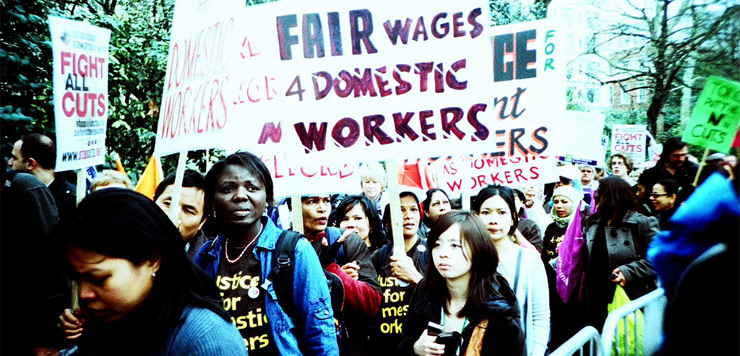
Let’s change the story. Stop talking about protecting women workers. Don’t protect domestic workers; protect domestic workers’ rights. That’s a major point of the International Labor Organization Convention Concerning Decent Work for Domestic Workers. Domestic workers’ rights should be protected because workers’ rights should be protected. Period. Not because women are vulnerable or need protection.

Domestic workers want dignity, respect, and power. That’s the lesson this week of the campaign in California to pass the Domestic Workers’ Bill of Rights. It’s as well the lesson, in Namibia, of the recently formed Domestic Workers’ Wages Commission. And it’s the lesson Mwanaisha Hussein teaches. Slavery is wrong. No one knows that better than the worker herself. As Mwanaisha Hussein explains, death is preferable to death-in-life. Decent work is the only option. That only happens when women workers organize themselves.


(Photo Credit: A Celebration of Women)


The unmaking of the indebted woman

In this season of hollow political American presidential campaigns, The Making of the Indebted Man: Essay on the Neoliberal Condition, by Maurizio Lazzarato appears as a work of resistance. The book explores contemporary financial power and the debt crisis that comes with it, a crisis that has shaped our current political situation.

Maurizio Lazzarato sees the debt system as a political project that means to engage the individual for the future. Debt creates a system of efficiency/ profitability that tends to control all individuals, unemployed or employed. As Lazzarato points out, the economical origin of the current crisis, the subprime crisis, has been rendered invisible. In fact, the couple debt-fault is only applied to individuals while the debt crisis, as the failure of the entire neoliberal system, is left untouched, unmentioned.

The creation of mechanisms of debt has been the central action of neoliberal political economy. This new world order begat a dynamic of work subjectivity in the post-industrialized economy, thanks to the neoliberal turbine: the differential of power between the lender and the borrower. According to Lazzarato, Michel Foucault’s The Birth of Biopolitics expounded on the historicity of incipient neoliberal governance, but neglected to incorporate the power-function of debt-money finance in neoliberal governance. Lazzarato relies on Gilles Deleuze’s Postscript on the Societies of Control to argue that as capitalism moved from production to service, social control moved from disciplinary control to market based control with the fluctuation of interest rates as the basis of the production of indebted citizens.

In this world, debt political economy is the real global controlling power.

In his conclusion, Lazzarato calls for new solidarities and a new cooperation, reminding us that neoliberalism has also legitimized a debt toward the planet itself.  There’s global debt, and there’s planetary debt, and the two are intertwined and mutually reinforcing. Nevertheless, I wonder if the title, the making of an indebted man does not carry a singular and restrictive vison. After all, the making of the indebted woman started way before the advent of neoliberalism.

In “The political economy of vulnerable”, Dan Moshenberg recently highlighted a transnational reality of the fate of the indebted woman, showing that this “in debt” status now has a widely recognized name: the vulnerable. Moshenberg showed how predatory rates of local banks rendered a woman desperately vulnerable and isolated until she finally killed herself. Debt is part of the recently installed system of domination that will continue to control women, as our lives (including sexual and reproductive) will be even more dependent on this global financial order. Now is the time for women to strengthen and intensify our resistance. The unmaking of the indebted woman is the beginning of the end of the neoliberal condition. Cancel the debt … now!


(The Making of the Indebted Man: Essay on the Neoliberal Condition, by Maurizio Lazzarato, translated by Joshua David Jordan, will be released in the United States by Semiotext(e) next month.)


(Image Credit: aspoonfulofsuga)

Lonmin: Massacre is never justified

Police, armed to the teeth, kept the peace at the tumultuous Lonmin platinum mine in Marikana, Rustenburg, in the North West province of South Africa. The reports differ as to the price of peace. Some claim nearly 50 dead, others 30 some. Killed by police bullets.

Striking miners had occupied a hill, Wonderkop, ostensibly because “it is not mine property and the police would not kill us here.” They did. The police came, surrounded the hill, and, at some point, opened fire on the protesters. The police opened fire with live ammunition.

The State claims to have claimed to accept responsibility. What could we do, it says, when the miners were so violent, when protests have become so violent? `We’ could show up with some other than live bullets.

There’s more to the story … and there’s less.

Massacre is never justified. In the very many, eloquent, passionate, and often persuasive analyses that have followed the massacre that occurred just yesterday, one thing is being missed. Massacre. The existential thing that massacre is.

Massacre is not just another word. Massacre is when language stops, when reference and when representation stop. It is an absolute rupture of all. One doesn’t `explain’ massacre. One simply stops. Because massacre is absolutely impassable.

The question of how the massacre occurred will be debated and, hopefully, answered. Hopefully, the answers will lead to humane policy and practice.

But first … stop. Remember, massacre is never justified. No peace follows massacre. No justice emerges from massacre. Nothing emerges from massacre.

And now?

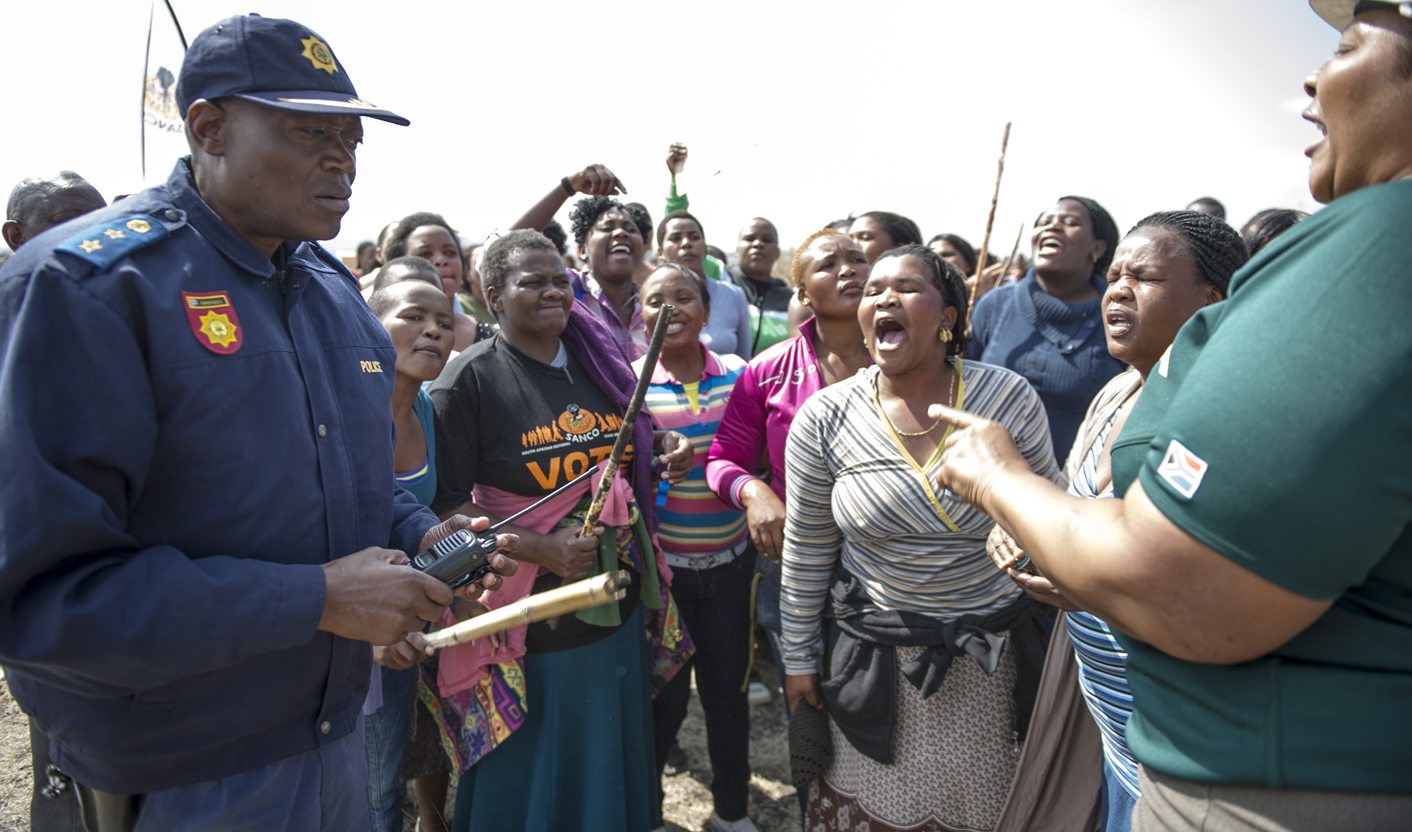
A hundred women danced in a dirt road on Friday, singing protest songs amid ramshackle wooden and corrugated metal shacks sitting over one of the world’s richest platinum deposits. These songs were once directed at South Africa’s white apartheid government, but these women were singing to denounce their own police who fired on their striking menfolk, leaving 34 dead, the day before. The police came here to kill our husbands, our brothers. Here. Our children!” said 42-year-old Nokuselo Mciteni.”

Nothing emerges from massacre. Nothing.

(Photo Credit 1: AFP)

The political economy of vulnerable

Around the world, women, children, men, are humiliated and abused as a matter of public policy and widespread practices. When the practices are finally reported, the women, children, men are described as `vulnerable,’ as if vulnerability were a state of being. It’s not. Vulnerability is an active verb, as is violence.

In the past week, in the United States, reports have shown that pregnant school girls are kicked out of school or refused schooling. Why? Across the country, children living with disabilities, and especially Black children living with disabilities, suffer extraordinarily high school suspension rates. Why? In New York City, it has been `discovered’ that the stop-and-frisk practices that target Black communities are particularly humiliating for Black women. Why do these policies exist? To produce vulnerable populations and individuals.

I thought of these as I read about Happiness Mbedzi. Happiness Mbedzi lived in Diepsloot, a “sprawling informal settlement north of Johannesburg”. Sprawling … and notorious for its desperate conditions as well as innumerable popular mobilizations and organizing efforts. Diepsloot: water-less, info-less, service-less … but not without hope?

In Diepsloot, Happiness Mbedzi tried to maintain her household, herself, her husband, her son. To do so, she took on debts. The debts had crushing interest rates. Happiness took out more loans to pay for the interest on her earlier loans. Finally, she borrowed money from her young son, went to the shops, bought poison, and killed herself.

This is described as a tale of the `vulnerable.’ Happiness Mbedzi was not vulnerable. She was under attack. Local banks, community stokvels, neighbors are all reportedly charging predatory rates. How is it that stokvels, which traditionally supported women like Happiness Mbedzi, are now as predatory as the banks, at least in Diepsloot? How is it that no neighbors are around who would lend money to a neighbor woman in desperate straits?

For Happiness Mbedzi, as for young women students, the Black students living with disabilities, the Black women of New York, institutions ostensibly designed to assist and even improve one’s situation have been transformed into lethal weapons. Schools target particular young women. Schools target particular Black women and men. Police target Black women. The result? Targeted impoverishment that goes under the name of development and the common good. And those who are assaulted, who are wounded simply because of whom they are, they are then reported as being `vulnerable.’ It was destiny that struck them.

Vulnerability is not a status nor a class nor a caste nor a rank. It is not a state of being nor is it synonymous with weakness. And vulnerability is not inevitable. Vulnerability is a political and economic power relationship. Individuals and populations are designated and then produced, and reproduced, as vulnerable. Happiness Mbedzi was not vulnerable and she was not part of a `most vulnerable population’. She was turned into a `vulnerable woman’ by public policy and by State practices that have constructed Diepsloot as inevitably `vulnerable.’ It’s not.

(Photo Credit: Daily Maverick / Reuters)

You have struck the woman farmer and farm worker …

It’s Women’s Month in South Africa, and the news from government is predictably grim. Women are still suffering, announced Minister for Women, Children and People with Disabilities Lulama Xingwana, and in particular for `rural women’. This comes a year almost to the day of the Human Rights Watch report, Ripe with Abuse Human Rights Conditions in South Africa’s Fruit and Wine Industries. The report described and documented the face of the abused farm worker in the Western Cape, and, to no one’s great surprise, the face is a woman’s.

A year later, the struggle continues.

For example, Worldwatch Institute issued a report this week that finds that investment in women farmers, globally, is too low. Remember, women produce half of the agricultural output in South Asia and 80 percent in sub-Saharan Africa. Further, women farmers produce more than half of all food and comprise 43 percent of the global agricultural labor force. `Forgetting’ women endangers food security as it threatens food sovereignty. Beyond that, and perhaps more to the point, excluding women farmers and farm workers imperils democracy, locally, nationally, regionally, globally. Remember that the next time you bite into a piece of fruit, wherever you are.

While the situation is grim, the news is not all bad. In the United States, undergraduate women enrolled in agriculture programs outnumber undergraduate men by more than 2,900 students. That’s out of a sum of around 50,000 students. This trend corresponds with the increase in women farm operators.

In Sierra Leone, Nigeria, Senegal, the Philippines, Nepal, and beyond and between, women farmers, women farm workers, rural women activists and organizers, ordinary rural women, are breaking new ground … literally. They are moving from a field not quite her own to a field of her own. And that’s good news … for food security, for food sovereignty, for democracy. The struggle continues.


(Photo Credit: Phuong Tran/IRIN)

In Namibia, the women say, “Non negotiable: my body, my womb, my rights”


In 2009, three Namibian women sued the State. They claimed they had been forcibly sterilized and that they had been sterilized because they were HIV positive, and so were victims of discrimination. This week, the High Court of Namibia decided the case. Judge Elton Hoff ruled in the plaintiff’s favor in the first claim and dismissed the second, due to insufficient evidence. The case is widely viewed as a landmark case.

Three separate women, ranging in age from 20s to 40s, at the height of labor, were presented with the sterilization `option’. In one case, the woman had been in labor for over four days and was in severe pain. She was led to believe that her caesarean could only take place if she signed the form. In such circumstances, what is the gender of informed consent?

In a decision that took Judge Hoff two hours to read, the Judge said there was no informed consent. He further noted that the women were Oshiwambo-speaking and that none of the health staff spoke Oshiwambo. He also noted that the forms the women signed were filled with acronyms no one, other than a specialist, could be expected to understand. Finally, in all three cases, the women only discovered the meaning of “BTL”, bilateral tubal ligation, long after they had undergone the surgery.

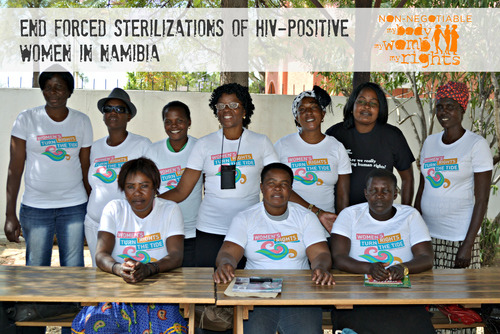
As the judge said: “There could not have been counselling in those circumstances.” When Judge Hoff looked up from his papers, he saw a courtroom, packed with women in black t-shirts that read, “Non negotiable: my body, my womb, my rights”.

This is a story, on one side, about how women at their most vulnerable are treated. Violently. It’s equally a story about how women organize and turn men’s swords into women’s ploughshares.

The three women are members of the Namibian Women’s Health Network. During a routine inspection of post-treatment papers, Network members started noticing BTL on members’ treatment cards. When the women were asked about it, no one knew what BTL was, and absolutely no one knew that this had happened to them. The women then hooked up with the Southern Africa Litigation Centre, and in particular with Priti Patel, deputy director and HIV program manager, who managed the case.

Though mixed, the decision is a step forward, and it’s a step that women Namibian women took, as they are doing in South Africa, in Kenya, in Swaziland, in Zambia. In South Africa, for example, Promise Mthembu went through a similar torture. At 22, she discovered she was HIV positive. She went to hospital and was told she had to sign a paper and undergo sterilization if she wanted treatment. And so she signed. Now, 16 years later, she says she is `haunted’ by having signed that form.

In response, Promise Mthembu has organized, among other groups, Her Rights Initiative, HRI: “Her Rights Initiative (HRI) was formed in 2009 by a group of feminist South African women. The Initiative is building from the knowledge and experience of its founding members who all identified the gap between HIV/AIDS policies and HIV positive women’s experiences and the potential HIV positive women represent in improving existing policies or recommending new ones to ensure women living with HIV/AIDS are able to access their sexual and reproductive rights in South Africa with a potential for improvement for all women.”

Last year, HRI researchers, feminist researchers, produced `I Feel Like Half a Woman All the Time. The researchers interviewed HIV positive women in Gauteng and KwaZulu-Natal. They found cases, and not just a few, of explicitly coerced sterilization and other cases of sterilization performed without informed consent. More to the point, they listened closely and intently to what the women were saying. It’s what feminist researchers and activists do.

Feminist South African women, feminist Namibian women, feminist African women are moving the State and the continent.  It’s non negotiable.

(Photo Credit: socialgoodmatters.tumblr.com)