Indigenous women’s weaving circles crush marble mining companies

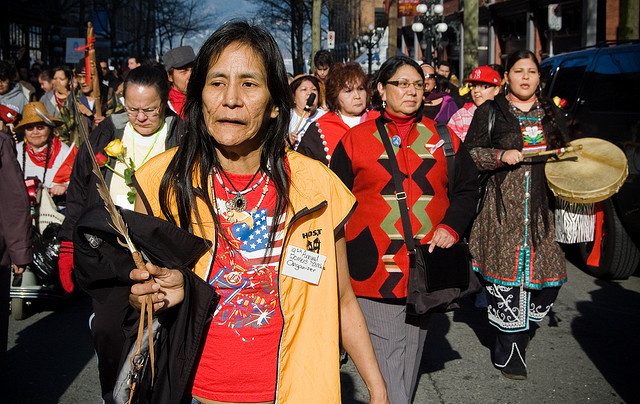
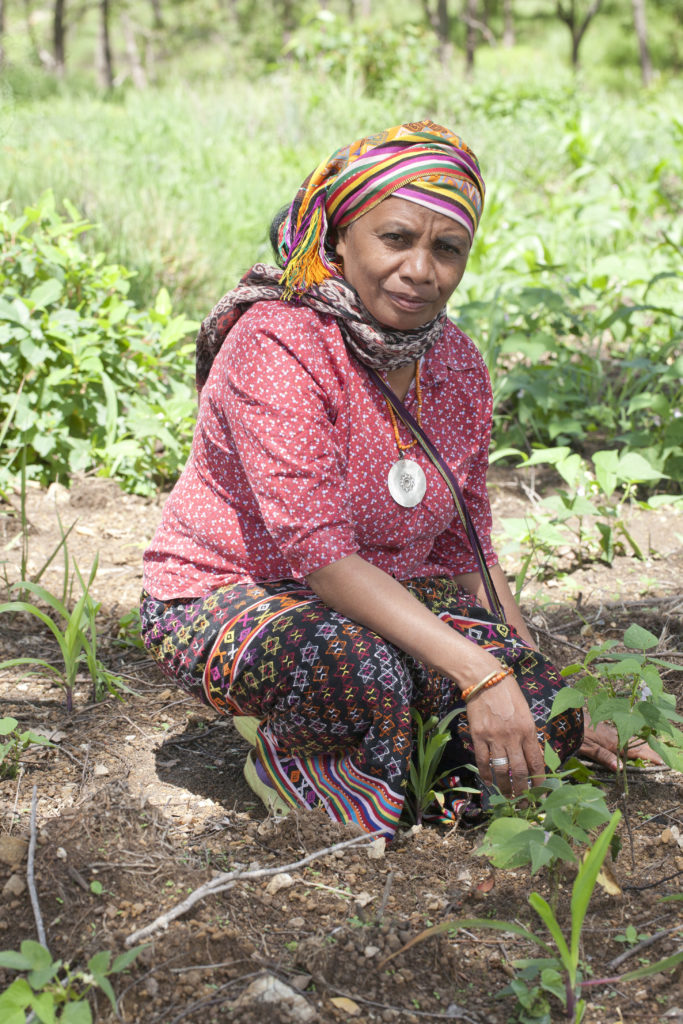
Mama Aleta Baun is a Molo indigenous woman living in the Indonesian part of the island of Timor. Aleta Baun lives in the shadow, and light, of Mutis Mountain, which is the source of all of the rivers on the island. For Timor, Mutis Mountain is the source of life.

In the 1980s, the local government illegally issued permits to marble mining companies to mine on Mutis Mountain. In 1996, the companies started clearing trees and rocks on the mountain. Aleta Baun saw this and went into action.

First, she formed an alliance with three other women. They went door-to-door, village-to-village. The distances between houses and, even more, villages were great. Baun and the three other women persevered. Their message was simple, direct and profound: “We regard the earth as our human body: stone is our bone; water is our blood; land is our flesh; and forest is our hair. If one of them is taken, we are paralyzed.”

For the Molo people, that paralysis would be a form of death. Baun had an additional message for the women: “We also emphasized to women that the forest provides the dyes for our weaving, which is a very important part of our lives. That inspired us to showcase our weaving in the form of a peaceful protest starting in 2006.”

Baun organized a weaving occupation of the mining camps. Over 100 women showed up, formed a circle in the mining quarry, sat down and silently wove traditional textiles. They sat and wove, silently, for over a year: “When we began our protest, women realized that they could do more — take a stand and be heard. Women are also the recognized landowners in the Molo culture, and this reawakened in those women who hadn’t been actively speaking out a desire to protect their land.”

The assault on the forest targeted women. Women are the ones who go into the forest and emerge with food, medicine, dye, sustenance. The marble mining companies had touched the women and struck a rock.

For four years, the women organized weaving occupations, and for four years the Molo men took on all the domestic work in their communities. This was a women-led full community campaign. In 2010, the marble mining companies packed up their tools and left.

From Aleta Baun’s perspective, the heart of the struggle was popular re-education: “The protest is part of the re-education of the people.” Now, Mama Aleta Baun is busy organizing Molo women and men to map the forestlands for themselves, and then to lay proper legal claim to all that is their land, their dignity.

Have you heard about Mama Aleta Baun and the weaving occupation? It’s a story worth repeating.

(Photo credit: Goldman Environmental Prize)
We all fail Nadine Wright

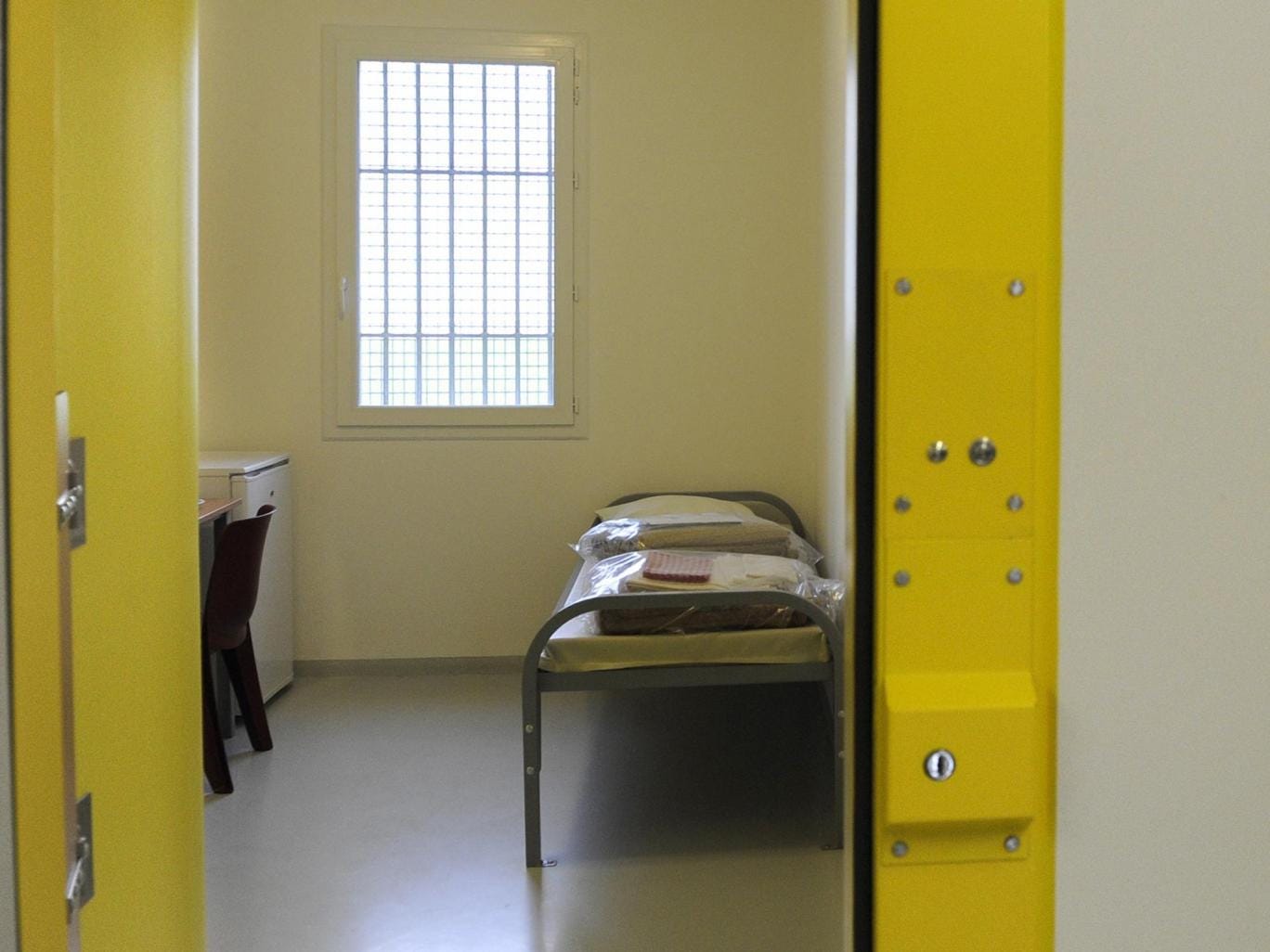
HMP Peterborough is touted as a model private prison. It’s about five years old, run by Sodexo Justice Services. It houses, or contains, both men and women. The women are mostly remand prisoners, awaiting trial. Everyone is supposed to be short-term, low level, and generally available to `rehabilitation.’ As far as accounting goes, Peterborough brought to the United Kingdom, and in large degree to the world, “payment by results.” This means, the prison corporation is paid based on prisoner re-entry results. Some think Petersborough might be the way forward, the path out of the neoliberal prison forest. It’s not.

Keep the advertised fabulousness of Peterborough in mind as you ponder the story of Nadine Wright.

Nadine Wright is a woman living with disabilities and crises. Mental health illnesses. Heroin addiction. Her mother died in September, and there was no one to assist Nadine Wright. Meanwhile, the State repeatedly fails to make her benefits available to her. Wright did not receive her benefits in November. And so she was barely living, desperately poor, somewhere below hand-to-mouth.

So, what’s a desperately poor woman to do? Nadine Wright stole some food. She was caught and arrested. She was sent to Peterborough. Nadine Wright was pregnant when she was arrested. While in her cell, she went into labor and suffered a miscarriage. A nurse was in attendance.

According to Nadine Wright’s attorney, the nurse then left the cell. She left the fetus in the cell. No one came to clean up the cell, and so Nadine Wright was left to clean up her own blood … by herself: “There was blood everywhere and she was made to clean it up. The baby was not removed from the cell. It was quite appalling. It was very traumatic. She only received health care three days later, after the governor intervened.”

Everyone failed Nadine Wright. Her probation officers and the entire probation system. The health providers. The prison staff. Sodexo. The State. Culture. A world in which prison is the answer to mental illness, to disability, to poverty, to trauma, to personal chaos and crisis, to women acting out, to pretty much everything. We all collude in that world. We all failed Nadine Wright, and we all continue to do so.


(Photo Credit: AFP / Getty / Independent)

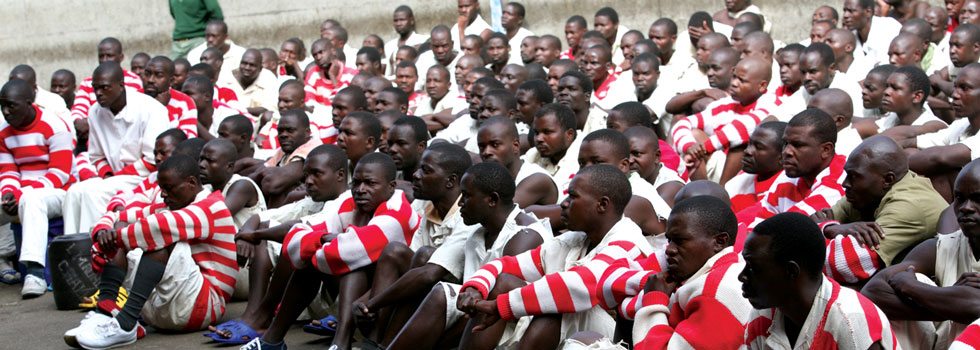
In Zimbabwe, prison = death


The Republic of Chikurubi is getting worse. Last week, Zimbabwe’s “justice ministry” and prison officials revealed that at least 100 prisoners died from hunger and starvation this year. At least 100. Given Zimbabwe’s prisons, they could as easily have been remand prisoners as convicted prisoners, but really, what difference does it make? They’re dead, and they died a long, slow, painful, harrowing death. If that’s not torture, what is?

There is shock but no surprise here. Four years ago, a report on death and disease in Zimbabwe’s prisons began: “A bare struggle for survival, with food at its core, has come to define prison life in Zimbabwe. Describing the conditions in two of the capital city Harare’s main prisons in late 2008, a prison officer explained: “we’ve gone the whole year in which—for prisoners and prison officers—the food is hand to mouth…They’ll be lucky to get one meal. Sometimes they’ll sleep without. We have moving skeletons, moving graves. They’re dying.” Prison staff have had to convert cells and storage rooms to “hospital wards” for the dying and to makeshift mortuaries, where bodies “rotted on the floor with maggots moving all around”. They have had to create mass graves within prison grounds to accommodate the dead. In many prisons, the dead took over whole cells, and competed for space with the living. Prisoners described how the sick and the healthy slept side by side, packed together like sardines, with those who died in the night. A former prisoner, a young man, struggled to convey the horror of these conditions: “That place, I haven’t got the words…. I can describe it as hell on earth—though they say it’s more than hell.” Another simply said, “The story of the prisons is starvation”.”

As prisoners lose the bare struggle for survival, humanity loses the bare struggle for dignity. Doctors, lawyers, ex-prisoners, prisoners’ family and friends, prison staff, and others have written repeatedly that Zimbabwe’s prisons are death traps. Some talk about “necropolitics”, the power politics of death. They say necropolitics is “the power and the capacity to dictate who may live and who must die.” In Zimbabwe’s prisons, it’s not about living and dying. It’s about ways of dying. There’s torture, and there’s starvation. Life or death is not the currency. The currency is pain and suffering.

Meanwhile, the Zimbabwe National Water Authority, which is a government agency, has shut off water to Marondera Prison: “About 500 inmates at the Marondera Prison are at risk of contracting waterborne diseases after the Zimbabwe National Water Authority (ZINWA) disconnected water supplies over a $375,000 Bill… The complex has not had water since December 4th raising prospects of an outbreak of diseases such as cholera.” The officer in charge of the prison describes it as “a time bomb.”

Torture. Death by starvation. Cholera. In the prisons of Zimbabwe, the time bomb has long exploded. It’s beyond time for a real change.


(Photo Credit: News Day Zimbabwe)

The prison State attacks women living with disabilities

Ellen Richardson

How does the United States respond to women who living with depression or women living with cancer? Exclusion. Solitary confinement. Women pay a high price for `security’. For women who have ever asked for help, the cost exacted from their bodies is astronomical and lethal. When so-called security trumps absolutely everything, absolutely anything can be done in the name of `protection.’ Ask Carol Lester. Ask Ellen Richardson.

Carol Lester is 73 years old, a grandmother, and a guest of the State, at the New Mexico Women’s Correctional Facility. Lester suffers from thyroid cancer, bipolar depression, and now, thanks to the State, possibly PTSD. Here’s part of her story.

Carol Lester complained about stomach pains. Prison staff gave her Zantac. Shortly after, she tested positive for methamphetamine. Lester has no history of drug abuse of any kind, and Zantac is well known to result in false positives. No matter. Right after the `positive’ result, Carol Lester was sent to solitary, where she protested on many counts. To no avail. Carol Lester spent 34 days in the hole. The drug use charges have been rescinded. Carol Lester continues to suffer … and to protest. She is suing Corrections Corporation of America, CCA, who run the prison, and Corizon Inc, who run the prison `healthcare’ system, such as it is.

Ellen Richardson was on her way, from her home in Toronto, to New York. There she was to board a cruise ship headed for the Caribbean. Homeland Security had other ideas. Richardson was turned back at the border. Why? “Ellen Richardson says she was told by U.S. customs officials at Pearson International Airport on Monday that because she had been hospitalized for clinical depression in June 2012, she could not enter the U.S.”

Richardson has been very public about her earlier, and lifelong, struggle with depression. She has written about it, has given talks about it. It’s no secret. Quite the opposite. Ellen Richardson is a woman who asked for help, received help, and now that she is doing both better and well … must pay the price. Richardson has joined with other mental health activists to find out how Homeland Security had access to her medical records.

Carol Lester and Ellen Richardson are not anomalies nor are they exceptions. From the perspective of the State built on security – surveillance – imprisonment, putting a grandmother with cancer in solitary confinement is anything but crazy. From that perspective, it’s good business, good policy, a win-win for democracy. Turning away a paraplegic women because she asked for help is part of the rule of law, in this case the United States Immigration and Nationality Act, Section 212, which instructs border agents to protect the United States from anyone who has a physical or mental disorder that threatens “property, safety or welfare.”

Nothing here is accidental or incidental. Carol Lester and Ellen Richardson are both women living with disabilities. In this country, they are marked, one for the slow death of solitary confinement, the other for the virtual death of exclusion. What you can’t see can’t hurt you, right? The only surprise, for the State, is that the women aren’t taking it. They are organizing and mobilizing, and that, of course, is no surprise at all. The struggle continues.


(Photo Credit: Toronto Star / Bernard Weil)

Hamba kahle, Madiba

In 1995, my wife, son and I spent a little over six months in South Africa, in Cape Town. It was a heady time. Giants roamed the earth, often right around the corner, sometimes in the same room. Madiba aka Nelson Mandela. Walter Sisulu. Albertina Sisulu. Govan Mbeki. Sister Bernard Ncube. The list goes on. The Rugby World Cup was on. The RDP, the Reconstruction and Development Programme, was in its most intense moments. Women were organizing. Workers, students, gay and lesbian people were on the move. Those living with HIV and AIDS were organizing like crazy. Everybody was organizing. And the buses, the Golden Arrow buses, the bus for us, encouraged everyone to smile.

South Africa was one big hopeful project, and so much of that hope passed through the very body of Nelson Mandela. He helped people of all communities and persuasions focus the light of hope into the fire of transformation. While the policies of Madiba’s own government and those that have followed have often worked precisely against the hopes of the marginalized, the violated, the disenfranchised, today we remember the person. So let me tell you a story.

In 1995, my wife, son and I were watching Dali Tambo’s People of the South, a talk show of the highest kitsch and a great family favorite. That evening, Madiba was to be the guest. Mandela came out, sat on the sofa, surrounded by women in antebellum United States frills and bonnets. Madiba and Tambo talked for a while, about the government, about hopes for the future, about their families. Dali Tambo is the son of Adelaide and Oliver Tambo, the President, and then National Chairperson, of the African National Congress until his death in 1993.

And then Dali Tambo introduced the next guest, Jermaine Jackson. Jackson entered. Madiba stood up, shook his hand, looked him straight in the eyes and said, in his unforgettable voice and manner, “I have always been a great fan of yours.”

And he meant it.

That is Nelson Rolihlahla Mandela, better known as Madiba. During the 27 years of imprisonment, apparently, he was organizing and teaching and leading, always by example, while dancing and singing to the Jackson 5.

Nelson Mandela brought dignity, humor, principle, humanity, great shirts and an extraordinary, almost magical, transformative capacity to every encounter: as a young lawyer and boxer, as a representative of the ANC, as a founding architect of Umkhonto we Sizwe, the armed wing of the anti-apartheid struggle, as a prisoner on Robben Island and then in Pollsmoor and Victor Verster Prisons, as a democratically elected President, and finally as an elder.

He touched each of us, and for that reason, he is loved. We remember. Hamba kahle, Madiba.

(Photo Credit: John Adams / South Coast Sun)

Stop sending Aboriginal women to prison!


Canada’s federal prisons hold more prisoners than ever before. The provincial prisons are also full to the brim. What’s going on? Crime is on the decline. The White prison population is also in decline.

Last Tuesday, Canada’s Correctional Investigator Howard Sapers issued his annual report. The picture is both grim and not surprising. There’s a `boom’ in prisoners, and it’s made up of people of color. Aboriginal people make up around 4 per cent of the population, and close to 25% of the Federal prison population.

Black prisoners are “over-represented”, especially in maximum-security prisons. Black prisoners are also “over-represented” in solitary confinement. Black prisoners disproportionately face the “use of force” from guards. Black prisoners also face discrimination in prison jobs employment and in parole release.

Meanwhile, the prison staff remains overwhelmingly White. The Fear of a Black Planet continues to this day. To no one’s surprise.

For women in the system, the rates of incarceration far exceed those of men. Since 2003, the female prison population increased by over 60%. One in three women the federal prison system is Aboriginal. Since 2003, the Aboriginal women’s federal prison population has increased by 83.7%

Why are Aboriginal women being imprisoned at such high, and higher, rates? What happens to Aboriginal women when they enter into the prison system?

In September 2012, an independent review commissioned by the Department of Public Safety entitled Marginalized: The Aboriginal Women’s Experience in Federal Corrections was released. The external report examined the reasons behind the over-representation of Aboriginal women in federal penitentiaries, revealing a depressing picture of dislocation, isolation, violence, poverty, victimization and discrimination. It examines several themes that are consistent with the Office’s own findings and recommendations in this area of corrections: over-classification of Aboriginal women inmates; high prison self-injury rates among Aboriginal women; lack of culturally appropriate programming; and limited use of CCRA [Corrections and Conditional Release Act] provisions to share care and custody of Aboriginal offenders with Aboriginal communities.”

Aboriginal women are “over-represented” in solitary and maximum security. Force is used on Aboriginal women prisoners at an extraordinarily high rate. But the highest rate is that of self harm. From 2011 to 2012 Aboriginal women accounted for almost 75% of self-injuries among women prisoners. More often than not, self-injury results in charges being filed, solitary confinement, and security reclassification. If an Aboriginal woman hurts herself, it’s a crime. Instead of help, counseling, anything supportive, she’s sent into the hole.

Correctional Investigator Howard Sapers concluded, “You cannot reasonably claim to have a just society with incarceration rates like these.” Public Safety Minister Steven Blaney replied, “The only minority I would say we are interested in are the criminals.”


(Photo Credit: flickr / Vice)

The global AIDS war on young women … and especially girls

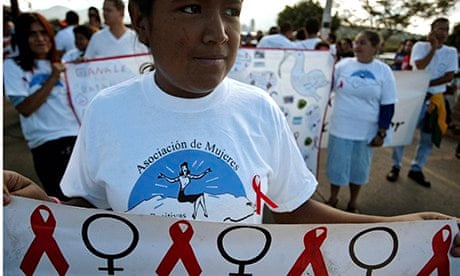
A global war is being waged against girls and young women. From 2005 to 2012, public policy and popular determination resulted in a global dip of 30% in AIDS-related deaths. In that same period, 10- to 19-year-olds suffered a 50% increase in AIDS-related deaths. The epicenter of this is sub-Saharan Africa, and the heart of that epicenter is comprised of girls and young women. How did this happen?

From global agencies (and their donors) to national governments to local practitioners, everyone refused to respect the arc of peoples’ lives. They refused to think of the number of children born HIV+.  Many of those children never received antiretroviral treatment, or ART. Of those who did, few received adequate, or any kind, of follow-up or support. Everyone refused to plan child- and adolescent-friendly services. Children were left to fend for themselves, often without the knowledge or information of their status.

And so the children have died in increasing numbers… especially girls: “Adolescents and young people remain extremely vulnerable to acquiring HIV infection, especially girls who live in settings with a generalized HIV epidemic or who are members of populations at high risk for HIV acquisition or transmission.”

Especially girls. Consider some numbers:

92% of the world’s pregnant women with HIV live in sub-Saharan Africa. 59% of those women received ART or prophylaxis during pregnancy and delivery.

A recent survey indicates that only 15% of young women in sub-Saharan Africa know their status. Put more directly, 85% have no idea.

Young women are three times more likely than young men to become infected.

The situation is actually worse, because there are well-known successful youth-centered programs and projects. They’re out there, and there not difficult to find, from South Africa to Botswana to Mozambique to Jamaica and beyond, successful programs begin with respect for the individual and collective autonomies of children, adolescents, and youth, and they work to better understand the particular operations of genders in their communities.

One study released this week indicates, “Child support grant keeps sugar daddies away.” Or, as the researchers put it, “Our findings provide evidence that government-administered cash transfers are associated with reduced incidence in the past year and lower prevalence of risky sexual behaviours in adolescent girls, but no consistent associations for boys… Child-focused cash transfers target specific—rather than all—risky sexual behaviours, and that a possible mechanism of change might be interruption of risks driven by economic necessity. This finding is especially important because transactional and age-disparate relationships are linked and major vectors of HIV infection, via power inequalities and higher infection rates in older male partners and male partners who provide financial support.”

Do you need a study to tell you that most young girls engaging in sex with older, and wealthier, men are acting “transactionally”? Common sense or conversations with those young girls would suggest as much.

National governments and their international partners have steadfastly refused to have those conversations. They refused to look at girls and young women with anything like a gender lens, with anything like respect. And so the death tolls mount, and the piles of corpses are overwhelmingly women and girls. Girls and young women are not “falling through gaps in HIV services”. They were not forgotten or overlooked. They have been positioned, targeted, by agencies and nation-States that give lip service to women’s rights while colluding in the mass deaths of young women … and especially girls.


(Photo Credit: The Guardian / Elmer Martinez / AFP / Getty Images)

A specter haunts the festive shopping season


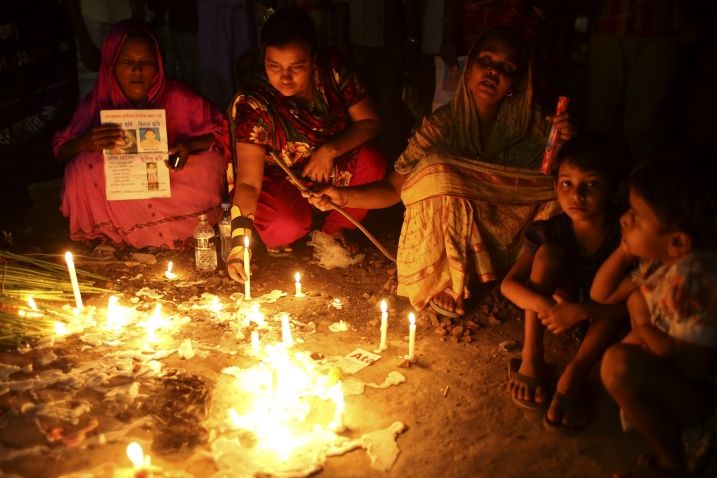
Tomorrow, November 24, will mark seven months since the Rana Plaza collapsed, killing over a thousand garment workers, overwhelmingly women. Tomorrow, November 24, will also mark the one-year anniversary of the Tazreen Fashion factory fire in which over a hundred garment workers were killed. Almost all of those killed were women. These were not accidents but rather pieces of a plan in which the lives of women, of women workers, of Asian women workers count for less than nothing.

Today, a report notes that U.S. retailers have `declined’ to aid “factory victims in Bangladesh.” The phrase “factory victims” is both telling and apt. The women who died, often slowly and always terribly, were indeed victims of factory production. A year later, as inspectors and engineers begin for the first time ever to examine factory structures in Bangladesh, Wal-Mart, Sears, Children’s Place have “declined” to assist at all in any compensation or aid program for “factory victims”. In fact, as of yet, every U.S. retailer has “declined.” Corporations from elsewhere, such as the Anglo-Irish company Primark and the Dutch-German company C&A have been “deeply involved in getting long-term compensation funds off the ground.”

Across the globe, factory workers struggle with corporate exploitation. Factory workers in sectors, such as garment and textile, that are “reserved” for women workers struggle with super-exploitation. That is part of the tragic and the everyday of the garment industry. But this tale of “factory victims” is more particular. This is about U.S.-based corporate global development plans, in which women workers of color are not only worth less than the machines they work at. For Walmart, Sears, Children’s Place and their confreres, those women are worth less than the chairs on which they sit every day, producing goods and profits.

80% of Rana Plaza survivors are women. Now they find themselves in a situation more desperate than ever.”  That too is part of the plan. That were no accidents; there were massacres. Remember that on Monday, as we enter, again, the 16 Days of Activism Against Gender Violence. Remember the specter of “factory victims’ that haunts the end-of-year shopping seasons.

(Photo Credit 1:  IndustriALL) (Photo Credit 2: IndustriALL)

Life without parole: The staggering work of heartbreaking

Two recent reports, taken together, describe a United States in which the violence of mass and hyper incarceration has become an intrinsic part of the contemporary American project. As at least one writer noted years ago in a different context, the rule of law is the force of law. And that force is coming down on Black populations with particular intensity.

The American Civil Liberties Union’s report, A Living Death: Life Without Parole for Nonviolent Offenses, has attracted attention and sparked conversation, although thus far not beyond the circle of usual participants. The ACLU findings, while horrible, are not all that surprising. The so-called War on Drugs has fueled the life without parole, or LWOP, economy. Pretty much any hint of `drug involvement’ can land a person in jail for life without parole. Most of the LWOP prisoners are first-time drug offenders.

Here’s the heart of living-death: “There is a staggering racial disparity in life-without-parole sentencing for nonviolent offenses. Blacks are disproportionately represented in the nationwide prison and jail population, but the disparities are even worse among the nationwide LWOP population and worse still among the nonviolent LWOP population. Based on data provided by the United States Sentencing Commission and state Departments of Corrections, the ACLU estimates that nationwide, 65.4 percent of prisoners serving LWOP for nonviolent offenses are Black, 17.8 percent are white, and 15.7 percent are Latino. In the 646 cases examined for this report, the ACLU found that 72.9 percent of these documented prisoners serving LWOP for nonviolent offenses are Black, 19.8 percent are white, and 6.9 percent are Latino.”

Staggering? Yes. Surprising? Not at all.

According to the ACLU, 3, 279 people are serving life without parole for nonviolent crimes. Of that group, 2,074 are in federal prisons and jails. Of the 2074, 1757 are Black. That’s 60%. 91.4% of Louisiana’s LWOP prisoners are Black, and so Louisiana wins the Race Race to the Bottom.

The individual stories are heartbreaking… and not surprising. Life without parole is a death sentence. It emerges not only from the War on Drugs, but also from a national belief that rehabilitation does not work, that `criminals’ are not human and so must be caged.

As the Sentencing Project report, Life Goes On: The Historic Rise in Life Sentences in America, suggests, the initial impetus for the LWOP was the elimination of the death penalty. So, state-by-state, over twenty years, the `nation’ replaced the instant of death with a lifetime of dying.

The Sentencing Project findings, while useful, are also not surprising. Serious crime is down, and the number of LWOP prisoners, in the same period, has more than quadrupled. Last year, over 159,000 people were serving life sentences. Close to 50,000 were LWOP.

One in nine prisoners is in for life, and, as the Sentencing Projected documented earlier in the year, this includes an increasing number of juveniles, of children. Around 10,000 people have been sentenced to life in prison for nonviolent offenses. Almost half the `lifers’ are Black. Nearly 10,000 people have been sentenced to life behind bars for crimes that occurred before they turned 18. Around 2,500 of that 10,000 were sentenced to life without parole. Children waiting to die.

More than 5,300, or 3.4%, of prisoners sentenced to life are women.

According to the Sentencing Project, the United States boasts 5,361 women serving life sentences. That’s up 13.2% since 2008. Who are these women?

Women serving life sentences often have particularly tragic histories. Among the females serving LWOP for offenses committed in their teenage years, the vast majority experienced sexual abuse in their childhood. Among women convicted of intimate partner violence-related homicides, the majority have been battered. This is even more evident among women serving life sentences. Statistics from nationally representative inmate survey data show that 83.8% of life-sentenced women were sexually or physically abused and that abuse is significantly more common among female lifers than male lifers or female prisoners not serving life sentences.”

Who are the women serving life sentences, and even more those serving life without parole? They are the abandoned. Growing up in a period in which public and social services, caring services, were slashed, growing up in a time and place in which needing help was criminalized, as girls they were left to fend for themselves. Today, they are the fantastic products of a national social factory, one that stretches from `Welfare Queens’ to `Drug Mules’.

There is no surprise in this, and there is no `genius.’ There is only the staggering work of heartbreaking.


(Photo Credit: ACSlaw.org / lawanddisorder.org)

Shackling the birthing, dead and dying: All in a day’s work

Juana Villegas

Juana Villegas

Which is worse, the use of chains and shackles to confine the most vulnerable in times of crisis or the fact that the usage has become routine? Ask pregnant women prisoners across the United States. Ask terminally ill, hospitalized, disabled and even dead prisoners in the United Kingdom.

Last month the Nevada Prison Board voted to stop shackling and otherwise `restraining’ women prisoners in labor, in delivery, and in post-delivery recuperation. This decision resulted from a lawsuit brought by Valorie Nabors, with the ACLU. Nabors had been an inmate at the Florence McClure Women’s Correctional Center. She went into labor and was placed in leg shackles in the ambulance. Ten minutes after giving birth to a daughter, Nabors was again placed in shackles. Valorie Nabors and her attorneys argued, apparently convincingly, that she suffered injury when doing doctor prescribed rehabilitative exercises while shackled.

Juana Villegas has lived a related story. In 2008, nine months pregnant, Mexican, undocumented, Villegas was picked up in a traffic stop in suburban Nashville. Under `an arrangement’ between Davidson County and Federal authorities, Villegas was detained for six days. Villegas went into labor, was taken to the hospital, where she was chained to a bed, during labor and during recovery. She has since sued for damages and recently won, not only financial compensation but also, possibly, a resident visa.

Meanwhile, in the United Kingdom, prisoners literally at death’s door, prisoners living with paralyzing and debilitating disabilities, are shackled, not only when taken to hospital but also during their stay. Michael Tyrrell, dying from cancer and too weak to move; Kyal Gaffney, diagnosed with leukemia, unconscious due to a brain hemorrhage; Daniel Roque Hall, 30, in intensive care, wasting away, and barely able to use arms or legs: these are typical of the `security risks’ that required not only chains and shackles but three prison guards … each.

And then there’s `Lucy’. In 2007, Lucy was transported to hospital for a recurring and serious gynecological problem. Although Lucy had no history of violence and had actually just returned from a daylong release on license, she was handcuffed to a male and a female officer en route to the hospital and while at the hospital. During the interview with the doctor, Lucy was handcuffed to both officers. When the doctor said he would be doing an internal examination, the male prison guard said he would have to remain in the examination room. At last, the doctor convinced the male officer to handcuff Lucy to the examining table and wait outside. Throughout the entire internal examination, the female officer remained handcuffed to Lucy.

That the global prison has produced a boom niche market in chains and shackles is horrible enough. Worse is that the shackling has become routine. Prison guards routinely shackle women in childbirth and women and men on deathbeds, and then go home to their families and communities. Medical professionals routinely tend to shackled women in childbirth and shackled women and men on their deathbeds, and then go home to their families and communities. It’s all in a day’s work.


(Photo Credit: The New York Times / Mark Humphrey / Associated Press)