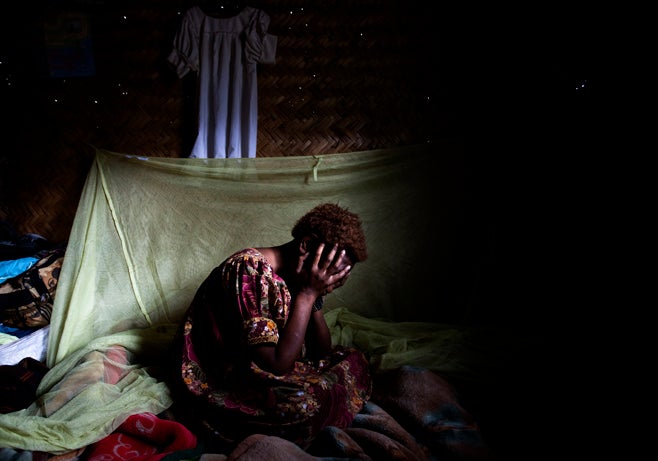
In Zimbabwe, conditions are not favourable to women prisoners

In Harare today, Zimbabwe Lawyers for Human Rights and the Law Society of Zimbabwe launched a joint research report, Pre-Trial Detention in Zimbabwe: Analysis of the Criminal Justice System and Conditions of Pre-Trial Detention. The conditions are infernal, evil, and lethal, but you knew that already. Over 100 human beings starved to death in Zimbabwe’s prisons last year. Prisoners like Rebecca Mafukeni died, or were killed, through malign neglect. Other prisoners confirm Yvonne Musarurwa’s description of Zimbabwe’s prisons as nightmare. Not nightmarish. Nightmare itself. In Zimbabwe, prison = death.

Thanks to direct and indirect political control of the police and the corrections system, the prisons are severely overcrowded. That’s why Robert Mugabe gave `amnesty’ to some 2000 prisoners a couple weeks ago. The presidential amnesty released all women prisoners, except those serving life sentences, and all juveniles. Terminally ill prisoners and elderly prisoners were also released. 505 women were promised release; three were left inside.

According to Female Prisoner Support Trust (FEMPRIST) director Rita Nyamupinga, “These women were caught up in criminal activities out of ignorance.” For example, somebody hid a gun allegedly used in a crime at one woman’s house, apparently unbeknownst to her. When found, she was sent to prison … for life. As so often occurs, around the world, the three women were abandoned, especially by male partners, once they went behind bars.

Today’s report adds remand prisoners to the picture. Thirty percent, one of three, residents of Zimbabwe’s prisons and jails are awaiting trial. They’re not guilty, and they’re not convicted. They’re just too poor or too despised by the regime to be allowed freedom. Despite a “strong legislative framework”, “excessive detention” goes hand in glove with administrative incompetence and political malfeasance

Whatever the causes, the lived reality is severely overcrowded, deadly prisons, housing close to 17,000 people, where some have waited for two months for their trials while others have waited eleven years. Eleven years a remand prisoner.

And for women: “Mlondolozi, Shurugwi and Chikurubi are the only fully fledged female prisons in Zimbabwe. All the other prisons have a section that has been set aside for women and the conditions are not favourable to female inmates. In particular, pregnant inmates are treated like any other female prisoner, without due recognition of their needs. After giving birth at public health facilities, they are returned to jail with their newly born babies – sometimes as young as a day or two old. Unfortunately, prison facilities are not designed to support the post-natal care of either the mothers or the babies. The plight of older children incarcerated alongside their mothers is also serious since there are no proper facilities to cater for their early childhood development needs because the ZPS does not have a budget line for such support.”

One former prisoner remembers, “It is inhuman and completely degrading for 17 women to be packed into a cell that does not even have a toilet. Particularly because by 4pm you are already locked up in the cell and it will only be opened in the morning between 6 and 7am. I think it is particularly inhuman to force those women to relieve themselves in little containers that they have each cut around.”

Zimbabwe’s prisons are designed to be destructive to fatal for pregnant women, indigent women, women with children, women living with HIV, women living with any chronic illness, women living with any disability, all women. Don’t release 500 only to replace them with 1000. Open the gates, tear down the walls, start anew.


(Photo Credit: Wits Justice Project)

Reza Barati’s blood

Reza Barati died last week or was it yesterday. Reza Barati, 24-year-old Iranian asylum seeker, was killed in an `encounter’ on Manus Island, the dumping grounds for those who seek asylum in Australia. Prisoners protested the lies they were being fed, the conditions they were forced to endure, the ongoing abuse. Guards rushed in, rushed out, rushed in again, and then the protest turned into `a riot’. According to eyewitness reports and an initial police report, when the guards, employees of G4S, rushed in, violence erupted.

Manus Island, in Papua New Guinea, is Australia’s new final solution to the asylum and refugee problem. That there is no problem is irrelevant. Australia is not being overrun by asylum seekers.  As with other nation-States choosing punishment as a default response to asylum and refuge seekers, Australia is the problem. Not the seekers.

Liz Thompson worked as an asylum claims processor on Manus Island. She knows the situation, and she says: “It’s not designed as a processing facility, it’s designed as an experiment in the active creation of horror, to deter people from trying in the first place. These guys are smart, they know what’s going on, they know they’re being lied to, and having that stuff come to them from Immigration, from us, is just part of the active creation of horror. That’s what Manus Island is: it’s the active creation of horror in order to secure deterrence. And that’s why Reza Berati’s death is not some kind of crisis for the [immigration] department – it’s actually an opportunity, an opportunity to extend that [deterrence] logic one step further, to say, ‘this happens’.”

Across Australia, people have protested and held vigils. Artists have withdrawn from the Sydney Biennale because its principle corporate sponsor profits from “offshore detention.” Call it torture. On Christmas Island, asylum seekers have gone on hunger strike. When asked why, they answered, “Reza Barati’s blood.”

Meanwhile, outside of Australia, the news media, particularly the English language news media, has been silent. Search for Reza Barati, and you’ll see … or you won’t.

Instead of silence, let us hear: “In this desert of silence that now passes for our public life, a silence only broken by personal vilification of anyone who posits an idea opposed to power, it is no longer wise for a public figure to express concern about a society that sees some human beings as no longer human; a society that has turned its back on those who came to us for asylum – that is, for freedom, and for safety. And so, with our tongues torn we are expected to agree with the silence, with the lies, and with the murder of Reza Barati… There are no more fairy stories. The cane toads grow fatter. And Reza Barati’s corpse lies in a Port Moresby morgue with a large hole in the back of its head as inexplicable, as shameful as what our country has done.”

Cry the beloved country, cry the beloved world in which it exists. Reza Barati deserved better. We all do.


(Image Credit: Refugee Action Collective)

How many women? Ask the women of Papua New Guinea

How many women are raped in order to produce the world’s gold? How many women are chased off their land, kicked out of their own social structures, and otherwise beaten down in the pursuit of mineral resources? Ask the women of Papua New Guinea.

The Porgera open-pit gold mine in Papua New Guinea is a good old-fashioned money, and blood, pit: “The mine has a terrible reputation for both human rights abuses (rapes, beatings and killings by security personnel) and environmental damage (vast quantities of potentially toxic tailings dumped into a nearby river). But gold prices, while down from their recent peak, are still three times what they were a decade ago, so dig they must.”

The Porgera mine, owned by the Canadian company Barrick, is rich. In the last two decades, the mine has produced over 20 billion dollars worth of gold. Barrick is rich. Papua New Guinea is poor. Almost a third of the population lives in dire poverty. Around the Porgera mine, it’s worse. As happens so often around `wealthy’ mining sites, the area has experienced severe “social disintegration.” The local communities derive little benefit from the mines, and what benefit they get is slotted to the men. Gender inequality increases. Women become both absolutely and proportionately poorer and more vulnerable. Bride price and polygyny increase dramatically. Women’s status declines. Women’s customary abilities to negotiate dwindle. Abandonment of women and children rises. Domestic violence both increases and intensifies.

Three years ago, a major report investigated and confirmed repeated incidents of gang rape of local women by Porgera’s private security firm. All of the women were brutally beaten. None of the women reported the rapes. What would have been the point? Another report, this one from last year, noted: “A number of the women whose assaults had become public knowledge were stigmatised, beaten by family members or divorced by their husbands.”

The women started organizing and issued demands. What happened? At first, nothing. Then … Barrick created a “remedy program for victims”. This included “the requirement that to receive compensation, women must waive their right to sue Barrick.”

In order to get help, in order to get compensation, the women have to sign away their rights. First, Barrick denied and stonewalled for five years. Then they bullied and bullied some more, all in the name of `remedy.’ The United Nations `recommended’, and the world `condemned.’ No matter. The Barrick non-judicial grievance mechanism remains in place, opaque as ever. Here’s how one witness describes it: “Many women were not aware of the remedy program, others were suspicious of it, and we found general lack of clarity about the process. Women said that the program was being run in a language that they could not understand and that they had not been offered translation. Women said that the things they were being offered through the program were either not what they needed to address the harm they had suffered, or not compatible with culturally appropriate remedies for the type of harm they had suffered, or simply not commensurate with the harm they had suffered. The primary things these women were being offered were baby chickens to raise and second hand clothes to sell. The program seemed to be confusing small scale development programs with remedy.”

There is no confusion. The founder and chairman of Barrick explained that the sexual violence at Porgera occurred because, in Papua New Guinea, “gang rape is a cultural habit.” It never happened, we weren’t there, and anyway it’s your fault, even though it never happened. Barrick was there, Barrick is there … and in Tanzania … and … How many women? How many more women?


(Photo Credit: Brent Stirton/Getty Images for Human Rights Watch)

Where is the boundary between solidarity and paternalism?

Where is the boundary between solidarity and paternalism?

Last week, a prominent New York Times’ columnist wrote that South Africa [a] is an adolescent going through that awkward phase; [b] lacks the maturity to develop a mature, sustained opposition, as witness the failure of Ramphele and Zille to consummate the deal and the various locations of Cyril Ramaphosa; and, most African of all, [c] is mired in something called tribalism. He did all of this in the name of caring for the `fledgling’ nation.

There’s so much wrong with the piece it’s hard to know where to begin. The author locates `opposition’ in a curiously isolated purely electoral laboratory, the location of which only he knows. Even the Democratic Alliance is unfairly treated, which is a hard trick to pull off. Somehow, the roles of Helen Zille, Lindiwe Mazibuko, Patricia de Lille, and others, especially other women, don’t qualify, unless they have someone who can pull them out of the morass of `tribalism.’ What? Somehow, Marikana never happened, and NUMSA isn’t happening. Somehow, women aren’t organizing critical interventions into State practice as well as party formations.

The week after the Times piece, the Traditional Courts Bill was killed … largely by the work of women organizing across the country. The Mail & Guardian had a long piece on prominent activists, such as Zanele Muholi, who are organizing all over the place, and not as individuals but as members and promoters of movements and organizations. Somedays, it seems there’s nothing but opposition in South Africa. Others have written, and others, especially those better placed than I, will write about those issues and more.

I want to to reflect on the scenario in which a White Man who “watches and roots for this struggling young democracy” declares that a Sub-Saharan Africa, read Black, nation and population is going through its `adolescence.”

In a period in which much of the United States fixes its gaze on the United States’ lethal agenda for Black youth, and in particular for young Black men, who’s calling whom not yet ready for prime time? As much of the United States, agonizes and struggles with the death of Jordan Davis, and behind him that of Trayvon Martin, and behind him that of … so many others, as Black parents look at their adolescent sons and daughters with love and anguish, how does anyone in the United States blithely render a majority Black population as adolescent?

But that’s precisely what happens … all the time. Those who `watch and root’ turn to dismay and despair at the drop of hat, or the refusal to drop a hat into a ring, as they use the oldest narratives of Black delayed political, read mental, development. Where is the boundary between solidarity and paternalism? Ask the `adolescent’ Black individuals and populations of the world.


(Photo Credit: Mambaonline.com)

The Traditional Courts Bill is dead. Long live Sizani Ngubane!

Sizani Ngubane

The Alliance for Rural Democracy, South Africa, announced today that the Traditional Courts Bill is dead: “The Traditional Courts Bill (TCB) is dead. This follows years of opposition from civil society and is a massive victory for the thousands of people in rural parts of the country who spoke out against the bill during provincial public hearings … Women have been at the forefront of opposition to the TCB, arguing that it would legalise and entrench current discrimination.”

The Alliance statement quotes Nomboniso Gasa, of the Alliance for Rural Democracy and the Centre for Law and Society, University of Cape Town, and Sizani Ngubane: “Sizani Ngubane of the Rural Women’s Movement in KZN states: `The TCB was never about custom. It was about bolstering the power of chiefs. Government can no longer deny the abuses that many chiefs are getting away with, because we explained these abuses over and over again in the public hearings. What we need now is a law that protects real custom and protects women, especially, against the kinds of autocratic power that chiefs got used to under apartheid.’”

Many other women, and women’s organizations, contributed to the death of the Traditional Courts Bill. The Women’s Legal Centre has worked tirelessly in the courts. Siyasanga Mazinyo, of the Rural People’s Movement, has been organizing and representing tirelessly across the provinces. And Aninka Claasens has been researching and writing tirelessly on the implications and injustices of the bill.

For decades, Sizani Ngubane has been speaking out, organizing, researching, writing with rural women initially in KwaZulu Natal, and then across South Africa. She founded the Rural Women’s Movement in 1998, which later became the National Movement of Rural Women.

In 1999, Sizani Ngubane met with women across the rural expanse of KwaZulu Natal. She was conducting research about the situation of women and the prospects for organizing a women’s movement. Here’s her conclusion: “Although no longer constitutionally defined as minors in the law of the country …women continue to be treated as subordinates to men; this subordination is defended by many (including some women) in the name of `African culture’ … As a result of the gendered division of labour in the communities, women carry much of the responsibility associated with food production … Women also carry the burden of responsibility for maintaining the household, energy and water collection and childcare. As a result women have less time to develop themselves as individuals or as groups. The prime constraint women face is the absence of a strong lobby campaigning for women’s land rights in rural areas … Organizing women around the land their needs is central to meaningful land reform: that process must begin now.”

The Traditional Courts Bill is dead. Long live Sizani Ngubane and all the women who killed it!

(Photo Credit: International Alliance of Women)

Massachusetts Stops Shackling Women (Prisoners) in Childbirth!


Yesterday, we asked, “Will Massachusetts stop shackling women prisoners in childbirth?” Today, the Governor gave his answer. Yes! Governor Duval Patrick today said, “We will end finally, completely and immediately the use of restraints on pregnant inmates in labor.” Yes!

The struggle does not end with the Governor’s regulation. As Senator Karen Spilka, who sponsored the bill currently in the Massachusetts legislature, noted, “It’s not necessary, it’s inhumane, and it can be very detrimental to the woman and the baby. We need to codify this to strongly send a message that we are a state that treats our women humanely and wants to foster their health and wellness.”

Or, as Governor Patrick succinctly said, “Regulation is good, but here law is better.”

The bill puts the shackling of women prisoners in childbirth in the context of pregnant women’s rights to well being, to decent and affirmative health care. Shackling pregnant women is inhumane and misogynistic. It hates women as women.

Senator Karen Spilka and Representative Kay Khan, along with the women and men of ACLU, NARAL, The Prison Birth Project, and others will keep the struggle going for passage of the legislation. But for today … YES! Yes, women prisoners are women. Yes, it is wrong to shackle pregnant women. Yes, it is right to support women’s right to health, well being, and being women. Yes!


(Image Credit: RadicalDoula)

Will Massachusetts Stop Shackling Women Prisoners in Childbirth?


Massachusetts and Maryland legislatures are considering abolishing the practice of shackling women prisoners in childbirth. Last Friday, the Massachusetts legislature moved, inched, a little closer to banning the practice: “In a step toward joining the 18 states that have passed legislation restricting the shackling of pregnant incarcerated women, the Massachusetts Joint Committee on Public Safety has released a bill that would prohibit such shackling in Massachusetts during labor and childbirth, post-delivery recuperation, and transportation to the hospital. The bill, sponsored by Senator Karen Spilka, has now passed the first hurdle to passage.”

This bill has languished in committee for ten years. Each year, it would come up in the House, be assigned to the Judiciary Committee, and sit. Each year that happened, for ten years. Finally, this year, Senator Karen Spilka said enough already, and moved the legislation in the Senate. Last Friday, it moved out of committee.

The bill does more than end shackling, although that would be something in itself. It “promotes safe pregnancies for female inmates.” The authors of the bill understand that shackling women prisoners is part of a program to deny that pregnant women prisoners are, indeed, women who are pregnant. Childbirth is childbirth is childbirth. Women should never be shackled during childbirth.

Yet they are.

Marianne Bullock is Co-Founder, with Lisa Andrews, of The Prison Birth Project. She has worked in Western Massachusetts with over 100 pregnant women prisoners: “Passing this bill is crucial. Ending the practice of shackling and restraint of pregnant, laboring and postpartum women in Massachusetts will allow mothers throughout the commonwealth to give birth with dignity—free of restraint.”

Senator Karen Spilka argued, “Shackling pregnant women interferes with a physician’s ability to treat mothers and their newborns, and it is an inhumane, unacceptable practice. This bill is an important and necessary step toward improving reproductive health for female prisoners and ensuring safe, healthy outcomes for women and their babies.” She added, “It still is amazing to me that in 2014 we have to work to even pass such a bill. I believe very strongly we need a single standard in these situations when women are pregnant and incarcerated, and the standard should be no shackles.”

The standard must be no shackles. If Massachusetts passes the bill, and that’s not at all a foregone conclusion, it will become the 19th state to do so. In more than half of the United States, the simple truth that women in childbirth should not be shackled is neither simple nor true. Whether the ordinary and everyday spectacle of the shackled woman in childbirth reiterates the motif of slavery or that of the witch-hunt, the point is it must end. Now. The alibi of modernity expressed in the surprise that in 2014 we still have this work to do must be set aside, and instead of surprise, we should be ashamed and disgusted with ourselves, for living in a place and time where women in childbirth are shackled. Stop shackling pregnant women now!


(Image Credit: RadicalDoula)

African women smallholder farmers haunt the G8 … and The Guardian

In 2012, the G8 launched the New Alliance for Food Security and Nutrition, which, controversially, gave agribusiness a seat at the African farming table, right next to governments and aid donors. Agribusiness had always been there, but now the arrangements of hand holding and pocket filling would be formalized. Despite promises of the `new’, transparency around the arrangements did not increase. If anything, the world of African food security and nutrition transactions became murkier.

This week The Guardian ran a series of articles on the New Alliance. Many see the Alliance as colonialism with a neoliberal face. First, the aid processes become increasingly privatized and imbedded into the workings, and failings, of markets. Second, the contractual and policy decisions are not only made behind closed doors, they’re made in settings that prohibit any direct involvement of smallholder farmers. Neither the Alliance nor The Guardian seems to care that smallholder farmers in Sub-Saharan Africa are overwhelmingly women. What’s not new here? Millions of women workers rendered invisible … again.

Ten African countries signed agreements that `open’ them to greater foreign direct investment. The countries are Benin, Burkina Faso, Ethiopia, Ghana, Ivory Coast, Malawi, Mozambique, Nigeria, Senegal, Tanzania. The national commitments involve land and water; seeds; tax; finance; infrastructure; food security or nutrition; and other. Ten countries signed 209 commitments. Of those ten countries, only Benin made any commitments to women, and those two commitments are, at best, vague: “Design and set up a gender-based information and communication system to prompt behavioural change in the agricultural and rural sector.” “Improve how gender is addressed when designing, implementing, monitoring and evaluating projects/programmes and activities in the agricultural sector.” As of yet, the progress on these is listed as “Unknown.”

The Guardian reported on Malawian smallholder farmers being kept in the dark on Malawi’s commitments; on Tanzanian smallholder farmers’ concerns that the new alliance will only turn them into cheap labor for the new, large farming corporations; and on Ghanaian smallholder farmers’ mixed reactions. The Guardian doesn’t mention or quote any women smallholder farmers.

Women comprise as much as 80% of African subsistence farmers. In Burkina Faso, gardeners and smallholder farmers are overwhelmingly women. From palm oil production in Benin to cocoa production in Ghana to general smallholder production in Tanzania, women predominate in numbers but not in access to resources or control. In Malawi, women make up almost 70% of the full time farmer population. Every major multinational agency has issued a report on the centrality of women in agriculture to any food security agenda. Repeatedly, reports demonstrate that women constitute the majority of smallholder farmers in Sub-Saharan Africa, and yet have little to no access to land tenure or to State or international assistance. Those reports also suggest that extension services automatically look to men as `change agents.’

Women farmers are a majority of the adult farming population. They are not part of the picture. They are the picture. They are not part of the story. They are the story. When you see the picture, when you read the story, if you don’t see and read about women farmers, write to the authors and tell them, “No women farmers, no justice.”


(Photo Credit: Wikipedia.org)

Cry the beloved Khayelitsha (Commission)

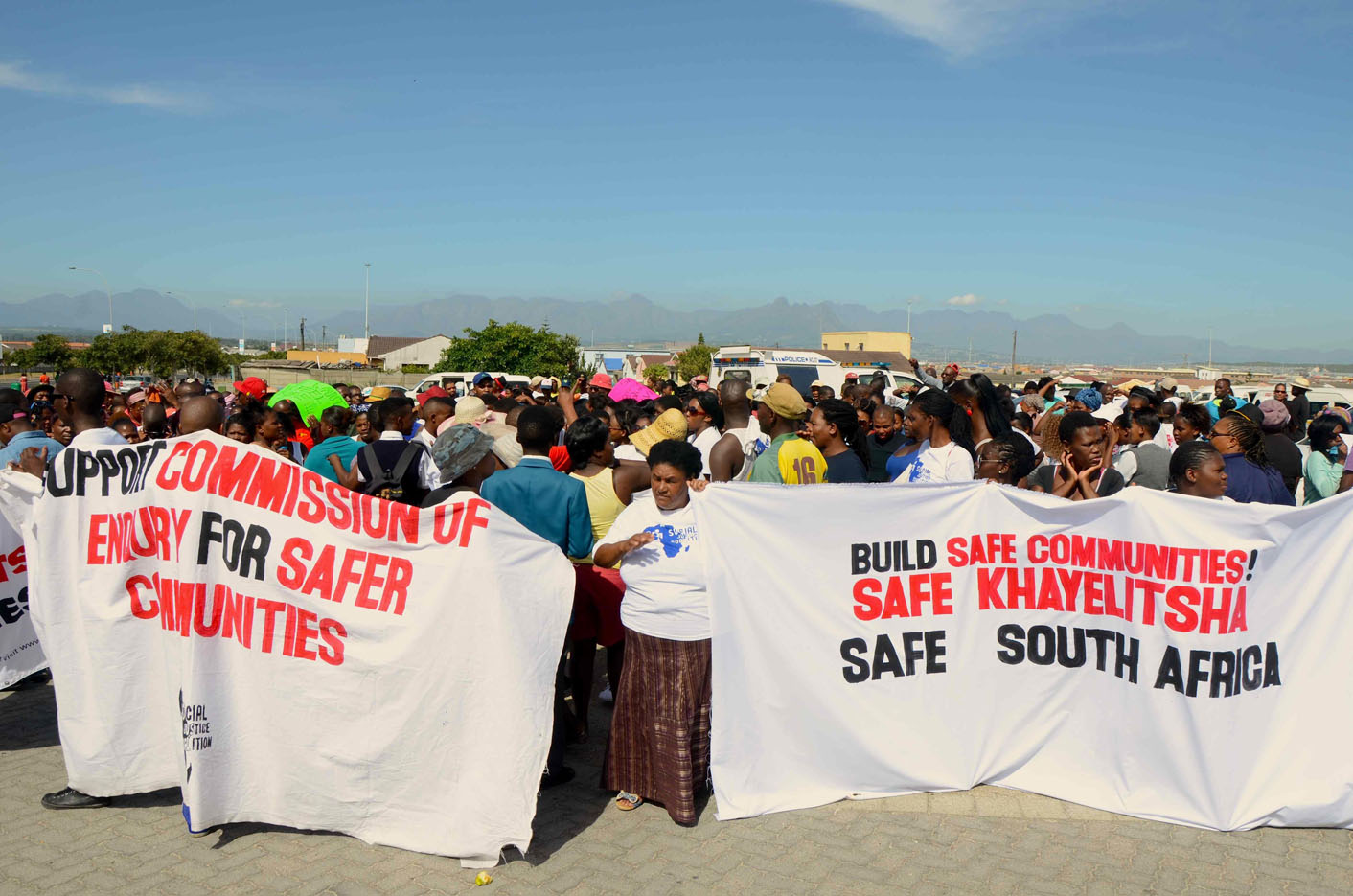
South Africa is currently awash in commissions of inquiry. There’s the ongoing and perhaps never-ending Marikana Commission. Today we read there’s to be a new commission of inquiry into the Tongaat mall collapse, last November. And there’s the Khayelitsha Commission of Inquiry into allegations of police inefficiency in Khayelitsha and a breakdown in relations between the community and police in Khayelitsha.

While women are significant participants in the Marikana and the Tongaat events and commissions, women are in many ways the subjects of the Khayelitsha Commission. This is not surprising, given the nature of the inquiry. The Commission’s mandate isn’t to get to the bottom of a tragic event, but rather to investigate and get to the texture of decades long dissolution of everyday life.

In the 1980s, the State built Khayelitsha and has continued to do so ever since. Part of this construction has involved the establishment of a State of sexual tyranny. That State of sexual tyranny has come forth in the testimony of Khayelitsha residents to the Commission.

The Commission began in response to a complaint lodged by the Women’s Legal Centre, representing the Social Justice Coalition, Treatment Action Campaign, Equal Education, Free Gender, Triangle Project, and Ndifuna Ukwazi. That complaint was lodged in 2012. The Social Justice Coalition had been organizing hard for two years prior for an investigation into the situation of justice administration in Khayelitsha. As the complaint noted, “Since 2003 the civil society organisations have held more than one hundred demonstrations, pickets, marches and other forms of protest against the continued failures of the Khayelitsha police and greater criminal justice system. The organisations have also submitted numerous petitions and memorandums to various levels of government in this regard. There have been sustained and coordinated efforts from various sectors of the Khayelitsha community for action to be taken by government agencies, including the police, to improve the situation.”

For over a decade, intensifying police incompetence, corruption, violence, and disregard for the local population went hand in hand with `vigilante justice’. In 2012 alone, 20 `vigilante’ collective killings were reported in the area. The struggle for space and for citizenship was running with blood and smoke. In the struggle for safe space and full citizenship, women, again, have been key. As the Women’s Legal Centre complaint noted, “Girls and women are frequently beaten and raped whilst walking to and from communal toilets or fetching water from communal taps close to their homes, while domestic abuse poses a threat to the safety of many women within their own homes. Between March 2003 and March 2011 there has been a 9.36% increase in the number of reported sexual crimes reported in Khayelitsha.”

Throughout the decades, women have kept their eyes on the prize. Khayelitsha is home. They should be able to live, and love, at home without fear of violence. Their children, partners, parents, friends, neighbors should as well. Through the use of public funds and private security forces, Cape Town has established `improvement districts’ … in the central city, inner southern suburbs, Sea Point and Green Point. Not in Khayelitsha. The women know that, and they don’t accept it.

Funeka Soldaat, founder of Free Gender, recounted her story of being raped, because she is lesbian, in 1995. She went to one police station, where nothing happened. Finally, without her statement being taken, she was taken to a hospital and dumped outside. The hospital said she needed a statement, and so she walked to Khayelitsha Site B police station, all of this right after having been raped. There she was treated disrespectfully, she felt because of her sexual orientation, and no statement was taken. Finally, literally barefoot, she walked home and went to sleep. The rest of the story is pain, healing, organizing. As to the police: “Khayelitsha police appear to lack the energy, will and intent to provide a service to LGBT [people].”

Malwande Msongelwa described what happened when she found her brother, stabbed to death at a bus stop. She called the police, and they didn’t come. She called again, and they finally came, but did nothing. Worse, they refused to get out of their cars: “The police do not care about people… [they] will only come out if there are drugs. Then they will come out with 10 cars …They do not even care if you are injured… If the ambulance hasn’t arrived they won’t touch you. They wait in their car… I don’t trust the police.” Her brother lay on the ground for six hours. The crime scene was never investigated.

The stories continue. Ms. Nduna describes how a police van hit and dragged one of her children. This was the fifth child in the area to suffer harm, and worse, at the hands of a police vehicle. What happened? “We buried and there was nothing still.”

The harrowing stories of violence, of police inaction and worse, of vigilante action and worse, occur in a framework of radical hope. Phumeza Mlungwana, Secretary General of the Social Justice Coalition, put it simply and directly: “Most of Khayelitsha is policeable.”

Witness and after witness explained that lights, presence, a diversity of site appropriate techniques, a committed and engaged and respectful police force are what are called for. It’s not rocket science, and it’s not impossible. The women of Khayelitsha know that. They know, from experience, that when the work of struggle accompanies the work of mourning, they can make things happen. The Commission itself is a step along that path. The struggle continues.

(Photo Credit: Kate Stegeman / Daily Maverick)

Lampedusa nowhere, Lampedusa everywhere

The plan was, and is, simple. Cut off routes for migration; create one “forced route”, an impossible route. If anything goes wrong, blame it on the dead. Call it Plan Lampedusa.

The only problem is that those who moved through Lampedusa refuse to die, vanish, or accept. Welcome to the Lampedusa Charter, welcome to Lampedusa in Hamburg. Welcome to Lampedusa … everywhere.

A week ago or so, over three hundred immigration and asylum activists met, on the island of Lampedusa, to write a new Lampedusa Charter. The 300 included representatives from Lampedusa in Hamburg, the Moroccan Social Forum, and Terre Pour Tous, a Tunisian organization of relatives of migrants and shipwreck victims. The Charter rejects the forced route to Europe. The authors of the Charter reject the erasure of their lives, their humanity, and their stories.

For Europe, and beyond, Lampedusa has become the spectacle of tragedy. Regularly, Africans, by the boatload, drown or “are saved” off its shores. But the news media never seem to question why those shores? Why are there so many drowning off the shores of Lampedusa? And what happens to those who pass through, on to the continent?

Lampedusa in Hamburg offers one response. In early 2013, about 300 West African men made it to Hamburg. They survived the treacherous trip through Libya. They survived the impossible journey across the Mediterranean. They made it through Lampedusa and onto the mainland, and finally made it to Hamburg.

The 300 applied for asylum and ran into obstacles, many of which derived from EU regulations. And so they organized. They organized Lampedusa in Hamburg. They organized solidarity networks. Football clubs supported them. Bar bouncers protected them from racist attacks. The State did nothing. Then the “Lampedusa tragedy”, the death of over 300 African refugees, happened in October 2013. Hamburg declared “danger zones”, meaning specified areas in which police could demand anything of anybody, without any proper cause or due process. Lampedusa in Hamburg, and its allies, responded with mass demonstrations. Finally, the State relented … somewhat. The danger zones were disbanded. Lampedusa in Hamburg still lives under threat of deportation.

In Hamburg, African refugees and asylum seekers joined with others in the local Right to the City movement. They organized for the universal right to stay. From squatters to homeowners and apartment dwellers in suddenly chic neighborhoods to residents in areas facing `redevelopment’ to asylum seekers and refugees, people organized to combat racism, gentrification, exclusion, inhumanity.

Lampedusa in Hamburg, and its allies, are rewriting the narrative of immigration and citizenship, as they re-draw all sorts of maps. No amount of crocodile tears over the tragedy of Lampedusa can wash away the reality of Lampedusa. And that reality is that Lampedusa is everywhere. Migrants, immigrants, irrespective of their status, carry the portal of entry with them forever. Those who have passed through Lampedusa, they are forever citizens and bearers of Lampedusa. The plan was Lampedusa nowhere. Instead, the reality is Lampedusa everywhere. And the residents of that reality are organizing, demanding the right to stay.


(Photo Credit: Getty Pictures / Express.co.uk)