Mississippi is burning to kill Michelle Byrom

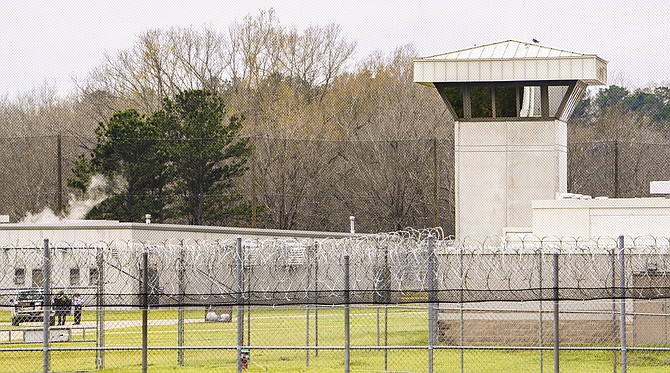
Central Mississippi Correctional Facility

Kill the pig. Cut her throat. Bash her in.

Michelle Byrom may, or may not, be executed this Thursday, in two days. She currently sits on death row in Central Mississippi Correctional Facility, in Pearl, Mississippi. Mississippi has three State prisons. All women `offenders’ end up in CMCF. In 1996, Mississippi hosted 807 women prisoners. By 2001, it boasted 1,445 incarcerated women. Today, according to the State’s March 2014 `fact sheet’, Mississippi’s prisons and jails hold 2,233 women behind bars. 900 women live, and die, in Central Mississippi Correctional Facility.

In 1999, someone killed Edward Byrom, Sr. By all accounts, Byrom Sr. was a vicious, abusive man, who tortured his wife, Michelle, and forced their son, Edward Byrom Jr, known as Junior, to live in the lowest rungs of hell. Physical abuse, mental and emotional torture, and sexual exploitation were the daily, and hourly, fare in the Byrom household.

The State decided that Junior and a friend had been part of a murder-for-hire plot hatched by Michelle Byrom. When Byrom was killed, Michelle Byrom was in the hospital for double pneumonia. Junior has confessed, at least four times, to having actually murdered his father. Something snapped, he picked up a gun and shot him. Michelle Byrom has been diagnosed “with borderline personality disorder, depression, alcoholism and Muenchausen syndrome, a serious mental illness that caused her to ingest rat poison to make herself ill.” And, of course, her counsel, by all accounts, was somewhere between dreadful and criminally negligent.

Observers have waxed literary in describing the case. For example, Warren Yoder, executive director of the Public Policy Center of Mississippi, said, “John Grisham couldn’t write this story … In any reasonable world, this would be a short story by Flannery O’Connor. Instead, it is happening now in our Mississippi.”

Why is Mississippi burning to kill Michelle Byrom. For that, better to turn to Lord of the Flies. Mississippi hasn’t killed a woman in 70 years, and Mississippi can read the writing on the wall. Soon, capital punishment will come to an end, even in Mississippi, a national leader in executions. That recognition feeds the fire. Facts be damned, along with presumption of innocence and shadows of doubt. The beast needs blood.

The details of Michelle Byrom’s life are hard and disturbing, but the substance, and stench, of Mississippi’s burning is far worse. Stop the execution of Michelle Byrom. Stop all the executions.


(Trip Burns / Jackson Free Press)
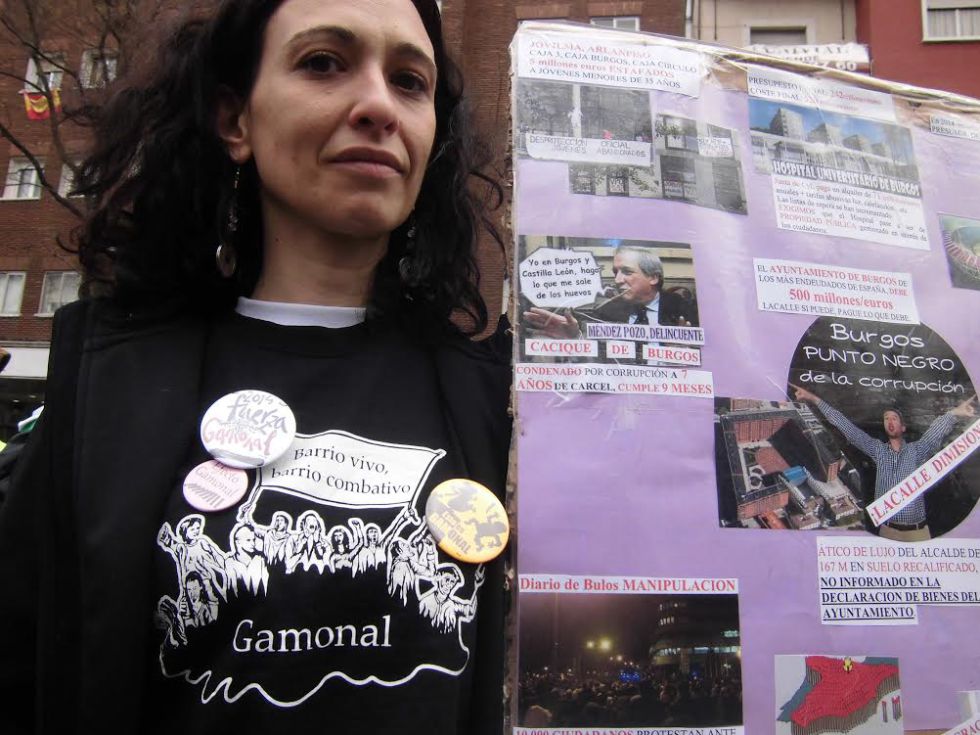
In Spain millions march for dignity

Belèn Calvo

“I came because I have dignity.”

As many as two million demonstrators converged on Madrid this weekend to reject austerity and support individual and collective dignity. For the past month, eight columns have been on the move, and Saturday, they met, as the Marches for Dignity flooded the streets and captured the imagination of the Spanish people.

Marchers and supporters have demanded no more payment of the debt; no more cuts; no more Troika; and bread, work, shelter (and roses) for all. While they have specific policy demands, such as a law establishing a basic income and an end to all evictions, the heart of the mobilization has been to demand an end to State terror and a concerted effort to build dignity. To march, and to work, for dignity is to reject the politics of fear and terror.

The marchers’ manifesto demanded equal rights for women, migrants, people of color, members of LGBTIQ communities, elders, the poor, workers, dissidents, and more. More to the point, they have demanded an end to the assaults and a beginning to real democracy and real dignity.

Women have been prominent across the sectors. Women have led the anti-eviction movement, and they have led and populated all other movements as well, from mining communities to farm communities to urban communities, from factories to schools to clinics. Women like anti-eviction activist Mamen Ruiz argued that women had been pushed to the brink, and beyond, and that now is the time. Women like Virginia, a government employee, marched to protest the astronomically rising tax rates and the new, stringent anti-abortion laws. Women like teacher Belén Calvo came because, in her words, “I have dignity.”

Women marched to secure an end to sexual violence and exploitation. They argued that women had long struggled with and organized to secure the right to live without male violence and the right to family planning. Under the Troika’s constant assault on women, and almost everyone, violence against women has intensified. Violence has intensified against women of color, immigrant and migrant women, women workers, women students, women seeking medical assistance, and the list goes on.

Outside of Spain and the usual suspects, the Western media has barely covered the largest protest in recent Spanish history, except to note that they ended with some clashes between police and a very small number of demonstrators. Whether police or protesters began those clashes remains debatable. What is clear is that the only `news fit to print’ is violence, however incidental.

For the international news media, austerity is the new normal. Meanwhile, anti-austerity resistance is gaining ground in Greece, Cyprus, Ireland, Portugal, Spain. Much of the prison resistance organizing in the United Kingdom, United States and Australia is anti-austerity at its core. Much of the protests about public service in South Africa are as much about the State’s austerity development program as the shoddy service. In each instance, women are at the core of organizing. In each instance, women echo Belén Calvo: “I come because I have dignity.”

The message is clear. End the reign of terror and torture that passes for austerity. Remember, we each and all came because we have dignity.


(Photo Credit: El Pais / J.J.G.)

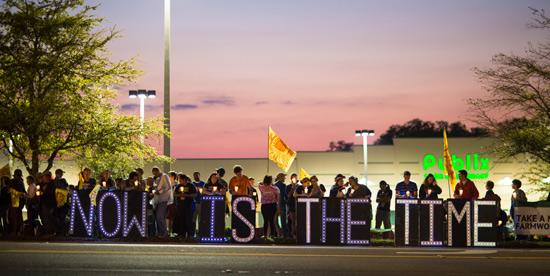
For women farmworkers of Immokalee NOW IS THE TIME!

In Florida’s tomato fields, and across the United States, women tomato pickers and farmworkers – such as Lupe Gonzalo, Silvia Perez, Nely Rodriguez, and scores of others – are organizing a quiet revolution, by waging a raucous, joyous, ferocious struggle. Welcome to the tomato fields of Immokalee, Florida. Welcome to the future.

The Coalition of Immokalee Workers has been organizing, representing, testifying, winning and consolidating farmworkers’ power for twenty-one years. In that time, the organization itself has matured. A key part of its growth has been the formation of the Immokalee Women’s Group and the recognition of women as a central sector in the struggle for farm worker’s rights, dignity, and power.

Recognizing women’s centrality has meant recognizing that the struggle for rights, dignity, and power is a community wide struggle rather than strictly a `shop’ issue. While exorbitantly expensive, predatory housing affects everyone, women carry the greater load of both dealing with rent payment and of maintaining the household. Women attend more to health care, child care and children’s well being, food provision in food deserts amidst the farmlands, and the list goes on. Women keep the daily train of the everyday moving along.

At the same time, women in the fields face their own special circumstances. Rampant, and often illegal, use of pesticides and lack of both information and safeguards imperils women’s health in particular ways. Sexual abuse at work attacks women daily.

The women of Immokalee have declared NOW IS THE TIME! They reject the planned catastrophe of lethal housing, fatal indebtedness, wage slavery, sexual abuse and exploitation. They reject the harvest of shame and the fields of abjection. They organize hope.

On Saturday, March 8, International Women’s Day, the women of Immokalee wrote and delivered a letter to Wendy’s, which has thus far refused to sign the Fair Food agreement, “Hear the voice of the woman, who today dares to defend her dignity in the fields. A new day is coming to Florida’s fields, with the Fair Food Program. It guarantees that the dignity of women is respected. We have to keep fighting, and we have to keep shouting, at Wendy’s and other corporations, that the hour has arrived. NOW IS THE TIME!”

On the following Saturday, Lupe Gonzalo, CIW farmworker and organizer, spoke directly to Publix, which has also not signed the Fair Food agreement; to supporters and to the world: “We want to say to Publix that as women, we will not even consider allowing sexual violence to continue in Florida’s fields or the agricultural industry.  We will not take one step backward.  We will only continue forward.”

We will not take one step backward. Lupe Gonzalo has been recognized as “a powerful voice” for justice. She is. Her power is the power of women, rejecting sexual abuse and all forms of exploitation. Her power is her capacity for affirmation, her ability to reach and teach others around her, and especially women, to affirm themselves, individually and collectively, and to “feel proud to walk, to march, to demand justice, to demand respect for ourselves, for our families, for our children, for future.”

As one CIW woman farm worker noted, two years ago, “Our history is not written in any books. I don’t think there’s enough paper to capture the daily life of a woman in the struggle, fighting to provide for her family. We as women want to move forward, so that tomorrow our children will not have to suffer as they do today.”

The future is now. NOW IS THE TIME!

(Photo Credit: Forest Woodward / Facebook)

In Cyprus austerity passionately embraces incarceration


Sunday, March 16, marked the first year anniversary of Cyprus’s crash program in austerity. The troika – the European Commission, the European Central Bank and the International Monetary Fund – in its infinite wisdom forced Cyprus to welcome a raid on all its bank deposits by means of a tax on all deposits. While that particular, and particularly destructive, policy was rescinded, other measures remain in place. Two weeks ago, Cyprus Parliament approved massive and deep privatization of public services. What does not close is the prison.

Last week, in response to two reports, the European Parliament backed resolutions critical of the Troika’s lack of democratic accountability. For Liem Hoang-Ngoc, co-author of one report, Cyprus is a prime example of the Troika’s anti-democratic practices and mentality: “If there had been open debate at the European Parliament, the Eurogroup would never have suggested that Cyprus tax deposits under 100,000 euros… Macroeconomic goals have not been realized: growth is sluggish and debt has skyrocketed. We underlined the disagreements among the members of the Troika, proving that other politics were possible. The message I wanted passed is that the politics of austerity have failed. Democratic debate must be open in order to make public the existence of alternative politics.”

Throughout the island nation’s year of political uproar and economic collapse, prison, and specifically detention of migrants and asylum seekers, has remained a growth industry.

Cyprus has had a longstanding love affair with putting asylum seekers behind bars. A 2012 report noted, “Every year, hundreds of people who flee to Cyprus to escape persecution, war or simply grinding poverty are put behind bars and detained as if they were criminals, even though they have committed no crime. Most are detained for months, often in poor conditions without access to adequate medical care and usually unable to challenge the lawfulness of their detention due to the paucity of free legal aid. In some cases, the Cypriot authorities refuse to free people even when the Supreme Court has ordered their release.”

The report told the story of N: “N. is an asylum-seeker from Sri Lanka. She is married to another Sri Lankan asylum-seeker who lives in Cyprus and they have submitted a family asylum application. They have an eight-year-old daughter. In September 2011, N. was arrested without documents and detained in Block 9 of Nicosia Central Prison. Her lawyer, [said] that despite his repeated requests, the authorities did not provide him with the deportation and detention order, so in April he challenged the lawfulness of her detention before the Supreme Court…In December 2011, N. was still in detention along with several other women held pending deportation. She tearfully said: `What kind of country separates a mother from her child? Yesterday it was her birthday. My daughter told me, ‘mama I miss you so much’.’ N. was eventually released on 23 April 2012, one day before the scheduled Supreme Court hearing and after seven months in detention.”

That was 2012. A report released today suggests the only change is from `prison’ to `detention centre’: “One woman, Nina (name changed), 28, was separated from her 19 month old son whom she was still breastfeeding and detained in a police station, after she was arrested while trying to apply for permanent residency. She is married to a Romanian citizen and told Amnesty International her immigration status has always been regular and that she did not know the reason for her arrest. Her son was taken away by social services and was only allowed to see her three times a day for 20 minutes at a time for feeding.

A second woman from Sri Lanka, was detained in Menogia detention centre after visiting her husband, also a Romanian citizen, who was being held at a police station. They were accused of having a marriage of convenience despite a DNA test proving that her husband was the father of her child. She was only allowed to see her three year old son twice a week for half an hour each time. Both women have since been released after four days and four weeks in detention, respectively.”

In the past year, there have been repeated hunger strikes both by prisoners inside Menogia and by loved ones and others outside: “It must be a special kind of hell, the bottom beneath the bottom, to escape persecution, war or a natural disaster only to be locked up indefinitely in a place every bit as dehumanizing as a prison. At the Menogia detention center in Cyprus, twenty-five Syrian refugees fasted to try to end their mistreatment, which included the denial of food and medical care.”

From the debtors’ prisons popping up in the United States to the immigration and asylum prisons in Cyprus, austerity passionately embraces incarceration. In a world in which “migrant populations have become increasingly feminized,” another world, without special kinds of hell, must be possible.


(Photo Credit: Cyprus Mail)

The 1001 days and nights of Reeyot Alemu’s imprisonment


“Every new stretch of prison for a group of political prisoners gave birth to a new batch of freedom songs. Jail spells had not broken us; they had helped make us.”
Ruth First: 117 Days: An Account of Confinement and Interrogation Under the South African 90-Day Detention Law

Sunday, March 16, marked the 1000th day Reeyot Alemu spent in an Ethiopian prison, the notorious Kaliti Prison, for the crime of writing critical news pieces. Alemu followed a path similar to that of Ngugi wa Thiong’o in Kenya, Paulo Freire in Brazil, Ruth First in South Africa, Angela Davis in the United States, and so many others. That is, she is a teacher who was called upon to write. Nothing heroic. Just write. Write the news. Write the facts. Write the analyses. These acts of writing qualify as terrorism in Ethiopia (as they do in much of a world covered by interlocking Wars on Terror).

In Reeyot Alemu’s case, her terrorism was to focus on poverty, inequality, corruption, and gender inequality, or, more precisely, women’s rights and the oppression of women. For that, she was initially sentenced to fourteen years in prison. The sentenced was then `reduced’ to five years.

In 2012 Alemu won the International Women’s Media Foundation’s Courage in Journalism Award. In May 2013, she won UNESCO’s Guillermo Cano World Press Freedom Prize 2013. Each time, she managed to smuggle out notes that called on journalists to be of courage, to report and write and expose, to “be voices of the voiceless [and] reveal the truth of the oppressed ones.”

Since the UNESCO award, it appears that life has grown even more difficult for Alemu. Her visitors have been restricted. At one point, she was only allowed to see her parents and a priest. Her fiancé and her sister have both been prohibited from seeing her. In September, Reeyot Alemu was on hunger strike. Alemu’s family says she is living with breast cancer, and the prison is refusing her medical treatment. Reports suggest that the State has paired Alemu with a “tormentor”, a prisoner whose job is to make another prisoner’s life a living, and dying, hell. When Alemu is not in the living hell of her cell and cell mate, she’s in the torture hell of solitary confinement.

Some, such as the Committee to Protect Journalists, have broadcast Alemu’s case, but in general the media has remained silent. Why? Have the abusive and abysmal conditions of Kaliti Prison become the new normal? Has the abuse of journalists and teachers become beside the point? Is the War on Terror so much a part of the global everyday that the struggle of one woman to address the conditions of women and the corruptions of State become just so much collateral damage?

Some suggest that Ethiopia’s anti-terrorism law, passed in 2009, was actually forced upon the nation by the United Nations. While that’s doubtful, it is the case that in passing the law, and entering into the global prison regime, Ethiopia joined the 21st century’s league of nations.

The pedagogy and the literature of the oppressed will emerge from the prisons of the world. One day, Reeyot Alemu will teach us that the voiceless are not voiceless. They are working and giving birth to new batches of freedom songs, and to new practices of justice.

Meanwhile, today, Monday, March 17, 2014, marks day 1001 of Reeyot Alemu’s imprisonment. Tell someone … now.


(Image Credit: Global Voices)

Amira Bouraoui: Barakat! Ça suffit! Enough! ¡Ya basta!


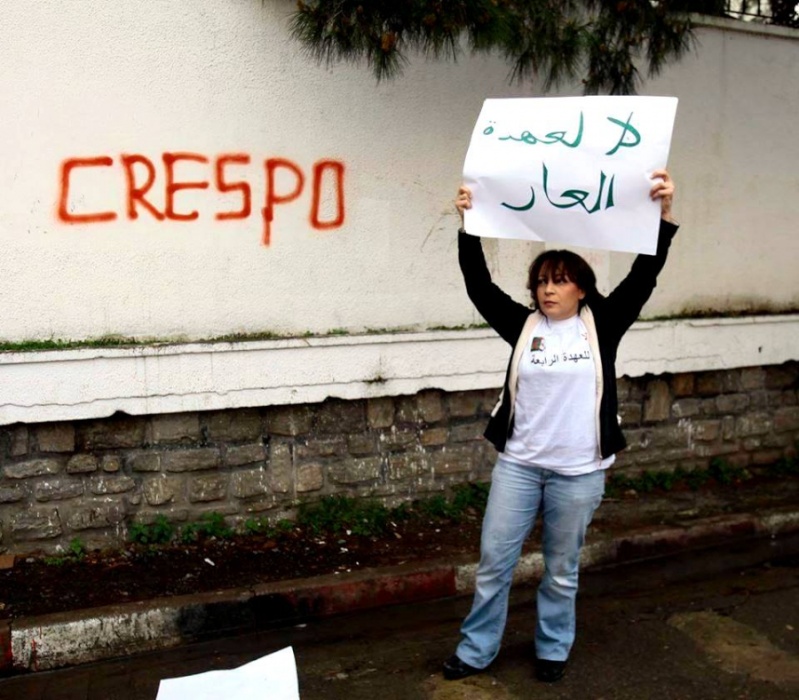
Enough! That’s Amira Bouraoui’s message for Algeria’s President Abdelaziz Bouteflika, in office now for 15 years and running for another term. Bouraoui started a new, and yet not so new, movement in Algeria, a movement of  “Algériens indignés”. Indignant Algerians. Algerians who refuse to be counted out or, worse, counted among the dead: “L’Algérien n’est pas mort, il réfléchit et il n’est pas d’accord.” The Algerian is not dead. He thinks about what’s happening, and he does not agree.

Amira Bouraoui is a gynecologist, a mother of two, and an ordinary woman. On February 22, before Bouteflika had formally announced his candidacy, Bouraoui showed up at the gates of her local university, stood there alone with a placard, and said, STOP. She said, Barakat! Ça suffit! It’s enough! Around the world, people heard a woman saying, yet again, “¡Ya basta!”

Within two days, that singular action sparked a movement.

On Thursday, hundreds gathered in a peaceful demonstration and were met with police intimidation and, for some, brutality. Bouraoui was arrested. Of Thursday’s demonstration, Bouraoui said, “We organized this protest not only to say NO! to a fourth term for Bouteflika, which would be a shame for Algeria, but also to promote the struggle to dispel people’s fear of expressing ourselves freely and openly in our own country.”

Around the world, women, individually and singularly and collectively and together, organize to say NO to patriarchy, domination, oppression, violence. Women organize to say YES to expression, sharing, collaboration, real peace, love.

Amira Bouraoui got up one day, kissed her children, and walked out the door. Alone, she carried a sign to the local university, because she thought and thinks students matter and education matters, and she said, NO! Barakat! Enough is enough! Ça suffit! And around the world … the world heard a woman saying, yet again, “¡Ya basta!” It was a woman’s solitary, small gesture that lit up the sky.

That’s the message for March 8, 2014, International Women’s Day. ¡Ya basta! Enough! Ça suffit! Barakat!


(Photo Credit: Le Portail des Hommes Libres)

#YakiriLibre: Tod@s somos Yaki, tod@s merecemos justicia

The case of Yakiri Rubio is a celebrated case in Mexico, which has received practically no attention in the United States or in the Anglophone press worldwide. That’s a shame, because Yakiri’s case articulates with cases in the United State, and with the more general situation of women’s safety and wellbeing.

In December, 20-year-old Yakiri was seized by two men, brothers, and taken to a hotel, where she was raped. Yakiri picked up a knife and struggled with her attackers. She struck one of the attackers in the neck, and he subsequently died of his injury. Clothes ripped, bleeding and bruised, Yakiri fled the hotel, found a police officer, and described what happened. She was taken to the police station. No one believed her. That night in the police station, she received no gynecological examination or any medical attention. No medication, no treatment, no nothing. Then Yakiri was booked for first-degree homicide. The only eyewitness to testify against her is the other brother, also involved in the rape.

Yakiri has been in one prison after another for three months. Her family organized a major campaign. Women’s groups, civil and human rights organizations, and others have mobilized their forces. Yesterday, finally, a judge reviewed the case and decided to downgrade the charge from first-degree murder to self-defense with excessive force. While this downgrade did not absolve Yakiri, it did make her release on bail possible. She was supposed to be released yesterday but, thanks to bureaucratic foot dragging, as of noon today, people were still awaiting her release. Her lawyer, Ana Katiria Suárez, felt pretty confident that Yakiri Rubí Rubio would walk out of prison today, not a free woman, not an exonerated woman, but at least no longer behind bars and caged.

On line and on lampposts and walls, Free Yakiri posters have proclaimed: “#YakiriLibre: La violencia machista es un crimen, que te encarcelen por defenderse tambien”: “#FreeYakiri: Male violence against women is a crime, and they put in jail for defending yourself against it.” In Mexico, women and men understand that Yakiri defended herself against both an immediate physical assault and ongoing structural, cultural, political, economic and societal violence against her as a woman and against all women.

Yesterday, the State announced it will review the cases of women currently behind bars, in the light of Yakiri’s case. There will be others like Yakiri.

This is a Mexican case that speaks to cases worldwide. In Florida, Marissa Alexander shoots a warning shot to stop a murderously abusive partner, and is not only charged but also persecuted by the State. In California, Patricia Norma Esparza was 20 years old when she was raped and then struggled with and killed her rapist. In a preliminary hearing last week, the police argued that Esparza “consented to” being raped, and so it’s all on her.

In each case, the woman was offered a deal, and in each case, the woman turned it down and demanded either a trial or to be let free. From the formal rule of law – the police, the Courts, the prison – to the informal everywhere else, women reject the compromised position and status that is offered to them as a `gift.’ They know: When it comes to ending sexual violence, when it comes to establishing a material world of peace and safety for all, there are no deals. As one demonstrator’s sign read, “#YakiriLibre: Tod@s somos Yaki, tod@s merecemos justicia”. We are all Yaki, we all deserve justice.


(Image Credit: https://mediosindependientes.wordpress.com)

What Dembe, Mari, Masani, and Flavirina knew and what they learned

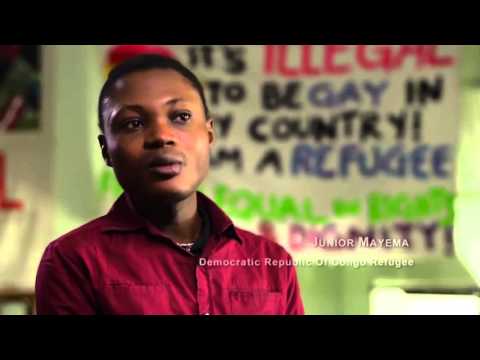
Dembe Ainebyona has suffered: State violence, mob violence, rape. Ainebyona is a 31-year-old lesbian, originally from Uganda, currently living in the Cape Town metropolitan area. In 2009, she applied for asylum status in South Africa. Unaware of South Africa’s liberal laws concerning LGBTQ people, Ainebyona hid her lesbian identity and hid the real reasons she had fled Uganda. She was denied asylum. Her appeal comes up in a few months.

This is not a story about Uganda. This is a story about South Africa and the reality of its so-called liberal laws as lived by LGBTI refugees and asylum seekers. It’s not a pretty story.

A recent report, Economic Justice: Employment and Housing Discrimination Against LGBTI Refugees and Asylum Seekers in South Africa, read against the account of Dembe Ainebyona, reveals a story, that of asylum seekers and refugees in the Cape Town area.

Why focus on Cape Town? Dembe Ainebyona lives there. It’s a global tourist as well as refugee destination. It’s a `model’ for neoliberal urban redevelopment.

And this: “In July 2012, the Department of Home Affairs (DHA) closed its Cape Town RRO [Refugee Reception Office] and refused to accept any new requests for asylum at the location. The temporary shutdown was particularly problematic for undocumented LGBTI newcomers because it placed them at risk of detention and subsequent repatriation. In fact, the largest population of refugees and asylum seekers reside in Cape Town. To push back, PASSOP and other advocates protested outside the closed RRO. Another human rights organisation also challenged in court the legality of the RROs closing. In July 2012, the Western Cape High Court ordered the DHA to continue accepting new asylum applications until the court provided a final determination on the case, thereby providing new asylum seekers entering Cape Town interim relief. After months of rallies and public outcry spearheaded by PASSOP, the Western Cape High Court ordered in March 2013 that the RRO fully resume operations by July 2013. However, despite these 2012 and 2013 court rulings, it was reported in April 2013 that the Cape Town RRO had not accepted any new applications since June 2012.” Welcome to Cape Town!

Here’s the story of Mari, Masani, and Flavirina, residents of Cape Town.

Mari: “Lesbian asylum seeker Mari has an educational background in finance management and worked as an accountant in her home country of Angola. She reports that she had two interviews where, after having a positive reception on the phone, the potential employer would not even ask for her CV or paperwork after meeting her in person and assuming her sexual orientation … Mari, who recently escaped from Angola with her girlfriend, explained that she and her girlfriend had to sell all of their possessions and combine their savings to purchase plane tickets to flee to South Africa. Since arriving in Cape Town, they have been unable to find work and therefore are unable to afford housing. (Mari explains that despite their efforts to find employment, they are extremely limited because they cannot seek asylum seeker status and obtain legal documentation since the Cape Town DHA office has stopped accepting new arrival applicants.)”

Masani: “Lesbian refugees and asylum seekers are particularly vulnerable as they are often victims of sexual assault. As a result of discriminatory attitudes, police officers do not take reports of sexual assaults targeting the LGBTI community seriously. [Masani, a Ugandan lesbian] explains that police often respond with additional harassment when speaking with victims, asking questions such as, `How can you enjoy sex with ladies?’”

Flavirina: “Flavirina arrived in Cape Town from Burundi as a guest for an LGBTI/transgender conference. When people in her hometown heard why she had left the country, an official from Burundi contacted her and warned her to stay out of the country or she would likely be imprisoned or attacked upon her return. She applied for refugee status in South Africa and is still pending a determination. Since living in South Africa, she has lived in various shelters, on the streets and is currently living in a township. At one point, Flavirina found refuge at a Christian shelter, where she had to hide both her Muslim religion and her gender identity. The shelter separated the living quarters by gender, forcing her to share showers, dressing rooms, and other living quarters with men. As the shelter did not allow new members to leave the premises for the first three months of their stay, Flavirina was trapped in this environment, having to dress and act male. After coming out to the pastor in charge of the shelter, he told her he could no longer guarantee her safety.”

Most interviewees in this report were aware of the protections in South Africa’s Constitution, and the minority that were not came to the country following rumors of tolerance in the nation’s communities.” They found violence and promise, persecution and hope. They found that, in South Africa, life can be hard and dangerous for lesbians. They found as well that, in South Africa, life can be hard and dangerous for women marked as `foreigner’.  As non-national Africans and as lesbians, they face housing and employment discrimination.

In February, Free Gender, the Khayelitsha-based Black lesbian organization, celebrated 20 years of democracy and lamented 20 years of fear. They celebrated the rule of law as they decried the rule of violence and torture.

For those who decry and work to reverse the current wave of homophobic legislation, continue to do so. At the same time, ensure your country has more than good laws. Make sure you welcome and care for the stranger in your strange land, whoever she may be.


(Video Credit: The Atlantic Philanthropies / YouTube)

Alabama built a special hell for women, the Julia Tutwiler Prison for Women

Thanks to an ongoing investigation, the news is beginning to seep out that Alabama has built a special hell for women, the Julia Tutwiler Prison for Women.

A 36-page letter of findings laid out a gut wrenching picture of sexual violence at Tutwiler: “For nearly two decades, Tutwiler staff have harmed women in their care with impunity by sexually abusing and sexually harassing them. Staff have raped sodomized, fondled, and exposed themselves to prisoners. They have coerced prisoners to engage in oral sex. Staff engage in voyeurism, forcing women to disrobe and watching them while they use the shower and use the toilet. Staff sexually harass women, subjecting them to a daily barrage of sexually explicit verbal abuse. Tutwiler has a toxic, sexualized environment that permits staff sexual abuse and harassment… Prison officials have failed to curb the sexual abuse and sexual harassment despite possessing actual knowledge of the harm, including a federal statistical analysis identifying sexual misconduct at Tutwiler as occurring at one of the highest rates in the country. Prison officials discourage prisoner reporting of sexual abuse due to actual and perceived retaliation against individuals who make allegations. For example, immediately after making allegations, Tutwiler often places women in segregation and gives them lie detector tests. In some instances, reporting the sexual abuse of one staff member results in additional abuse from other staff members. When confronted with allegations of sexual abuse and harassment, Tutwiler fails to adequately respond or investigate… Systemic deficiencies at Tutwiler directly contribute to staff and prisoner sexual abuse and staff sexual harassment that injures prisoners, and creates a substantial risk of further harm.”

While the intensity of the violence may surprise some, the fact of immediate physical and structural violence against women at Tutwiler has been known for a long time. In July 2011, we wrote about structural violence and overcrowding at Tutwiler and again in June 2013, we wrote about violence against older women at Tutwiler. Historically, the media have been prohibited. But prisoners have reported, both formally and informally, the hell that Alabama had built specifically for women. Women former prisoners talked of rape and of children born of rape. Did the State prosecute the fathers of those children? Occasionally. Did the State force the fathers to pay child support? Seldom, and only when pushed … hard. Who listened? Not the State, not the general citizenry, not the world.

The State built for women a house of horror, but the `free world’ did not feel horror. The State built for women a universe of fear, and the `free world’ felt neither fear nor terror. Why does it take a Federal investigation to pry open, a tiny bit, a prison system that is unconstitutional, terrorist, and evil? Why does the fate and why do the lives of hundreds and thousands of women lie, abandoned and worse, in a mass torture chamber? Why does `the world’ not care?

The Federal government is now investigating the mental and medical `care’ of prisoners at Julia Tutwiler Prison for Women. They will find more violence, horror, and damage … again.

(Photo Credit: Alabama Reporter)

I was one of six young females from Chaneng who were arrested


Next Wednesday, in South Africa, six young women activists go on trial. They have been charged with “public violence.” Their crime was protesting peacefully, on Human Rights Day, March 21, 2013, against the physical and structural violence at the Styldrift Project, run by the Royal Bafokeng Platinum Mine. They were protesting the collusion between the local mining corporation and the South African government. Around the world, Styldrift is touted as an example of `community beneficiation.’  It’s not.

For having engaged in peaceful protest, the six young women were thrown into jail, without charge, and were held for seven days without a hearing. Those who had been wounded by rubber bullets were left untreated, and their wounds were left to fester.

Mpho Makgene has described the police brutality: “I was one of six young females from Chaneng who were arrested and a few injured by rubber bullets, while participating in a peaceful march. The youth of Chaneng took to the streets … making sure there was no movement in the village. Their voices were clear as they said ‘we won’t allow cars in and out of our village, no one goes to work’ Public Order Police blocked the group, encircled them, set off the tear gas and shot rubber bullets even in people’s yards.”

The abusive and corrosive conditions at the Styldrift Project are longstanding and well documented. Top to bottom and end-to-end corruption grows ever more intense. Police violence is rampant. Police and private security have destroyed homes, and violently evicted families. Ancestral gravesites have been desecrated. The environment has been polluted. The community has repeatedly sought help from various levels of government, to no avail. And throughout the Royal Bafokeng Platinum Mine, which purchased Styldrift through highly contested processes, rolls along with seeming impunity.

How has Styldrift benefited Chaneng? Youth unemployment is astronomically high and rising. Carbon emissions are dangerously high. As a result of emissions and dust, children suffer respiratory problems. Local water is polluted. The local health clinic is collapsing.

But the biggest concern is collusion: “All complained of the lack of jobs, the poverty despite the wealth of platinum under their land. The biggest concern for all is the collusion between their traditional authorities and the mining corporations, between the local government and the mining corporations, between the politicians and the mining corporations.”

Styldrift touts itself, to South Africa and to the rest of the world, as “a community-based investment company”, but the community only gets violence and refusal. The people of Chaneng have demanded transparency and consultation; reparations for destroyed homes and desecrated ancestral graves; employment; in short, real community investment. Instead, they have received insults, rubber bullets, and jail time. On Wednesday, Mpho Makgene and five others will go to trial. In the next two weeks, sixty-four others will be brought to trial. The mining corporation that crushes the earth thinks it can as easily crush the women. It can’t.


(Photo Credit: communitymonitors.net)