From Texas to Paris, women fight for their lives

From Texas to Pennsylvania to France, women’s rights have to be re affirmed. Moreover, the engagement implies defending an idea of society that goes beyond the right to abortion or women’s right to control their bodies.

In September, in Paris’ City Hall, the forum “Feminist Struggles and Reflections to Advance Society” summed up the current need to switch to the offensive. The Deputy Mayor of Paris opened the forum recalling that feminist struggles always upset the men and women who want to go further in social regression at times of economic crisis. Maya Surduts, President of the National Coordination of Associations for the Right to Abortion and Contraception, concurred, “We are at a turning point. The status of women is being called into question in this society.”

Maternity and the right to decide are under attack as is as the conception of women as full citizens, in France and in the United States.

In the United States, two recent cases of mistreatment of women show that an individualistic, utilitarian, patriarchal, neoliberal idea of society normalizes cruelty.

A woman in rural Pennsylvania has been sentenced from 9 to 18 months in jail for providing, through an online vendor, RU 486 to her 19-year-old daughter, who wanted to end an unwanted pregnancy. The nearest abortion clinic is 75 miles away. The woman was reported to the authorities by the local hospital where they went when her daughter had stronger stomach cramps. The details of the story show the intricate manipulations of events that led to the charge that sent this woman to jail. A state senator commentating on the case accused her of endangering the welfare of a child. It is not clear which child he is referring to. In this judgment, the fact that a fetus is not an unborn child fades away along with the acknowledgment that her daughter is a person and not a womb made to carry children.

She was also charged with “offering medical consultation about abortion without a license”. The daughter did not have health insurance, and the mother and the family seemed to have limited resources. The reality is that the mother had no information about abortion and, working in this vacuum of respect for rights to help her daughter, used the Internet to cut costs. The judge ruled, “This was somebody taking life and law into their own hands”. In fact, this situation is created by a system that plays with women’s lives without any respect for the latter. It works by creating a halo of shame and guilt around the woman, a halo that obscures the shame that the state has for not fulfilling its responsibilities.

Meanwhile in Texas last week, a court decision authorized HB2 to go into effect. This bill imposes restrictions on abortion centers, demanding them to meet the standards of hospital surgery departments. There is no medical reason for that requirement. Nevertheless, it forced 13 clinics to close immediately.

Constraints imposed on women who decide to have an abortion are also medically unnecessary. Now, a woman must arrange four visits to the clinic with the same doctor in a very rigorous timing. She must undergo an unnecessary and invasive vaginal probe ultrasound. Then she has to listen to the description of the development of a fetus, completing her physical torture with a psychological one.

With this measure, women from the western part of Texas will have to travel up to 500 miles round trip to an abortion clinic in San Antonio, the last area where the eight remaining clinics are located. The situation’s worse for the large population of people who live in the Rio Grande Valley without documentation or who have work permits that allow very limited travel. Meanwhile, immigrant women will have to go through immigration check points to reach an abortion clinic, basically depriving immigrant women from this area of their rights.

From the United States to Europe, new measures and laws add devastating constraints on women. In Europe, austerity measures stripped women of their way of life, work, and access to public services, most notably in Greece.

Although in France abortion is free of charge and guaranteed by law, a certain rationale of profitability combined with austerity measures has made access to abortion centers and hospitals trickier. Forced restructuration has closed many locations where women had access to reproductive services. While the Pennsylvania and Texas cases would be inconceivable in France for now, Maya sees the attacks on labor laws and on public services as the point of entry to make women the first to be harmed and exploited. She emphasized that immigrant women are always in the forefront. She added that these situations are unacceptable and that it is time to retake the initiative to defend the rights that protect the majority of the population.
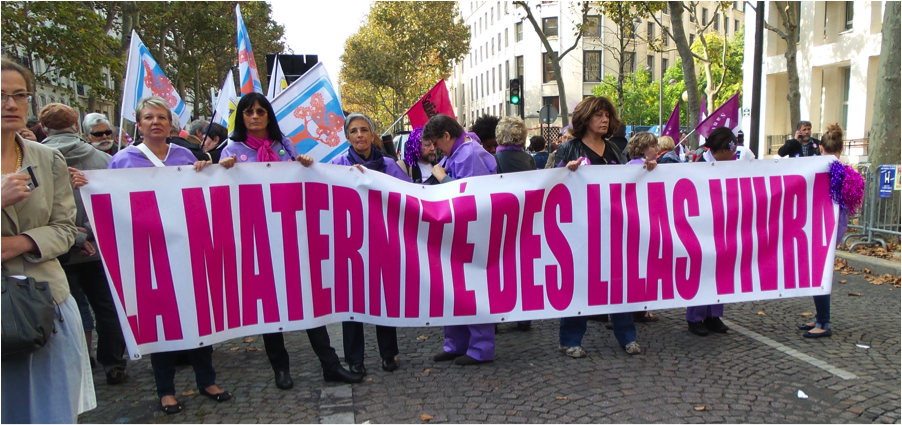
Convergence, tous et toutes ensemble, resistons, all together we can resist

La Maternite des Lilas

On September 23d, an important demonstration was organized in front of the Minister of Health in Paris. The demonstration was organized by the movement Convergences of the hospitals fighting against Hosterity (Convergences des hopitaux en lutte contre l’Hosterity), which gathers together personnel from public hospitals associated with numerous associations defending women’s reproductive rights. They coined the term hosterity to indicate the strong correlation between the disassembling of the public hospital and the austerity measures that have shattered public services throughout Europe.

The neoliberal grip on the European population through the implementation of austerity measures has opened the way to uncontrollable privatization of hospitals and health care services. In Germany, Greece, the Netherlands, Spain, France and beyond, public hospitals are sold to private firms or health care systems. In particular, the French health care service, once praised for its efficiency and quality, has been the target of a series of neoliberal restructurations.

In 2012, the Chairman of the European Bank, Mario Draghi stated that the European Social Model was gone. What he meant was that under the aegis of neoliberal ideologues the rhetoric of needed reforms was going to force a drastic change for the public and its services. The immediate target has been the reproductive health sector, followed by other health care services.

The story of the maternity hospital of les Lilas epitomizes the gendered techniques employed to disassemble a solidarity system and the need for an active and political convergence of resisting forces. And so the Convergence movement was created.

On September 23d the women of the maternity hospital arrived with their now famous banderole that says, “La maternité des Lilas vivra”. The Maternity hospital of Les Lilas will live. The determination of its personnel is remarkable. They know first hand the accounting manipulations that have strangled their department and have denounced this attack on public health care. Giving birth is free of charge by national law, and so the way to attack this principle was to create administrative constraints and force many local maternity departments to close down and send women to maternity “factories” with fewer and fewer midwives and ob-gyn.

I talked with head of the department Marie Laure Brival and the midwives and the nurses, and the members of the supporting collective. In 2009, said Marie Laure Brisal, the budget for the necessary renovations was agreed on by the experts and signed by the Minister of Health. Then, under the same government, the restructuration of the health administration created the conditions through this new health plan for a retroactive review of this budget. The goal was to create big health structures in which ob-gyn departments had to be rearranged in factory-like structures with fewer personnel, and more deliveries and other reproductive services. In France, maternity hospitals take care of delivering babies as well as contraception and abortion services since both are what women need.

The maternity hospital les Lilas is located in a populous suburb of Paris and provides personal non-threatening service to women. The dedication of the staff to the comfort of women has been a model for many.

“Our fight has been going on for the past four years and has taken a national dimension, we receive support from everywhere. They even come from beyond the French borders from all over Europe” said Marie Laure, adding, “They fought with obstinacy and elegance.” When candidate to the presidency of France, Francois Hollande gave his support to the fight and promised that Les Lilas would remain open. “Unfortunately,” said Maris Laure Brival, “Political statements do not last long.”

The midwives told me that they were exhausted. Besides providing an excellent and peaceful environment, they have to organize and continue the actions in every way possible. I talked with women who have been patients there and all explained that it was a memorable experience.

Having just won a battle with the guarantee that they will not be absorbed by a bigger structure, they still have to obtain the complete funds to continue to put women first in a maternity hospital.

The bureaucratic structure Regional Health Authority have been operating since April 1 2010, Although they were presented as a necessary tool to enhance the health care system efficiency, their real function was to rationalize in a financial/accounting manner the delivery of care, in other words reduce social expenditures.

The American for-profit health care system is becoming the norm. The most universal systems are being transformed with the usual neoliberal tools that have the capacity of turning social responsibility into a violent arithmetic of profitability and deficits reduction. With this logic, the rhetoric of competitive enterprise and dehumanized factory production is applied to places of care.

In this context the struggle of the maternity hospital des Lilas is emblematic of the fight of women against the impoverishment of their lives with an overall continuously contested reproductive rights and health. Women are enormously affected by austerity measures or hosterity. First, they fill the ranks of poor workers, an expanding category. Women are overwhelmingly employed in care facilities, 49.8% of the public sector employment in France. In addition, when public care services are curtailed, women become unpaid care providers with all the consequences that implies. Finally, the restructuration of the reproductive health structures that are being pushed with this Hosterity represents an enormous set back for the entire health care system.

Last week, the demonstrators reaffirmed that health and social protection are not for sale. The convergence is broad. Other movements were represented from the struggle against austerity measures in Greece to the Spanish struggle for reproductive and health rights. Solidarities are being formed against the fragmentation of the civil society that characterizes the neoliberal order with its rhetoric of competition. Marie Laure Brival took the microphone and ended her speech with Tous ensemble resistons (all together we can resist) and the crowd repeated it several times. We are not competing we are cooperating against the neoliberal order!

Violence is violence……

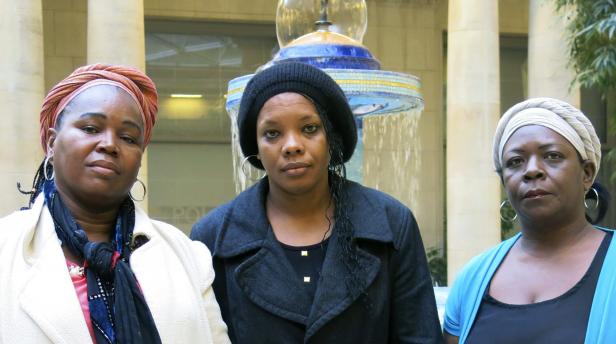
Gloria Amparo Arboleda, Maritza Asprilla, Mary Medina of the Mariposas Network

Gloria Amparo Arboleda, Maritza Asprilla, Mary Medina of the Mariposas Network

When a woman is knocked out by her partner, fiancé, or spouse and her assault is caught on camera, is there something to be done at the time of that assault instead of waiting for a tabloid media to use it to make profit?

In “For real equality between women and men,” recently passed in France, violence against women appeared as a component that keeps women dominated. The telephone “grand danger” was part of the tools used to address the immediate crisis and to guarantee the woman who is threatened that she won’t stand alone. In the case of Janay Rice, the “surveillance” camera of an elevator in a casino was not there to protect the woman.

Whether both were drunk is not the issue, the issue is violence and what should be done about it.

Now the video of the assault on Janay Rice is shown everywhere, many have commented and nothing is done to exit from this violence. The woman is re victimized, she is accused of many things from having married the man after the assault to having angered her fiancé and thereby triggering the attack. Meanwhile the main issue for women experiencing this violence is that they don’t have a space to speak.

In this case, Ray Rice, the perpetrator, is punished by the corporate sport organization, the NFL. The sport itself is a spectacle that uses violence to attract viewers. Some studies have suggested that the numerous injuries, mainly cranial injuries, have been overlooked. In a racialized way, the Bread and Circus of the Roman Empire is still a concept in men’s sport. Capitalist ventures in sport demand return on investment, and an organization like the NFL acts as if protecting its logo is more important than reducing the impact of violence on women’s lives. At the same time, players’ injuries may have a role in transporting violence from the playing fields to the everyday life of players. Although it is just one factor, it speaks volumes about the organization and what women who are with the players have to deal with as if it were their designated role.

Meanwhile, the statistics on domestic violence are staggering. In the United States and elsewhere, many don’t report their assaults for fear of repercussions, which take various forms but always affect women gravely, socially and physically.

Celebrity cases are unfortunately not about violence against women. Instead, they contribute to the overall normalization of violence. Many should learn from the women of Mariposas de Alas Nuevas Construyendo Futuro who received the UN Nansen prize on September 12, 2014 for helping and caring for victims of domestic violence in Bonaventura, a place where violence is rampant. As Mery Medina, a member of the group, declared, “The fight is to fight indifference. One way of protesting is not to keep our mouths shut.” It is the only way to form solutions to exit from the violence.


(Photo Credit: Radio Nacional de Colombia / EFE / Raquel Castán)

Najat Vallaud-Belkacem fighting racism and sexism in France for real equality


Najat Vallaud-Belkacem

Not long ago, Najat Vallaud-Belkacem, then the French Minister of Women’s Rights, introduced and successfully defended a bill entitled “For Real Equality Between Women and Men.” This bill supported the normalization of parity. After the recent reshuffle of the government, Vallaud-Belkacem has become France’s Education Minister. This position is the fourth most important in the ranking of ministers in France. She is also the first woman to hold this major ministry.

Her nomination could have been a sign that something was working toward real parity in the highest political representation in France, but alas no. Immediately after her nomination, Vallaud-Belkacacem was targeted in right wing magazines by sexist and xenophobic attacks. These attacks used her dual Moroccan and French citizenship, her Muslim origin, her youth (she is 36), her sex, her support for same sex marriage, her support for the inclusion of gender theory in regular primary and secondary education, and, finally, her active feminist support for women’s rights.

Valeurs Actuelles, a magazine that the former president Nicolas Sarkozy uses regularly to make statements about his eventual return to politics, staged her as “the Ayatollah” on its front page, with an edited photo that accentuates the darkness of her eyes, making the portrait loaded with negative representations of Islam. The subtitle uses play on words to suggest that she is going redesign the National Education system. The title of another magazine “Minute” does the rest: “A Moroccan Muslim at the National Education, the Najat Vallaud Belkacem provocation.”

None of these displays of hatred is new. The latest was Christiane Taubira, the Minister of Justice, whose origins and skin color sparked off racist and sexist slurs. Both women epitomize the fight against all inequality, including gender, ethnic and social inequality. Christiane Taubira reacted and wrote to her colleague in a tweet, “They must have nothing in their heads, be empty in their heart, and have hardened souls. Najat, you’re flying high with our ambitions for schools. Thanks.”

Meanwhile, the line between right and extreme right becomes increasingly blurred. In a tweet by a right wing city counselor of Neuilly sur Seine, Najat Vallaud-Belkacem was accused of using her femininity, also called “skirt promotion”, to access this position. The counselor, of course, added a suggestive picture. Another right wing enclase, the city of Puteaux, in a charity effort to support families with children returning to school, distributed strong blue backpacks to boys and strong pink one to girls, making clear the separation in colors and roles of girls and boys in a binary society.

“Najat Vallaud-Belkacem is the ideal target for all those who would like to distill the idea that an immigrant woman could not legitimately be part of a government” says SOS Racism, an association that denounces all sorts of racism. These attacks go beyond that. They exploit the old demon of colonial countries to block advances in women’s rights and human rights and to achieve various goals: controlling the population at large, curtail all debates, policing the whole of the neoliberal environment.

When Najat Vallaud-Belkacem was Minister of Women’s Rights, she declared that we needed to be politically proactive to address gender inequalities. She was right about that. When she said that gender, class, ethnicity are the bases of inequality and that hatred is the way “to emptied hearts and hardened souls” where inequalities grow, she was right again.


(Photo Credit: RTL.fr)

From Paris to Washington, all women need easy access to real help in times of crisis

Recently, former President of George Washington University, Stephen Joel Trachtenberg suggested that violence against women on university campuses in the United States could be reduced if only women were trained not to drink in excess. He added that we need to educate “our daughters and our children” who drink too much.

At least, with these recommendations, women will remain sober while being subjected to violence? This type of comment is too often accepted in public spaces, such as NPR where it was expressed. As long as discriminatory comments and acts are still presented as primitive solutions, violence against women will persist.

Women need easy access to real help in times of crisis. Women also need society as a whole to stop discriminating against them, making us ever more susceptible to acts of violence.

In France, a recent bill, For a Real Equality Between Women and Men, takes on violence against women in its multifaceted approach to create conditions for more equality. The bill offers other methods to address this issue. Some are for immediate relief for women. Others offer a long-term approach to make violence against women clearly and unequivocally unacceptable.

The distribution of the free personal cell telephone “grand danger” (emergency phone) to women who are at risk of domestic violence is inscribed in the new law. This measure has been initiated by Najat Vallaud-Belkacem, who presented the bill to Parliament in coordination with Christiane Taubira (Minister of Justice) and Bernard Cazeneuve (Minister of the Interior in charge of police).

The cell phone is connected to a call center where trained people may activate a police intervention, which should be effective within ten minutes, according to Najat Vallaud-Belkacem. A woman who feels threatened presses three times on the bottom of the phone to be connected to the call center. Other numbers are pre-registered in the phone to give access to associations that provide psychological support to women who may just need to talk.

The phone is given for six months, renewable, to women whose former companions have been issued a no contact order by the court. With the phone comes psychological support to reduce the feeling of isolation that domestic threat produces.

This system is already widely used in Spain.

After four years of trial in various areas in France, the phone “grand danger”, according to Christiane Taubira, has been a clear success. It has saved lives and has helped women to break the cycle of violence and isolation. In fact, the phone seems to give women a sense of security. According to the Public Prosecutor of the Republic of Paris, the great majority of women call just to make sure that the phone is working; only 10% of the calls are for actual emergencies.

This method is now part of a national plan of action to reduce violence against women and will be accessible to women in the entire French territories including the DOM TOM (French overseas departments and territories). However, as Christiane Tuabira made clear, it is not a gadget. It is there to stop the cycle of sexual and domestic violence and provide preventative and timely assistance to women who are the victims of such violence. This device is part of a larger set of actions. The goal, said Christiane Taubira and Najat Vallaud-Belkacem, is to reduce the level of acceptability of violence against women in society in order have fewer “grand danger” phones.

Let’s extend this goal to the United States and stand up against comments, such as those of Stephen Joel Trachenberg, that show the pervasiveness in ordinary language of discrimination against women, making us more vulnerable to violence. There’s a petition that offers one of the numerous actions to change the level of discussion. You can find it, and sign it, here.

Please sign and share the petition. Every effort counts!


(Image Credit: Najat Vallaud-Belkacem)

In France, for the real equality between women and men

Najat Vallaud-Belkacem, France’s minister for women’s rights

On July 23, 2014, the French Parliament passed a bill entitled “for the real equality between women and men.” The bill covers nine fields of societal life and avoids the pitfall of opposing private and public life that has always kept women invisible. Najat Vallaud-Belkacem, France’s Minister for Women’s Rights who introduced the bill, explained, “Because inequalities are everywhere, we’re having to act everywhere.”

Here is a quick summary of the nine parts that address parity and professional equality as well as precariousness and violence.

* Pregnancy and employment.

Women already enjoy maternity leave from 6 months for the first child to a possible 3 years after the second child. With the bill there will be an additional 6 months for paternity leave. Jobs will be guaranteed during maternity and paternity leaves. Today only 3.3% of fathers take some kind of parental leave. Commonly, men argue that they don’t want to suffer career consequences in taking parental leave. This law may help reverse this trend by first forcing paternity leave and reducing the impact of parental leave on parent’s career. However, the financial compensation is still meager compared to what is given in countries like Sweden where 90% of fathers take their parental leave, but it is a start.

*Professional equality.

Women are paid an average of 25% less than men for equal qualifications and have a harder time finding jobs that are labeled masculine. A broad range of measures in the bill address this issue, from subsidies to penalties for companies, public administrations, etc. In addition, a campaign has been launched in order to support jobs’ desegregation and fight gender stereotypes that affect women’s education. According to France’s Department of Labor, in order to have professional parity, 52% of the workers should change jobs. Studies suggest that in 60% of the cases educational segregation is responsible for discrepancies. Although in France women hold more degrees than men, they are more under employed.

*Breaking the glass ceiling to support access to decision-making position in public administration and companies for women.

Starting in 2017, there will be mandatory 40% women candidates to positions of executive manager in the public sector.

*Protection of single mothers.

For single mothers who don’t receive regular child support from the father of their children, a public trust will be granted to women to protect them from financial loss while measures to recover child support will be taken.

*Protection of women against domestic violence.

Women who are victim of domestic violence will have full protection, and their violent “partners” will be removed immediately. The bill reinforces the anti-abuse laws in the military and at university. It also provides better protection for immigrant. The law provides a wider array of possibilities for the sentencing of perpetrators of domestic violence to avoid repeat offences, with more education programs. The bill ensures nationwide of the very successful free emergency hotline.

*Better access to information on abortion.

The bill changes the language of the abortion law from a situation of distress to not pursuing an unwanted pregnancy. It also reinforces protections against anti abortion activists.

*Act against gender stereotypes.

France’s media regulator CSA will now have the authority to assure that women are not diminished with sexist statements or degrading representation. This measure will include sensibility training for journalists.

*Addressing hyper-sexualization of girls.

Beauty contests for children under the age of 13 are banned, and authorization is needed between the age of 13 and 16.

*Political representation

The bill increases fines for political parties that do not meet equal representation objectives. In 2012 with 40% of women candidates to the National Assembly, only 26.9% were elected.

All these measures tackle the various reasons that keep women in precarious positions. They also work on language and symbols as patriarchal references. For instance, the bill removed some gender-loaded language, such as “the good family man”, from the Civil Code. It also works on societal symbols, equaling marriage and civil union.

These measures are a start and were long due. Still, as Vallaud Belkacem declared, “I don’t believe that history is going to spontaneously take us forward, so going towards more equality needs us to be politically proactive.” Meanwhile, the French government barely respects the bill’s call for parity since men hold the all main ministries.

The opposition to the bill was small. However groups that have a conservative vision of family and nation argue that women should keep their role and it will cost too much to the state to support these changes. This type of opposition reveals once again that the unpaid, unrecognized work of women has been sustaining the civil society at the cost of women’s rights and well-being.

After all, at the time of the French revolution, the French Revolutionary Congress did not include women as citizens in its Declaration of Rights, the Declaration of Rights of Man. Instead it sent revolutionary women to the guillotine and banned women from debating men as equals.

Two centuries and a half later the Parliament finally showed signs of change. Clearly, Najat Vallaud-Belkacem is right. We need proactive political actions to address gender inequalities , and we need to remember that class and ethnic inequalities are linked to gender inequalities and must be addressed politically.


(Photo Credit: RFI / Reuters / Jacky Naegelen)

France’s twisted road to restorative justice


Christiane Taubira

Christiane Taubira, France’s Minister of Justice, epitomizes the tensions and dilemmas that the neoliberal world order produces. The moment Taubira was nominated, she suffered countless personal attacks. Originally from the former French colony Guiana, she early on took strong positions for social and racial justice. Her career is marked by her independence from the establishment, and she has ruffled feathers on the right and the left.

Two years ago Christiane Taubira promised a profound transformation of the penal system. She posed the question of punishment from an angle that departed from the neoliberal mass incarceration common sense. She questioned the role of prisons in connection with citizenship, affirming that prison cannot be the only response in a penal system. In fact, although the public has been bombarded with populist rhetoric and images about punishment, a recent poll showed that 77% of the French said that prison is not a deterrent. She worked with a Consensus Conference that produced recommendations to diminish repeat offenses.

Her bill encountered a multitude of trials and negotiations. She faced constant opposition from the right, as was to be expected. However the President and his Prime Minister Manuel Vals, who has developed a “tough on crime” political persona, had open conflicts with many aspects of her bill.

Her commitment was rehabilitation and reinsertion in society, or simply de-insertion from the lock-up logic. Despite the many roadblocks encountered in the parliamentary process, the bill passed last week. One deputy from the right wing UMP voted in favor of the bill. Immediately after the last vote the opposition filed a complaint to the Constitutional Council to repeal it. Many feel that case will go nowhere

The bill includes a new system of probation for those sentenced to less than five years. This frees judges from the mandatory minimum sentences introduced by Sarkozy that has sent many to hopeless overcrowded prison. Taubira’s initial proposal did not link probation to eventual jail-time. A compromise was adopted giving the penal system the leeway to change probation to jail-time.

Minimum sentencing is now completely eliminated.

The correctional court for minors, established during the previous administration bringing the treatment of underage offenders closer to the one in the United States, has not been terminated yet as promised. However, Christiane Taubira gave assurances that these exceptional courts will disappear in the next series of bills concerning minors.

The bill guarantees more actual aid to victims, including financial aid.

In the midst of this important process, Anne-Sophie Leclere, a candidate for local election for the far-right Front National, posted on Facebook a photomontage comparing Christiane Taubira to a chimpanzee and then confirmed her racist views about Taubira on French television. A complaint was filed by an association and received. Neither the offender nor her lawyer deigned to appear in court for the trial. A French court in Cayenne in Guiana sentenced her to nine months in jail, and 50 000 Euros fine with a ban from running for office for five years. Her party, that excluded her later, was also fined.

Some have criticized the sentence as overly harsh. If so, let’s ask if probation should be an option here and if a rehabilitation is possible for Anne Sophie Leclere? Racism is a very serious offence that has been continuously trivialized while other petty offences have condemned thousands to years in jail.

Of course, the Sarkozy administration was not tough on financial crimes as it cut the power of the financial courts, which resulted in a decrease of sentencing for financial crimes from 101 cases in 2007 to 37 in 2010.

The debate over the reworking of the penal system in France is a reflection of the struggle against the controlling neoliberal world-order that uses insignificant figures to operate racist mechanisms in order to humiliate and discredit serious reformers. Incarceration has been normalized as a business to deal with the superfluous bodies of this market/debt economy. The latter relies on violence for a constant destabilization of a civil society. It is crucial to bring to light every fight that has a chance to change this irrational penal violence.


(Photo Credit: Libération / Stéphane de Sakutin / AFP)

Les Lilas, and women everywhere, are under attack

In France, women’s health and autonomy are under attack. When Francois Hollande ran for office, he made great promises. He promised that the maternity hospital “Les Lilas,” would not close down after having been the target of the conservative financial restructuration. Now he’s backtracking, and women’s reproductive rights are likely to be compromised.

The maternity hospital “Les Lilas” is located in a diverse area in the North of Paris. Les Lilas was built in 1964 with the feminist agenda to serve women’s needs. A privately run not-for-profit hospital, Les Lilas serves and participates in the public health care system. Les Lilas has historically been the symbol of women’s struggles for reproductive rights.

Today, the team of medical staff offers, with equal enthusiasm, obstetrical, gynecololical and abortion services to all women regardless of their social status or ethnicity. Their approach is integrative, making women’s needs and desire a priority. The feminist and militant aspect of the care they deliver departs from the current trend of cutting public services, including health care.

During the Sarkozy years the idea of profitability was extended to medical care. This was new for the French health care system. Sarkozy’s administration introduced a tariff arrangement that relegated care behind accounting. Now, President Hollande, having forgotten promises to save Les Lilas, has submitted the hospital to the same neoliberal profit motive.

Les Lilas needed funds for necessary renovations. These renovations were delayed making the hospital more dependent on credit for financing. Then, a tariff system was implemented devaluating abortion, which is a great part of its activity. Basically, the tariff devalued all health care services offered to women. This conjunction of devaluations typifies how women’s lives are undervalued in general.

Then, more regulations came to unfairly impose medical services upon Les Lilas, which forced the maternity hospital to invest money it did not have. These measures increased the hospital’s debt.

Across France, these conditionalities have forced many maternities to regroup, turning hospitals into “usines a bébés,” or baby factories.

When Les Lilas first needed some renovations, it had no debt. In fact, it was financially stable and had agreements to secure the future. With a debt forced upon it, the services provided to women are only measured in financial terms. With that shift, the hospital loses value.

The community, women and men, have joined together to counter this evolution. A collective committee has been formed; the staff of Les Lilas has been active using many media to show what this struggle means. Demonstrations have been organized with the support of many feminist and political groups. The last demonstration gathered 3000 people.

Isabelle Louis, of the French Movement for Family Planning and a member of the collective committee, told me that the negotiations with the regional health authority were difficult. Although the fund for renovations had been promised, the health authority now argues that running a deficit makes the delivery of that fund impossible. They use a new language of neoliberal accounting to confuse negotiations. The people used to be the actors and now they have become the developers. Isabelle Louis remarked how this neoliberal economic language has negated the social. This language talks of indicators of success, progress, and realization to respond to deficit with efficiency. However, this language has no term to analyze the health and well-being of the women who rely on “Les Lilas.”

Isabelle met with socialist Claude Evin, former minister of health and now general director of the regional health agency. He admitted that his obsession is to build more retirement medical homes than maternity hospitals. Of course, retirement facilities, unlike maternity hospitals, are part of a great market open to private investments. Isabelle has found the solution, “Let’s deliver babies in retirement medical centers!”

This tale is exemplary of the massive undertaking of neoliberal ideology on public systems. Women are under attack. In France, the progressive health care system and the reproductive health policies are threatened. France today, the United States yesterday, tomorrow … ? All of us, everywhere, need to pay attention to these signs.

(Photo Credit: La Maternité des Lilas Vivra)

Can Christiane Taubira move France from repressive to restorative justice?


Two women are making headlines in Europe and in France: Marine Le Pen and Christiane Taubira. Marine Le Pen leads the Nationalist party “Front National”(FN) that got 25% of the French votes, with a very low turnout, at the recent European Elections in France. Christiane Taubira, the Minister of Justice, will introduce her reform of the penal system for debate at the parliament in June.

These two women have a dramatically different vision of society. Le Pen developed her message using leftist critiques of neoliberal policies and then proposing xenophobic and populist solutions that actually end up benefitting those who thrive on the policies. Her communication technique is based on political spectacle to discourage any kind of debate. Given the opportunity, she would send any opposition to jail. Marine Le Pen participates in the creation of a nationalist right that openly accuses migrants; the poor and any and all marginalized populations of being responsible for any capitalist crisis. Similarly, the Republican Party in the United States has absorbed the extreme tea party branch and normalized the same type of approach of political spectacle in the political debate.

In this context, the coming debate over the penal reform bill will stage a political spectacle with no intention to actually address the question of incarceration and justice. The right and extreme right have shown no inhibition in attacking Christiane Taubira on racist and disrespectful terms.

Meanwhile, Christiane Taubira and her collaborators have undertaken the difficult task of reinserting human values into a penal system that had evolved to serve neoliberal policies. The previous Sarkozy administration responded to calls for prison as the only solution. These policies were fueled with a rhetoric of fear and security, which produced a fertile terrain for the development of political parties such as the FN. Under the aegis of security, the goal was to normalize the punitive control of populations increasingly marginalized by the reduction of social protection and public services, and increasingly precarious working conditions.

Taubira’s ministry has worked on this project since the beginning of her appointment. Consultations were broad and produced a great number of recommendations, especially from the Conference of the Consensus. This multi layer review system brought comprehensive recommendations largely directed at lowering the rate of repeat offenders with more productive solutions for offenders, moving away from mandatory sentencing.

According to Christiane Taubira, the central aspect of the bill is to establish restorative justice. The bill would abolish minimum sentencing, deemed one of the worst legacies of the previous president. It promotes case-by-case individual sentencing. Victims would benefit from a more distributive and generous support system. The bill would reduce “dry release” from prison, which means release without supportive measures for reentry.

The key is the criminal coercion measure, which supplies the judge with an array of sentencing possibilities, including injunction to care. Prison would no longer be the only resource available. This measure was to be applied to all offences. Many voices opposed this measure including within the government, from Prime Minister Manuel Vals to Minister of Interior Bernard Cazeneuve and finally to President Hollande. The men of State united to demand that the criminal coercion measure be limited to offences shorter than five years. The problem is that the criminalization of drug use has lengthened sentences beyond five years. A parliamentary technicality allowed representatives to amend the text so that Taubira’s initial bill could be restored. After the council of ministers on Friday, the President made clear that he would not tolerate this part of the bill without a five-year ceiling.

For these three leading men from a Left government, what is the basis of their vision of criminal law? Is it that incarcerating bodies is the best means to render justice, or is it that the climate of intolerance and suspicion, brilliantly exploited by right and extreme right nationalist elites, has forced them to compromise?

Marine Le Pen and the right in general, have accused Christiane Taubira of defending migrants and delinquents. They made this myth the main argument of their campaign. There is nothing new here. Ronald Reagan used mythologies of the welfare queen to win election. This simplification of social debate to mythical images erases the complexities of the current political economy.

This is the climate that awaits Chritiane Taubira as she engages parliament in a debate about the role of incarceration in connection with the protections of civil society, which implies a reduction of inequalities. As labor and social laws are being compromised to serve a financial market that has no desire to protect society but rather seeks to fragment it in order to utilize it, Taubira begins a national debate on mass incarceration as a function of a political economy of growing inequality.

Hopefully, the President, who claimed to be a progressive change agent, will support his Minister of Justice Christiane Taubira in her attempt to transform the criminal justice system and abandon repressive justice in favor of restorative justice and a restoration of civil society protections. We’ll see.


(Photo Credit: Libération / Joël Saget /AFP)

European Elections: Let’s organize hope with a feminist voice!

The campaign for this weekend’s European elections has seen the formation of lists that express a strong resistance to conservative, neoliberal and nationalistic attempts to control the European Parliament. Among these newly formed political entities is the Feminist Party for a Europe of Solidarity. This election is an opportunity for feminists to argue in the political realm. The public campaign system allows them to have their campaign clip filmed by professionals and mandates space for them in the media.

Each country in Europe will vote to elect their Members of the European Parliament (MEP). Then the MEPs regroup according to political visions and agreements to form groups. In the past Parliament several issues concerning women’s rights were downplayed.

The 2008 Parliamentary Assembly Resolution 1607 showed how the EU has delayed a clear positioning on women’s rights to control their own bodies. In December 2013, the European parliament failed to vote for the Estrela report that stated that reproductive rights are human rights. The reports spoke about the role of access to contraception and abortion especially for young women in the advancement of gender and economic equality in Europe. These lists demand the right to abortion to be inscribed in the European Charter, which, ideally, woud constrain the countries (Poland, Ireland and Malta) that have no such right to take action.

In France, Caroline de Haas, the top candidate for the Paris region, affirms that public policies are not neutral. In the rise of neoliberal debt economies, women are the most vulnerable to their policies. The austerity measures that have swept European countries recommend cuts on public services. Women are the most dependent on public services, which include reproductive services. Across Europe, women constitute an average of 70% of civil servants. When pay cuts and hiring freeze are the economic tools that governments adopt, the consequences for women and ultimately for society are dire. We have seen the devastation of these policies in Greece. In this destabilization of the civil society, violence against women has increased and the difficulties to report these crimes remain significant across Europe.

The Feminist Party program demands that the EU protect migrant women’s work conditions, whether for pay or not. Women are generally underpaid compared to their male counterparts, but when their immigration status is uncertain, the gap increases. The “ represent half of the migrants residing in Europe. Feminists in the Green party have also been critical of the immigration and refugee’s policies resulting in mistreatment of migrants.

The European feminist candidates, half of whom are men, assert that the feminist project is a political project in which both women and men must work together. That project is vast. The lists have been formed in Sweden with one candidate likely to have a seat, as well as Germany and France. In other countries, feminist political voices are heard in the Green Party, in other smaller progressive lists and in socialist coalitions. Feminists are realistic and clear: “Before changing the mentalities, which will take a long time, direct actions have to be taken. That is why feminism has to become a political matter.” The goal is to fight for new majorities and new solidarities and to fight the political apathy that the TINA (there is no alternative) doctrine has encouraged.

The fight is real, as nationalist parties have progressed all over Europe. Feminists know that gender does not guarantee feminism. Angela Merkel has fostered neoliberal policies with dire consequences for women’s rights and reproduction rights. Marine Le Pen the leader of the French nationalist party is promoting hatred and is ready to support the Spanish government’s breach on reproductive rights.

These lists have triggered positive reactions also among other progressive candidates who perceive the importance of building coalitions to force women’s rights and organize resistance to neoliberal infringement on public policies. Clearly, the threats of nationalistic and neoliberal demons are real. But as Paulo Freire stated, “Despair is unconvincing…and hope is reliable.” Let’s organize hope with a feminist voice!


(Image Credit: Féministes pour une Europe solidaire)