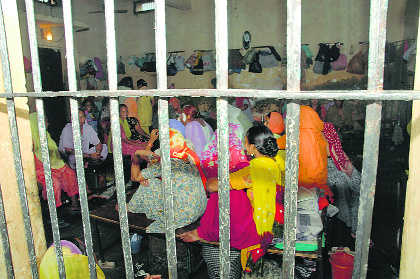
India votes and `suffers’ women prisoners and their children. And we call it democracy.

Elections matter. Australia voted, catastrophically, and immediately after suicide attempts and other forms of self-harm spiked among refugee and asylum seeker prisoners on Manus Island and Nauru. Elections matter. India voted, catastrophically, and the news for women inmates in prisons and jails across India is grim. The last five years of the Modi regime have meant ongoing and increasing violation of women prisoners’ rights, autonomy and well-being, on one hand, and a policy of increased opacity, on the other. In both instance, Australia and India, the State blames the women and children for the violence and torture the State visits upon their bodies and souls … and they call it democracy.

India went to the polls from April 11 to May 23. While it had little or no impact, the same week the elections began, the National Crimes Record Bureau, NCRB, finally released its Prison Statistics India 2016 Report. That report came in after an unexplained years’ long delay. The Prison Statistics India 2015 Report was issued in a timely manner in September 2016. The 2015 Report opens: “I am privileged to release the 21stedition of `Prison Statistics India’ for the year 2015, an annual publication of National Crime Records Bureau since the year 1995.” In 1996, the National Crime Records Bureau was tasked with publishing an annual report on the conditions in India’s prisons and jails. For 21 years, it did so, dutifully and faithfully. And then … it stopped. This silence concerning the conditions of prisons, jails and, most importantly, prisoners was matched by an equivalent “failure” by the NCRB to publish its annual Crime In India report for 2017. This was the first “failure” of this annual report since 1953. Taken together, the lack of reporting begins to look more like refusal than failure: “All this has happened on the watch of a government that is known for being less than forthright about official data.”

This refusal to provide detailed data continues throughout the Prison Statistics India 2016 Report. Most glaringly, the new report says nothing about caste or religion. Whereas earlier reports described, in detail, the situation and conditions in prisons and jails for Dalits, members of the Scheduled Castes and Scheduled Tribes, members of religious minorities, especially Muslim, this last `report’, the methodology of which is ostensibly the same as previous reports, says nothing. According to the most recent census, 16.6% of India is Dalit, while Dalits made up 21.4% of India’s prison and jail population. Likewise, Scheduled Tribes make up 8.6% of the Indian population and 12.8% of the prison and jail population. Many noted these discrepancies and strove to address them. The Modi regime has addressed them by erasing not only categories but whole sectors of the population. This is not failure to represent, this is refusal to represent, and it’s part and parcel of the caste and religion-based politics of the Modi regime and of his political party.

Where are the women in this picture? Everywhere and nowhere. Before the latest report came out, it was already known that prisons and jails in India are particularly damaging to women. First, they’re designed for men. Second, they have less access to facilities and resources within prisons and jails. Third, they have less access to resources outside of prisons and jails. For example, “a woman, nearly 70 years old, has been in jail for the past 18 months on kidnapping and rape charges … While five others, including two male co-accused, have been released on bail, she continues to be behind bars. Having lost her husband during her incarceration, she has no one to reach out to. What purpose is being served by keeping her inside?”

Further, over the preceding fifteen years, the rate of men’s incarceration has increased by 33%, while that of women has grown by 61%. Despite this growth of women’s incarceration, neither budgets nor infrastructure has increased. Thus, the women’s prisons are severely overcrowded and filthy; the food and hygiene are deplorable; and there is virtually no physical and mental health care. For Dalit and Adivasi women, the conditions are predictably worse. According to a recent study, “76% (279 prisoners) of prisoners sentenced to death in India belong to backward classes and religious minorities, with all 12 female prisoners belonging to backward classes and religious minorities.” None of this is in the most recent NCRB report.

The NCRB report does provide some data, and the most salient fact is that 67% of India’s prisoners are “undertrial”, meaning awaiting trial … meaning officially innocent. From 2014 to 2016, the number of undertrial, or remand, prisoners rose 3.6%, from 282,879 to 293,058 in 2016. Close to 71% of undertrial prisoners are deemed illiterate or low literate. While among convicted prisoners, prisoners 30 – 50 years old predominate, among undertrials the majority are 18 to 30 years old. 72% of women prisoners are awaiting trial. Much more than with male prisoners, women prisoners are overwhelming young, minimally educated, poor … and formally innocent. Additionally, there are 1,809 children in prisons and jails across India, and they all are cared for by their mothers, women prisoners. Of the 1809 children living behind bars, 78% of their mothers are awaiting trial, minimally educated, poor … and formally innocent. 

Elections matter. Information matters. Transparency matters. Democracy matters. The United States “discovered” this week that a 10-year-old girl from El Salvador died in custody, last September, and that the State lied and hid that girl-child’s death. We are dismayed but not shocked or surprised. Refugee and asylum prisoners in Australia engage in increased self-harm and suicide attempts following the Australian national elections. Some are finally, in some cases after five-year delays, sent to the mainland for `care’. India cages more and more Dalit, Adivasi, Muslim young women and children, all formally innocent, and covers it in the civil equivalent of the fog of war. And we call it democracy.


(Photo Credit: The Tribune India)
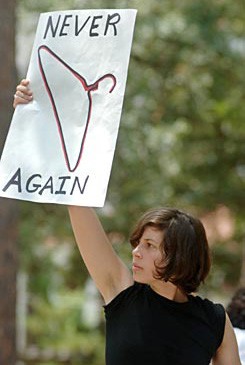
Banning abortion isn’t about morality: It’s the economy

Stop trying to convince anti-abortion folks that they should listen to the stories about a person’s choice with abortion: they don’t care. I don’t mean to imply that people who have had abortions should not go public, as it helps to end the stigma even within pro-choice organizations. Those in positions of power could care less about a person’s abortion story because the problem was never abortion. Just look at the extensive list of anti-abortion advocates whose motto boils down to “it’s OK for me; evil for thee.” A person shouldn’t have to air their personal and complex decisions with the hope that it would change some terrible peoples’ minds. It won’t, because it was never about abortion. 

Why, at this moment, are abortion bans happening? Think about the economic and population consideration that cause the state and those in power to decide that abortion and other contraceptives are suddenly immoral, that a woman’s essential purpose in life was motherhood and that sex was only for reproductive purposes. And if the birth of that child causes even more economic strain and forces those who can get pregnant into low-wage and exploitative labor? Well, that’s par for the course. If people have no choice but to pay back multiple medical bills even though they gave the child up for adoption? Well, get a second or third job. And if a person dies because they sought a back-alley abortion. Well, they deserved that punishment. A person goes to prison for miscarrying or for seeking an abortion only because they haven’t served their purpose of producing the next generation of workers, laborers and child-bearers, and the state deserves retribution, because we’re starting to need those next generations, desperately.

Abortion access and contraceptives have been banned or legalized depending on the state’s political and economic needs. Prior to the 19thcentury, a person could to a physician and end her pregnancy as long as it was before they could feel the fetus move. Growing concerns over the rise of Catholic immigrants served as a pretext for the rise of restriction to abortion, since immigration was infringing on the White Anglo-Saxon majority and Protestant were having fewer children. The first attempts at opposition to abortion and contraception were the Comstock Laws in 1873, passed to regulate information to the public about abortion, contraception, and sexually explicit material such as pornography. Fetal personhood hardly came into the argument until the early 20thcentury, and that argument was subsumed by the rise of religious morality which tied sex solely to the role of reproduction and not for pleasure. 

States implementing abortion restrictions saw birthrates drop from 37 to 29 births per 1000 population. Between 1900 and 1935-39 birth rates dropped to 17 per 1000, causing that lowering birthrates would have disastrous effects on the industrialized economy, which relied on the reproduction of laborers in the workforce. For enslaved peoples, access to birth control and abortion was expressly forbidden, since slaveowners saw slave children as adding to their human capital. Slaveowners routinely would put slaves together with the hopes of children being produced and tied a person’s status as a slave to the status of their mother, ensuring a continuous supply of enslaved individuals. 

Numerous examples highlight how abortion access and restriction is tied to economic and population needs of the state and elites in power. Despite its landmark ruling, Roe v. Wade was a continuation of regulating for those needs. Nowhere in the majority opinion does an individual’s choice come into the fore: 

“A state criminal abortion statute of the current Texas type, that excepts from criminality only a life-saving procedure on behalf of the mother, without regard to pregnancy stage and without recognition of the other interests involved, is violative of the Due Process Clause of the Fourteenth Amendment. 

For the stage prior to approximately the end of the first trimester, the abortion decision and its effectuation must be left to the medical judgement of the pregnant woman’s attending physician.

For the stage of subsequent to approximately the end of the first trimester, [emphasis added] the State, in promoting its interest in the health of the mother, may, if it chooses, regulate the abortion procedure in ways that are reasonably related to maternal health. 

For the stage subsequent to viability, [emphasis added] the State, in promoting its interest in the potentiality of human life may, if it chooses, regulate, and even proscribe, abortion except where it is necessary, in appropriate medical judgement, for the preservation of the life or health of the mother…

This holding, we feel, is consistent with the relative weights of the respective interests involved, with the lessons and examples of medical and legal history, with the lenity of common, and with the demands of the profound problem of the present day.”

Even in such an important decision, the Supreme Court has given the state leeway to enact and decide regulations for a person’s right to choose what happens to their bodies. Wade was the beginning, but the work still needed to be done. Anti-abortion backlash happened almost immediately after the decision.

What is the economic and population landscape of American society now that is leading us back to a time where people are going to be criminalized for seeking abortions? What are people not seeing when it comes to the political landscape, where white men in positions of power can cry for the life of the fetus but demand that a mistress seek termination of a pregnancy? 

The US birthrate fell to a 32-year law in 2018, a 2% drop since 2017. Birthrates fell across all racial lines, a 1% fall for Latinx people and a 2% fall to Black and White individuals. The economy is desperate for higher birthrates, both for the future labor force and caregivers for the aging population. Instead of fixing economic factors that would lead to higher birthrates – a living wage, parental leave, a robust welfare state and single-payer healthcare –, states would rather criminalize any form of birth control to get the desired results. 

These decisions are further impelled by white supremacist ideology. Since the United States is going to have to rely heavily on immigrants to supplement those labor needs, a white majority in an Anglo-Saxon society is once again in “danger” of turning into a minority. The same racist fears that led to bans in abortion and contraceptives are being rehashed. That is why we cannot rely on the state, Democrats in power and a better President to save us by telling the stories of the individuals that have had abortions. That is why calling for safe abortions to happen because back-alley abortions will kill people won’t matter.  Again, they don’t care. Stop giving pro-life the “sensible” debate about a person’s choice. From here on, and as before, we can only rely on each other to ensure a person’s bodily autonomy.


(Photo Credit: Women’s Web)

Maria Mahlangu is still dead. How many Maria Mahlangus died without justice?

Maria Mahlangu is still dead. We do not know how many Maria Mahlangus died without a voice, without their story making news, without justice. Many domestic workers are in jeopardy because our homes (their workplaces) are not always safe workplaces. We can end this, by joining the call of thousands of domestic workers to end the era of exclusion, of them being treated as third-class workers. 

Domestic workers, predominantly Black women, make up “more than 8%” of Black workers in South Africa, far outnumbering Black professionals in our workforce. The way we treat domestic workers (in law and in our homes) is an expression of our disdain for Black bodies, for Black women’s bodies and their labour as a nation. The extent to which we continue to extract their labour with little recognition of their dignity and rights, and even less legal recognition, is a moral outrage, a profound injustice. This is a cause we are obligated by our morality and our sense of justice to get behind. If there are more than 2million domestic workers in this country, this is a cause of millions of us in this nation. 

Let this be where we begin our full stop to injustice, gendered injustice. It is an outrage that this had to go to court to begin with, but it has come to that. Tomorrow domestic workers will be in court to defend what should be a constitutional right. How will you stand with them? It is not enough to be nice to Mavis, although Mavis deserves all the respect you should give. We can do something more fundamental than that, that improves the lives of all the Mavis’s. So, dear friend, how will you show up for the people who show up for millions of our families every day? 

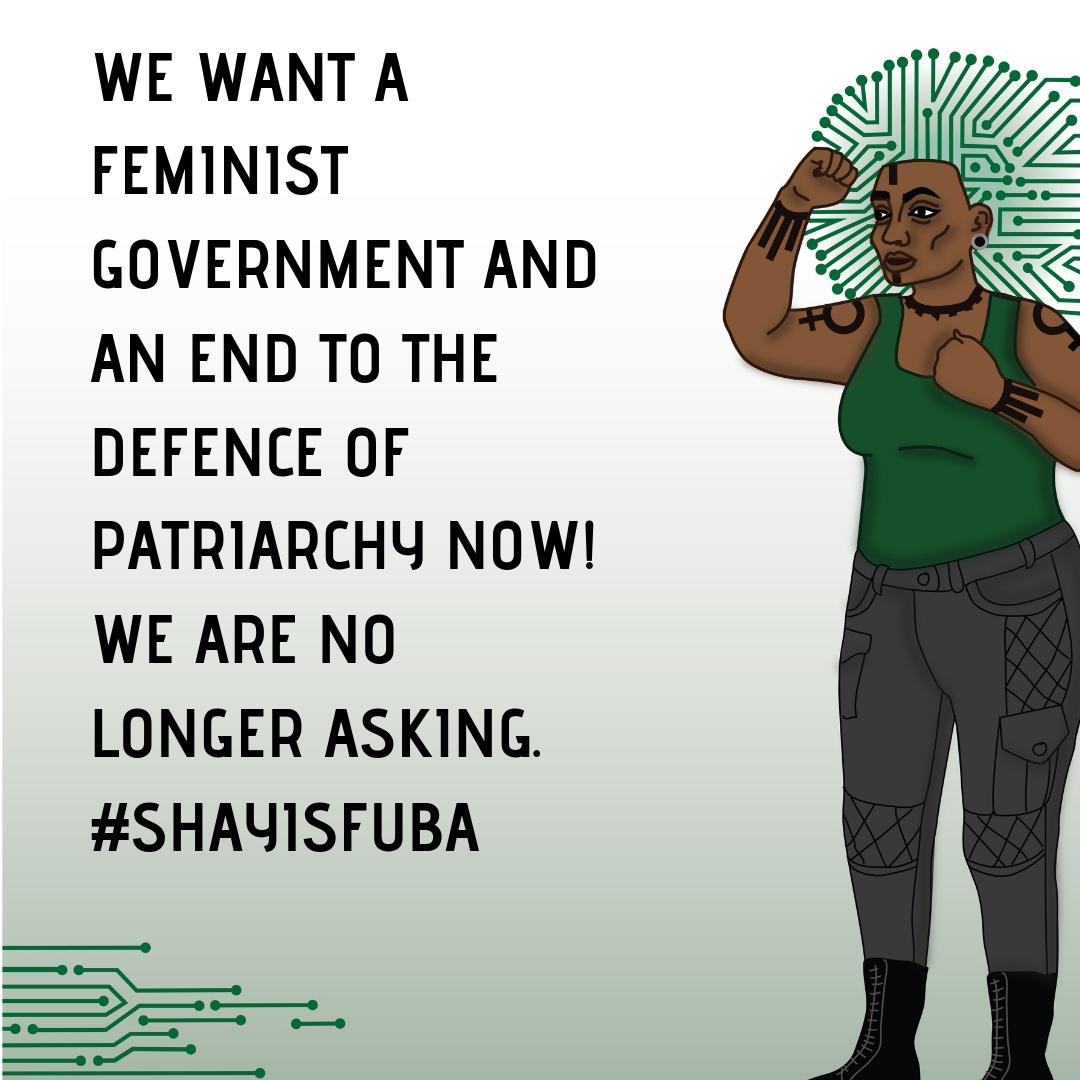
Domestic workers, their union formations and those who support them started the campaign under the Domestic Workers Rising banner. They are co-founders of #Shayisfuba, an intersectional movement of womxn individuals and formations who’ve come together to build solidarity with each other, to learn about and fight common struggles. The movement is saying a feminist government would have prioritised equal protection for all workers, particularly the least protected, domestic workers. It is not too late!

(Image Credit: New Frame)

Goddess Kaddish: dedicated to Greta Thunberg a faithful Kaddishim

Goddess Kaddish: dedicated to Greta Thunberg a faithful Kaddishim

I can hear my mother call; can you hear your mother call?
The Mothers who have chosen to give birth
And The Mothers who have chosen not to

Can we let our Mothers choose 
While also choosing our Mothers?

Fetal heartbeat laws
Alabama, Georgia, Ohio, and Louisiana
Restrictive American meccas 
Using 21st century trick-nology to make medieval decisions.

The heartless say they hear a heartbeat
Could the Religious Right
Be religiously wrong?

Macrocosmic microcosmic contradictions
We use laws to remove choice from Mothers
While refusing to enact laws to protect Mother Earth 

Leave the seamless webs to Mother Ariadne
Because when we weave
our webs are frayed 
And misshapen 

And Mother knows best

To She whose name means: 
The Mother of all Living
Who continues to get a bad rap

To the serpent encircling the egg of creation who waits patiently for our realization.

ॐसंसरस्वत्यैनमः॥
Auṃ saṃ Sarasvatyai namaḥ॥
Hail to Thee oh Source of all Wisdom

May Her great Name grow exalted and sanctified

ॐशान्ति: शान्ति: शान्ति:॥
Oṃ śhāntiḥ śhāntiḥ śhāntiḥ॥
Amen Peace, Peace, Peace

In the world that She created as She willed
May Her sovereignty prevail in your lifetimes and in your days, 
And in the lifetimes of the entire world family
Swiftly and soon. 
Now say: 

ॐशान्ति: शान्ति: शान्ति:॥
Oṃ śhāntiḥ śhāntiḥ śhāntiḥ
Amen Peace, Peace, Peace

May her Names be blessed forever and ever

I can hear my mother call; can you hear your mother call?

But no science applying to Mother Earth.
Why listen to climate science when you can just guess?

Black milk from the breast of mother earth 
 she nurses us patiently
But will we ever be weaned?

To Greta Thunberg who sees her long body already perceiving herself
As mother 
As crone 
As ancestor

Sixteen year old Tetragrammaton 
She is three in one and one in three 
And speaks as the mystical fourth
Obsessively and compulsively seeing the world in Black and White
So that it may stay forever Green

The celebration of the earth needs more then a single day
One million species at risk of extinction in the next twenty years

The greatest threat to biodiversity

U.S.

(We see you, Monsanto) 

Can we collectively reassemble this shattered vessel while there is still time

tikkun olam:
Goddess will only come to earth when she is no longer needed.

All poets have selective mutism and speak only when necessary
And this is one of those times
Oh sing, Greta 
Sing you faithful kaddishim
Your skin, bone, and heretic’s heart be your authority.

ॐश्रींलक्ष्म्यैनामः॥
Auṃ srīṃ Lakṣhmyai namaḥ॥
Hail to Thee Oh Source of all riches

Blessed, praised, glorified, exalted, extolled,
Mighty, upraised, and lauded be the Name The Triple Goddess
Blessed is She.
Beyond any blessing and song, 
Beyond any praise and consolation that are uttered in the world.
Now say:

ॐशान्ति: शान्ति: शान्ति:॥
Oṃ śhāntiḥ śhāntiḥ śhāntiḥ॥
Amen Peace, Peace, Peace

May Her Name be blessed forever and ever

I can hear my mother call; can you hear your mother call?
To the earth mothers through whose hands the Goddess feeds
Can you see her hands in all hands hands?
Making a chapati
Or a flour tortilla
A loaf of bread 
Injera 
Sweet potato flat bread
Or offering fermented cabbage and a single bowl of rice

ॐक्रींकाल्यैनम:॥
Auṃ krīṃ kālyai namaḥ॥
Hail to She who takes away the darkness 

Blessed, praised, glorified, exalted, extolled,
Mighty, upraised, and lauded be the Name 
Of She who governs the fullness of time
Blessed is She
Blessed beyond any blessing and song, 
Beyond any praise and consolation that are uttered in the world. 
Now say: 

ॐशान्ति: शान्ति: शान्ति:॥
Oṃ śhāntiḥ śhāntiḥ śhāntiḥ॥
Amen Peace, Peace, Peace

To the Virgin
To the Naiad 
To the Crone
In her fear inducing 
And beneficent forms
Can you see her vigorously pointing 
Spanking your bare bottom
Or using a shoe like a boomerang

(Boy! I brought you into this world and I can take you out, too)

To the Angels in suffragette white raising the roof in Congress; 
The workers striking and singing Bread and Roses
The burnt wreckage of our lady in Paris 
The Black meteoric stone in Mecca encased in Vaginal shaped silver 
We all come from The Mother and unto Her we shall return

ॐह्रींश्रीं  दुं दुर्गायैनमः॥
Auṃ hrīṃ srīṃ duṃ durgāyai namaḥ॥
Hail to She who is difficult to approach
Grantor of Increase
Who Removes all Difficulties

May there be abundant peace from Heaven 
And life upon us and upon all the world
Now say:

ॐशान्ति: शान्ति: शान्ति:॥
Oṃ śhāntiḥ śhāntiḥ śhāntiḥ॥
Amen Peace, Peace, Peace

I can hear my mother call. Can you hear your mother call?

To the Southern Black Women in a galvanized steel tub
Who laundry danced so that I could fly
Oh mother I would kiss those soapy feet if I could

To the German char woman who could
butcher
cook
and eat 
every single part of a pig
“Brains is good waste not want not”
she would say

Three boxes of detergent in her cupboard at all times 
When one was empty 
Time to buy a replacement box

To Sister mothers who held my hand while mama died
She who habitually stole the last crispy perfect french fry 
From my dinner plate

From womb to tomb
Womb to tomb 
again and again
be they 
Stellar
Aqueous 
Or Earthly dust

We all come from The Mother and unto Her we shall return

She who makes peace in Her heights, may She make peace, 
Upon us and upon all the world
Now say:

ॐशान्ति: शान्ति: शान्ति:॥
Oṃ śhāntiḥ śhāntiḥ śhāntiḥ॥
Amen Peace, Peace, Peace

Mother you are full of grace
And blessed are we the fruit of Your womb
Bless us now and in the hour of our deaths and rebirths


(Photo Credit: Hanna Franzen / Reuters / New Scientist)

man-up

man-up

It is said
about men
that they 
have it

The balls

that fascist ruler-past
out in Brexit country
she had it they say

The balls

we hear now
that she can
our Caster Semenya

she can
man-up
and race
against men

she still 
facing a testing time
in a world insensitive 
to anything unlike

(a strong girl she is
post-Saartjie Baartman
post-apartheid’s pencil test
and virginity testing too)

man-up
they say
those folks

are they men
one and all

those folks
who run 
athletics

man-up
they say

not yet
Uhuru


(Photo Credit: Athletics Weekly)

Australia is not shocked by the torture of refugee children; Australia is shocked by their survival.

Sajeenthana

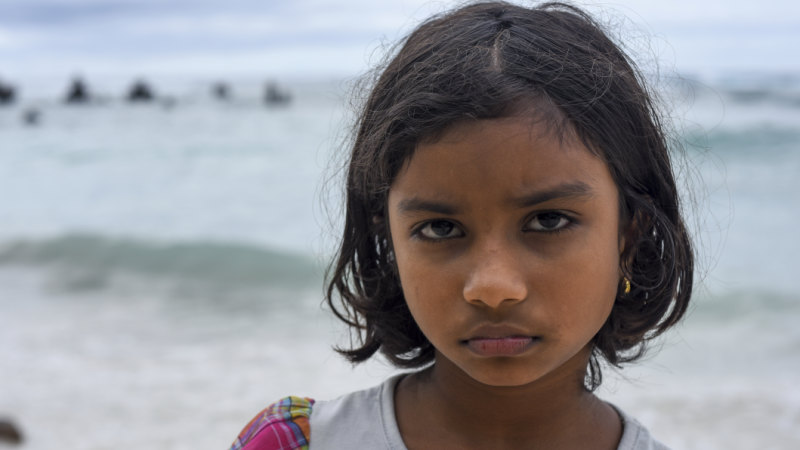
Tomorrow, Thursday, May 16, 2019, in Sydney, Australia, for one night only: “COMMUNE presents LIMBOLAND, an exhibition by Sydney artist Lachie Hinton and photojournalist Mridula Amin exposing the stories of refugees and asylum seekers who were detained indefinitely on Nauru.” At the heart of this exhibition, and project, is a Tamil girl from Sri Lanka, named Sajeenthana. At the age of three years old, Sajeenthana “arrived”, was dumped, on the island of Nauru, thanks to Australia. When anyone tried to engage with Sajeenthana, she had a simple, straightforward response: “I want to kill myself”. That’s what Sajeenthana said, and that’s what the other child refugees on Nauru said. Australis is not shocked by the pain, suffering, torture it has inflicted on these children. Australia is only shocked that they survived. Sajeenthana is now eight years old.

In February 2019, Australia emptied Nauru of its child refugee population. Many were sent to the United States. Sajeenthana and her father were rejected. In October 2018, Sajeenthana stopped eating. She spent 10 days in hospital on Nauru. Then she and her father were moved to a Brisbane hospital. From there they were moved to “community detention” in Brisbane. No one knows what will happen next.

What is known is this: Australia forced Sajeenthana to endure a childhood composed of suicide and self-harm. Leaving Nauru is a first step, but Nauru has not left Sajeenthana, nor all the other children who lived there, the ones who witnessed “successful” suicides as well as suicide attempts, who watched so many others cut themselves that it became a “natural” part of life. 

Australia has engaged in a decade and more of unrestrained, indefinite detention of migrant, immigrant, refugee, asylum seeker children. Why do the adjectives matter? Australia’s national policy has been to torture children. The torture of children has become ordinaryroutine, and while some may claim to be shocked, in fact the State has been proud of its routine torture of children and proud of its people, the true Australians, who are NOT shockedNOT SHOCKED, by the routine torture of children. That’s why, even if it looks like the camp on Nauru is closed, there are no plans to close the camps.

So, here is a poem for the children, the ones who were never meant to survive:

Detention Deficit Disorder
by Jane Downing

How do you write a poem about Manus and Nauru
We’ve seen the razor wire footage/ listened to the reports succumbed to Attention Deficit Disorder – look a celebrity died Will a well chosen image connect
Move someone to action (not me)
like poetry in the old days recited in the heat of revolution Does this need a personal anecdote
to give it a punch above lecture/harangue
a poignant quote*
A crisis point to bring into focus the human face
that reveals the inhumanity of our country of the Fair Go turning a willfully blind eye
and blaming the hypocrisy of smiling politicians
Will a reference to Hitler help any (no) 

How could the Germans not have known? It’s not as if we don’t 

History will not be kind
An Apology will be too late
Having written a poem will not have been enough 

* ‘Poetry is about the grief. Politics is about the grievance’. Robert Frost 


(Photo Credit: SBS News / Lachie Hinton)

Restraint and seclusion in Maine schools is an atrocity

Yesterday, May 13, 2019, Disability Rights Maine, DRM, released a report on the use of restraints and seclusion rooms in schools in Maine, an update on its 2017 report. Conditions in Maine have worsened: “DRM found: 1) the use of restraint and seclusion has increased every year since 2014 – from 12,000 to more than 20,000 in 2018; 2) data remains incomplete because multiple covered entities fail to report every year; and 3) students with disabilities continue to be disproportionately subjected to restraint and seclusion, as a majority of the restraints and seclusions in Maine take place in special purpose private schools for children with disabilities.” The report concludes, “Restraint and seclusion are dangerous and ineffective practices. They are supposed to be reserved for emergency situations, but as the data shows, they are being used at alarming rates and it continues to rise every year. Just last school year, there were an estimated 20,000 restraints and seclusions in Maine schools and likely more. This translates to a restraint or seclusion every 5 minutes that school is in session. Something has to change … Maine students are restrained and secluded at rates over four to eleven times the national average, and students with disabilities are subjected to these practices at significantly disproportionate rates.” Every 5 minutes, a child in Maine is tortured and they call it education.

In 2017, New Zealand banned seclusion rooms, calling them unreasonable and oppressive. Last year, Alberta, Canada, was forced acknowledge and begin to address its use of seclusion and restraint as a form of torture of children living with disabilities. Last year, England was forced to begin to acknowledge its use of seclusion and restraint of schoolchildren as a form of torture. In the United States, Georgia has `struggled’ with its seclusion rooms for the last decade. In 2004, Jonathan King, 13, hanged himself in a Georgia seclusion room, an 8-foot-by-8-foot cell called a “timeout room.” In 2009, the National Disability Rights Network published School is not supposed to hurt: Investigative Report on Abusive Restraint and Seclusion in Schools. It’s 2019, and schools across the United States today hurt more children more intensely.

Why have we declared war on children living with disabilities? Why have we chosen to do something worse than criminalizing children living with disabilities? In the name of education, we have chosen to torture children until they seek their own death. What terrible sinhave these children committed? Why do we continue to send children into solitary confinement? Why do we continue to torture those who are most vulnerable? When will we stop this practice? What are we teaching children, all children in all schools, when we torture their classmates and then call it “seclusion” and “restraint”? Why does it take so much time and energy to stop torturing children? Solitary confinement in prisons is torture. Seclusion rooms in schools is torture. This is us: children dying in seclusion rooms across the country

Now it’s Maine’s turn to suffer the children. Maine legislators will sit through heartrending testimony of parents of children who have been `secluded’: “She was a different kid when she came back. It was months before she genuinely smiled or laughed again. And this happened in Maine, to my daughter, to my girl. And it’s not OK.” It’s not OK. It never was.


(Infographic Credit: Kennebec Journal)

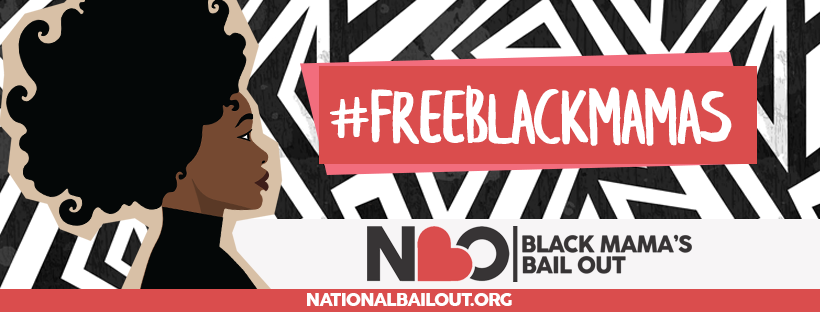
This Mother’s Day, remember the women who can’t be with their children: Support Black Mama’s Bail Out Day

This year, remember the women who can’t celebrate Mother’s Day with their children because of the exploitation of black women in the criminal justice system. Help the work being done to make sure that women forced to remain in jail can be home with their children for Mother’s Day. This Mother’s Day will mark the third annual Black Mama’s Bail Out Campaign, a grassroots community-based movement focused on dismantling the cash bail requirement, “With cash or money bail, individuals awaiting trial, plea bargain or a conclusion to their case must remain in jail unless they (or a relative, bail bond agent, etc.) can pay for their release.” 

Advocates nationwide will be coordinating to help free incarcerated Black mothers and caregivers in time for Mother’s Day. The bailouts are scheduled to start from May 6-12 into two dozen jurisdictions, including Cleveland, Memphis, Detroit, Baltimore, Philadelphia and Los Angeles.

The movement was launched May 2017 with a campaign to post bail for Black mothers who would otherwise be separated from their children on Mother’s Day, the campaign helping to free 100 women and sparking year-round movements. Other fundraising events center around Father’s Day, Juneteenth and Pride. The campaign will continue to highlight local organizing efforts as activists, “call on legislators, judges and district attorneys to abolish the cash bail system.” Such cash bail systems punish people with continued incarceration for living in poverty. 

Nearly half a million people who have not been convicted of a crime are imprisoned on any given day because they can’t afford to pay bonds or bails, according to the Prison Policy Initiative. This system disproportionately affects the poor and communities of color including Black, Latinx and Native American women. Almost 70% of women in jail who can’t afford bail are mothers of children under the age of 16. 

National Bail Out Collective has also worked to bring to the forefront the issues of mass incarceration as it affects women. Marbre Stahley-Butts, founding member of the movement and executive director for Law for Black Lives, has argued that the discussion also needs to focus on women’s growing rates in prison. “We know that right now, women are the fastest growing prison population. There’s a real need to talk about how these systems impact women,’ said Stahly-Butts, who believes such conversations should be inclusive of queer and trans women. Describing mothers and caregivers largely as ‘the backbone of our communities,’ she told Essence, ‘When one of these women is taken away, it’s their children, partners, and the entire community that suffers.” Even if individuals are later cleared of charges, current bail systems can be detrimental to these families; they lose jobs, housing, and child custody as they are forced to sit behind bars. 

The movement and campaign work to end the racist and classist mechanisms that keep marginalized communities in jails without ever being convicted of crimes. Since its launch the National Bail Out Collective has helped secure the freedom of more than 300 individuals across the country, and $2 million have been raised by donors to fund bail and criminal justice reform work. This work also includes providing opportunities for previously incarcerated women. 

“National Bail Out is a Black-led and Black-centered collective of abolitionist organizers, lawyers and activists building a community-based movement to support our folks and end systems of pretrial detention and ultimately mass incarceration. We are people who have been impacted by cages—either by being in them ourselves or witnessing our families and loved ones be encaged. We are queer, young, elder, and immigrant.” 

You can still donate to help bring Black mothers home here.


(Image Credit: National Bail Out / Facebook )

#SADecides2019: Today I’ll be voting for the future, for the ones that will bring us closer to ourselves, to each other

Every minute I believe this. It’s what keeps me going, why I do what I do, what explains the choices I’ve made in life and perhaps those I shall yet make, what makes me who I am. The unwavering belief in the power of people to make a country, a society. To heal themselves and each other. They may get lost in the woods sometimes, sometimes for quite a while. But eventually, they find themselves. 

I’ve come to know intellectually, intimately, how broken societies are a manifestation of broken people.

Today I’ll be voting for the future. For the political formations of the future. The ones that will bring us closer to ourselves, to each other. Those that will inspire us to heal, and to lead ourselves and each other from the inside out. Those who will remind us to honour our own promises to ourselves, and to make promises to each other that we can keep. The promise to love, to value genuinely, to care deeply. Those who will not inspire us by grandstanding on highwaters waving the pennant of empty militancy to our fragile hopes. Those who will remind us that we have survived this long because we are powerful and not because political parties of so-called leaders did anything for us. Who will reconnect us fiercely to our power within, our power to, our power with.

I am sick to my core of big bombastic words and shallow philosophies of big men who perform their fragile masculinity like it’s some spectacular show we zombies must cheer at. After so many years, I’m done with this fake show. As I go out to vote, I am carrying Alice Walker’s poem in my hand, in memory of my mother, my grandmother, all the broken ones in my family, my movement homes, the people known and unknown that I believe in because they believed in me, all the womxn and the theys who are the source of my belief in our hopeful future, the ones who literally hold up the sky from falling and crushing us all. 

And of course also I carry this book to keep me company in case I find no friends in the queue to talk to, such as Xthi Nxngxmso and Mmatshilo Tumelo Motsei. I’m also carrying this book to give as a gift to a new friend I may meet in the queue and discover could use it. It’s that kind of day, maCom.

Alice, thank you for the words, sisi wam, may we find our power in our brokenness!

I WILL KEEP BROKEN THINGS
                        by Alice Walker

I will keep
broken
things:
The big clay
pot
with raised
iguanas
chasing
their
tails;
two
of their
wise
heads
sheared
off;

I will keep
broken
things:
The old
slave
market
basket
brought
to my
door
by Mississippi
a jagged
hole
gouged
in its sturdy
dark
oak
side.

I will keep
broken
things:
The memory
of
those
long
delicious
night
swims
with
you;

I will keep
broken
things:
In my house
there
remains
an
honored
shelf
on which
I will
keep
broken
things.

Their beauty
is
they
need
not
ever
be
‘fixed.’

I will keep
your
wild
free
laughter
though
it is now
missing
its
reassuring
and

graceful
hinge.

I will keep
broken
things:

Thank you
so much!

I will keep
broken
things.
I will keep
you:

pilgrim
of
sorrow.

I will keep
myself.

#SADecides2019: I am taking my weary soul to the polling station now

I am taking my weary soul to the polling station now. Present in my bones is our countries histories. I want to keep walking. Even in my moments of despair, I want to keep finding the will to walk forward. 

The past few months found me deeply immersed in a Realising a Feminist Government Campaign with many womxn and gender non-binary people. We dreamed the campaign into reality from years and years of being in conversation as feminists at different times and in different spaces. Feminists who thump our chests and stand solidly in our rage, our pain, our expansive love, our willfulness. Feminists whose patience has worn thin. Feminists who demand a governance system that smashes all forms of oppression. 

The rolling actions around the country were spaces of radical healing, deep sharing, tears… tears…., song…song…., imagining futures where even currencies look different and spaces of rest are wherever we want them to be, and it’s safe and our bellies are all full. It’s not impossible with the right intention. 

Today I am with myself – just me and my ballot paper. Tomorrow is another day we will keep mobilizing and invoking the kind of world we want, until we are in it!!!

Shayisfuba #feministgovernment #dreamingfeministfutures 

SHAYIS’FUBA! SHAPA SEFUBA!


(Image Credit: Twitter / SHAYISFUBA)