CHII CHIRIKUITA: WHAT’S UP?: Eight: A Solo Encounter With Dudu Manhenga

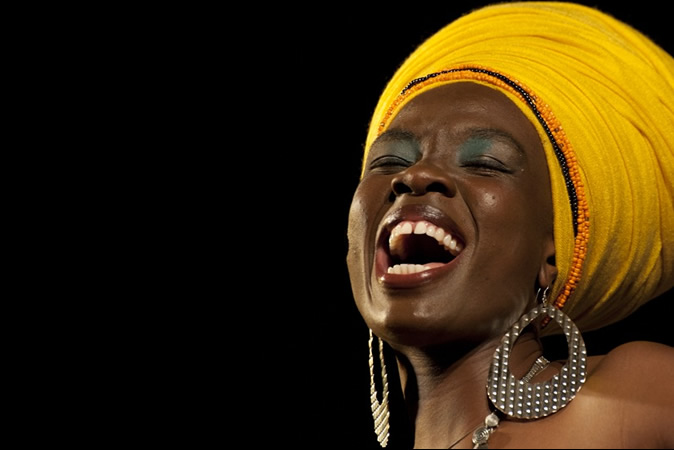
Dudu Manhenga

The stage glows with shades of blue, the glitter ball casts a thousand stars …
She walks in tall and svelte, her eyes dancing
Her passion and enthusiasm is infectious
Her delivery is tight, on par with top music acts in the Southern African region, and indeed the world.
Her style is influenced by the great Afro jazz singers.
The power of her voice and the dignity of her delivery make the audience sit up and listen transporting them on the highways and byways of the rhythms of jazz. 

Meet Dudu Manhenga.  And the Color Blu. 

Involved in music from a very early age and influenced by Bulawayo based Amakhosi productions Dudu says, “the art called out to me, I never intended to be an artist. 

When my Mama first saw me perform on stage using a microphone, at my grade one  prize giving at St Bernards in Pumula, she said, “I knew this was going to be trouble!’” 

She has travelled a long road since and her current offering is Solo Encounter’s running at REPS theatre from the 17th – 21st of March.  It’s a close-up interaction with the afro-jazz artist.  “Most of the time when I perform in clubs I don’t get intimate time with my audience.  A solo encounter makes it feel like the audience has a one on one with me.  It’s an interactive show, people can make requests, ask questions and discuss the songs, they can actively be part of shaping the show”, she says. 

Her songs explore the politics of the self.   She sings different aspects of women being.   It’s an organic performance and it does indeed feel like we’re home, the audience responds, soon leaving their seats to dance in the aisles. 

Backing Dudu for this series is the jazz group Color Blu.  The current line-up is Blessing Muparutsa (drums), Nick Nare (keys), Enoch Piroro (bass), Strovas on percussion, David Machaka (watch out for him) and Victor Muparutsa (backing vocals).  Tino Bimha, and Zanele Manhenga also provide backing vocals or the show. 

She laughs as she says of the 5 men “I am the rose among the thorns” and then more seriously notes, “It’s a statement that says it’s ok for men, lots of them, to stand behind a women.  And still be men. The guys are beautiful, amazing and talented.”  The band also performs music from their forthcoming debut album. 

Solo Encounters will be recorded for Dudu’s next live album offering, and her first two CDs, Dudu Manhenga and the Colour Blu and Jula are available for sale along with her distinctive, funky merchandise. 

The diva is also a major contributor to the Female Literary Arts Music Enterprise (FLAME), for the development and promotion of women artists, run by Pamberi Trust. 

The programme includes workshops and performances for young women entering into the industry.  Sisters Open Mic is one such space, a performance programme for emerging women artists, that runs every second Saturday from 2pm – 5pm at the Book Café in Harare. 

She notes how in Zimbabwe “…being an artist is not considered worthwhile”. She laughs as she recounts how her mother’s friends would ask after her by enquiring whether “she had found a job yet?”  Zimbabwe has so much talent that is often unrecognised within the country.  The music industry is tough on women, sexism is rife and the economic climate means things are tough.  But the workshops provide up and coming performers with necessary skills, support and solidarity to begin navigating through the terrain. 

Dudu notes that the ground is fertile for artists to blossom as long as people think out of the box and pull together, “we need a culture where we are prepared to give to each other and to contribute to the change that we want.”  Ultimately we need to encounter each other as people.  She is under no illusion that it is going to take a lot for things to change in the lcaol music industry and the country, but despite this it is clear that Dudu Manhenga is here to stay. 

The lyrics of her last song in the solo encounters repertoire clearly communicates her message.  It’s hypnotic.  Her voice is clear:  “I want you to create, innovate, elevate, don’t be afraid. I want you to create, innovate, elevate, don’t be afraid.”  She explains in recitative that “if you are creative, I can create, if you are elevated, I can elevate”.

Look out for Dudu Manhenga and if she comes to a city near you go and enjoy the afro jazz of one of Zimbabwe’s foremost women in jazz who continues to thrill her listeners with beautiful melodies and exciting rhythms, fused with intricate contemporary styles and techniques of the world in which she lives. 

(Photo Credit: Bulawayo24)
CHII CHIRIKUITA : WHAT’S UP?: Six: The Day The Rainbow Fell On The Floor

“Look” she said to me, pointing to the multi-coloured powder paint that had fallen onto the tarmac, “the rainbow fell on the floor.”  She stood there, eyes wide, hands on her hips, her oversized school uniform making her look smaller than her 6 years. 

Then, I watched her skip away, satchel in tow, to the school hall.  Yes, the rainbow had come crashing down from the sky and onto the floor landing in the car park of a private school.

In these, Associated Trust Schools (ATS), parents who are unable to pay school fees see their children excluded:  barred from the classroom, separated from their friends, these sprites are exiled to the school hall. There are many parents who struggle to make the fee payments which range from anything between US$500 – US$1500 per term (3 months) depending on the school.

And the handful of private and state schools where parents can pay large supplements to teachers’ salaries to subsidise the running of the school, are the only ones that are fully functional at the moment. 

But in a bold move this week, the new Minister of Education, Sports, Arts and Culture, David Coltart, announced that no child should be excluded from school for non-payment of fees. Arrangements for payment in instalment now have to be made to ensure that every child no matter the school has access to education.

This is just the beginning of what Mr Coltart, who reported for duty only a month ago, has had to deal with.

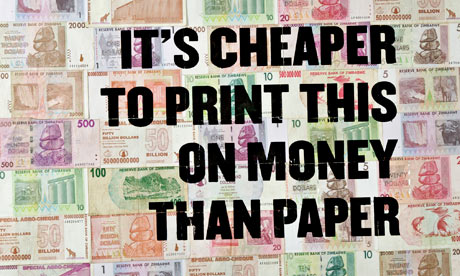
From once having one of the highest standards of education in Africa, recording a 72% national O-level pass rate in the mid 1990’s, last year it crashed to 11%.  With the mid 1990 implementation of Economic Structural Adjustment the Zimbabwean government spent less and less on education, so that by 2006 expenditure on education was only 13% of the national budget. By this time hyper-inflation had begun to bite, and it is estimated that in 2008, the value of government spending per child was equivalent to just 18 cents.

The many children in government run schools did not receive an education last year. The Progressive Teachers Union of Zimbabwe estimates that the majority of pupils in the country had a total of 23 days uninterrupted in the classroom.

The academic year should have just been cancelled!

2008 saw teachers go on strike, their salaries worthless, eroded by stagnation and inflation that was officially pegged at 231 million percent.  Many teachers simply could not afford to go to work because their monthly pay was less than the bus fare for the same period.  This, coupled with election violence, the assault of teachers by ZANU PF militia, the looting of schools and the use of some school premises as torture centres dealt the final blow to Zimbabwe’s education system.

And now, virtually all rural schools are closed as well as some urban ones.  Even if they were open and teachers tried to teach the vast majority of schools do not have desks, they do not have textbooks, chalk, exercise books.  Overwhelmed by water and power cuts, buildings are in a state of disrepair and children are adrift.

Nothing is more true than for some of Zimbabwe’s most vulnerable, homeless, hungry and abused:  street kids.   At a workshop held at Streets Ahead, a care and drop-in service for street children, girls write and paint their dreams – murals of beautiful visions of healthy and happy futures.  Here girls and boys can drop in during the day, take a shower, have a meal and engage in activities such as art, drama, craft.  It’s a classroom even though it may not be formally recognised as such, there are many such classroom spaces in and around Zimbabwe, without walls or desks. Its an unidyllic idyll.

The girls talk and discuss as they work. As economic orphans (children are left behind whilst their parents go in search of forex) girl headed households mean that girls shoulder the burden of care.  Sexual violence and rape has meant that many girls now nurse babies. 

But the small people go on with the business of living and learning.  There are many ways to learn, formal and informal and life in Zimbabwe teaches children skills to survive.

No matter where they are located, children always find time to play, run, laugh, have mud fights, right in the midst of everything.  Life always goes on for the living.   Children dream dreams even though the rainbow has fallen out of the sky.

In the formal learning domain, teachers have threatened to go on strike at the end of April 2009 if their salary demands are not met.  Coltart makes no bones of the fact that right now the coffers the empty.  Before he can fund teachers demands, he needs to know how many teachers he has.  There is no computerised database at present and the departments records are apparently in a chaotic state.  In the past few years, many teachers have left Zimbabwe, for jobs elsewhere. It is believed that the number of teachers currently in Zimbabwe is less than 50 percent of a full complement of 140 000.

A think tank comprised of educationalist from various sectors has been put together in order to provide strategic direction and advise in rebuilding and reviving education in Zimbabwe.  The board includes amongst others, former Minister of Education Dr Fay Chung, Zimbabwe Teachers Association President Tendai Chikoore, politician Ms Trudy Stevenson, clergy man Father Joe Arimoso as well as Dr Stanly Hadebe.

Infrastructure is important.  Having the teachers in place is important.  Having the money is important.  But one of the lessons that we can take from history is that it is not enough.  Education is one of those rights that requires active mobilisation, organisation and vigilance.  We have to think outside of the current parameters.  What kind of country do we want?  What kinds of citizens do we want in this country?  What kind of curriculum is going to facilitate that? 

In Zimbabwe today, education includes the participation of everyone from children, women, men, the young and the elderly, everyone has to work to construct new relations and consciousness both inside and outside the classroom.  This includes a broad, relevant and dynamic curriculum, healthy cultures of questioning, debate and critique.  It includes an expanded understanding of what constitutes education.  Participation in seminars, assemblies, walks, volunteer work, acts of solidarity, coming together across the divides to learn and teach reading and writing, to talk and discuss, and more than this, to read and write the reality of life.

This is the hard work.

The work that will reflect and refract a gazillion rainbows in the lives of that six year old little girl standing in the school parking lot and for hundreds and thousands like her all  around the country.    


CHII CHIRIKUITA : WHAT’S UP?: Five: Walking Parliament in High Heels

9 March 2009 

In an unprecedented move in Harare last week women cabinet ministers, deputy ministers and Members of Parliament (MPs), from across party lines, gathered over lunch.  They gathered to celebrate the women who contested the March 2008 elections and to continue the process of building and strengthening a cross party women’s alliance in Parliament in order to push forward a women focused agenda. 

First to arrive was Lucia Matabenga MP (MDC-T), she was followed by Margret Zinyemba (MDC-T). Priscilla Misihairabwi-Mushonga Minister of Regional Integration and International Cooperation (MDC-M) and the new Minister of Labour and Social Welfare, Paurine Mpariwa (MDC-T) were joined by Flora Bhuka, head of ZANU-PF women’s league.  Next came Deputy Minister of Justice and Legal Affairs, Jessie Majome (MDC-T), Sekai Holland MP (MDC-T), Fay Chung and Rudo Gaidzanwa who stood as independents (linked to Muvambo) were followed Mai Dandajena (MDC-T) a long time community activist and now a senator. Oppah Muchinguri (ZANU-PF) former Minister of Women’s Affairs called in an apology, along with Olivia Muchena (ZANU-PF), current Minister of Women Affairs, Gender and Community Development and former Minister Shuvai Mahofa (ZANU-PF).  Still they continued arriving.

Despite the Southern African Development Community (SADC) Protocol on Gender and Development which stipulates that women should hold equal position to men in both public and private sectors by 2015, there are no provisions for quotas as a way to advance the representation of women in publicly elected bodies in the current Constitution of Zimbabwe (1980) or the electoral laws. 

Political parties are left to their own devices on this score and effective participation of women has been dramatically limited by the closed political environment and the “political competition and contestation” that has characterised opposition politics in Zimbabwe in the last 12 years. 

Women were caught and sacrificed in the party politics that characterised the last elections, literally and figuratively. Subsequently, there is a low representation of women politicians in the inclusive government, in fact the lowest in 15 years: only four women are part of the 35 member cabinet. Women make up 14% of the House of Assembly and 33% in the Senate. 

But getting bogged down in the math is tiring. 

Quotas are a step forward, but the numbers are not enough.  Quota’s arose out of a feminist strategy to get women into parliament in order to represent, fight for and be accountable to the needs and issues of women as a constituency. It was ultimately one of a number of strategies to ensure transformation and subsequently true and meaningful freedom for women.   But as we’ve discovered, just because you are in a women’s body, doesn’t necessarily mean you embody a transformatory politics.  As we’ve discovered too, a depoliticized uptake of quotas prevents the adoption of a political culture whereby women, however they may be positioned, are integrated into the political system.  Quotas  can circumvent meaningful structural change. 

Listening to the conversations around the table that day, I realised that once in, women face different challenges: quotas do not ensure real political participation or leadership by women; women’s activity in Parliament can often remain marginal and “women’s issues” become ghettoised and reduced to the implementation of “gender policies” often with the lack of financial resources to support their implementation. 

The dominant model of political leadership remains competitive, masculine, territorial, violent and dehumanising.  This limits not only women but also men with “non-traditional” approaches and now more than ever we need not only alternatives, but people who are willing to break rank in order to make them a reality.

The status quo is not going to do it for women in Zimbabwe and the women sitting around the table know this.  They know it for they have been in the patriarchal party political trenches.

There are no “women’s issues”.  Every issue facing Zimbabwe right now involves and impacts on Zimbabwean women. Ask them, they will tell you.

So.  Where does that leave us?

While I will always have a healthy skepticism about the extent of parliament as a radical site for change.  My hope lies in the energetic and vital link that some of these women parliamentarians have with their constituencies, through Constituency Consultative Forums, more commonly known as CCF’s.

Facilitated by a cutting edge Women’s Political Support Organisation, since 2005 these structures have been systematically established in constituencies where women MP’s committed to women served a term of office and/or were contesting elections, either under a ZANU PF or MDC ticket.

The CCF’s are comprised of a minimum of 70 women drawn from the various wards in the constituency.  Members participate in political education programmes and exchange visits to other, rural or urban, constituency forums.  The CCF’s provide both a support base for the women MP’s during elections and the vibrancy and dynamism of the CCF’s means that they also provide the necessary checks and balances in terms of accountability after the elections.

“In areas with CCF’s women contested elections and won.  In the two areas where women lost, the tide of internal party politics was too strong.  The CCF’s are powerful structures and the women members know what they want”, said a key organizer within the facilitation team.

In the chain of public participation in governance, we move from the CCF’s to another interesting women’s only space: The women’s parliamentary caucus. Many of the women who broke bread together that day were members of this body. From here, women MPs share, learn, support and startegise.  Women can and have caucused on issues, put forward positions and have even creatively blocked things detrimental to women at large from passing through parliament.  It’s certainly “safer” for women MP’s to come together under the banner of the women’s parliamentary caucus in order challenge the status quo, than for individual women to do so!

The party whip is never far away. It’s a fragile space.

In this period of “transition”, I guess my hope lies in the potentials and possibilities of  the space to contribute to a radical politics:  a politics that centers the needs and demands of ordinary Zimbabwean women wherever they may be found; a politics committed to real and sustainable change, not just the transfer of power from one elite patriarchal group to the next; a politics that interrogates our current political cultures and that refuses a paternalism that “allows” women to have their quotas, thereby fulfilling regional and international obligations around governance, with very little else.

No, this is not enough.

In this period of transition, whether the women’s parliamentary caucus and the CCF’s will haemorrhage from the wounds of partisan politics, be suffocated by the quest for individual power or be nurtured so that it can grow and form the beginnings of this new politics, remains to be seen.

I for one will be listening, following the click click of those heels as they walk from the far flung districts through to the corridors of parliament. 

Increase the peace, not the police

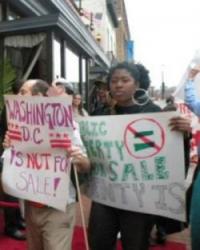
As someone who lives in deepest Southeast DC (Alabama Avenue and Stanton Road), I’m living in an area where the global collapse of capitalism has stalled gentrification. Of course, in my predominantly African American neighborhood, it wasn’t called that. My new neighbors are participating in “revitalization,” which has meant the literal razing of the old projects and the construction of flimsy new townhomes.
What hasn’t been built is the community center for all the youth, many displaced from closed low-income housing in NE and NW, like Sursum Corda, now living in this high-density zone. Summertime has been getting lively around here, to say the least. In anticipation of the coming summer:

“DC Council member Jim Graham has introduced a bill to the DC City Council that would create Hot-Spot No-Loitering Zones. The police chief would be able to declare one of these zones at any time, thus giving police the power to move people off the streets in the targeted neighborhood. The zones would make it a crime to be gathered with two or more people on public property. If people did not disperse when told to by the police, they could be arrested and given up to a $300 fine and/or 180 days in jail. This all just for being on public property.” (from an email to the CCJP listserv).

I’m not sure the bill, if passed, will even have any effect on my neighborhood. It seems likelier that it will be used in NW and NE neighborhoods, where gentrification has more of a foothold, to harass youth and others who just want to get out of the house. From what I can see, the police already have all the powers they need to stop, intimidate, search, detain, and generally make miserable ordinary folks going about their business.

While I haven’t been able to identify the original composer of the information below, I do agree that greater police powers are not the solution to high spirits (pun intended). My neighborhood is desperate for folks who offer a middle way between shooting craps on my doorstep and jail. A fabulous new community center, the ARC, has been built eight blocks from where I live. More than increased police presence, we need a shuttle bus running between the ARC and my neighborhood every 15 minutes to pick up and drop off the young folks for all the activities there, and provide a safe space for youth from different blocks with different beef to meet up and question their differences.

Here’s what we can do to divert energies from increasing policing to increasing the peace:

Talking Points

*      Being outside in a city should not be a crime!
*      We need more programs, like recreation centers, quality schools and housing.
*      Anti-loitering laws have a long history of discrimination and racial profiling; this is not a part of history that the DC government should participate in.
*      We need viable, community-based strategies for safety, not more policing and incarceration.

What you in DC can do:

*      Write your city councilmember and the at-large council members (contact details below)
*      Call the councilmembers
*      Testify at the hearing on March 18th at 10am. To testify send an email to htseu@dccouncil.us or call (202) 724-7808 by 5pm on March 16th with your Name, Address, Phone Number, and Organization and Title, if you have one. Everyone who testifies will have 5 minutes to speak. You may also submit written testimony, which can be longer, and you can do without being at the hearing.
*      Talk to people about this bill, why it’s a problem, and talk about other solutions to create safety and justice in our communities.

And you everywhere, this is an issue that concerns Right to the City, and this is an issue that concerns Women In and Beyond the Global. Its particular form and application may be local, but the issue is global. We need to take action now!

[For those in DC, here are the contact details:

Vincent C. Gray – Council Chairman (undecided): vgray@dccouncil.us.

David A. Catania – Councilmember (At-Large) (co-sponsor): dcatania@dccouncil.us.

Phil Mendelson- Councilmember (At-Large) (undecided): pmendelson@dccouncil.us.

Kwame R. Brown – Councilmember (At-Large) (co-sponsor): kbrown@dccouncil.us.

Michael A. Brown – Councilmember (At-Large) (undecided): mbrown@dccouncil.us

Jim Graham – Councilmember (Ward 1) (Introduced bill): jgraham@dccouncil.us

Jack Evans – Councilmember (Ward 2) (co-sponsor): jackevans@dccouncil.us

Mary M. Cheh – Councilmember (Ward 3) (undecided): mcheh@dccouncil.us

Muriel Bowser – Councilmember – (Ward 4) (co-sponsor): mbowser@dccouncil.us

Harry Thomas, Jr. – Councilmember (Ward 5) (undecided): hthomas@dccouncil.us

Tommy Wells – Councilmember (Ward 6) (undecided): twells@dccouncil.us

Councilmember Yvette M. Alexander (Ward 7) (co-sponsor): yalexander@dccouncil.us

Marion Barry – Councilmember (Ward 8 ) (Undecided): mbarry@dccouncil.us].

(Photo Credit: DC Jobs with Justice)

CHII CHIRIKUITA : WHAT’S UP? Two: In Search of a River

At 6.50am today, International Women’s Day, I joined hundreds of women all around Harare in search of a river. 

The search took me down the beautiful tree lined Josiah Tongogara Avenue, past what Zimbabweans now know as the hanging tree.  The tree where Mbuya Nehanda, a spiritual medium and revolutionary war heroine of Zimbabwe’s first chimurenga, was hanged, after capture by colonial forces in 1896.  

But the freedom from oppression for which she fought and died remains elusive.   Zimbabwean women are still waging wars against oppressions, a reality made even starker on this 8th of March.

Today the struggle takes the shape of resistance to deprivation.  To the lack of a basic need – water.   The entire city of Harare has been without water for the last 4 days. 

Harare City Council, which recently reclaimed water management functions from the Zimbabwe National Water Authority (ZINWA) said it was battling to restore supplies. 

The grapevine tells a story of sabotage.  That Zinwa is withholding much needed chemicals because of the takeback by the city council.  But Harare is a city rife with rumour.  The more conventional understandings speak of a lack of chemicals for water purification, an outdated and dilapidated water treatment system and a lack of electricity to pump.

Whatever the reason, the taps are dry and Zimbabwean women are taking to the streets.

Walking or driving, carrying plastic bottles, buckets, containers of all shapes and sizes, pushing wheel barrows or bearing the weight of full buckets on their heads women go in search of water.  It’s a massive movement that will continue throughout the day. Like a relay. A rolling demonstration for life, against all odds. It is a form of resistance.

For some women the only water source they have is unprotected and the chances of contamination are high. There are boreholes that are also contaminated due to the overflow of sceptic tanks. There are schools with wells and there are some private residences who have installed taps near the roadside of their properties for public use.

The one I found had a queue.  It took me an hour to reach the tap.  You learn to make the water stretch.  You bath in a litre – 4 cups. 

While waiting for my turn, we talk.  We talk about sanitation, cholera and how difficult it is to live in this man-made drought. 

Death is always imminent in this demonstration for life.  On this women’s day, standing around a tap on the side of a suburban road we also talk about Susan Tsvangirai. 

Mainstream news in Zimbabwe has been circumspect around the details of her death. While late last night the Zimbabwe Broadcasting Corporation (ZBC) reported that the wife of Prime Minister Morgan Tsvangirai, bore the full impact when the landcruiser they were traveling in was sideswiped by a USAID truck near Beatrice, causing the vehicle to veer off the road and roll three times.   Today the news is more circumspect.  They are giving minimal detail.  Rumour, speculation and conspiracy theories are rife.

But for now, my bucket is full.  Who knows what will happen next in this place where water = life and where death is never far away.

Prespone Matawira

CHII CHIRIKUITA : WHAT’S UP?: What’s More Free Than A Free For All

In Harare now, some say heaven can be found in the middle class suburbs of Arundel, Borrowdale and the Avenues. This heaven comes in the form of Spar supermarket and the queues of people waiting to get through the metal gates are long.  After all, “Spar is good for you”!

Once inside you would be forgiven for thinking you are in any South African Supermarket. A walk down the aisle will land you ricotta cheese for $1.10; oven baked chips at $3.90; Flame grilled honey and mustard chicken breasts, $5.60 … anything and everything can be found here.  People navigate their way up and down the aisles their shopping carts rolling on the well oiled wheels of “hard currency”.

If you do not have the ma usa or ma rand, you are not permitted to enter heaven.  Infact currently in Zimbabwe, if you do not have the US dollar or South African rand, there is very little you can do. 

Venturing out of Harare, rural women run a roadside equivalent of a US dollar store.  They sell home-grown fresh produce to get forex.  The vegetables are stacked in piles, each valued at a dollar: 5 bunches of Muriwo (collard greens); 6 tomatoes; 4 green mealies; 15 small mapudzi (squash); 1 large pumpkin, a big bag of groundnuts. 

While the price is quoted in dollars, seeing me ruffle through Rands in order to pay for the giant pumpkin, the seller, Moreblessing, quietly says “10 Rand”.  There is no longer an exchange rate.   1 dollar = 10 rand.

When the deal is done, Moreblessing tells me she needs to get foreign currency.  That will buy her and her children a future. “I don’t want to talk about politics” she tells me. 

While she may not know that Morgan Tsvangirai is now the new Prime Minister, Moreblessing and many people like her, in rural and urban Zimbabwe are equally aware of the limitations and precariousness of the Zimbabwean currency caused by stratospheric inflation, unstable exchange rates and the inability of people to get their money out of the banks.

Gradually then, Zimbabweans began trading in hard currency on the parallel market.  In order to attract foreign currency back into the official market and reign in inflation, the central bank licensed some retailers, mostly multinationals, to charge for services in foreign currency.  (Although no one will admit it, currently dollarisation is the greatest threat to “national sovereignty” in Zimbabwe!)

But if the Zim dollar has led us to a dead-end, dollarisation has acted as a form of collective hypnosis. It’s created an illusion of possibility and freedom.  If only you have the hard currency, anything is possible. All people have to do is get with the programme. 

At first glance this has its merits.  Its true.  US dollars can buy you access to … Spar, to wealthier, healthier, more comfortable lives. But there are also problems here, for the one does not automatically translate into the other.  Freedom for the mighty is slavery for the weak and dollarisation only exacerbates this position.  It’s kind of like capitalism beyond control.

While some Zimbabweans revel in the availability of basic and luxury commodities, the devil lies silently in the detail.  Dollarisation is backfiring in the same way that the floatation of exchange rates back in May 2008 accelerated the collapse of the Zimbabwe dollar.  For some dollarisation has translated into greater deprivation and a rising sense of injustice.

Economists argue that dollarisation can result in a rapid rise in the price of commodities which in turn results in a sharper increase in levels of poverty.  This trend is already apparent.  There has been an accelerated inflation of the US dollar in Zimbabwe, which is now estimated at more than 50%, compared to 5.3% in the US. What does this mean in reality?  It means that the prices of everything sold in US dollars in Zimbabwe is four to five times higher than in South Africa or other countries with convertible currencies.

The anesthesia created by dollarisation has also erased the fact that with an estimated 80% unemployment, foreign earnings capacity is less than 5% of the population. Of course cross border trading is rampant and besides remittances from the diaspora, there is very little other evidence to suggest that the majority of Zimbabweans have access to foreign currency.  

So it is logical that the effect will be a natural and legitimate demand by those who are employed to be paid in foreign currency.  This demand gained even more traction after the February 11th inauguration speech by Prime Minister, Morgan Tsvangirai, when he boldly committed to pay 150 000 civil servants in foreign currency until the economy is stabilised.   These empty promises are a brand of very dangerous populism. Where this money is going to come from is anyone’s guess. 

But for now, the current situation presents even more challenges for an already exhausted and abused people.  Not only does the country not have the foreign currency reserves, but the banking system itself is largely not a US dollar depository.  This means foreign currency circulation will fall outside the banking system which has the potential to ignite another banking crisis, as all Zim dollar accounts are now, de facto, frozen.

But as the cycle goes, with nearly everyone, licensed or not, attempting to sell goods and services in US $, what’s more free than a free for all?  

Prespone Matawira

Pushing the Sex Out of the City

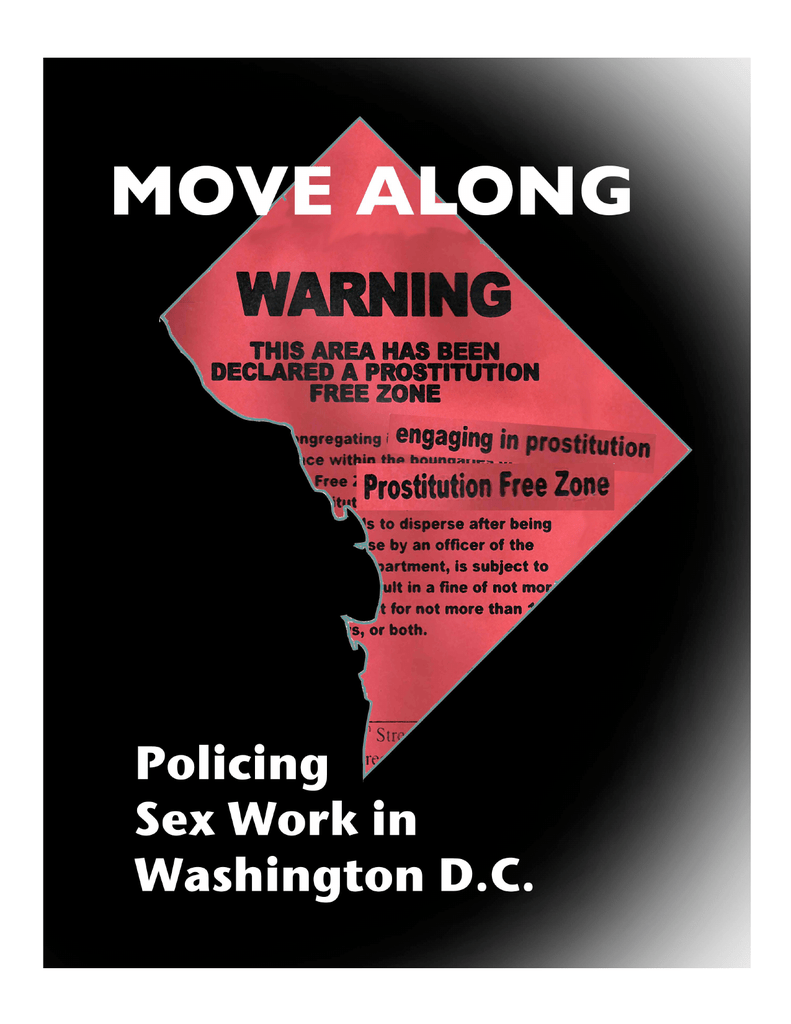
In 2004, then D.C. Mayor Anthony Williams announced a plan to build a brand new baseball stadium around Half and O Streets SE to house the newly purchased Montreal Expos. The land chosen for the new baseball stadium was home to one of the largest conglomerations of gay bars and clubs in the city including a couple of strip clubs.

On February 13th, the first of the displaced clubs was able to reopen in SW after much debate about the ordinances restricting the rebuilding of all the clubs.  The location chosen for the stadium seems hardly accidental, as this less than picturesque area of the city had been considered too seedy and dangerous for the average citizen, especially at night.  Yet, it was the only area where these clubs had been allowed to exist.  Queer culture had literally been peripheralized and pushing it out of this area, by way of literally dropping commerce onto it, meant that this section of SE had just been designated for gentrification.

Over the past decade, the D.C. landscape has been transformed both by physical structures and in the dispersal of its population.  The city’s gentrification is far from accidental beginning with the plan of Mayor Williams to increase tax revenues for the city.  Entire sections of the city have been re-established as middle-income trend spots where there once existed rent-controlled low-income housing and families.  This has also meant that historically black neighborhoods, like Shaw, U Street and Columbia Heights, have changed drastically in their ethnic make-up as well as class.  While the black exodus moves further east and into Maryland, the landscape of the city becomes de-urbanized and includes oddities like a corporate mall on 14th and Park Streets NW where there was low-income housing 4 years ago.  With the higher class and sometimes semi-suburban façade comes an expectation of what types of people will be frequenting and living in these areas.  Such assumptions about what safe and higher-class look like have from the beginning been police-enforced.

While gentrification is an intensely complicated and problematic situation overall, I am concerned that it has been an assault on the sexual geography of the city as it had been known for decades.  Overt alternative sexualities, like sex work and queer culture, are displaced by gentrification and city ‘beautification programs’.  These elements are often correlated to dirty underbelly of the city and not to be seen in civilized or safe areas of town.  Sexual elements, however, do not disappear simply because the rent goes up in a neighborhood; after all queerness did not flee the city when the bars were paved over.  Visible signs of sex work or queerness is physically pushed beyond the perimeter of “good” areas of the city and into progressively more neglected areas.  In D.C., this has meant that street work has been moved further east and closer to the Maryland border as well as literally marching a group of workers to the Virginia border.    The pushing is being done by the Metro Police Department’s prostitution unit, which has been given more tools and legislation to combat prostitution.  Remember the “prostitution free zones”?  They aren’t just saved for major events and tourist attractions but are usually used crack down on groups who have started working within the gentrified zone.  I’m sure that those lovely signs are very assuring to the residents of those areas.  A fancy billboard in certain areas, I think, could do wonders for real estate values.

Harass, though, is probably a better word than combat, if we’re defining the role of the prostitution unit.  Even MPD doesn’t claim to be able to make prostitution end within the District.  They don’t even necessarily claim to make life easier for those performing it on the streets.  Considering some of the propositioning that takes place by officers, some sexual harassment protections or a decent firehose could really be useful on the streets.  Instead, former police Chief Ramsey portrays “those residents who must endure the presence of prostitutes and their paraphernalia in our neighborhoods” as ‘victims’ of prostitution.

The areas that workers are forced to move to are often more residential or industrial but they are also significantly less safe than the areas previously worked.  This is because these areas are both geographically and literally peripheral.  They are often very low-income if they are residential or highly unregulated and violent.  Such policing creates a progressively more dangerous and violent situation for those being regulated.  This is ironic considering that so many proponents of the abolition of prostitution sight women’s rights as justification.  Yet, it assumes that by practicing sex work a person somehow forfeits their ability to be treated humanely rather than prodded and herded like stray cattle.  These tactics, however, assure that the issue remains out of sight and therefore out of mind for the majority of the public.  How can this be service and protection?

(Image Credit: StudyLib)

Starving for Control

Nomboniso Gasa

Nomboniso Gasa, Chair of the Commission for Gender Equality in South Africa, is trying to save hungry people in Zimbabwe by starving herself.  Her 21 day water only hunger strike began on February 11th.  She recorded a video during her first day on the strike explaining that she was, “in solidarity with the people of Zimbabwe who are not able to make a choice about whether to eat or not.  That choice is made for them because there is no food, there are no provisions.”  She goes on to stress her personal concern with the plight of women in situations such as these.  As Gasa emphasizes here, the motivation behind her choice not to eat is the lack of choices that others have.  Being able to make a choice is evidence of having some kind of control.  Gasa has made the decision to abstain from food in order to feel in control in a space where there is little control. She is also able to protest through her hunger strike the systems in place in Zimbabwe that have been taking control and choice away from the people.  Most Zimbabweans cannot decide whether to eat or not.  Thus, seizing control over one’s body and diet, as Gasa has done, becomes an exhibition of a far larger social and political power struggle.

Employing self-starvation in order to gain control over one’s body and social position is not a new phenomenon.  Starvation is a tool of personal and political power that is engaged in voluntarily in a variety of contexts.  Among these, hunger striking is one of the more obvious and influential, especially when practiced in prison where all forms of personal control have dissipated.  Another form of control-oriented starvation that is particularly relevant considering Gasa’s focus on women is anorexia.  Both anorexia and hunger striking are practiced publicly and privately across the globe as a way to gain control over and as a protest against the circumstances and restrictions that are placed on an individual’s body.

Anorexia is rarely analyzed in comparison to hunger striking.  On the surface, these two bodily statements seem unrelated.  But a brief look at the testimonies of various fasts reveals common ground between these acts: control.  As Bernarr Macfadden stated at the turn of the century, when fasting had become very popular, it was, “a stunning weapon of mastery, an instrument with which to prove one’s superiority over menacing perils ranging from microbes to men.”  It is this “weapon of mastery” that lends credence to Nomboniso Gasa’s stand against starvation.  Similarly, Brian Keenan, an Irishman taken hostage in Beirut in 1986 confirms the power of starvation during his hunger strike in prison.  He says, “I was confident, I was strong-willed and almost ecstatic as I pushed each meal from me…I was in control and control could not be taken from me.”  Choosing to starve becomes an instrument of empowerment because it is a choice.  This theme resounds in the testimonies of anorexics as well.  Aimee Liu is quoted in Susan Bordo’s Unbearable Weight: Feminism, Western Culture, and the Body, saying, “the sense of accomplishment exhilarates me, spurs me to continue on and on.  It provides a sense of purpose and shapes my life with distractions from insecurity.”  Despite the context, making the choice to refuse food creates a sense of power and control that many find lacking in their social and political lives.

Tomorrow, March 4th, Nomboniso Gasa will end her 21 day fast.  Assuredly, she has gained a personal feeling of control and accomplishment through her choice to go hungry.  She has shown mastery over her own body and given shape to her life amidst a culture of insecurities.  But the question remains, have her actions helped others acquire control over their lives?  Will going hungry become a choice for the people of Zimbabwe? Or will they continue to remain at the mercy of others?

(Photo Credit: IPS News / Save Zimbabwe Now!)

What are the ages of woman in the U.S. policing prison state?

What are the ages of woman? In the U.S. policing prison state, that’s an easy question with a simple answer. One. 92, 15, and anywhere in between, it’s all the same.

On November 21, 2006, three police officers burst into the home of 92 year old grandmother, of 92 year old Black woman, Kathryn Johnston. Breaking the locks and door took the officers a couple minutes, and so Ms. Johnston had time to get her revolver and shoot. She shot once. She hit the porch roof and nothing else. The officers fired 39 shots. They didn’t miss. They then “handcuffed the mortally wounded woman and searched the house. . . .There were no drugs. There were no cameras that the officers had claimed was the reason for the no-knock warrant. Just Johnston, handcuffed and bleeding on her living room floor.” Three men with guns and battering rams shackled a 92 year old woman whom they had already transported to the just-about-far side of death’s door.

The raid was bogus, the cover up was as botched as the break in (and the prosecution), and the three officers were sentenced last week.

For many, this story is one of corruption. For some, it’s the corruption of over reliance on “paid or otherwise compensated snitches” also known as confidential informants. For others, Johnston’s killing, two days before Thanksgiving, “laid bare the corruption of an out-of-control narcotics squad that lied to get search warrants and planted drugs on suspects.” U.S. District Judge Julie Carnes suggested that “Atlanta Police Department performance quotas influenced the officers’ behavior”. One of the officers “said his moral compass failed when he began to think “drug dealers were no longer human. `I saw myself above them,’ he said”. Department policy or workers’ mentality? Either way, the story wants us to believe the culture of the thin blue line has been corrupted. In Atlanta, many, especially in the African American communities, suspected that corruption in the police force was rampant. The federal investigators did as well. After what is called a full investigation, it has been determined that the officers who killed Kathryn Johnston were `a rogue unit’, and that corruption is not rampant.

If Kathryn Johnston’s murder was not racially motivated, because the three were two White and one Black officer and because the Chief of Police is Black, if her murder is not the result of mass corruption, then how is one to understand the sense of this `senseless killing”? Let’s stop making senseless, if only for an instant.

The three were sentenced Tuesday, February 24. Three days later, at another corner of the nation, in Seattle, “a video showing a King County Sheriff’s deputy pummeling a 15-year-old girl in a holding cell was released Friday over the strenuous objections of the officer’s attorney.” Two fifteen year old girls were picked up in a reportedly stolen car, in fact not stolen but owned by the parents of one of the girls. In a holding cell, perhaps something happened perhaps not. Regardless, as you can see in the video, at one point one officer “ lunged through the door and kicked her, striking either her stomach or upper thigh area, court documents say. He pushed her against a corner wall before flinging her to the floor by her hair. He then squatted down on her and made “two overhead strikes,” although it’s unclear where the blows landed.” There were two officers in the holding cell: “The second officer shown in the video was a trainee at the time and is not under investigation.” This holding cell was a classroom for the trainee. This is `education’, and it’s all about big boys and little girls. Today’s lesson, how to treat the female juvenile offender. First, throw her to the ground. Then, beat her. Repeat if it feels good, because Justice, swift and armed, hair yanking and female body flinging, Justice squatting, feels good.

Finally, Sunday, March 1, the following story, in New York, began to emerge: “The NYPD’s Internal Affairs Bureau is investigating a claim that the patrolman raped an intoxicated business executive after the cop and his partner responded to a cabdriver’s 911 plea for help with his drunken passenger, the sources said.” The police officer and a companion were not only caught on surveillance tapes returning to the woman’s apartment, but also are clearly trying to hide, once they see the camera. I don’t know how old a “business executive” is, but I think it’s safe to say, older than 15 and younger than 92.

In the reports of the New York and the Seattle police events, police involvement of some sort with drugs and alcohol is suggested. That may very well be the case, but if we focus on the women, something else emerges. Repeatedly the rule of law is the force of law is the law of violence is the rule of violence, and an important element binds that wrangled mangled syntax: women.  Black women, White women, old women, young women, women of indeterminate age, low income women, affluent women, women of indeterminate income. Women thrown to the floor or to the bed, dead, alive, unconscious, seen by the law as not human.  In that context, you know what’s lower than a drug dealer? Women … literally.

Whether or not the two officers in New York or the one in Seattle are `found guilty’, the point is that the story of their violence in the service of the law, though shocking, is not surprising.  What is the value of a woman’s life in the United States policing prison state? In Atlanta, along with the jail time served, “each defendant was also sentenced to serve 3 years on supervised release following his prison term, and collectively to pay $8,180 in restitution for the costs of Ms. Johnston’s funeral and burial.” $8,180. That’s the accounting of the value of a woman’s life in the marketplace of the rule of law.

(Photo Credit: Eidard.com)

The Security of Sex: Take This Job and Shove It


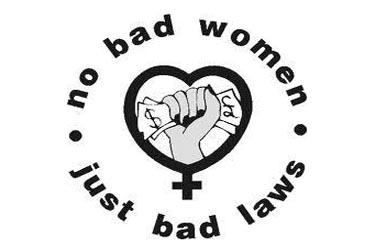
Last September, a recently graduated co-ed, going by the pseudonym Natalie Dylan, decided to put her virginity up for auction on the Moonlite Bunny Ranch website.  She has claimed that she is doing so for a number of reasons from social experiment to paying for graduate school.  What’s interesting here, remarkably, is not that there actually exists a 22 year-old co-ed whose virginity is intact or that she is able to command $3.7 million for the opportunity to pop it. Instead, the ambivalence expressed both in the popular and feminist media have raised larger issues as to how we discuss women’s sex work and female sexuality.  The media is fascinated, shocked and constantly debating whether or not this “poor girl” actually knows what she’s getting into, whether or not she’ll regret it. Would she regret it less if she lost it to a former beau in the back of a car or on a bed of roses or on her wedding night?  Who knows and, honestly, who cares? I am not concerned with virginity.  I don’t recall any fireworks, club invitations or a hardy handshake at the time the money-making capacity apparently went down a notch or two. I am instead concerned with this idea that sex work may be considered to be degrading and exploitative in all situations.

As with everything else in feminist circles, discussions around sex and sex work seem to orbit ad nauseum around this elusive notion of choice.  Interestingly, unlike many discussions around choice, the most virulent debates do not hinge on who has the right to do what but actually on whether or not an individual may ever have the ability to choose to do sex work.  For some, this is an absolute impossibility.   During December session of the Transnational Network of Women’s Issues, which was held on the issues of trafficking and slavery, the two guest speakers illustrated the ambivalence towards choice in sex work perfectly.  When asked to place trafficking and slavery within the global structures of power, Carolina De los Rios, a case a manager with the Polaris Project said that “Poverty is triggering this work…These women work to support their family. They feel trapped by immigration [status] and threatening …Initially they made the choice but after a while they don’t want to do it.”   On the other hand, Jessica Leslie of Free the Slaves gave an example of quarry workers who had returned to the same type of work without the threat of debt bondage.  She remarked that they had returned “not necessarily because they liked the work or wanted to do that kind of work but because it was a work they knew and knew they could do to survive… The question was not whether they chose to do a kind of work but whether or not they were in a situation of bondage… It is the circumstances around that type of work that make it slavery or not.”

The distinction made by Jessica, however, is not generally made in regards to sex work.  While it is generally acknowledged that people do not go into quarry, domestic or other types of work associated with low-income communities because they like it, these types of work and workers are still discussed as having agency.  Yet, sex work is generally discussed in terms of being forced by different factors, primarily poverty; I am assuming sex work done by women as it generally what the media assumes unless we’re talking about Senators or televangelists and transgender workers are mentioned rarely if ever. Except that sex work is not always done simply out of financial necessity.  The example of Natalie Dylan and recent stories of highlighting higher-class escorts makes that clear enough. So, what distinguishes sex work from other forms of labor?

This whole discussion seems to go back to the public myth that there is something sacred about sex or at least that there is something more respectable about hooking up with a random stranger in a club as opposed to having regulars to pay the rent. Somehow the combination of SEX and MONEY breeds disaster, especially for women who might be doing so outside of a traditional marriage.  If women were simply having sex in parked cars for free, like teenage caricatures, I wonder if there would exist as much of a police presence.  Perhaps so, as much of the discussion orbits around these women either being fallen and needing to be saved or being burdens upon the community.

I asked Carolina to clarify what she had said before, wanting to know if sex work was inherently abusive.  She said “Yes definitely…we believe that these women are exploited in the sex industry. Many of these women have been trafficked.  Some never knew what they were getting into. They may have made the choice initially but then they were pretty much trapped and when they were not able to leave.”  This may be true but are workers victims because of something innately degrading about the work or is it the working conditions as mentioned by Jessica?  The dangers associated with sex work include rape, battery, low wages, poor working conditions, manipulation by pimps, and blackmail.  These dangers are not caused by sex work but can be drawn back to either the immigration status of workers or criminalization.

Does the media obsess over victimhood in sex work because society still feels that “promiscuous women” don’t deserve services, respect or legal recognition of their labor? Or must women’s sexual fragility be rescued incessantly from the man in the shadows?  It would seem that when it comes to conceptualizations of sex work, we have not yet departed from the notion that women’s sexual purity must be protected, that women are merely vessels to be exploited by hypersexual and predatory men.  Such an approach to analyzing sex work and trafficking ignores the larger powers at work in these situations and actually reinforces archaic constructions of female sexuality that disempower women and demonize men. These constructions trap all of us.

(Image Credit: Rewire News)