Domestic workers are women workers are workers. Period.

The International Labour Organization released a major study today, Domestic workers across the world: Global and regional statistics and the extent of legal protection. Though the report’s picture is largely what one might expect, it’s still worth engaging.

In 2010, at least 53 million women and men worked as domestic workers, up 19 million from the last count of 33.2 million people, in 1995. That’s almost a 60% increase in the size of the global domestic labor force. And remember, the numbers are always lowballed, so that the ILO suggest there could be as many as 100 million domestic workers.

Globally, universally, everywhere, domestic workers are overwhelmingly women. Which women might change from place to place, but they’re always women. Globally, 83% of domestic workers are women. Globally, 1 in every 13 women wage earners, or 7.5%, is a domestic worker. In Latin America, 26.6% of women workers are domestic workers. In the Middle East, 31.8% of women workers are domestic workers.

In the United States, 95% of domestic workers are women, of whom 54% are women of color. Latinas make up the largest group among the women of color domestic workers.

This means the status and state of domestic workers is part and parcel of the pursuit of gender equality. Addressing the inequities of domestic workers’ lives and situations is key to women’s emancipation … everywhere.

The United States gets something of a free pass in the report, but it shouldn’t. Here’s why. The report focuses on three areas of major concern: working time; minimum wages and in-kind payments; and maternity protection. Paid annual leave falls under the category of working time, and guess what? Of the 117 countries in the report, the United States is one of only three countries without a universal statutory minimum for paid annual leave. The other two are India and Pakistan.

When it comes to coverage of domestic workers’ control over their time, the United States is the only so-called developed country and the only country in the Americas that excludes live-in domestic workers from overtime protections.

The picture is worse when we turn to maternity leave. Among so-called developed countries, only the United States, Japan, and South Korea have no entitlement to maternity leave for domestic workers and no entitlement to maternity cash benefits. In the Americas, the United States is the only country that has neither maternity leave nor maternity cash benefits for domestic workers.

At the beginning of the 20th century, women were described as “being forced to become servants”. A hundred years later, they are described as “preferred by employers.” That’s the march of neoliberal progress. You weren’t forced; you were preferred. Otherwise, it’s been a century of exclusion of domestic workers from protective labor legislation.

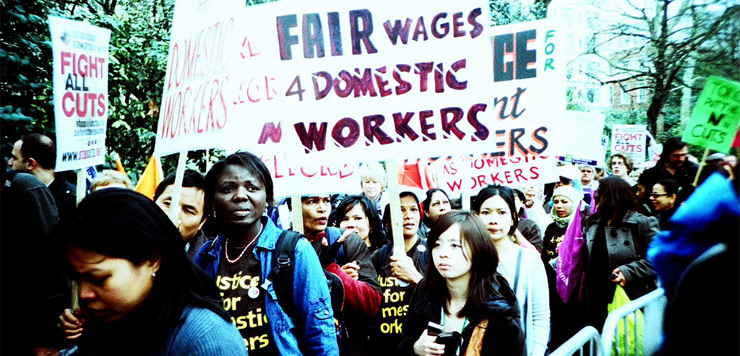
It’s time to end that century. Domestic workers are under attack. They’re under attack because they are women. End the exclusion of domestic workers from national labor laws. Domestic workers are women workers are workers. Period.


(Photo Credit: ACelebrationofWomen.org)
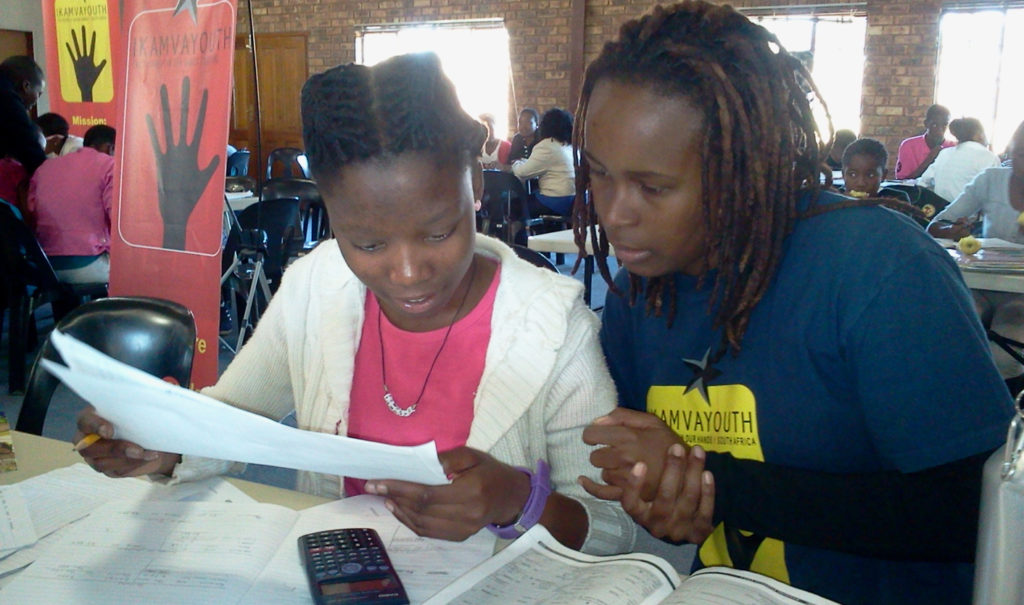
 

Ikamva means the future … is now!

In Xhosa, ikamva means the future.

Asanele Swelindawo. Ayathemba Njovane. Akhona Nokeva. Siyabulela Godwana. Rhondashein Ntebaleng Morake. Joy Olivier. Zamo Shongwe. Thabisile Seme. Khona Dlamini. Nyasha Mutasa. These are just some of the names of IkamvaYouth.

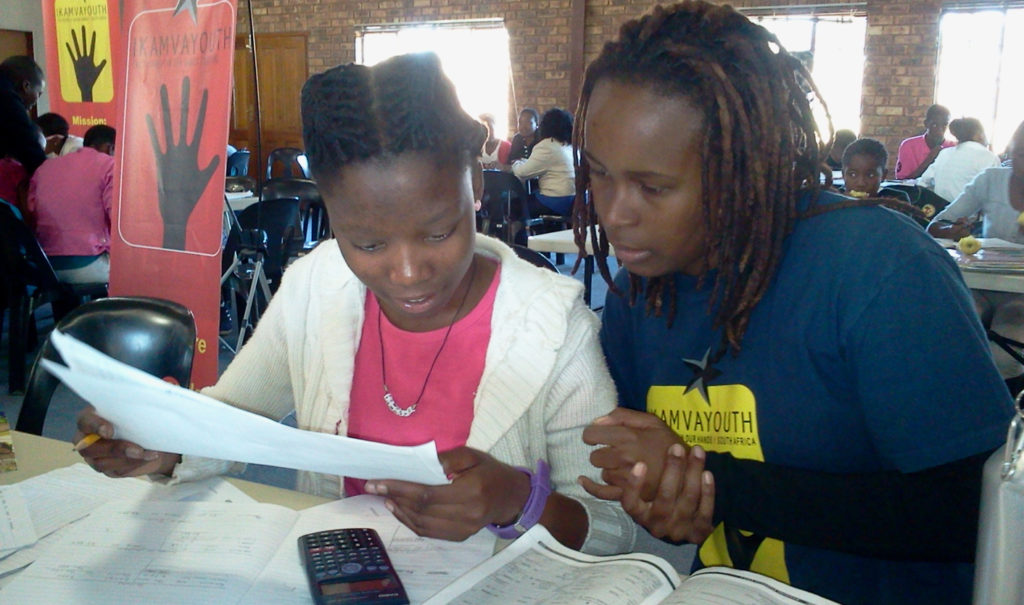
IkamvaYouth is a movement that began in Khayelitsha in 2003, in response to the tragedy of township education then … and in too many ways still is. Two researchers, Joy Olivier and Makhosi Gogwana, went to Gogwana’s old high school, only to find that it was impossibly worse than when he had graduated.

They decided to help matriculants graduate and prepare for either university or for full and gainful employment. They began small and, each year, grew. Each year, as well, their record of graduation and of successful entrance into university has grown by leaps and bounds. Today, IkamvaYouth has branches in Makhaza, Masiphumele, and Nyanga, all on the `outskirts’ of Cape Town, in the Western Cape; in Ebony Park and Ivory Park in Gauteng; and in Chesterville and Umlazi in KwaZulu-Natal. They are organizing two new branches this year, in Grahamstown, in the Eastern Cape, and one in Gauteng.

This year the Gauteng and KZN branches had 100% pass rates. 91% of the learners have qualified for university entrance. That’s impressive. But there’s more.

The literature on IkamvaYouth refers to it as a non-profit organization that draws on an ever-growing pool of volunteers. Others describe it as a successful tutoring and mentoring program or as a best-practices model grass-roots youth development organization. Much of the scholarly literature on IkamvaYouth focuses on social entrepreneurs, mathematics and science instruction, and the use of ICTs.

That’s all accurate, but it misses a key point: democracy. For Joy Olivier “IkamvaYouth drives social change… IkamvaYouth has a democratic youth-led structure.” The tutors are mentors, and the tutor-mentors are increasingly `Ikamvanites’, graduates of the program who return to keep the energy and the learning and the movement sustained.

Last year, IkamvaYouth made the 2012 WorldBlu List of Most Democratic Workplaces. IkamvaYouth is the first South African AND the first African organization to receive such recognition. Here’s what WorldBlu said: “IkamvaYouth empowers disadvantaged youth to lift themselves out of poverty into a university education or employment. IkamvaYouth practices the democratic principle of Fairness + Dignity by creating an environment in which each individual has an equal representative voice, regardless of rank or age. It is the “level of insight” on a particular issue that is valued above the position a person may hold. To uphold this value over a wide geographical spread, branches have online meetings, where a democratically-elected representative of each grade sits on the committee and is also involved in all decision-making. Minutes of meetings are sent to all participants and are available on Facebook groups for additional input. The youngest and newest members’ votes hold as much weight and value as their branch coordinators.”

Democracy matters. Democracy in education matters. IkamvaYouth is creating autonomous spaces of democratic action and nation building in South Africa. They are teaching the world that ikamva means the future … and the future is now!

(Photo Credit: Jon Pienaar/Daily Maverick)

The ticket to ride

The ticket to ride

I now have the ticket
to improve my life and
one day be able
to take care of my family

So says Asanele Swelindawo
an orphan who managed
to get three distinctions
in our much-maligned Matric

She is an Ikamva Youth member
a by-youth for-youth
volunteer-driven initiative
just up your street

The ticket to ride
at the end of it all
a stairway to heaven
folks would have it

(Zero to hero turnaround
out at Peak View High)

Though experts have it
that our matric ticket is one
loaded with mediocrity

(quality over quantity
the new post-apartheid
standard grade of life )

The ticket to ride
in the context of
our country gone
to the (pampered) dogs

(our girl-child illiterate
and barefoot and pregnant
out here in darkest Africa)

The future is in our hands
says Ikamva Youth

Is it in yours

An email missive tells it all: “IkamvaYouth learners from township schools achieve 100% pass rate with 91% eligible for tertiary education” (www.ikamvayouth.org); and the Argus “Zero to hero turnaround” and its Comment “Quality over quantity?” (Friday, Jan 4 2012).

(Photo Credit: Jon Pienaar / Daily Maverick)

Swazi women have always been on the move

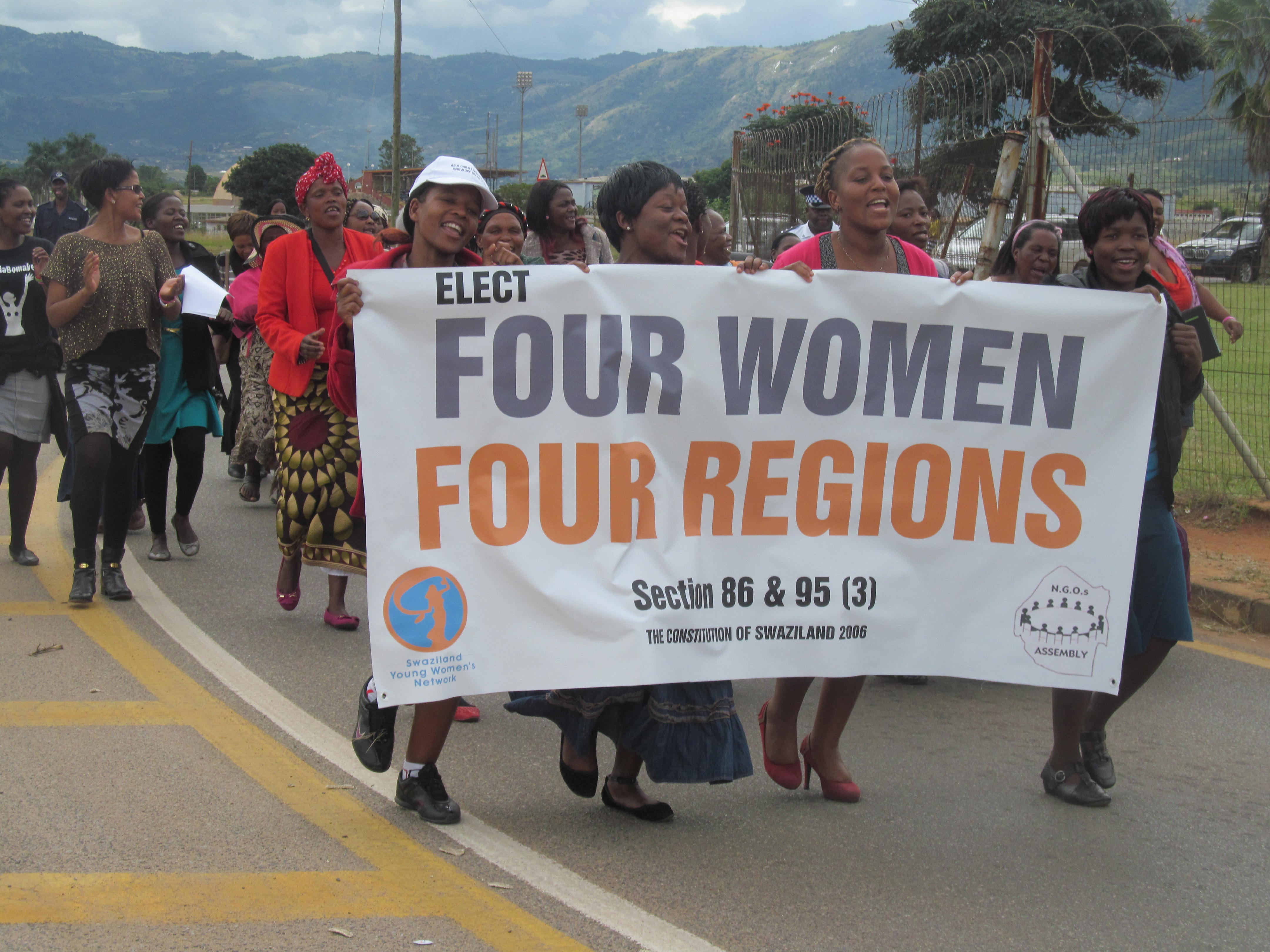
Swazi women are on the move. Actually, Swazi women have always been on the move, organizing, opening spaces for women, opening spaces for democracy. Every year, the international media `discovers’ Swazi women on the move. But Swazi women know they have never been still and they have never been silent.

As Swazi feminist and labor organizer Cynthia Simelane explained recently, Swazi women have a longstanding tradition of organizing. Over 20 years ago, in 1990, women got together and started the fabulously named SWAGAA, Swaziland Action Group Against Abuse, an organization initially dedicated to addressing family violence and sexual abuse. They’re still going strong. In 2001, Thelma Dlamini, Siphiwe Hlope, Nonhlanhla Dlamini, Elina Hltatshwako, and Gugu Mbata, five middle-aged women living with AIDS, organized something variously called Swaziland Positive Living, Swazis for Positive Living, or Swaziland for Positive Living. Whatever its exact name, 12 years later, they’re still rocking, expanding, stretching, creating and representing. In 2009, Swazi women organized Swaziland Single Mothers Organization, which in the last year doubled its membership.

Between 2001 and 2009, Swaziland acceded to the Convention on Elimination of All Forms of Discrimination Against Women, CEDAW, in 2004. In 2005, the King, Mswati III, “acceded” to a new Constitution, which contained some victories for Swazi women, including a Bill of Rights which enumerates the rights and freedom of women: the right to equal treatment and opportunity; the right to assistance from the State “to enhance the welfare of women to enable them to realize their full potential and advancement”; and the right to protection for women from being “compelled to undergo or uphold any custom to which she is in conscience opposed.”

While the Constitution is far from perfect (and what State document isn’t far from perfect anywhere?) and while its implementation has been spotty, at best, it’s not nothing. Ask Mary-Joyce Doo Aphane. She’s the woman who used the 2005 Constitution to sue for her rights to property under her own name. And, last year, she won her historic case. What’s in a name? Plenty, especially if the person is a woman. Ask Mary-Joyce Doo Aphane and all the women of Swaziland.

2011 saw the emergence of the Swaziland Young Women’s Network, a multi-focused organization committed to young women’s empowerment and to transforming not only the State but also everywhere and everyone in order to create autonomous spaces, once again, for women, in this instance for young women. And they’ve been kicking it ever since, from taking on public transportation’s sexual violence to creating vibrant events for young women artists to organizing last month’s mini-skirt march.

Swaziland is more than one corrupt monarch. Swaziland is hundreds of named and unnamed women’s groups, traditions, actions and movements, where women have always organized for the realization of democracy, not in some distant future, but now. The next time some article `discovers’ Swazi women are organizing, remember … Swazi women have always been on the move.


(Photo Credit: Swaziland Young Women’s Network)


Cry, cry, cry, set the women prisoners free

For the New Year, Zambia’s President Michael Sata released 59 women from prison. Of the 59 women, 43 are “inmates with children”, four are pregnant, and 12 are over 60 years old. As a consequence of President Sata’s move, 50 children, who were living in prison with their mothers, will see something like the light of day. The Zambian Human Rights Commission is pleased, as is Zambia’s Non-Governmental Organisation Coordinating Council. Both remind the President, as well, that now the State must attend to the “empowerment” of the 59 women. That includes economic, political, emotional, physical and spiritual well being.

In Uganda, members of civil society are calling on the State to “exempt women offenders with babies and expectant mothers, from long custodial sentences”. 161 children of women prisoners are currently guests of the Ugandan State. 43 of them are in Luzira Women’s Prison, aka Uganda’s Guantánamo. In March 2012, Luzira Women’s Prison at 357 percent capacity, and it’s only gotten worse since.

The situation for U.S. children of the incarcerated is equally horrible. In the U.S. the children don’t get sent to prison with their mothers. Instead, they are sent to “kiddie jail” … or they are left to fend for themselves at home, especially if the at-home parent is a single person, and more often than not in that case, a single mom. One study has shown that only a third of patrol officers modify their behavior or actions if a child is present. Of that third, 20% will treat the suspect differently if children are present, and only 10% will take special care to protect the children. That’s 10% of 30%. That’s 3%, in a country in which imprisonment is a national binge, and in which women are the fastest growing prison population.

And that “special care” can mean something like this: If an adult caregiver is arrested and there are no other adults around to care for a child, the child is taken first to the hospital, then to juvenile detention for processing, and then dropped off at a foster home. It’s a recipe for post-traumatic stress disorder.

The vast majority of incarcerated mothers lived with their children before going to prison. Almost half of incarcerated mothers are single heads of households. Most of their kids end up going to stay with grandparents. For those women prisoners who give birth to children while in prison, more often than not the children are immediately taken away, often forever.

And for women of color, and the children of women of color, it’s worse. For example, some judges give mothers longer sentences because “these women should have considered the impact on their children before committing a crime.” Women of color “bear the brunt” of that largesse.

Since 1991, the number of children under age 18 with a mother in prison more than doubled. In 2007, 1 in 15 Black children, 1 in 42 Latina/Latino children, and 1 in 111 White children had a parent in prison in 2007. Those are the ratios of racial justice and concern for children in the United States.

Make 2013 the year of the child. Set the women prisoners free, and, in so doing, set the children free.


(Video Credit: YouTube)

The ordinary torture of children

2012 has been a year of spectacular violence – Marikana, Newtown, Delhi, Dhaka – against women, against children, against workers. And that’s only the last five months. There was cause as well to celebrate, to hope, as the Idle No More movement across Canada extends the light of indignation, occupation, Spring into the new year.

And there was the absolutely ordinary violence against children that continued, largely unmarked, except of course by those immediately affected and by the usual suspects of social justice advocates and activists. Especially in the United States and Australia, children continue to spend long times in prison. This includes children asylum seekers.

In a sense, 2012 began with Jakadrien Turner, a fourteen-year-old African American, US citizen, girl who was shipped off to Colombia, alone. Turner spoke no Spanish, knew no one in the country. At the beginning of the year, she was returned to the United States. No apologies. No explanations. Silence.

Displaced and refugee children who move to high-income countries face numerous mental health and other risks, not the least of which are the delicacies of class warfare taking place across the austerity-soaked `free world.’ But they also face a risk mental health studies don’t acknowledge: a war on children.

In the United States, for example, an applicant for asylum faces a double test: evidence of an objective risk of persecution and evidence that they subjectively fear this risk. Recently, Burhan Amare, a nine-year old hearing impaired girl from Ethiopia, was denied asylum. There was clear evidence of real risk of persecution and violence. But the child, communicating through a sign-language interpreter, didn’t sufficiently manifest subjective apprehension.

Burhan Amare has a brother, in Australia. Not a biological brother, but a brother nevertheless. The boy, nine years old, is an asylum seeker in detention. Australia has mandatory detention for refugees and asylum seekers. The boy tried to commit suicide. Supporters are “distressed”. The State is maybe taking the case “under advisement”.

There is a sickness in the system of long-term immigration detention … and the sickness is the world that produces that machinery and then walks away from the slow torture of children in prisons. That is our world, a world in which, daily, children are subjected to long-term detention, for the crime of having nowhere to go. This is the silence and the muffled noises we hear, or don’t, that are the foundation of the explosions of spectacular violence. We must mark the everyday so that we understand the seemingly exceptional explosions are not exceptional. They are part of the fabric of everyday violence. The war on children must end … now.


(Photo Credit: Mike Fuentes/Ap)

In Canada, five women set the spark

Thanks to five women, four of them First Nation women, who have had enough, winter in Canada suddenly turned very hot. Idle No More is sweeping the country with the heat of justice, democracy, emancipation, and peoples’ power. It’s a Native Peoples’ Northern Lights, and it could shine on all of us.

Five women have started a national movement with global reach. Chief Theresa Spence of the Attawapiskat First Nation is on the fourteenth day of a hunger strike. Her immediate demand is that the Prime Minister and the Queen meet face to face with her and other First Nation leaders to address the longstanding violations of treaties. First Nation peoples and communities have had enough of sitting on the sidelines of their own histories.

At the same time, Chief Spence has another, call it existential demand: life with dignity. Last year, Chief Spence drew international attention to the deplorable living conditions on her Northern Ontario reservation. Since then … nothing has improved. So, Chief Spence is saying that death-in-life, that survival without dignity, that being turned into something less than a shadow is unacceptable. And so she is on a hunger strike.

The hunger strike is as well part of a mass strike, initially organized by four women in Saskatchewan: Jessica Gordon, Nina Wilson, Sylvia McAdam, Sheelah McLean. The women were fed up with the intensifying assault against First Nation peoples by the Canadian government, not to mention the assaults by the State on Native women. The last straw was something called Bill C-45, a monster omnibus bill that threatens First Nations with loss of land, environment, life, agency and autonomy. To the four women, it seemed that Bill C-45, and the Canadian government and State, offered First Nations people, and everyone, loss and the promise of more and deeper loss as the only absolute value. And, of course, the State calls it democracy.

So they organized, and the organizing effort has spread like prairie fire. The lesson here is the lesson the women of Egypt, Sudan, Spain, Chile, have brought over the last couple years. It’s the lesson the women of the Indignados, Girifna, the Arab Spring, the Chilean Winter, Occupy, UK Uncut, and, behind them, of the Zapatistas and Ya Basta, and behind them …

The lesson is that hope is material. Hope must be maintained as a concrete, material part of all of our lives. When loss is offered instead of hope, when debt is offered instead of hope, when autocracy and kleptocracy are offered, in the name of democracy or security, instead of hope, it’s time to be idle no more. It’s time light the winter skies.

And that’s the star the five wise women of Canada and their sisters and brothers have taught us to follow this December. They are “opening the eyes of this land” and, hopefully, this world.

(Photo Credit: Idle No More)

Domestics: For Children of Filipino Transnational Families, Classification as Control

Geraldine Pratt’s recent work with Filipina domestic workers in Canada examines the narratives of ambitious mothers who travel overseas to take care of others’ children in order to provide for their own. Once their children are able to reunite with them in Canada, mothers cite issues of deskilling, where they “lose their skills during the years that they work as caregivers,” limiting them to caretaking jobs and unable to further develop their human capital. Furthermore, Pratt reports that these mothers usually spend an average of eight to twelve years engaged in domestic work overseas and separated from their families before reunification.

As a former educator, I taught in a rural high school in Hawaii, where we had a high Filipino student population whose parents and/or grandparents were immigrants. Many of my students’ family members had limited English speaking ability. When calling home, older sibling often translated my messages for me. We also saw low attendance for parent-teacher conferences. However, when mothers did attend these conferences, they shared their frustrations at being unable to help their children with schoolwork, emphasizing their hopes that their hard work would enable their children to gain “a better life.”

My experience with immigrant Filipino families as an educator prompted me to investigate the education for Filipino American students from transnational families. However, I must stress that Filipino students were also among my best students. It is important to remember that stereotyping all Filipino students according to ethnicity is more dangerous than excluding these narratives. We must look at all contributing factors, such as family education and class in host country, discrimination, and generation.

Despite popular depictions of Filipino migrants as working in highly skilled professions, the US continues to recruit domestic and home care workers. Among Filipino domestic and home care workers: 80% are women, the median age is 44, 60% hold US citizenship, the median annual income was $17,050 in 2005, 1/3 have at least a college-level degree and another 30% attended college without completion, and 3% have graduate and post-BA level degrees. Filipino women are disproportionately represented among domestic workers, and, contrary to prevailing views of Filipinos in the US, a majority of Filipino domestic workers are neither highly educated nor have much opportunity to leave domestic work to enter other skilled professions. The median annual income is just below the federal poverty line. With only 60% of domestic workers reporting citizenship status, some Filipino domestic workers lack access to most social services.

I wrote to Geraldine Pratt on the topic of classifying Filipinos and the use of “Asian/Pacific Islander.” Pratt responded:

“I think in Canada there is a tendency not to lump Filipino youths with other Asian-Canadian youths, because the migration of Filipinos to Canada has been so particular.”

For example, consider how the Canadian and the US census approach the question of race and ethnicity. The Canadian census uses an open-ended question, along with examples and guidelines, which requires respondents to write in their race/ethnicity. The US census requires respondents to check off one or more race/ethnicity box (where Filipinos would fall under “Asian”) and allows respondents to specify their subgroup. Since respondents are not required to specify their subgroup, the US Census Bureau is continuously working on better ways to track race/ethnicity. At the same time, Canadian research tends to give more attention to Filipino academic achievement while research focused on Filipino Americans generally still include Filipino Americans in the pan-ethnic group of “Asians.”

As Michel Foucault suggested, the classification of individuals drives governmental strategies of control. By inventing all-encompassing pan-ethnic terms, which represent group otherness rather than group needs, the counting of certain “kinds of people” informs state allocation of resources and penalties. The state’s power to name a people translates into a power over people’s daily lives. When I report my ethnicity, which box(es) am I allowed to check off, how is it packaged and interpreted in study results, and later, how does someone else’s interpretation of my identity continue to mold my everyday identity and life chances, and consequently, manipulate my identity further through defining my race/ethnicity?

In Pratt’s study, Filipino domestic workers are “sacrificed for the vitality of the Canadian population”, and Canadian families “prosper” while Filipino domestic workers labor and live under conditions “unacceptable to national citizens.” Following Foucault’s critique of the state, state racism and discrimination against certain “inferiorized races” serves a “murderous function” in order to regenerate the general population. In this way, the state “saves” by denying care to domestic workers and their families, but the state also “gains” when domestic workers provide privatized services, such as health care and child care, which the state normally provides its citizens. The state denies transnational domestic workers’ full citizenship rights in order to sustain citizenship rights for others without actually investing in those services.

Though there are issues with the education system and its reinforcement of capitalist ideals and hierarchies of power, a lack of support for Filipino students from transnational families could prove to be more detrimental. When we assume that all Filipino or all Asian students are successful and fail to recognize specific needs, we allow false assumptions to further deny students their rights. For Filipino children of transnational families, lower academic performance and higher dropout rates perpetuate their place among low-waged workers. Filipino Canadian youth struggle to exceed their parents’ educational levels and work almost exclusively in certain service professions. More academic support and guidance can help Filipino American youth from transnational backgrounds overcome these statistics and use education as a tool to achieve the social mobility which originally prompted their parents to become transnational domestic workers.

There are still songs to sing …Newtown, Connecticut, 2012

Friday, December 14, 2012, and the news from Newtown, Connecticut, is terrible. A nation says it is in anguish. The President speaks of the pain and the horror, of our children and our neighborhoods. Our tears flow. And the traffic in guns continues. And in these theaters of horror, more often than not, the shooters are men and the first targets are women.

We have been here before. It is all too familiar.

Near the end of a life spent trying to turn the pain, horror and anguish of mass violence into the possibility of understanding, Paul Celan found that the project of poetry, his life project, was “an impossible struggle, doomed from the start to disaster. For poetry cannot save the soul or retrieve a lost world. It simply asserts the given.”

And Celan wrote:

“THREADSUNS
above the grayblack wastes.
A tree-
high thought
grasps the light-tone: there are
still songs to sing beyond
mankind.”

The thought that is tree-high is too high for our grasp. It is too late to sing songs beyond mankind. There must be songs to sing now. And they must begin by turning swords into ploughshares … now. Right now.

(Photo Credit: Panoramio.com)

Domestics: Domestic work is important. Deal with it.

Domestic labor, which includes everything from caring for the elderly to doing laundry, is a profession that exists globally. From South Africa to China to England, domestic labor exists in hundreds of thousands of households. A great deal can be learned from researching the pivotal group of domestic laborers across cultures. Domestic labor is important.

Something is important when it has great value or significance. In the case of domestic work, it means that it is worth it to take the time and energy to examine and understand the purpose, consequences, and meaning of domestic care and labor. Domestic work is important because it changes society. Domestic labor or care is an integral and important element of global society. Examining the importance of this labor form allows for a greater understanding of that global society. Through a closer examination of domestic labor, or by considering it to be significant, more can be learned about class, race, gender, cross-cultural interactions, and global exchange.

In the United States, a “care crisis” is currently plaguing families as the ageing baby boomer population heads into retirement. The crisis consists of more elderly persons needing some type of care and fewer able to provide it. Because of improvement in health care that extend a person’s lifespan, the demand for these works is likely to increase and become a serious problem. The “care crisis” cannot be managed by dealing with the number of individuals that require care. Instead, we must consider the workforce and look at how appropriate care workers can be introduced into the workforce. Caring Across Generations attempts to address this issue by finding solutions to the care crisis through training programs, policy solutions, and enhancing the relationships between care workers and those they care for. This “care crisis” is an important issue in American society today. By understanding and studying the field of care work, we can better understand and find ways to fix, manage and survive the crisis.

Part of the problem is the value of work: “It is easy to appreciate why work is held in such high esteem, but considerably less obvious why it seems to be valued more than other pastimes and practices”. Work is acknowledged as something important, and choosing to not work results in condemnation. But only specific types of work hold value. For example, there is a great difference between the work of a neurosurgeon and a janitor. It is said the former required years of education, training, and work to be able to attain his or her position. The janitor required less training and preparation to be perform her or his labor correctly. So, the janitor is paid much less than the doctor. But is the janitor’s work less valuable?

According to US standards, yes, it is. The work performed by the janitor is considered commonplace, and she or he is considered replaceable. The wages for housework is a perfect large-scale example. Housewives asking for compensation for work they were expected to perform with smiles on their faces seemed farfetched and unreasonable. Despite its budgetary difficulties, the plan had the potential to place the issue of housework on the national front burner.

The amount of work contributed through caring for children, the elderly, and maintaining a household should not be overlooked. It is a time consuming endeavor and an extremely important one. In this context, importance is so great that were the work to cease, society would collapse.

From the need for domestic workers to what the position itself can explain about social structures, domestic labor needs to be studied and understood. It is important. It deserves to be examined, researched, argued, debated, and challenged. A system of gender biases, abuse, and blatantly inhumane treatment persists in domestic labor employment. This is intolerable. Unless the field is examined, how can these systemic abuses be successfully eliminated and the contradictions of importance and value resolved?

Organizations such as the ILO are attempting to remedy the very real issues in this particular labor market, but it is a difficult road. The ills that exist within domestic labor are so ingrained that it seems nearly impossible to eradicate them completely. This, however, should not diminish the importance of domestic work. Just as poorly treated worker should not accept abuse because of fear, others should not accept silence merely because the task of change seems insurmountable. Change is slow and difficult, but it is necessary. And above all it is important.


(Image Credit: International Labour Organization)