Australia tortures migrant children


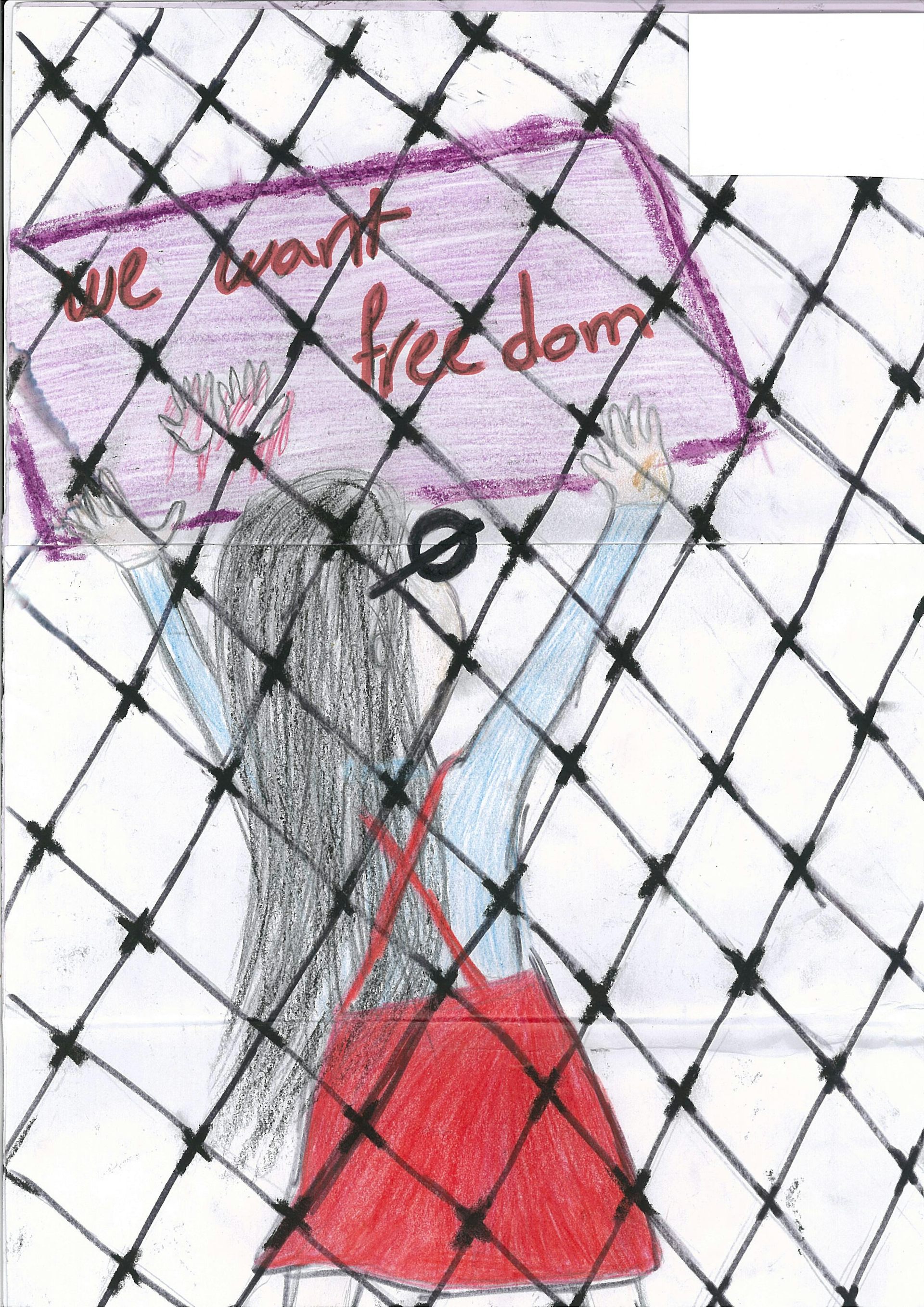
The Australian government continues to torture refugee and asylum seeking children. The State currently holds some 2000 children in detention. That’s mandatory detention for all non-citizens who arrive without prior authorization. That rule includes children. And so there is a `furor’ of  `concern’ for the well-being, and in particular for the mental health, of the children behind bars.

None of this is new, and none of it is surprising. A mandatory incarceration policy that makes no exceptions for children, and in particular for children fleeing violence and persecution, will have exactly the effects you imagine. Seemingly healthy children will engage in `self-harm’. This includes slashing one’s body and suicide by any and every means possible. Children report not being able to sleep. Children report a desperate desire to go to school, to play, to have normal children’s lives. Children report fear that they will go crazy and kill themselves. And then they kill themselves.

For girls, the situation is equally predictable. Girls are `particular’: “Girls and young women are at particular risk of gender based violence and sexual abuse… Girls and young women are particularly at risk of harm due to their sex… Moreover, girls are particularly susceptible to marginalization, poverty and suffering during armed conflict, and many may have experienced gender-based violence in the context of armed conflict.” The particularity of girls’ vulnerability emerges from both detailed and extensive research scholarship and from simple common sense. You know migrant girls, girl refugees, and asylum-seeking girls are `particular.’ So does the Australian government. What does the State do in recognition of this particularity? Absolutely nothing. Less than nothing. It intensifies and increases the pain, the torment, and the torture.

Children in low-security prisons in Pontville, in Tasmania, and in Darwin, in the Northern Territory, are falling apart. Their precariousness is not about this condition or that condition. It emerges directly from the totality of being-caged. The intensity and levels of self-harm in both locations is off the chart. Meanwhile, Australian Human Rights Commissioner Gillian Triggs has been informed that she cannot visit the refugee and asylum seeker detention camps on Nauru and Manus Islands because that would violate the sovereignty of the island nations. Australia’s massive funding of those prison camps apparently did not violate any sovereignty. Australia’s insistence on shipping off hundreds of women, girls, boys, and men to the island nations also did not violate any sovereignty proprieties. This is the way of sovereignty, the wink-wink nudge-nudge of fraternal violence.

This is why the Australian government can so easily ignore reports of sexual violence against Tamil refugees, and especially the `particular’ targeting of Tamil girls. To accept such reports would violate Sri Lankan sovereignty, and after all, the refugees and asylum seekers had already violated Australian sovereignty. That’s why they’re in prison, isn’t it? It’s a perfect circle … of hell.

Rather than `discovering’ yet again the nightmare of child detention, why not discover the simple, open alternative? Recognize and respect the particularity of girls. Take the children, all the children, far from the cages. Teach them to respect themselves and others. Help them to find peace and love. End child detention. Do it now.

(Image Credit: The Conversation)

Child prisoners lose more than their clothes in strip-searches


Joseph Scholes, 16, hanged himself in custody, in March 2002

Over the weekend, Carolyne Willow revealed that when it comes to the treatment of child prisoners in the United Kingdom, Charles Dickens is alive and well.

Willow looked at admittedly incomplete records for 21 months leading up to December 2012. These records cover 25 institutions, 15 child prisons and 10 `secure’ children’s homes. The children are anything but secure … in the homes and in the prisons.

In the past 21 months, child prisoners suffered 43,960 strip-searches. The real number is higher, but the State can only do so much to document its abuses. For example, “The data does not reveal what proportion of the children were subjected to intimate cavity searches.”

The numbers are actually worse than they seem, because they tend to be concentrated in some institutions and not others. So, Ashfield, a private prison run by Serco, holds a maximum of 400 boys, and performs an average of 399 strip-searches … every month.  At the other end, three of the “secure children’s homes” never conducted a single strip-search in the entire 21 month period.

Some of the children are as young as 12-years-old. Think about that. Think about a 12-year-old being forced to strip naked in front of a crew of adult strangers. Think about a 12-year-old having her clothes ripped and often cut from her body. Think about a 12-year-old being forcibly restrained while being stripped naked. You don’t have to think about. You don’t have to imagine. Here’s what the children say.

One girl said: “It makes me feel upset, embarrassed and really violating because I have been raped and it’s awful being strip-searched.” Another girl explained, “When I had my first full search I was 14, it was horrible as I have been sexually abused and I didn’t feel comfortable showing my body as this brought back memories.”

Who are these children? Forty-eight per cent of the children who were subjected to strip-searches were children from Black and minority ethnic communities. To no one’s surprise.

Ironically, or tragically, two years ago this month, the State announced the end of routine strip-searches for juveniles. Those were replaced by … necessary strip-searches? And what’s the necessity? Of 44,000 violations by the State of children’s bodies and persons, something illicit was found a whopping 275 times. The overwhelming contraband of choice was tobacco. Drugs were found 15 times. No guns, no knives, no explosives, no big deal. No need.

All of this is happening while the incarceration rates of children have actually declined. But the restraints continue, the indignities post-release continue, and the violations of dignity and person continue. Some children, like 14-year-old Adam Rickwood and 16-year-old Joseph Scholes, commit suicide, largely in response to the abuse and what it triggers.

It’s not irony. It’s tragedy. And it’s also not rocket science. It’s injustice. First, the strip-searches must stop. Without adjective. Routine. Necessary. Strip the language of its obscurantist deceit rather than strip children of their dignity and their personhood. Second, reconsider the use of prison and `secure homes’ for children. If people knew the children were going to be violated, would they send those children into the system? Would you? Remember, a strip-search takes more than the clothes off a child. It robs their dignity, their hope, their last bit of trust in adults, their last bit of trust in others more generally. It turns children’s dreams into so much trash by telling the dreamers, the children, that they are less than nothing.


(Photo Credit: The Guardian / PA / Empics)

I didn’t see malice in Oscar


Thanks, if that’s the right word, to Oscar Pistorius, the international community has once again `discovered’ South Africa, and it’s dangerous, violent, even paranoid. From various angles, the press was eager, if not desperate, to demonstrate the `typicality’ of Pistorius. Pistorius’ murder of Reeva Steenkamp has been trumpeted as highlighting something crucial about South Africa. Somehow, in all of this, Reeva Steenkamp’s typicality, or exceptionality, gets completely lost. For the media, Steenkamp’s value is as statistic and as corpse, and not much else. Successful and ambitious law student? Who cares?

What does the event `highlight’? On the bright side, Pistorius’ oh so brief imprisonment highlights the plight of South Africa’s disabled prisoners. It would be good if the world, and even more if South Africans at large, paid more attention to the conditions in South Africa’s prisons. Meanwhile, locally, some have noted that the treatment of the Steenkamp case “highlight(s) the police’s general bungling of gender violence cases.”

Pistorius’ fixation, as some have called it, with guns “highlights the violence at the heart of South Africa, a country that suffers more than 15,000 murders every year … The truth is this: guns are us.”

The murder of Reeva Steenkamp “sheds light on the humongous problem of domestic violence, in particular femicide, which is murder of an intimate partner. There are so many cases that happen on a daily bases that don’t even get reported because so many of them that have been reported have just been thrown out of court. The numbers are astounding. And so people get discouraged. They don’t — they don’t report those cases, because there’s just no real justice for women at this point.”

Not every reporter has fallen for the highlight hype nor does every reporter recognize his or her South Africa in the international descriptions, nor, by the way, in Pistorius’ self serving statements in court. For example, Globe and Mail reporter Geoffrey York noted, “Even in the most dangerous cities, gun-wielding paranoia is not nearly as common as outsiders believe… Studies suggest that 12 per cent of South Africans own guns. It’s a relatively high percentage by global standards. But it still means that the vast majority of South Africans prefer not to have guns in their houses – mostly for safety reasons, since they realize how often guns can be stolen, misused, or accidentally fired.”

As development blogger Tom Murphy noted, homicide is actually down in South Africa. Furthermore, violent crimes tend to occur in areas with high unemployment and low income, while property crimes tend to occur in areas of, well, property. This pattern is true for most of the world, and it suggests that those who live in wealthy areas have reason to protect their property, but not with lethal force.

Who’s at risk? Women: “guns play a significant role in violence against women in South Africa, most notably in the killing of intimate partners.” So, it’s Reeva Steenkamp who’s typical, whose life and death should highlight something. That of course hasn’t happened.

This sludge stew all came together the night of the murder, in an interview on PBS with Michael Sokolove, a New York Times reporter who had written an earlier, long profile of Pistorius. Here’s part of what he said:

“Oscar liked his guns. Oscar felt under threat, and South Africa is a place that apartheid is over, but there’s a terrible chasm between rich and poor, income equality, and people with money, people with homes, tend to live behind walls, behind barbed wire, behind gates with guns. And this is not a pretty thing. It is somewhat understandable, but I think Oscar’s paranoia, if that’s what it was, was not uncommon to his class in South Africa … I think that perhaps even more than our own violent society and our own gun-soaked society, South Africa society is on a hair trigger. And I think it’s fair to say… that Oscar was on high alert. Oscar was on a hair trigger. Oscar had a paranoia about who might be coming into his house … I didn’t see malice from Oscar. I didn’t see him as a violent person. I did see him as a man of action, coiled, and on a hair trigger. And that has its own dangers.”

So, that’s the story. The paranoia of the White master class explains violence. The hair trigger does what hair triggers do. High alert is high alert; `we’ are in a Code Red. And the facts be damned. What matters are the impressions, on the one hand, and the perception of malice. Because, as we know, the perpetrators of domestic violence, as of sexual violence more generally, are always recognizable. Aren’t they?

(This appeared, in slightly different form, at Africa Is a Country.)


(Image Credit: The Globe and Mail / Masi Losi / AP )


Israel’s `emergency’ stalks Ethiopian women’s bodies

According to a recent report, Israel has been administering Depo-Provera to Ethiopian women without any informed consent. At present, it’s estimated that thousands of Ethiopian women are receiving regular shots. The women never consented to receiving this highly controversial treatment. Many were never told that the shots are contraceptive, and questionable contraceptives at that.

The Ethiopian women started receiving `the treatment’ in the so-called transit camps in Ethiopia. Exactly who originated the program and who runs it now, from the camps in Ethiopia to the clinics in Israel, is under investigation.

Some women say they were told, in the camps, “No shot, no Israel.” Others say they were told it’s a flu shot.

At one level, this news is not new. In 2008, a day care center director noticed a sharp decline in the numbers of Ethiopian children. She went to the nearby clinic and was informed the clinic had been “had been instructed to administer Depo Provera injections to the women of child-bearing age.” They were merely following instructions.

In 2010, the Women and Medical Technologies Project of Isha L’Isha, or Woman to Woman, released a study, “Depo Provera: A contraceptive method given via injection: A report on its prescription policy among women of the Ethiopian community in Israel.” They noted that while Ethiopian women made up 2% of the female population in Israel, of “the mentioned 4833 cases, 2759 (57%) were women of Ethiopian origin.”

The most recent `discovery’ occurred in December of last year, thanks to a documentary made by Sava Reuben, a woman of Ethiopian origin. Reuben has been in Israel since 1984. The `nation’ was shocked. Outcry ensued.

How is one to read this tale of racial, xenophobic, sexist violence against women … all under the sheltering sky of State health policy? In Namibia, South Africa and elsewhere, women have been forcibly sterilized because they were HIV-positive. In Namibia, the women took the State to court … and won: “Non negotiable: my body, my womb, my rights”. In India, Indira Gandhi’s government, in the mid-1970’s, launched a campaign of forced sterilization. It was `the Emergency.’

It’s always `the Emergency.’ From Namibia and South Africa to India to Israel and beyond, it’s always `the Emergency’ and women always pay. Emergency is the state of the modern State. This too is not new. In 1940, Walter Benjamin wrote: “The tradition of the oppressed teaches us that the ‘state of emergency’ in which we live is not the exception but the rule. We must attain to a conception of history that is in keeping with this insight.” Almost sixty years later, Giorgio Agamben commented on Benjamin’s insight: “Walter Benjamin’s diagnosis … has lost none of its relevance. And that is so not really or not only because power no longer has today any form of legitimization other than emergency, and because power everywhere and continuously refers and appeals to emergency as well as laboring secretly to produce it. (How could we not think that a system that can no longer function at all except on the basis of emergency would not also be interested in preserving such an emergency at any price?)”

None of this is new.

What is the price of a permanent State of emergency? Ask the Ethiopian women in Israel. They’ll tell you.


(Photo Credit: Care2.com)

The women of Namibia say, “Rape is not NAMIBIAN”

We mean business, and we really are serious. We are just tired of being disempowered, being talked to like little children.”

In Namibia last week, Police Inspector General Sebastian Ndeitunga issued a ban on miniskirts. He warned women that too short and revealing clothes are not African. He acknowledged that in Namibia there’s something called a Constitution, but then went on to explain that “culture” trumps constitutional rights. He then warned that wearing clothes that are too revealing would lead to arrest.

The Namibia Press Agency reports that 40 women were arrested, over the festive season, for wearing “hot-pants.” The women were held in custody overnight and then released to their parents, with lectures on public indecency. As the Police Inspector explained, “I don’t want to prescribe how people should wear, even if it’s new fashion style, it should be within our tradition.”

While women have been threatened with arrest for wearing miniskirts, it has been noted that no men have been threatened with arrest for wearing sagging pants. Apparently `culture’ and `tradition’ only `protect’ women.

Not surprisingly, the women rejected the ban, and even more its political context, vociferously and boisterously. Women’s organizations filed protests. Women, and men, wrote in opposition. Women and men organized public demonstrations. Finally, the Inspector General claimed, predictably, that he had been misquoted. The actual arrests of women in hot pants can’t be brushed away quite so conveniently.

Namibian women understand “culture” and “tradition” and know that assaults on their clothing are never what they seem. Banning the miniskirt, of course, is itself a long and often violent tradition. Edith Head banned the miniskirt from the Academy Awards. (Somewhere Seth MacFarlane is singing, “We saw your knees”, and it’s still not funny.) At various times, the governments of Swaziland, Russia, and the Democratic Republic of Congo have outlawed or come close to outlawing miniskirts. In recent years, women wearing miniskirts have been attacked because of their attire in Zimbabwe, Malawi, and South Africa.

In each case, the women rose, organized, and attacked, because in each case, the women understood that the attack on their clothes was an attack on their bodies and themselves.

In the recent past, Namibian women have been organizing, working at the unfinished business of creating national and local democracy. Herero and Nama women have been organizing for the rights and realities of indigenous populations as they have organized to increase the presence and power and expand the rights of Herero and Nama women. Namibian women farmers have been organizing and developing sustainable agriculture political economies. And Namibian women, who were forcibly sterilized, without their consent, have been organizing, organizing, organizing, and gaining ground.

When Namibian women heard of the Inspector General’s remarks, they understood the context immediately: sexual violence. Namibian women know about the sexual harassment, violence and threats they often face, for example at taxi ranks, and they know it has nothing to do with their clothing. Namibian women know about rape and other forms of sexual assault, including what gets called “corrective punishment”. They know about the everydayness of date rape. They know about the often-limited access to sexual and reproductive health services, and the severe restrictions concerning abortion, and they know that lack of access and prohibition is part of a structure of violence against women. HIV-positive women know about the reproductive and sexual rights violations they suffer repeatedly, and in particular in doctors’ offices, clinics and hospitals. Women know they are tired partly because all matters of contraception and family planning are left to them. They take the burden and the blame.

They know all that. They know the miniskirt is a diversion, on one hand, and serious, on the other.

And they said as much at the protest rally in Windhoek:

There is no excuse to rape a woman, no excuse, no matter what she wears.”

The women of Namibia refused to be limited to a discussion of clothing, of mini this and hot that. Instead, they put the issue forward directly and squarely. As one placard said, “Rape is not NAMIBIAN.”


(Video Credit: OATV News / YouTube)

America’s seclusion rooms form a landscape of atrocity

Recently, legislators in Oregon, Arizona, and Indiana began to address so-called seclusion rooms. Seclusion rooms are solitary confinement cells in schools. They’re also called `isolation booths’, `isolation boxes’, and `behavior support’. George Orwell is alive and well, and apparently in charge in the schoolhouses of the United States.

Jared Harrison is now 12 years old. He went to primary school in Eugene, Oregon. According to his testimony, for four years, starting in first grade, he was forced into a seclusion room pretty much every day, often for hours. Further, his parents were never informed. Ever. As his mother, Jennifer Harrison, explained, “”I was never notified. I didn’t know it was happening until I walked in and found him screaming facedown on the ground with two adults sitting on top of him.”

Parents have notified the State that they’re considering a lawsuit.

Parents in Arizona are also suing the State for having put their child in seclusion for hours on end. When the child asked, begged, to go to the bathroom, he was refused. And so finally, he urinated in the cell. The boy’s mother, Leslie Noyes is quite clear on at least one point: ““It’s like five by six, padded walls, no windows.  It is definitely like a cell.” Don’t call those rooms `seclusion rooms’, don’t call them `cool-down’ spaces, and certainly don’t call them `open air rooms’. Call them prison cells.

In Indiana, parents and advocates are also saying those prison cells are not “quiet rooms” or “safe rooms.” They’re specifically not safe because no one monitors the child while she or he is in the cell. They’re simply left there, absolutely alone. That’s not quiet, that’s not safe, and that’s not education. That’s violence.

Repeatedly, the story of violence is at least twofold, and each fold intensifies the other. First, there is the forced seizure and abandonment of a child into a cell for an extended period of time. Second, there is the discovery by the parents of what has been going on. The parents and the children share in the tragedy. When the children testify, the mothers, such as Jennifer Harrison, listen by their side and weep. The violence doesn’t stop once the door to the `seclusion room’ has been opened.

This is a tale of atrocity: “[M]ore often than not, [contemporary psychiatric]’medicine’ is a complete atrocity-comparable only to the history out of which it grew: is four-point restraint-being tied down at the wrists and ankles-an improvement over being bound with chains? Is the cage inhumane whereas the seclusion room is not?”

Speak the truth fearlessly. Solitary confinement in our prisons is torture. Seclusion rooms in our schools are an atrocity. The solitary confinement of seclusion rooms comprises the social human landscape of the United States today. Close the seclusion rooms. Do it now.


(Video Credit: Dan Habib / Vimeo)

Plenty of reasons to be outraged

Jessica Valenti started a recent address with a question that she said a young man asked her: “Why are you so angry?” She immediately said that she was not angry but sad and exhausted. Then after enumerating a series of laws and actions against women and reminding the audience that the Hyde Amendment has nullified the Roe decision for many financially vulnerable women, she finally admitted that she is angry: “I am angry that forty years after Roe, women are still fighting for recognition of our basic humanity.”

The fact is that there are plenty of reasons to be outraged.

A recent study demonstrates that, in the United States, many actors are eager to deny women their basic humanity and access to care and are already doing great harm to pregnant women thanks to recent legislation that put a pregnant woman in a lower rank than a fetus.

The feticide laws have encouraged and required health providers to inform police of pregnant patients who had problems with drugs. Many providers comply with these demands quite easily, especially when their patients are African Americans and/or poor. In many instances, for women patients, and especially for African American women patients, there is no medical confidentiality.

Why are so many American doctors ready to relinquish their medical ethical responsibility toward their women patients? A court can put a fetus in protective custody with a guardian to the fetus being appointed by a court decision requiring “the fetus to be detained…and transported” to the local hospital for “in patient treatment and protection.” The care of the mother is not considered, whether by health care providers of the pregnant woman or whether by the court.

Where are medical ethical rules for women like Laura Pemberton who wanted to have a vaginal delivery after having had a C-section? Her doctor used a court order to perform the surgical procedure. Pemberton was strapped and hauled off to a judge who decided her fate. Neither she nor her husband was allowed legal assistance.

In case after case, pregnant women who have sought help for reasons ranging from problems with drugs to requesting vaginal birth as the first option have been threatened and persecuted instead of being helped, and all of this with the approval of their own health care provider.

Where are the social workers and social programs to support women with the problem of drug addiction? Instead, their lives are torn apart even more?

Astonishingly, already inadequate access to health care is threatened during pregnancy, especially, but not only, for women who live in precarious conditions. They need to be listened to in order to receive the most appropriate care. Instead of receiving health care, they get prison.

Absurd situations have been created to intimidate and even terrorize pregnant women.  Sometimes the State goes to unbelievable lengths. For example, one woman was imprisoned because she “did willfully and unlawfully give birth to a male infant”.   In its absurdity, the wording of the official court document shows the profound disdain for the life of the pregnant woman

Sending pregnant women to prison in the name of protection of the personhood of the fetus while prenatal care provided by the state to incarcerated women is notoriously inadequate, if not absent, is absurd … and criminal.

There is an alternative.

Under the Nazi occupation of France, authorities commanded French doctors to report any wounded person. The board of the newly formed French Medical Association responded immediately:

“The President of the French Medical Association takes this occasion to remind every colleague that when called to assist the sick or the wounded, there is only one mission to fulfill and that is to deliver care. Respect for professional confidentiality is a necessary condition for the trust those who are ill have in their physicians. No administrative reason whatsoever exists that allows you to free yourself from this obligation.”

This declaration was sent to every doctor in the country. It became the nonnegotiable rule of ethics. It still is. This declaration is engraved on marble and is visible in the hall of the French Medical Association building in Paris. It is also taught in medical school to future doctors who would have eventually to fight for their patients’ protection. To this day, medical confidentiality is key and protects patients, even in court.

Doctors, nurses and other medical and social workers should be protecting women, who deserve the care they need. Instead, they have become `providers’, removing their human responsibility that the French doctors once understood to be their unbreakable ethical duty. Alternatives to state brutality already exist. Being ethical sometimes demands resistance to inhuman laws.


(Photo Credit: Charlotte Cooper / Flickr)

Man to man

Man to man

Do not Rape in my name as a man!
A woman’s body, a lesbian’s body, a girl’s body is sacred, it is her sacred
temple.
Revere it in my name as a man!

Do not make mother-in-law
Jokes in my name as a man
Your mother-in-law gave birth to
Your wife, she is the grandparent of your children
Honour  her as a woman
In my name as a man!

Do not ridicule your wife in my name as a man!
Respect the woman you chose to marry, to be mother to your children, to be
your partner, your friend.
Respect, cherish and honour  her on bended knee in my name as a man!

Do not demean your female co-workers in my name as a man!
Recognize their abilities to think, to be productive, their contribution,
Accept their intelligence, their equal standing in my name as a man!

Do not disrespect, diminish your girl-child’s capabilities in my name as a
man.
Encourage her, love her unconditionally,  nurture her ambitions, her
passions and sing her praises,  so that she may be grow to be a woman of
substance, a woman of worth in my name as a man!

Do not disrespect humanity with violence and sexism and oppression in my
name as a man!
In my name as a man let ALL of humankind live, work, love and play in
freedom from oppression and violence and hatred.


(Photo Credit: Faith In a Jar)

Canada’s Highway, Prisons, Foster Homes, and Schools of Tears

The Ashley Smith inquest continues. Ashley Smith was a 19-year-old woman prisoner who troubled the government of Canada too much with her constant acting out and suicide attempts, and so, finally, was allowed to commit suicide while seven guards stood and watched.

The guards, four women and three men, have now testified. They all say their hands were tied; they were only following orders. They’re very sorry, even anguished, for how Ashley Smith died. They know they failed her, they know the State failed her. They were misinformed. They were told Ashley’s problems were “behavioral not mental.” Behavioral not mental is code for in control of one’s actions. When the madwoman in the attic is a 19-year-old in solitary confinement, somehow she becomes `sane.’ The guards say they knew something was wrong, but the doctors had told them otherwise. It was a victory of military discipline over human and common sense.

Some ask, “How does an 18-year-old end up doing serious time in a federal prison for throwing crab apples at a postman?” Others wonder if Ashley Smith’s death was suicide or murder. Did Ashley Smith die or was she killed?

The Ashley Smith inquest continues, and Ashley Smith is still dead.

Here’s another question. Is Ashley Smith’s experience an isolated one? How does Canada treat its troublesome children? Three current reports suggest that the treatment of Ashley Smith is more common public policy than exceptional horror.

One study documents “ongoing police failures to protect indigenous women and girls” in Northern British Columbia. This “failure to protect” includes gang rape, torture, abduction, and a whole menu of violence. This “failure to protect” has contributed to the construction of what many call the Highway of Tears, as has the national government’s `failure’ to care about the lives of indigenous women and girls. That’s not failure. That’s refusal, and it’s an aggressive public policy, not an omission or lack of action.

A second study follows a 13-year-old Aboriginal child from cradle to cage. Taken from his parents at an early age, he was tossed from one foster home to another. Most of them were abusive environments. The one foster parent who actually cared and tried to take care of the boy couldn’t get help from the State, and so had to give the child up. When the boy turned eight, and was in a residential facility, the staff started disciplining him by calling in the police. And so began his life of being Tasered, followed by time in prison.

His story is a common one. In British Columbia, of children and youth `in care’ more enter into the juvenile criminal justice system than graduate from high school. One in six youth in care have been in youth custody. Close to one-third of the youth in the juvenile justice system is Aboriginal, which pretty much accords with the adult prisons. As above, so below. That’s equality in a prison State; that’s public policy.

An unpublished study reports that more than 3000 Aboriginal children died in Indian residential schools. Children died of disease, malnutrition, and accidents. Children froze to death. From the 1870s to the 1990s, 150,000 First Nations children were forced through the meat grinder of “civilizing” instruction, and at least 2% of them died in house. The names of 500 of the 3000 dead are still unknown. What is known is that in 1917, the Department of Indian Affairs stopped reporting the deaths and death rates of Aboriginal students in residential `care’: “It was obviously a policy not to report them.”

In each instance, from the 3000 Aboriginal children to the one Aboriginal child to hundreds of missing Aboriginal women and girls to Ashley Smith, the State responded with silence, followed by denial.

The Highway of Tears is not a road to nowhere. It leads to the Prisons of Tears, to the Foster Homes of Tears, to the Schools of Tears. Ashley Smith’s suffering is part of the brutal disposal of children in a world in which care is forced to surrender to the business of security as usual.


(Photo Credit: cbc.ca/highwayoftears.ca)

Schools developing best practices in Gauteng


As I go from province to province, I have become very familiar with being guided to a school step by step. “Take the exit, turn right and then call me.” And after the next phone call, “Go straight, turn at the t-junction, and when you see a primary school on your right, call me.” Then a third set of instructions.  A couple of weeks ago, in Katlehong, outside of Johannesburg, I missed a turn and the principal had to come get me and guide me to the school.

Some schools simply exist in a place, but for others, their space has meaning. I had read only a little about Katlehong, but this school’s founding, its history and its present are grounded in its space.

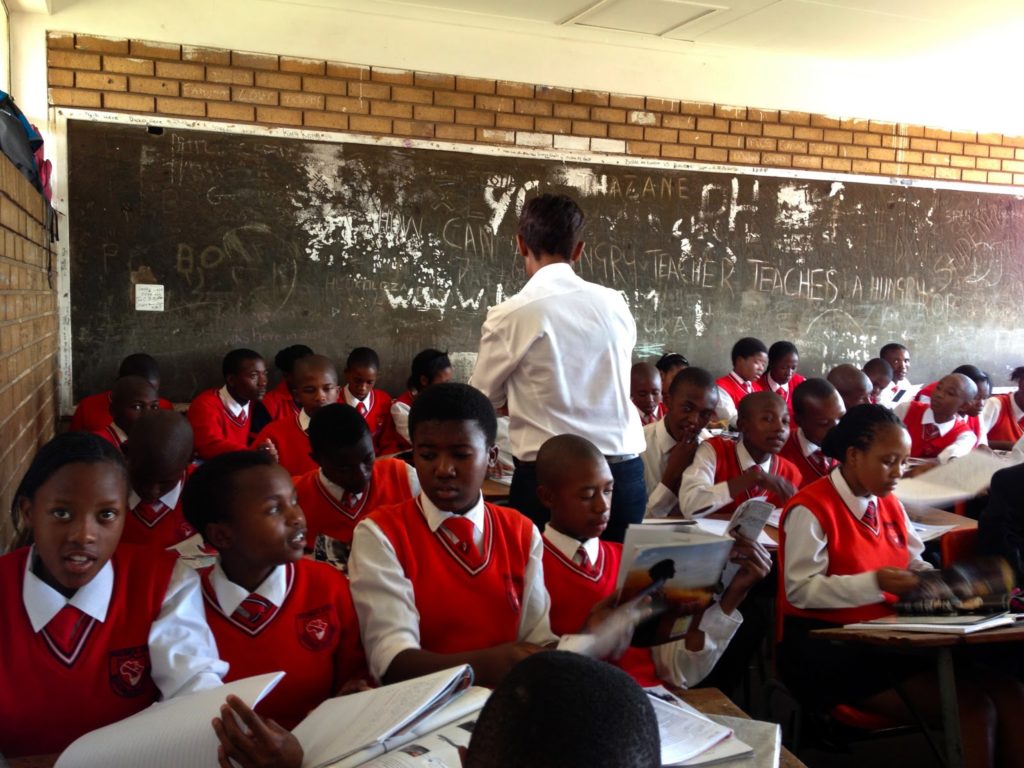
Phumlani Secondary School opened in 1993. “It was the last school formed in the area by the previous government,” Principal Shumi Shongowe told me. “There was a fight, a war between the IFP and the ANC, the soldiers that were deployed by the previous government… People were killing each other. There was blood all over. And there was no time even to bury those that were dead.”

Then he paused, looked up and calmly said, “And it is then that this school was started.”

It was a reminder to me of the painful history of this country and the trauma and chaos out of which so much, including this school, has been born.

Many people who work in schools say that uniforms help with discipline and focus, but I rarely hear that the blues and yellows and greens and maroons have any meaning. Surrounded by brutal violence in 1993, Shongowe consciously chose the school colors. Red for the blood that was spilled. White for the hope that remained. “To say,” he told me, “after some time, all this shall be over and life shall go back to normal.”

In 1994, that was a new normal.

The school has grown from 200 students and a 5 percent pass rate in 1993 to 1,783 students and a 94 percent pass rate in 2012.

These 1,783 learners also find meaning in the uniform. “I call it a uniform of success,” one learner told me. “People who are in jail, not that I’m criticizing, but people who are in jail, they are wearing a uniform of regret. So this is a uniform of success.” The nuance and generosity he extended to prisoners with the use of the word regret struck me. Not violence, evil or wrong, but regret.

My mandate here is to identify keys to success. I often find that while those keys are unique, they should be commonplace.  One principal only hires teachers who studied that subject in college or university. That seems fairly basic, right? How can a history teacher teach biology? How can an Afrikaans teacher switch to technology, as I saw happen at one school? This too often happens as teachers are moved from subject to subject to fill gaps, despite a lack of training.

In another example, at Tetelo Secondary School in Soweto, Principal Linda Molefe and his staff end the year with a two-day meeting where they create a comprehensive plan for the following year. Acknowledging that plans constantly shift and change once the year begins, he said, “We can start right away because we know where we’re going.”

I always ask about parent involvement because it’s a critical factor but often difficult to achieve. Both principals emphasized that getting the parents to show up wasn’t enough. It was their obligation to teach parents how to be involved, to be clear about what is expected of them.

One principal has created an easy way for parents or grandparents, regardless of their education, to check their children’s progress. It involves simple numeric indicators. “Some of these grannies, they have never been at school… it is your responsibility to try and school them. To say what role are you expecting them to play. And these grannies with the issue of indicators, they also become excited because they can now get involved and give support to their granddaughters and grandsons.”

*************

 I have a new word for moments in these journeys that surprise me. I now call them “a capella moments.” At Phumlani Secondary, a group of boys approached me and asked if I would film their singing group. I was blown over when I heard their harmony, the noises they created through snapping and percussive beats.  It was like nothing I had heard before at a school in South Africa. The Soul Singers (as you may have guessed) are an a capella group.

The a capella moment at Tetelo Secondary came at the very end of the day, during mandatory study time for grade 12 learners. Because of the heat, many brought desks and chairs outside. We found one group of about 10 learners sitting under a tree, intently studying physics, debating and teaching one another. They traded off being the teacher, chalk in hand, using the side of a Cell C container to write on.

The irony was not lost on me that these kids were choosing to learn under a tree in a country where for years children like them had been forced to learn under trees. I shouldn’t speak of it in the past tense, since this still happens in some rural schools.

When I flew back to Cape Town on Friday morning, there was an article in the newspaper about an Education Charter that was recently put forward by the South African Human Rights Commission. The charter offers rules and recommendations to the government on giving quality education to all children. It addresses issues like crowded classrooms, suggesting that pupil teacher ratios not exceed 1 to 40 for grades 1 to 12. It proposes ambitious deadlines to meet aims for everything from reduced class size to electricity and running water for all schools, to making sure schools have other basic and essential services needed to teach and learn properly.

The Charter is filled with incredible goals to improve education across the country.  I don’t understand how they are going to fix so much so quickly. At Phumlani, the 1738 students are based in an old primary school building. The principal says he is basically running two schools. At Tetelo, I saw students mopping out their container classrooms in the morning because it had rained the night before and the classrooms leak. In the midst of cleaning and mopping, some were polishing shoes and straightening ties.

How will the government build enough classrooms and buildings so these students aren’t packed 65 in a class and don’t have rain dripping on their books? To have actual libraries and labs rather than a lab on a cart that is pushed from class to class.

I remain somewhat doubtful, but hopeful and will wait and see. In the meantime, maybe the government should bring some of these principals to other schools to share their best practices. “There is no recipe for success,” Principal Molefe told me. But I think sharing ingredients would be a good start.

Molly Blank. This piece originally appeared, in slightly different form, here.

(Photo Credit: Vimeo / Phumlani Secondary School)