Siphokazi Mdlankomo challenges perceptions of domestic workers in South Africa

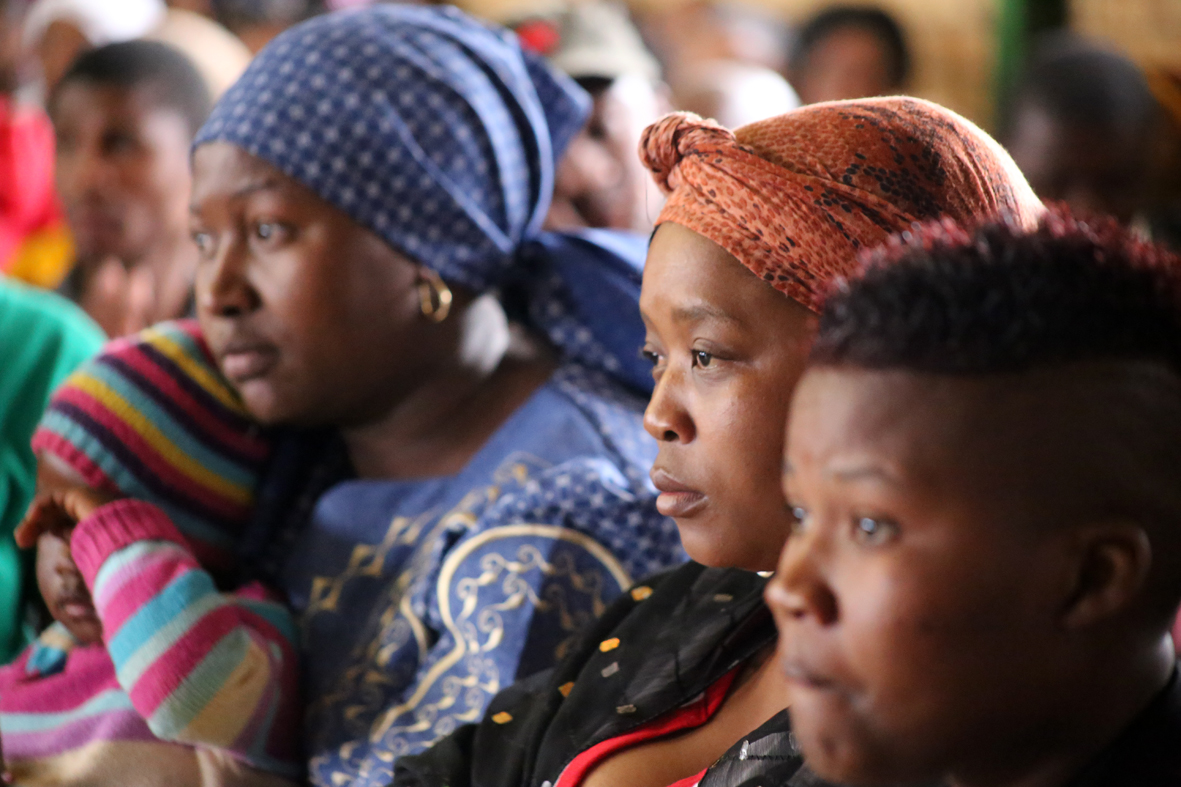
Siphokazi Mdlankomo, a domestic worker from Newlands, South Africa, is garnering international attention – and she’s using her new celebrity to call for the equal treatment of domestic workers. Mdlankomo debuted as a contestant on the popular show “MasterChef South Africa” last month and quickly became a fan favorite. The show’s contestants compete against each other in cooking challenges in the hopes of securing a future as a professional chef.

But becoming a chef is not Mdlankomo’s only goal. As noted in her biography for the show and reported last week, she also aims to use her time in the limelight to challenge global perceptions of domestic work and prove that domestic workers are not “second-class citizens.” “People, not only in South Africa, but all over the world should start taking domestic workers much more seriously,” she said. “People need to start thinking of domestic work as any other profession … it’s not just cleaning and cooking, there is far more talent in domestic workers.”

That Mdlankomo lives and works in South Africa is noteworthy. There are approximately 1.15 million domestic workers in the country. According to the International Labour Organization (ILO), more than three-quarters of domestic workers in South Africa are female, and their racial breakdown is highly imbalanced. Ninety-one percent of the country’s domestic workers are classified as “African/black” and the remaining nine percent are “Coloured.” Domestic worker employers, however, span all races.

In many ways, South Africa has been a leader in establishing legal protections for domestic workers. The country set requirements for minimum wages and formal employment contracts for domestic workers in 2002 and 2003, and it provides domestic workers with unemployment insurance, skills development opportunities and other resources. It was also one of the first countries to ratify the standards set by the ILO’s Domestic Workers Convention.

Despite these advances, abuse and exploitation of domestic workers is still an issue in the country. Some argue that this is due to a lack of enforcement of the laws. Wages remain low, 70 percent of domestic workers in the country work without a contract, and there are still reports of abuse, disrespect, segregation and racism. Researchers from the Community Agency for Social Enquiry found that many South African domestic workers think their employers view them as inferior and discriminate against them based on their race.

The recent actions of two South African university students exemplify the racism and objectification that still surround domestic work and the women who perform it. Soon after Mdlankomo’s debut, two white University of Pretoria students posted photos of themselves dressed up as domestic workers online, with their faces smeared with brown paint and pillows shoved in their skirts. The photos are a stark reminder of domestic worker stereotypes and the country’s racial history, and they make clear that legal protections do not generate social and cultural change overnight.

The university immediately condemned the students’ behavior, and there was much criticism from South Africans through social media. These reactions suggest awareness among South Africans that racism and ridiculing domestic workers are intolerable, at least in public – and therein lies a big part of the problem. Even though domestic worker employers might know that the mistreatment of domestic workers is socially unacceptable, they may not recognize more subtle forms of exploitation, and what happens in their own homes is ultimately private and hidden behind closed doors.

That’s what makes the reaction to Mdlankomo’s message, her popularity, and her efforts significant. Her presence on the hit show and commitment to using it as a platform to call for respect for domestic workers is helping to make domestic workers more visible to a popular audience. Scholars worldwide have well documented the legal, economic, physical and social forces that contribute to the invisibility and isolation of domestic workers. Pushing domestic workers’ stories, talents and struggles into the public sphere might help counter harmful and dangerous representations that appear all too common, even among a younger generation of university students.

As we noted previously, scholars have long studied media’s impact on public understanding and opinion. For this reason, groups like Migrant Rights have criticized the way media portrayals of domestic workers perpetuate degrading stereotypes that contribute to the mistreatment and abuse of workers. From this perspective, Mdlankomo and her message offer a positive alternative depiction.

News media coverage of Mdlankomo has so far framed her comments as “causing a stir,” “striking a nerve” and “heating up the black servants’ debate.” The fact that her common sense message is controversial and discomforting makes clear that it is necessary. Whether it will have a major impact remains to be seen. In the meantime, Mdlankomo is challenging South Africans’ understanding of domestic workers and confronting them with the need for equal treatment, and that has the potential to generate important and valuable conversations within households and beyond.


(Photo Credit: 702)
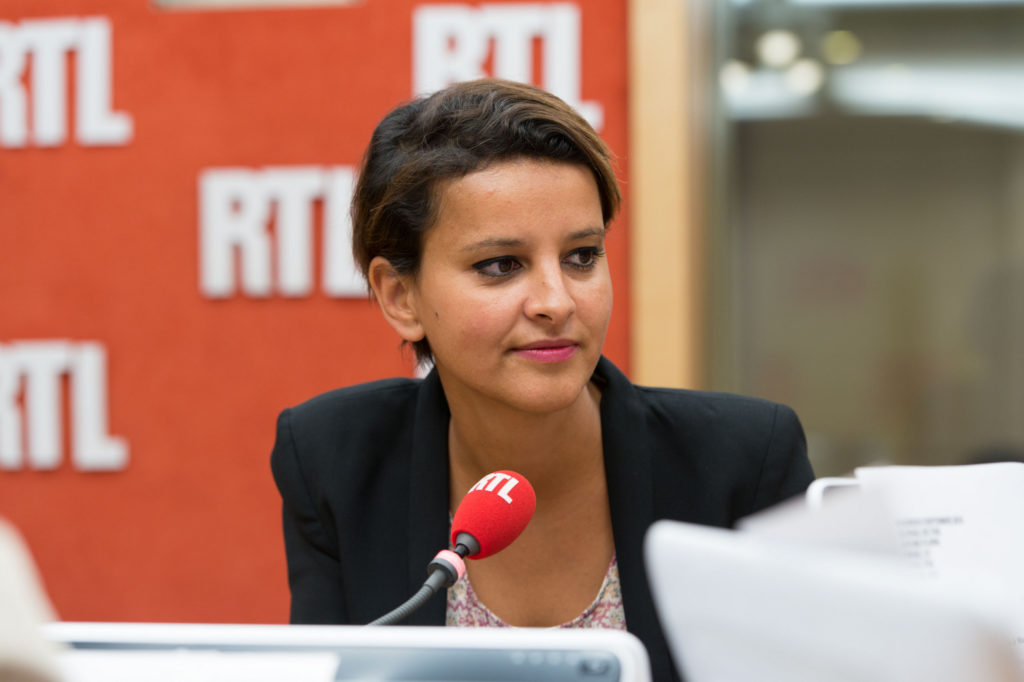
Najat Vallaud-Belkacem fighting racism and sexism in France for real equality


Najat Vallaud-Belkacem

Not long ago, Najat Vallaud-Belkacem, then the French Minister of Women’s Rights, introduced and successfully defended a bill entitled “For Real Equality Between Women and Men.” This bill supported the normalization of parity. After the recent reshuffle of the government, Vallaud-Belkacem has become France’s Education Minister. This position is the fourth most important in the ranking of ministers in France. She is also the first woman to hold this major ministry.

Her nomination could have been a sign that something was working toward real parity in the highest political representation in France, but alas no. Immediately after her nomination, Vallaud-Belkacacem was targeted in right wing magazines by sexist and xenophobic attacks. These attacks used her dual Moroccan and French citizenship, her Muslim origin, her youth (she is 36), her sex, her support for same sex marriage, her support for the inclusion of gender theory in regular primary and secondary education, and, finally, her active feminist support for women’s rights.

Valeurs Actuelles, a magazine that the former president Nicolas Sarkozy uses regularly to make statements about his eventual return to politics, staged her as “the Ayatollah” on its front page, with an edited photo that accentuates the darkness of her eyes, making the portrait loaded with negative representations of Islam. The subtitle uses play on words to suggest that she is going redesign the National Education system. The title of another magazine “Minute” does the rest: “A Moroccan Muslim at the National Education, the Najat Vallaud Belkacem provocation.”

None of these displays of hatred is new. The latest was Christiane Taubira, the Minister of Justice, whose origins and skin color sparked off racist and sexist slurs. Both women epitomize the fight against all inequality, including gender, ethnic and social inequality. Christiane Taubira reacted and wrote to her colleague in a tweet, “They must have nothing in their heads, be empty in their heart, and have hardened souls. Najat, you’re flying high with our ambitions for schools. Thanks.”

Meanwhile, the line between right and extreme right becomes increasingly blurred. In a tweet by a right wing city counselor of Neuilly sur Seine, Najat Vallaud-Belkacem was accused of using her femininity, also called “skirt promotion”, to access this position. The counselor, of course, added a suggestive picture. Another right wing enclase, the city of Puteaux, in a charity effort to support families with children returning to school, distributed strong blue backpacks to boys and strong pink one to girls, making clear the separation in colors and roles of girls and boys in a binary society.

“Najat Vallaud-Belkacem is the ideal target for all those who would like to distill the idea that an immigrant woman could not legitimately be part of a government” says SOS Racism, an association that denounces all sorts of racism. These attacks go beyond that. They exploit the old demon of colonial countries to block advances in women’s rights and human rights and to achieve various goals: controlling the population at large, curtail all debates, policing the whole of the neoliberal environment.

When Najat Vallaud-Belkacem was Minister of Women’s Rights, she declared that we needed to be politically proactive to address gender inequalities. She was right about that. When she said that gender, class, ethnicity are the bases of inequality and that hatred is the way “to emptied hearts and hardened souls” where inequalities grow, she was right again.


(Photo Credit: RTL.fr)

The scale of India’s “one small incident of rape”

According to India’s National Crime Records Bureau, in 2013, there were, nationally, 33,707 rape cases, up precipitously from 24, 923 in 2012. New Delhi suffered the highest incident of rape, accounting for 1,636 cases in 2013. That’s up from 706 in 2012. Mumbai, Jaipur and Pune, the next three cities with the highest reported incidents of rape, together had 754 rape cases in 2013. In 2013, in 13,304 of the reported cases, the victim was a minor. In 2012, that number was 9,082. Finally, in 94% of the cases, the offender was “familiar to the accused”: a parent, neighbor, relative other than parent, or someone else. 94%.

These numbers are beyond disturbing.

Last month, India’s Finance Minister Arun Jaitley raised a storm of protest when he reflected, “One small incident of rape in Delhi advertised world over is enough to cost us millions of dollars in terms of lower tourism.” The “one small incident” was the 2012 gang-rape and murder of a young woman, now known as the Nirbhaya case. Nirbhaya means fearless.

When protests exploded all around him, the Finance Minister regretted his words, and, of course, the ways in which they had been “misconstrued”. As witness to his recantation, the formal, published version of the Finance Minister’s talk removed the word “small.”

While the diminishment of a terrible event of violence against a woman, and of violence against women, was horrible, and according to many of the responses and critiques much worse, the reduction of sexual violence to an economic equation is equally problematic and wrong. If the `one small incident of rape’ only cost, say, a thousand dollars, would it then be fine? Would it then not be a matter of concern for India’s Finance Minister? Is finance exclusively and only a matter of hard, cold cash, and curiously that of other nations?

There are calls – from the victim’s family, from women’s groups, and from the general citizenry – for the Finance Minister to resign. It’s not enough. Words of repentance and regret are fine, but they do not suffice. Arun Jaitley is part of State power. He has been for years, both in the opposition and now in Cabinet. Let him and his colleagues say less and do more. If they feel they must talk, let them say, publically, that as members of State they take full responsibility for the 33,707 women and girls.

But the place to show real remorse is in the national budget. Invest in those organisations in India that are sisters to organisations such as Rape Crisis Cape Town Trust in South Africa, organisations made up of women and men, made up of individuals and communities, hard at work at the coalface of sexual violence. Incidents of reported rape rose 35% in one year. Raise the budget for prevention of sexual violence and for care for survivors of sexual violence by 70%. Don’t talk about the millions of dollars lost to “one small incident of rape.” Instead, invest in stopping violence against women. Be fearless.

(Photo Credit: Al Jazeera)

(This is part of a collaboration between Rape Crisis Cape Town Trust and Women In and Beyond the Global. The original, in a different version, can be found here. Thanks to the staff and volunteers at Rape Crisis Cape Town Trust for their great and urgent work.)

MH’s victory is a victory for all women workers everywhere

At the end of July, the Supreme Court of the United Kingdom handed down its judgment in the case of H (Appellant) v Allen and another (Respondents), In their unanimous decision, the Court decided to protect and strengthen the rights of women workers, and in particular of migrant and immigrant women workers, irrespective of legal status. It’s a great decision and an important victory for women everywhere.

Lord Nicholas Wilson, Justice of the Supreme Court, explained the case and the Court decision as follows. On 28 January 2007, “Mrs. Allen” brought “Miss H”, aged around 14, into the United Kingdom on a visitor’s visa. Miss H is described as illiterate. She had lived with Mrs. Allen’s brother in Lagos. Miss H was brought into the United Kingdom under two false claims. First, her age was listed as 20. Second, she was claimed as the granddaughter of Mrs. Allen’s mother. Miss H was “aware” of the false pretense. She knew that she could only stay for six months and that she could not legally work for pay.

Miss H, illiterate and 14 years old, “entered into a contract” with Mrs. Allen to help with Mrs. Allen’s children. Miss H never received any pay, nor was she ever allowed to attend school. Further, Mrs. Allen verbally, emotionally, and physically abused Miss H, and repeatedly threatened her with prison, explaining that since she was “illegal”, if she were caught on the streets, she would go to jail. Miss H lived under these conditions for a year.

On 17 July 2008, Mrs. Allen pushed Miss H out of the house, locked the door, and that was that. Miss H was found by someone, who took her to Social Services.

Miss H sued Mrs. Allen for discrimination, since she was brutally mistreated because of her Nigerian nationality and her unlawful immigration status. The Employment Tribunal agreed with Miss H and demanded that Mrs. Allen pay compensation. Mrs. Allen appealed the case, claiming “the defense of illegality.” That is, Mrs. Allen claimed that since Miss H was working illegally, she could not sue. The Court of Appeals agreed with Mrs. Allen.

The Supreme Court unanimously reinstated the Employment Tribunal’s decision. For two of the Justices, “the defense of illegality” did not hold, and so that alone sufficed to throw the appeal out. For the remaining three, the more compelling argument was that Miss H had been trafficked. They argued that the public policy of maintaining the integrity of the legal process was secondary to the public policy of opposing trafficking and protecting the rights, if not the well being, of vulnerable people. To accept Mrs. Allen’s claim of “defense of illegality” and to refuse Miss H’s appeal would be, in the words of Justice Wilson, “an affront.”

Anti-trafficking activists and others have hailed this decision as an important step forward. The immigration status of a worker has no bearing on the labor rights of that worker, including the right to sue the employer in court. In the United States, women understand that courts matter. In South Africa, women understand as well that judges matter. And in this decision, in the United Kingdom, MH, who as a child labored in virtual slavery in someone’s house, has demonstrated that courts matter, judges matter, justice matters, women and girls matter. All women. All girls. Always.


(Video Credit: UK Supreme Court / YouTube)

From Paris to Washington, all women need easy access to real help in times of crisis

Recently, former President of George Washington University, Stephen Joel Trachtenberg suggested that violence against women on university campuses in the United States could be reduced if only women were trained not to drink in excess. He added that we need to educate “our daughters and our children” who drink too much.

At least, with these recommendations, women will remain sober while being subjected to violence? This type of comment is too often accepted in public spaces, such as NPR where it was expressed. As long as discriminatory comments and acts are still presented as primitive solutions, violence against women will persist.

Women need easy access to real help in times of crisis. Women also need society as a whole to stop discriminating against them, making us ever more susceptible to acts of violence.

In France, a recent bill, For a Real Equality Between Women and Men, takes on violence against women in its multifaceted approach to create conditions for more equality. The bill offers other methods to address this issue. Some are for immediate relief for women. Others offer a long-term approach to make violence against women clearly and unequivocally unacceptable.

The distribution of the free personal cell telephone “grand danger” (emergency phone) to women who are at risk of domestic violence is inscribed in the new law. This measure has been initiated by Najat Vallaud-Belkacem, who presented the bill to Parliament in coordination with Christiane Taubira (Minister of Justice) and Bernard Cazeneuve (Minister of the Interior in charge of police).

The cell phone is connected to a call center where trained people may activate a police intervention, which should be effective within ten minutes, according to Najat Vallaud-Belkacem. A woman who feels threatened presses three times on the bottom of the phone to be connected to the call center. Other numbers are pre-registered in the phone to give access to associations that provide psychological support to women who may just need to talk.

The phone is given for six months, renewable, to women whose former companions have been issued a no contact order by the court. With the phone comes psychological support to reduce the feeling of isolation that domestic threat produces.

This system is already widely used in Spain.

After four years of trial in various areas in France, the phone “grand danger”, according to Christiane Taubira, has been a clear success. It has saved lives and has helped women to break the cycle of violence and isolation. In fact, the phone seems to give women a sense of security. According to the Public Prosecutor of the Republic of Paris, the great majority of women call just to make sure that the phone is working; only 10% of the calls are for actual emergencies.

This method is now part of a national plan of action to reduce violence against women and will be accessible to women in the entire French territories including the DOM TOM (French overseas departments and territories). However, as Christiane Tuabira made clear, it is not a gadget. It is there to stop the cycle of sexual and domestic violence and provide preventative and timely assistance to women who are the victims of such violence. This device is part of a larger set of actions. The goal, said Christiane Taubira and Najat Vallaud-Belkacem, is to reduce the level of acceptability of violence against women in society in order have fewer “grand danger” phones.

Let’s extend this goal to the United States and stand up against comments, such as those of Stephen Joel Trachenberg, that show the pervasiveness in ordinary language of discrimination against women, making us more vulnerable to violence. There’s a petition that offers one of the numerous actions to change the level of discussion. You can find it, and sign it, here.

Please sign and share the petition. Every effort counts!


(Image Credit: Najat Vallaud-Belkacem)

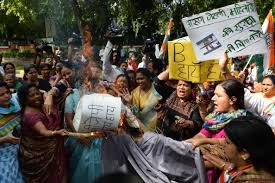
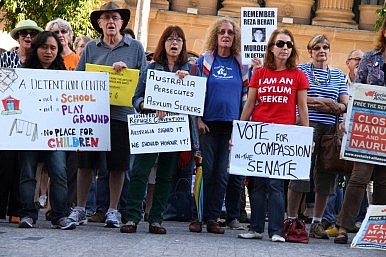
Australia’s shameful trade in refugees and asylum seekers

What’s the going rate, the market value, for refugees and asylum seekers these days? Ask the Australian government.

Australia and Cambodia are close to finalizing a deal on refugees. No one seems to know the details of this arrangement, because both countries are keeping it very hush-hush. But what we do know is it involves refugees and asylum seekers being moved from Australia’s catastrophic adventure in Nauru, to Cambodia. Some, in the Cambodia opposition, say this could involve as many as 1000 refugees, and they are most likely going to be `relocated’ on a remote island off the coast of Cambodia.

We also know that Australia is one of Cambodia’s largest aid donors. Over the past four years, for example, Australia has donated over $329 million to Cambodia. We know that Cambodia is one of the poorest countries in the world. We also know that Australia has criticized Cambodia’s human rights record, more than once and most recently at the United Nations.

We are told that refugees will be `relocated’ only if they volunteer, but if they refuse to volunteer, their refugee status will be reviewed.

In both Cambodia and Australia, opposition to this deal has been fierce and intense. Much of it has centered on the conditions in Cambodia and the folly of sending refugees, many of them fleeing the violence of conflict zones, to an area just emerging from a long and brutal civil war. Others point to the economic hardship of life in Cambodia and others to the difficult political, civil and human rights situation.

What about the marketization of refugees and asylum seekers? Australia won’t be `relocating’ refugees. It will be dumping human beings, like so much cargo, and wiping its hands clean … or dirty. One thousand human beings who have asked for help and have already been dumped on one inhospitable island are now to be dumped again on another, even more inhospitable island? This `deal’ takes the privatization of `care’ for asylum seekers and refugees to a new, and yet very old, place: offshoring.

Cambodia will `volunteer’ to take the refugees because Australia has offered it cold, hard cash, or financial benefits. And so the entire region will become one giant marketplace for human cargo, not quite slaves, not quite not slaves.


(Photo Credit: TheDiplomat.com)

Shackling pregnant women prisoners violates the law and women’s rights!

This past session, Maryland passed anti-shackling bill HB 27. It took two years to pass a bill that protects pregnant inmates from being shackled. The Maryland bill passed along with one in Massachusetts, making these the 19th and 20th states to have such legislation. A number of states have passed anti-shackling bills restricting the use of restraints. Still, these bills don’t guarantee protection of the right for dignity of pregnant inmates, especially considering that most pregnant inmates are African Americans, Latinas, American Indians or members of other stigmatized communities.
The Maryland bill was enacted on July 1, and already the question of monitoring and enforcement has emerged. Why? In the states where these “anti Shackling” bills have been enacted, women detainees are still being shackled.

Recently, some cases of shackled pregnant or post partum inmates made the news, in horrific cases of women who were degraded in the process and had long term health consequences or were put at risk of having complications for being shackled during pregnancy, labor or post partum. Equally shocking is that the reasons or justifications given ranged from lack of training of personnel in charge to lack of enforcement power attached to the bill. According to one report, “Many correctional systems, doctors, guards and prison officials simply are not told about anti-shackling laws, or are not trained to comply”

How can professionals in charge of women prisoners ignore what constitutes torture, despite “modern” means of communication? Speculators can place financial orders to make enormous amount of money in a nanosecond, but a bill that forbids torture needs so much effort to be understood? What type of training is needed to see that a pregnant women walking with chains or having chains around her waist is torture?

Despite anti-shackling legislation, pregnant women in Texas are constantly at risk of being shackled. New York passed an anti-shackling law in 2009. Recently, in a survey of 27 women who had given birth in New York prisons, 23 said that they have been shackled before, during or right after their delivery.

The women prison population is on the rise. The official language is that the vast majority goes to prison for non-violent offenses. The reality is their social position makes them more vulnerable to being punished for pitiful reasons. Meanwhile the punishment inside the prison is constant and degrading. Abuses go from restricting the number of maxi pads for periods per month and per woman, unless the woman pays for more, to restricting motherhood, making it difficult to keep contact with already born children as well as guaranteeing decent conditions for pregnancy, delivery and post partum recovery.

70% of incarcerated women are mothers, and about 6% are pregnant. Still, women inmates are treated like men. In Maryland during the discussion of the anti-shackling bill, testimonies arguing against the bill presented possibility of escape as a major risk. All the “evidence” concerned men’s attempts to escape while being transported to hospital. No one said anything to correct this. Women who are pregnant don’t escape. There has been no incident of women in labor escaping or causing harm.

The anti-shackling bills have also a tendency to be weak in the protection of pregnant women. In Maryland a series of amendments dulled the impact of the introduced bill. The language – including recognition of the conditions of pregnancy, the importance to comply with international human rights principles, and more precisions about the monitoring of use of restraints if deemed necessary of HB 27 – was crossed out. Still, this bill is important, and it is what we have in Maryland. All efforts should now go to monitoring the application and enforcement of the bill so pregnant inmates are not left alone to deal with abuses.

So far, when pregnant or post partum inmates are shackled in anti-shackling states, the response is a lawsuit. “But there is no policing entity that’s really going to hold these institutions responsible.”

The conclusion should be clear and should include the entire United States. The United States should pass a clear federal law that prohibits shackling pregnant incarcerated women. Why not become more human and make the incarceration of pregnant women more difficult if not impossible? Why not stop the cycle of violence and torture? Women’s right to dignity has to be defended at the national level. A right is a right, and a law to protect women’s dignity is a law!


(Image Credit: RadicalDoula.com)

Gift Makau was laid to rest today

I have struggled to sit down and write about the rape, torture and murder of Gift Makau in Ventersdorp last Friday for days now. The mix of ugly and disturbing emotions that battle within me for expression is something to be avoided. I hate the grief, pain and anger I feel and how they permeate my days. How to say what needs to be said? How to find words, the right words?

Even after almost twenty years of working in the field of sexual violence and violence against women I still have little or no idea why men rape. So often people ask this question both in formal and in informal conversations. Why? I sidestep the answer, I dance around it, I avoid the standard rhetoric and the psychological theories. None of them do it for me. None of them give an explanation that would lead to a solution, a cure, a correction. Rehabilitation of sex offenders is a contentious issue with many believing that it is seldom successful. Certainly our rape rates in South Africa indicate that nothing is slowing this problem down.

To make it a problem of men or to cast women continuously in the passive light of victim is not an answer that I like. Sex is something that happens between men and women. Rape is something that happens between men and women. What is that “between” space? What happens there? The same thing happens between two women or between two men having sex. It is not the province of one gender or one kind of sexual act. It is a like a continuous ongoing conversation of enormous complexity. We bring ourselves, or parts of ourselves, to that conversation and it continues to compel us all. We have to begin to talk about what happens between us. To find the words, the right words.

In the end I decided to address my words to the man that raped and killed Gift Makau. At Rape Crisis we never comment about the motives of the perpetrator of rape. We never claim to know what he is thinking or feeling or what drives him. When journalists or researchers ask us we always refer them to an expert from an organisation that works with offenders. For once I want to break that rule.

To the man that killed Gift Makau: “How lost are you to your own humanity? What made you like that, what shaped you? What choices, if any, did you make that lead you down this path? Could you even answer these questions? What makes you think that you can change something that is not a personal choice? As if you could change your race? Or the fact that your mother gave birth to you? Or the placement of your internal organs in your body? These are facts of your identity. Just as being a lesbian was a fact of her identity. You can never change that fact.

“Just as you can never change the fact that she has sisters and brothers. All across South Africa and all around the world she has sisters and brothers that rage, and sorrow and mourn for her. We will fight this fight to make you know, just as you know your own name, that she is who she was and always will be. There are many, many more like her who will live lives of strength and courage and integrity and never stop asserting their right to do so even in the face of acts such as yours.”


((This is part of a collaboration between Rape Crisis Cape Town Trust and Women In and Beyond the Global. The original, under different title, can be found here. Thanks to Kathleen Dey and all the staff and volunteers at Rape Crisis Cape Town Trust for their great and urgent work.)


(Photo Credit: Inkanyiso.org)

Irom Sharmila’s struggle against militarization and for peace


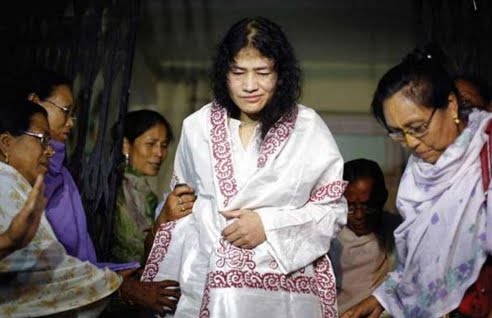
After fourteen years in “protective detention”, fasting, and being force-fed (in the name of protection), Irom Sharmila, anti-militarization and just peace activist walked away from the shackles of State protection yesterday.

On November 1, 2000, in the state of Manipur, in India, insurgents exploded a bomb as a battalion was passing by. No one was hurt, nothing was damaged. Nevertheless, the battalion retaliated, on November 2, by mowing down ten innocents standing at a bus stop in Malom. Included in what has come to be known as the Malom Massacre were “a 62-year old woman, Leisangbam Ibetomi, and 18-year old Sinam Chandramani, a 1988 National Child Bravery Award winner.” A pregnant woman was also reported as being one of the dead.

The army knew it could act with impunity. It was covered by the Armed Forces Special Powers Act, or AFSPA. AFSPA was imposed in Manipur in 1961. Much of the rest of the Northeast has been under its rule since 1972. By the government’s own testimony, tens of thousands of people have been disappeared, tortured, beaten, abused. In Manipur, this began in 1961. By 2000, it had gone for almost four decades.

Irom Sharmila decided then and there that enough was too much. On November 4, 2000, she entered into an indefinite fast, a hunger strike that would continue until the Armed Forces Special Powers Act is rescinded, the soldiers withdrawn, the people restored. She was arrested almost immediately and put into “custody” for attempting to commit suicide.

This week a judge decided that there was no evidence of a suicide attempt, and the State must release Irom Sharmila, and so on Wednesday, she walked out of the hospital, a “free woman.”

Asked about her feelings, Irom Sharmila smiled and described the air outside as “refreshing.” She then got down to business: “I will not touch food or water. I want a mass uprising on the AFSPA issue. I don’t want people to glorify me. I want them to come forward and support my cause, my protest against AFSPA. It’s a draconian law that has widowed many women, robbed women of sons, husbands and fathers. It must be repealed.”

Fourteen years ago, Irom Sharmila began a hunger strike against militarization in one part of India. Today, we see a global network of supposedly democratic, ostensibly protective militarization of everyday life, a “special powers” global factory that produces only corpses and widows and mothers in mourning in the name of security, just war, and, worst of all, peace. When Irom Sharmila left the hospital, where she’d been held for fourteen years, she walked a short distance to a tin shack, where her supporters have been camping. She wanted to spend her first day of independence in the arms of solidarity, surrounded by women. The struggle for peace continues.


(Photo Credit: The IndiAgent)

In France, for the real equality between women and men

Najat Vallaud-Belkacem, France’s minister for women’s rights

On July 23, 2014, the French Parliament passed a bill entitled “for the real equality between women and men.” The bill covers nine fields of societal life and avoids the pitfall of opposing private and public life that has always kept women invisible. Najat Vallaud-Belkacem, France’s Minister for Women’s Rights who introduced the bill, explained, “Because inequalities are everywhere, we’re having to act everywhere.”

Here is a quick summary of the nine parts that address parity and professional equality as well as precariousness and violence.

* Pregnancy and employment.

Women already enjoy maternity leave from 6 months for the first child to a possible 3 years after the second child. With the bill there will be an additional 6 months for paternity leave. Jobs will be guaranteed during maternity and paternity leaves. Today only 3.3% of fathers take some kind of parental leave. Commonly, men argue that they don’t want to suffer career consequences in taking parental leave. This law may help reverse this trend by first forcing paternity leave and reducing the impact of parental leave on parent’s career. However, the financial compensation is still meager compared to what is given in countries like Sweden where 90% of fathers take their parental leave, but it is a start.

*Professional equality.

Women are paid an average of 25% less than men for equal qualifications and have a harder time finding jobs that are labeled masculine. A broad range of measures in the bill address this issue, from subsidies to penalties for companies, public administrations, etc. In addition, a campaign has been launched in order to support jobs’ desegregation and fight gender stereotypes that affect women’s education. According to France’s Department of Labor, in order to have professional parity, 52% of the workers should change jobs. Studies suggest that in 60% of the cases educational segregation is responsible for discrepancies. Although in France women hold more degrees than men, they are more under employed.

*Breaking the glass ceiling to support access to decision-making position in public administration and companies for women.

Starting in 2017, there will be mandatory 40% women candidates to positions of executive manager in the public sector.

*Protection of single mothers.

For single mothers who don’t receive regular child support from the father of their children, a public trust will be granted to women to protect them from financial loss while measures to recover child support will be taken.

*Protection of women against domestic violence.

Women who are victim of domestic violence will have full protection, and their violent “partners” will be removed immediately. The bill reinforces the anti-abuse laws in the military and at university. It also provides better protection for immigrant. The law provides a wider array of possibilities for the sentencing of perpetrators of domestic violence to avoid repeat offences, with more education programs. The bill ensures nationwide of the very successful free emergency hotline.

*Better access to information on abortion.

The bill changes the language of the abortion law from a situation of distress to not pursuing an unwanted pregnancy. It also reinforces protections against anti abortion activists.

*Act against gender stereotypes.

France’s media regulator CSA will now have the authority to assure that women are not diminished with sexist statements or degrading representation. This measure will include sensibility training for journalists.

*Addressing hyper-sexualization of girls.

Beauty contests for children under the age of 13 are banned, and authorization is needed between the age of 13 and 16.

*Political representation

The bill increases fines for political parties that do not meet equal representation objectives. In 2012 with 40% of women candidates to the National Assembly, only 26.9% were elected.

All these measures tackle the various reasons that keep women in precarious positions. They also work on language and symbols as patriarchal references. For instance, the bill removed some gender-loaded language, such as “the good family man”, from the Civil Code. It also works on societal symbols, equaling marriage and civil union.

These measures are a start and were long due. Still, as Vallaud Belkacem declared, “I don’t believe that history is going to spontaneously take us forward, so going towards more equality needs us to be politically proactive.” Meanwhile, the French government barely respects the bill’s call for parity since men hold the all main ministries.

The opposition to the bill was small. However groups that have a conservative vision of family and nation argue that women should keep their role and it will cost too much to the state to support these changes. This type of opposition reveals once again that the unpaid, unrecognized work of women has been sustaining the civil society at the cost of women’s rights and well-being.

After all, at the time of the French revolution, the French Revolutionary Congress did not include women as citizens in its Declaration of Rights, the Declaration of Rights of Man. Instead it sent revolutionary women to the guillotine and banned women from debating men as equals.

Two centuries and a half later the Parliament finally showed signs of change. Clearly, Najat Vallaud-Belkacem is right. We need proactive political actions to address gender inequalities , and we need to remember that class and ethnic inequalities are linked to gender inequalities and must be addressed politically.


(Photo Credit: RFI / Reuters / Jacky Naegelen)