Brigitte Marti

Brigitte Marti is an organizer researcher who has worked on reproductive rights and women's health initiatives in France and in the European Union and on women prisoners' issues in the United States.

Prisoners have visitors in France and in many other European countries

Prisoners have visitors in France and in many other European countries. The prison visitors are volunteers who respond to prisoners’ requests to have visitors. As a prison visitor explained: “We are not contracted, we are not entertainers, we come to share and we don’t come to judge the act that sent this person to prison but to meet with the person who is beyond the act. The act is his or her business, our goal is that this person breaks free from the spiral of losing self esteem.”

How does it work? When a person is incarcerated, he or she is informed about the possibility of having a prison visitor assigned, and then the prisoner has to send a request to the prison authorities.  The prison visitor commits to visit the prisoner regularly. The visit is confidential, takes place in cells reserved for meetings with lawyers, and may last from 45 minutes to one hour and thirty minutes.  For the detainee, this moment with the prison visitor is one rare instant without surveillance.

The association of prison visitors, ANVP, was created in 1932 and became state approved in 1951. It presently counts over 1500 members, not enough, they say, to guarantee the ideal ratio of 1 visitor per 20 prisoners. The president of the association, himself a prison visitor, explains that they are always looking for and recruiting volunteers. The age required is between 21 and 75 years old, and it takes about 2 months to be accredited after an interview and a police background check, followed by six months of probation with more training.  The main quality expected is to be able to listen: “We are here to listen. We are the wind coming from the outside.”

For prisoners in France, the outside world continues to exist and detainees remain full citizens. As Stephanie Balandras, director of “Les Baumettes” women’s prison in Marseille, explained, prison visitors “ensure that a detainee remains a citizen”.

In a democracy, everyone with citizenship has the right to vote. In France, as in most democracies in the world, detainees retain the right to vote. The right to vote is recognized by the European Court of Human Rights and the Council of Europe as an essential right in a democracy; its suppression is incompatible with a true democratic system of governance.

Among the 47 countries of the European Council, 19 have no restrictions on civic rights for detainees, 21 have some restrictions, mostly decided in court, and 7 states suspend the right to vote for detainees.

Meanwhile, in the United States prisoners lose their civic rights when convicted. Writing on the extension of the robotized war with the development of the American drone program, Barbara Ehrenreich quoted the US Secretary of Education who reported in 2010 that “75% of young Americans between the ages of 17 to 24 are unable to enlist in the military today because they have failed to graduate from high school, have a criminal record, or are physically unfit.” As African Americans fill the American prisons, they are losing their civic rights in greater proportion than Whites. There are no prison visitors to listen to them or help them retain a sense of belonging as they are pushed further to the margins.

According to Denis Salas, “The principle of human dignity is the reference on which lies the right to bend state power.” As one prison visitor put it, this principle has to come from the outside to the inside: “The prison visitor’s objective is to make each detainee aware of her or his own riches and deficits, and to help him or her to build their own project for the future”.

Let’s imagine more prison visitors in the United States, people who would help make American prisoners more visible, retain and develop their own humanity, and have their civic rights restored.


(Image Credit: Sentencing Project)

Evolution of a scandal in France

Christiane Taubira announces new penal reform plan

Christiane Taubira announces new penal reform plan

Last Saturday the dispute between Minister of the Interior Manuel Valls and Minister of Justice Christiane Taubira concluded …  at least for now. First, Taubira responded to Valls’ letter by debunking the manipulation of numbers and ideas that were the basis of his attacks on her reform agenda. In so doing, Taubira underlined the dangers of exploitation in penal populism.

Then she announced the main points of her penal reform proposal. She called for an end to the “enfermer, enfermer sans cesse” (lock up, ceaselessly lock up) doctrine of the past 10 years when Nicolas Sarkozy was, first, Minister of the Interior and, then, President. In a speech to Europe Ecologie Les Verts, Taubira described these as ten years that had damaged French society, ten years of constant social tension, “of martial discourses, of great threats, of intimidating virility”.

The crux of Taubira’s reform is repeat sentences. About 58% of the offenders in France re-offend.  In response to this crisis, she proposed alternative sentencing, known as probationary sentencing, for any sentences under five years. Probationary sentencing would be used at the discretion of the judge.

Taubira further announced the official end of mandatory sentencing. She explained that her approach to reform is both serious and rigorous. To that end, she introduced a social component that would limit the “sorties seches” (or “dry releases”), releases that offer absolutely no personalized support.  The vast majority of releases from prison are of the “dry” variety.

In Europe, most sentences are short, anywhere from a few months to a few years. Nevertheless, the shock of incarceration, the shock at the series of humiliations, is enormous. Then the shock of being released without support is equally enormous and is considered a kind of second sentence. One third of the people in sheltered housing have been in prison before. Taubira amassed an array of measures and means to foster personalized assistance for former prisoners.

What lies behind Christiane Taubira’s announcement is a clear sign that we are witnessing the end of the pile of devastating penal laws passed in the last 10 years. Most, if not all, have just increased the tension between justice and society and increased the sentiment of malaise and insecurity.

The instrumentalization of victimhood in the political arena has changed the role of justice and served to construct a penal populism.

The latter has been used in the United States for political and economic purposes. It hurts and renders many people and communities more vulnerable. One should be particularly wary of the multiplication of laws after intense media coverage of crimes. For instance, the murder of Laci Peterson, eight months pregnant, in 2002 brought the Unborn Victims of Violent Act in 2004. Ever since, numerous pregnant women have been threatened and often wrongly convicted by this act. The consequences for pregnant women are dire, especially for poor women, and have affected reproductive rights in general.

The real scandal is the spread of poverty and social fractures, the real junction between the ruthless neoliberal global market and the population.

Christiane Taubira has to deal with a public opinion whose sentiment for “security” has been stirred up by the previous government, which shook the social solidarity system with its neoliberal privatization of public services. She is demonstrating that there is a way to get out of this logic of reactionary repressive system of punishment. In the end, she quoted the poet Rene Char “stupidity likes to govern…” She added that her goal is to destroy the methods that led to increased incarceration and have endangered the true security of a society.


(Photo Credit: Sebastien Calvet / Libération)

Prison is torture!


Amid all the discussions of prison, people on the outside only rarely hear the voices of  the prisoners themselves. In a series of interviews with prisoners, Le Monde and the France Culture program  “24 hours in prison” attempted to give a somewhat autonomous audio space to those voices.

The arrival in prison is always a traumatic event. Hugo (56 years old now) describes his first arrival in prison, when he was only 16. He returned years later and spent 29 years altogether in jail. At 16, he was terrorized and felt deeply the foreign gaze that scrutinized his naked body with a simultaneous purpose of watching and penetrating. During the strip search, he was indeed penetrated. He felt that his body was being thrown to the lions.

The search is a form of punishment, says Helene who spent 11 months in pretrial custody. Hafed explains that he always accepted getting undressed but always refused what he calls “les à côtés”, the things on the side that are all kinds of penetrating searches. He paid for his resistance with many stays in solitary confinement. Djemel adds that there is nothing more humiliating than the search.

Helene remembers solitary confinement as a place where the image of the self disappears: “You are alone truly alone; nobody else is there.”

Solitary confinement is another humiliation within the punitive system that erases personality as it destroys prisoners’ bodies. Helene recalls that she started to lose her hair immediately after her incarceration. Her hair would stay in her hands; she cut her hair short with little school scissors.

Hugo says that he has 5 upper teeth and 6 lower teeth left. He adds, “Most of the people who land in prison are already poor and arrive with dental problems and living in confinement just aggravates the problems.” He admits that he even pulled some with a fork.

The body is malnourished in prison, thanks to the mediocre quality of the meals served by Sodexo. In 2009, the Sarkozy administration contracted with Sodexo to serve 27 French prisons. Prisoners often have to buy at excessively high cost additional food to ameliorate their poor ordinary diet.

“In 2003 before I had my problems. I weighed 75 kg. Now I am 50 and weigh 54 kg. Prison makes you ugly! Because you are in a constant state of humiliation,” explains Hugo.

Sport is often a way for prisoners to remedy the effect of the penal environment. Hafed explains: “You lift weights… In that way, you wipe clean the windows and let the backroom turn to trash.”  The body becomes even more mutilated. “Sport is not a matter of harmony,” explains Djemel, “You are in constant brutal relationship with sports.”

In France, as elsewhere, there are a large number of suicide attempts in prison: “Your body is in prison. You cut yourself to attract attention,” says Hugo. Desperation from the humiliating process entails mutilation but cutting is also a way to assert one’s personality and existence when facing the impossibly heavy and brutal weight of the penal system.

These prisoners’ testimonies are there to remind everyone that prisons today are designed to break their bodies and minds. As one prisoner said, “Prison is torture!”


(Photo Credit: Le Monde)

Scandal in France! Prison as a last resort!

Christiane Taubira explains prison

Scandal in France! August 5th, at the beginning of the sacrosanct vacation month for the French, three “delinquents” who had not yet served their full sentences were released, due to lack of space in the overpopulated French prisons. The three men had been sentenced to 2 to 3 months in prison for light offenses. The decision to remit their time in prison was made by the public prosecutor department of Chartres/Dreux, in the western part of France.

Some politicians from the right decided to use this story to denounce the approach taken by the current Minister of Justice Christiane Taubira that departs from the previous government. Taubira wants to reform the system of sentencing, rather than keeping incarceration as the central remedy for all social problems.

Under Sarkozy, the State used the imagery of (in)security to call for tougher punishments on behalf of the victims. It developed a policy of prison expansion and the use of incarceration as incapacitation, along the lines of the United States penal system. Laws such as minimum mandatory sentences, until that time unknown in France, were proposed and passed, guaranteeing 4000 additional bodies every year on the assembly line to prison. These additional prisons ensured a smooth transfer of funds to private prison contractors, in particular Sodexo.

Christiane Taubira responded to her critics by denouncing the previous policies that created the current prison overcrowding crisis. But things got complicated when a letter by the current Minister of Interior Manuel Valls, who is in charge of police, to President Francois Hollande was leaked. In the letter expresses, Valls disagreed with his colleague Taubira, asserting that the individualization of sentence and the reduction of prison sentencing through alternative sentences should not be applicable for recidivists for whom he demanded tougher laws.

Manuel Valls voices a populist approach that tends to eliminate the individualization of sentencing, therefore edging closer to the American system of mass incarceration. Denis Salas, a law professor at the magistrate institute in France, argues for the importance of individualized procedure to avoid the mechanical effect of a law that prescribes incarceration as an unavoidable, or mandatory, sentence.  He explains: “The shock of incarceration, detention on remand, then the first incarceration as most of the suicidal attempts occur in the first weeks of imprisonment have irreversible effects.” Moreover, many reports have concluded, including the recent report “Conférence de Consensus de prevention de la recidive” (consensus conference on the prevention of recurrent offenses), that prison does not help prevent the recurrence of offenses. The report was handed to the current Prime Minister last February and contained 12 recommendations for better penal public policies that all call for reestablishing human dignity, rather than tougher laws.

If the real goal is to break the cycle of repeating offense, one can only encourage Christiane Taubira to continue her work to sustain a society that sees prison as a last resort. A repressive police force and criminal justice system only serves the market economy, erasing the lives of individuals and collectivities as it strips bodies of very social existence. In this `debate’ between human dignity and mass incarceration, where exactly is the scandal?

(Photo Credit: http://www.lemonde.fr)

Casual rape in prison work places

What is considered rape? Often, the definition of rape depends on who holds the power to define it.  For example, what is happening in places where women are confined, dependent and supervised?

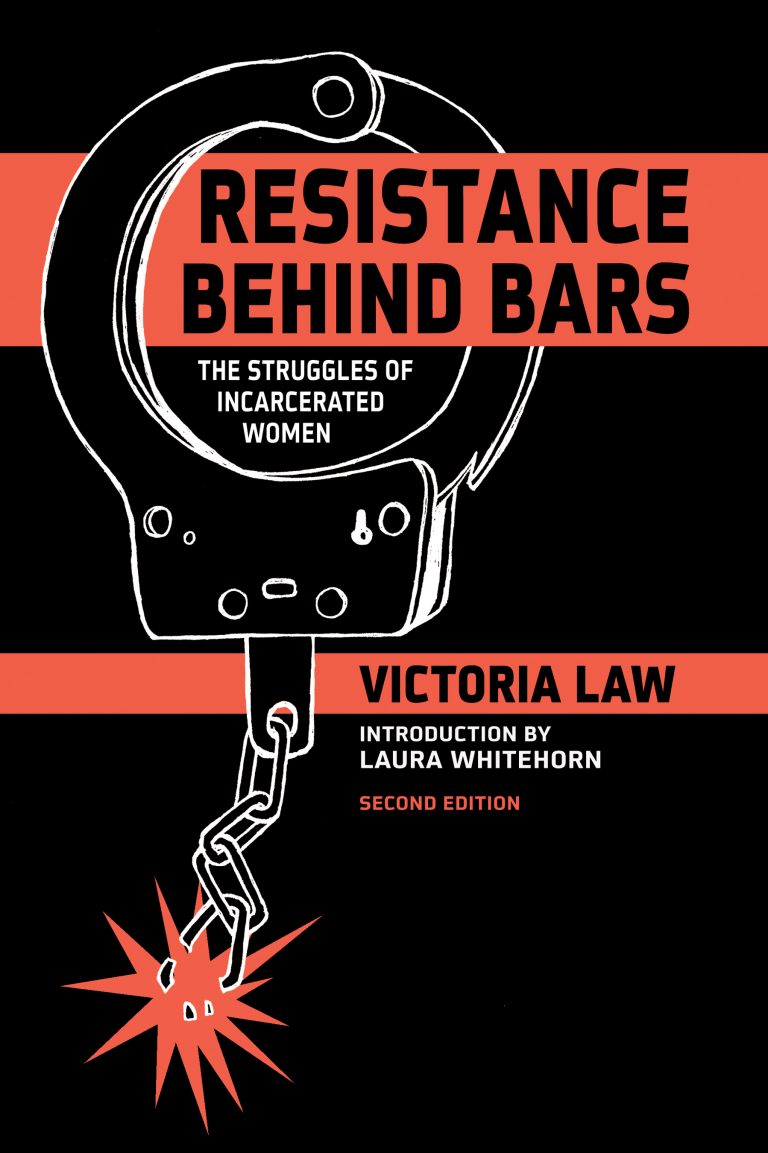
In Resistance Behind Bars, Victoria Law devotes one chapter to sexual abuse in prisons. Women like Gina are forced into having sex with male wardens or supervisors. Gina worked in a correctional coffee shop in Oregon as a prisoner. Everyday she would work with the food coordinator who was a male prison employee. She loved her job and thought that her relationship with the food coordinator was friendly, and then he ordered her to have sex with him, “Scared Gina complied.” Casually, sex was part of her everyday work life. As Victoria Law explains, “She did not know if it was rape. All she knew was that she felt alone, afraid and unsure of herself.” (59)

As at many workplaces, women in prison don’t feel secure reporting abuse. Prisoners fear that reporting to internal affairs will result in retaliation from prison personnel and sometimes from prisoners who trade sex for favors. Retaliation in prison may take different forms, including more harassment, delays for release, visiting rights compromised, and worse.

Rape threatens women prisoners and renders them vulnerable as prisoners and as subordinates. In that context, sex becomes a illusory bargaining chip that ultimately generates feelings of being trapped. The ticket out buys the women prisoner another day or more in solitary confinement. Consent or its absence is not the question when women are already condemned, and damned, by incarceration and structures of dependency.  For many women prisoners, the only issue, the only ethical existential issue, is survival, paying the bills, and managing life in a brutal penal system.

(Image Credit: PM Press)

In France, mandatory minimum sentences kill

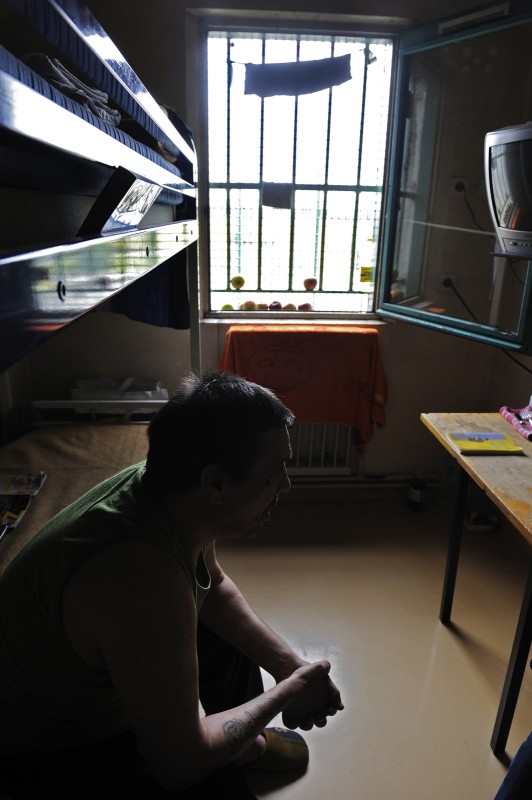
A cell in Longueness Prison

The Council of Europe‘s recently published Annual Penal Statistics officially reveal that European prisons are overcrowded. The report looks at 47 countries of the pan European organization, including the EU countries. The report coordinator, Marcelo Aebi, explained that every country, except Russia, sent data that seemed valid. The numbers may be valid, but the interpretations bear scrutiny. For example, in the calculation of the prisoner-to-space ratio, each country seemed to assess the need for space differently.

Space is never a neutral issue. In penal space, bodies are manipulated, processed and intentionally humiliated. They are confined with no horizon in sight, both figuratively and literally. With bodies piling up in the global prison, the prospect of “rehabilitative” policies and practices becomes ever more distant. Media promotion of insecurity linked with neoliberal austerity measures that trivialize public services have played a major role in passing tough-on-crime legislation, particularly mandatory minimum sentences. This happened in many European Countries, including France under the administration of Nicolas Sarkozy, 2007 to 2012.

The results are clearly visible in France’s prisons today. French prisons are still overcrowded, as are those in half of the European countries. Under the Sarkozy government, judges were encouraged, rewarded, for sending people to jail or prison. Mandatory minimum sentences for recidivist and the obsessive tough-on-crime attitudes pressured judges to sentence for more years. Between 2007 and 2012, 4000 years of incarceration were added every year. According to the president of the conference of prosecutors, while the current executive branch exerts less direct pressure, as long as the mandatory minimum sentences remain in place, little will change.

More importantly the rate of suicides in prison has increased tremendously, with 15.5 for 10,000 prisoners in France and a European high of 29 per 10,000 in Luxembourg. While the conditions before were difficult, today the length of pretrial detention contributes to the escalating suicide rate. This means that much of the overcrowding has nothing to do with “rates of crime”, since many of those being held are awaiting trial. France has a high rate of pretrial detentions compared to other European countries, although still much lower than the United States. The issue of pretrial detention is a key to understanding the rising suicide rate, since most suicide attempts occur at the beginning of detention. When it comes to suicide, the distinction between pretrial and convicted is moot.  All that matters is being behind bars.

The Observatoire International des Prisons (OIP) published the story of Martial, who chose to be sent to solitary confinement rather than `share’ a cell with another prisoner. He requested a single cell, which is impossible in Longueness Prison. Longueness was built for a maximum of 196 prisoners. It currently warehouses 380 prisoners. There are no `singles’.

This situation must change!

Christiane Taubira, the current French minister of justice, has pledged to make prison the last resort. As Marcelo Aebi has acknowledged, this is a good but too small step, especially since it doesn’t affect the rest of the European countries and their overpopulated prisons.  Instead, Aebi has called for a new approach that reduces the length of sentences and relies much more on alternatives. Aebi argues that the cost of keeping someone in jail (85Euros/day in pretrial detention in France) is high compared to supporting decent housing: “It would cost society less to invest in prevention, from early childhood and adolescence, which would keep us from having almost 2 million Europeans (1, 828 000) in prison.” The global lockdown costs lives, money, well-being, the future. We need to interrogate the relationship between economic crisis, austerity and rates of incarceration.

In all of this, let’s not forget the women, who are overlooked in these statistics, perhaps because 95% of the prisoners are men. None of the articles and reports used for this blog statistically addressed or qualitatively discussed the fate of women prisoners. Where are the women in the French, and the European, lockdown?

(Photo Credit: Michel Le Moine / Divergence)

La torture dans tous ces Etats américains

Dans la même semaine la torture a été à l’honneur deux fois aux Etats Unis. Tout d’abord Asa Hutchinson, un ancien représentant républicain au Congrès, ancien sous-secrétaire d’Etat  au département de la sécurité intérieure sous le gouvernement George W. Bush, et un des deux rapporteurs de la commission d’étude sur le traitement des détenus après le 11 Septembre, a présenté à la presse le rapport qui conclu officiellement que les Etats Unis, sous la présidence de G W Bush, ont pratiqué la torture pour interroger ses prisonniers après les attentats du 11septembre.

Il a déclare : “We found that U.S. personnel, in many instances, used interrogation techniques on detainees that constitute torture. American personnel conducted an even larger number of interrogations that involved cruel, inhumane or degrading treatment. Both categories of actions violate U.S. laws and international treaty obligations.”

« Nous avons constaté que le personnel américain, dans de nombreux cas, a utilisé des techniques d’interrogation des détenus qui constituent une torture. Le personnel américain a mené un plus grand nombre d’interrogations qui ont impliqué un traitement cruel, inhumain ou dégradant. Les deux catégories d’actions violent les lois américaines et les obligations des traités internationaux. »

Parallèlement, la chambre de l’Etat du Maryland (un Etat mitoyen de Washington) a refusé d’examiner en dernière partie de session pour l’année 2013 une loi qui aurait interdit d’entraver les femmes enceintes emprisonnées dans le Maryland durant les deux derniers semestres et l’accouchement. Les autorités pénitentiaires assurent que cette loi n’est pas utile puisque les femmes ne seraient attachées qu’en cas de nécessité.

Les associations de défenses des femmes prisonnières, telle que Power Inside, ont fourni des témoignages accablants démontrant que les femmes étaient très souvent entravées. Cela laisse à penser que les cas de nécessité sont donc fondés sur des paramètres qui ne respectent en rien la dignité de ces femmes.

Quelques données nous permettent de comprendre que les standards d’humanité sont déplacés. Un tiers des femmes emprisonnées dans le monde le sont aux Etats Unis. Dans trente deux Etats il est légal d’enchainer ou de menotter des femmes enceintes y compris lors de l’accouchement. Les mères font parties de la population carcérale dont le nombre augmente le plus rapidement. Bien souvent, on emprisonne les femmes avant leur procès, par exemple, dans le Maryland, à Baltimore 90% des femmes incarcérées, dont 79% sont noires, attendent d’être jugées. De plus la grande majorité des femmes sont envoyées en prison pour des crimes non-violents.

La loi actuelle dit que dans le Maryland les menottes, les entraves ou chaines pour les jambes et le ventre peuvent être utilisées pour maitriser/contrôler les femmes enceintes pendant le transport, le travail, l’accouchement et les suites d’accouchement.

Les témoignages sont là, Angela a eu les mains et pieds attachés pendant son transport a l’hôpital et une grande partie du travail et ce n’est que sur l’insistance du docteur qu’elle a accouche sans chaine, de même Danielle raconte son accouchement attachée et humiliée avec plusieurs voyages a l’hôpital toujours avec des entraves aux chevilles et aux mains.

Il nous faut reconsidérer ce que torture veut dire. Avons nous besoin de lois internationales pour imposer aux Etats Unis de traiter les femmes enceintes incarcérées avec respect. La grossesse constitue un grand moment de vulnérabilité pour les femmes défavorisées en général. De plus les lois sont aussi punitives que les aides sociales manquent gravement et que la précarité augmente.

Déjà en 2010 le rapport sur le respect par les Etats-Unis de ses obligations en matière de droits de l’homme dans le domaine de la santé reproductive et sexuelle remis pour revue aux Nations Unis, faisait état de la torture quotidienne infligée aux femmes les plus vulnérables.

Malgré tout, dans le Maryland la loi qui aurait protégé les femmes enceintes emprisonnées est restée sans suite.


(Photo Credit: Mark Humphrey / Associated Press / New York Times)

Demand state responsibility or is the state a vendor of misery?


Last Friday, in a post about the imprisonment of asylum seekers in private facilities in Australia, Dan Moshenberg demanded that the state be held responsible for the atrocities committed on hunger strikers who were in prison and never charged with any crime whatsoever.  What would constitute a public policy in which the state contracts its responsibility?

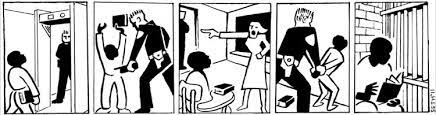
The same day, the New York Times reported that the presence of police in schools has resulted in an increased number of children in the criminal justice system. For over twenty years, police officers have been present inside middle and high schools across the United States. After the most recent school shootings, the NRA has lobbied hard for having more police officers in school. According to the Times, with the help of federal subsidies, local districts pay for their own police. Does this mean that patrolling schools has become a new business that is contracted to the police, which was once a public service agency? Does the school police budget compete with the school educational budget? Shouldn’t those scarce and dwindling resources be allocated to enhance the pedagogical and educational role of schools?

Contracted police surveillance had hurt more than it’s helped. Rather than `keep the peace’, police presence have created more schoolhouse disturbances, and has contributed to channeling youth – particularly African American, Hispanic and disabled students – into the penal system. The marriage of school and police has increased the vulnerability of the already-most-vulnerably by interrupting their schooling, instead of giving them the support they need.

A 15-year-old student talking to Democracy Now about the school-to-prison-pipeline in New York City had this advice for mayor Bloomberg: “Take all the amount of student safety agents that you get in schools, take the amount of funding you give them, and give it to the school, give it to the Department of Education, so they can give it to our schools. If I was running a school, the perfect school for me would be more restorative justice, peer mediation, clubs in schools that actually the students actually want to go to and feel like they belong to, and no student safety agents and no metal detectors.”

From Australia’s detention of asylum seekers to the police surveillance of middle and high school students in the United States, unfair, and often brutal, treatment has been turned into a commodity. Let’s demand that the state be accountable for having sold off its responsibility.

(Illustration Credit: Seth Tobacman / Rethinking Schools)

Censoring women and poetry

Pramila Venkateswaran

“They hate our freedom,” said President Bush in 2001. We are not sure who “they” were or what freedom he was talking about, but the statement was presumptuous and based on false arguments. What freedom are we talking about? What are its dimensions, who is allowed to hold it and who not, how much can we have, and who places limits on it and how?

In a recent Performance Poets gathering in a chain bookstore, poet Pramila Venkateswaran read her poem entitled “Ode to the Vagina.” Two parents passing by with their children heard the words of the poem. They complained to the chain about the language that they overheard that evoked female body parts. Notwithstanding that it was a reading space for a special event, the chain commanded the host, Performance Poets, out. The latter had to apologize and state that they would make sure that invited poets would not read anything that was injurious, hateful and obscene. As Venkasteswaran said, the poem talked about the sacredness of the woman’s body, not its obscenity. How did writing about the female body become an object of censorship? That is the real question.

Spaces for poetry and other art works are sparse in corporate America and are increasingly under scrutiny of standardized definitions of morality that impede dissent or simply questioning, one of the beauties of poetry. The poet Aimé Cesaire once said that poetry is a way of saying everything while seeming to say nothing, but everything is there. He thought that he could get around censorship. Is it still possible to do that under the current neoliberal order? Meanwhile, the same corporate world uses public airwaves to bombard children with incredible violence and denigration of women.

And forget about poetry; a high school teacher may lose his job for using the word vagina…

For the sake of freedom, here is the poem:

Ode to the Vagina

Strictly vertical , as if you were bisecting
A woman’s lips, you loosen up with time.
You speak volumes, learning to shed
Learned shame the more you understand
Yourself.

You first saw yourself in a mirror
And drew back in horror at your
Dark amorphousness, as once men did
When they thought you had teeth that would
Dismember them.

People thought your tongue was dangerous,
It made them want you more when they
Found you enjoyed receiving them.
But when you expressed yourself more,
you were shunned.

You did not rest, for rest to you was death.
Instead you embraced your darkness.
It kept calling out to you, come, come,
you yearned to enter it,
this jet brilliance of space,
emptiness that knows itself without
intermediaries, the beginning,
velvet and longing, bearing creation
after creation after creation after
creation.

You are goddess, unquenchable
weaving an endless yarn. You are
endless, but no yarn, for you are no fake,
despite your games sometimes
of acting, faking some beached creature
wailing its diminuendo—that’s your recreation.

But deep within, you are surprise and
cornucopia. Old age and desert sands
are not in your language. You speak
of rivers, you sport in soft sand
that turns with the moon, you know
how to rebel, how to give and take,
you know the delicate ring of fire
that the barbaric will enter despite
your shrill “No.” You know that the barbarian
is your own personal stranger.

You reignite,
you choose,
you want to wake
up to your own solitary self.

by Pramila Venkateswaran

(Photo Credit: String Poet Journal / YouTube)

Revealing the code of silence that rules reproductive rights

In Algeria abortion is simply illegal. A woman can be punished by six months to two years in prison and a fine. The abortionist is subject to one to five years in prison and a hefty fine.

According to the president of a women’s rights association, as reported in the Algerian newspaper L’Expression, there are about 80 000 abortions a year for 775 000 pregnancies in Algeria. The police reported only 27 cases in 2012. So what is happening in Algeria?

The code of silence is the rule.

Women who seek help with unwanted pregnancies have few options and they all imply a sense of shame and fear. The rule is to use word of mouth information and have enough money, on average $400, which is high price in Algeria.

The journalist of L’Expression follows the same principle of word of mouth to investigate the providers’ identities, how women get information and how the procedure is performed. It leads him and his partner to doctors who are militant and outraged by the situation as well as to charlatans who take advantage of women’s desperate search for relief. In any case, women are ashamed, isolated and have no protection and no recourse as they face horrendous medical consequences.

The article sends a clear message that this situation is shameful for society and that it has to change. As the reporters note, there have been changes, especially with the advent of the Internet. Women in Algeria have begun to engage in a public forum to break the rule of silence. We have seen the possibilities of these strong women’s voices in neighboring countries.

The code of silence has become the rule as well for many women in the United States seeking reproductive services where, law after law, women’s right are being restricted, putting many women to precarious situations. In 42 states restrictions on abortion rights have already been anticipated under the Patient Protection and Affordable Care Act, which will be enacted in 2014.

2012 has been the second year with the greatest number of new legislation to restrict access to reproductive services such as abortion, with about 122 provisions related to restrict access to reproductive health. Being a woman at the age of reproduction is a risky condition … in the United States as in Algeria.

Stop the code of silence, let’s hear women’s voices and respect their right to be.


(Photo Credit: Reuters / Zohra Bensemra)