Christiane Taubira: “Parfois résister c’est rester, parfois résister c’est partir”

Christiane Taubira

Christiane Taubira, France’s Minister of Justice, resigned today. As she explained, “Sometimes staying is resisting, sometimes leaving is resisting”. We’ll have something on Christiane Taubira in the next couple days. For the last four years, Brigitte Marti has written regularly, at Women In and Beyond the Global, about Christiane Taubira’s struggles to reform the French penal system, to restore justice to so-called criminal justice, all the while combating racist sexist attacks on her and her policies. Christiane Taubira may be leaving the government, but she is not leaving the struggle for women’s rights, immigrants’ rights, workers’ rights, prisoners’ rights, gay rights, minority rights and more, all in the context of a vision of a realizable just world. A just world is possible!

Christiane Taubira explains prison

Here’s a partial list of Brigitte Marti’s pieces that, from June 2012 to last year, profiled Taubira’s varied engagements and interventions:

Resistances, les femmes, le pouvoir et l’élection (June 18, 2012)

From Paris to Baltimore, our prisons are full but empty of sense (November 21, 2012)

In France, mandatory minimum sentences kill (June 27, 2013)

Scandal in France! Prison as a last resort! (August 19, 2013)

Evolution of a scandal in France (August 29, 2013)

Must punishment mean prison? Why are you asking? (September 21, 2013)

These racist attacks assault the heart of the Republic (November 13, 2013)

It is the responsibility of the State to defend reproductive rights and health (November 21, 2013)

French prison guards strike for global incarceration and dehumanization (May 13, 2014)

The false case against Christiane Taubira (May 24, 2014)

Can Christiane Taubira move France from repressive to restorative justice? (June 2, 2014)

France’s twisted road to restorative justice (July 22, 2014)

From Paris to Washington, all women need easy access to real help in times of crisis (August 29, 2014)

In France, isolation is not the answer to anything! (July 22, 2015)


(Photo Credit: Women In and Beyond the Global)

Remember Marikana


(Photo Credit: Dave Mann / The Con)

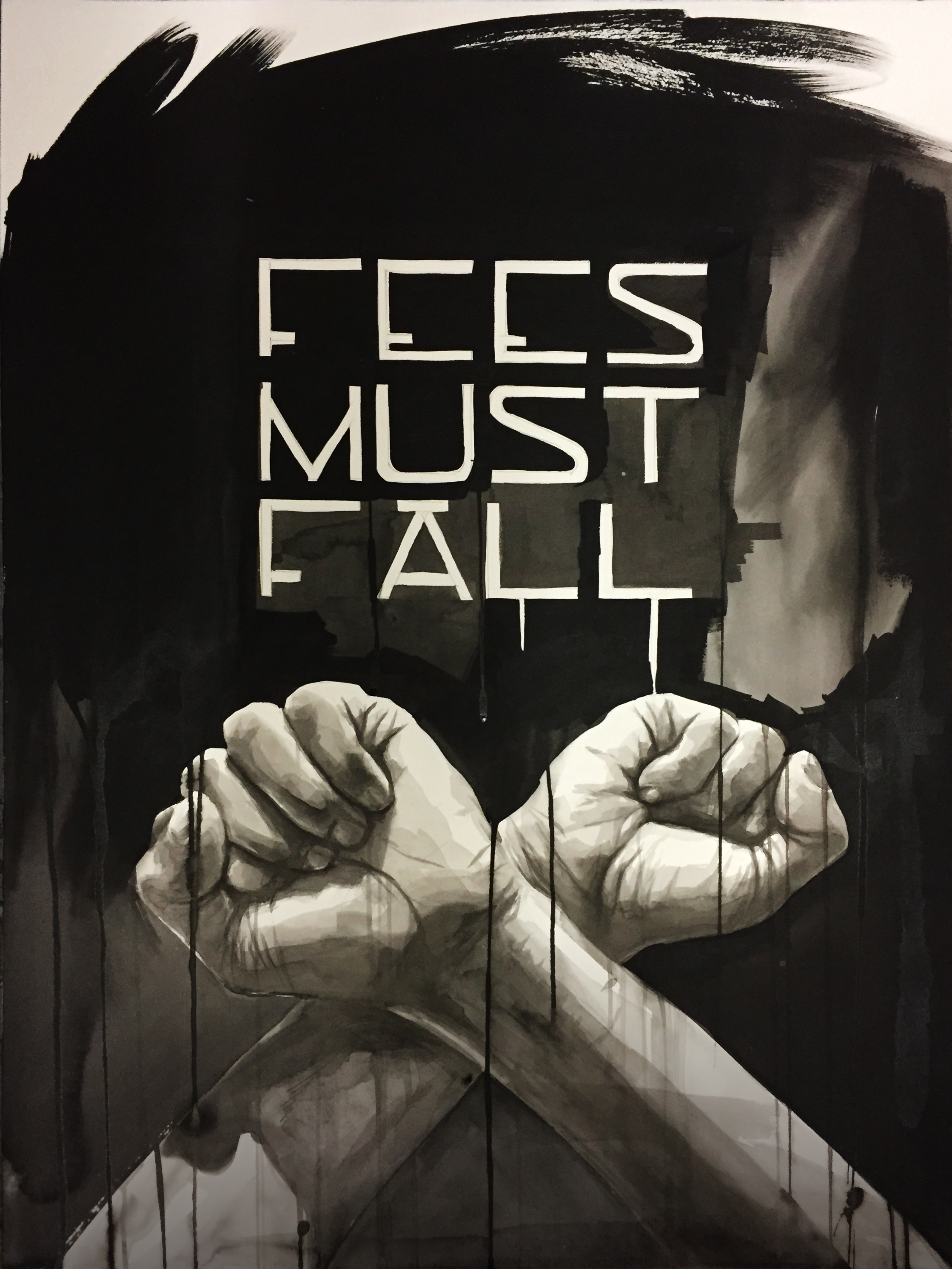
#FeesMustFall

Fees Must Fall


(Image Credit: Faith47 / Daily Maverick)

We remember: Send a message of solidarity to the widows of Marikana

(Photo Credit: Greg Nicolson / Daily Maverick)

A Celebration: Barack Obama and Sojourner Truth share a moment

We, the people, declare today that the most evident of truths –- that all of us are created equal –- is the star that guides us still; just as it guided our forebears through Seneca Falls, and Selma, and Stonewall; just as it guided all those men and women, sung and unsung, who left footprints along this great Mall, to hear a preacher say that we cannot walk alone; to hear a King proclaim that our individual freedom is inextricably bound to the freedom of every soul on Earth.”

If the first woman God ever made was strong enough to turn the world upside down all alone, these women together ought to be able to turn it back, and get it right side up again!”

The struggle continues.

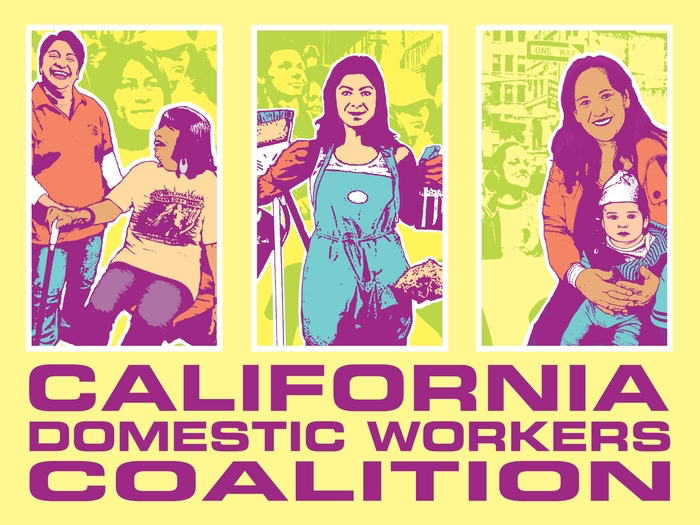
Domestics: Who’s Burdening Whom?

Following Governor Jerry Brown’s veto of the California Domestic Workers’ Bill of Rights (AB 889), the California Chamber of Commerce expressed support for Brown’s decision and claimed that the bill would have placed a “burden onto working families who are struggling.” Apparently the California Chamber of Commerce does not view sexual harassment, underpayment and  70 hour work weeks – just three of the countless unjust labor standards faced by domestic workers – to be burdensome.

What’s even more alarming than the California Chamber of Commerce’s ignorance is the fact that Brown is on their side. Brown asked, “What would be the additional costs [to the employers of domestic workers]?” But whose cost is greatest here? While the price of nannies, care takers and housekeepers may increase for employers, the cost of not having basic labor protections is surely a greater issue.

Although the business community in California considered AB 889 to be ‘radical’ in its demands, in reality, the bill would have simply extended the rights granted to the rest of the labor workforce to domestic workers. What is ‘radical,’ however, is denying the 200,000 domestic workers in California the same labor protections granted to almost every other manual laborer since the New Deal. As Caitlin Vega, a legislative advocate with the California Labor Federation, stated, “We’re not creating new rights that no one has ever heard of.”

Sylvia Lopez, a worker with the California Domestic Workers Coalition stated, “For decades we have tirelessly cared for California’s homes, children, the elderly and people with disabilities with the protection of basic rights.” Even Brown referred to the work done by domestic workers to be a “noble endeavor.” But until California grants basic labor protections to its domestic workers, a burden will continue to lie on these hard workers and their families.

Michael Smith, michaelsmith093@gmail.com

Domestic Workers’ Rights: An Increasingly Relevant Transnational Issue

California Governor Brown’s recent veto of the Domestic Workers‘ Bill of Rights (AB889) has given several domestic workers‘ groups a platform on which to raise awareness about and discuss the significance of equal rights for and, even more, valuation of domestic workers. Unfortunately, this is the only positive outlook on Brown’s veto.

According to a member of the California Domestic Workers Coalition, “more than just protecting meal breaks, the workers had hoped the bill would signal a fundamental shift in the way society regards their work.” Domestic workers, most of whom also need to provide and take care of their own families, deserve to both feel and actually be legitimate in regards to their job security and self-representation while on the job.

By referring to domestic workers as “companions” to the elderly and disabled, it evokes a responsibility of love and devotion to their employers – one that is too easily manipulated and exploited by the state (in this case, Gov. Brown specifically) who believes it would be dangerous for the elderly and disabled to regulate domestic work.

However, this seems like it would be a very workable issue once domestic workers are recognized under the basic protection of job rights. In fact, the Director of the National Domestic Workers Alliance, Ai-jen Poo, says that “it was clear [they] would work through [the state’s questions] during the regulatory process [after the bill was signed].” One foreseeable solution could be the implementation and regulation of shifts by domestic worker unions. This would hopefully allow the workers to receive eight hours of daily and fairly paid work.

Without saying it, it appears that another concern of Governor Brown’s is the immigration status of these California domestic workers. As a US citizen myself, I am less concerned with this aspect of the issue. Since these domestic workers are worthy enough to take care of other people’s children, grandparents, houses, etc., this should earn them the right to visibility in regards to both the law and society.

Zoë Waltz

(Photo Credit: California Domestic Workers Coalition)

Sawt Al Niswa: Collectively Pushing the Patriarchal Elephant Through the Door


Sometimes it takes a collective of feminists to spot the patriarchal elephant in the room (and to show it to the door).

Battling patriarchy is difficult, particularly when you try to do it alone. If anything was learned from the Jan 14 March, solidarity is both empowering and inspiring. Change will only come if we work together to identify problems and construct positive solutions.

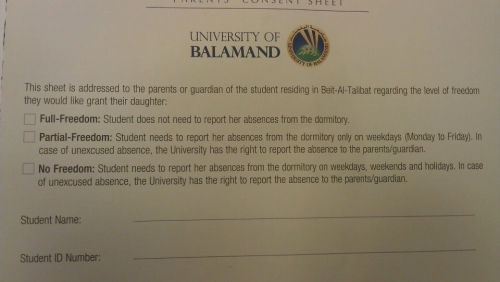
On Thursday 19 January 2012, Nasawiya member Sarah Abou Raad posted an image. It was of the ‘Parental Consent Sheet’ for the Beit el-Taibat (women’s dorms) at the University of Balamand. On this form the parent’s were asked what ‘level of freedom they would like to grant their daughter’. The options were ‘Full Freedom’, ‘Partial Freedom’, or ‘No Freedom’. Outraged, Sarah posted an image of the form with the caption ‘That’s how education is supposed to free our minds!! Im indignant!! I cant believe it!!’

Roughly an hour later, another Nasawiya member, Christine Lindner, saw Sarah’s post. Being an Assistant Professor at the University of Balamand, Christine was immediately frustrated by the image that she saw. During the past few months, Christine, with the help of many dedicated students, has helped start the debate about gender discrimination on campus. Farah from the Adventures of Salwa led a great discussion, while the student newspaper covered a number of important topics related to sexual harassment. Christine met with the Dean of Students to revise sexual harassment policies and felt a general interest for change. However, this form, it is language of ‘no freedom’ for female students was a huge step in the wrong direction.

An interesting exchange took place between Sarah and Christine that night, over the implications of the application and its wording. As a result, Christine sent an email to the Dean of Student Affairs asking questions about the application, which she posted to the Nasawiya wall. Other members posted responses to the image’s comment thread. Some mentioned that similar forms are used at dorms for other universities. This needs to be researched further and pursued for change.

Christine met with the Dean of Student Affairs and the university counselor on Monday 23 January 2012. Both positively received the complaint, stating that it was only when Christine had identified the strong language of the form that they realized how counterproductive it was to their goals of empowering the students. As such, a replacement form was created emphasizing not the disempowerment of the female students, but the level of supervision that the university would play, upon the request of the parents (many of whom live abroad). It was also agreed that this form would be signed by the parents of students resident at both the women’s and men’s dorms. The updated version can be found at

http://www.balamand.edu.lb/english/OSA.asp?id=2705&fid=160

So while this does not mark the erasure of patriarchy at the University of Balamand, it does mark a small victory, while illuminating a few important lessons:

Firstly, a variety of tactics are needed to bring down patriarchal systems. At times, large protest marches are needed. In other times, it is a stern email from a member of faculty asking questions about a problematic practice. Others, it is the threat of images going viral on the internet. Sometimes, all three. Patriarchy and social injustice manifest themselves in all facets of life. We need to keep all tools ready, harnessing the appropriate tool for the specific situation and specific audience.

Secondly, identifying and challenging patriarchy is a collective effort. Sarah’s posting of the image prompted Christine to write the letter, which illuminated the problem to the Dean, so that the form was changed and the discriminatory practice equalized. This is the collective at work. This is its strength. This is why it works. We cannot stand alone, for the elephant is too big sometimes to even see, let alone push out the door. And if one project fails, we are there to catch each other, provide an umbrella when it rains, or a tissue for the tears. This is the strength of the collective and this is why it will succeed.

Nasawiya (North)

This first appeared here at Sawt Al Niswa (Voice of the Women). Thanks to Sawt Al Niswa.


(Photo Credit: Sawt al’ Niswa)

Kubatana: Circles of Women

Kubatana: Circles of Women

Sheltered beneath cool thatch
surrounded by green lawns and fig trees

a circle of Zimbabwean women sit passing a stone
sewing beads onto a red velvet cloth as each one spoke

women’s work

they cross three generations
mothers, wives, sisters, daughters, grandmothers
facilitators, lawyers, counselors, activists

What is it, we asked, that we celebrate about being women?
‘Our ability to love,
to take responsibility for our children, our families
to take responsibility for the food, and the schooling
our ability to hold serious jobs
to talk about our feelings
to share the load’

And what is difficult about being  women here, at this time?

‘Being disrespected
often abused,
by the men with whom we live
sexual harassment
political rape and violence’

It was a story of attrition and overwhelming responsibility

One of the elders spoke
of the infidelities of her husband
of the pain it had cause her young soul
as she watched over her small children

and of the growing strength of realization
that she was the one

she would not seek what was impossible
she would take the responsibility
and do the work
and love her children
because she had the courage and strength to do it

of the power and satisfaction her life had brought her
of the wonderful children she had grown into the world
of the circles of women she shared her life with

They spoke of strong, enduring, loving mothers
of the father who had supported one young woman’s journey
allowed her the freedom to make her own choices
of her gratitude for this trust in her abilities

They spoke of the ‘enemy within’
their own jealousies
of women’s part in infidelities
the insecurity they carried

And then they looked at what they could change
and of holding circles with men

It is the first conversation of many, many conversations

everything changes

Bev Reeler

Bev Reeler is a Zimbabwean poet and feminist, who writes, among other places, at Kubatana.net, where this poem first appeared: http://www.kubatanablogs.net/kubatana/?p=7784 Thanks to Bev Reeler and to Kubatana for this collaboration.

Criminalizing Black Women: Mom Jailed For ‘Stealing An Education’ for Her Children

I have not written about the Kelley Williams-Bolar case previously because I did not have the words to describe how I felt about it. When I first read about the case, I immediately started to tear up and my emotions were in turmoil. I didn’t understand the strong feelings and then I realized that the case recalled ancestral memories of slavery for me. Kelley Williams-Bolar was being accused of “stealing an education” for her children.

Here is some brief background on this case…

Prosecutors in Ohio brought criminal charges against Kelly Williams-Bolar of Akron and her father. The state accused the pair of “allegedly falsifying residency records of two of the woman’s children formerly enrolled in the Copley-Fairlawn City Schools.” The most serious of the charges brought against Ms. Williams was tampering with records which is a “third-degree felony carrying potential penalties of one to five years in prison and a $10,000 fine.” Her 64-year old father was charged with “one count of grand theft for aiding and abetting his daughter in her alleged deception to obtain educational services from Copley-Fairlawn schools.”

Bolar-Williams said her two girls were enrolled in the Copley-Fairlawn school system four years ago — in August 2006, according to court records — over ”safety issues.”

During the trial, several pieces of evidence were presented supporting Ms. Williams’ claims that she was in fact living with her father when she enrolled her children in the suburban school district. However what was also made clear was the lengths to which the school district went to “prove” that she was in fact not a resident in their catchment area:

School officials, according to trial testimony, hired a private investigator in an attempt to document the activities of Williams-Bolar on more than a dozen school mornings.

In several hours of the videotaped surveillance — much of which was shot under cover through a wrought-iron fence — the jury saw Williams-Bolar dropping off her children at a school bus stop within a short walk of her father’s home on Black Pond.

However, when Williams-Bolar took the stand in her own defense on Friday, O’Brien introduced evidence showing that she had 2008 and 2009 W-2 statements from her employer, Akron Public Schools, sent in her name to the address of her father in Copley Township.

Williams-Bolar works as a teaching assistant with special-needs children at Buchtel High School.

The defense also produced 2005 mailed correspondence to Williams-Bolar — more than a year before her children were enrolled in the schools — from the Copley-Fairlawn district. It, too, was sent to her father’s home.

More specific details about the trial can be found here. On January 15th, Ms. Williams was convicted by a jury after 7 hours of deliberation. She was sentenced by the judge to 10 days in jail, three years of probation and community service for falsifying residency records. As if this were not enough, here is more from the judge in this case:

Cosgrove noted Williams-Bolar faces another form of punishment.

Williams-Bolar, a single mother, works as a teaching assistant with children with special needs at Buchtel High School. At the trial, she testified that she wanted to become a teacher and is a senior at the University of Akron, only a few credit hours short of a teaching degree.

That won’t happen now, Cosgrove said.

”Because of the felony conviction, you will not be allowed to get your teaching degree under Ohio law as it stands today,” the judge said. ”The court’s taking into consideration that is also a punishment that you will have to serve.”

Williams-Bolar addressed Cosgrove briefly before being sentenced, saying ”there was no intention at all” to deceive school officials.

She pleaded with Cosgrove not to put her behind bars.

”My girls need me,” she said. ”I’ve never, ever gone a day without seeing them off. Never. My oldest daughter is 16.

”I need to be there to support them.”

Williams-Bolar’s two girls, now 16 and 12, are attending schools elsewhere. They left the Copley-Fairlawn district before the 2009 school term.

Ms. Williams-Bolar was interviewed later and expressed stunned disbelief that she would be jailed for this offense. She believed that if she were convicted she would be sentenced to probation at most.

Kelley Williams-Bolar took an extended pause, pondering as she sat in jail Thursday.

Tears came to her eyes as seconds ticked away. She’s a single mother of two daughters in the middle of a 10-day jail term — a convicted felon — all because of the school the girls attended.

Years ago, she said she took her daughters from Akron’s public housing after their home was burglarized and placed them with their grandfather in Copley Township.

Take a step back to consider everything that is at play in the story of Ms. Bolar-Williams. Here you have a black single mother who was living in public housing with her two daughters. After a traumatic incident of their home being burglarized, she moved her daughters to their grandfather’s home so that they could be safe and attend a good school. A school district spent thousands of dollars to hire a PI to investigate this black woman and her children. Why exactly was this? Are public schools in Ohio so flush with extra cash that they can afford such luxuries? If Ms. Williams and her children had been white would the school have gone to this trouble to expose them as supposed ‘criminals?’ I think that any fair-minded observer would have to say ‘no’. Now we have a tragedy on our hands with lives being destroyed. A 40 year old woman who was putting herself through college to become a teacher is having that dream dashed. What lesson do you suppose her daughters are learning in all of this? Are they learning that America is a just society? Are they learning that they can ‘be anything that they want to be’ when they become adults?

I would say that they have learned a bitter lesson about American INjustice and oppression. This is a form of state violence that the Williams family has been subjected to. Ms. Williams has been accused of defrauding the district for over $30,000 in educational costs because her daughters did not meet the residency requirement. At least four lives have been destroyed over $30,000? Surely that cannot be just!

Apparently this case is causing a lot of controversy in Ohio as well it should. Reporter David Scott writes about some of the reaction. However, I want to point to the words of commentator Boyce Watkins who wrote this:

This case is a textbook example of everything that remains racially wrong with America’s educational, economic and criminal justice systems. Let’s start from the top: Had Ms. Williams-Bolar been white, she likely would never have been prosecuted for this crime in the first place (I’d love for them to show me a white woman in that area who’s gone to jail for the same crime). She also is statistically not as likely to be living in a housing project with the need to break an unjust law in order to create a better life for her daughters. Being black is also correlated with the fact that Williams-Bolar likely didn’t have the resources to hire the kinds of attorneys who could get her out of this mess (since the average black family’s wealth is roughly 1/10 that of white families). Finally, economic inequality is impactful here because that’s the reason that Williams-Bolar’s school district likely has fewer resources than the school she chose for her kids. In other words, black people have been historically robbed of our economic opportunities, leading to a two-tiered reality that we are then imprisoned for attempting to alleviate. That, my friends, is American Racism 101.

This case is a textbook example of how racial-inequality created during slavery and Jim Crow continues to cripple our nation to this day. There is no logical reason on earth why this mother of two should be dehumanized by going to jail and be left permanently marginalized from future economic and educational opportunities. Even if you believe in the laws that keep poor kids trapped in underperforming schools, the idea that this woman should be sent to jail for demanding educational access is simply ridiculous.

In her own words, Ms. Williams said from jail:

”If I had the opportunity, if I had to do it all over again, would I have done it? . . . ,” she said. After almost a half-minute of silence, she answered her own question.

”I would have done it again,” she said. ”But I would have been more detailed. . . . I think they wanted to make an example of me.”

Yes indeed, the state of Ohio wanted to make an example of a black single mother trying to find a way to ensure a successful future for her children by giving them a chance to have a good education… Welcome to America in the 21st century, still racist and unjust.!

Mariame Kaba, http://www.usprisonculture.com/blog/.

(This first appeared here at Prison Culture. Thanks to Mariame Kaba for writing it and for sharing it with Women In and Beyond the Global.)