I wrote this in grief, but also in discomfort.
There are deaths that ask us not only to mourn, but to reckon with what happened while a person was still alive: the hounding, the racialised scrutiny, the slow taking apart of a human being in public, and the silences that gather around it.
When Breath Becomes a Country is a dirge for what cannot be undone. It is also about regret — about the terrible lateness of recognising what someone may have been carrying only after they are gone.
I did not want to write a poem of easy hope. I wanted to stay with the shame, the sorrow and the question of what solidarity demands before mourning becomes necessary.
This is for the hunted, and for the living.
When Breath Becomes a Country
There are griefs that do not arrive.
They accumulate.
A headline. A whisper. A thousand small permissions
given to cruelty
until cruelty believes itself righteous.
And somewhere a human being learns
the terrible arithmetic of being watched:
how softly to speak,
how carefully to enter a room,
how brightly not to shine,
how much of yourself to surrender
before they call you safe.
We know this arithmetic.
Its oldest name is racism.
After that, it acquires better manners.
A raised eyebrow.
A careful insinuation.
The question asked again after it has been answered.
The doubt that follows you from room to room.
Until a life becomes an endless defence of itself.
This is how a soul is pillaged:
not always in one great violence,
but piece by piece, certainty by certainty,
breath by breath- until even breathing
must produce evidence
of innocence.
And now grief comeswith questions
we are too late to ask.
Did we stand close enough when the hounds began circling?
Did we hear the hunt beneath the language of scrutiny, standards, concern?
There is shame here.
Let it remain.
Not the shame of the hunted.
Never that.
The shame belongs to the hunt.
And there is regret.
Mountains of regret.
Regret is such a useless country.
Every road ends at the same locked door:
if only.
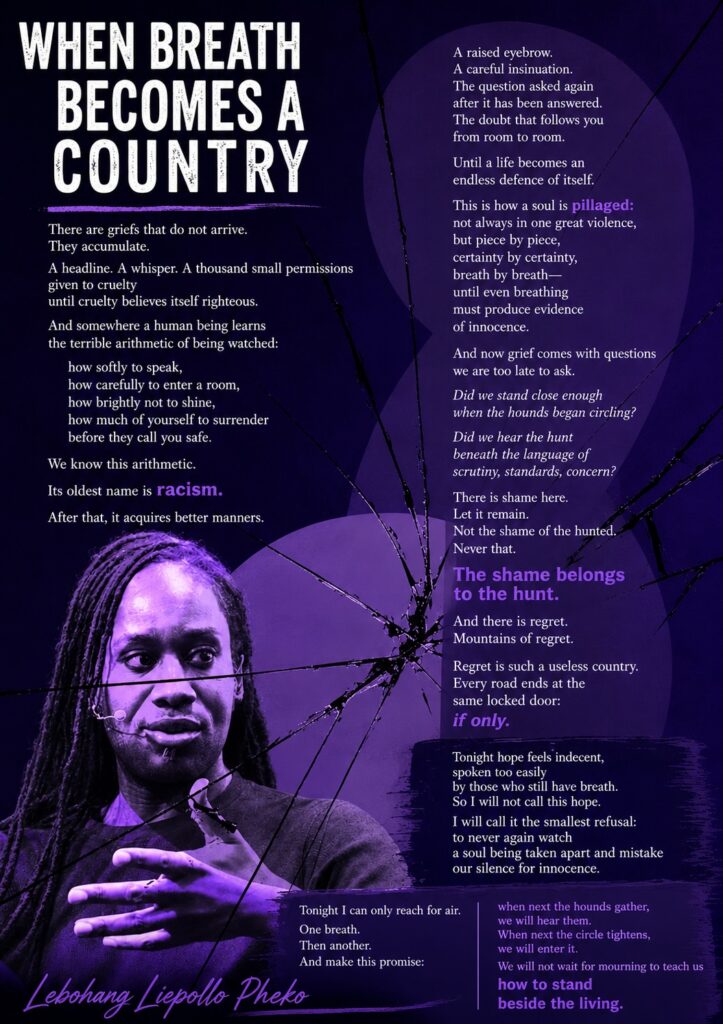
(by Lebohang Liepollo Pheko)
(Image Credit 1: Ad Reinhardt, Abstract Painting / Solomon R. Guggenheim Museum)
(Image Credit 2: Lebohang Liepollo Pheko)