From 1976 to 2026, neither peace nor ceasefire have ever been keywords. So what?

“The blues remembers everything the country forgot”
Gil Scott-Heron and Brian Jackson, “Bicentennial Blues”

What does it mean to forget the meaning of peace? Of ceasefire? Or, what does it mean to never have known?

In 1976, the year of the United States Bicentennial, the Welsh activist scholar Raymond Williams published Keywords: A Vocabulary of Culture and Society. Williams was careful to state, and repeat often, that his work was a vocabulary, not a dictionary, that it was imbedded in and woven through the social and political usages and tendencies of both his time and the times that produced his times, and the people that made and were made by, in and through those times. In 1976, Williams’ vocabulary included neither peace nor ceasefire. Nineteen words comprised the total of C-words. From capitalism to culture, C was the largest collection of words in his vocabulary. Peace did not figure in among the nine words beginning with P, from peasant to psychological. In 1976, no one gave peace a chance … and why would they? Has anything changed since then?

In 1976, the year of the United States Bicentennial, Gil-Scott Heron and Brian Jackson wrote and recorded Bicentennial Blues. The song investigates reasons the United States is the “home of the blues”. A few stanzas in, after the initial explanation, the song explains:

“The point is
That the blues has grown
The blues is grown now, full grown
And you can trace the evolution of the blues
On a parallel line with the evolution of this country
From Plymouth Rock to acid-rock
From 13 states to Watergate
The blues is grown
But not the home
The blues is grown
But the country has not
The blues remembers everything the country forgot

It’s a bicentennial year and the blues is celebrating a birthday
And it’s a bicentennial blues

America has got the blues and it’s a bicentennial edition
The blues view might amuse you
But make no mistake, it’s a bicentennial year
A year of hysterical importance
A year of historical importance”

And here we are, 2026, a year of hysterical importance, a year of historical importance, a year, five decades later, in which the blues remembers everything the country forgot.

In 1982, June Jordan published “Apologies to all the people in Lebanon”. The poem opens:

“I didn’t know and nobody told me and what
could I do or say, anyway?

They said you shot the London Ambassador
and when that wasn’t true
they said so
what
They said you shelled their northern villages
and when U.N. forces reported that was not true
because your side of the cease-fire was holding
since more than a year before
they said so
what
They said they wanted simply to carve
a 25 mile buffer zone and then
they ravaged your
water supplies your electricity your
hospitals your schools your highways and byways all
the way north to Beirut because they said this
was their quest for peace
of mankind isn’t that obvious?”

Here we are, decades later, and the “quest for peace” remains invasion, destruction, devastation, and death, and we continue to say, “I didn’t know and nobody told me and what could I do or say, anyway?” Where is the vocabulary, where are the culture and society, in which peace and ceasefire are keywords, words of critical significance, rather than invitations to say, “So what?”

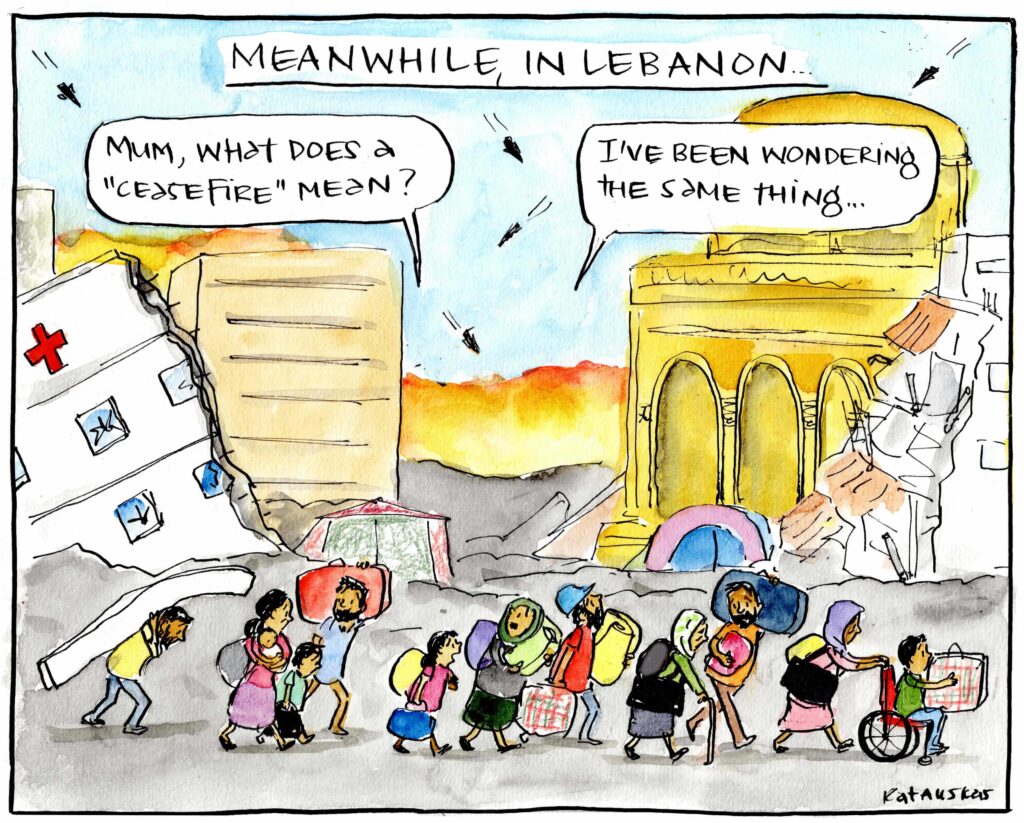
The illustration below appeared in yesterday’s issue of The Guardian. How many more times will we see such illustrations? So what?
 

(By Dan Moshenberg)

(Illustration: Fiona Katauskas / The Guardian)
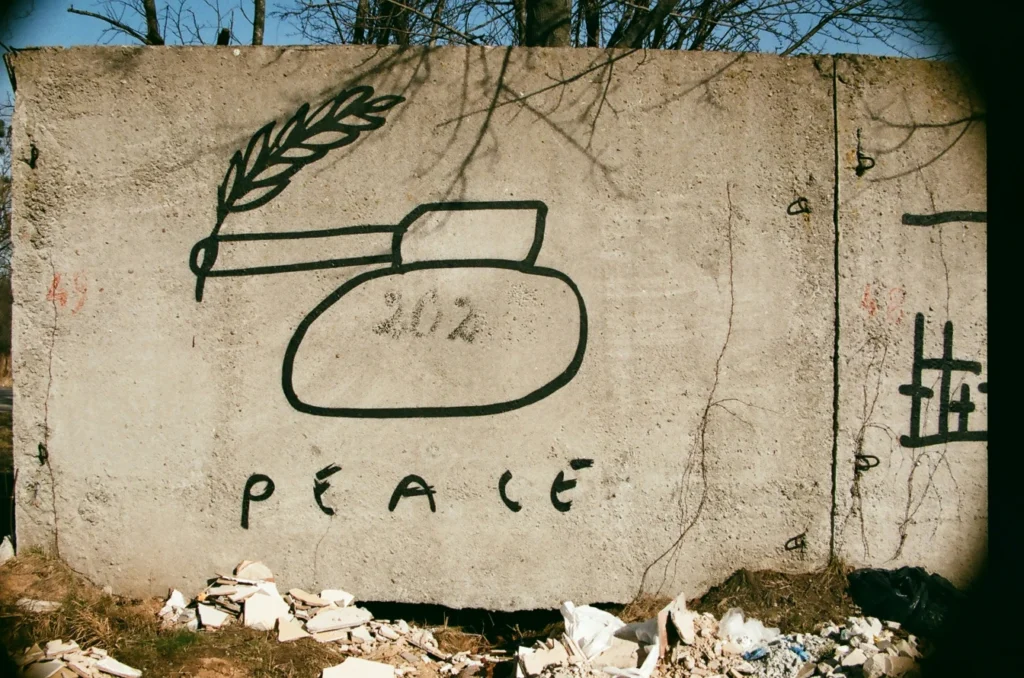
Empty words that empty us: ceasefire

because your side of the cease-fire was holding
since more than a year before
they said so
what
June Jordan, “Apologies to All the People in Lebanon

Today, The New York Times (finally) thankfully revealed the truth we already know and have known: “Russia-Ukraine War Shows Cease-Fires Have Lost Meaning Under Trump”. For the past few years, we have watched Israel establish “ceasefires” with one entity and another, only to continue the devastation. The same goes for Russia in Ukraine. The same goes for Israel and the United States in Iran. The only problem with this “discovery”, with this truth is that it ignores a history of devastation masquerading as ceasefire and of the devastating ceasefire masquerading as peace.

In 1982, June Jordan wrote “Apologies to All the People in Lebanon”, first published in the Village Voice, July 20, 1982. This is the poem as it appeared in 1982 in its entirety:

“Apologies to All the People in Lebanon

I didn’t know and nobody told me and what
could I do or say, anyway?

They said you shot the London Ambassador
and when that wasn’t true
they said so
what
They said you shelled their northern villages
and when U.N. forces reported that was not true
because your side of the cease-fire was holding
since more than a year before
they said so
what
They said they wanted simply to carve
a 25 mile buffer zone and then
they ravaged your
water supplies your electricity your
hospitals your schools your highways and byways all
the way north to Beirut because they said this
was their quest for peace
They blew up your homes and demolished the grocery
stores and blocked the Red Cross and took away doctors
to jail and they cluster-bombed girls and boys
whose bodies
swelled purple and black into twice the original size
and tore the buttocks from a four month old baby
and then
they said this was brilliant
military accomplishment and this was done
they said in the name of self-defense they said
that is the noblest concept
of mankind isn’t that obvious?
They said something about never again and then
they made close to one million human beings homeless
in less than three weeks and they killed or maimed
40,000 of your men and your women and your children

But I didn’t know and nobody told me and what
could I do or say, anyway?

They said they were victims. They said you were
Arabs.
They called      your apartments and gardens      guerrilla
strongholds.
They called      the screaming devastation
that they created       the rubble.
Then they told you to leave, didn’t they?

Didn’t you read the leaflets that they dropped
from their hotshot fighter jets?
They told you to go.
One hundred and thirty-five thousand
Palestinians in Beirut and why
didn’t you take the hint?
Go!
There was the Mediterranean: You
could walk into the water and stay
there.
What was the problem?

I didn’t know and nobody told me and what
could I do or say, anyway?

Yes, I did know it was the money I earned as a poet that
paid for the bombs and the planes and the tanks
that they used to massacre your family

But I am not an evil person
The people of my country aren’t so bad

You can expect but so much
from those of us who have to pay taxes and watch
American TV

You see my point;

I’m sorry.
I really am sorry.”

Later, an epigram was added: “Dedicated to the 600,000 Palestinian men, women, and children who lived in Lebanon from 1948-1983.”

In 2024, Faisal Mohyuddin wrote “Ceasefire Haiku”. At the center of this sequence of haiku, these four verses:

“Shame: a legacy
Your descendants will decry,
Bemoan, be cursed by.
____

To remain silent
Is consent, is wrong, is more
Deadly than more bombs.
___

You can’t really see
Me, except as your conscience-
Cleanser, your blindfold.
___

When I condemn crimes,
You call me culprit, settle
My heart to scrub yours.”

Forty-two years separate those two poems. Easily half of Lebanon’s population have lived all of their lives in a “ceasefire” in which the guns never ceased firing and the bombs never stopped falling. In fact, easily three quarters of the world have lived their lives in the ceasefire, a ceasefire in which guns never ceased firing and the bombs never stopped falling. While Trump’s actions are egregious and worse and Netanyahu’s programme of genocide is a legacy our descendants will decry … they are not a new invention. They are merely the latest phases in this, the Age of Ceasefire. May peace be with you. I’m sorry. I really am sorry.

(By Dan Moshenberg)

(Aliaksei Lepik / Unsplash / LAist)