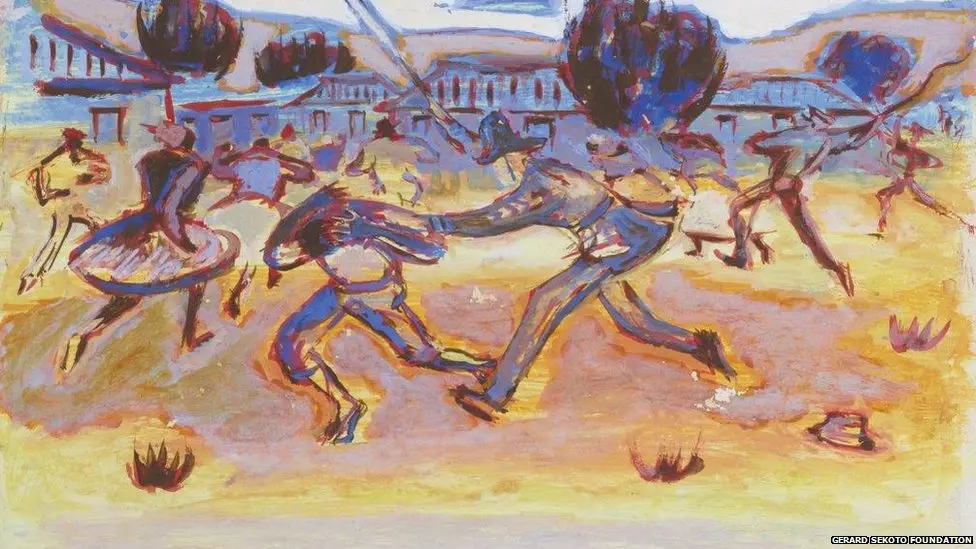
In Cape Town, the Zeitz Museum of Contemporary Art Africa is currently showing an exhibition entitled A Protea Is Not a Flower, which considers the works of Gerard Sekoto, Bessie Head and Don Mattera, apartheid-era artists who struggled with various modes of exile. Zeitz describes the exhibit as follows: “A Protea Is Not a Flower is a multigenerational conversation between South African artists and writers whose lives and works contend with the complexity of the exilic experience …. The exhibition explores the spectrum of personal and political expression, navigating themes of exile, identity, and memory.” Exactly what is the vehicle, engine or pilot that “navigates” exile?
Exile is not estrangement. Exile is, as it was from its inception, banishment, and although “self-imposed exile” is a common enough phrase, in fact exile is never self-imposed: “No one leaves home unless home is the mouth of a shark.” Despite phrases like “government in exile”, there is no return from exile. Exile is and always has meant banishment. The ancient Roman lawmakers understood this. For them, exile was an “alternative” to capital punishment, or, at least, that’s how it’s understood today. Actually, exile wasn’t alternative, it was synonymous. Exile came with an administrative decree, interdictio aquae et ignis, “interdiction of water and fire”. This decree declared that anyone who ran into an exile within the borders of the country was encouraged to kill him or her. That is not an alternative to capital punishment. No water, no shelter, no warmth, no hope. Exile today has the same design and intent as exile in the past, death-in-life.
The categories of exile are numerous, perhaps infinite, and growing. Refugees. Forced migrants. Internally displaced. Those fleeing persecution, conflict, violence, or human rights violations; “those fleeing” are those forced to flee. Forced to flee climate change, weather-related disasters, and other “natural disasters”, such as wildfires, earthquakes, tsunamis, and the list goes on. Some are forced to flee epidemics. Others are forced to flee mass displacement caused by “development”. No one is fleeing, everyone is forced to flee.
This isn’t “just about” where you live, it concerns where you are, where you are yourself. Millions are counted as unable to return home. In an age of “self-deportation” and “self-eviction”, in order to avoid greater harm today and in the future, millions more who can’t return are uncounted, by the agencies, the State, the media. They are all in exile.
Gerard Sekoto was born in 1913 in what was then the Eastern Transvaal, in what is now Mpumalanga. From an early age, he studied to be an artist. He spent his early adulthood as a teacher and then devoted himself fully to the visual arts. In 1938, at the age of 25, he left for Johannesburg. In 1947, an accomplished artist, he fled South Africa, never to return. He lived and worked and came to renown in Paris, where he died in 1993. He never returned … because he couldn’t. South Africa, though in his soul and bones, was not his.
In 1942, the American poet Karl Shapiro, in the midst of World War II, wrote “Travelogue for Exiles”. The poem is three stanzas; the third reads:
Look and remember. Look upon this land,
Far, far across the factories and the grass.
Surely, there, surely they will let you pass.
Speak then and ask the forest and the loam.
What do you hear? What does the land command?
The earth is taken: this is not your home.
The earth is taken: this is not your home …
(By Dan Moshenberg)
(Image Credit: Gerard Sekoto. “The Sharpeville Massacre” / BBC / Gerard Sekoto Foundation)