Want to raise the GDP? Set the women prisoners free

Booz & Co, now known as Strategy&. recently released a report, “Empowering the Third Billion: Women and the World of Work in 2012.” The Third Billion is women. According to the company website, the Third Billion was `born’ in 2010, when the corporate business world `discovered’ women.

On one hand, the report is welcome. It shows that if government and business acted with even a modicum of common sense, women could enter more fully and fulsomely, and most importantly equally, into labor markets. The kicker is that women’s engagement would necessarily raise national GDP’s, and quickly. The United States would rise by 5%, Egypt by 34%.

Other `discoveries’ include women’s greater involvement in care work prevents them from `productive’ activities. If care work were more evenly shared between and among genders, GDP would rise. If care workers were paid actual living wages, GDP would rise as well, but that’s not in the report.

Here’s something else that’s not in the report. Prison. In particular, the section on the United States forgets to mention that for the last few decades, women have been the fastest growing prison population in the country. The report talks at length about “female talent”, “workforce and entrepreneurial landscapes”, and “family responsibilities.” It suggests the importance of both government and the private sector finding ways to “boost women’s entrepreneurship”. One way would be to stop sending so many women to prison. Another way would be to release, immediately, something like 90% of the women behind bars. Most of them are in for minor, non-violent infractions. In fact, most are in prison precisely because of their entrepreneurial talents and the ways in which the real markets are structured against them.

So, if you really want to `empower’ the U.S. portion of the “Third Billion”, Mr. President, Mr. State Governor, Mr. Mayor, Mr. Corporate Executive (and yes, in the United States, most are still Mr.), tear down these walls.


(Photo Credit: Prison Photography / Fabio Cuttica)
Ask Peninah Mwangi about the PEPFAR pledge

Faced with violence against sex workers in Kenya, Peninah Mwangi noted, “The death of a sex worker is the death of a woman, a mother, a sister, a Kenyan.”  Mwangi should know.

Peninah Mwangi is the Executive Director of the Bar Hostess Empowerment and Support Programme, BHESP, located in Nairobi, Kenya. BHESP organizes, advocates, and empowers sex workers. Before the recent elections, BHESP organized `awareness campaigns’ with bar hostesses and their customers, to make sure that everyone voted, that no one missed voting due to drunkenness. It was a critical citizenship participatory popular education program run from one bar, and one barstool, to the next.

BHESP has marched and lobbied for decriminalization and legalization of sex work. They have marched and lobbied to end police violence against sex workers. At the same time, they have established drop-in centers, legal services, hotlines and havens. The Bar Hostess Empowerment and Support Programme have improved and saved women’s lives in Kenya, and are a model for the rest of the world.

They are supported by Pathfinder International, the Open Society Foundations; the Global Fund to Fight AIDS, Tuberculosis and Malaria. Almost every major organization that matters admires and supports the great, innovative and urgent work that BHESP provides. The large exception, the elephant-in-the-room exception, to this is PEPFAR, the US President’s Emergency Plan for AIDS Relief. Why? Because Peninah Mwangi and her colleagues won’t take the `anti-prostitution pledge.’ Apparently sex work is a far greater `emergency’ than AIDS.

Today, the U.S. Supreme Court is hearing a case in which opponents to the `pledge’ argue that the `pledge’ violates first amendment rights and impairs attempts to improve the working conditions of sex workers. Proponents claim the `pledge’ rescues women from trafficking and worse.

Behind, or obscured by, the legal debate are the sex workers themselves. On one hand, researcher after researcher has noted that the PEPFAR pledge harms any campaigns or programs among sex workers to reduce and eradicate HIV and AIDS. Criminalization of sex work increases risk factors for AIDS among sex workers. Transnational and global criminalization of sex work widens the pool of those increasingly at risk into a global ocean. As some have noted, it’s a dark ripple effect, which keeps on spreading.

Here’s one example of the impact of the `pledge’: “As a result of the pledge, in many instances information sharing about successful programming with sex workers has nearly ceased. Sex work programming has become a taboo topic; organizations that receive other funding are likely to be interested in or to seek US government contracts and funds. Others with specific missions have reigned in all activities unrelated or tangentially related to their missions; this has affected many sex work projects the world over. The anti-prostitution pledge has prevented the sharing of information about successful programming and prevented scaling up successful operations.”

Prevented the sharing of information. Silence. Equals. Death. The death of a sex worker is the death of a woman, a mother, a sister, a `fellow citizen’, a human being. Ask Peninah Mwangi. She should know.


(Video Credit: Josephine Nekesa Were / YouTube.com)

The Life and Times of Esther K


Esther Kiobel

Barinem Kiobel is dead. Esther Kiobel is alive, kicking, and organizing. Remember that, and remember the name: Esther Kiobel.

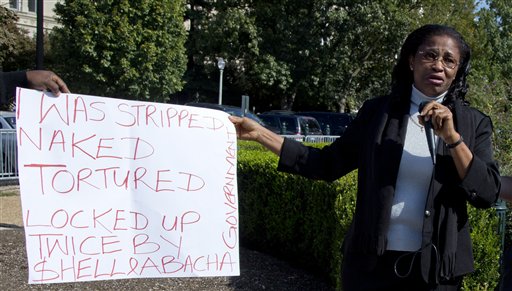
Yesterday, the U.S. Supreme Court issued a decision in Kiobel v. Royal Dutch Petroleum. Kiobel is Esther Kiobel. Esther Kiobel’s husband, Barinem Kiobel, was a prominent member of government who opposed the devastation wrought by Shell Oil and opposed the violence being committed against the opposition. In 1994, he was arrested, along with Ken Saro-Wiwa and seven others, mostly the leadership of Movement for the Survival of the Ogoni People, MOSOP. They were tortured for a year and then hanged. The nine, the Ogoni 9, were then dumped in unmarked graves in a Port Harcourt cemetery. The rest, as they say, is history.

Or is it?

Esther Kiobel fled Nigeria, applied successfully for asylum status in the United States, became a U.S. citizen, and sued Shell Oil, aka Royal Dutch Petroleum, for their role in the torture and assassination of her husband and so many others. There’s more to the story. There’s the “ecological genocide” committed over decades by Shell and Chevron … in cooperation with the various national governments of Nigeria. There’s the story of women in the Niger Delta organizing, as they continue to do. And there’s the story of rapacious multinational corporations operating without restraints.

The U.S. Supreme Court yesterday decided that Kiobel and her group don’t have a case, at least not in U.S. courts the way the law is currently written. The vote was 9 – 0. This decision is a setback for human rights organizations that hope to bring multinationals to justice, or at least to some sense of accountability, through the U.S. court systems.

Reporters and discussants of the Supreme Court decision have focused on the corporations. Some note the irony of corporations having the rights and standing of individuals, but not the responsibilities or constraints. Others focus on the impact on human rights suits, on corporations, on the prosecution of torture. In a quick and informal survey of articles, barely half reference Esther Kiobel, preferring instead the shorthand Kiobel.

Esther Kiobel is the story. Barinem Kiobel is dead. Ken Saro-Wiwa is dead. So are Saturday Dobee, Nordu Eawo, Daniel Gbooko, Paul Levera, Felix Nuate, Baribor Bera, and John Kpuine. Erasing Esther Kiobel from the story does not honor the dead. It continues the narrative.

So, kudos to Katie Redford, of EarthRights International, who wrote: “There are only a few things that are clear about today’s decision in Kiobel.  First, a lot of ink is going to be spilled trying to parse what it really means in the next few days.  And a lot of attorney hours are going to be spent in the next few years litigating the issues in the lower courts.  And of course, the Court dismissed Esther Kiobel and her fellow plaintiffs’ claims of torture, killing, and crimes against humanity, giving Shell a pass for these human rights abuses.  That result is a shame.”

That result is a shame.

Esther Kiobel and her allies will find ways to continue their struggle for justice. Justice must be more than rememorative. It must exist in the present, and it must open new spaces for the future. Meanwhile, for now, let us make sure Esther Kiobel doesn’t vanish in the haze. Corporations are not people; people are people. Esther Kiobel is the story. Remember her name.


(Photo Credit: AP / Carolyn Kaster)

The Iron Women who resist eviction

At the beginning of the 20th century, the slum dwellers of Glasgow, Scotland, were faced with predatory landlords, rising rents and a government that was hand-in-glove with the slum owners, the `urban developers’ of the day. Today, at the beginning of the 21st century, the working poor of Alexandria, Virginia, face predatory landlords and, again, a local government that is hand-in-glove with the latter-day developers. In both instances, the weapon du jour is mass eviction. From Glasgow to Alexandria, from then to now, women have organized to stop the evictions and to secure justice.

On Saturday, April 13, 2013, the Alexandria City Council voted, 6 – 1, in favor of redevelopment with a vengeance, in this instance of the Beauregard neighborhood, the last redoubt of affordable housing in the city. After 30 years of actively and energetically reducing the number of available affordable housing units, and after 30 years of engaging in mass displacement of working communities and families, primarily people of color, the City Council decided to continue on the same path.

But there was opposition, in the streets and on the Council, and, while the immediate results are discouraging and the tone and content of discussion at the Council level was depressing, there is reason for hope.

The City Council heard technical, passionate, eloquent testimony after testimony from residents and from their supporters. Beauregard tenant organizer and leader Veronica Calzada spoke through tears of the stress of three years of facing evictions, and a future that promised only bleaker and grimmer vistas. Longtime Beauregard resident Neota Hall described the fear her neighbors lived with, the palpable sense of persecution and harassment, and of her own difficulties, at 70 years of age, of planning for the future. Longtime activists, such as Sammie Moshenberg, described the meaning of demolition, and the alternatives that still remain. Victoria Menjivar, President of the Tenants and Workers United, described in detail the dire mathematics of mass displacement and, again, the alternatives still available. Woman after woman described the conditions, protested the injustices and lack of vision, offered alternatives, and told the human story of possible, attainable justice.

Seven people sit on the Alexandria City Council. Only one, Allison Silberberg, Vice-Mayor of Alexandria, listened. She insisted on the centrality and value of people’s lives. She insisted on listening, critically and compassionately, to what the actual residents of the actual units were saying. Silberberg insisted on placing these people at the center of the discussion and, more importantly, at the center of public policy, municipal and regional development, and justice.

Silberberg withstood the visible and verbal scorn and derision of some of her `fellow’ Council members for her refusal to accept a plan that included mass eviction. Hers was the single and singular opposing vote.

Later that night, when the residents of Beauregard gathered to eat and share their sense of the day’s events, they talked of Silberberg’s courage and vision, and they talked, with dismay and pain, at the inhumanity of the rest of the Council. They said this a government that does not want us. This is a government whose vision is measured in the dollars and wealth of some at the expense, and exclusion, of the labor and worth of others.

So, the vote went down, 6 – 1. The Council and the developers worked hard to make it unanimous, and in this they failed. Silberberg stood with the Iron Women of Alexandria, not alone.

This is an old, even redundant story, one of `municipal development’, mass removals, and resistant women.

For example, in 1914, in Glasgow, Scotland, slum owners saw that many men were off to the wars and many others were coming in, suddenly, to work in the munitions industry. In other words, they saw women heads of households, on one hand, and new migrants, on the other. They saw both as vulnerable, and so raised the rents astronomically.

Mary Barbour, housewife and mother, began organizing to stop the rent increases and to repel the sheriff’s officers who came to evict tenants. She helped organize the South Govan Women’s Housing Association, which grew into the Glasgow Women’s Housing Association. She organized and led “Mrs. Barbour’s Army”, which physically stopped the sheriffs. Barbour’s organizing led to the passage of the Rent Restriction Act. It was an army of women who changed the laws, who secured housing, who insisted on the dignity of all people, equally.

From Glasgow then to Alexandria now, women have insisted that the working poor are people. The working poor have a right to their homes, to their neighborhoods, to their communities. That’s the history of Mary Barbour, the Iron Lady of Glasgow, and it could be the future in Alexandria. In Alexandria, women are organizing in households and on the streets, as well as in the City Hall.  When it comes to housing and the concrete, lived right to the city, women are leading the struggle for human decency and for justice. From Glasgow then to Alexandria today … and beyond.


(Photo Credit: alextimes.com)

In Australia, a transit camp to nowhere means …

In Australia, refugee and asylum seeker prisoners at the Broadmeadows detention centre are on hunger strike. Except that Broadmeadows is not formally a detention centre. It’s actually the Melbourne Immigration Transit Accommodation. And the only part of that title that in any way approximates the truth is Melbourne. For the prisoners on hunger strike, there is no immigration, there is no transit, and there is absolutely no accommodation. There is indefinite detention in a no man’s and no woman’s land. Sometimes silence = death. At other times, language = death. This is one of those latter times.

The hunger strikers have all been deemed acceptable for refugee and asylum status. But they have been deemed, by the ASIO, security risks and so cannot be released. They can’t stay; they can’t go. Samuel Beckett seems to rule Australian jurisprudence, except, as is so often the case, this Samuel Beckett has no mercy, no sense of irony, and less than no sense of justice. Once again, the theater of the absurd gives way to the theater of atrocity.

The ASIO is the Australian Security Intelligence Organisation, and it claims its “role is to identify and investigate threats to security, wherever they arise, and to provide advice to protect Australia, its people and its interests…. Security is defined in the ASIO Act as espionage, serious threats to Australia’s territorial and border integrity, sabotage, politically motivated violence, the promotion of communal violence, attacks on Australia’s defence system, and acts of foreign interference.”

So, the ASIO `evaluated’ the asylum seekers, who had been deemed legitimate asylum seekers, and found them suspect. On what grounds? More often than not, on little to no grounds: “One Sri Lankan refugee was assessed negative because he ran a shop where Tamil Tigers were alleged to have done business. Another is claimed to have trained with the Tigers — he insists he was at university at the time and can prove so through enrolment and attendance records.” Of course, the actual evaluations are unavailable, even to the applicants or their attorneys. For `security reasons.’

And so, 25 `indefinitely detained refugees’ entered the fifth day of a hunger strike today, at Broadmeadows. The sad, and ironic, truth is that Broadmeadows is the tip of the iceberg, as the refugees well know. They are constantly threatened with removal to Maribyrnong Immigration Detention Facility, where conditions are, incredibly, infinitely and brutally worse.

For some, the fact that these facilities are private, run by Serco, is the key point. For me, it’s the State that contracts Serco to run these facilities that must be interrogated. What is the name of the public policy, and the order of justice, that imprisons indefinitely and without charge legitimate asylum seekers? Where is the language for that atrocity, and who will finally speak its truth, not in civil society but at the level of State?


(Image Credit: mitahungerstrike.wordpress.com)

From New York to Kampala to Jakarta, the State assaults women

On Sunday, the BBC, via Twitter, began contacting Ugandan women and feminist bloggers, journalists and writers with the following invitation, “‪@bbcworldservice radio wd like to hold discussion Mon a.m. with Ugandan women about ‪#SaveTheMiniSkirt. Are you interested?”

#SaveTheMiniSkirt.

The Ugandan Minister of Ethics and Integrity has proposed a law that would outlaw `indecent dress’, only for women of course. This `anti-pornography’ law will somehow `protect’ women, deflect men from their `natural’ instincts, and generally return Uganda to a state of innocence it never knew. Nevertheless, the passage will be one of promised return.

On one hand, the Bill is a distraction. As Ugandan journalist Grace Natabaalo responded, “We have mini-hospitals that can’t cater for our needs, mini-roads with potholes, mini-funds for education. Why focus on miniskirts?” Writing of the misinformation campaign surrounding the Marriage and Divorce Bill in Parliament, Ugandan journalist Rosebell Kagumire might have been writing on the miniskirt ban as well, “However long it takes, the struggle for social justice will see a fruitful day. You may fool non-reading Ugandans for now but you can’t deny that it tells a lot about the country when 30 years down the road we are still stuck with a colonial marriage law! And if Museveni wants a pro-people law, it will have to threaten those in privileged positions whom the current law favours. Believe you me the changes required are not a threat to ordinary people suffering violence resulting from unresolved marital issues. It is not enough for those victims for MPs to say they are against the law. It is not enough to oppose! We need to hear you on what you think Uganda deserves!”

Believe you me, women suffering violence, including the threat of violence, do not feel protected by a ban on their clothing. Women know the ban on women’s clothing is never a ban on clothing. Instead, it’s an attack on women.

In opening this non-debate, Uganda joins quite a list this past year: India, Zambia, Kyrgyzstan, Indonesia, South Korea, Mexico, Namibia, Swaziland, Nepal, Cameroon, France, and the United States. And this is only a partial list. In the past year, no continent has been free of State assault, via clothing bans, on women’s bodies.

For example, in New York, police stop-and-frisk practices target transgender women. Transgender women, and especially transgender women of color, are stopped at high rates, under suspicion of engaging in sex work. What constitutes that suspicion? Cross dressing. What confirms the suspicion? Condoms. It’s a perfect vicious noose that binds New York to Yaoundé to Katmandu and beyond.

The charge, from New Delhi to New York, is always already prostitution. At the same time, the length of a woman’s hemline explains rape. That was the explanation in India, Indonesia, Namibia, and now Uganda.

I hope the BBC conversation will contextualize the Uganda Bill in the ongoing struggles for women’s rights, for the rights of sexual minorities, and the movements for democracy in Uganda. I also hope that the BBC discussants will remember that this assault on women’s integrity, autonomy, agency, sexuality, power, bodies is a global phenomenon, and that is precisely the mark of our times. Believe you me.


(Photo Credit: pbs.twimg.com)

Miss G Gets Gender Studies into Ontario’s High Schools

Starting in the Fall 2013, the Ontario high schools will start offering a gender studies course as part of its curriculum. This terrific news emerges from the work and play of something called The Miss G Project For Equity in Education, a grassroots feminist organization working to combat all forms of oppression in and through education organized by five fabulous feminist college students.

In some ways, The Miss G Project sits at the intersection of two stories.

The first story: It’s January 2005. Some students are sitting in a dorm room, at the University of Western Ontario, when they hear a story, one they recognize instantly as altogether too typical. There’s a high school party over a weekend. Something happens between a young woman and a young man, both students. Some kind of sexual violence is involved. Come Monday, the young woman is being “slut-shamed’ and the young man is getting props.

The university women students look at each other and decide to organize. They decide that the reason they know how to respond to this story is the information and the consciousness that they’ve encountered at university. They decide that the idea that that kind of information somehow must wait `until after the Revolution’, in this instance meaning after high school graduation and entrance to college, is worse than wrong. It’s pernicious, and a part of a general unwillingness to really address the capacity of educational spaces to intervene in oppressive structures and actions.

So, they decide to organize a campaign to get a Women’s and Gender Studies course into the Ontario high school curriculum. That was 2005. The women – Sarah Ghabrial, Sheetal Rawal, Dilani Mohan, Lara Shkordoff, and Laurel Mitchell – then set off to change the world … and succeeded.

The second story is the story of Miss G.

In 1873, Dr. Edward H. Clarke of Harvard Medical School wrote about “Miss G,” a top student “leading the male and female youth alike” at a time when women were just beginning to push the boundaries holding them from higher education. Miss G died. Clarke `explained’ her death:  “And so Miss G died, not because she had mastered the wasps of Aristophanes and Mecanique Celeste, not because she had made the acquaintance of Kant and Kelliker, and ventured to explore the anatomy of flowers and the secrets of chemistry, but because, while pursuing these studies, while doing all this work, she steadily ignored her woman’s make. Believing that woman can do what man can, for she held that faith, she strove with noble but ignorant bravery to compass man’s intellectual attainment in a man’s way, and died in the effort.”

As the organizers at Miss G explain, “We stumbled across the mysterious Miss G in a Women’s Studies syllabus in 2005 and named the Project for this righteous intellectual whose real identity is `lost to history.’ By reclaiming her from the Dr. Clarkes of the world and repositioning Miss G as the feminist educational pioneer she was, through our own activism and education we aim to ensure that her story and the stories of others like her do not go unrecognized.”

So, they organized, and pushed, and organized, and formed new coalitions, and challenged everyone, and held garden parties for women Members of Parliament and held rallies and mobilized students and others across the Province. And now, eight years later, they have pushed open a door that involves far more than the Province of Ontario and that exceeds the borders of Canada.

If this project had involved only one high school, it would have been great. If it had involved only one province, it would have been terrific. If it had involved only one nation-State, only one country, it would have been stupendous. But it wouldn’t have been enough. Coming soon to a high school near you, courses in Women’s and Gender Studies, and courses in feminist action for social justice? Coming soon to a high school near you, respect for the capacity of high school students to make this a better world? Make it so.


(Image Credit: http://www.themissgproject.org)

Ann Roberts challenges stop-and-search as racist


Good news. Racist stop and frisk isn’t only a New York phenomenon. It happens in London too. In what may become a landmark case, Ann Roberts is hoping to change that.

Ann Roberts is a 38-year old Black woman. She is mother to an 18-year-old son. Until two years ago, she worked as a college special needs assistant. She had never had a run-in with the law … until September 9, 2010.

On September 9, 2010, Ann Roberts was on her way home from work. She was on a bus, when the conductor realized she didn’t have enough money on her fare card. The conductor then demanded to see the contents of her bag, claiming they were in a gang and knife crime hotspot. She asked to be taken to the police station, rather than have the search on the bus, so as to avoid any embarrassment in front of her colleagues and students.

Instead, the police came, and six police officers wrestled her to the floor and pinned her face down, and handcuffed. They searched her purse and found no weapons. Instead, the officers found credit cards with two names, and so charged her with fraud. Roberts explained that she was recently married and hence was in the process of changing over her cards. Despite the truth of her statement, Ann Roberts was taken to the police station, where she was first tested for drugs and charged with fraud, threatened with a crack cocaine charge, and issued a caution for having obstructed an arrest. Her drug test came back negative, and the charge was dropped. The caution was dropped. The fraud charge was dropped. Meanwhile, Ann Roberts spent eight hours behind bars.

Afterwards, Roberts reflected, “One of the officers pulled the chain from around my neck and broke it. It wasn’t valuable but it was the force they used, the action. I ended up with a bleeding right hand and injuries to my arm and shoulder. I had to go to hospital next day.”

Despite being cleared of all charges, Ann Roberts was suspended from her job working with vulnerable young people. She had become a security risk.

Ann Roberts is a Black woman in an urban stop-and-search regime. It’s a story of prime real estate, urban hyper-development, metropolitan growth, and `disposable’ populations. Stop-and-search is not universal. In many parts of the United Kingdom, it almost never occurs. In London, it’s the order of the day. According to one report, a Metropolitan police officer is about 30 times more likely to stop-and-search to stop a black person than a colleague outside London.

Stop-and-search as a means of virtually unregulated control came into force in 1994, under section 60 of the Criminal Justice and Public Order Act 1994. Originally it was meant to combat football hooliganism and late-night raves. In what some call “mission creep”, the number of section 60 stops went from 7,970 in 1997/98 to 118,112 in 2009/2010. That is no creep. That is a breathtaking leap, especially if one considers these numbers are concentrated in London. Neither creep nor leap, it’s an occupation.

Who’s the target? Black and Asian communities. During 2011, a Black person was 29.7 times more likely to be stopped and searched than a white. Asian people were 7.6 times more likely to be stopped and searched. Every year, the gap has increased. Section 60 is the mapping of Black and Asian communities in London’s metropolitan renewal.

When Ann Roberts was taken down, she said, “Enough is enough.” She spoke the unspeakable truth: she charged section 60 with racism, arguing it is a violation of the European Convention on Human Right. This week, the High Court gave Ann Roberts permission to challenge the legality of powers granted to police under section 60 of the Criminal Justice and Public Order Act 1994. The struggle continues.

(Photo Credit: blackexperienceofpolicing.org)

The short and terrible life of Pennsylvania SCI-Muncy Prisoner #6

Last Monday, the Disability Rights Network of Pennsylvania filed a lawsuit against Pennsylvania for abuse of prisoners diagnosed as “seriously mentally ill.” DRNP claims that over 800 prisoners deemed seriously mentally ill are dumped, for long periods of time, into Restricted Housing Units, basically solitary confinement, where they are kept for 23 hours a day, during the week, and 24 hours a day, during weekends and holidays. No contact with others, no work or education or religious services or rehabilitative programs, and of course little to no mental health care. But the lights are left on in the cells 24 a days. So …

It’s a vicious, even criminal, cycle. People deemed seriously mentally ill end up in solitary, which then results in parole denial, which sends them back to the hole. If it weren’t so dreadful, it would be considered elegant.

The suit profiles twelve prisoners, 11 men and one woman. The woman prisoner is in SCI-Muncy. Pennsylvania has two women’s prisons, Muncy and Cambridge Springs. Muncy is both maximum security and the intake prison for all women prisoners in Pennsylvania. Muncy also houses Pennsylvania’s death row for women. Every woman prisoner in Pennsylvania first comes to Muncy, where her `security level’ is assigned, based on an assessment of criminal record, medical, mental health, and substance abuse. Lower security prisoners are sent to Cambridge Springs; the rest stay at Muncy. Guess where those with serious mental health issues go?

Muncy has a death row, but it doesn’t have a Secure Special Needs Unit, or SSNU. The profile of the one woman prisoner suggests why that matters.

Prisoner #6

Prisoner #6 is a 39-year-old female prisoner in SCI-Muncy. She has a long history of serious mental illness, including at least one suicide attempt and multiple admissions to state psychiatric hospitals, prior to her incarceration. Prisoner #6 has a “D” stability rating and has been diagnosed with schizoaffective disorder, bipolar type, low normal intelligence (86 I.Q.), and a personality disorder. Prisoner #6 has been charged with disciplinary infractions and sentenced to disciplinary sanction in solitary confinement in the RHU based on behaviors directly attributable to her serious mental illness, such as throwing liquids, covering her cell window with paper, sticking her arms through her cell door food slot, harming herself and demanding to be placed in restraints, and flooding her cell.

“Between May 6, 2001, and January 14, 2012, Prisoner #6 received 115 misconduct reports, mostly occurring in the RHU. Her mental condition has deteriorated in the RHU. Although SCI-Muncy has no SSNU, according to the DOC website, prison records state she has been assigned to the SCI-Muncy “SSNU.” However, she has been returned to the RHU as a “time out” from this “virtual” SSNU for weeks or months at a time.

“Prisoner #6 received a negative psychological evaluation for parole purposes in July 2010 because of the behavior described in her numerous misconduct reports, most if not all of which arose from conduct directly attributable to her mental illness. An independent psychiatrist has recommended that Prisoner #6 receive psychosocial rehabilitative treatment, which cannot be provided in an RHU.”

The story of Prisoner #6 is in many respects like that of her eleven male counterparts, except for the phantom SSNU. Somehow, Prisoner #6 was sent to a “special needs unit” that doesn’t exist. After that, she was returned to solitary. If it weren’t so dreadful, it would be ironic.

Women prisoners, even those at maximum-security Muncy, report lower rates of recidivism than male prisoners, but “they are also all women.” Women prisoners also report much higher rates of mental health illness, much higher rates of abuse, much higher rates of needing help. Higher than whom? Higher than everyone. Higher than men prisoners. Higher than women in `the free world.’ And how does the State respond? It dumps their bodies, for months and years on end, in ferociously well-lit pits where their conditions can only worsen. That is the short and terrible life of Prisoner #6, designed, directed and produced by the State of Pennsylvania. Living with serious mental illness? Welcome to hell.


(Photo credit: SayNoToStigma.com/Menninger Clinic)

Beatrice Mtetwa is the course of justice

Beatrice Mtetwa, leading human rights lawyer and Board member of the Zimbabwe Lawyers for Human Rights, recently noted, “People who go to do things under the cover of darkness are afraid of light. So, if you come at midnight, I’ll be there with my headlights glaring.”

The smoke, fog and dust of Zimbabwe’s Constitutional referendum had not yet dissipated or settled when the news circulated that Beatrice Mtetwa had been arrested. Her crime was asking the whereabouts of a client. The State refers to that as “obstructing or defeating the course of justice.” The truth is that Beatrice Mtetwa is the actual course of justice.

Mtetwa is a fearless and tireless defender of human and civil rights and a remarkably persistent proponent of the law as an instrument of change, in Zimbabwe and everywhere. Some call that `the rule of law’, but it’s more than that. It’s the rule of transformation, of always struggling to become more fully human.

Mtetwa has consistently, openly and formally challenged police, judges, even fellow lawyers to act according to oaths and promises taken. After being beaten by police, in 2003, the moment Mtetwa sufficiently regained her capacities, she went straight to the police station, and to the very police who had injured her, and filed charges. When she defended Jestina Mukoko, she did more than protest Mukoko’s innocence. Again, she filed charges against the State. Each time, Mtetwa understood that the Supreme Court of Zimbabwe, if it heard the case, would find against her. And each time she said, history will be the judge … not these corrupt men and women who sit on a high bench and act despicably.

She has asked, repeatedly, what is law in a nation-State in which the Constitution has been mutilated? What is freedom in a nation-State built on ever deepening cycles of violence and ever multiplying and intensifying violations of persons and communities, and especially those of women? For example, according to Mtetwa, during the 2006 round of pogroms, “The most brutal assault against opposition activists occurred on 11 March, when members of the Women’s League were attacked, some of them with batons, as they attempted to attend a prayer meeting organised by the Save Zimbabwe Campaign. The League’s president and secretary-general were among the injured, and there were many reports of injuries such as broken limbs, torn ears and severe bruises.”

Maybe something good, or at least not altogether bad, will come of Saturday’s referendum. Maybe Presidential powers will be curtailed. Maybe women will have more presence in matters of State. Maybe.

But the real referendum is taking place in the prisons and police stations, where people are being held without charges or with trumped up charges. Where people have been abused and tortured in so many ways, there sits Beatrice Mtetwa, and she says, “I’ll keep trying, and I’m not going to stop.” `Releasing’ Beatrice Mtetwa into yet another cycle of violence is not enough. The State is guilty of obstructing and defeating the course of justice, not Beatrice Mtetwa. Who’s afraid of the light? Not Beatrice Mtetwa. Shine the light; make sure it’s glaring.


(Video Credit: Vimeo)