Judge Leonie Brinkema and the overwhelming fact of isolation


On Friday, U.S. District Judge Leonie Brinkema confirmed a decision she had made last November. In Prieto v Clarke, Judge Brinkema ruled that, despite the horrific nature of Alfredo Prieto’s crimes, which had landed him on Virginia’s death row, he still had rights, including his Fourteenth Amendment right to due process. At issue was Virginia’s practice of automatically and permanently putting all death row prisoners into 23-hour-a-day solitary confinement.

In her November ruling, Judge Brinkema wrote, “Plaintiff’s conditions of confinement on death row are undeniably extreme, He must remain alone in his cell for nearly 23 hours per day. The lights never go out in his cell, although they are scaled back during the overnight hours. Plaintiff is allowed just five hours of outdoor recreation per week, and that time is spent in another cell at best slightly larger than his living quarters. He otherwise has no ability to catch a glimpse of the sky because the window in his cell is a window in name only. Nor can he pass the time in the company of other inmates; plaintiff is deprived of most forms of human contact. His only real break from the monotony owes to a television and compact disc player in his cell and limited interactions with prison officials. Such dehumanizing conditions are eerily reminiscent of those at the maximum-security prison in Wilkinson. … The Court likewise finds it significant that plaintiff has already spent five years in this placement, and there is no end in sight. Plaintiff has not even begun federal post-conviction proceedings, which are likely to play out over the course of several years and further delay the carrying out of his sentence. For all practical purposes, his placement `is for an indefinite period of time’.”

Wilkinson was a 2005 Supreme Court case in which the Court decided, among other issues, that being sent to supermax had to be based on certain considerations. As Judge Brinkema put it in November, “Courts have considered whether the conditions in question are particularly extreme or restrictive, whether the duration of confinement is excessive or indefinite, whether an inmate’s parole status is negatively affected, and whether an inmate’s confinement in such conditions bears a rational relationship to legitimate penological interests.” According to Judge Brinkema, Virginia had failed on all three counts: particular extremity and restrictiveness of conditions; indefinite duration of confinement; lack of legitimate penological interests.

To no one’s surprise the Commonwealth of Virginia objected, and this Friday, Judge Brinkema responded. She rejected Virginia’s request that her decision be delayed. Judge Brinkema reiterated her view of what counts here: “the overwhelming fact of isolation — plaintiff is left alone in a small cell for nearly every hour of every day.”

The overwhelming fact of isolation is an injustice. Indefinite and prolonged isolation is an injustice. Justice, as part of being human, matters. That’s what U.S. District Judge Leonie Brinkema confirmed on Friday, and therein some hope lies.


(Image Credit: ACLU)

War against the refugees, madness, madness, war

The news today presents the two faces of a spinning coin. On one side, the direct war against asylum seekers. On the other side, the structural war against asylum seekers. Spin the coin, and the two become one.

On a morning talk show today, Australia’s Prime Minister was asked about the varieties of silence and secrecy that mark the State’s campaign against boat people reaching Australia. Boats have been secretly towed to Indonesia, according to some reports. Reporters are routinely denied access to immigration prisons. The Prime Minister’s response is telling: “The public want the boats stopped and that’s really what they want – that’s really my determination. If stopping the boats means being criticised because I’m not giving information that would be of use to people smugglers, so be it. We are in a fierce contest with these people smugglers. If we were at war we would not be giving out information that is of use to the enemy just because we might have an idle curiosity about it ourselves.”

When it comes to the immigration centers, the Prime Minister continued his line of reasoning: “I am confident that we are running these centres competently and humanely … Let’s remember that everyone in these centres is there because he or she has come illegally to Australia by boat. They have done something that they must have known was wrong. We don’t apologise for the fact that they are not five star or even three star hotels. Nevertheless, we are confident that we are well and truly discharging our humanitarian obligations. People are housed, they’re clothed, they’re fed, they’re given medical attention, they’re kept as safe as we can make it for them, but we want them to go back to the country from which they came. That’s what we want.”

The public wants, we want, war. Under the new campaign, Operation Sovereign Borders, Australia militarized its refugee practices, policies and policing agencies. In permanent of border protection, all’s fair, and no need to discuss justice. It’s about winning the fierce contest. The Prime Minister bristles with military `confidence’.

On the other side of the world, the British government today received a report from its National Audit Office. The report, COMPASS contracts for the provision of accommodation for asylum seekers, suggests, in detail, that the `confidence’ placed in private corporations that house asylum seekers was, at best, misplaced.

COMPASS stands for Commercial and Operating Managers Procuring Asylum Support. As always, this outsourcing was meant to save the government money. In March 2012, the government contracted three companies: G4S, Serco and Clearel. From the beginning, Clearel seemed to meet its contractual obligations, and complaints from residents were far and few between. G4S and Serco, on the other hand, started poorly and continued in that vein. This is not surprising, given that neither Serco nor G4S had any experience in housing asylum seekers. They knew how to detain them, how to put them in cages and throw away the keys, as the Yarl’s Wood experiences have shown. But they had never actually housed asylum seekers in communities. So … how did they get the contracts?

Confidence.

The two largest outsourcing and private security corporations in the world exuded confidence. The State felt confident as well. And now, two years later, they’re failing, and the government wants to recover £7m, and that’s just for starters.

Sometimes the housing was substandard, other times the processes were inhumane. With little to no prior warning and absolutely no consultation, women and children, in particular, found themselves shunted from one side of the country to another. Women asylum seekers also reported that staff would carry out unannounced property visits. Sometimes staff would enter into the house or apartment without even knocking. Some women asylum seekers reported these intrusions “made them feel unsafe.” The majority of women asylum seekers in England, as everywhere, are fleeing sexual violence, more often than not from partners or community members, and are single. None of that mattered to the staff; they had their jobs to do.

When it comes to refugees and asylum seekers, only confidence counts. The State has confidence in itself and in its contracted confreres. In the Australian and the British cases, this confidence is intensified by the racial/ethnic dynamic of White majority governments declaring war on individuals and populations, and in particular women and children, of color.

Where once the situation was “war amongs’ the rebels, madness, madness, war”, today the song sung with confidence is “war against the refugees, madness, madness, war.”


(Photo Credit: AAP/Scott Fisher)

Brazil’s chronicle of a death foretold


Yet again, women gather outside prison gates to find out if their loved ones are still alive. This time, it’s Pedrinhas Prison, in the state of Maranhão, in the northeast of Brazil.

On Tuesday, a local news outlet broadcast a video, delivered by Sindspem, a prison workers’ union, showing the decapitated bodies of three prisoners in Pedrinhas. Local, national, and international agencies yet again decried the situation in Brazil’s prison system, and in particular at Pedrinhas. In 2013, 60 or more prisoners were killed in Maranhão prisons. Maranhão is bad, and Pedrinhas is bad. But Pedrinhas is not the worst. The worst is that it’s typical.

Pedrinhas is designed to hold 1700 prisoners. It currently houses 2500. By Brazilian standards, that’s not so bad. The entire system is supposed to hold no more than 3,300 prisoners, and actually holds 6,200. Pedrinhas may be intolerably overcrowded, but, by Brazilian standards, it’s not so bad.

At the end of last year, a judicial report listed cases of torture, assassination, and sexual violence. Women visiting loved ones have been raped by gang leaders. As one judge put it, “The relatives of the powerless prisoners inside the jail are paying this price so that they won’t be murdered.” The relatives have paid the price all along, for their loved ones but also for `national development.’

Maranhão is a particular case. The Brazilian `economic miracle’ hasn’t quite reached the northeast state. Of Brazil’s 27 states, Maranhão has the second-worst Human Development Index. Its per capita income is Brazil’s lowest in Brazil. Where Brazil’s national illiteracy rate is just below 9 percent. Maranhão’s is over 20 percent. One family, the Sarneys, have ruled the state for almost fifty years. Not surprisingly, the Sarneys claim the press is being sensationalist, the report is the work of disgruntled employees, and the overcrowding is a result of slow courts.

In that last claim, the Sarneys are not altogether wrong. Where Maranhão is an outlier State, Pedrinhas is just one of the gang. Brazil boasts the world’s fourth largest prison population. In the past twenty years, the prison population has increased 380 percent, while the national population has only gone up by 30 percent. From 2000 to 2012, the number of prisoners awaiting trial skyrocketed from just below 81,000 to close to 200,000, an increase of 250% in 12 years. HIV prevalence among prisoners in Brazil is one of the highest in the world.

And for women? The incarceration of women has kept pace with the national trend, which is to say it’s risen quickly over the last twenty years. Women’s prisons are overcrowded. Women prisoners have high rates of HIV. Half of women prisoners are young (18 to 29 years old). Two-thirds are categorized as Black or Mixed race, and two-thirds of women prisoners are in for “drug trafficking”.

Sound familiar? It should.

And what’s the proposed solution to the twenty-year surge in incarceration that has criminally overcrowded prisons, by criminalizing and then militarizing urban poor and working-class populations? Privatization!

None of the Pedrinhas story is a surprise. It’s been Brazil’s public policy for twenty years. For Lucia Nader, executive director of Conectas, “The tragedy in Pedrinhas was foretold.” The real tragedy is that there is no tragedy. There is only redundancy, murmurs of complicity, and, then, as in Chronicle of a Death Foretold, the inconceivable: “It was inconceivable that they would suddenly abandon their pastoral spirit to avenge a death for which we all could have been to blame.”


(Photo Credit: Mercopress.com)

In Cambodia, the women are saying, “No!”

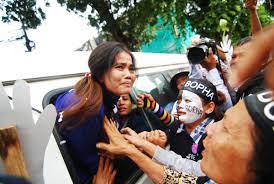
Yorm Bopha

Yorm Bopha, Tep Vanny, Phan Chhunreth, Song Srey Leap, and Bo Chhorvyfive women land rights activists – were arrested today, while peacefully petitioning for the release of other Boeung Kak lake activists arrested over the weekend. Boeung Kak lake, in the heart of Phnom Penh, has been the site of major `urban development’, which means mass evictions. And women have been the heart of the Boeung Kak lake pro-democracy, women’s rights, community rights, land rights movements.

These arrests take place against the backdrop of the recent women garment worker demonstrations across Cambodia, and the State response of criminalization and repression of public dissent and gathering. Women workers have been protesting for over a year. In many ways, they have been protesting for decades.

This is the face of Cambodian `stability’ and `development’: women facing mass eviction, women facing super exploitation. In both instances, the logic has followed the gender of sacrifice. Women must give up land and lives for `the good of the nation.’ Around the world, this is a familiar tune, the song women as silver or diamond, and the women of Cambodia reject it, as they have for decades.

At one of the intersections of land rights, workers’ rights, and women’s rights stands Mu Sochua.

As government forces attacked women garment workers, over the weekend, Mu Sochua, an opposition Member of Parliament, explained and contextualized. She explained that the workers’ demonstration were about a living wage and about democratic governance. She explained that, for the first time, all the trade unions had joined together and had joined together with the Cambodia National Rescue Party. When the State fired its AK47s, it took aim at both labor and democracy, and the heart of those movements, this weekend as so often before, is women workers, organizers, and advocates.

According to Mu Sochua, “The workers are now hiding. They’re living in fear. Do you want to wear clothes made by people who live in fear? With the wages they get today, they can’t even get three nutritious meals in a day. … Does the international community want to continue to support this kind of dictatorship … and support international buyers who make billions while our workers are deprived of basic rights?”

Mu Sochua has been posing the question, and pushing the crisis, of human rights, women’s rights, workers’ rights, democracy in Cambodia for a long time. Sochua has been targeted by the State and has kept on keeping on. She led the struggle against the hyper-exploitation and abuse of Cambodian women and girls working as domestic workers in Malaysia. She connected the development logic of landgrabbing within Cambodia to the export of women workers by Cambodia. Sochua founded Khemera, the first women’s rights organization and the “first indigenous NGO” in modern Cambodia. She has faced imprisonment and worse, and much of this while a sitting Member of Parliament.

Throughout, Mu Sochua’s message has been clear. Democracy matters. Women matter. Justice matters. Cambodia matters. The garment factories of Cambodia have been reaping mass profits while cutting workers’, women workers’, salaries. The State has been claiming democracy while ignoring the will of the people, in development projects for the rich, in industrial production, in national elections. Do you want to support dictatorship, political, economic, and `developmental’? In Cambodia, the women are saying, “No!”


(Photo Credit: Lauren Crothers/The Cambodia Daily)

Things that begin with A: Aqua, asylum, atrocity, Australia

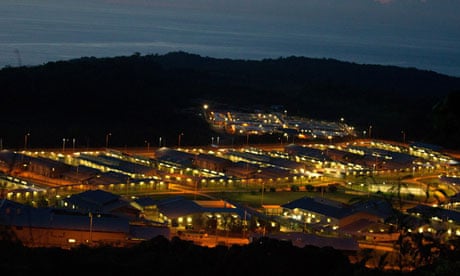
The detention center on Christmas Island

A new year begins: “Australian Federal Police are investigating an allegation of sexual assault made by an asylum seeker detained on Christmas Island. An AFP spokesperson confirmed the matter was referred to the police on 27 December… Union of Christmas Island Workers’ president Gordon Thomson told Guardian Australia the allegations were made by a female asylum seeker housed in Aqua compound, one of the family compounds in the detention centre.”

Christmas Island and Aqua family compound are such lovely names for such sinister operations. Aqua and Lilac “family compounds” are part of the immense immigrant, refugee and asylum-seeker prison system Australia employs Serco to run. It’s a bad place, as reported by Serco staff, prisoners current and former, and doctors who have served on the island.

Serco staff members complain that the prisons are overcrowded and understaffed. For example, at night, 11 security workers monitor hundreds of prisoners. Women prisoners have complained, repeatedly and to no avail, of their fear for their safety.

Women prisoners fear sexual assault. They also fear systemic abuse. Pregnant women, such as Elham, are told to lower their expectations, when it comes to medical care. When asking for an ultrasound, Elham was told, “You are in detention and should not expect a lot.” Women who need to terminate their pregnancies are in even more dire conditions. Women in high-risk pregnancies are treated like everyone else, poorly and viciously. The new policy is to ship them off to even more isolated and desolate Manus Island and Nauru. If a few women die in childbirth, well … it’s the price of public policy, isn’t it?

Women with disabilities are treated like trash. A 30-year-old woman with severe mental disabilities was separated from her family until doctors and others forced the Government’s hand. How many others living with severe mental disabilities languish and deteriorate right now in what is effectively solitary confinement?

The stories continue: an epileptic child held without treatment for at least two months; a baby with a defective pacemaker had to wait for two months to leave the island, despite the pleas of a waiting hospital; a woman with level-five cerebral palsey who receives little to no treatment; the HIV+ person who went poof, lost in the system that is nothing more than a system of loss and losing.

The 15 doctors who wrote and presented, last month, a 92-page letter of concern describing the conditions, describe the prison island as “life-threatening” and “harmful.” They talk of the risk to lives that is endemic to the entire process. Others describe the situation as “inhumane.”

It is all of those and worse. The worse is that this system of atrocity and abuse is, around the world, business as usual. It is the situation that emerges when the State works to persuade its citizenry that immigrants are `a flood’ and, worse, `a tsunami.” When human individuals and populations become jetsam and flotsam, so much trash to be cleared before it pollutes the pristine beaches and bucolic alleyways, prisons become overcrowded. In those overcrowded prisons, women are routinely attacked. Other women are systematically abandoned to new forms of isolation and self-harm. Other women are simply lost. There is no surprise here.

Australia, along with other so-called democracies, has been building this world for decades. Another asylum is possible, isn’t it?


(Photo Credit: Guardian / Paula Bronstein / Getty Images)

Remember this: We all killed Ashley Smith

On October 19, 2007, 19-year-old Ashley Smith died, or was encouraged to kill herself, while seven prison guards in a model Canadian women’s prison watched, followed orders, and did nothing. And by doing nothing is meant committed homicide. That was a decision of coroner’s jury, Thursday, December 19, 2013, six years and two months, to the day.

While it’s a good decision, and while it allows Ashley’s mother, in particular, a kind of peace, there’s more here. Ashley Smith was a girl, then a young woman who lived with mental and emotional problems. She needed help. She knew she needed help. She begged for help, and not only in her last moments. Her entire adolescence and brief adult life, she begged for help. There was none available in New Brunswick, where her family lived, and so she went into the system, and then was shipped around, from prison to prison, from prison system to prison system.

How does a young woman beg for help in prison? There’s one sure-fire way: self-harm. And that’s the route Ashley Smith took. That irked the warden who ordered the staff to do, ultimately, as they did.

But this is not about Canada, nor about seven guards, nor one warden, nor even the so-called correctional system nor the so-called criminal justice system. It’s not about the mental health system either. It’s about us, you, me, all of us.

Where ever you live right now, people, and in particular young girls, are being thrown behind bars for the crime of asking for help. `Budget crises’ produce austerity programs just as `inefficiencies’ once produced structural adjustment programs. These are all too genteel descriptors for a global factory of torture and death, that begins and ends with everyone who is supposed to be responsible responsibly watching a girl kill herself and doing nothing to stop it.

This is not about strangers `letting something bad happen’ nor is this `the order of things.’ This is the order of people and power.

We all contribute to a world in which prison has become the first and the final solution to everything, in which prison and military budgets dwarf all other government expenditures. We vote for that, we teach that, we allow that to continue, we contribute. Remember that.

And in the New Year, remember this: we all killed Ashley Smith. We did not `fail’ her; we killed her. So, rest in peace, Ashley Smith. Perhaps your death and life will not have been for naught. Perhaps.

(Photo Credit: UWaterloo.ca)

Amnesty has never meant freedom

Maria Alyokhina and Nadezhda Tolokonnikova, members of Pussy Riot, walked out of prison today. This is good news, but it’s not freedom. Freedom does not exist where whole populations live in fear of State mandated, sponsored, or instigated terror. Gay and lesbian individuals and populations, from Moscow to Kampala, know this all too well. Ask Kasha Jacqueline Nabagesera about life in Uganda, and she will not talk about “freedom.” She will talk about the struggle for freedom, the long hard walk to a freedom dreamt of but not in sight. Ask those, like Alyokhina and Tolokonnikova, who suddenly leave prison if they feel “free.” They may feel joyful and relieved to be on the outside, however precariously, but they do not feel free. They remember too much.

President Obama recently “pardoned” and “commuted” a few sentences. He talked a little about the unfairness of some aspects of the so-called War on Drugs. He didn’t mention that he has the lowest pardon rate of any President in recent history. He didn’t mention the bodies piling up in prisons and jails across the country.

He certainly didn’t mention Karen Sandoval, originally from Honduras, who lives in constant fear and terror. He didn’t mention the terror of a rigid “immigration enforcement policy” that rips families and communities apart, that rends hearts and souls and sometimes minds, and, not incidentally, that targets women – as undocumented individuals, as those left to clean up and care for those, and in particular the children, `left behind’, and, when incarcerated, as those most vulnerable to sexual abuse and violence from staff.

In Spain, the conditions in immigration detention centers, in the notorious centros de internamiento de extranjeros, or CIEs, are infamously toxic. What’s the anwer? Build more! Put one on every corner. In Italy, the vicious conditions of immigration detention centers are so bad they have inspired prisoners to sew their lips shut, in protest. They say these are worse than prisons “or any other place”. In these prisons, “people … are treated like animals.”

None of this is new. We have seen the sewn lips before, and we have turned away. We have each time taken an oath to forget. That’s what amnesty is, that’s what amnesty was at its origin. Once a year, those who committed violence in the name of preservation of the democratic State, would gather, each year at the same time in the same place, and would take an oath to forget. That is why the State, from its earliest, feared the mothers in mourning, the mothers who refused to forget, who howled their remembrances in words and deeds.

Amnesty has never meant freedom. Ask those who remember.


(Photo Credit: CalvertJournal.com)

Uganda’s Christmas gift? Homophobia, violence, pogrom, witch-hunt

Kasha Jacqueline Nabagesera

Kasha Jacqueline Nabagesera. Clare Byarugaba. Julian Pepe Onziema. Frank Mugisha. Geoffrey Ogwaro. These are the names of the most prominent gay activists in Uganda today, and they are under attack. Today, the Ugandan Parliament passed legislation, `ethics laws’, that threaten the LGBT communities with life in prison, and do so using the most vague, and hence most lethal, language. The law also outlaws mini-skirts. Of course. Because really, the biggest problems facing Uganda today are homosexuality and hemlines.

Three years ago Kasha Jacqueline Nabagesera, Julian Pepe Onziema, and David Kato sued a Ugandan tabloid for its “Hang the Gays” series in which it posted names, addresses, pictures of individuals reputed to be “gay”. Remarkably, they won the case.

Remarkably as well, Kasha Jacqueline Nabagesera helped found FAR-Uganda, Freedom and Roam Uganda; while Julian Pepe Onziema and David Kato led SMUG, Sexual Minorities of Uganda. David Kato was brutally murdered in January 2011.

Since then, the struggle for an end to the pogrom against LGBT people has waxed and waned, often deeply influenced by outside funders, and in particular those from the United States.

Gay activists organized and pushed back. For example, when the Minister for Ethics and Integrity broke up a gay rights workshop, run by FAR-Uganda, they sued. In fact, that case is meant to be decided next month. We’ll see.

This bill had been sitting in Parliament for two years. Last year, House Speaker Rebecca Kadaga promised passage as a “Christmas gift,” and today she delivered. No matter that the Parliament may not have had a proper quorum, no matter that proper procedures were scanted. What matters is “the gift.” After passing the bill, Parliament passed a motion thanking the House Speaker for “the gift.” Parliament was very excited to receive its gift.

And now the witch-hunt proceeds to the next level. Clare Byarugaba, of the Civil Society Coalition on Human Rights and Constitutional Law, put it directly: “You need to deal with your personal security. Whereas we’d rather stay and fight, but we know that people in power are way too powerful, and they can push their agendas at any level. So, rather than be witch hunted in the country that I’ve grown up in, that I love, it would be important for me to get out of the country and re-strategise on the future of gay rights in Uganda.”

 Clare Byarugaba


(Photo Credit 1: PRI) (Photo Credit 2: BBC)

What happens in immigration detention stays in immigration detention

This is a story of whistleblowers in the land where there are no whistles and ears are forbidden. That land is called “immigration detention”. In different places, it goes by different names. Yarl’s Wood in England. Centro de Internamiento de Extranjeros, or CIE, in Spain. The names change, but the structures and situations are the same. “Immigration detention” is a country, and it’s global.

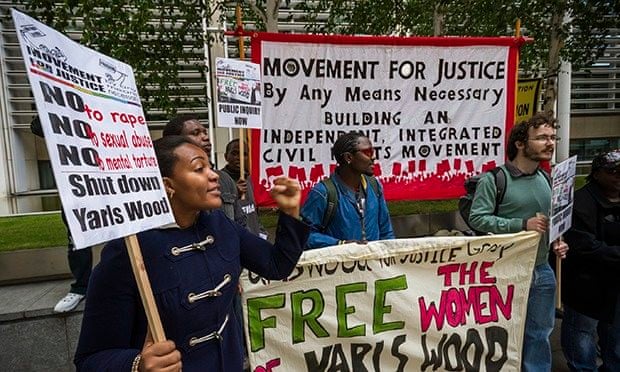
In September, there was yet another story about systematic sexual predation at Yarl’s Wood. This time it was Tanja’s story, an account that only made it to the public because of the tenacity, perseverance and creativity of Tanja, who just kept on pushing. Yarl’s Wood is a designed community in which staff preys upon the most vulnerable, typically young women fleeing sexual violence. Remember, the Yarl’s Wood prison population is almost 90% women, while men make up almost half the staff. The police yet again said they would conduct an investigation. The real story here is the story of the story, the fact that Tanja could get the story out at all. And that story continues.

Since Tanja’s story broke, all hell has broken loose, and by hell is meant silence. First it was Sirah Jeng, a 59-year-old Gambian, who said she could corroborate Tanja’s story. Her reward? In November she was informed, with barely any notice, that she should get ready for imminent deportation … hours before her scheduled appointment with investigating police. That was November.

This month, Afolashade Lamidi, 40-year-old Nigerian, also confirmed parts of Tanja’s accounts, and then some. And she received the same treatment as Sirah Jeng. She was promised the opportunity of forced return to Nigeria.

This is in so many ways a common story. In Spain this month, Aramis Manukyan, known by his friends and now the world as Alik, was “found dead in his cell.” Alik was a 42-year-old Armenian, a father of a 7-year-old daughter. Found dead in his cell was immediately translated into suicide, despite various testimonies to the contrary. Prisoners reported from different floors that they could her Alik’s cries, but no matter. He committed suicide.

After much pressure from the usual suspects like SOS Racismo, Cerramos los CIE (Close the CIE) and Migra Studium, the police, yet again, say they would conduct an investigation. And that’s when the two key witnesses were deported.

For every Tanja and every Alik there are tens, hundreds, thousands of neighbors and friends, prisoners all. There are witnesses in prison, and they are not the kings or queens in the land of the blind. They are the witnesses in the land of the blinded. They are the whistleblowers in the land where whistles are prohibited and hearing is a crime. Remember, what happens in immigration detention stays, or dies, in immigration detention.


(Photo Credit: Guy Corbishley / Demotix / Corbis / The Guardian)

Women are Tunisia’s revolutionary guards


Three years ago, December 17, 2010, something happened in Tunisia: the Jasmine Revolution. Remember? On December 17, Mohammed Bouazizi, a street vendor, set himself on fire. It was a desperate act that lit the sky and the world. His act reflected a general sense of despair, and in that reflected despair, people saw transformative change as their only hope. Within 28 days, on January 11, 2011, President Zine El Abidine Ben Ali resigned.

From its first flicker, the Jasmine Revolution was more than the ouster of a dictator. It was an assault on patriarchy that emerged from decades of women and youth organizing. Three years later, it still is.

For Tunisia, the past three years have been “interesting,” and particularly for women. The government has seesawed repeatedly on its position vis-à-vis women’s rights, equality, and roles. The State and parts of Civil Society have colluded in trying to diminish the significance of women’s work and contributions. And women have pushed back.

When the Ben Ali regime was in its last days, the State unleashed its dogs. Women, especially those in poorer areas, were sexually harassed, assaulted, and raped by security forces.  Women pushed back, and helped push Ben Ali out.

Once the unity of the first phase of the Jasmine Revolution dissipated, fractures emerged. In the intervening three years, women have reported increased attacks on women ostensibly for their attire. In some instances, women were attacked for not wearing a veil or for wearing jeans; in other instances, women were attacked for wearing veils.

The policing of women’s bodies intensified until last year, when a young woman was raped by police officers. She took the officers to court, where she was charged with public indecency. Across much of Tunisia, women and men said, “We are not going back!” Women pushed back, and continue to do so.

Women are organizing. They’re running for office, training, mobilizing, and generally opening common spaces and freer zones. According to the Association Tunisienne des Femmes Démocrates, ATFD, a majority of women participating in revolutionary activities had suffered violence as women. This included secular feminists, such as those in the ATFD or the Association des Femmes Tunisiennes pour la Recherche sur le Développment; Ennahda women, especially those who had been imprisoned; the anti-heroic women youth insurgents who kept coming out into the streets and squares; women trade unionists and women homemakers; rural women and urban women; women who had extensive formal education and those who had been systematically denied access to education. Women.

And women are pushing back. They’re organizing tribunals to hear, publicize and respond to testimony on the forms of violence against women. There will be one taking place next week. Prominent women, such as Wided Bouchamaoui, Maya Jribi, Basma Khalfaoui, Salma Baccar, Amira Yahyaoui, Kalthoum Kennou, Leïla Ben Debba, Dalila Ben Mbarek, Mbarka Brahmi, Yamina Thabet, Néjiba Hamrouni, Amel Grami, Latifa Lakhdar, Olfa Youssef join women across the country in rejecting what Tunisian feminist Lilia Labidi named “féminisme au masculin.” Women are Tunisia’s revolutionary guards, and the revolution continues.


(Photo credit: Fethi Belaid / AFP / Jeune Afrique)