How do you like your torture, fast or slow?

Saleyha Ahsan has been visiting Y, an Algerian who fled Algeria for the United Kingdom, seeking asylum. His story is being enacted in a video on the Guardian website. He can’t see it, because he’s “a threat to national security”, and so he can’t access a computer, much less the internet or a mobile phone. His crime? “Y was tortured in Algeria – the evidence is clear from the scars on the front and back of his head. His crime was to speak out against human rights abuses in the early 1990s. When it was clear that he had to leave he came to the UK, and with his powerful testimony he was given full rights to remain. Not a false passport or fake name in sight. Leaving saved his life. Not long after, he was issued with a death sentence in absentia in Algeria.” Wait. That can’t be right. His crime is that he `agreed’ to be tortured? Yes, that made him a threat. However one parses the niceties, Ahsan has watched “an isolated edgy young man turned old through the “slow torture” of these last eight years in the UK. Detained for a total of 57 months in prison – first for the ricin case, for which he was fully acquitted, then detained again based on…? Your guess is as good as mine. It’s called secret evidence and neither Y or his lawyers have any idea what it is.”

This practice of slow torture is particular to women and takes many forms.

In the UK, according to the most recent Prison Reform Trust Fact Files, “The number of women in prison has increased by 60% over the past decade, compared to 28% for men. On 12 June 2009 the women’s prison population stood at 4,269. In 1997 the mid-year female prison population was 2,672. In 2007, 11,847 women were received into prison.” Twelve years of step-by-step, rung-by-rung escalating incarceration of women. Twelve years of silence. Slow torture.

Nadera Shalhoub Kevorkian has been thinking and writing about the slow torture of Palestinian women. Palestinian women have been placed in a condition of betweeness: “we as women are in a state of betweeness, we are kind of border patrolling everything, we are border patrolling the border between the outside and the inside, the private and the public – our bodies, our lives, our future are all in the state of betweeness….Look at the example of the checkpoints …; I was dropping my partner off at his clinic… they stopped us and they put the men on the right side and the women on the left side, and they told the men to raise their hands and body searched them, and we were on the other side, and this kind of not knowing, this uncertainty that we were all living at that moment, this geography of fear that they created in a very small space, our space as women, all of a sudden it became militarized and they kind of stole our space from us. We became exilic in our own space and the men became dehumanized and demonized in front of our very eyes….This militarization … ends up putting us, as women, as boundary markers, so we are the punching bag for the men outside and the punching bag for the men inside, and we want to move and change the situation, but we are in a state of ‘betweeness’.” The checkpoints are the fast and the quick of torture. The slow torture is the state of exile in one’s own home. How many decades of silence before a new language and a new home are fully established?

Slow torture is a product of a particular application of the rule of law to women and men deemed to be foreigners, and so [a] menace to society and [b] meant to be grateful for whatever juridical crumbs they can get.

In California, for example, activists have targeted undocumented residents and their U.S.-born children. They want to cut off public services to undocumented residents, to challenge the citizenship of any U.S. born citizens of undocumented residents, and set harsh new standards for birth certificates. Who’s targeted here? Women. Making pregnant women worry about what will happen, to them and their children, if they go to hospital in labor is that same as shackling women prisoners while in labor and childbirth. It’s criminal, and it happens all the time. It’s slow torture.

Veronica Lopez  is from Guatemala. She lives in California. She lived with a violent and abusive partner. She reported him. He was tried and deported to Guatemala. Lopez then spent nine months in immigration detention, terrified that she would be deported back to the reach of her abusive husband. Only at the eleventh hour, and then some, did the State come through and grant her a U-Visa, which is designed precisely for women in Lopez’s situation. Others have not been so lucky, and have been deported. The state of betweeness for women stretches across the world. The practice of slow torture haunts us.

(Photo Credit: Los Angeles Center for Law and Justice)

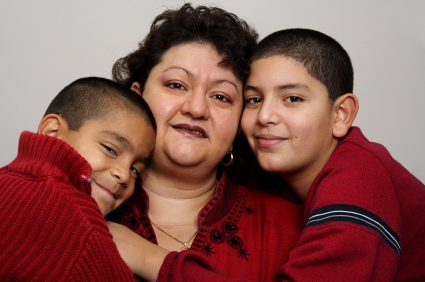
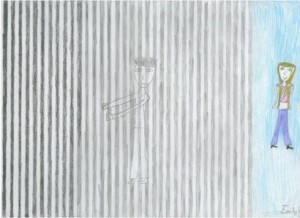
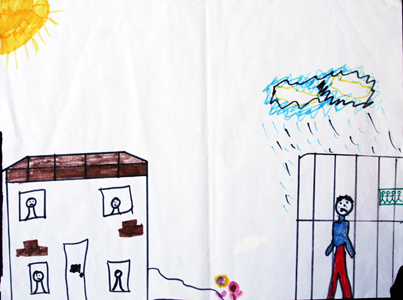
Children of Incarcerated Mothers, or Albie Sachs haunts U.S. prisons!

Albie Sachs is a South African judge who haunts the U.S. prison system. Why? Because he is a decent human being, that’s why. He decided to listen to a woman colleague. He decided that primary caregivers of children should not be sent to jail. Here’s a version of the story:

“Albie Sachs…was fleetingly in the UK last week, primarily to tell the story behind the judgment he made in South Africa not to send a woman to prison because it would infringe the human rights of her three children.…

“Judges are the storytellers of the 21st century,” says 74-year-old Sachs….

At first sight, he had intended to throw out an appeal on behalf of Mrs M, who was facing four years in jail for up to 40 counts of credit card fraud that she had committed while under a suspended sentence for similar offences. “I remember drafting an extremely dismissive response. I said: ‘This doesn’t raise a constitutional question. She simply wants to avoid going to jail. She doesn’t make out a case, and her prospects of success are zero.’ “It was a female colleague…who insisted that the case be heard. She argued that the human rights of the accused woman’s children were not being looked at separately.

“She said: ‘There is something you are missing. What about the children? Mrs M has three teenage children. She lives in an area that we politely call fragile, an area of gangs, drug-peddling and a fair amount of violence. The indications are that she is a good mother, and the magistrate gave no attention to the children’s interests.’

“The minute my colleague spoke to me about the importance of the three teenage children of Mrs M, I started to see them not as three small citizens who had the right to grow up into big citizens but as three threatened, worrying, precarious, conflicted young boys who had a claim on the court, a claim on our society as individuals, as children, and a claim not to be treated solely as extensions of the rights of the mother, but in their own terms.”

As a result, Sachs created a legal precedent in 2007: a woman who otherwise would have gone to jail did not have to, because of her children’s rights. “We could have said the children’s rights must be considered but sent Mrs M to jail anyway, perhaps for a lesser term. But that would not have changed anything.”…

Although three judges dissented from the majority verdict, the precedent was set in South Africa that – at least in borderline cases – primary caregivers of children should not be sent to jail. And if the court decided to jail a primary caregiver, it had to take some responsibility for what happens to the children. “The court can’t simply say that she should have thought of that before she committed the offence, or that she can’t hide behind her children.”…

At the time he was drafting the judgment, Sachs did not know of any country that took the rights of offenders’ children into account, but he subsequently discovered that similar ideas were being framed in Scotland in a report by the then children’s commissioner, Kathleen Marshall. The report, Not Seen, Not Heard, Not Guilty, argues that the rights of offenders’ children to family life under the UN Convention on the Rights of the Child are systematically ignored by the court system. The report found that almost two-thirds of prisoners in the Cornton Vale women’s prison in Stirling had children under 18, but there was no provision to take their rights into account during sentencing.

“This was astonishing,” Sachs told the audience. “In a totally different legal system, in a totally different society, a conclusion was being reached that is almost identical. It showed that the time has come for new ways of thinking.””

Albie Sachs haunts the United States, home of “the incarceration generation”: “The chances of seeing a parent go to prison have never been greater, especially for poor black Americans, and new research is documenting the long-term harm to the children they leave behind. Recent studies indicate that having an incarcerated parent doubles the chance that a child will be at least temporarily homeless and measurably increases the likelihood of physically aggressive behavior, social isolation, depression and problems in school — all portending dimmer prospects in adulthood. “Parental imprisonment has emerged as a novel, and distinctly American, childhood risk that is concentrated among black children and children of low-education parents,” said Christopher Wildeman, a sociologist at the University of Michigan who is studying what some now call the “incarceration generation.” Incarceration rates in the United States have multiplied over the last three decades, in part because of stiffer sentencing rules. At any given moment, more than 1.5 million children have a parent, usually their father, in prison, according to federal data. But many more are affected over the course of childhood, especially if they are black, new studies show. Among those born in 1990, one in four black children, compared with one in 25 white children, had a father in prison by age 14. Risk is concentrated among black children whose parents are high-school dropouts; half of those children had a father in prison, compared with one in 14 white children with dropout parents, according to a report by Dr. Wildeman recently published in the journal Demography. For both blacks and whites, the chances of parental incarceration were far higher than they were for children born just 12 years earlier, in 1978.”

None of this is new, news or surprising. Cage the fathers, superexploit the mothers, forget the children. It’s simple. Put a nation of mothers behind bars, where too often there are no fathers or other guardians around and there is no public support, and you imprison the children. Where’s the surprise? Shackle pregnant women prisoners in labor and delivery, in the name of security. Are you surprised? This has all been said before. It’s common knowledge.

In South Africa, Albie Sachs acted. In Scotland, so did Kathleen Marshall. In the U.S., it’s time, it’s way past time, for similar action.

(Image Credit: http://childrenofprisoners.eu)