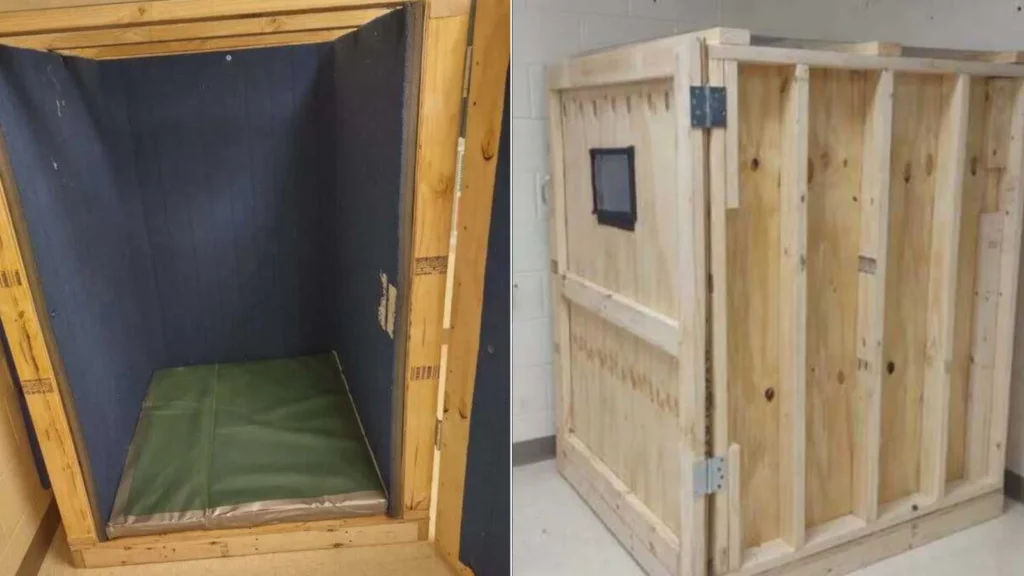
Salmon River schools seclusion room
This week, NPR reported rampant abuse of Native American children in schools in a district in upstate New York: “Native kids with disabilities were held in wooden boxes. Sweeping reforms are coming”. The story is deeply disturbing. Schools built wooden boxes, “timeout” spaces”, and confined children with disabilities, children in majority Mohawk districts, into those boxes. Now the state says it’s going to do something, something `sweeping’, about those atrocities, about “seclusion rooms”. If history is any judge, they’ll need a big broom, one to cover the whole of the United States.
The story concerning upstate New York first broke last year. December 18: “Salmon River educators placed on leave over allegations that students were locked in box”: “Educators in the Salmon River Central School District have been placed on administrative leave, and the superintendent has been reassigned amid allegations that special needs students were restrained in wooden boxes at school. In addition, the district has shifted to remote learning for Friday.” At first, the Superintendent said the pictured box that was circulating on social media was not used to discipline children. Within two days, not only did he have to recant that, he had to admit there additional boxes. December 18: “Salmon River school admits to using wooden boxes as `timeouts’”: “Organizers said the box was designed for a specific 8-year-old student who is on the spectrum and non-verbal.” Faced with a child with serious needs, they bought a box to hold that eight-year—old. December 20: “A ‘Timeout Box’ in an Elementary School Draws Outrage: ‘This Is Not OK’”: “In a district in which more than 60 percent of students are Native American — and where schools sit alongside the St. Regis Mohawk Reservation — community members said that the episode recalled the well-documented harm and trauma that generations of Native American children faced in boarding schools.” In March, an “independent” study found “no abuse … but … many compliance violations”. The more recent study, by the state, has found that those breaches of “compliance” constituted abuse. Meanwhile, in New York State, seclusion rooms were already prohibited. But now that prohibition will have “sweeping” energies applied to it.
The story is disturbing in itself. It’s equally disturbing because it’s so unsurprising. Here’s some news from the past few months. March 11: “50 Minnesota school districts still using ‘seclusion’ rooms”: “More than 50 Minnesota school districts continue to use so-called seclusion rooms …. The 50 school districts maintain 194 registered seclusion rooms across 100 school buildings across the state.” Two weeks ago, in Amherst, Massachusetts, parents of children with disabilities urged their local school board to remove seclusion rooms, also known as “`reflection rooms’ or `blue rooms’ — padded isolation rooms”. At the end of February, the Virginia Beach School Board unanimously voted to limit the use of seclusion rooms. The change follows two years of discussion and “scrutiny” after the isolation of an 11-year-old student with autism led to his death: “Virginia Beach reported the highest number of seclusions among school divisions in Virginia in the 2024-25 school year.” There’s much sweeping needed.
Charles Bell, author of the recently published No Restraint: Disabled Children and Institutionalized Violence in America’s Schools, noted, “44 states have laws that limit the use of restraint and seclusion to emergency situations or ban it altogether. Minnesota, for example, bans the use of seclusion for children who are in third grade or younger. And 41 of these same states have laws that schools must notify parents each time their child is restrained or secluded. Various news organizations, such as ChalkBeat, have found that schools in North Carolina, Michigan and Illinois have violated restraint and seclusion laws. In some cases, schools use terms such as `quiet room’ and `timeout’ to circumvent laws that mandate reporting restraint and seclusion to parents and government agencies.”
What are these seclusion rooms teaching children, not only the children thrown into the boxes but also those who watch? We have asked this question since 2010. We asked in 2011, 2012, 2013, 2014, 2015, 2017, 2018, 2019, 2020, 2021, 2023. It is too late to “discover” the atrocity and torture of seclusion rooms. The time for discovery is long over. Across the country, children with disabilities and children sitting with them are being traumatized and tortured, all in the name of education. What is the lesson here? What exactly are children meant to learn, the ones thrown into solitary, the ones watching their friends go into solitary? Why are we so invested in seclusion and restraint of children, generally, and of children living with disabilities, particularly?
(By Dan Moshenberg)
(Photo credit: Chrissy Onientatahse Jacobs / NPR)