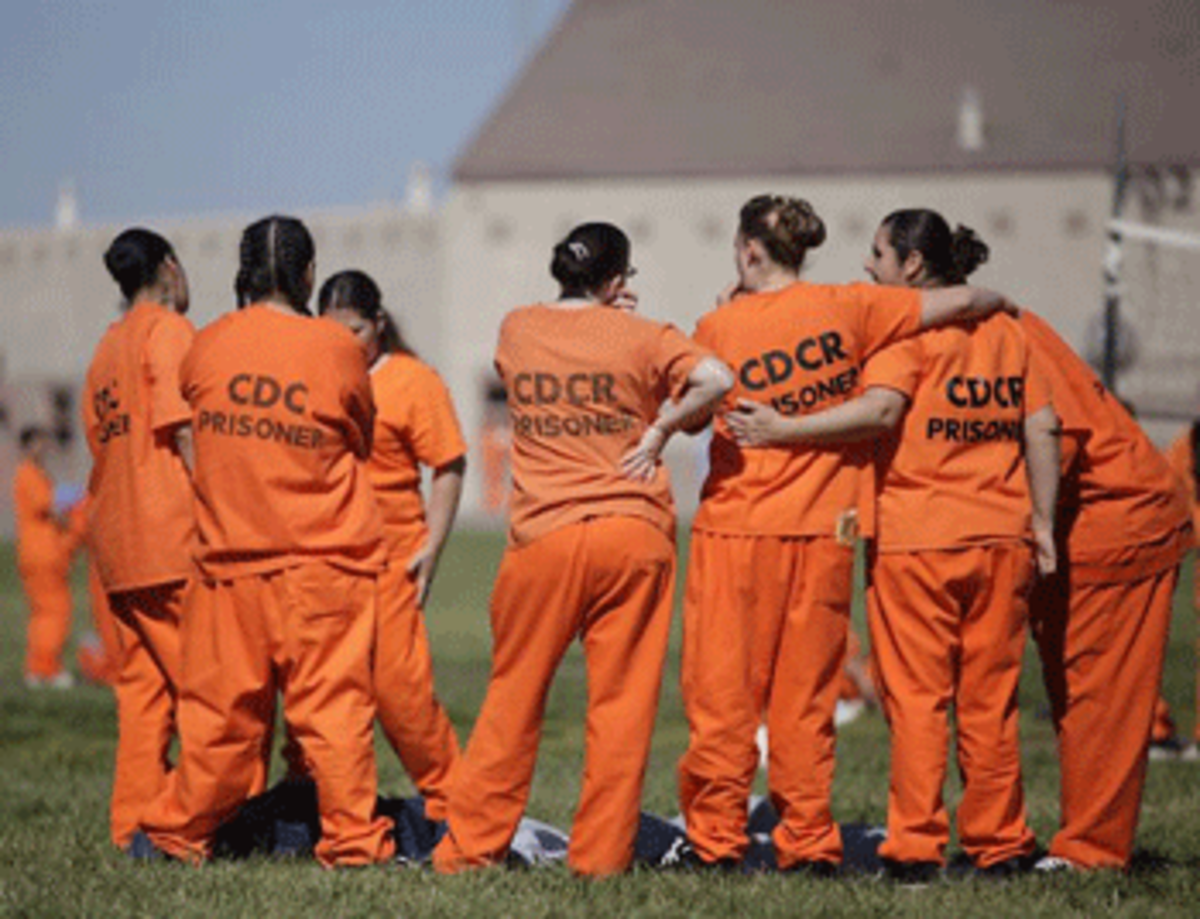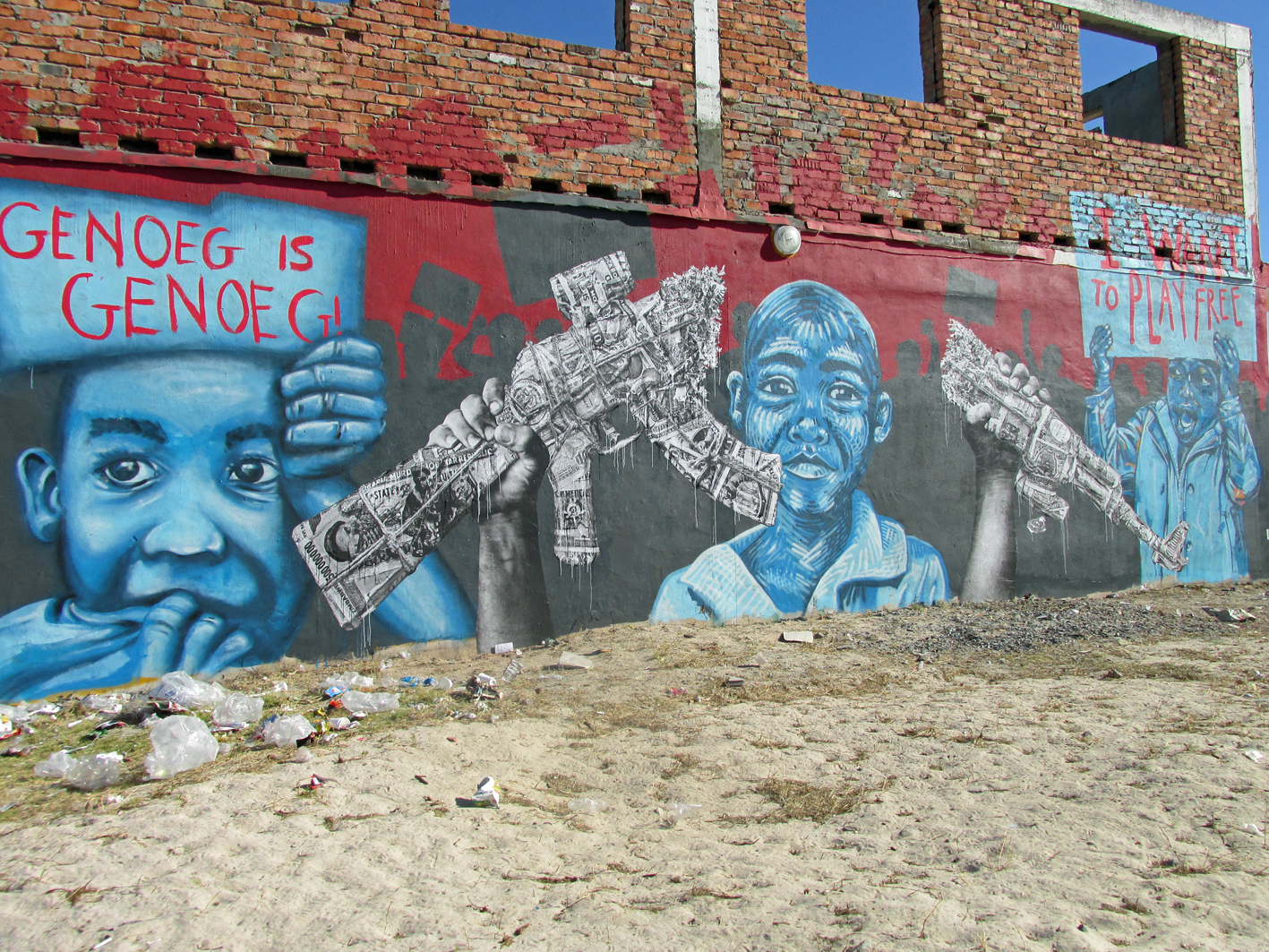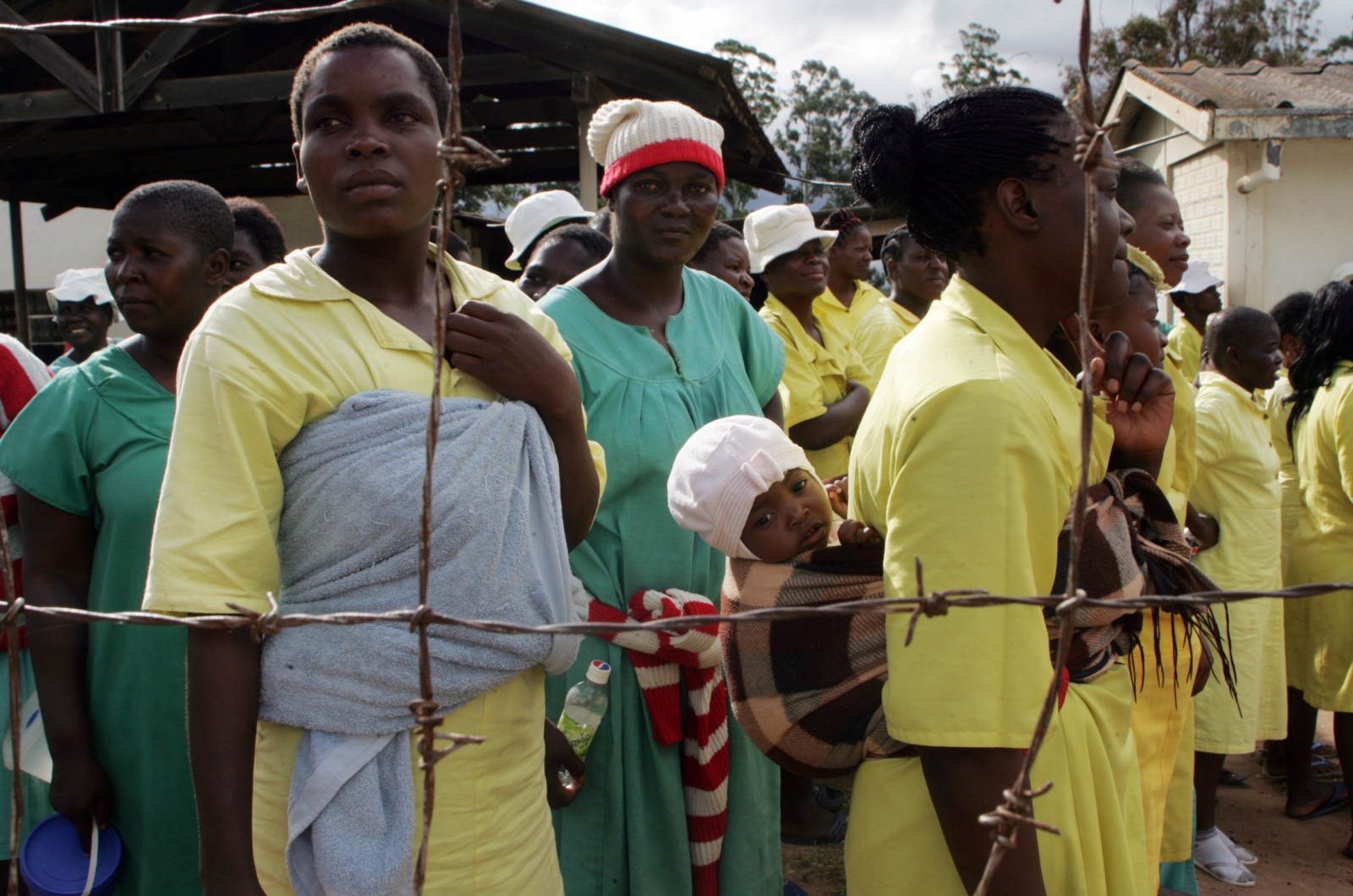
Chikurubi = death. Tear it down!


“In the endless moments that I spent in the cells at Highlands police station, I did not imagine that I could ever be in a worse place. That was before Chikurubi. As it turns out, hell is other people, especially when those other people are your fellow women prisoners and there has been no water for a week and flies are buzzing over the gamashura and the only ablution possible is to run a dry towel across your body, hoping that the dirt and smell will somehow be absorbed by as inadequate an object as a prison-issue towel with a visible thread count”
Petina Gappah, The Book of Memory: A Novel

This is the Republic of Chikurubi, aka Zimbabwe. Robert Mugabe pardoned more than 2000 prisoners this week: “The amnesty has freed all convicted female prisoners … leaving Chikurubi Female Prison literally empty. Only two females serving life sentences have been left behind.” No one was freed, but they were released from prison, and the prison is not literally empty, both because there are still women prisoners inside and because we have been here before and we know Chikurubi is not empty until Chikurubi is torn down once and for all.

These prisoners were sent home ostensibly because the prisons are overcrowded, but the prisons in Zimbabwe have always been overcrowded and toxic. In 2013, the Deputy Commissioner of the Zimbabwe Prisons and Correctional Services reported that 100 or so prisoners had died that year due to lack of food and medication. They died slowly, starving and writhing in pain, and so in February 2014, Robert Mugabe “freed” thousands of prisoners. In 2009, Robert Mugabe “freed” 2,513 prisoners, due to overcrowding.

Meanwhile, Chikurubi still stands. Built by Rhodesia in 1970, the year that entity declared itself a republic, and maintained since by Zimbabwe, from the first day to today, Chikurubi has been “notorious for its filthy, freezing and overcrowded cells infested by maggots and rats.” It’s the one constant, and that’s why Zimbabwe is truly the Republic of Chikurubi. Half the population dies of starvation one year, and there’s barely a murmur. A two-year old child, Nigel Mutemagawo, is abducted and held in custody for 76 days. He was held in Chikurubi Maximum Security Prison for close to two weeks: “Medical reports show that during his abduction and continued detention for charges of banditry and terrorism, two year-old Nigel was assaulted and denied food and medical attention by his captors.” He was two years old. Prominent human rights and women’s rights advocates, such as Jestina Mukoko, are tortured in Chikurubi. What of it? Women like Rebecca Mafukeni are denied access to necessary medication and die in Chikurubi. Too bad. Rosemary Margaret Khumalo, affectionately known as Makhumalo, died, waiting for the new Constitution to be followed. Bad luck.

While it’s a relief to the women and their families and friends and communities to no longer have to sit in the hellhole that is Chikurubi, the flies are still buzzing over the gamashura. Don’t call it freedom. There is no freedom in the Republic of Chikurubi until the Chikurubi prison is destroyed, first the buildings and then structures. Don’t fix it; be done with it. Chikurubi = death. #ChikurubiMustFall

(Photo Credit: International Business Times / Jekesai Nijikizana /AFP /Getty Images)
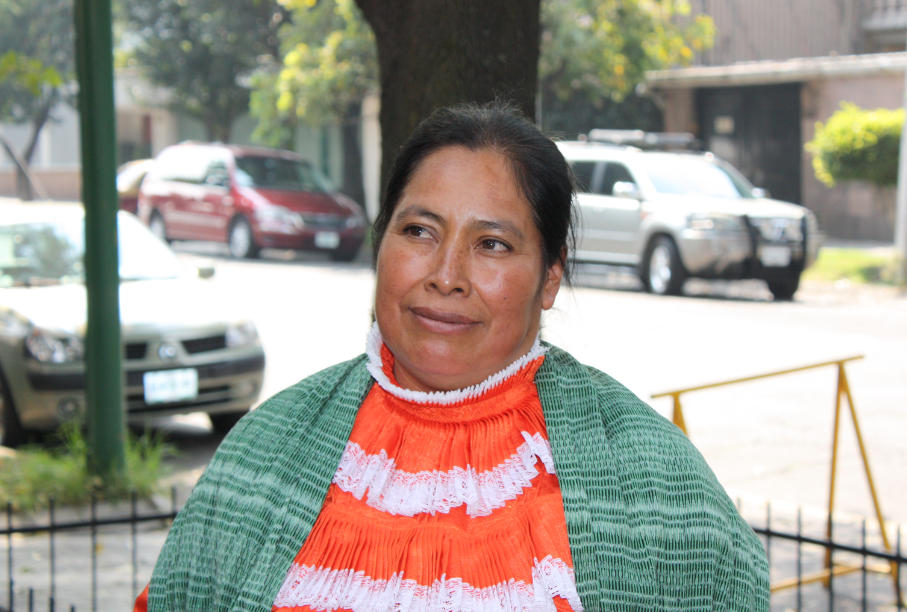
Jacinta Francisco Marcial, Alberta Alcántara Juan, Teresa González Cornelio demand justice!

Jacinta Francisco Marcial

Jacinta Francisco Marcial, Alberta Alcántara Juan, and Teresa González Cornelio are Otomí-speaking ñhäñhú women street vendors who have struggled for the past decade to force the Mexican government to do more than `stop oppressing’ indigenous women. Asserting their dignity as indigenous women, they have demanded justice. This week they may have moved a step closer to that goal.

Jacinta Francisco Marcial, Alberta Alcántara Juan, and Teresa González Cornelio were arrested, charged, tried, convicted, and sentenced to decades in prison for a crime that never occurred. On March 26, 2006, members of the now-defunct Federal Investigation Agency (AFI) of the federal Attorney General’s Office showed up at the town plaza of Santiago Mexquititlán in the state of Querétaro. Never identifying themselves as police, they began to shake down the local street vendors, the vast majority of whom were ñhäñhú women. The women massed around the agents and demanded they stop their extortion. The agents’ superiors arrived and offered to pay for damages, and that should have been that.

Four months later, Jacinta Francisco Marcial, Alberta Alcántara Juan, and Teresa González Cornelio were arrested and charged with having kidnapped six agents. The evidence was allegedly a newspaper photograph that showed the three women somewhere in the vicinity of the crowd of indigenous women. The trial dragged on for two years. Not a single federal agent ever showed up or gave testimony, and yet all three women were sentenced to 21 years in prison. That’s justice in Querétaro for the crime of being a working poor, indigenous woman.

At the time of her imprisonment, Jacinta Francisco Marcial was 43 years old. She was married and the mother of six children. She sold juices and ice cream in the town square. Jacinta Francisco Marcial was guilty of the crime of survival with a modicum of dignity.

When she was sent to jail, the Centro Prodh took up her case. Soon after, Amnesty began investigating and campaigning as well. In September 2009, Jacinta Francisco Marcial was released from prison. The Attorney General’s Office had dropped the charges, but never declared her innocent. In April 2010, Alberta Alcántara Juan and Teresa González Cornelio were also released. At the time of their release Alberta Alcántara Juan was 31, and Teresa González Cornelio 25 years old. Teresa González Cornelio gave birth to a baby girl while in prison.

The three women had been released, but Jacinta Francisco Marcial had not been exonerated, and so she sued the State for damages and demanded an apology. In May 2014, in a groundbreaking case, Jacinta Francisco Marcial won, the first time a Mexican citizen sued the State for wrongful incarceration and was awarded reparations and a public apology.

The State refused to pay up or apologize. This week, the earlier judgment was confirmed, and there’s no chance for the State to appeal the decision. The State must compensate and formally apologize, and it must do so by September 2016.

Mexico currently holds over 9000 indigenous people in its prisons. The prisons are hellholes generally, and for indigenous people, even more so. There are little to no language services either in the courts or in the prisons, and so many indigenous people are left to fend for themselves, which is to say disappear. As Jacinta Francisco Marcial has explained on more than one occasion, she didn’t know what kidnapping was when she was charged with that crime.

According to the Mexican National Commission on Human Rights, the conditions of women’s prisons are deplorable. Querétaro’s Centro de Reinserción Social Femenil San José El Alto offers threats, humiliation, discrimination; toxic maintenance conditions; unregulated and irregular application of solitary confinement; overcrowding; and more. According to the Commission, Querétaro’s Centro de Reinserción Social Femenil San José El Alto is not one of the worst women’s prisons in Mexico, not by a long shot.

The State tried to crush Jacinta Francisco Marcial, Alberta Alcántara Juan, and Teresa González Cornelio, because it considered three working poor indigenous women as so much dust. From the streets to the courts to the prisons to the highest offices in the land, State agents thought they could abuse such women with impunity. But when they struck Jacinta Francisco Marcial, Alberta Alcántara Juan, and Teresa González Cornelio, they hit and dislodged a boulder that will continue to roll and pound until the State of impunity is crushed. There are many Jacintas in Mexico and beyond.


(Photo Credit: Centro Prodh) (Video Credit: Amnesty / YouTube)

This story is about Jessica Williams. #SayHerName


On Thursday, May 19, activists from various national movements – including Black Youth Project 100, Project South, Ferguson Action and Black Lives Matter – joined with local activists around the country for a day of action to protest and do something about State brutality against Black women. The banner and hashtag for the day were #SayHerName. On Thursday, May 19, Jessica Williams, 29 years old, Black, was killed by a white San Francisco police sergeant. Jessica Williams was unarmed. The reports on Jessica Williams’ death have barely said her name. Until late Friday night early Saturday, Jessica Williams was “an unarmed Black woman.” More to the point, the story line has been about the Police Chief being removed, about the new Police Chief, and about racism in the San Francisco Police Department. While all of those count, the story should be about Jessica Williams. Even in her own death, even now, Jessica Williams suffers the indignity of being removed from the center of her own life and death story. Jessica Williams. Say her name. #SayHerName

The story of Jessica Williams’ death is a common one, both for San Francisco and beyond. Williams was in a car identified as having been stolen. She refused to leave the car and allegedly tried to drive away. That’s when a police officer shot and killed her. According to all reports, Jessica Williams was not driving towards the officer. In fact, she wasn’t driving at all. According to police, “Williams drove away after officers tried to talk to her, officials said, but crashed into a parked utility truck about 100 feet away. She continued to disobey police instructions, and the sergeant then fired one shot and killed her as she sat in the car, said police, who added that no weapon was found on Williams.”

From 2000 to today, San Francisco police officers have been in 95 shootings. Forty have been fatal. Twenty-three of the shootings involved people “in moving or stopped vehicles.”

Jessica Williams was killed in the Bayview District, a hotbed of `revitalization.’ Bayview is the epicenter of San Francisco’s “shrinking African American population”. In early December last year, Mario Woods, 26 years old, Black, was shot 20 times by police officers in Bayview.

The San Francisco Police Department has already been under investigation for racist and homophobic practices, both formal and informal. Police Chiefs will come and go, as will police sergeants and other police. It’s important to address the police, as a group of people, a culture, a public agency, and a body of practices. But first and last, we must learn to move the police off center in the narratives of those killed by police. Jessica Williams is the story, not this sergeant or that chief.

Her name is Jessica Williams, and she did not deserve the fate that was dealt her by the State. No one deserves that fate, and no one deserves that treatment. Jessica Williams is the name of `urban redevelopment’ and skyrocketing real estate markets. Jessica Williams is the name of militarized and uncontrolled policing, witch-hunting, all in the name of zero tolerance and urban revitalization. Jessica Williams, 29 years old, Black, female, was sitting in a stationary car when she was killed. This story is about Jessica Williams. Say her name. #SayHerName


(Photo Credit: Twitter / @SisterSong_WOC) (Image Credit: Ferguson National Response Network)

Senator Cotton Wants More Women of Color Behind Bars, and For Longer

On May 19th, Senator Tom Cotton of Arkansas stood before an audience gathered for the Hudson Institute’s event on Crime and Justice in America and argued that the United States of America is currently suffering from an under-incarceration problem. Yes, Senator Cotton believes that the country with 25% of the world’s prison population has an under-incarceration problem.

The gist of Senator Cotton’s argument, and overly simplified linear logic, is how could we have a mass incarceration problem when so many “criminals” are getting away. Well, Senator Cotton, allow me to explain. The problem with mass incarceration is not simply how many people we have incarcerated (though that is a big part of it) but who this country is incarcerating by the millions. The simple answer is low-income men and women of color for predominately low-level drug offenses.

To better understand the fallacy of the ‘Gentleman’ from Arkansas’ logic, we can turn to the fastest growing prison population: women. Since the introduction of federal and state level policies like broken-window policing, 3-strike laws, mandatory minimums (policies Cotton credits with turning around our society), the number of women in prison has risen 700%. Of the 215, 332 women who have entered prison, nearly half have entered for drug-related offenses. In the world Tom Cotton lives in, a longer prison sentence will help these women beat drug addiction and rehabilitate them into law-abiding citizens. In reality, these women will sit in prisons where only 10% will receive any form of substance abuse treatment. For those that do receive treatment, the treatment they receive is based on the substance abuse history of men and has been found to be largely ineffective.

Prisons do not just serve as makeshift substance abuse treatment centers, in which the majority of incarcerated women have substance abuse histories and barely any women actually receive substance abuse treatment. Prisons also serve as mismanaged, ill-equipped, and overcrowded places to house women with mental health concerns. While 12% of women in the general population have mental health concerns, 73% of women in state prisons, 61% of women in federal prisons, and 75% of women in jails have mental health disorders. Again, these women are largely low-income women of color. For these women, “treatment” often comes in the form of restrictive housing (solitary confinement), a form of punishment that has been shown to cause psychotic episodes, hallucinations, and suicidal tendencies.

Cotton also gives credit to the “thankless” work of Correction Officers who work tirelessly to rehabilitate individuals in prison and keep them safe. In reality, women are perhaps in more danger inside cell walls. Kim Shayo Buchanan describes prisons as if “the clock has been turned back to the nineteenth century. Women, especially women of color, are exposed to institutionalized sexual abuse, while a network of legal rules prevents them from seeking protection or redress in courts. Guards know they can sexually exploit women without fear of institutional sanction or civil liability”. Despite making up only 10% of the prison population, women make up nearly half of all survivors of sexual assault in American prisons.

Senator Cotton, the prisons you imagine, places where bad people go to repent for their wrong doings, do not exist. The US penal system currently operates as a place to control, abuse, and neglect our nation’s poor and mentally ill. The answer to the issues Senator Cotton worries about is not an increase of punishment but an increase in attention and investment to the communities that are being effected by our MASS incarceration.

(Image Credit: Bitch Media) (Photo Credit: LA Progressive / Lea Suzuki / The Chronicle)

Solidarity with the women prisoners of Fleury-Mérogis!

In Fleury-Mérogis, France’s biggest prison and one of its worst, women detainees have been organizing against new conditions of detention arranged by the new software GENESIS (Gestion nationale des personnes écrouées pour le suivi individualisé et la sécurité, National management of imprisoned people for individualized monitoring and security), an acronym that blurs its material reality for women incarcerated in Fleury-Mérogis. The software was sold under the aegis of efficiency and harmonization between the men’s quarters and the women’s quarters. In practice, this harmonization meant worsening the conditions of detention: reduction of the number of promenades, limitation of access to the gym and cultural activities, and reduction of visiting room sessions.

In December 2002, France ratified the United Nations’ resolution, Optional Protocol to the Convention Treatment or Punishment (OPCAT). As a result of that ratification, in 2007 the French parliament passed a law creating an independent public body “contrôleur général des lieux de privation de liberté” in charge of monitoring all places and institutions where people are locked up.

This independent body released a report in January 2016 concerning the conditions of detention of women, which includes women in jails, prisons, administrative (immigration) detention, and psychiatric detention.

Women prisoners represent 3.2% of the prisoners in France with 5 to 6% of women prisoners in administrative detention. Juvenile delinquents may be locked up in educational centers, which resemble a prison anyway. Girls make up 6 % of incarcerated minors. Proportionately, women in psychiatric hospital are in greater number; 38.21% of those committed to psychiatric detention are women. Historically, women have been the targets of psychiatric control.

The report points out that women are more susceptible to suffer from separation from family circles, and especially from their children, than men. Although by law women are entitled to the same rights as men, the gap between them is even wider in prisons and jails.

With the consolidation of detention centers, women have been sent further away from home. This situation is well known in the United States but is relatively new in France. The report insists on the inherent injustice of this situation since about 75% of the incarcerated women are mothers. The law demands that women’s incarceration respects their familial responsibilities. Further, most of the women are incarcerated for minor offenses. Among the 188 detention centers and prisons in France only 43 may receive women. Often the women’s side in a prison is simply very basic compared to the men’s side.

The report stresses the lack of services for women detainees and disparities among the various prisons and jails receiving women; these services go from health services to judicial services such as parole and day parole. The carceral administration justifies the inequality by claiming that there are too few women to merit more equipments or services.

The report recommends adding services, improving the conditions of detention, implementing the required access to school and other activities, all in the respect of the principle of equality.

Despite this detailed and clear report that demanded actions for revising the conditions of incarceration for women, Fleury-Mérogis’s administration launched GENESIS March 3d.

Immediately, the Basque women political prisoners incarcerated in Fleury-Mérogis organized women prisoners against this injustice. A support group has also been organized. Citizens outside the prison have written letters to the prison administration. Signs of solidarity with the women inside are key when women are locked up and may feel isolated. So each rally outside has to be heard inside.

The women prisoners’ demand is simple: “We call for dignified living conditions, they talk about rules. We talk about mutual assistance and sharing, they talk about logistics and “traffic.” We talk about humanity, they talk about laws. We talk about communicating and coming together, they answer with security and solitary confinement.” The response of the prison’s management has been harsh, 4 women have been sent to solitary confinement. Since May 10th, 5 men and 2 women have been on hunger strike in solidarity with the women in isolation.

This is a struggle against the logics of over incarceration producing a carceral and societal aberration that started in early 2000. It is a fight against a higher degree of materialistic dehumanization of prison conditions, another step toward a harmonization with the United States’ penitentiary hell. Solidarity with women prisoners is required, today in Fleury-Mérogis, tomorrow …

(Photo Credit: L’Envolée) (Image credit: Paris-Luttes.info)

For the silicosis widows of India, the struggle continues

On May 4, India’s Supreme Court directed the Gujarat government to compensate the families of 238 workers who died of silicosis while working in unregulated quartz crushing factories. Within the month Gujarat is supposed to pay each family 300,000 rupees, or around $4,500. The Court also directed the Madhya Pradesh government to take care of an additional 304 workers currently suffering from silicosis. As in South Africa, the story of industrial silicosis is a widows’ tale, from horrible start through brutal inner chapters to whatever the end will be.

According to a 1999 Indian Council of Medical Research report, in India about 3 million are at risk of silica exposure. Since that report, the numbers of workers in the various fields – mining and quarries, manufacture of non-metallic products, manufacture of basic metals and alloys, and construction – has only increased, and since that time pretty much nothing has improved in the conditions of labor, and so one assumes that the 3 million mark has been exceeded by quite a bit.

Across Madhya Pradesh, this “occupational trend” has produced an archipelago of widow villages, and that’s the point. The villages are not new and are not unknown. Women’s organizations have long lobbied for compensation. For ten years, the National Human Rights Commission has documented and organized to improve the situation of the workers and their families. At every step of the way, the Rajasthan and Madhya Pradesh governments have refused any sort of assistance.

It’s a common enough story. Small hold farmers from tribal communities were forced off their lands by market forces, weather, and the poverty of the Mahatma Gandhi National Rural Employment Guarantee Act, which, in Madhya Pradesh, guarantees stay-at-home-and-die. And so populations of mostly male workers went off to work in the factories of Gujarat. When they returned home, usually earlier than expected, they were frail, coughing, bleeding versions of the men who had left. And women were left to tend to the dying, the dead, and the debts. Then the women started going to Gujarat to work crushing stones.

Madhavi comes from a village in Madhya Pradesh. She joined four family members who went to work in Gujarat. Six months later, sick, they all returned home. To pay for medical treatment, they sold off their livestock and mortgaged their land. Then Madhavi’s mother, two brothers and sister-in-law died of silicosis. Now, sick with silicosis, Madhavi cares for her father and struggles with debt: “With my brothers gone, I am not sure when I‘ll be able to pay off all the loans. I have received no support from the government. My father does not receive any pension. It is very difficult to get by as I am always tired and run out of breath while working.”

Meanwhile, across Rajasthan, mineworkers’ widows tell the same story of death, debt, and desperation. Prembai explains, “[My husband] could not work for the last six years of his life, so I would work to keep things going. Women earn just Rs100 a day in the mines, while men are paid about Rs250.” The bodies and debts pile up; the State looks away. In Rajasthan as elsewhere, entire villages are called “the land of widows”.

The story of silicosis in India is the same as that in South Africa. For those who work the mines and factories, there is no dignity in labor. For the widows, there is no dignity in death. The bodies come home, the debts and demands mount, the extraction continues.


(Photo Credit: The Hindu / Rohit Jain Paras)

Why do women in every corner of the world experience shortages of sanitary pads in prison?

As of 2013, approximately 74% of incarcerated women in the United States are between the ages of 18 and 44. After adding the number of incarcerated juvenile women of menstruating age to this number, it becomes apparent that the vast majority of incarcerated women in the United States experiences menstruation while in prison.

Menstruation in prison can often be unpredictable, making it difficult for incarcerated women to prepare for their periods by purchasing or saving sanitary products in advance. The stress of incarceration on newly imprisoned women was found to have severe effects on many of their menstrual cycles, causing irregularity. After an extended period of time spent in close quarters with other incarcerated women, menstrual cycles among many women can synchronize, leading to a high demand for sanitary products within a short period. Despite this high demand, many prisons in the US do not provide their inmates with adequate amounts of sanitary products. As the majority of incarcerated women are indigent, many cannot afford to buy extra sanitary pads from the prison commissary. This leaves them with few options other than to reuse old pads or wear a dirty uniform.

The United States is not alone in this violation of human dignity. Incarcerated women across the world experience similar shortages. For example, due to lack of access to sanitary pads, female prisoners in South Sudan often use dirty rags during their menstrual cycle and sometimes insert clay into their vaginas to stop the bleeding. These practices can leave women vulnerable to infection, and often prevent them from working or leaving their cell during their period.

Why do women in every corner of the world experience shortages of sanitary pads in prison?

The short answer is capitalism, as it often is when examining injustice in the modern world; the long answer is a little more complicated.

The spread of capitalism through colonial expansion is essential to understanding why women experience similar indignities while incarcerated. Long after Europeans relinquished their territorial hold on nations across the globe, capitalist ideals remained, dividing the proletariat (and men and women) with constant competition for capital. In the past four decades, capitalism has utilized a new weapon: neoliberalism. Neoliberal rhetoric is integral in the response of the prison system to the health needs of women—with their inaction and inadequate provision of products, the state’s implication is that each woman should look after herself and provide her own sanitary pads while incarcerated. This narrative ignores the economic, social, and political circumstances of her incarceration: the state does not consider whether or not she was able to afford sanitary pads outside of prison (which is unlikely, as the majority of incarcerated women are indigent), and ignores the racist and classist sentencing practices that likely led to her imprisonment. Neoliberalism demonizes poverty and blames inadequate health care on the individual’s lack of motivation, and this dangerous narrative is accepted by the majority of the public.

When neoliberal ideology has entrenched itself so deeply into the global economic, political, and social spheres, how can one change the conversation to hold institutions accountable for their neglect of marginalized populations?

The answer is through grassroots organizing and supporting projects that focus on restoring incarcerated women’s dignity. Donate to organizations like A Woman’s Worth, Inc., which is a non-profit organization based in Oregon that works on several projects regarding feminine hygiene product access worldwide. They have a prison project called “Dignity Behind Bars,” and they suggest that activists donate maxi pads to be distributed in US prisons and reusable cloth pads to be distributed in prisons abroad. They also ask activists to contact women’s prisons in the US to inquire about the commissary stock and hygiene product distribution.

Through donations to organizations such as this and attempts to hold the prison system accountable for neglecting the needs of incarcerated women, we may be able to work towards restoring some dignity into the lives of incarcerated women.

(Image Credits: A Woman’s Worth, Inc)

Prison is neither a childcare nor a residential center

Dunia Romero and daughter Stefany.

The United States has built three special hells for immigrant women and children: the Berks Family Residential Center, in Leesport, Pennsylvania; the South Texas Family Residential Center, in Dilley, Texas; and the Karnes County Residential Center, in Karnes City, Texas. U.S. Immigration and Custom Enforcement is very proud of Karnes. When first opened, ICE boasted, “The Karnes County Residential Center (KCRC) is the first facility housing ICE detainees built from the ground up with ICE’s civil detention standards in mind. It represents a significant milestone in the agency’s long-term effort to reform the immigration detention system.” Last Friday, April 29, despite numerous `deficiencies’, Karnes was issued a temporary residential childcare license. Rather than a significant milestone in any attempt to reform anything, this is just another scene in the theater of cruelty that is immigration policy. Prison is neither a childcare nor a residential facility. Ask Dunia Romero and her fifteen-year-old daughter Stefany; ask Josie and her ten-year old son Manuel; ask Susana Arévalo Hernández and her two children; ask the mothers of Berks, Dilley, Karnes, and to a person they will tell you the same thing: “This is a prison. We fled violence and you have treated us as criminals. Why?” End the torture of women and children, and while you’re at it, stop the abuse of language and common sense. Prison is not childcare.

Yesterday, Dunia Romero and her daughter joined dozens of other undocumented mothers and children in a demonstration outside the White House. They are part of the Esperanza que Florece – Blooming Hope campaign, urging people to send Mother’s Day postcards to four prominent and influential mothers: Michelle Obama, Jill Biden, Celia Muñoz, Valerie Jarrett. The postcards call for an end to “family detention.”

Yesterday, as well, a judge in Austin granted a temporary restraining order to stop the Dilley prison from being licensed until a full court hearing on May 13. While it’s only a temporary stay, it’s an important step, and it was initiated by a lawsuit filed by two women prisoners of Dilley and Grassroots Leadership. The Karnes prison retains its license.

Today, the Center for American Progress released A Short-Term Plan to Address the Central American Refugee Situation, which noted, “The administration should close the South Texas Family Residential Center in Dilley, Texas, and the Karnes County Residential Center in Karnes City, Texas, and release those detained mothers and children who do not pose a security or flight risk that cannot otherwise be mitigated … The administration should create short-term processing centers for families upon arrival that function like shelters rather than prisons. These centers would give families the ability to get their bearings in the United States; attend legal orientations and connect with pro bono counsel; and receive medical, mental health, and other needed care.”

This Mother’s Day, various groups – including currently and formerly imprisoned women and children refugees, legal teams, advocacy groups, and just plain folks – again attempt to move the State to turn its prisons into shelters and its swords into welcoming arms. Please consider joining others by sending a postcard, the link is here. Honor Mothers’ Day this year by joining the fight to release imprisoned immigrant mothers and children and by ending family detention now.

(Photo credit: Armando Trull / WAMU)

It’s way past time to recognize AND support women prison journalists

We live in an age of news desertification. Today, May 3, is World Press Freedom Day, and much of the discussion of press freedom centers, rightly, on censorship, and on the intimidation, brutalization and imprisonment of reporters. At the same time, and especially in the United States, “news deserts” are popping up in fairly predictable communities: rural areas and urban minority neighborhoods: “Minority communities in big cities tend to be the most arid news deserts of all.” News deserts are places in which people can no longer get the local news, and it’s the no longer that matters here. News deserts are places that had local community newspapers, usually for generations that either failed or, as with the vast majority, were bought out by corporate interests and then dumped or `re-tooled’ out of their community base. While the news air is indeed very dry in urban minority communities, the epicenter of news desertification across the United States is the prison, and the dead center of that map is the women’s prison.

Prison journalism has a long and storied record in the United States. In 1887, a group of prisoners in the Stillwater Prison, in Minnesota, pooled money and energies and founded The Prison Mirror. Today, The Prison Mirror is the longest running jailhouse newspaper in the United States. Today, The Prison Mirror, The Angolite, started in 1976, and the San Quentin News, revived in 2008 after 26 years of silence, are the only three prisoner-run publications that do serious and investigative reporting on criminal justice and injustice. But the real story is the rise and fall of prison newspapers.

The Prison Mirror was wildly successful from the beginning, so much so that prison newspapers, newsletters and news magazines started popping all over the country. By the early 1960s, there were prison reporters in almost every state. From 1965 to 1990, there was an active Penal Press Awards, with real competition among real prison house journalists. Then the 1990s happened. A predictable component of mass incarceration’s austerity budgets was the elimination of educational and cultural programs, included in which was the programmatic disappearance of jailhouse news venues. More prisoners, more isolation, more self harm and suicide, and more silence. Mass incarceration = news desertification.

Today, there are very few prisoner-run news outlets, and that’s a shame. These projects did more than “help” prisoners, although prisoners certainly benefited from them. Check out The Prison Mirror, The Angolite, or the San Quentin News and you’ll see hard hitting and urgently useful news reporting.

Where are the women? Here, there and everywhere. Short-lived newspapers emerge from a journalism course, and women prisoners produce newsletters, like Through the Looking Glass, published by women prisoners at the Purdy Correctional Treatment Center, outside Seattle, Washington, between 1976 and 1987. From 2002 to 2006, women prisoners at the Edna Mahan Correctional Facility for Women in New Jersey published a monthly magazine, Perceptions. In 2003, women prisoners in Oregon approached Vikki Law to help them publish their voices and visions, and so was launched Tenacious, a zine of art and writings by women incarcerated across the United States. The most recent issue, Tenacious 35, was published in December 2015.

None of these has received the kind of support, institutional and cultural, given to similar projects in men’s prisons. The Prison Mirror, The Angolite, and the San Quentin News are great examples of prisoner run news media, and they are great examples of the resources needed to sustain such projects, from the warden and staff to time and space to training to encouragement, from within and without. It’s way past time to recognize AND support women prison journalists. Prison doesn’t have to be a news desert, and women’s prisons don’t have to be shrouded in silence.


(Image Credit: California Coalition for Women Prisoners) (Photo Credit: POC Zine Project)

On the run

On the run

(women) going strong
in a Brave Run
against violence 
(and patriarchy) 
from Khayelitsha
 to central Cape Town

Not waiting
(waiting in vain)
for our ritual
16 Days of Activism
for No Violence
against Women and Children

(when one and all come out
to be seen and heard)

Manenberg’s Rock Girls
and others braving
crime-affected areas
(and the country’s male-folks
who rape and murder)

(combined with
454 kids murdered
in (a) single year
combined with
smacking kids
making them anti-social)

On the run
braving the elements
(not the weather)
an inaugural event in memory
of the killing of 2 teenage girls
(raped and murdered in the same week)

On the run
not running away


“Concerned residents, activists sweat it out as Rock Girl uses 34km run to call for safety” (Cape Times, April 25 2016), “Brave Run links city in fight against violence” and “454 kids murdered in single year” (Weekend Argus, May 1 2016). See also “Smacking kids can cause them to become anti-social” (Argus, April 29 2016).


(Photo Credit: Rockhoppin’ Trail)