Wage Theft in Music City: HOTELS SHOULDN’T HURT!

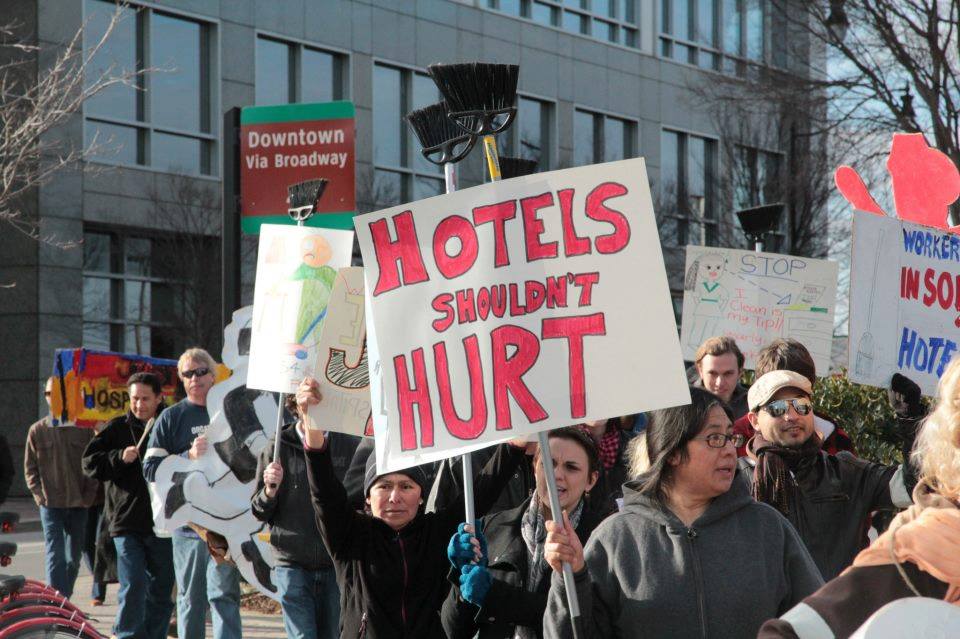
HOTELS SHOULDN’T HURT! is the new battle cry for Workers’ Dignity’s newest campaign against wage theft and working conditions in Nashville’s booming hospitality industry. The member-led workers’ center for Nashville’s low-wage workers, with support from researchers at Vanderbilt University, released a report last week detailing the harsh conditions of labor for the city’s hospitality workers. The Music City has experienced a huge boost to its hospitality industry in the recent years thanks to Nashville’s rise to prominence as an “it” city. However economic benefits have not reached the lowest paid workers in the industry – housekeepers, custodians, and laundry employees.

The findings of the report are saddening, though not shocking. The hospitality industry has a long history of wage theft and abuse among its lowest paid workers. Nashville is no exception. The report finds that nearly 10% of all hospitality workers in Nashville make less than the federal minimum wage of $7.25. 89% of workers worked more than 40 hours a week without receiving fair overtime compensation. As housing and living costs sky-rocket in Nashville, the average wage of a hotel housekeeper, $8.36 an hour, falls far below the national median income. Who are the housekeepers? Overwhelmingly women of color.

In addition to criminally low and stolen wages, the industry is providing little in way of quality safety standards to the lowest paid workers. 39% of employees received no on the job training in handling toxic chemicals. 21% of workers reported that their employees did not provide protective materials such as masks or gloves. 27% of employees reported being injured on the job and 51% of employees are not provided sick days (paid or unpaid). Workers report constantly becoming ill due to long exposure to toxic cleaning chemicals, malfunctioning elevators that lead them to run flights of stairs as they are not permitted in the elevators with hotel patrons, and severe burns that received no attention from hotel management.

Wage theft anywhere cannot be tolerated, but in a city where prices, and buildings, continue to go up, it is crucial that every worker has access to a fair wage and safe working environments. As Workers’ Dignity claims, Nashville is in the midst of a crisis. You may donate to Workers’ Dignity here and remind the Music City that HOTELS SHOULDN’T HURT!

(Photo Credit: Workers’ Dignity)

Offering

Offering

you wake in the night
lips shaped
around a word that has not
yet
arrived

you close your eyes
wait
for it to grow into a poem

a poem that might breathe itself
into heat, form
into a body merged with yours

and if you entered that body
with every sense
ferocious, tender
nothing withheld

it would become a doorway
you could walk through
clear-eyed
find your country

see it truly
for the first time

and if you stood
in the sticky churning
red mud of your country
naked to the wind

refused to shut
your eyes refused
to shut
your eyes

the word would arrive
cymbal in your mouth

sing history
back onto itself, sing tearing
whole again, sing altered
tally sheets clean, blood
back into bodies, blades
back to the forge

sing women
unviolated, infernos
downward to soil, crops
greenly skyward, sing it all
back to the beginning

in a language
none of us
has ever heard

have you ever woken
in the night? Reached
for the body beside you
as if its living warmth
could teach your hands
a new language?

in the dark
it is your own bare skin
the holy innocence of belly
unslashed
the fearless softness of breast
unraped
that whispers back to you

beloved

history is a million terrors
tides that have engulfed your country
you were never going to arrive
in time

it began before you
will not suck itself
back through the doorway
of your longing

and a doorway
is not a body
to wrap you
in the night

a body
is not a poem
to teach
the language you yearn for

the poem you seek
will never
fit
grape-round, grape-sweet
into the shape your mouth makes
when you wake in the night
crying
for all we once believed
we knew

all we once imagined
our struggles had made safe

crying
for all those
choked, drowned
in the quicksands of history
history we did not arrive
in time to drain

beloved

what remains
blossoms out of the skin
of your belly
nudges into your palm
on your breast
a pulse you fit words to
one by one

breathe
see
choose

truth
work
justice

you will wake with your fingers
wrapped around them
breathe see choose

wake with them salty
under your tongue
truth work justice

they hold your right of return
to the country of childhood
they map where you will stand
in the scorched erupting soil

breathe see choose

they

are your passport

to morning

– Shailja Patel (2008) © All rights reserved

This poem first appeared in Imagine Africa; edited by Breyten Breytenbach, Archipelago Press (2011). Our thanks to Shailja Patel for writing, sharing, and permitting us to publish.

(Photo Credit: Christopher Burkett / Michael Ingbar Gallery)

Women say NO! to the new labor laws in France and across Europe that attack women

Once more, labor laws and work conditions are under attack in Europe, this time in France. The labor code of France, a heavy book, probably needed some cleaning up as laws had piled up and sometimes were redundant. With the encouragement of the Medef (the union of employers), the current government has undertaken to reshuffle all the principles of labor protection. Using a rare executive order (Article 49-3 of the Constitution), the French President passed a bill that was once opposed by the same Francois Hollande, who then called it undemocratic. Since his action, a movement to remind the government of its democratic responsibility has grown, and demonstrations and strikes succeed each other daily.

The Medef has argued that to create jobs employers must be able to fire more easily with fewer constraints that guarantee employees’ rights. So the French government offered a new labor law that has the potential to erase the type of labor protection that is the basis of labor rights. The bill was largely inspired by other labor bills passed in other European Countries under the aegis of austerity measures. Germany, Great Britain, Italy, Greece, Spain have passed bills to feed the exploitative neoliberal system with precarious labor contracts, called zero hour contract in one place and one-euro jobs in the next. In Greece, despite all the critics, the Troika imposed its memoranda making firing very easy. The minimum wage is now at its lowest level (511Euros for those under 25) and the social security system, which was efficient and inexpensive, is now close to being totally destroyed. Additionally, the dismantling of labor rights is very handy in making migration another source of marketization.

In France, the opposition to the bill first came from the students, who are fairly well unionized in high schools and universities. They immediately organized, understanding that this law would create a transitional system to precariousness for the youth, either for intellectual work or blue-collar jobs. Soon after many unions joined, including the CGT (Confédération Générale du Travail), CGC (Confédération générale des cadres), and FO (Force Ouvrière). Meanwhile, Nuit Debout (Night Standing Up), a rather spontaneous movement, gathered in public squares in various French cities, including Paris, Lyon, Bordeaux, and beyond.

Like other European labor bills, the French labor law is a double sentence for women. The bill ignores women’s rights while asserting its respect for the principle of equality. The bill’s language actually razes all means to attain this infamous gender equality. Flexibility supersedes gender equality. The law will limit the bargaining power of unions and fragment their negotiating power; it will aggravate the asymmetrical relationship between the employers associated with the financial oligarchy and the employees or the labor force in general. The obligations of employers toward their employees will be reduced tremendously. It will reduce the number of days off and possibilities for days off that made the leave of absence system a model for labor organizations.

The notion of flexibility has been used as a mythical term for progress while it’s real meaning for working class and particularly for women is increased precarity. In France, women make 80% of the part time labor force. Women also perform 80% of unpaid domestic work. The employers union never discusses this reality. Flexibility means lowering additional pay for extra hours, reducing delay for notices, and easing the firing process. This assault on workers’ time is a double assault on women workers.

The bill will also weaken the occupational medical system that has provided strong medical protection for employees. The risk in feminized professions of lowering the standard of protection is more than real.

Across France, mobilization is high. Feminists have been in the forefront, sending petitions and organizing demonstrations. The movement is also picking up in Belgium, for the same reasons. To understand what is at stake today, we should reread Emile Zola on the disastrous condition of the working class during the industrial revolution and especially women’s conditions. The struggle continues.


(Photo Credit 1: 20minutes) (Photo Credit 2: France24)

Australia is NOT shocked by the routine torture of women asylum seekers on Nauru

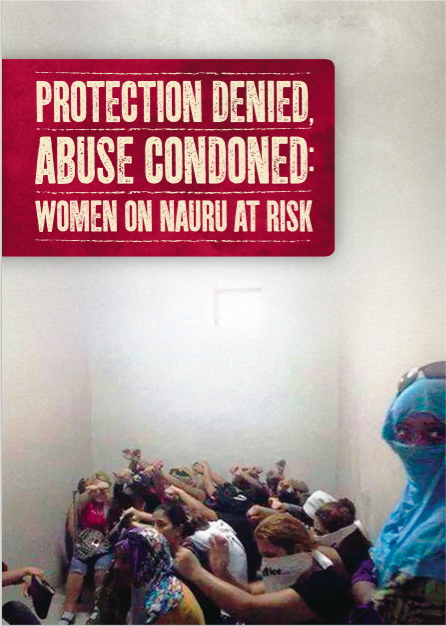
Yesterday, Australian Women in Support of Women on Nauru released a report, Protection Denied, Abuse Condoned: Women on Nauru at Risk. It’s a powerful, and all too familiar, description that ends with recommendations for Australia, guilty of waging a war on women, through a campaign of systemic sexual violence and torture. While gruesome and horrifying, none of this is new, and the Australian government is not shocked by the routine torture of women asylum seekers on Nauru. If anything, it’s proud of the system of routine, deterrent torture.

After briefly detailing the recent intensification of violence against women asylum seekers and refugees on Nauru, the report notes, “Ample evidence of the likely damaging impact of inde nite detention and lack of adequate health facilities on detainees was readily accessible when Labor reopened Nauru. For example, an Oxfam Report published in 2007 painted `a shocking picture of psychological damage for the detainees’ including mass hunger strikes, multiple incidents of self-harm and widespread depression and other psychological conditions. Oxfam may have been shocked, but this was already old news to those who had erected the Nauru adventure.

A page later, the report notes, “Stories of the sexual assault of women on Nauru both in the camps and in the community have been told in horrified whispers to trusted people. They are backed up by reports of shocking incidents.” Maybe ordinary people with a sense of conscience or humanity would find these incidents shocking, but, again, not the members of the Australian Parliament.

Repeatedly, the population was allowed to be shocked as long as its elected government refused the shock: “The Australian population had been shocked by vivid footage of the SIEV 221 carrying mainly Iranian asylum seekers foundering onto the jagged cliffs of Christmas Island in December 2010. More than 40 people died, including children and babies. In 2013, when Rudd was Prime Minister again, he announced that none of those detained in o shore centres would ever make it to Australia.”

In 2012, when an Expert Panel recommended the re-opening of offshore centers, “the refugee and human rights sector was visibly shocked.” The centers were re-opened.

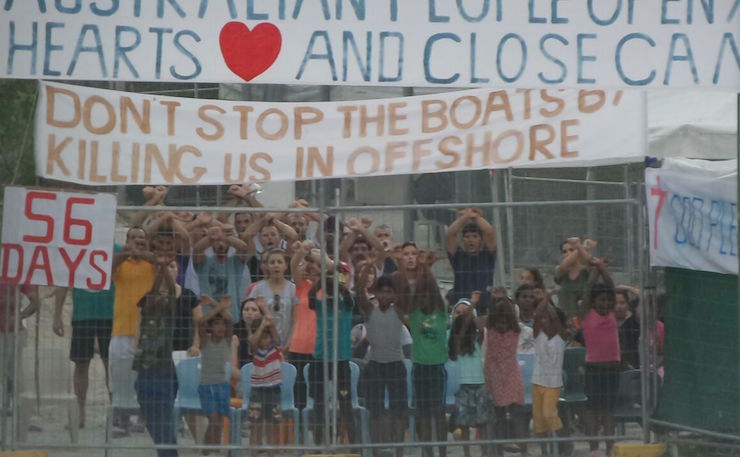
There was no shock when one atrocity after another was reported, and there was no shock when the detention center and later the island itself became “a black site, with access to the island denied to the international media.” There can be no shock, given the purpose of Nauru. Nauru was set up as a dumping ground built on a legalistic nicety: “The detention centres on Nauru house women and children who arrived in Australia by sea seeking asylum after 19 July 2013 and who the Australian government has declared will not have their claims processed in Australia, nor will they be allowed to settle in Australia.”

The name for the policy that allows this toxic legerdemain is No Advantage. In 2001, Australia established offshore centers. In 2008, the Nauru center was closed. In 2012, under the No Advantage policy, the Nauru center was re-opened: “The basic premise was that asylum seekers arriving after 13 August 2012 would be given no advantage over those who waited for a humanitarian visa in a refugee camp overseas.” The result was predictable. Four years later, “No Advantage underpins the punitive offshore regime where even death by violence, death by medical neglect, rape of women and sexual abuse of children has not deterred either the current or the previous government from this policy.” No one is shocked.

None of this will come as a shock to members of the Australian Parliament. Letters and photographs detailing the attacks on women have been sent to every Member of Parliament and Senator. They know what is happening on Nauru.”

The report is harrowing as was the last and as will be the next. Australian Women in Support of Women on Nauru has done great work here. Their recommendations to Australia are eminently sensible and familiar: obey the law; close Nauru and Manus Island; transfer everyone to Australia; invest in ending violence against women on Nauru and in Papua New Guinea.

But no one is shocked by “a deliberate policy of sending women who have already been exposed to sexual violence to a place where they are exposed to further violence.” No one is shocked by the torment of women on Nauru. We need a new kind of report. Let the next report on the atrocities in the camps focus on the members of Parliament who are not shocked. Show the faces of members of Parliament as they yawn and roll their eyes at the stories of rape and torture. Include mirrors, because right now, no one is shocked by the routine torture of women asylum seekers on Nauru or anywhere else.


(Photo Credit 1: Australian Women in Support of Women on Nauru) (Photo Credit 2: New Matilda / Refugee Action Coalition)

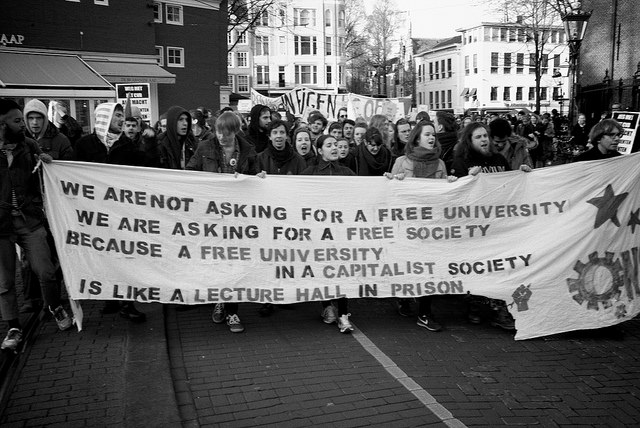
A specter haunts the university: the permanence of workers’ space and time

In Washington, DC, the George Washington University (GWU) fired more than half of the faculty at the Corcoran School of the Arts and Design. The decision came roughly one year after the acquisition of the Corcoran School by GWU. One professor, Antje Kharachi, whose contract was terminated, said, “The past few years have been absolutely exhausting. As much as I loved the Corcoran, I feel relief that the seemingly endless wait is finally over. We’ve been lied to, undermined, disrespected, while trying to hold the [Corcoran School] together for our students.” Kharachi was just informed her contract would be terminated, and she felt relief. This comes on the heels of the firings of two of the University’s Women’s Studies Program’s most widely known adjunct faculty in an effort to “restructure” the program at GWU. Two months prior to the Corcoran layoffs, GWU announced they would also be restructuring their dining program. The over forty workers, many of whom have spent anywhere from one to five decades working in some capacity with the dining program, have recently lost the permanence of the space they have made their livelihoods for decades. Both faculty and dining workers had heard only vague reports of their future employment at the University, and spent years reporting to work under the presumption that any day could be the day their jobs were lost.

“All right, Chesimard, pack your things. You’re being moved.”
“Moved? Where?”
“You’ll find out when you get there.”
“Then i’d like to call my lawyer.”
“You can call your lawyer when you get where you’re going.”

In Assata: An Autobiography, Assata Shakur describes the physical space of her incarceration in and around the Middlesex County Jail: “My abrupt transfer form one jail to another, without either notice to my lawyers or explanation to me, was a scenario that would be repeated over and over again during the next few years.” We often envision and discuss the space of incarceration as one of stagnant permanence. For Assata Shakur, and many others, along with solid cell walls and the indefinite permanence of solitary confinement, space also involved abrupt relocations without warning. It dictated and severely limited her relationships with her lawyers, friends and family. According to a Department of Justice report, nearly every state’s Department of Corrections “does or can transfer inmates to destinations in other states.” In Washington D.C. alone, one in five people incarcerated on felony charges is imprisoned more than 500 miles from the District of Columbia.

In relation to global militarization and securitization, violence and displacement, or “expulsion”, the impermanence of space operates as psychological warfare from individuals, such as Assata Shakur, to entire local communities to millions of people. These displacements benefit the systems of expulsion by expelling people from both land and sense of self. People are forced out of their sense of permanence and community. Landless, homeless, and without anchor, people experience loss of community as a kind of radical individuality that is not conducive to pushing back against the forces that lead to Assata’s incarceration, the ambiguity of future employment in campus dining, or displacements on a massive scale.

At GWU, the fear and unknowing about whether or not one’s job would continue to exist instilled in many a sense of despair. Lack of communication and vague non-promises about what comes next produces a demoralization that keeps workers in a state of anxiety, a state of heightened individuality that creates an even more challenging environment for collective organizing. These decisions are not specific to the George Washington University alone, but rather emblematic of a broader trend in higher education, and in the global economy as a whole. The precariousness of work has come to play a central role in efforts to financially, psychologically, and emotionally control huge swaths of people. To understand both the permanence and impermanance of space is to better understand the precariousness of work. The structuring of this new impermanent work environment leaves many with hyper-individualistic sense of despair – kept in the dark about their own time and futures, and left feeling powerless.

Workers in the struggle to put an end to on-call scheduling and reclaim some permanence in their work lives; students, workers, staff, and faculty at universities demanding accountability and transparency for administrator’s decisions to cut budgets and restructure programs; communities organizing to be informed about rights and resistance in the face of raids that fill the beds of immigrant detention centers globally are already challenging the impermanence of space. It’s time to demand full transparency and accountability from administrators as they dangle workers’ futures over a ledge, it’s time to end the practice of prisoner relocations beyond the reach of their families and loved ones. When we challenge the logics and practices that leave us feeling powerless and alone, we win. These systems are allowed to thrive when the individual is adrift amongst a sea of individuals, and to assert that a radical collectivity is not only ideal, but also necessary.

(Photo Credit: Guido van Nispen / Truthout)

Judy Da Silva: “The bottom line is the river has to be cleaned up”


Judy Da Silva is the environmental health coordinator for the Grassy Narrows First Nation, also known as the Asabiinyashkosiwagong Nitam-Anishinaabeg, in northern Ontario. Judy Da Silva is 54 years old, a mother, grandmother, and activist. Her story is the story of contemporary Grassy Narrows, a tale of industrial violence followed by State brutality with a stream throughout of community activism, organizing and hope.

In 1962, the year Rachel Carson’s Silent Spring was published, Reed Paper, in Dryden, Ontario, began dumping untreated mercury waste into the Wabigoon River. By 1970, the mill had dumped more than 9,000 kilograms, or close to 10 tons (US), of untreated mercury into the waters. Just downstream lay Grassy Narrows, an Ojibwa community that had been on the Wabigoon and English Rivers for centuries. For centuries, they had relied on fishing as a food source and a cultural and economic base. For centuries, the people of Grassy Narrows had prospered. Then the mercury came, the fish turned to poison, and the mercury levels of the Grassy Narrows First Nation population hit astronomical heights. Members of the community recognized early on that they were suffering new and catastrophic symptoms.

Judy Da Silva is 54 years old, and so she was born in that fateful year, 1962. In an interview this week, Judy Da Silva noted: “I have mercury poisoning. It affects me physically. I’m like the age of the mercury poisoning. I was in my mother’s womb when the poison was being poured into the river … It’s like a slow degenerative form of dying … My mom is still alive and she says they roamed the land freely. They fished, they hunted, they lived off the land. They hardly went to the store. They were very independent economically and socially. Now, it’s like our hands have been severed.”

Since the 1970s, a team of Japanese scientists has been studying and documenting the mercury poisoning in Grassy Narrows. Others have as well. The contamination is considered “a prominent example” by scholars, activists, and just plain folk. And since the 1970s, the Canadian government and the provincial government of Ontario have done absolutely nothing to clean up the river. This week a new report said that the river can be and should be cleaned up. Ontario has a new regime, which seems to be more committed to the rights of indigenous populations, and to the need to address the centuries long violence committed against indigenous people. Will the new provincial government clean up the river?

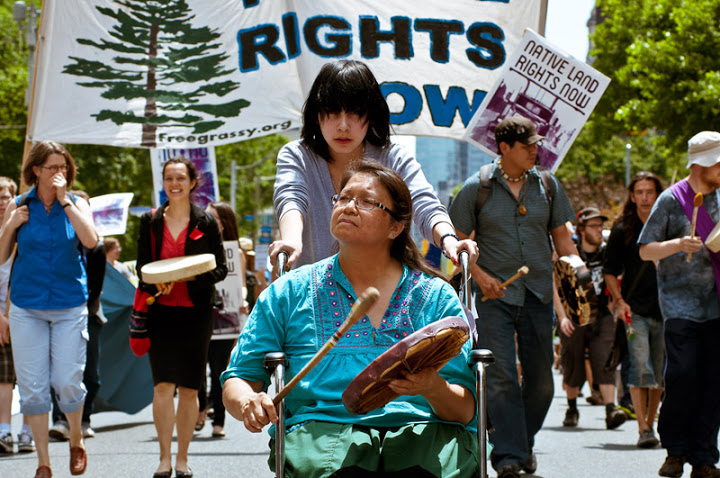
Thursday, over a thousand people, led by Grassy Narrows teenagers, marched through Toronto, demanding justice. Judy Da Silva was among them, having returned from Geneva where she made a case before the United Nations, arguing Canada had violated the Grassy Narrows First Nation’s right to access to clean water. Back in Toronto, Da Silva is of two minds. On one hand, “We are not valuable enough to be considered. We, as Indigenous people, are expendable. And that’s why the poison is allowed to be still in the river. Money is more important than us.” On the other hand, “I always gotta be hopeful. I can’t be a victim. I gotta be a powerful person.”

In the end, “the bottom line is the river has to be cleaned up.” Judy Da Silva joined the women, elders, teenagers, and everyone in the Grassy Narrows First Nation to say: “No more fancy words, no more studies”. They say NO to the murderous racist devaluation of their lives. They say the time is NOW.

(Photo Credit: Legal Defense Fund for Judy Da Silva)

South Carolina built a special hell for those living with mental illness: prison

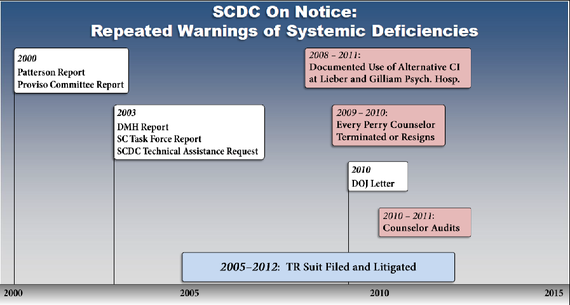
South Carolina’s prisons and jails are overcrowded, under-resourced, and toxic. People, like Joyce Curnell, regularly die in agony, begging for help. Jails are fatally overcrowded. For example, the Pickens County Jail, built for maximum 91 prisoners, currently holds close to 200. South Carolina’s prisons and jails are bad, but for those living with mental illness, the prisons and jails are absolutely infernal. They are described as negligent, outrageous, abusive, where cruel becomes usual, appalling and worse. People living with mental illness spend years in solitary confinement, engaging in self-harm, and scores have died in agony, begging for help. Finally, after twelve years of struggle, this might just change, thanks to prisoners themselves and to Protection and Advocacy for People Living with Disability.

In 2002, Protection and Advocacy and the Death Penalty Resources Center approached a prominent South Carolina law firm and asked for help concerning the systemic abuse of prisoners living with mental illnesses. The lawyers took on the case. In 2005, three inmates – T.R., P.R. and K.W. – and Protection and Advocacy sued the South Carolina Department of Corrections and its director, William R. Byars, Jr. They laid out a horror story of abuse, neglect, mayhem, torture, pain, suffering, and death. The details were horrifying as was the scale. In 2012, the case went to trial. In 2014, Judge Michael Baxley ruled decisively against the State. He opened his remarks noting, “It has been the privilege of this writer to serve the State of South Carolina as a general jurisdiction judge for fourteen years. At the time this case was heard, Court Administration reported there were more than 5,000 new case filings per year for each of our state’s circuit court judges. Thus, over 70,000 cases of every imaginable sort have come to this Court over the years. This case, far above all others, is the most troubling … The evidence in this case has proved that inmates have died in the South Carolina Department of Corrections for lack of basic mental health care, and hundreds more remain substantially at risk for serious physical injury, mental decompensation, and profound, permanent mental illness.”

Judge Baxley handed down his decision January 2014. South Carolina immediately leapt to the defense of its clearly abusive and troubling treatment of those living with mental illness. Meanwhile, self injury and harm continued unabated. A year later, in January 2015, an agreement between the parties was reported, but that proved not to be the case. Finally, this week, a final agreement – with real goals, timelines, independent checks and assessments, and a budget – was signed.

South Carolina built a special hell for those living with mental illnesses. Its ratio of mentally ill in prison or jail to mentally ill in hospital is 5.1 to 1, one of the worst in the country. South Carolina is near the bottom of state rankings when it comes to “availability of public psychiatric beds, efforts to divert mentally ill individuals, per capita state mental health expenditures, and almost every other measure of treatment for mentally ill individuals.” Furthermore, when it comes to investing in prisoner healthcare, it’s the second worst state in the country. Only Oklahoma is worse.

For decades South Carolina has tortured people living with mental illnesses. It was State public policy, everyone knew. Everyone knew that seriously mentally ill people were sent to solitary more than others, and everyone knew that they stayed in solitary for much longer. Judge Baxley wrote repeatedly that the State was aware of what was happening under and within its administration. This torture was public knowledge, and so the question lingers, “What is that public?” Why does it take spectacular deaths for us to acknowledge the torture we already knows? Why does it take heroic struggles that last for years for us to say that we cannot torture people because they live with mental illnesses? Who are we who know and then turn away? Who are we? This case, far above all others, is the most troubling.


(Image Credit: The Atlantic)

Chadian women win a victory for women everywhere!


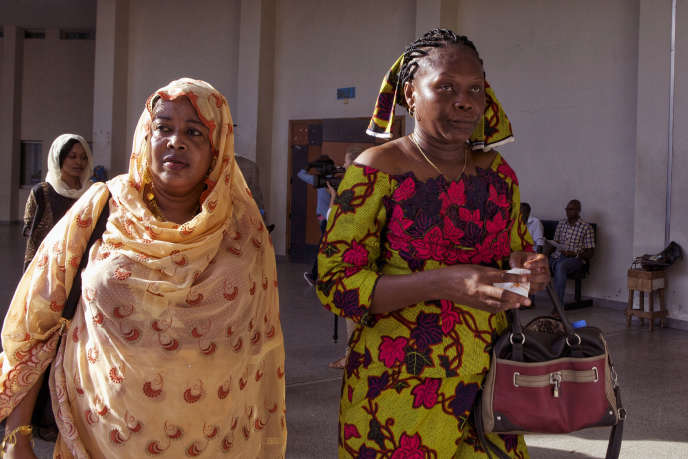
On May 30, 2016, after Chief Judge Gberdao Gustave Kam, of the Extraordinary African Chambers, read the decision against former Chadian despot Hissène Habré, there was momentary silence, and then all heaven broke loose: “After Kam delivered the verdict, it took a minute for the full weight of it to sink in. Then a quiet ululation went up from the victims’ benches. It was the widows, a row of brightly dressed women who had travelled from Chad to see what would happen to the man responsible for the deaths of their husbands. They stood and threw pieces of black cloth on the floor. After decades of waiting, they could finally celebrate. The courtroom erupted in cheers, and in weeping.” Jacqueline Moudeina and Delphine Djiraibé “clung to each other in relief.” Khadidja Hassan Zidane, Kaltouma Deffalah, Haoua Brahim, and Hadje Mérami Ali had broken decades of silence to report on the systemic and brutal sexual violence committed directly by Habré as well as his forces. From beginning to end, this is a story of women organizing, persevering and never giving up. Hissène Habré was brought to justice because women refused to accept injustice.

Habré ruled Chad from 1982 to 1990. When his reign of terror ended, people set to demanding justice instantly. Delphine Djiraibé returned from exile in 1990, and seeing the situation, founded the l’Association tchadienne pour la promotion et la défense des droits de l’homme, the Chadian Association for the Promotion and Defense of Human Rights, which she presided over until 2003. Jacqueline Moudeina returned from exile in 1995 and immediately set to work with Delphine Djiraibé. In 2004, Moudeina became President of the Association, and is to this day. The two set their eyes on the prize, and kept it there steadily for twenty six years, and that prize is more than one man. The prize is justice.

Moudeina and Djiraibé involved Human Rights Watch and others to do both research and to advise on legal matters. They joined with Souleymane Guengueng, founder of l’Association des victimes des crimes et répressions politiques au Tchad, the Association of Victims of Political Crimes and Repression in Chad, and Clément Abaïfouta, who took over when Guengueng had to flee. Then they set to work. In 2000, representing seven Chadian women, Modeina filed the first human rights complaint against Habré. The next year, Moudeina was almost killed by a hand grenade assault, which sent her to France for a year for medical care and from which she still suffers pain, fifteen years later: “The grenade became a challenge for me, to live and continue the legal work, and so I did.”

For many, the turning point of the trial was the testimony of four courageous women who gave direct witness to the sexual violence and exploitation they had suffered. Khadidja Hassan Zidane described the violence Habré had committed directly against her, and the other three testified to what they had experienced and witnessed. Their testimony changed the tenor of the proceedings and added to the charges against the torturer. Where originally Habré was charged with torture and murder, in December sexual slavery and rape were added to the charges. As lain Werner, director of Civitas Maxima, noted, “They were just women in the middle of the desert with soldiers, abused for a very, very long period of time. We fought very hard for the sexual violence to be brought back. Women suffered so much under Habré. It puts the whole sexual violence aspect back in the middle of the case, and it was very unexpected, to be candid.”

They were just women, women who suffered so much, and women who day by day year by year refused anything other than justice. The lawyers, the witnesses, the widows burst into weeping, cheers, embraces and applause, as should we all.

Haoua Brahim, on the left, leaving court in September

(Photo Credit 1: Coalition for the ICC / Twitter / Ruth Maclean) (Photo Credit 2: Le Monde / AP / Jane Hahn)

Immemorial Day and the unbroken surface of the Mediterranean

“Fear not suffering’s gravity.
Return to earth its weighty share;
heavy are its mountains, heavy the sea.”
Rainer Maria Rilke, Sonnets to Orpheus

Last week at least 700 people – refugees and asylum seekers – drowned in the Mediterranean. That raises this year’s known death toll to 2000. Italy plans to build a cemetery, a memorial of sorts, to those who die at sea. It would be located next the remains of the country’s largest fascist concentration camp. While the cemetery is the least Italy, or any country, can do, that cemetery is not a “final resting place”. There is no final resting place for those refugees and asylum seekers. This weekend is filled with images of cemeteries and those who come to the cemeteries: families, dignitaries, people. But there is no picture of the surface of the Mediterranean, and there should be. As we stare at the photographs of cemeteries, we should be made to stare at the unbroken surface of the Mediterranean. We should remember all who have perished in the name of war.

One day, impossibly, we will come to the water’s edge and grasp one another’s hands. We will encircle the Mediterranean and we will say the names of every child, woman, and man who drowned in the heavy sea while trying to find haven. Amen.

(Photo Credit: Europe Now)

Hong Kong and Singapore face a day without Indonesian domestic workers

Earlier this month, Indonesia’s President Joko Widodo, commonly referred to as Jokowi, started quite a stir, especially in the Middle East and East Asia, when he announced plans to limit and then stop the migration of live-in domestic workers. The President argued that much of the abuse of young Indonesian women stemmed from their working in informal, unregulated sectors, and that that has to stop. Indonesia wants those who work as domestic workers overseas to live in their own quarters, to work regular hours, and to enjoy one day off each week and public holidays. This is big news, on a scale of Los Angeles imagining a day without Mexicans.

Indonesia provides Singapore with most of its domestic workers. Currently 125,000 Indonesian women work as domestic workers in Singapore, the overwhelming majority as live-in. 50,000 Indonesian women work as domestic workers in Malaysia, and 150,000 work in Hong Kong. According to the Indonesian government, of the more than 7 million Indonesians working abroad, 60% are domestic workers. That’s over 4.2 million women, a lot of women and a lot of money.

Not surprisingly, employers in the receiving nations are `lukewarm’. Indonesian women workers’ groups argue that the solution to the problem of abuse of domestic workers overseas is for the State to actually protect them, rather than cut off their freedom of movement. While the President talks of national shame and dignity, women workers’ groups argue for decent work and more protections.

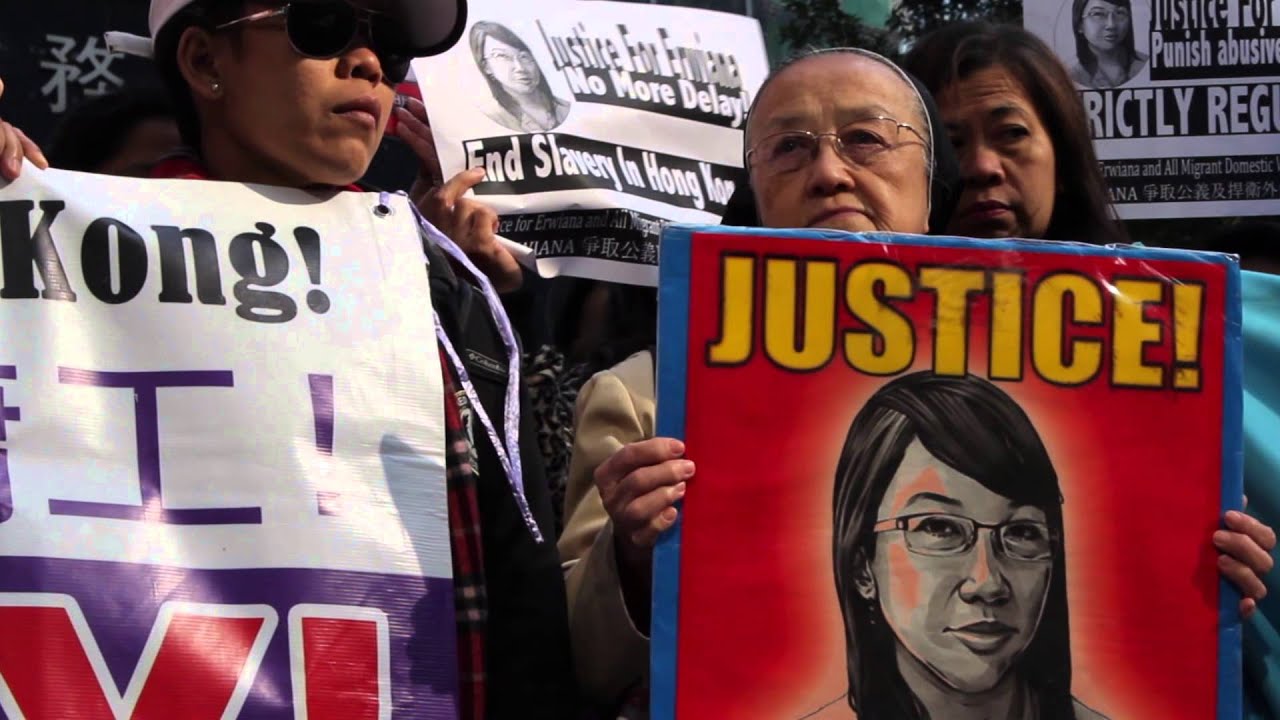
Where everyone is in agreement is that abuse of Indonesian, and other transnational, domestic workers is rampant. The case of Erwiana Sulistyaningsih, two years ago, sparked more than mass mobilizations. Erwiana Sulistyaningsih had gone to Hong Kong to work so as to be able to attend university. After eight months of torture, she was dumped at the airport and sent back to Indonesia. The sight of her damaged body sparked outrage. Two years later, she says, “I still have problems breathing. I cannot go swimming because I cannot get water into my ears. And I still have the scars. I need to see the doctor from time to time.”

The abuse of domestic workers is as old as domestic work itself, as is the work of organizing among domestic workers. What’s new is the transnational. That has meant, on one hand, that domestic workers, especially live-in domestic workers, are radically, viciously isolated, often with no place to go. In many countries, that lack of place is codified by labor and migration laws. These women are beaten by their bosses and trapped by State policy. Additionally, it takes money to travel, obtain visas and work permits, and to find employment. That means overseas domestic workers necessarily incur large debts. They are trapped in indebtedness. They are beaten by the bosses and trapped by international fiscal and monetary policy.

The domestic workers of this not-so-new neoliberal world order engage in domestic work largely because they want to use the money for the future, and the jobs available at home are too few and too low paying. For the past decades, this scam has been run to the fill the coffers of the sending nation-States, through remittances, and of the receiving nation-States, by subsidizing the entire care industry. People in Hong Kong are wondering who will pay for childcare, eldercare, home health care and so much more if the Indonesians really do vanish and, even more, if the Philippines national government follows suit? From Hong Kong to Singapore and beyond, people really are beginning to imagine a day without Indonesians.

Around the world, women domestic workers are organizing. They’re pushing for Domestic Workers’ Bills of Rights in the United States and in Kuwait. They’re organizing domestic workers’ unions in Jordan and Lebanon. They’re mobilizing everywhere. Most South American countries have ratified the ILO Convention Concerning Decent Work for Domestic Workers. In South Africa, Namibia, Zimbabwe and Tanzania domestic workers’ unions are on the move. The time to end the super-exploitation of domestic workers occurred decades, centuries, ago, but now is the time to support their efforts to end the global household plantation system. This is the story of women breaking the chains, locally and globally, of bondage, old and new, and seizing and creating power for themselves, collectively, in the name of women’s dignity. My name is Erwiana Sulistyaningsih, and I am unafraid. Justice for all!


(Photo and Video Credit: You Tube)