For Mother’s Day, Make a Loud Noise

Sunday is Mother’s Day. Mother’s Day is, not surprisingly, a painfully emotional day for women in prison. Remember, women are the fastest growing prison population. And so … how do we celebrate Mother’s Day?

In Raleigh, North Carolina, the Internationalist Prison Book Collective is organizing a Mother’s Day Anti-Prison Noise Demonstration: “We’ll be breaking the isolation and monotony of the women in the Raleigh Correctional Center for Women and the North Carolina Correctional Institution for Women (a minimum-security prison next door to RCCW). Together these two prisons have almost 1,500 women, almost all of them mothers. RCCW is the state’s largest prison with 1,288 women including women’s death row.”

Women in prison receive far fewer visitors, especially from their children, than do their male counterparts. The isolation of women prisoners, and of prisoners who are mothers in particular, is intensified by monopolistic and predatory rates for phone calls that make phone calls for more than 65,000 incarcerated mothers prohibitively expensive. “Prohibitively expensive” means impossible. Mother’s Day is just another form of punishment for those women.

But it doesn’t have to be. On the one hand, there are actions of engagement and solidarity, such as those in Raleigh. On the other hand, there are policies and programs. In Brooklyn, New York, District Attorney Charles Hynes has joined with the Women’s Prison Association to create an alternative, JusticeHome, that will allow mothers convicted of felonies a chance to stay home while they serve their time.

The program begins and ends by acknowledging the centrality of context. Women take responsibility for their actions and for their lives. The State takes responsibility as well. The children, who bear no responsibility in this drama and yet somehow have paid the price in the increased incarceration of women, and especially of women of color, are allowed to continue to grow and thrive. It’s an experiment … an experiment in justice.

So, this Mother’s Day, make a joyful noise. Make a joyful noise, all the earth; make a loud noise, and rejoice. Make a loud noise, and make it heard.


(Image Credit: Kelsey Dake / New York Times)
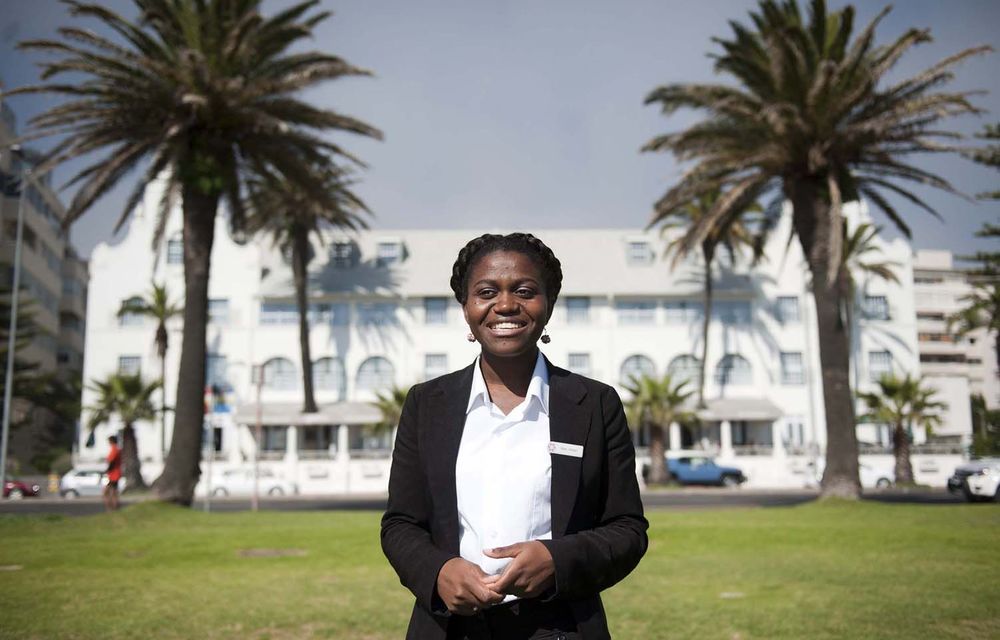
Welcome Irene Kainda as a neighbor, not as a stranger

Irene Kainda

What are the borders of being-a-refugee? When does one stop being a stranger and become simply a neighbor? Irene Kainda wants to know.

Irene Kainda is 21 years old. She lives in Cape Town. She has lived in Cape Town continuously since 1998. She used to live with her mother and her brother, Felipe, who is two years younger than Irene. In 2006, Irene and Felipe’s mother abandoned them. The two children spent three years in a homeless shelter, and then were taken in by some good people. Now Irene is in college and so is her brother, thanks to Irene’s hard work. In many ways, this is, or could be, a tale of great promise, a tale of a young woman who keeps on keeping on.

Irene and Felipe came to South Africa as refugees, and there’s the rub. The civil war in Angola is officially at an end, and the situation is both improved and improving: “Angola is a nation of bright minds, brilliant writers, exceptional musicians, and a civil society that, almost 11 years after war’s end, is ready to have its voice heard.” Of course, there’s much room for improvement, but that’s true everywhere.

Recently, the South African government decided to `encourage’ Angolan refugees to return `home’. The `invitation’ to `apply for repatriation’ is universal. Everyone has to `apply’. Hundreds of thousands of people, call them Angolans who have sought refugee status, live in South Africa. Many of them have lived there for twenty years. For many of them, South Africa is the only home they really know. Irene Kainda notes, “I came to South Africa when I was seven. I don’t remember Angola, I don’t know where I am from and who or where my family there is.”

What are the borders of being-a-refugee, and how does gender inflect those borders? Women and girl refugees haunt the world. According to the most recent UNHCR Global Trends Report, at the end of 2011, 42.5 million people were displaced. Of them, 15.2 million were refugees. Women and girls made up 49 per cent of persons “of concern to UNHCR.” According to the UNHCR, 48 percent of refugees are women and girls. Further, “in 2011, UNHCR submitted some 92,000 refugees for resettlement. Ten per cent of all submissions were for women and girls at risk, the highest percentage of the last six years.” The next UNHCR report comes out in a month.

The civil war in Angola saw massive, programmatic and widely acknowledged violence against women and girls, and yet the processes and structures concerning demobilization altogether avoided women and girls as a distinct group. Thus, no resources were dedicated to their specific needs. And now it looks like South Africa’s Department of Home Affairs will do the same, avoid any recognition of the specific situations of Angolan-born women and girls living in South Africa.

Meanwhile, more than one study has noted that xenophobia is the dark side of the new supposedly democratic South Africa: “Intolerance is extremely pervasive and growing in intensity and seriousness. Abuse of migrants and refugees has intensified and there is little support for the idea of migrant rights.” Sometimes the abuse was directed specifically at Angolan refugees in Cape Town: “The City of Cape Town, like many other cities, has seen a number of xenophobic attacks on foreigners…The most well-publicised conflicts have been those in Danoon, Doornbach in 2001 and in Joe Slovo Park in 2002. Perhaps the most publicised incident was in Joe Slovo Park, where four people were killed in clashes between Angolan refugees and South Africans.”

Irene Kainda is an Angolan-born young woman who has lived and grown up, and raised her younger brother, in Cape Town in a very particular historical period. She has labored through abandonment, homelessness, xenophobia, violence against women, and more. At every step of the way, she was supposed to fail, and take her younger brother down with her. Instead, she succeeded, and took her younger brother up with her. And her reward, if the South African government has its way, is to be shipped to a `homeland’ she doesn’t know?

That cannot be. The State cannot punish Irene Kainda who has spent almost all her life engaged in Cape Town in performing the labor of survival with dignity, hope, and humor. Rather than deport Irene Kainda, reform the State. Institute a statute of limitations on being-a-refugee. Take responsibility for being a haven. Stop treating Irene Kainda as a stranger and welcome her as a neighbor.

(Photo Credit:Mail & Guardian)

Love thy neighbour (or not)

Love thy neighbour (or not)

Love thy neighbour (or not)
Zambia’s vice-president
sheds his load about us
we who are the bees-knees
(or so we too oft imagine)

Love thy neighbour (or not)
right next door to you
here partners keep killing
the women in their lives

(where fire, rain and global warming
put our poor at risk first)

Children too at risk
in the early grades
reading not fostered
too few reading books
in classes and even
fewer school libraries

Backward we are
so much trouble
we have caused
in this southern neck
(we now the new imperialists
the old wolf dressed up
in democracy’s clothing)

Not yet decolonized
we think we are special
effortlessly emulating
our previously-advantaged elites
at the sushi-feeding trough

Love thy neighbour (or not)
turn your other cheeks
in the name of Africa
and that elusive African unity
(patriotic hand on your own)

Love thy neighbour (or not)
you watch behind your back
and we’ll look after those
who scratch ours

“Teachers not fostering reading in the early grades” and “Partners keep killing women in their lives”. And we hear that ‘South Africans are backward’ (all in the Argus, May 3 2013).


La torture dans tous ces Etats américains

Dans la même semaine la torture a été à l’honneur deux fois aux Etats Unis. Tout d’abord Asa Hutchinson, un ancien représentant républicain au Congrès, ancien sous-secrétaire d’Etat  au département de la sécurité intérieure sous le gouvernement George W. Bush, et un des deux rapporteurs de la commission d’étude sur le traitement des détenus après le 11 Septembre, a présenté à la presse le rapport qui conclu officiellement que les Etats Unis, sous la présidence de G W Bush, ont pratiqué la torture pour interroger ses prisonniers après les attentats du 11septembre.

Il a déclare : “We found that U.S. personnel, in many instances, used interrogation techniques on detainees that constitute torture. American personnel conducted an even larger number of interrogations that involved cruel, inhumane or degrading treatment. Both categories of actions violate U.S. laws and international treaty obligations.”

« Nous avons constaté que le personnel américain, dans de nombreux cas, a utilisé des techniques d’interrogation des détenus qui constituent une torture. Le personnel américain a mené un plus grand nombre d’interrogations qui ont impliqué un traitement cruel, inhumain ou dégradant. Les deux catégories d’actions violent les lois américaines et les obligations des traités internationaux. »

Parallèlement, la chambre de l’Etat du Maryland (un Etat mitoyen de Washington) a refusé d’examiner en dernière partie de session pour l’année 2013 une loi qui aurait interdit d’entraver les femmes enceintes emprisonnées dans le Maryland durant les deux derniers semestres et l’accouchement. Les autorités pénitentiaires assurent que cette loi n’est pas utile puisque les femmes ne seraient attachées qu’en cas de nécessité.

Les associations de défenses des femmes prisonnières, telle que Power Inside, ont fourni des témoignages accablants démontrant que les femmes étaient très souvent entravées. Cela laisse à penser que les cas de nécessité sont donc fondés sur des paramètres qui ne respectent en rien la dignité de ces femmes.

Quelques données nous permettent de comprendre que les standards d’humanité sont déplacés. Un tiers des femmes emprisonnées dans le monde le sont aux Etats Unis. Dans trente deux Etats il est légal d’enchainer ou de menotter des femmes enceintes y compris lors de l’accouchement. Les mères font parties de la population carcérale dont le nombre augmente le plus rapidement. Bien souvent, on emprisonne les femmes avant leur procès, par exemple, dans le Maryland, à Baltimore 90% des femmes incarcérées, dont 79% sont noires, attendent d’être jugées. De plus la grande majorité des femmes sont envoyées en prison pour des crimes non-violents.

La loi actuelle dit que dans le Maryland les menottes, les entraves ou chaines pour les jambes et le ventre peuvent être utilisées pour maitriser/contrôler les femmes enceintes pendant le transport, le travail, l’accouchement et les suites d’accouchement.

Les témoignages sont là, Angela a eu les mains et pieds attachés pendant son transport a l’hôpital et une grande partie du travail et ce n’est que sur l’insistance du docteur qu’elle a accouche sans chaine, de même Danielle raconte son accouchement attachée et humiliée avec plusieurs voyages a l’hôpital toujours avec des entraves aux chevilles et aux mains.

Il nous faut reconsidérer ce que torture veut dire. Avons nous besoin de lois internationales pour imposer aux Etats Unis de traiter les femmes enceintes incarcérées avec respect. La grossesse constitue un grand moment de vulnérabilité pour les femmes défavorisées en général. De plus les lois sont aussi punitives que les aides sociales manquent gravement et que la précarité augmente.

Déjà en 2010 le rapport sur le respect par les Etats-Unis de ses obligations en matière de droits de l’homme dans le domaine de la santé reproductive et sexuelle remis pour revue aux Nations Unis, faisait état de la torture quotidienne infligée aux femmes les plus vulnérables.

Malgré tout, dans le Maryland la loi qui aurait protégé les femmes enceintes emprisonnées est restée sans suite.


(Photo Credit: Mark Humphrey / Associated Press / New York Times)

Daughter of darkness

Germane a ‘Poona girl” travelled many a path to find the one she sought –relevance. From joining the mission of healing with the Medical Mission Sisters, to moving out of their institutions to work with a Jesuit missionary in the Santhal Adivasi homeland, to moving further out into the forest of Hazaribagh in Jharkhand where she finally settled to work and be one with them in revered relevance.

In the twenty odd years we knew each other we could meet on not more than three or four occasions. Yet I remember well that we never exchanged more than a few dozen words. But she conveyed enough for me to know her more deeply than she probably guessed.

Stubbornly determined she stuck deep there to serve a people being dispossessed and pauperised by the outside world. To empower them she built a school, a boarding, a chain of health clinics and microcredit groups for women.

Silly enough to risk her own health needs that finally shortened her precious life she died on 5th April 08. At her funeral as I stood in that deep forest experiencing such glory such bonding and such blindness of the religion of my birth, I just could not help penning these feelings on the blackboard of my mind. I owe this to her – the one who may never be remembered in history (and I am sure couldn’t have cared less), but who went on to make it………

Daughter of darkness[i]

 Unseen she just wanted to be
Detached, silent, from us –her we
In search of love
She went aground
And grew a tree with fruits of love

No trumpets, no fuss, no flatter
A messenger minus the clatter
Their being, was all she lived to be.
Their flesh, their word, their humanity
Enliven with her humble humility
One with them in their eternity

For Sarhul[ii], she called us all.
“Come, Come ye all”
“Partake of the Mahua[iii] fall”
“Spring has come and so has my call

Covered by a dense crowd
There she hid
Peeping though heaps of shroud[iv]
A teasing wink, yellow turmeric paste,
Her beautiful brown face
Was all she bared in that haste

And then they came en masse
To rescue her back, after mass
A mass, so genuine and germane
From the concluded ritual profane
One people, one body, hoisted her
It just couldn’t be any grander
Such attention she once detested
Now in slumber she just couldn’t resist it
Yelling multitudes marched in rounds
Drummers, trumpeters around the grounds

No Saints go marching here
No heaven’s inn to get in
No burning hell too to fear
As saintly women anointed her
To be their new ancestor

Xavier Dias 6th April 2008


[i] The Adivasis of Jharkhand have been an unacknowledged people and kept in the darkness of any human rights.

[ii] The Santhal festival of spring

[iii] A beautiful spring flower of the Mahua tree a staple food as well as used to make alcohol.

[iv] The number of shrouds people brought to cover her on her final journey was overwhelming


Real Food, Real Jobs, Real Women of Color, Real Workers, Real Hope

In mid-March of this year, a dining hall worker at The George Washington University in Washington, DC named Rochelle Kelly was fired.  Rochelle has worked in the GW dining hall, J Street, for over twenty-seven years.

Why was Rochelle fired?  She had to take time off to care for her husband, who had a stroke.  Then, Rochelle had a heart attack, and took more time off.  This time off is perfectly legal.  The general manager at J Street fired Rochelle anyway, breaking both the law and any sense of common decency.

Rochelle is a recognizable face at J Street and in the university community at large.  She is a leader in the dining worker union, and is friends with many people that frequent the dining hall.  Students, faculty, and others at GW noticed her absence immediately.

GW contracts its dining services to a multinational corporation named Sodexo.  While the workers at J Street face firings, decreasing wages, and disrespect from management, Sodexo makes millions off its contract with the university, and hundreds of millions more worldwide.  Sodexo is a company known for workers’ rights abuses, especially against Black women.  J Street employees are mostly people of color (Rochelle is Black) and Sodexo management is mostly white (like the general manager who fired Rochelle).

Because Rochelle does not currently work for Sodexo, she cannot claim any benefits provided by the company.  She must now work to find ways to pay for health care, food, and other necessities.  Sodexo and GW exploit Rochelle’s extra work—whether it’s care work for her husband or for herself—in order to increase corporate profits, like so many others in debt at the university.  The complete devaluation of the time needed for Rochelle’s care work mirrors the historical devaluation of Black women’s care work in the United States.

But Rochelle’s situation is not only one of misery.  It is also one of hope.  Along with other workers, students, faculty, and community supporters, Rochelle is organizing to get her job back, and to increase the power of dining workers at GW and across Washington, DC.  Over four hundred supporters signed letters to Sodexo, students and workers did a delegation to the general manager’s office, and dining workers at another one of GW’s campuses voted to unionize.

That’s just the beginning.  Women are leading, organizing, teaching, and working to build a better world.  They are doing that through local, national, and global struggles, like the Real Food, Real Jobs campaign.  They are joined by students, workers, and all others who work for a just world.

If you would like to join in solidarity with Rochelle and other food workers, please visit UNITE HERE Local 23’s website and sign their Real Food, Real Jobs pledge here.  If you would like to get involved in the campaign at GW, contact the GW Progressive Student Union at gwprogress@gmail.com.  To leave a message to the Sodexo general manager at J Street, contact Bernadette Thomas at bernadette.thomas@sodexo.com

(Photo Credit: Real Food Real Jobs / Facebook)

La Palabra: In DC, women of color resist school closures


Public school closures are sweeping the nation, devastating cities like New York, Philadelphia, Chicago, and our home of Washington, D.C. Since 2008 DCPS has closed 29 schools, and Mayor Vince Gray and Chancellor Kaya Henderson recently announced plans to close up to 20 more schools by the end of the 2013 school year.

It’s a trend located in a larger shift toward privatization in education and elsewhere—a move that threatens democratic access to vital social resources.

It’s also a racist trend: overwhelmingly, families of color are affected. With just the most recent wave of closures in DC, of the 3,800 students who will be displaced by closures, only 36 are white. Of those students, 80% are low income.

In DC, activists are fighting the closures—in the courts, and on the streets. La Palabra, an internet radio project broadcast on WPFW’s Latino Media Collective, is interviewing people at the schools slated to be closed. They have interviewed grandparents, parents, and other caregivers affected by the closures and the response is unanimous: Mayor Gray, Chancellor Kaya Henderson, you CAN NOT have my school!

Since women are overwhelmingly the primary caregivers in families, women are the most burdened by these closures, after, of course, the students themselves. Some parents at Ferbee-Hope elementary school have already survived multiple school closings. Mothers and grandmothers are worried about the impact on their kids lives, the safety of the new neighborhoods they’ll be in. They see a city government that cares more about paving the way for development than about their kids.

Children with disabilities will be especially hard hit by the displacement and disruption the closures entail. Their entire learning community will be relocated without their input, and the staff on which they depend will be forced to reapply for their job. Tamara, a mother at Sharpe Health (a school for special needs kids), observes that the mayor and chancellor “don’t care about the emotional stability, the physical stability of our children.”

But mothers in DC care, and La Palabra is listening—parents are ready to act and block the closures! Support their voices with yours by signing Empower DC’s petition calling on an immediate moratorium on public school closures.

La Palabra, http://lapalabradc.tumblr.com/. Beck Levy,  beck@astropressdc.com


(Photo Credit: http://lapalabradc.tumblr.com)

Want to raise the GDP? Set the women prisoners free

Booz & Co, now known as Strategy&. recently released a report, “Empowering the Third Billion: Women and the World of Work in 2012.” The Third Billion is women. According to the company website, the Third Billion was `born’ in 2010, when the corporate business world `discovered’ women.

On one hand, the report is welcome. It shows that if government and business acted with even a modicum of common sense, women could enter more fully and fulsomely, and most importantly equally, into labor markets. The kicker is that women’s engagement would necessarily raise national GDP’s, and quickly. The United States would rise by 5%, Egypt by 34%.

Other `discoveries’ include women’s greater involvement in care work prevents them from `productive’ activities. If care work were more evenly shared between and among genders, GDP would rise. If care workers were paid actual living wages, GDP would rise as well, but that’s not in the report.

Here’s something else that’s not in the report. Prison. In particular, the section on the United States forgets to mention that for the last few decades, women have been the fastest growing prison population in the country. The report talks at length about “female talent”, “workforce and entrepreneurial landscapes”, and “family responsibilities.” It suggests the importance of both government and the private sector finding ways to “boost women’s entrepreneurship”. One way would be to stop sending so many women to prison. Another way would be to release, immediately, something like 90% of the women behind bars. Most of them are in for minor, non-violent infractions. In fact, most are in prison precisely because of their entrepreneurial talents and the ways in which the real markets are structured against them.

So, if you really want to `empower’ the U.S. portion of the “Third Billion”, Mr. President, Mr. State Governor, Mr. Mayor, Mr. Corporate Executive (and yes, in the United States, most are still Mr.), tear down these walls.


(Photo Credit: Prison Photography / Fabio Cuttica)

Ask Peninah Mwangi about the PEPFAR pledge

Faced with violence against sex workers in Kenya, Peninah Mwangi noted, “The death of a sex worker is the death of a woman, a mother, a sister, a Kenyan.”  Mwangi should know.

Peninah Mwangi is the Executive Director of the Bar Hostess Empowerment and Support Programme, BHESP, located in Nairobi, Kenya. BHESP organizes, advocates, and empowers sex workers. Before the recent elections, BHESP organized `awareness campaigns’ with bar hostesses and their customers, to make sure that everyone voted, that no one missed voting due to drunkenness. It was a critical citizenship participatory popular education program run from one bar, and one barstool, to the next.

BHESP has marched and lobbied for decriminalization and legalization of sex work. They have marched and lobbied to end police violence against sex workers. At the same time, they have established drop-in centers, legal services, hotlines and havens. The Bar Hostess Empowerment and Support Programme have improved and saved women’s lives in Kenya, and are a model for the rest of the world.

They are supported by Pathfinder International, the Open Society Foundations; the Global Fund to Fight AIDS, Tuberculosis and Malaria. Almost every major organization that matters admires and supports the great, innovative and urgent work that BHESP provides. The large exception, the elephant-in-the-room exception, to this is PEPFAR, the US President’s Emergency Plan for AIDS Relief. Why? Because Peninah Mwangi and her colleagues won’t take the `anti-prostitution pledge.’ Apparently sex work is a far greater `emergency’ than AIDS.

Today, the U.S. Supreme Court is hearing a case in which opponents to the `pledge’ argue that the `pledge’ violates first amendment rights and impairs attempts to improve the working conditions of sex workers. Proponents claim the `pledge’ rescues women from trafficking and worse.

Behind, or obscured by, the legal debate are the sex workers themselves. On one hand, researcher after researcher has noted that the PEPFAR pledge harms any campaigns or programs among sex workers to reduce and eradicate HIV and AIDS. Criminalization of sex work increases risk factors for AIDS among sex workers. Transnational and global criminalization of sex work widens the pool of those increasingly at risk into a global ocean. As some have noted, it’s a dark ripple effect, which keeps on spreading.

Here’s one example of the impact of the `pledge’: “As a result of the pledge, in many instances information sharing about successful programming with sex workers has nearly ceased. Sex work programming has become a taboo topic; organizations that receive other funding are likely to be interested in or to seek US government contracts and funds. Others with specific missions have reigned in all activities unrelated or tangentially related to their missions; this has affected many sex work projects the world over. The anti-prostitution pledge has prevented the sharing of information about successful programming and prevented scaling up successful operations.”

Prevented the sharing of information. Silence. Equals. Death. The death of a sex worker is the death of a woman, a mother, a sister, a `fellow citizen’, a human being. Ask Peninah Mwangi. She should know.


(Video Credit: Josephine Nekesa Were / YouTube.com)

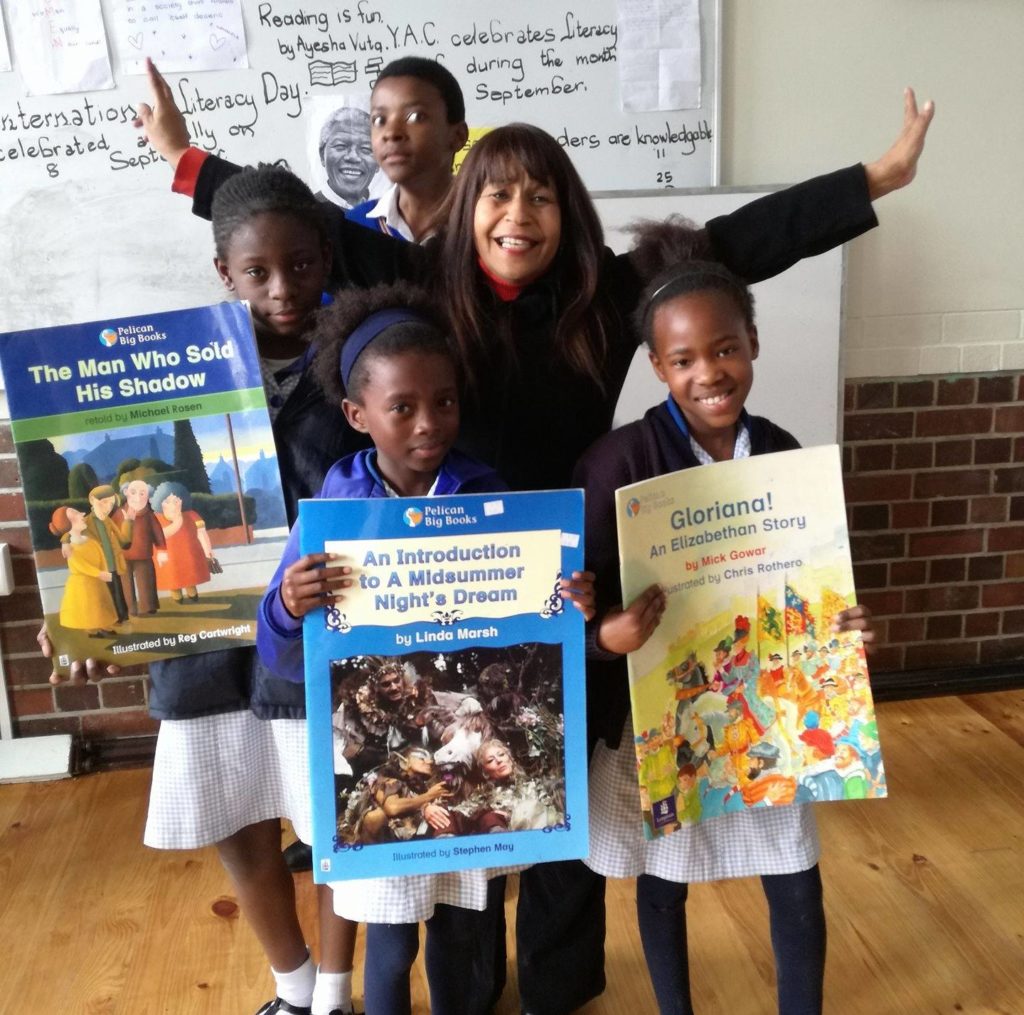
It’s in the genes

Brenda Rhode and the Young Authors’ Club

It’s in the genes

It’s in the genes
we hear of youngsters
crazy about books
and reading too

It’s in the genes
and not their jeans
I must add as I have
my mother’s English
tea-drinking habits

Crazy about books
and reading too
like their parents
and their parents before

(might we lionize them
rather than those
who tyrannized nations
colonized people
and played apartheid sport)

It’s in the genes
and not their jeans
or trousers, if anyone
still uses that word

(Did they honour
World Read Aloud Day
by reading up a tree)

Crazy about books
and not shiny objects
and brand labels

It’s in the genes
crazy about books
and reading too

Aren’t you

A social media tale (or “chronicle”) courtesy of Brenda Rhode – she of Young Authors Club fame and fortune – gets my chromosomes going, sometime Tuesday 17 April 2013.

David Kapp

(Photo Credit:  Young Authors’ Club / Facebook)