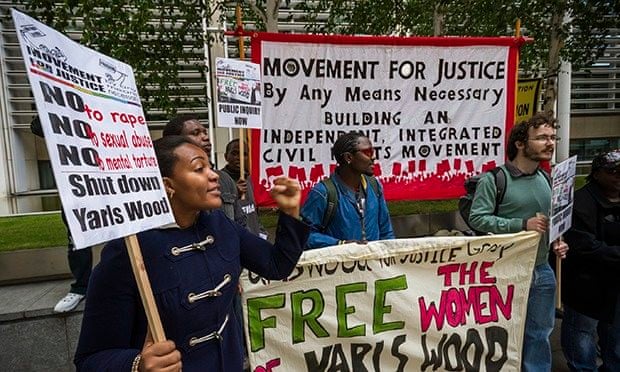
What happens in immigration detention stays in immigration detention

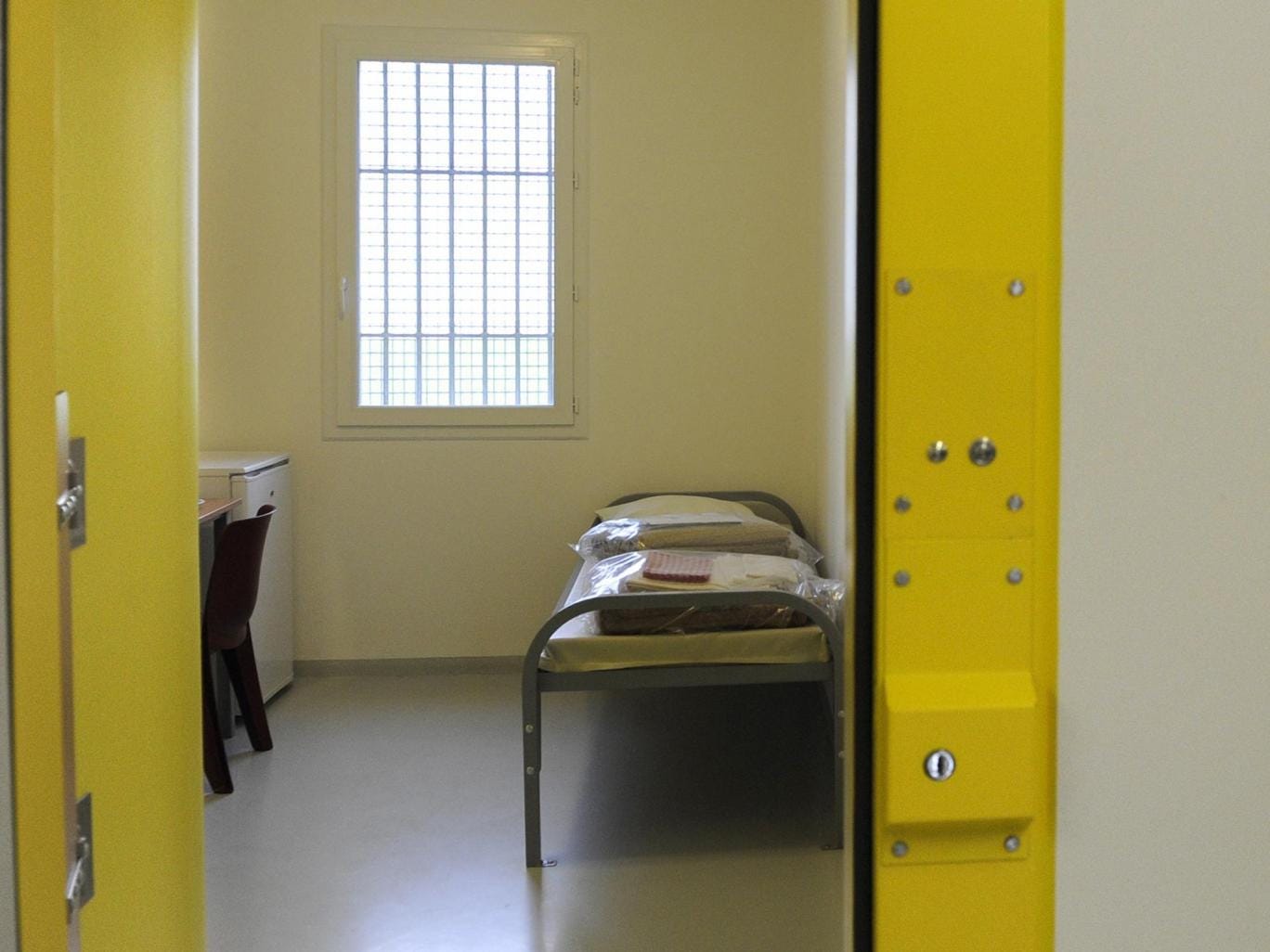
This is a story of whistleblowers in the land where there are no whistles and ears are forbidden. That land is called “immigration detention”. In different places, it goes by different names. Yarl’s Wood in England. Centro de Internamiento de Extranjeros, or CIE, in Spain. The names change, but the structures and situations are the same. “Immigration detention” is a country, and it’s global.

In September, there was yet another story about systematic sexual predation at Yarl’s Wood. This time it was Tanja’s story, an account that only made it to the public because of the tenacity, perseverance and creativity of Tanja, who just kept on pushing. Yarl’s Wood is a designed community in which staff preys upon the most vulnerable, typically young women fleeing sexual violence. Remember, the Yarl’s Wood prison population is almost 90% women, while men make up almost half the staff. The police yet again said they would conduct an investigation. The real story here is the story of the story, the fact that Tanja could get the story out at all. And that story continues.

Since Tanja’s story broke, all hell has broken loose, and by hell is meant silence. First it was Sirah Jeng, a 59-year-old Gambian, who said she could corroborate Tanja’s story. Her reward? In November she was informed, with barely any notice, that she should get ready for imminent deportation … hours before her scheduled appointment with investigating police. That was November.

This month, Afolashade Lamidi, 40-year-old Nigerian, also confirmed parts of Tanja’s accounts, and then some. And she received the same treatment as Sirah Jeng. She was promised the opportunity of forced return to Nigeria.

This is in so many ways a common story. In Spain this month, Aramis Manukyan, known by his friends and now the world as Alik, was “found dead in his cell.” Alik was a 42-year-old Armenian, a father of a 7-year-old daughter. Found dead in his cell was immediately translated into suicide, despite various testimonies to the contrary. Prisoners reported from different floors that they could her Alik’s cries, but no matter. He committed suicide.

After much pressure from the usual suspects like SOS Racismo, Cerramos los CIE (Close the CIE) and Migra Studium, the police, yet again, say they would conduct an investigation. And that’s when the two key witnesses were deported.

For every Tanja and every Alik there are tens, hundreds, thousands of neighbors and friends, prisoners all. There are witnesses in prison, and they are not the kings or queens in the land of the blind. They are the witnesses in the land of the blinded. They are the whistleblowers in the land where whistles are prohibited and hearing is a crime. Remember, what happens in immigration detention stays, or dies, in immigration detention.


(Photo Credit: Guy Corbishley / Demotix / Corbis / The Guardian)

Women are Tunisia’s revolutionary guards


Three years ago, December 17, 2010, something happened in Tunisia: the Jasmine Revolution. Remember? On December 17, Mohammed Bouazizi, a street vendor, set himself on fire. It was a desperate act that lit the sky and the world. His act reflected a general sense of despair, and in that reflected despair, people saw transformative change as their only hope. Within 28 days, on January 11, 2011, President Zine El Abidine Ben Ali resigned.

From its first flicker, the Jasmine Revolution was more than the ouster of a dictator. It was an assault on patriarchy that emerged from decades of women and youth organizing. Three years later, it still is.

For Tunisia, the past three years have been “interesting,” and particularly for women. The government has seesawed repeatedly on its position vis-à-vis women’s rights, equality, and roles. The State and parts of Civil Society have colluded in trying to diminish the significance of women’s work and contributions. And women have pushed back.

When the Ben Ali regime was in its last days, the State unleashed its dogs. Women, especially those in poorer areas, were sexually harassed, assaulted, and raped by security forces.  Women pushed back, and helped push Ben Ali out.

Once the unity of the first phase of the Jasmine Revolution dissipated, fractures emerged. In the intervening three years, women have reported increased attacks on women ostensibly for their attire. In some instances, women were attacked for not wearing a veil or for wearing jeans; in other instances, women were attacked for wearing veils.

The policing of women’s bodies intensified until last year, when a young woman was raped by police officers. She took the officers to court, where she was charged with public indecency. Across much of Tunisia, women and men said, “We are not going back!” Women pushed back, and continue to do so.

Women are organizing. They’re running for office, training, mobilizing, and generally opening common spaces and freer zones. According to the Association Tunisienne des Femmes Démocrates, ATFD, a majority of women participating in revolutionary activities had suffered violence as women. This included secular feminists, such as those in the ATFD or the Association des Femmes Tunisiennes pour la Recherche sur le Développment; Ennahda women, especially those who had been imprisoned; the anti-heroic women youth insurgents who kept coming out into the streets and squares; women trade unionists and women homemakers; rural women and urban women; women who had extensive formal education and those who had been systematically denied access to education. Women.

And women are pushing back. They’re organizing tribunals to hear, publicize and respond to testimony on the forms of violence against women. There will be one taking place next week. Prominent women, such as Wided Bouchamaoui, Maya Jribi, Basma Khalfaoui, Salma Baccar, Amira Yahyaoui, Kalthoum Kennou, Leïla Ben Debba, Dalila Ben Mbarek, Mbarka Brahmi, Yamina Thabet, Néjiba Hamrouni, Amel Grami, Latifa Lakhdar, Olfa Youssef join women across the country in rejecting what Tunisian feminist Lilia Labidi named “féminisme au masculin.” Women are Tunisia’s revolutionary guards, and the revolution continues.


(Photo credit: Fethi Belaid / AFP / Jeune Afrique)

Indigenous women’s weaving circles crush marble mining companies

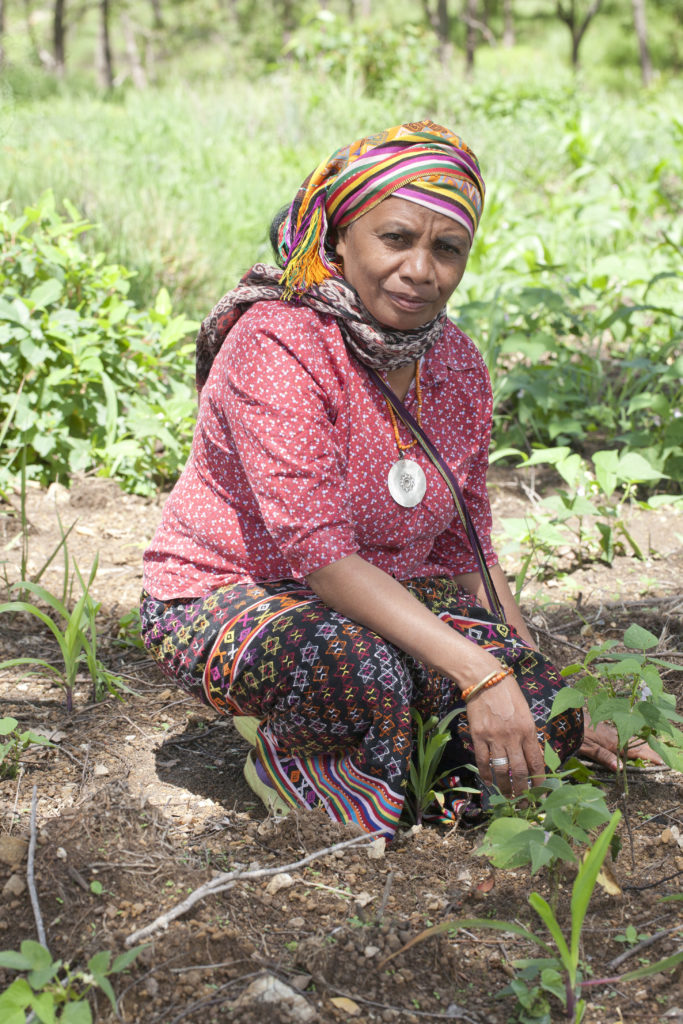
Mama Aleta Baun is a Molo indigenous woman living in the Indonesian part of the island of Timor. Aleta Baun lives in the shadow, and light, of Mutis Mountain, which is the source of all of the rivers on the island. For Timor, Mutis Mountain is the source of life.

In the 1980s, the local government illegally issued permits to marble mining companies to mine on Mutis Mountain. In 1996, the companies started clearing trees and rocks on the mountain. Aleta Baun saw this and went into action.

First, she formed an alliance with three other women. They went door-to-door, village-to-village. The distances between houses and, even more, villages were great. Baun and the three other women persevered. Their message was simple, direct and profound: “We regard the earth as our human body: stone is our bone; water is our blood; land is our flesh; and forest is our hair. If one of them is taken, we are paralyzed.”

For the Molo people, that paralysis would be a form of death. Baun had an additional message for the women: “We also emphasized to women that the forest provides the dyes for our weaving, which is a very important part of our lives. That inspired us to showcase our weaving in the form of a peaceful protest starting in 2006.”

Baun organized a weaving occupation of the mining camps. Over 100 women showed up, formed a circle in the mining quarry, sat down and silently wove traditional textiles. They sat and wove, silently, for over a year: “When we began our protest, women realized that they could do more — take a stand and be heard. Women are also the recognized landowners in the Molo culture, and this reawakened in those women who hadn’t been actively speaking out a desire to protect their land.”

The assault on the forest targeted women. Women are the ones who go into the forest and emerge with food, medicine, dye, sustenance. The marble mining companies had touched the women and struck a rock.

For four years, the women organized weaving occupations, and for four years the Molo men took on all the domestic work in their communities. This was a women-led full community campaign. In 2010, the marble mining companies packed up their tools and left.

From Aleta Baun’s perspective, the heart of the struggle was popular re-education: “The protest is part of the re-education of the people.” Now, Mama Aleta Baun is busy organizing Molo women and men to map the forestlands for themselves, and then to lay proper legal claim to all that is their land, their dignity.

Have you heard about Mama Aleta Baun and the weaving occupation? It’s a story worth repeating.

(Photo credit: Goldman Environmental Prize)

Wish you were here

Wish you were here

Wish you were here
voices a local headline
not used to solemnity
of the non-rude kind
in getting folks to read

Wish you were here
everyone wants a piece
the sweaty ones so-called
the selfie-I-me-mine crowd
not to mention those
of the empty promises variety

Wish you were here
Madiba-jiving away
piloting the path
of the straight and narrow
(now in whose hands is it)

It now is in our hands
wandering they are
often in the state’s coffers
or in someone else’s

Wish you were here
many lost souls flapping
in their rainbow fishbowls
on their way backward
to past habits and customs

Wish you were here
the weightiness lifted
if only for an Ubuntu-while
then it is the same old ground

The same old ground
women know your place
speak when you’re spoken
children should just be seen

Wish you were here
to remind those who need
to be reminded lest
we forget why we wish
you were here

A tabloid headline reporting on the Cape Town Stadium music tribute brings forth Pink Floyd’s sombre ditty “Wish you were here”, itself marking the life of an artiste-past.


(Photo Credit: PRI / Reuters)

We all fail Nadine Wright

HMP Peterborough is touted as a model private prison. It’s about five years old, run by Sodexo Justice Services. It houses, or contains, both men and women. The women are mostly remand prisoners, awaiting trial. Everyone is supposed to be short-term, low level, and generally available to `rehabilitation.’ As far as accounting goes, Peterborough brought to the United Kingdom, and in large degree to the world, “payment by results.” This means, the prison corporation is paid based on prisoner re-entry results. Some think Petersborough might be the way forward, the path out of the neoliberal prison forest. It’s not.

Keep the advertised fabulousness of Peterborough in mind as you ponder the story of Nadine Wright.

Nadine Wright is a woman living with disabilities and crises. Mental health illnesses. Heroin addiction. Her mother died in September, and there was no one to assist Nadine Wright. Meanwhile, the State repeatedly fails to make her benefits available to her. Wright did not receive her benefits in November. And so she was barely living, desperately poor, somewhere below hand-to-mouth.

So, what’s a desperately poor woman to do? Nadine Wright stole some food. She was caught and arrested. She was sent to Peterborough. Nadine Wright was pregnant when she was arrested. While in her cell, she went into labor and suffered a miscarriage. A nurse was in attendance.

According to Nadine Wright’s attorney, the nurse then left the cell. She left the fetus in the cell. No one came to clean up the cell, and so Nadine Wright was left to clean up her own blood … by herself: “There was blood everywhere and she was made to clean it up. The baby was not removed from the cell. It was quite appalling. It was very traumatic. She only received health care three days later, after the governor intervened.”

Everyone failed Nadine Wright. Her probation officers and the entire probation system. The health providers. The prison staff. Sodexo. The State. Culture. A world in which prison is the answer to mental illness, to disability, to poverty, to trauma, to personal chaos and crisis, to women acting out, to pretty much everything. We all collude in that world. We all failed Nadine Wright, and we all continue to do so.


(Photo Credit: AFP / Getty / Independent)

In Zimbabwe, prison = death


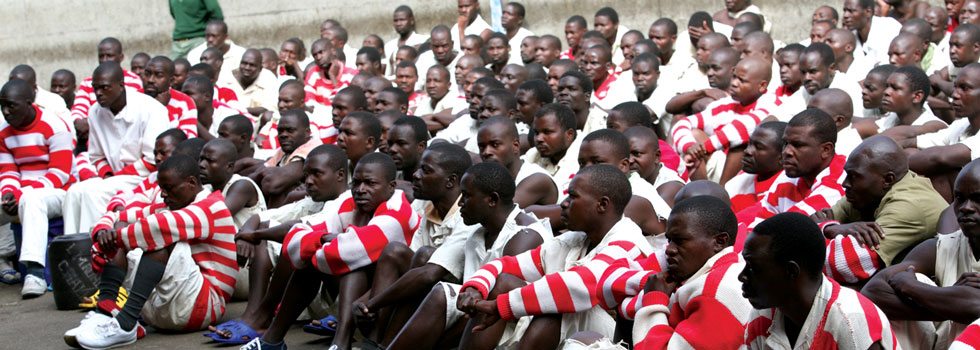
The Republic of Chikurubi is getting worse. Last week, Zimbabwe’s “justice ministry” and prison officials revealed that at least 100 prisoners died from hunger and starvation this year. At least 100. Given Zimbabwe’s prisons, they could as easily have been remand prisoners as convicted prisoners, but really, what difference does it make? They’re dead, and they died a long, slow, painful, harrowing death. If that’s not torture, what is?

There is shock but no surprise here. Four years ago, a report on death and disease in Zimbabwe’s prisons began: “A bare struggle for survival, with food at its core, has come to define prison life in Zimbabwe. Describing the conditions in two of the capital city Harare’s main prisons in late 2008, a prison officer explained: “we’ve gone the whole year in which—for prisoners and prison officers—the food is hand to mouth…They’ll be lucky to get one meal. Sometimes they’ll sleep without. We have moving skeletons, moving graves. They’re dying.” Prison staff have had to convert cells and storage rooms to “hospital wards” for the dying and to makeshift mortuaries, where bodies “rotted on the floor with maggots moving all around”. They have had to create mass graves within prison grounds to accommodate the dead. In many prisons, the dead took over whole cells, and competed for space with the living. Prisoners described how the sick and the healthy slept side by side, packed together like sardines, with those who died in the night. A former prisoner, a young man, struggled to convey the horror of these conditions: “That place, I haven’t got the words…. I can describe it as hell on earth—though they say it’s more than hell.” Another simply said, “The story of the prisons is starvation”.”

As prisoners lose the bare struggle for survival, humanity loses the bare struggle for dignity. Doctors, lawyers, ex-prisoners, prisoners’ family and friends, prison staff, and others have written repeatedly that Zimbabwe’s prisons are death traps. Some talk about “necropolitics”, the power politics of death. They say necropolitics is “the power and the capacity to dictate who may live and who must die.” In Zimbabwe’s prisons, it’s not about living and dying. It’s about ways of dying. There’s torture, and there’s starvation. Life or death is not the currency. The currency is pain and suffering.

Meanwhile, the Zimbabwe National Water Authority, which is a government agency, has shut off water to Marondera Prison: “About 500 inmates at the Marondera Prison are at risk of contracting waterborne diseases after the Zimbabwe National Water Authority (ZINWA) disconnected water supplies over a $375,000 Bill… The complex has not had water since December 4th raising prospects of an outbreak of diseases such as cholera.” The officer in charge of the prison describes it as “a time bomb.”

Torture. Death by starvation. Cholera. In the prisons of Zimbabwe, the time bomb has long exploded. It’s beyond time for a real change.


(Photo Credit: News Day Zimbabwe)

Labor, Migration, and the Movement to Stop the Traffic in Women

The traffic in women (or sex trafficking, as it is usually called) has gained central attention in the humanitarian world of nonprofits and nongovernmental organizations. The emergence of sex trafficking as the ultimate humanitarian crisis has led to an uncritical, melodramatic discourse. Governmental and non-governmental organizational rhetoric posits women and children as the main protagonists in a tale of capture, rescue, and redemption. Slogans such as “Free the slaves,” “End slavery,” and the authenticity-promising  “Sex trafficking through the eyes of survivors,” prod audiences to learn about human trafficking and embark on rescue campaigns, by donating to anti-trafficking causes or by founding anti-trafficking NGOs.

Human trafficking (sex trafficking included) is a serious problem. What is unrealistic and uncompassionate is anti-trafficking activists’ presentation of trafficking in a political and economic vacuum, and the resultant erasure of capitalist socioeconomics, including labor migration and trade globalization. The Asia Pacific Network of Sex Workers (APNSW) sums up the problem best: “Don’t talk to me about sewing machines. Talk to me about workers’ rights.” The slogan refers to the frequent brothel raids undertaken by western humanitarians, raids that result in the so-called rehabilitation of sex workers as employees in the textile industry. Rejecting their easy subsumption under the logic of capitalist accumulation, sex workers mobilize the language of rehab only to reinvest it with their own struggles as workers and women living in deeply racialized and inequitable local and global economies. The APNSW re-channels the trafficking conversation into debates about labor exploitation, in the process recognizing sex work as a legitimate part of the labor sector, as well as situating human trafficking in the broader context of work migration.

So who are the sex trafficked? According to most anti-trafficking activists, the story is simple: the sex trafficked are non-western women and children coming from poverty-stricken places and desperate to move west for a better life. Enter pimps, traffickers, and organized criminal groups who pry on desperation and poverty. The poster child of anti-trafficking campaigns is the naïve and innocent young woman or girl — unfamiliar with capitalist transactions and ignorant of the perils of immigration — beaten into prostitution, her body a living testimony to the cruelty and inhumanity of the sex industry. The reality of migration is messier and less straightforward. As scholars and activists Laura Augustín, Jo Doezema, Kamala Kempadoo, among others, have shown, women migrate for a variety of reasons (poverty being only one of them) and go through a variety of situations that rarely resemble the absolute captivity envisioned by mass media.

The easy equation of sex trafficking and sex work jeopardizes anti-trafficking initiatives. Sex workers, not anti-trafficking activists, are more successful at fighting forced prostitution. The Durbar Mahila Samanwaya Committee in Sonagachi, the largest red-light district in Kolkata, India, is a network of sex workers who take upon themselves to locate underage sex workers or those workers who are in the trade against their will. Committee’s success in removing sex workers forced into prostitution should represent a lesson for the anti-trafficking movement. Despite evidence to the contrary, however, anti-trafficking scholars and activists  continue to discount sex workers as reliable allies in the fight against human trafficking.

The misguided conflation between trafficking and prostitution has had serious effects on AIDS prevention programs. The U.S. President’s Emergency Plan for AIDS Relief (PEPFAR requires all organizations that receive PEPFAR funding to oppose prostitution and trafficking, both seen as equally oppressive. This anti-prostitution pledge has had negative effects, such as forcing the closure of AIDS prevention programs geared towards sex workers. In 2013, the U.S. Supreme Court struck down the provision as unconstitutional.

Equally pernicious are the law enforcement and rescue paradigms that characterize current approaches to sex trafficking. In 2004, the U.S. Secretary of State, the Secretary of Homeland Security, and the Attorney General created the Human Smuggling and Trafficking Center (HSTC), a center that brings together officers and investigators from the FBI, CIA, and the Homeland Security to combat the traffic in women. The makeup of the Center mirrors the State Department’s punitive anti-immigration approach to human trafficking. The law enforcement approach relies on raids of red light districts and indiscriminate arrests of sex workers. The migrant women rescued during these raids have two options: return to their countries or testify against their so-called traffickers.  Following the 2000 Trafficking Victims Protection Act, Section 103.8, women must also prove that they suffered “severe forms of trafficking” in order to qualify for the T-Visa that enables them to remain in the United States.

Returning to the APNSW, one is puzzled by the exclusion of issues of labor and migration. What would change if activists were to heed the APNSW slogan and consider the rights of women as workers in a globalized capitalist economy. What if anti-trafficking activists acknowledged the fight of migrant women and sex workers for decent work, respect, and social inclusion? While this alternative is unlikely to dominate the anti-trafficking community too soon, the prospect of a justice paradigm centered on labor and migration will continue to inspire migrant workers, sex workers, and their allies.


(Photo Credit: Twitter / Lela Who)

The prison State attacks women living with disabilities

Ellen Richardson

How does the United States respond to women who living with depression or women living with cancer? Exclusion. Solitary confinement. Women pay a high price for `security’. For women who have ever asked for help, the cost exacted from their bodies is astronomical and lethal. When so-called security trumps absolutely everything, absolutely anything can be done in the name of `protection.’ Ask Carol Lester. Ask Ellen Richardson.

Carol Lester is 73 years old, a grandmother, and a guest of the State, at the New Mexico Women’s Correctional Facility. Lester suffers from thyroid cancer, bipolar depression, and now, thanks to the State, possibly PTSD. Here’s part of her story.

Carol Lester complained about stomach pains. Prison staff gave her Zantac. Shortly after, she tested positive for methamphetamine. Lester has no history of drug abuse of any kind, and Zantac is well known to result in false positives. No matter. Right after the `positive’ result, Carol Lester was sent to solitary, where she protested on many counts. To no avail. Carol Lester spent 34 days in the hole. The drug use charges have been rescinded. Carol Lester continues to suffer … and to protest. She is suing Corrections Corporation of America, CCA, who run the prison, and Corizon Inc, who run the prison `healthcare’ system, such as it is.

Ellen Richardson was on her way, from her home in Toronto, to New York. There she was to board a cruise ship headed for the Caribbean. Homeland Security had other ideas. Richardson was turned back at the border. Why? “Ellen Richardson says she was told by U.S. customs officials at Pearson International Airport on Monday that because she had been hospitalized for clinical depression in June 2012, she could not enter the U.S.”

Richardson has been very public about her earlier, and lifelong, struggle with depression. She has written about it, has given talks about it. It’s no secret. Quite the opposite. Ellen Richardson is a woman who asked for help, received help, and now that she is doing both better and well … must pay the price. Richardson has joined with other mental health activists to find out how Homeland Security had access to her medical records.

Carol Lester and Ellen Richardson are not anomalies nor are they exceptions. From the perspective of the State built on security – surveillance – imprisonment, putting a grandmother with cancer in solitary confinement is anything but crazy. From that perspective, it’s good business, good policy, a win-win for democracy. Turning away a paraplegic women because she asked for help is part of the rule of law, in this case the United States Immigration and Nationality Act, Section 212, which instructs border agents to protect the United States from anyone who has a physical or mental disorder that threatens “property, safety or welfare.”

Nothing here is accidental or incidental. Carol Lester and Ellen Richardson are both women living with disabilities. In this country, they are marked, one for the slow death of solitary confinement, the other for the virtual death of exclusion. What you can’t see can’t hurt you, right? The only surprise, for the State, is that the women aren’t taking it. They are organizing and mobilizing, and that, of course, is no surprise at all. The struggle continues.


(Photo Credit: Toronto Star / Bernard Weil)

Hamba kahle, Madiba

In 1995, my wife, son and I spent a little over six months in South Africa, in Cape Town. It was a heady time. Giants roamed the earth, often right around the corner, sometimes in the same room. Madiba aka Nelson Mandela. Walter Sisulu. Albertina Sisulu. Govan Mbeki. Sister Bernard Ncube. The list goes on. The Rugby World Cup was on. The RDP, the Reconstruction and Development Programme, was in its most intense moments. Women were organizing. Workers, students, gay and lesbian people were on the move. Those living with HIV and AIDS were organizing like crazy. Everybody was organizing. And the buses, the Golden Arrow buses, the bus for us, encouraged everyone to smile.

South Africa was one big hopeful project, and so much of that hope passed through the very body of Nelson Mandela. He helped people of all communities and persuasions focus the light of hope into the fire of transformation. While the policies of Madiba’s own government and those that have followed have often worked precisely against the hopes of the marginalized, the violated, the disenfranchised, today we remember the person. So let me tell you a story.

In 1995, my wife, son and I were watching Dali Tambo’s People of the South, a talk show of the highest kitsch and a great family favorite. That evening, Madiba was to be the guest. Mandela came out, sat on the sofa, surrounded by women in antebellum United States frills and bonnets. Madiba and Tambo talked for a while, about the government, about hopes for the future, about their families. Dali Tambo is the son of Adelaide and Oliver Tambo, the President, and then National Chairperson, of the African National Congress until his death in 1993.

And then Dali Tambo introduced the next guest, Jermaine Jackson. Jackson entered. Madiba stood up, shook his hand, looked him straight in the eyes and said, in his unforgettable voice and manner, “I have always been a great fan of yours.”

And he meant it.

That is Nelson Rolihlahla Mandela, better known as Madiba. During the 27 years of imprisonment, apparently, he was organizing and teaching and leading, always by example, while dancing and singing to the Jackson 5.

Nelson Mandela brought dignity, humor, principle, humanity, great shirts and an extraordinary, almost magical, transformative capacity to every encounter: as a young lawyer and boxer, as a representative of the ANC, as a founding architect of Umkhonto we Sizwe, the armed wing of the anti-apartheid struggle, as a prisoner on Robben Island and then in Pollsmoor and Victor Verster Prisons, as a democratically elected President, and finally as an elder.

He touched each of us, and for that reason, he is loved. We remember. Hamba kahle, Madiba.

(Photo Credit: John Adams / South Coast Sun)

We are all canaries in the coal mine

In December 2011 Swiss financial journalist Myret Zaki asked a group of economists a simple question, “Why now?  For example, you have all noticed that suddenly Greece was in crisis”. She noted that it was not because of Greece’s public debt, which had been fairly stable and not especially large. The economists mentioned Goldman Sachs, which had advised the Greek government to sell its financial products and then informed their own clients and friends about Greece’s “financial weakness”. Myret Zaki completed the picture with the story of the 2010 Soros Dinner, when a few hedge funds managers cooked up an attack on the Euro through Greece. The Wall Street Journal report on the dinner quoted Hans Hufschmid, a hedge-fund administrator (GlobeOp Financial Services SA), in London and New York: “This is an opportunity…to make a lot of money.”

We all know what happened next. We remember the demonstrations and how these speculators precipitated the demise of employees, citizens who were to pay for their financial coup. As France’s General Commissioner for Public Investment René Ricol explained, “This is a combat between the world of finance, the world who wants to make a lot of money very quickly, and the world of `true life’”. With the support of neoliberal doctrine, the world of finance has subsumed civil society.

But that was then.

Today, in Greece the world of “true life” has reorganized after the shock of the financial attack that sent many into poverty and precariousness. Taken by surprise, people believed at first that the country had overspent its revenues; now they know that overspending was not the problem.

The recent documentary, Canaries In the Coal Mine, shows how the State is controlling the revolt and the fight for reestablishing the democratic civil society values. This story should be understood as “a lot more than Greece’s tragedy.”

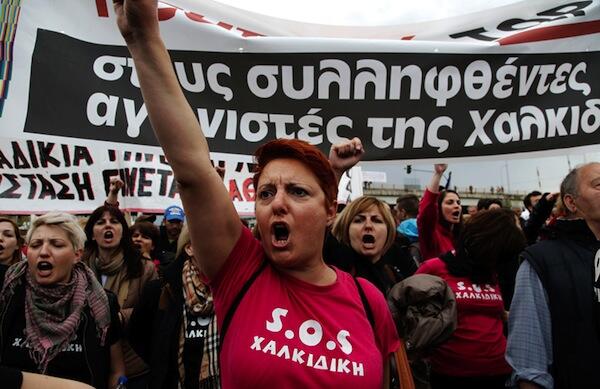
Greek trade unionists defending steel workers who were not paid during 18 months were sent to court, accused of terrorism for organizing demonstrations and for showing workers’ frustration. As prosecutions of heads of associations representing workers, immigrants, and others demonstrate, anti terrorist laws have been used to install a general surveillance of “true life” populations, producing the legal tools to choke any contestation.

The criminalization of Greece’s social movements has been generalized. The documentary makes it clear Greece is in Europe. Across Europe, many are being threatened by the same shock of the unfettered and ferocious financial powers. Everyone who fights for rights is in danger, according to Oliver Stein (Progress Lawyers Network) and Pierre Arnaud Perrouty (Human Rights League, Belgium): “The ones who carry the contestation protect the rights of us all…. They are the canaries in the coal mine”. Once the canaries are smothered, everyone will feel the blast.

Last week, Moodys upgraded its rating of Greece by two points. Why? “The Greek economy is bottoming out after nearly six years of recession”. Greece underwent appropriate structural reforms.

Yes, thanks to an artificially engineered recession, the Greeks touched bottom. That is not a positive sign!

Sofia Tzitzikou, who runs a community clinic in Athens, knows “the bottom” well. Greeks, who had a very effective health-care system until the “crisis”, lost their social security. Almost 50% of the population does not have access to social security, to health care. Women have been particularly affected as their reproductive rights are compromised, since women now have to pay for these services.

Sofia explains that the role of the community clinics is not to substitute for the public services that are the State’s responsibility. But people are suffering and dying, and so solidarity is indispensable. She explains that this engagement is also political work. Clinic workers explain to their patients that they have to get involved as well to revive and counter the structural reforms prescribed by the Troika (European Commission, IMF, European Central Bank).

“In Greece we have a systematic infringement on human rights, social rights, workers’ rights, on democratic rule of law, on the welfare state” declares Zoe Konstantopoulou, a representative at the parliament.

Canaries in the Coal Mine captures the aftermath of the neoliberal financial shock on “true life.” It debunks the construction of a crisis that is actually an experiment in controlling civil society for financial benefits for the few. That’s what happened in Greece, which, not that long ago, was one of the top 20 economies. Sofia explains that right now, in Greece, democracy is absent. Democracy is to serve people for the improvement of people’s lives, not the opposite. The documentary opens and ends with music by Greek rap artist Paulos Fyssas, assassinated in Athens by a Golden Dawn fascist activist.

What happened in Greece is possible anywhere. Only solidarity, in particular European solidarity, and true democratic resilience might counter this brutal attack on civil society. We should listen carefully to Athenian student Melanie Mavrogiorgi: “We don’t have the army in the government to control us. So we have hope as we see people still demonstrating. They are still hunting and fighting for their rights. I think that is a piece of democracy.”

The documentary ends: “Pay attention to the canaries in the coal mine. They warn us of the dangerous gas that neoliberal politics wants to blow up. It is time to get out of the mine!” The documentary ends; the struggle continues.


(Photo Credit: Twitter / 15M Barcelona)  (Video Credit: Yannick Bovy / YouTube)