In Cambodia, the women are saying, “No!”

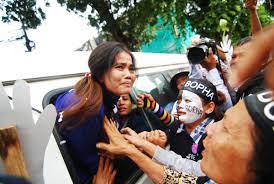
Yorm Bopha

Yorm Bopha, Tep Vanny, Phan Chhunreth, Song Srey Leap, and Bo Chhorvyfive women land rights activists – were arrested today, while peacefully petitioning for the release of other Boeung Kak lake activists arrested over the weekend. Boeung Kak lake, in the heart of Phnom Penh, has been the site of major `urban development’, which means mass evictions. And women have been the heart of the Boeung Kak lake pro-democracy, women’s rights, community rights, land rights movements.

These arrests take place against the backdrop of the recent women garment worker demonstrations across Cambodia, and the State response of criminalization and repression of public dissent and gathering. Women workers have been protesting for over a year. In many ways, they have been protesting for decades.

This is the face of Cambodian `stability’ and `development’: women facing mass eviction, women facing super exploitation. In both instances, the logic has followed the gender of sacrifice. Women must give up land and lives for `the good of the nation.’ Around the world, this is a familiar tune, the song women as silver or diamond, and the women of Cambodia reject it, as they have for decades.

At one of the intersections of land rights, workers’ rights, and women’s rights stands Mu Sochua.

As government forces attacked women garment workers, over the weekend, Mu Sochua, an opposition Member of Parliament, explained and contextualized. She explained that the workers’ demonstration were about a living wage and about democratic governance. She explained that, for the first time, all the trade unions had joined together and had joined together with the Cambodia National Rescue Party. When the State fired its AK47s, it took aim at both labor and democracy, and the heart of those movements, this weekend as so often before, is women workers, organizers, and advocates.

According to Mu Sochua, “The workers are now hiding. They’re living in fear. Do you want to wear clothes made by people who live in fear? With the wages they get today, they can’t even get three nutritious meals in a day. … Does the international community want to continue to support this kind of dictatorship … and support international buyers who make billions while our workers are deprived of basic rights?”

Mu Sochua has been posing the question, and pushing the crisis, of human rights, women’s rights, workers’ rights, democracy in Cambodia for a long time. Sochua has been targeted by the State and has kept on keeping on. She led the struggle against the hyper-exploitation and abuse of Cambodian women and girls working as domestic workers in Malaysia. She connected the development logic of landgrabbing within Cambodia to the export of women workers by Cambodia. Sochua founded Khemera, the first women’s rights organization and the “first indigenous NGO” in modern Cambodia. She has faced imprisonment and worse, and much of this while a sitting Member of Parliament.

Throughout, Mu Sochua’s message has been clear. Democracy matters. Women matter. Justice matters. Cambodia matters. The garment factories of Cambodia have been reaping mass profits while cutting workers’, women workers’, salaries. The State has been claiming democracy while ignoring the will of the people, in development projects for the rich, in industrial production, in national elections. Do you want to support dictatorship, political, economic, and `developmental’? In Cambodia, the women are saying, “No!”


(Photo Credit: Lauren Crothers/The Cambodia Daily)
Violence Against Women as a strategic weapon in a time of class war in Greece

We already knew that violence against women is often used as a weapon in times of war to punish, humiliate and dehumanize, but especially to repress and annihilate by all possible means the population to which they belong. This violence has often been seen as a means of domination rather than as a tool of destruction.

In the period of deep crisis shaking Greece, violence against women is becoming a weapon in the hands of the rulers. Such violence has been increasingly widespread in Greece. Here are four emblematic cases.

The most recent case occurred at the beginning of November 2013 when Greek police special forces (MAT) tried to prevent two Members of Parliament from entering the building of ERT, the public radio and television station, which had been occupied by the police. Police pushed opposition MPs Zoe Konstandopoulou of Syriza and Rachel Makris of the Independent Greeks party against the entrance gates and roughly handled them. Zoe Konstandopoulou, who nearly died from asphyxiation, is now taking legal action against her agressors for attempted murder. The two MPs were simply trying to exercise their constitutional right to enter the ERT building to prevent the police destroying equipment to frame the workers who had been fighting for the station to remain in public hands.

The morning following the incident at the ERT building, the pro-government daily newspaper TA-NEA, launched a campaign against the two MPs, publishing a cartoon on its front page showing them as strippers pole-dancing in front of a male audience. The caption, a conversation of a male client in the audience, to the cartoon read, “Rachel is on the right and Zoe on the left. Do they do anything else? I heard that they are taking legal action. But we should ask the waiter”.

The second case involved a television campaign against HIV-positive, some of whom are sex workers. In the middle of the election campaign, two social-democratic ministers, notorious for their role in repressing demonstrations against the Troika and in the destruction of the health service, called publicly for the arrest of those who, according to these ministers, “constituted a heath time-bomb”, “are polluting society with their contagious diseases” and are killing, with the AIDS virus, “Greek family fathers”.

The third case involved dozens of women, including some grandmothers, in Skouries in the north of Greece. These women were opposing the Canadian company Eldorado and its gold mining project. For months, special police forces under instructions of the minister have been targeting the women of the villages with a ferocious and massive repression. Some have been sent to prison. This unprecedented repression, carried out in the background of a state of emergency in a region inhabited by peasants, is exemplary, according to those who gave the orders to prevent the repetition of such acts of “civil disobedience”. As always, “exemplary repression” targeted women first and foremost.

Finally, Kassidiaris, an MP from the neo-nazi Golden Dawn, struck two female MPs on the face, while live on television during the election campaign last spring. Instead of rousing indignation and reprobation, this act of violence led to a wave of popular sympathy and contributed to the electoral success of Golden Dawn.

What is going on?

This violence against women reminds us of that committed during wars of ethnic cleansing. The rape of women by enemy forces should not be explained as the result of some “uncontrollable” male impulse but as that of a strategy of war during which women represent symbolically and biologically the integrity of the ethnic group or nation, which must be destroyed. In Greece today, we are not faced with nationalist violence pursuing ethnic cleansing. We face a different type of conflict, another sort of war, a class war.

Humiliate women MPs by comparing them to strippers sends the message that politics is first and foremost the exclusive domain of men. In that world, women are to be always available for sex and to be the property of men.

The public denunciation of HIV-positive women criminalizes and demonizes their sexuality and presents them as a “menace” to law and order, which must reign in our society. This “menace” has been denounced for the last two centuries as coming from the “dangerous” classes.

To make misogyny a weapon of war in the hands of the ruling elites comes as no surprise. The Troika aims to turn the clock back to the worst moments of the savage and barbaric capitalism of the 19th century. The Troika yearns for the time when women had no rights.

We are witnessing a frontal assault, a war of historic proportions, against the immense majority of citizens (the waged, poor, unemployed, pensioners, youth, the “different”, the immigrants and minorities). The transformation of violence against women into a weapon increasingly used by the ruling powers is an integral part of that war. Just like in the case of mass rape in nationalist/ethnic wars, violence against women used by the ruling class in a time of class war has the same objectives: to break the morale and social fabric, to force not just women but all victims, including men, into submission and acceptance of their inhuman neoliberal policies.

(This first appeared in a different form here: http://leftunity.org/violence-against-women-a-strategic-weapon-in-the-hands-of-the-rulers-in-a-time-of-class-war-in-greece/)

Things that begin with A: Aqua, asylum, atrocity, Australia

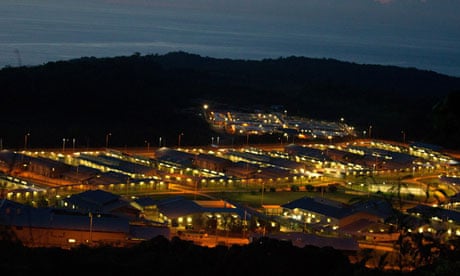
The detention center on Christmas Island

A new year begins: “Australian Federal Police are investigating an allegation of sexual assault made by an asylum seeker detained on Christmas Island. An AFP spokesperson confirmed the matter was referred to the police on 27 December… Union of Christmas Island Workers’ president Gordon Thomson told Guardian Australia the allegations were made by a female asylum seeker housed in Aqua compound, one of the family compounds in the detention centre.”

Christmas Island and Aqua family compound are such lovely names for such sinister operations. Aqua and Lilac “family compounds” are part of the immense immigrant, refugee and asylum-seeker prison system Australia employs Serco to run. It’s a bad place, as reported by Serco staff, prisoners current and former, and doctors who have served on the island.

Serco staff members complain that the prisons are overcrowded and understaffed. For example, at night, 11 security workers monitor hundreds of prisoners. Women prisoners have complained, repeatedly and to no avail, of their fear for their safety.

Women prisoners fear sexual assault. They also fear systemic abuse. Pregnant women, such as Elham, are told to lower their expectations, when it comes to medical care. When asking for an ultrasound, Elham was told, “You are in detention and should not expect a lot.” Women who need to terminate their pregnancies are in even more dire conditions. Women in high-risk pregnancies are treated like everyone else, poorly and viciously. The new policy is to ship them off to even more isolated and desolate Manus Island and Nauru. If a few women die in childbirth, well … it’s the price of public policy, isn’t it?

Women with disabilities are treated like trash. A 30-year-old woman with severe mental disabilities was separated from her family until doctors and others forced the Government’s hand. How many others living with severe mental disabilities languish and deteriorate right now in what is effectively solitary confinement?

The stories continue: an epileptic child held without treatment for at least two months; a baby with a defective pacemaker had to wait for two months to leave the island, despite the pleas of a waiting hospital; a woman with level-five cerebral palsey who receives little to no treatment; the HIV+ person who went poof, lost in the system that is nothing more than a system of loss and losing.

The 15 doctors who wrote and presented, last month, a 92-page letter of concern describing the conditions, describe the prison island as “life-threatening” and “harmful.” They talk of the risk to lives that is endemic to the entire process. Others describe the situation as “inhumane.”

It is all of those and worse. The worse is that this system of atrocity and abuse is, around the world, business as usual. It is the situation that emerges when the State works to persuade its citizenry that immigrants are `a flood’ and, worse, `a tsunami.” When human individuals and populations become jetsam and flotsam, so much trash to be cleared before it pollutes the pristine beaches and bucolic alleyways, prisons become overcrowded. In those overcrowded prisons, women are routinely attacked. Other women are systematically abandoned to new forms of isolation and self-harm. Other women are simply lost. There is no surprise here.

Australia, along with other so-called democracies, has been building this world for decades. Another asylum is possible, isn’t it?


(Photo Credit: Guardian / Paula Bronstein / Getty Images)

Remember this: We all killed Ashley Smith

On October 19, 2007, 19-year-old Ashley Smith died, or was encouraged to kill herself, while seven prison guards in a model Canadian women’s prison watched, followed orders, and did nothing. And by doing nothing is meant committed homicide. That was a decision of coroner’s jury, Thursday, December 19, 2013, six years and two months, to the day.

While it’s a good decision, and while it allows Ashley’s mother, in particular, a kind of peace, there’s more here. Ashley Smith was a girl, then a young woman who lived with mental and emotional problems. She needed help. She knew she needed help. She begged for help, and not only in her last moments. Her entire adolescence and brief adult life, she begged for help. There was none available in New Brunswick, where her family lived, and so she went into the system, and then was shipped around, from prison to prison, from prison system to prison system.

How does a young woman beg for help in prison? There’s one sure-fire way: self-harm. And that’s the route Ashley Smith took. That irked the warden who ordered the staff to do, ultimately, as they did.

But this is not about Canada, nor about seven guards, nor one warden, nor even the so-called correctional system nor the so-called criminal justice system. It’s not about the mental health system either. It’s about us, you, me, all of us.

Where ever you live right now, people, and in particular young girls, are being thrown behind bars for the crime of asking for help. `Budget crises’ produce austerity programs just as `inefficiencies’ once produced structural adjustment programs. These are all too genteel descriptors for a global factory of torture and death, that begins and ends with everyone who is supposed to be responsible responsibly watching a girl kill herself and doing nothing to stop it.

This is not about strangers `letting something bad happen’ nor is this `the order of things.’ This is the order of people and power.

We all contribute to a world in which prison has become the first and the final solution to everything, in which prison and military budgets dwarf all other government expenditures. We vote for that, we teach that, we allow that to continue, we contribute. Remember that.

And in the New Year, remember this: we all killed Ashley Smith. We did not `fail’ her; we killed her. So, rest in peace, Ashley Smith. Perhaps your death and life will not have been for naught. Perhaps.

(Photo Credit: UWaterloo.ca)

Deprivation in Greece … just an emotional issue???

“It has become impossible to give birth in public hospitals,” Sofia Tzitzikou told me in a recent phone interview. She has been organizing and running community clinics in Athens since the 2010 financial coup against the Greece. She also recently appeared in the documentary, The Canaries in the Coal Mine.

Until recently in Greece, women in labor did not have to worry about safe deliveries, thanks to an efficient public health care system. Since 2010 the steamroller of structural reforms directed by the Troika of financiers – the European Central Bank (ECB) the European Union, and the IMF – has dismantled that public system. The financial attack on Greece has produced a deadly correlation of high unemployment rate and elimination of the social safety net.  Women, children and elderly people have been hit this hardest. The Troika demanded cuts and then more cuts of public services in exchange for loans supposed to restore the solvency of the country. Consequently, Sofia explains, the cost of health care represents now only 1.5% of the national budget, and the `hope’ is that it will go as low as 1% while the military budget has been increased.

Recently, Jeroen Disselbloem, President of the Eurogroup, said he hopes to have completed the current examination of the economic adjustment program of the country very soon. In the 1980s, structural adjustments programs became the only formula for development. Now, it’s `economic adjustment.’ Whatever the name, these plans have destabilized emerging countries, and crushed unions and public health care systems with dire consequences for women and reproductive and health rights.

The Eurogroup, in its pursuit of `economic growth’, is blind to the suffering of the Greek population. As Sofia noted, “This means violently taking over the right to health, to life, as children are not vaccinated because their parents have lost their jobs;” the unemployment rate is currently close to 40%.

According to Sofia, the State now covers the fees for home delivery but not for maternity hospital care. Strong protests have forced public hospitals to reopen their doors to women in labor.  The bill will be sent to the tax system. Thus, women who are already extremely vulnerable incur a new level of debt just for giving birth. For Maurizzio Lazzarato,  “Debt constitutes the most deterritorialized and the most general power relation through which the neoliberal power bloc institutes its class struggle…” I would add gender struggle as well.

Since the ransack of Greek society by globalized financial power, the wages of those still employed has dropped 40%. Sofia tells me women are paid in kind in places such as supermarkets. Giving birth without health care coverage costs 600 Euros for a regular delivery and 1300 Euros for a C-section. In addition, explains Sofia, “Abortion rates have increased. Do women really choose?  Now we count three abortions for one birth … Childbirth is not a business, every one has the right to have or not have children.”

As we were talking on the phone, Sofia was interrupted several times to answer demands for medications no longer available in public hospitals: “Can you imagine, we as community clinics are asked to supply medications for public hospitals.” She has seen people abandon treatments because they cannot afford them. The suicide rate has been multiplied by four in three years.

Inequality is visibly on the rise, and for the first time, she says, we have deaths that were totally preventable. Women, again, are the most vulnerable. Sofia comments, “The State does not exist anymore. We are a country in regressive development.” The Troika is pushing for the privatization of education and health care. These privatizations produce more inequality. Additionally, there is little accountability in privately run services based on market logic. Sofia strongly opposes this dismantling of the State. She demands the government to be accountable for its decisions.

As vice president of UNICEF for Greece, Sofia was invited to the recent annual convention of the European Platform Against Poverty and Social Exclusion.  Although Sofia recognized that the convention broached important issues, she also noticed the presence of George Soros, one of the architects of the attack against Greece. He was the keynote speaker on “Roma and marginalized populations.” We both commented on his philanthropist high profile that allows him to be both arsonist and firefighter simultaneously.

Conference panels expressed the obligation of member States not to allow austerity over health services, and that the protection of children was central to this year’s platform.

In a workshop entitled “Ensuring adequate access to health care in times of austerity,” a Greek consultant to the Minister of Health in Greece gave the State line. On the panel, Sofia responded that his presentation in no way reflected the reality neither on the ground nor in the data. She explained the realities of poverty in Greece. She introduced the UNICEF and Athens’ University report “The State of Children in Greece 2013” released in May 2013. In Greece, 600 000 children live below the poverty line; 322 000 suffer nutritional deficiency. She pointed out the statistical data on social community clinics. She emphasized that it’s not enough to talk about generalities and that the State was absent.

The panelist angrily tried to belittle her, saying that she approached this question from an emotional perspective.

Sofia retorted: “I take that as a compliment when we persistently fight for the rights of people.”

Counting the victims: The politics of numbers in anti-trafficking campaigns

Numbers hold a fascination that borders on the irrational sometimes. Their simple mention turns hypothetical conversations into fact-based statements, triggering the you-can’t-deny-it effect. The link between the right numbers and the irrefutable reality they allegedly reflect works to bolster viewpoints and functions as the ultimate test of the work of evidence. To mention numbers is to halt conversations mid-sentence and present one with the naked truth: genocides are called by name when the right numbers are attached to killings and a humanitarian crisis is not a crisis unless numerically proven to be so.

It is no wonder, then, that human rights organizations rely on numbers to bring evidence and tell stories of human rights violations. Yet numbers, like stories, function affectively to represent reality. They do not merely reflect a sociopolitical phenomenon. They also produce the very phenomenon they represent, creating new realities and ways of understanding the world. Like stories numbers work emotionally, they are “what moves us” and “what makes us feel”; they “circulate and generate effects,” bringing people together and against one another.

The politics of numbers is at the center of the alleged humanitarian crisis of the traffic in women. The simple mention of high numbers of trafficked victims or survivors breathes new life into the anti-trafficking activist cause. To be clear, I am not arguing here that the traffic in women does not qualify for the name of “humanitarian crisis” or that activists make dishonest use of numbers. I am rather interested in the ways in which numbers are given, contested, and take on a life of their own in activist circles. My argument is that numbers are too easily mobilized with little understanding of what they mean and the effects they have for feminist politics.

Governmental and non-governmental anti-trafficking organizations cite the high numbers of sex trafficked women to justify rescue campaigns worldwide and to justify the large amounts of anti-trafficking governmental funding. The Polaris Project in Washington DC, a group that works closely with the U.S. Department of State, estimates that 100,000 children enter the sex industry in the United States each year, while the U.S. State Department places the global number of trafficked persons at 27 million. USAID estimates that there are between 12 and 27 million trafficked persons worldwide. The 2013 Traffic in Persons Report, issued annually by the U.S. Department of State, puts the number of survivors at 46, 000 out of the 27 million trafficked persons believed to exist worldwide.

Responding to these numbers and drawing attention to the illicit character of the phenomenon, many international organizations, including the United Nation, have declared such accounts unreliable. According to the UNESCO Bangkok office Trafficking Statistics Project, trafficking statistics circulated in media and scholarship are “false” and  “spurious”:

“When it comes to statistics, trafficking of girls and women is one of several highly emotive issues, which seem to overwhelm critical faculties. Numbers take on a life of their own, gaining acceptance through repetition, often with little inquiry into their derivations. Journalists, bowing to the pressures of editors, demand numbers, any number. Organizations feel compelled to supply them, lending false precisions and spurious authority to many reports.”

Numbers circulated liberally in mass media and governmental press releases have enabled the mobilization of a strong anti-prostitution coalition made up of anti-prostitution feminists (the so-called neo-abolitionists), evangelical Christians, and anti-trafficking activists. Under John Ashcroft, the Department of Justice spent approximately 100 million dollars a year to fight trafficking both inside and outside the United States. Between 2001 and 2008, the United States has channeled about $528 million into anti-trafficking assistance overseas. USAID alone has provided $123.1 million in assistance to more than 70 countries in the time period mentioned above. In 2011, the U.S. State Department’s Office to Monitor and Combat the Trafficking in Persons allotted $16 million in foreign assistance. In 2012, the sum rose to $64 million in assistance for 70 countries.

Fueled by this wealth of resources, numerous nongovernmental organizations have mushroomed throughout the U.S., embarking on humanitarian campaigns to stop the traffic in women. During the Bush administration, evangelical Christian groups received large sums of anti-trafficking funding. Citing the high numbers of trafficking victims, such groups spread their missionary work throughout the world finding yet another opportunity to disseminate their version of Christianity, this time under the guise of the struggle against trafficking and for women’s rights.

It is impossible to know the exact numbers of trafficked victims and survivors because of the complexity and illicit character of the trade. What is called human trafficking is, in effect, an amalgamation of distinct but related phenomena: migration, work, the globalization of capital, the emergence of the virtual space and its subsequent incorporation into the capitalist means of production, and the expansion and overall transformation of the sex industry. To talk about millions of trafficked persons is to simplify and misread the socioeconomic conditions that enable the forward movement of the capitalist machine. The impressionistic mention of numbers merely sustains the rhetoric of abolition, naturalizing what would appear otherwise to be the coercive actions of brothel raids and imprisonment of sex workers.


(Image Credit: UN SDG Action Campaign)

Lampedusa: Another solidarity is possible!

The little island of Lampedusa located between the Libyan and Italian coasts, actually closer to Libya than to Italy, has made the headlines again. Some call the island the Guantanamo of Europe. The island is the point of landing for many who either escape war zones or are simply pushed away as was the case for the many foreign workers from Africa or Asia in Libya. Lampedusa’s “reception” center or CPTA, centro di permanenza temporeana e assistenza, is full. It is a continuous theater of simple acts of dehumanization and intimidation.

Emotions are high after a video filmed by Ahmed, a Syrian refugee, with his cell phone and shown on channel 2 of Italian public television. The video shows people disrobing and standing naked in a cold wind before being spread with disinfectants said to contain a scabby outbreak.

Ahmed gave the video to a journalist adding: “We are treated like dogs… we were there naked in line, we were awaiting to be sprayed with disinfectant against scabby that we contracted in the center. It was like the Jews in the documentaries on Nazi concentration camps. The people in the center were staring at us, making fun of us to humiliate us…it was cold” and women were treated similarly.

These shocking images brought back memories of concentration camps and triggered public outrage as well as officials’ reactions. The mayor of the island compared the island to a “concentration camps,” although, a few years ago, another mayor of the same island showed no compassion for Tunisian refugees who were welcomed with slogans such as “Lampedusa does not want you, go away beasts”.

European Commissioner for Home Affairs Cecilia Malmström declared, “The images of Lampedusa’s center are appalling and unacceptable.” It is not the images that are unacceptable. It is the reality that these structures are there and badly run by a world of private associations and cooperatives that use public subsidies to create a very profitable business of locking up refugees.

“The more they are the better it is. The longer they stay the better it is and a minor refugee is a cherry on the cake,” wrote Alessandra Ziniti in La Repubblica.

With the free circulation of people and goods in Europe came the paradoxical concept of Fortress Europe. Actually the latter was formed as a business to serve the new globalized markets. It has left a trail of devastation and mistreatment of women, men and children. In Italy, during the Berlusconi years the business of dealing with refugees and migrants was given to the best financial offers. Even Catholic movements (comunione e liberazione) and entrepreneurial priests along with international energy corporations took part in it.

The money involved is colossal as Italy spends 1.8 million euros every day to detain 40 244 refugees.

Meanwhile the refugees and migrants whose futures were threatened in their home countries have been parked, sprayed and dispossessed of dignity and humanity in these centers. The latest scandal of Lampedusa is just the latest addition to the long list of State/EU mistreatment of people that accompanies austerity measures, as in Greece, that destabilize and impoverish civil society, creating the conditions for more dehumanization.

We need to imagine another type of solidarity to force the European Union to deliver the promises of its message as the one expressed by commissioner Malström after the drowning of 280 refugees off the shore of the island in October 2013: “This is not the European Union we want” it is certainly not the world society we want!

(Image Credit: Courrier International / Kountouris)

Why wasn’t Barbie a domestic worker? Who cares?


Following her creation in 1959, Barbie leapt from toy store shelves into the hearts and minds of children all over the world.  Her position as an influential figure in American popular culture is undeniable, and her reach has been as expansive and varied as her résumé.  Despite holding a plethora of positions from doctor to rock star to astronaut, Barbie has never been a domestic worker. While domestic work may not have been one of the careers Mattel had envisioned girls dreaming of when Barbie began using her motto “We girls can do anything,” the company eventually did release a doll that was equipped for domestic work, but it was not marketed as such.

Mattel claims that the 1991 Jamaican Barbie wears “a costume native to her homeland”. As scholar Ann Ducille points out, `Jamaican Barbie’ is actually wearing a maid’s uniform, thereby presenting a deeply troubling caricature of  both Jamaica and domestic labor. Clearly there are racist implications behind the fact that domestic work is acceptable for this ethnic other, but not for Barbie herself to have as a career. Jamaican Barbie is the only doll to be depicted as a domestic worker, but that word does not appear in the doll’s name or official description. If it had, that would have spelled out even more troubling consequences for the ways in which Mattel depicts not only domestic work and people of color, but entire countries. Moreover, in overlooking the doll’s actual depiction as a domestic worker, Mattel contributes to the conventional wisdom of domestic workers as an invisible and silent workforce.

The world around us shapes our perceptions of domestic work and domestic workers. The  narrative of domestic work being devalued persists because value and prestige are conflated, suggesting that because domestic work is not prestigious, it is not valuable and vice versa. Barbie projects a specific vision of American upward mobility, aspiration and imagination, and domestic work does not fit the profile of the extravagant and extraordinary careers in which Barbie has dabbled over the years. The idea that domestic work is somehow inferior or less important benefits the State’s capitalist machinery that relies on the extraction of surplus value from low-wage and unwaged labor. In the current neoliberal political moment, the precarization and casualization of labor has proven a formidable obstacle in bringing about any consistency in the way domestic work is regulated, legislated, and salaried.

Add to this the lack of `universal understanding’ of what a domestic worker is or looks like. Ideas surrounding workers’ attitudes, abilities, and obligations are as varied as the workers themselves. While Mattel has a history of capitalizing on difference and constructing a form of multiculturalism that is palatable to consumers, it would be impossible to dress and market a domestic worker Barbie in a way that is accurate and respectful. Mattel would be hard-pressed to convey the nuance and variety in the forms of domestic work. Would consumers buy Childcare Barbie? Eldercare Barbie? Cleaning and Maintenance Barbie? Home Healthcare Worker Barbie?

We need to consider domestic workers not just as consumers, but also as agents who deserve more than to be held to Barbie’s standards of visibility and success. If having an official Barbie doll career outfit really mattered to domestic workers, wouldn’t they have asked for one by now? For domestic workers, life is neither plastic nor fantastic. They face a multitude of challenges with very real impacts on their everyday lives, ranging from lack of legal protection to separation from their families, to living with undocumented immigration status to physical and sexual abuse, and much more. In this context, Barbie would barely register as a priority.

(Photo Credit: The Barbie Collection)

Amnesty has never meant freedom

Maria Alyokhina and Nadezhda Tolokonnikova, members of Pussy Riot, walked out of prison today. This is good news, but it’s not freedom. Freedom does not exist where whole populations live in fear of State mandated, sponsored, or instigated terror. Gay and lesbian individuals and populations, from Moscow to Kampala, know this all too well. Ask Kasha Jacqueline Nabagesera about life in Uganda, and she will not talk about “freedom.” She will talk about the struggle for freedom, the long hard walk to a freedom dreamt of but not in sight. Ask those, like Alyokhina and Tolokonnikova, who suddenly leave prison if they feel “free.” They may feel joyful and relieved to be on the outside, however precariously, but they do not feel free. They remember too much.

President Obama recently “pardoned” and “commuted” a few sentences. He talked a little about the unfairness of some aspects of the so-called War on Drugs. He didn’t mention that he has the lowest pardon rate of any President in recent history. He didn’t mention the bodies piling up in prisons and jails across the country.

He certainly didn’t mention Karen Sandoval, originally from Honduras, who lives in constant fear and terror. He didn’t mention the terror of a rigid “immigration enforcement policy” that rips families and communities apart, that rends hearts and souls and sometimes minds, and, not incidentally, that targets women – as undocumented individuals, as those left to clean up and care for those, and in particular the children, `left behind’, and, when incarcerated, as those most vulnerable to sexual abuse and violence from staff.

In Spain, the conditions in immigration detention centers, in the notorious centros de internamiento de extranjeros, or CIEs, are infamously toxic. What’s the anwer? Build more! Put one on every corner. In Italy, the vicious conditions of immigration detention centers are so bad they have inspired prisoners to sew their lips shut, in protest. They say these are worse than prisons “or any other place”. In these prisons, “people … are treated like animals.”

None of this is new. We have seen the sewn lips before, and we have turned away. We have each time taken an oath to forget. That’s what amnesty is, that’s what amnesty was at its origin. Once a year, those who committed violence in the name of preservation of the democratic State, would gather, each year at the same time in the same place, and would take an oath to forget. That is why the State, from its earliest, feared the mothers in mourning, the mothers who refused to forget, who howled their remembrances in words and deeds.

Amnesty has never meant freedom. Ask those who remember.


(Photo Credit: CalvertJournal.com)

Uganda’s Christmas gift? Homophobia, violence, pogrom, witch-hunt

Kasha Jacqueline Nabagesera

Kasha Jacqueline Nabagesera. Clare Byarugaba. Julian Pepe Onziema. Frank Mugisha. Geoffrey Ogwaro. These are the names of the most prominent gay activists in Uganda today, and they are under attack. Today, the Ugandan Parliament passed legislation, `ethics laws’, that threaten the LGBT communities with life in prison, and do so using the most vague, and hence most lethal, language. The law also outlaws mini-skirts. Of course. Because really, the biggest problems facing Uganda today are homosexuality and hemlines.

Three years ago Kasha Jacqueline Nabagesera, Julian Pepe Onziema, and David Kato sued a Ugandan tabloid for its “Hang the Gays” series in which it posted names, addresses, pictures of individuals reputed to be “gay”. Remarkably, they won the case.

Remarkably as well, Kasha Jacqueline Nabagesera helped found FAR-Uganda, Freedom and Roam Uganda; while Julian Pepe Onziema and David Kato led SMUG, Sexual Minorities of Uganda. David Kato was brutally murdered in January 2011.

Since then, the struggle for an end to the pogrom against LGBT people has waxed and waned, often deeply influenced by outside funders, and in particular those from the United States.

Gay activists organized and pushed back. For example, when the Minister for Ethics and Integrity broke up a gay rights workshop, run by FAR-Uganda, they sued. In fact, that case is meant to be decided next month. We’ll see.

This bill had been sitting in Parliament for two years. Last year, House Speaker Rebecca Kadaga promised passage as a “Christmas gift,” and today she delivered. No matter that the Parliament may not have had a proper quorum, no matter that proper procedures were scanted. What matters is “the gift.” After passing the bill, Parliament passed a motion thanking the House Speaker for “the gift.” Parliament was very excited to receive its gift.

And now the witch-hunt proceeds to the next level. Clare Byarugaba, of the Civil Society Coalition on Human Rights and Constitutional Law, put it directly: “You need to deal with your personal security. Whereas we’d rather stay and fight, but we know that people in power are way too powerful, and they can push their agendas at any level. So, rather than be witch hunted in the country that I’ve grown up in, that I love, it would be important for me to get out of the country and re-strategise on the future of gay rights in Uganda.”

 Clare Byarugaba


(Photo Credit 1: PRI) (Photo Credit 2: BBC)