I don’t feel sad that David Bowie died

I don’t feel sad that David Bowie died. I find it strange to adjust to the idea that figures like him, Lou Reed and some others are no longer alive. They were present somehow for my whole life. They’re close to my parents in age. I have thought about their personal lives, given hours listening to their music in my youth. But their deaths are like the final stages of fame to me. They mark the inequality of this relationship in which I will live an imaginary version of their intimate details, while they don’t know I exist (save for a strange encounter alone with Lou Reed on the subway.)

Both of them lived with fame and success. They represented the carrots on the end of the stick for the music industry, wielded quietly against a million would be musicians. They “helped” (?) categorize aesthetics and sexuality for even more people. They were part of the way kingliness and godliness sneak back in through the back door at the anti-authority after party, even if perhaps DB may have detested that idea. They represented the men’s cool which allowed some women in for a period in the 90s and then kicked them out after 9/11 when, in ‘Merica (and now globally) women lost yet another fight against being seen as childbearers, mothers.

I may never have started playing music if it were not for Lou Reed and David Bowie and their ilk, depending on who more directly credits their existence, and whether they influenced me. Then again, maybe I would have been something else.

Fame defines talent, not the other way around. There are probably a million storytellers on the planet who, given the right means, could make as (or more or differently) insightful and devastating set of final videos. But much of that group is being maimed and tortured by bad labor conditions; they’re being deported or held in an immigration cell; or they are taking care of babies at home. What would we learn if the resources of Columbia Records were put towards documenting these lives? What kind of music might the least musical among them create?

It’s strange to be in a world from which the glam and rock heroes are departing because death now immortalizes and justifies how out of reach they are. Even if Bowie is the nice celebrity, even if I could have run into either of them in Central Park on a nice day and had a conversation; even if I had friends who collaborated with them, their out-of-reachness is not about knowing them. Their subjectivities have been exploited to watermark the heavens and help produce an eternal return of the Same, in which some figures are Great, and others barely exist.

Why do we keep coming back here? On the tragic side, perhaps this kind of impersonal love is much easier than what’s involved in real human relationships. Or perhaps it’s easier to categorize the self according to the Master figureheads whose clothes, tastes and style were circulated by a mega-profiting industry. On the bright side, perhaps this love can be credited for the self’s brilliant moments as inspiration. I still want to ask: what might any of us have created without God?


(Photo Credit: Niklas Halle / Agence-France-Press / Getty Images / New York Times)
Radio WIBG: Sofia Tzitzikou: In Greece, despair is quietly settling in

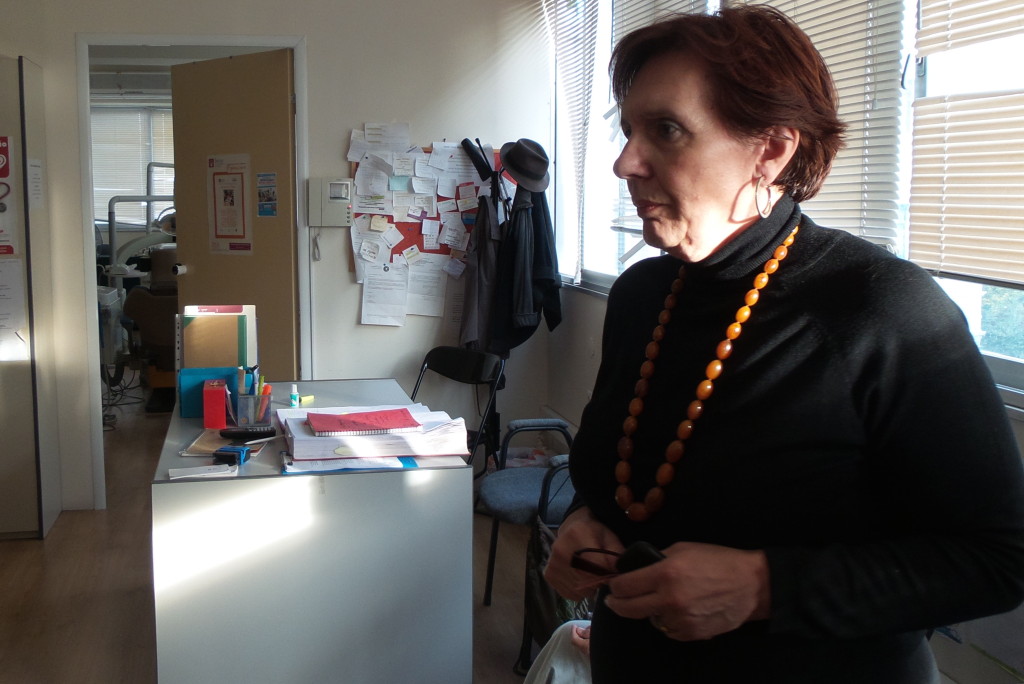
Sofia Tzitzikou

Sofia Tzitzikou

Sofia Tzitzikou, the acting president of UNICEF Greece draws attention to the quiet suffering of women, children and vulnerable people in Greece caused by economic manipulations.

With the best wishes of 2016 that everyone exchanges comes the true reality that goes beyond the turning page of the calendar. In Greece, nothing has been resolved and the measures that were imposed upon the population following the third memorandum are, as anticipated, aggravating the conditions of life for all, and even more so for the already vulnerable. As Sofia regrets, no policies are oriented toward the population in its individual and human representation. Nothing positive seems attainable at the moment, and a sentiment of despair washes over young people.

Notwithstanding, the UN report: Effects of foreign debt and Other Related Financial obligations of States on the full enjoyment of all human rights, particularly economic, social and cultural rights, that demonstrates and analyses the delirious effects of the system of debt, the harsh restructuring policies still go on.

Here is Sofia Tzitzikou who reminds us that the real danger is to become accustomed to such situations.


(Photo Credit: Brigitte Marti) (Interview conducted by Brigitte Marti)

The Stoned

The Stoned image

“I’m dead,” snorted the giant mammal as it crushed me. It fell on me wailing and crying before silence pervaded it. The world suddenly ceased to exist as a hush fell over everything. Over me.

No more of the savage howling of the wind, or the crackling sound of broken bones as stones rained from skies. I am crushed, not more than goo anymore. And I am lost in the abyss of its huge eye pressing onto me.

“I’m dead,” she says.

She pauses. Searching for words she can’t find.

“What about me?” I ask.

She ignores me, as if I don’t matter enough. That’s so typical of humans, so condescending.

“Ants do matter” I try to assure myself.

“If only I could hide in that crack on the wall. Who knows, I might have found myself in wonderlands,” she snorts with bitter laughter.

She pauses, searching for the look of contempt on my face. I realize that the deep nothingness inside me has dwindled. I can see and remember, as if I have always been part of her, present in all moments of her existence. My imperturbable face assures her.

A streak of light invading the wall from the corner of the curtain illuminates the cracks on the wall. It creates the image of a lonely thunderbolt frozen in time among the dried leafless brunches of a jungle. There is a new crack on the wall. It appeared last week. But it seems so familiar now, as if it has always been there, one of the crowds.

She feels a burning sensation as the cold tip of the knife cuts through the skin on her forearm. The world starts moving again. She licks the cut and tastes the salty metallic taste of blood on her tongue and contemplates the millions of bacteria that might have just entered her blood stream. With a faint lopsided smile on her lips, she imagines herself shrinking and entering the narrow crack on the wall.

The feeble light of an old lamp lights the sombre mud walls of the room. The nails holding the old and heavy blanket that covers the window have bent. ‘People talk,’ her mother had thought when she had nailed the blanket to the wooden frame of the window. She had told her, “It keeps the cold away”. The air outside this gloomy room is pitilessly raw. Stars have long forsaken its haunted sky.

Her frail body is crouched in a corner. Her pale complexion and the weariness in her eyes make her look out of this world. She is nostalgically listening to the tinkling of the stars as darkness infiltrates her skin.

Her heart is not beating. She puts her hand through her neckline, her skin feels hot against her cold sweaty palm. She has the look of someone teetering on a cliff, looking for something to hold on to. Anxiously moving her palm around to feel her heartbeat, she slightly brushes a nipple. Her hand violently jerks and withdraws itself of its own accord, creating a rush on the skin on her neck. Her heart is drumming in her ears as fear and disgust cling in the stifled air. Fear of stepping into forbidden territories.

She imagines beyond the curtain the sky changes colour. A storm roars. Rain impinges on earth washing away the walls like paint. The wind howls and uproots the dried up trees sending logs of wood dancing into the sky. She looks up. The gods are feasting and playing and the world is dancing all around her. Incessant needles of rain kiss her skin and she relishes in the pain of it all.

Clinching her fists so tight that her nails tear into the flesh of her palms, she screams. From the bottom of her lungs, with all the power she can gather in her fragile body. And for the first time, she hears her own voice.

Her sound is lost in the whirlwind of all things that should matter.

“I’m dead,” she reiterates calmly; “it really doesn’t matter, not anymore”.

Her corpse is pulled up as her eyes stare blankly into nothingness. A cold drop of tear washes me away from her. And as I fall into the dirt at the bottom of the pit, I see the question in her eyes. ‘Does it?’


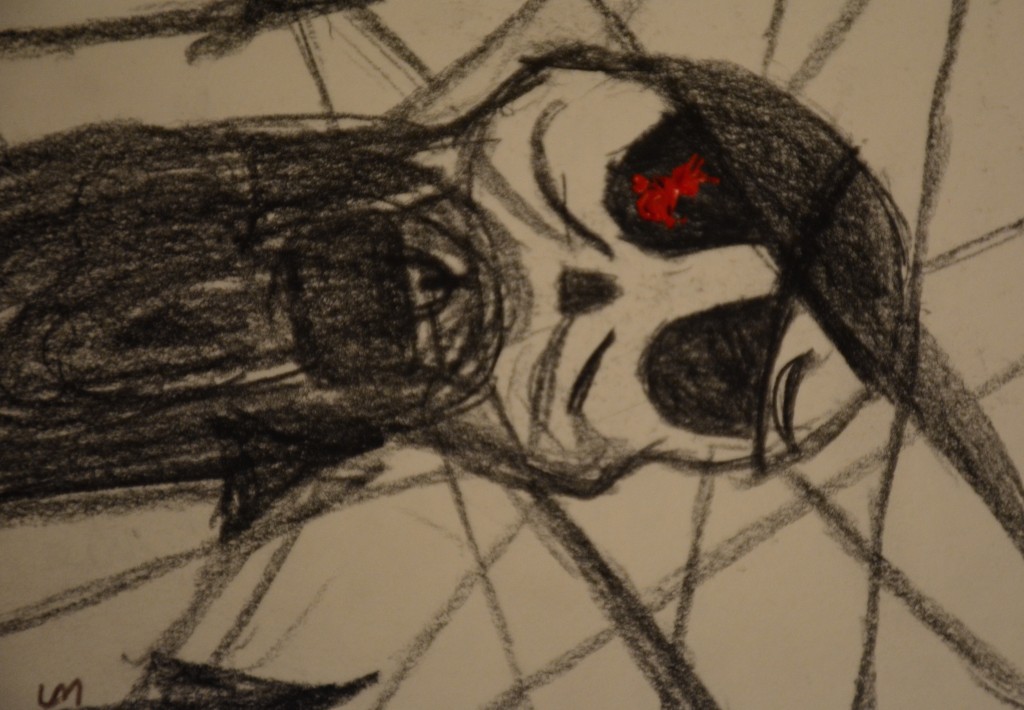
(Image by Leeda Mehran)

Women In and Beyond the Global will be back, January 10

WIBG takes a break

Starting today, December 10, Women In and Beyond the Global will take a one-month break, returning January 10. To all our readers, writers, collaborators and detractors, have a great and festive holiday season.

For Women In and Beyond the Global, it’s been a signature year. We began in January with pieces on indigenous women in Canada; women activists in Zimbabwe; reflections on the assault on Charlie Hebdo in, and beyond, Paris; reflections on police accountability and #BlackLivesMatter; and something on #BringBackOurGirls and the implications of our responses to the abduction and violence against women and girls in Chibok, Nigeria … and that was just the first week.

We end the year with a piece on transgender women prisoners in the United Kingdom and Canada; a reflection on women, climate change and women’s power in the Netherlands and across Europe; a reflection on Afghanistan’s response to Europe’s response to Afghan refugees; a critique of Switzerland’s banning the burqa … and Muslim women more generally; and a piece on Greek women rejecting and resisting austerity regimes.

Thanks to our writers and readers for your contributions, engagements, and insights with Women In and Beyond the Global this calendar year. Thirty-one people wrote over 200 pieces this year, which for us is quite an accomplishment. Thanks to your great work and labor, our readership grows, and, more importantly perhaps, the conversations grow and connect. We’ve also branched into Radio WIBG, an occasional series of audio files, and next year are looking forward to a video series as well. Finally, we’ve begun new partnerships, in particular with 50/50 magazine, in France, and deepened others, especially with Rape Crisis Cape Town Trust Fund, in South Africa. We look forward to more exciting collaborations next year.

Let’s do more than hope the end of this year and the entirety of next brings peace with justice and love. Let’s do more; let’s make it happen, step by step, prison by prison, household by household, and beyond.

Radio WIBG: Zoe Konstantopoulou: In Greece, a woman to defend women’s and human rights

Zoe Konstantopoulou

Zoe Konstantopoulou

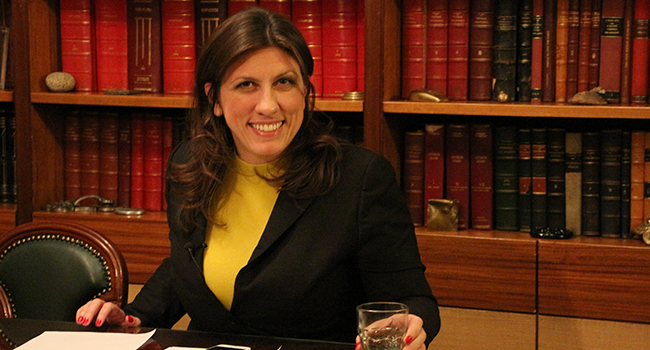
Progress may be illusionary. At the time of a global set back in terms of women’s human rights, with forceful movements of dispossession, the Greek crisis epitomizes this global process of dismantlement of social and democratic representation. In 2010, Greece was declared guilty of public debt. Consequently, Greece as a country was put in the custody of the Troika (the European Central Bank, the European Commission, and the IMF), a non-elected extraterritorial jurisdiction. Zoe Konstantopoulou in her first term in the Hellenic parliament with Syriza showed her determination to change the regime of undemocratic, unattended corruption that reigned in the parliament at that time, allowing the odious measures of austerity to control the country.

Konstantopoulou resisted the outrageous mockery of democracy, as on September 2013, when a series of bills were declared by the President of the Hellenic Parliament (the Vouli) of the time Kiriakos Virvidakis, adopted unanimously without actual votes. No debates took place in the Vouli that day, and only Zoe Konstantopoulou, one of the three delegates present, was screaming and demanding proof of the vote, to no avail.

In January 2015, Syriza won the election and Zoe was elected with 60% of the vote as President of the Hellenic parliament. She immediately instilled an anti corruption climate. In addition, for her restoring the democratic process meant inviting the civil society to be finally recognized. She celebrated women’s struggles for social justice. In April 2015, she mandated an audit of the public debt, forming the Debt Truth Committee, which released a preliminary report in June 2015. She declared during a meeting in Paris last May: “austerity kills, it kills society, human beings, and kills democracy and the Europe of people.”

The recent report of the Independent Expert on the effect of foreign debt and other related Financial Obligations of States on the Full Enjoyment of all Human Rights concurred with Zoe’s analysis. It stated, “To think of Sovereign debt markets as totally independent from the notion and realization of social and economic human rights is something unacceptable…” (Article 55)

The report also emphasized that with a 35.7% increase of the number of people falling into poverty, “austerity appears to have exacerbated the social crisis in Greece and have failed to stimulate the national economy to the benefit of the Greek population.” The same report asserted the importance of an audit of public debt.

Zoe Konstantopoulou lost her seat after the coup that triggered the new election last September. After the election, the audit was abandoned and its preliminary report and process were erased from the parliament web site. Syriza was reformed without people like Zoe; nonetheless she continues the struggle in the name of justice.

Let’s listen to Zoe Konstantopoulou:

A longer set of interviews with Zoe Konstantopoulou is available, in French, here.


(Photo credit: Marie-Hélène Le Ny) (Interview by Brigitte Marti)

THOU SHALT NOT WEAR THE BURQA

Member of Islamic Central Council of Switzerland member distributes flyers against veil ban

A few weeks back Switzerland passed a law banning women from going out in public in a burqa. The fine for such an offence is $10,000. Even tourists are not exempt from this law. A similar contentious debate over Muslim women wearing burqas in public arose in Canada. Conservative candidates want to bring about a ban on the hijab or burqa, while liberals argue for freedom of religion. In protest, one man appeared at the polls wearing a pumpkin mask and another covered his face with a Mexican wrestling mask to make a statement on the foolhardiness of a law that bans burqas in public.

Comedy aside, what are the repercussions of such a law that conveys that some people are not welcome unless they assimilate with the majority culture? Perhaps the burqa makes the Swiss uncomfortable. But in this era of mass migrations, multicultural societies should have made that discomfort passé. So will the Swiss next ban Indian women from wearing saris because this clothing exposes women’s midriffs?

Such a law will further ghettoize Muslims and make them hardened in their beliefs because they are reacting to a majority culture that demonizes Muslims for such customs. Such a hardening in fact harms future generations of Muslims within Switzerland and also increases the gulf between them and the majority culture.

The choice or lack of choice to wear the burqa depends on particular families and the cultures from which they originate. The politics within these cultures have also influenced the wearing of this clothing. There are many debates within Muslim societies about women’s freedom and their choices. If we do not allow for a community to figure out its choices, but impose a choice (or lack) from outside, we are colonizing these communities. The Swiss may argue they are liberating Muslim women by enacting the ban on the burqa. The Swiss are doing exactly what feminists did in much of the last century by imposing their ideas of liberation on minority communities. It is paternalistic and condescending to impose an assimilationist model on Muslim women.

Many of us, Muslims and non-Muslims, may feel that the burqa is a symbol of women’s subjugation, but do we have the right to impose our view on another? And if a Muslim woman does choose to wear a burqa as a sign of her surrender to Allah, do we have the right to tell her that her experience of spiritual liberation does not match with our idea of women’s freedom? Of course, in many fundamentalist communities, women are forced to wear the burqa. But does it mean that the members in these communities are not debating the issue?

In fact, the Swiss will be surprised to find that if the ban did not exist, Muslim women in the next decade could very likely appear in public without the hijab or the burqa or the niqab.


(Photo Credit: AFP / AlJazeera)

The Unwanted Afghan Immigrants In Pursuit of Golden Pavements

Accomplishing the twelve labours of Hercules, Afghan refugees get to Europe. They risk their lives, leaving everything and everyone they love behind. All this time, knowing that they might forever be branded as unwanted refugees and immigrants and might never recover from the nostalgia for “home”. For a better life.

According to Reuters, Afghans are widely viewed as unwanted migrants that form the sixth largest group of asylum seekers in Europe’s economic powerhouse in the first 10 months of this year. Germany’s Interior Minister Thomas de Maiziere had previously said that Afghan should “stay in their country”.

On Wednesday speaking a joint conference with Afghan president Ashraf Ghani in Berlin, the German Chancellor Angela Merkel threatened that Afghans who arrive in Germany in pursuit of better financial circumstances will be deported back home, “But where refugees come hoping for a better life – and I know that this hope is big for many – that is no reason to get asylum status or residency status here”. She further stated that “protected zones” should be created within Afghanistan, so that people living in unsafe areas move to protected and safe regions of their own country, instead of heading to Europe.

However, what caused a major backlash in the Afghan social media was the way the Afghan president responded. Concurring with Merkel that false information regarding immigration to Germany has been circulating which should be cleared; Ghani said, “We need to…make sure that everybody understands the streets are not paved with gold”.

With the exodus of Afghans, Afghan leaders have been concerned about the “brain drain”- the departure of some of the best minds of its young generation. Ghani’s government has launched a slick social-media campaign to dissuade Afghans from migrating to Europe urging the people that “our dignity, our respect is in Afghanistan”. “Don’t go. Stay with me. There might be no return,” or “Afghanistan needs you!” are messages Kabul is sending to its citizens who contemplate leaving.

In a recent interview, Ghani was asked if he can’t guarantee people safety and an economy that works, what should they stay for? He was also asked that while the families of the privileged elite – the vice presidents, cabinet ministers, his chief executive – all live outside and their children study, live and have fun in Europe and the United States, how can he ask the ordinary people to stay?

The interviewer astutely did not mention that the President’s own children live in the United States. Ghani condescendingly continued his line of reasoning saying, “If they live abroad, they become dishwashers. They don’t become part of the middle class”. Ghani was widely criticized for this statement in Afghan social media, which prompted a clarification by his spokesperson a few days later. On Sunday, his deputy spokesperson stated that, “what the president meant by that statement was that well educated and experienced Afghans who travel abroad don’t get that many employment opportunities”.

Mass unemployment, prevalent violence and the rise of the Taliban and ISIS as a result of the security vacuum created by the withdrawal of the foreign troops are some of the main factors that have contributed to mass immigrations. And the current government has proved its incompetency over and over in dealing with these issues.

So, Mr. President! As a young Afghan woman living in the diaspora who has washed dishes, I can assure you that it’s much more dignifying than being lynched or stoned a few blocks down your street. Or getting shattered into pieces next to a suicide bomber on the route to the non-existent job that you encourage me to stay for.


(Photo Credit: Reuters / Alkis Konstantinidis)

Radio WIBG: Sascha Gabizon and COP 21: “We need to include the language of gender equality”

Sascha Gabizon

COP 21 has opened in a difficult “climate.” After the attacks in Paris, a state of emergency has been declared. With that came the cancelation of all climate demonstrations organized by civil society. Nonetheless, a human-chain was organized gathering 10000 people; creative ways of demonstrating took place, thousands of shoes paved Republic Square to symbolize the march for the climate.

However, the abuses of the state of emergency are now being made visible and denounced, as 24 eco pacifist militants, some not even located in Paris, have been placed under a sort of house arrest during COP 21, marking the widening denial of democratic rights.

Climate change means the global elimination of people not only in Syria or Afghanistan but also generally in the global South. The COP negotiations work within the neoliberal market, shaping the climate paradigm as exchange value of the temperature degrees instead of taking into consideration the harshening condition of human lives, again ranked by gender, race and class.

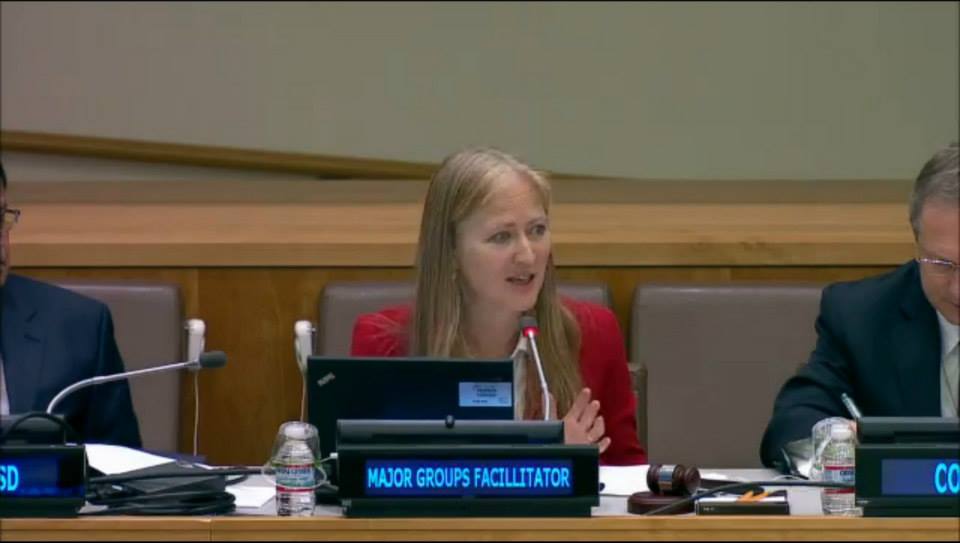
In this context the task of Sascha Gabizon, one of the co-facilitators of the Women Gender Constituency, a large coalition of feminists and women’s movements, is going to be arduous.

Climate disasters target women. As Sascha recalled, in the 1991 floods in Bangladesh 90% of the casualties were women. As climate disasters occur regularly, as in the Philippines, they impact in majority women, mainly because of gendered distribution of labor and roles.

As a result, we see all kinds of radicalization against women with the widespread expansion of brutal practices against women, in their home, in their everyday life, in prisons and jails, as well as the erosion of women’s rights especially sexual and reproductive rights in an increasing number of countries.

Sascha insists: “We need to include, in the first article of the COP 21 agreement, the language of gender equality, of equality in terms of human rights as defined in the United Nations charter including the rights of indigenous populations. Moreover, she remarks that in the current negotiations, this language is shockingly deemed unnecessary even by countries such as Norway.”

By the same token, she underlines the impossibility of women’s groups even the largest to use the financial system for the climate as currently defined for any of their projects simply because it requires a 10 million Euros investment, an amount of money impossible to collect for these organizations. Additionally, locking up countries in the current public debt system has dire impacts on any initiatives, local or state especially in emerging countries.

Finally, the reality of the increase of temperature means the elimination of lands and therefore populations. While we are justly appalled by the deaths from blind attacks in the streets of Beirut, Tunis or Paris, our eyes turn away from the surviving struggles of the populations of the South who have not produced this climate disaster.

Listen to Sascha Gabizon

and a longer interview, in French, is available here.

(Photo Credit: UN Women / Fabricio Barreto)

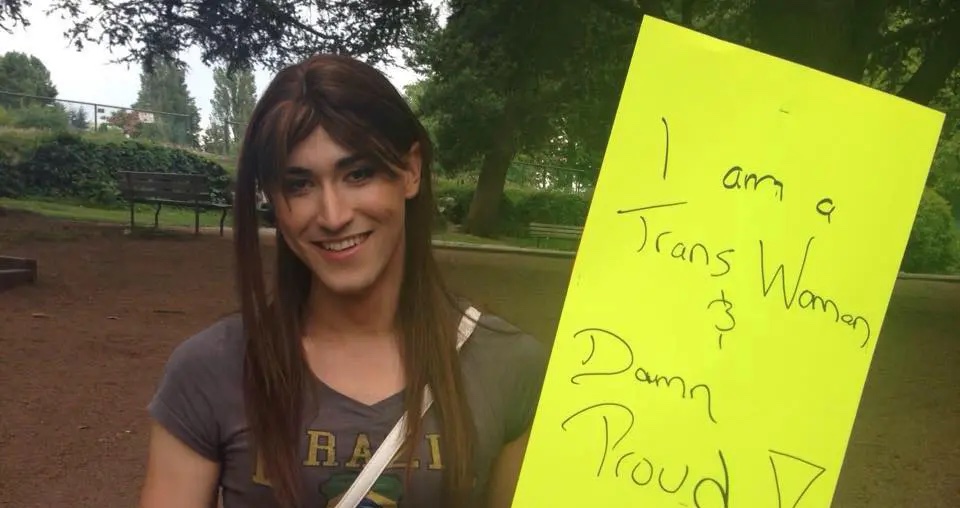
Transgender women prisoner warriors: Bianca Sawyer, Tara Hudson, Vikki Thompson


November 20th was the annual Transgender Day of Remembrance, a day to honor transgender people who have been murdered and transgender communities, past, present, future, who have survived. This is the story of Bianca Sawyer, Vikki Thompson and Tara Hudson, transgender women who were all `released’ this week.

Yesterday, it was reported that Vikki, or Vicky, Thompson was buried near her home in Keighley, West Yorkshire, in England. She was twenty-one years old. Her story is short, too short by far. Vikki Thompson, born male, identified all her adult life as a woman. She was arrested for robbery and sent to a men’s prison. She said if she were sent to a men’s prison, she would kill herself, and she did. The State is `investigating” … again. Vikki Thompson was released from all of that, however.

Yesterday, it was reported that Tara Hudson was also released. Tara Hudson is twenty-six years old. Born male, Tara Hudson has also self identified and lived as a woman all her adult life. She was arrested for getting in a fight with a barman, and was sent to a men’s prison. After much organizing, including a petition that went viral, Tara Hudson was finally moved from a men’s to a women’s prison. Yesterday, she was released from prison altogether.

A week ago, British Columbia announced it would start housing transgender prisoners according to their stated gender identities. This change in policy emerged largely from the mobilization of Bianca Sawyer, a transgender woman who has been in and out of the system for ten years, always placed in men’s prisons. After ten years, she had had enough and began petitioning and organizing. The last straw for Bianca Sawyer was the staff: “A group of, like, eight or nine officers were joking about how it would feel to get oral sex from me, and running their hands through my short hair [and making] jokes about me growing breasts. I was really upset. That night, I was like, ‘I don’t belong here.’”

When the State, in the form of staff members, began treating Bianca Sawyer with the misogyny and indignity it visits on women, she decided it was time to move. This is not irony, but rather the everyday of gender identity in the nation-State of mass incarceration.

Bianca Sawyer won her removal and managed to move the province to change its policies. British Columbia follows Ontario in recognizing prisoners’ gender identity based on the prisoners’ testimony, rather than the `science’ of experts, bureaucratically dispensed. For once, autonomy subsumes anatomy. What happens to transgender women in prison in your jurisdiction? Find out, and write to us. Remember Tara Hudson and Bianca Sawyer, and remember this, Vikki Thompson did not kill herself. The State killed Vikki Thompson, and will kill others.

(Photo Credit: The Globe and Mail)

What I’m about to say is based on the belief that a woman’s life matters

I wanted to start talking about Planned Parenthood and all of the fantastic services they provide to low-income and minority women. And I found myself minimizing their provision of abortion services. And I got pissed. So this post isn’t about that. This post is solely and entirely devoted to the termination of pregnancy and the women and girls who require them. Too many very well-intentioned people talk about Planned Parenthood as only doing some teensy number of abortions. That ain’t the goddamn point. Let me be among the first to call for an all day, everyday, 24 hour, drive thru abortion clinic with twofers and a free milkshake if you come on Mondays. Why? Women, that’s why. Because there aren’t enough abortions in my frank opinion, that’s why (you know you agree with me). Because to terminate a pregnancy is not a bad thing, it is a medical procedure, that’s why. 

This may be hard to read but, honestly, it really shouldn’t be. What I’m about to say is based on the belief that a woman’s life matters. That a girl’s life matters. Well, actually, that’s not fair. What I’m about to say is that our lives and bodies matter more than a baby’s. Yes, I am that warrior. I am saying what I suspect many of us feel but are afraid to speak aloud when confronted by talk of when the fetus is viable, when conception starts, when the fetus grows nails, heart beats, knows its mothers voice in the womb. And that is this: so what. So what if the fetus — fuck it, the baby — is playing chess rivaling Magnus Carlsen, playing double-dutch and hopscotch in the womb. If the mother does not, cannot carry the baby to term for gut-wrenching or superficial reasons then oh the fuck well.

I care about the lives of adult women and girls who are faced with a decision about their bodies and livelihoods. This battle is not about choice versus life. It’s about — and has always been about — whose life matters more and who gets to determine that. Think about it, women have always terminated pregnancies, that’s never going to end. This abortion battle is about the fact that many folk, mostly men but not all men, don’t like women deciding who lives and who does not.  In the history of women and motherhood, whether abortion was legal or not, women have had to determine who mattered more. Folks don’t like that. That’s what this age-old debate is really about and will continue to be about. So folks make it harder for lesser empowered women to make that choice about giving or not giving life. Because last I checked no one’s shooting up insurance companies that fund abortions, nope. Just the places that offer affordable options.

So to sum up, this is not about life versus choice, this is about women deciding to give life and the implications of such a reality. Further, this is about poor and women of color deciding to give life. Because, again, last I checked, private insurance companies can and do cover abortion and nary a protest or shooting occurs outside of their offices.


(Photo Credit: Urban Grace Magazine)