How is the border story told? Let’s look at Ciudad Juárez as an example. Reporters Without Borders and the Centre for Journalism and Public Ethics (CEPET) released a report this week that “points out that the deployment of many federal personnel – civilian and military – to this major drug-trafficking stronghold has not made the city any safer and has even exacerbated the violence.” The deployment of federal personnel exacerbates violence. Gaza, meet Ciudad Juárez.
But El Paso, just across the river, is safe. Why? For some, it’s the new immigrants, “who tend to be cautious, law-abiding and respectful of authority”, as well as Fort Bliss and a heavy police presence. Why does military and civilian presence in El Paso reduce violent crime, but increase it in Ciudad Juárez ?
A recent New York Times article ends with Marisela Granados de Molinar, who “was an office manager at the Mexican attorney general’s office in Juárez, but lived for decades in El Paso with her husband, Jose A. Molinar Jr.”. For decades, she crossed the border. In December, giving her boss a lift to El Paso, her car was riddled with bullets. Her boss “wanted to visit Wal-Mart.” Her husband reflected, “She was never afraid. She thought she wasn’t important enough for them to care about.” Not important enough to kill.
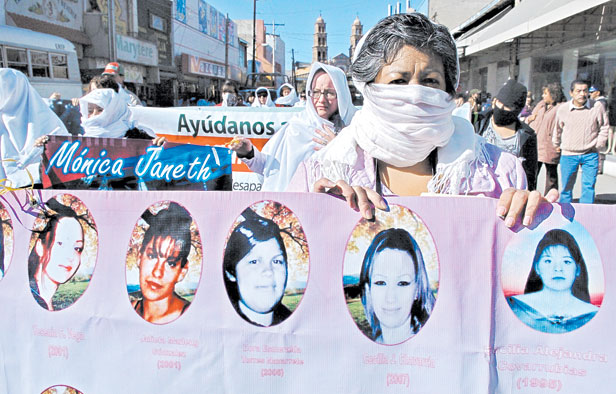
This is an old story, the story of murdered women not important enough to kill. Ask the mothers of the disappeared of Ciudad Juárez. They’ll tell you, it’s an old story: “On the same day Barack Obama was inaugurated as the first African-American president in U.S. history, an old story was repeating itself in Ciudad Juárez, Mexico, across the river from El Paso, Tex. Staging a caravan through the violence-ridden city, a new group of mothers of disappeared young women brought public attention to the cases of daughters who have gone missing since January 2008. Holding a rally at the downtown cathedral, the mothers demanded their daughters be returned home alive. . . . All of the disappeared young women are teenagers who went to school or worked for a living, and most were headed to downtown Ciudad Juárez, the scene of numerous disappearances since the 1990s.…At least 29 new cases of women who have disappeared in Ciudad Juárez since January 2008 are pending… The latest rash of women’s disappearances coincides with violent upheavals in the criminal underworld, increased seizures of drug loads, changes in political administrations, and deployments by the Mexican army or federal police. Since 1995, several groups of relatives have thrust the issue of their missing daughters and sisters into the international spotlight. Mass protests, which reached their zenith in 2003-04, prompted the administration of former Mexican President Vicente Fox to create new government bureaucracies, including a special commission on violence against women in Ciudad Juárez and a special prosecutor’s office. Both agencies were widely criticized for failing to clear up numerous disappearances and femicides. Since Mexican President Felipe Calderon assumed power in December 2006, the two agencies have become virtually invisible. Meanwhile, murders of women officially reached all-time heights in Ciudad Juárez last year, when at least 86 women were slain; many homicides were connected to the narco war that claimed more than 1,600 lives overall. Women´s murders have continued into 2009.”
It is an old story, but it’s not the whole story. Scholars and activists have addressed the femicide of Ciudad Juárez as local and national, the old story which must be told, and also as transnational, the story of the border town under neoliberalism, of the Mexican border town under NAFTA. Laura Carlsen this week noted that NAFTA begat the Security and Prosperity Partnership which begat the Merida Initiative, or Plan Mexico, which militarizes, well, everything and everyone south of the Rio Grande. Plan Mexico claims to impede transnational criminal activity, which, of course, only flows south to north. And the south-to-north “contagion” justifies militarization of civilian zones: “the militarized approach to fighting organized crime, couched in terms of the counterterrorism model of the Bush administration, presents serious threats to civil liberties and human rights. In Mexico, this has already been clear particularly among four vulnerable groups: members of political opposition, women, indigenous peoples, and migrants”. All those murdered ones not important enough to kill. Women are women, and women are members of the opposition and indigenous peoples and migrants.
NAFTA reordered the borderlands, in particular for women. Many have written on this. From Shae Garwood’s “Working to Death: Gender, Labour, and Violence in Ciudad Juárez, Mexico” to Melissa W. Wright’s Disposable Women and other Myths of Global Capitalism to Kathleen A. Staudt’s Violence and Activism at the Border: Gender, Fear, and Everyday Life in Ciudad Juárez, the myth of the disposable women is fused to the reality of the indispensable women. The murders and disappearances of women was never “merely” individual or local. The Juárez femicide is part of the historical moment, the moment of NAFTA, of economic and political restructuring. Women responded with new organization and action. Women of the border town Ciudad Juárez know that militarizing the police brings more violence against women. Their state of terror comes from gangs, police, soldiers, partners, and employers. For Staudt, violence against women is the overarching problem at the border.
Violence against women is the border. Everything of the border must be understood in the context of violence against women. Irma Maruffo gets it: “Women do not enjoy the freedom of secure transit in the city, and this is a right and a responsibility of political authorities and the legal system.” The regime of state and the rule of law stand accused. The Mexico – U.S. border has been redrawn by NAFTA, by the State, the Law and the Market, that value `national security’ over women’s freedom. The inequalities of that border generate and gender violence. Open that border, and make freedom and peace, rather than security, a priority and goal.
(Photo Credit: Borderland Beat)