For women workers, it’s time to change the song

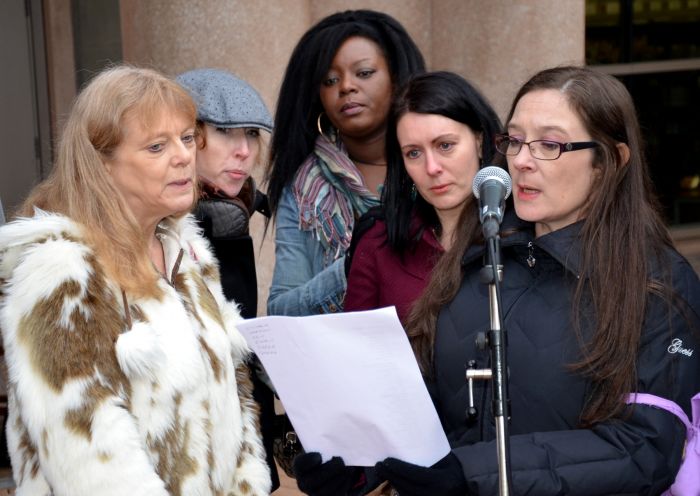
Reading the names of missing women

Across Turkey, women are at the forefront of the demonstrations. And not only women. Feminists: “At first groups of students chanted: `We are the soldiers of Ataturk’; this died out after feminist protesters objected to its militaristic overtones.”

From the first eruption through today, the Turkish movement has been a giant popular feminist education site, and one that includes sex workers: “`We used to sing ‘Erdogan is the son of a whore’. But when the police teargassed us, one of the brothels on Taksim Square opened its doors, and the women gave us shelter and treated us with lemons. We don’t sing that any more.’”

The solidarity of sex workers taught demonstrators that sex workers are workers, sisters, and women. Sex workers are not epithets or metaphors, and they are not criminals. They are part of the working mass, and they can represent themselves.

In the past week, sex worker organizations have taught exactly the same lesson to workers, social movements, and the State, around the world.

Across Canada this weekend, sex workers and supporters demonstrated, under the Red Umbrella, for legalization of sex work and for sex workers’ rights as workers, women, and women workers. This week, Canada’s Supreme Court will finally hear a challenge by Terri-Jean Bedford, Valerie Scott and Amy Lebovitch to the constitutionality of the laws concerning sex work.

Former and current sex workers have argued that criminalization makes sex workers more vulnerable, forces them further underground, further isolates them, and impedes access to public and social services. It’s a hard life, and the laws only make it harder, sometimes fatally so: “When Kerry Porth remembers her life as a sex worker in Vancouver, she can’t help but wonder how she survived when so many other prostitutes died a gruesome death at the hands of notorious serial killer Robert Pickton. `They were women just like me. Looking back, realizing just how much risk I was at, it was a real eye-opener.’”

In Kenya, sex workers in Laikipia District have organized a group called the Laikipia Peer Educators. They want formal recognition. They want the protection that formal recognition might provide, and they want the citizenship, the opportunity to participate and contribute to the common good in the same manner as every other worker. They want to trade in stigma for taxes.

In Australia, the Scarlet Alliance, representing Australian sex workers, lobbied to have foreign sex workers included among the skilled work visas. Sex work is legal across Australia, to varying degrees, but it’s not considered “skilled labor” by the State, at least not yet. Massage therapists, gardeners, florists, cooks, dog handlers, fashion designers, bed and breakfast operators, entertainers, dancers, recreation officers, makeup artists, jockeys, gymnastic coaches and horse riding instructors are considered skilled labor, but not sex work.

This is about work that is not called work, workers who are not called workers, and women who are told they cannot represent themselves. This concerns sex workers, as it concerns domestic workers in the United States. Both Hawaii and California seem to be on the verge of implementing or of passing respective Domestic Workers Bill of Rights. All workers are workers. Period.

Feminist political economists have argued for decades that women’s work is work, whether it’s waged or not, whether it’s called work or not. Women workers have known this and have organized for centuries for recognition, dignity, autonomy, rights and power.

From the social movements in Turkey to the courthouse in Canada to the District government in Kenya to the Australian Department of Immigration and Citizenship to the state houses across the United States, it’s time. It’s time to recognize women’s work, all work, as work, and to recognize all workers as workers. It’s time to change the song.


(Photo Credit: Rabble.ca / Murray Bush / Flux)

Laura S. didn’t have to die

This is the story of Laura S.

Laura was born in Mexico in 1986. She became involved with a boy, Sergio. Early on Sergio became violent. And Laura stayed with him. At the age of fourteen Laura S. gave birth to their first son, in 2001. She became a resident of Hidalgo County, Texas. She gave birth to two other sons by Sergio, in 2007 and 2005, respectively.

Sergio became increasingly violent and abusive. In March 2003, Laura obtained protection from the local police and courts. Sergio kept harassing Laura. In 2008, she obtained an order of emergency protection. Furious, Sergio returned to Mexico.

On June 8, 2009, Laura S. went out with a cousin and two friends. They were stopped near Pharr, Texas, by a local police officer for a minor alleged driving infraction. The officer then demanded their immigration papers. Only the cousin could produce papers.

“Laura S. began to weep, begging the officer to let her go.”

She explained about Sergio, about the threat to her life. She explained about the protective orders. She explained that her life would be finished, and violently so, if she were returned to Mexico. She talked about her three small children, one of whom was about to have surgery.

The police officer turned the three over to ICE. ICE took the three to Harlingen U.S processing center.

“On the way to Harlingen, Laura S. continued to weep and beg to be released.” More agents came in. Laura explained everything, again, to the federal agents. Laura wept and explained, explained and wept, begged and explained, explained and begged. No one listened.

Laura wept and trembled as she spoke with the agents. No one asked her any questions. No one tried to verify or evaluate her risk of harm. No one explained any of her legal rights to her. If Laura had had a hearing, even in Texas, there’s a good chance she would have been able to stay in the country.

Given the dangers Laura faced in Mexico, a hearing should have been “mandatory and non-discretionary”. Laura never saw Judge or lawyer. Instead, the federal agents decided on their own to ship Laura S to Mexico.

Although the agents intimidated and coerced Laura, she never agreed to go. She continued to beg and explain, to explain and weep, all the way to the Hidalgo/Reynosa international bridge. In the early morning hours of June 9, 2009, a mere few hours after having been stopped, Laura S. was forced to cross the bridge into Mexico.

Within a few days, Sergio found Laura, and slowly tortured and then brutally killed her. On June 14, less than a week after the traffic stop, Laura’s body was found in a burning car. Her mother went to Mexico and testified against Sergio, who was imprisoned. He later escaped.

Now Laura’s mother and her three young children are suing ICE and the Border Police.

Laura S. was forced to cross the bridge into Mexico. What authorizes that force? What is the the force that `gives’ a woman protection only to steal it at the moment its needed? What is the force that refuses to listen to or hear a woman begging for life? What is the force that refuses to recognize its own “mandatory and non-discretionary” rules?

That force is the regime of brothers, the fratriarchy, which underwrites national democratic sovereignty. One law protected Laura, but those federal agents understood that there is a more powerful law. There is the law of force that makes brothers of police agents on one side of a border and a torturer on the other. And the shuttle that binds them is always a woman.

And so Laura S, weeping and begging and explaining and trembling, was forced to cross the bridge. Her mother’s lawyer says, “Laura didn’t have to die.” Tell that to the State.

(Photo Credit: Proceso)

A tale of two (billion) women farmers


Mwajuma Hussein

In two days, in Jakarta, Indonesia women farmers from all over the world will gather under the banner slogan, “Sowing the seeds of action and hope, for feminism and food sovereignty!

Close to 2 billion women, out of a global population of around 7 billion, depend on agriculture for their livelihood. For those women, these are the best of times, these are the worst of times. Herein is one tale of two women farmers in these times.

Mwajuma Hussein is a 75-year-old woman farmer in the Geita Region of Tanzania. In 2007, she and all the residents of her small rural farming community, Mine Mpya, were evicted from their homes and lands to make way for the Geita Gold Mine, operated by AngloGold Ashanti, a South African mining corporation. They were forced out and have lived since, for close to seven years, in a “cluster of makeshift tents constructed from plastic sheeting and bits of wood and metal.” As Mwajuma Hussein remembers, “[One day in 2007] I was attacked by police at 5am.  They arrested three people and beat them, and then they dumped us here.” In the bitterest of ironies, the residents sometimes call their “cluster” Sophiatown, and other times they call it Darfur as well.

Women make up a large and increasing part of the agricultural work force of Tanzania. On the one hand, men are leaving to work in the cities or in the mines. On the other hand, women play an integral role in agricultural production and ensuring household food security. Women are in charge of farm labor, especially subsistence crops; child care; food preparation; water retrieval; household maintenance; caring for the sick; building and holding community together. Women run the farms … up to a point. Women do not have formal decision-making authority over land use and earned income, and they have at best tenuous land rights. For widows, the situation is even more precarious.

What happens to the women farmers of Mine Mpya now? They become day laborers. Where life was difficult before, especially for women, it is now reduced to the hardship, and practical impossibility, of purchase-based survival. Where before, women ensured that the household had enough food to live, enough water to function, and enough social connections to weather almost any storm, now that’s all gone.

Phindile Nkosi is also a woman farmer, in the Mpumalanga Province of South Africa. She has a share of Elukwatini Farm, in an arrangement with the upscale mega-market Woolworths. Woolworths set up Elukwatini Farm this way: 13 farmers farm 1 hectare each. Those who succeed get more hectares. The others are out. Phindile Nkosi now farms 3 hectares, and employs five full-time workers. It’s good for her, for her children, for the region.

As Phindile Nkosi explains, “There have been no jobs in the area since the mines closed down 15 years ago. But Woolworths has helped us to help ourselves and the community. When my neighbours saw how poor I was, living in a mud house to what I am now, they too want to start farming. For my children as well it’s been good.”

Phindile Nkosi is a single mother of four. With the profits from selling tomatoes to Woolworths, she has managed to build a home and to send her eldest through university.

Are “Sophiatown” and Elukwatini signatures for the worst of times and the best of times? Yes and no. In both Geita Region and Mpumalanga Province, women farmers are responsible for sustaining food production and reducing household food insecurity. The hand that rocks the cradle tills the fields. In both Geita Region and Mpumalanga Province, the mining industry devastated the agricultural sector at large and the political economy of women’s lives.

Most critically, both stories point to the utter refusal of the State to address women farmers. Mwajuma Hussein was not removed from her home by mining security guards.  Police removed her. Phindile Nkosi did not live in a wasteland created by the mine’s closure. She lived in a wasteland created by State policies of “non-intervention”. A little over ten years ago a study reported that rural women in South Africa were “isolated, confined and marginalized through the non-interactive government policies on rural areas.” Since then, rural women in South Africa have become more active and engaged in farming and in farm work, no thanks to any `interaction’ from the State.

In Tanzania and in South Africa, the rural zones are treated by the State as empty space, and, for the State, the women who inhabit that empty space don’t exist. If they’re lucky, a `beneficent’ corporation will come to their empowering rescue. If they’re not, they end up in Sophiatown – Darfur. Either way, where is the State?

Phindile Nkosi

(Photo Credit 1: IRIN / Zahra Moloo) (Photo Credit 2: Business Day)

Recognizing Virginia’s “non-violent felon” women voters

Great news from Virginia: “In a major victory for voting rights, Virginia’s Republican Gov. Bob McDonnell has announced he will automatically restore voting rights for people with nonviolent felony convictions. His decision will eliminate the two-year waiting period and petition process that currently disenfranchises thousands of nonviolent felons who have completed their sentences and satisfied all the conditions of their punishments. According to the Sentencing Project, 350,000 Virginians who have completed their sentences remained disenfranchised in 2010.”

Last year the Sentencing Project reported that 350,000 Virginians fell under the felony disenfranchisement regime. Virginia is one of six states where more than seven percent of the adult population is disenfranchised. Virginia is one of three states in which at least 20 percent of African Americans is disenfranchised. That’s three states – Florida, Kentucky, Virginia – out of fifty. Virginia is one of the seven states in which more than 7 percent of the adult population is disenfranchised.

The key phrase is “people with non-violent felony convictions.”

While it’s not particularly surprising that the gender of “people with nonviolent felony convictions” goes unnoticed, it’s worth noting. The majority of formerly incarcerated women in Virginia are “nonviolent offenders” … and are women of color.

In his letter to the Secretary of the Commonwealth, the Governor, not surprisingly, ignores the gender and racial component: “I believe that a person who is a non-violent felon, and has served his time as well as probation or parole, and fully satisfied all court costs, fine, restitution, and other court-ordered conditions, should be able to regain his civil rights and resume his life as a fully engaged member of society.”

Before you think this is too fine a point, the Commonwealth of Virginia Restoration of Rights page doesn’t speak of the restoration of his rights. It speaks of the restoration of his or her rights. The her matters.

Most of the press joins the Governor in ignoring the her side of rights restoration. Most, but not all.

For example, Benjamin Jealous suggested: “If you’re a drug addict and you’re poor, you tend to go to prison. You’re rich, you tend to go to Betty Ford, right? Or the equivalent. And when you go in, if you’re a woman—and that’s been sort of the huge increasing demographic over the last 20 years—your kids go to foster care. Well, you don’t get your kids out of foster care when you get home from prison. You get them home—you get them out of foster care when you get home from prison and find a job and can keep it. And for formerly incarcerated people, they find that they have this kind of scarlet “F” on their forehead, where it’s almost impossible in many places to get a job, where you can’t vote in places like Virginia, where—one woman spoke passionately yesterday about what it was like to be speaking to the Republican Women’s Club and asked to sign a petition for somebody who wanted to run for office, and be interrogated about why you couldn’t sign it, and finally have to sort of re-out herself as somebody who, on her worst day, had done something wrong and become a felon. And so, this is how we put people in—you know, kind of push people out of our society while having them live right amongst us.”

In Virginia incarcerated women are the huge increasing demographic for the last two decades, and the overwhelming majority are in for non-violent offenses. Since 1990, Virginia has had one of the highest increases in time served by prisoners and keeps people in prison for longer than most states. Recently the Commonwealth established the Virginia Criminal Sentencing Commission to address the possibility of diversion and alternative sentencing.

The Virginia Criminal Sentencing Commission found that for drug and fraud offenses, women are a much, much better `risk’ than men, nine times better. For larceny, men are a somewhat better risk, about 1.5 times better. Most recently, these numbers translated as follows: 635 drug cases for review; 951 fraud cases; 185 larceny cases. In the overwhelming number of cases, then, women are a much better prospect for anywhere but behind bars. That’s according to the Commonwealth of Virginia.

Virginia has taken a historic first step. It’s not quite a leap, but it’s an important step. Now, revoke the lifelong ban on access to welfare. Virginia still has a complete lifetime ban on welfare receipt for formerly incarcerated people. Less than a third of the states have such a ban. That ban targets women, and especially women of color, most directly and intensely.

At the same time, invest in diversion programs. Keep those convicted of non-violent offenses out of prison. Do it now, Virginia.


(Photo Credit: Eve Arnold / Magnum Photos / Slate)

Cambodia is not Bangladesh, and Asia is not a country!

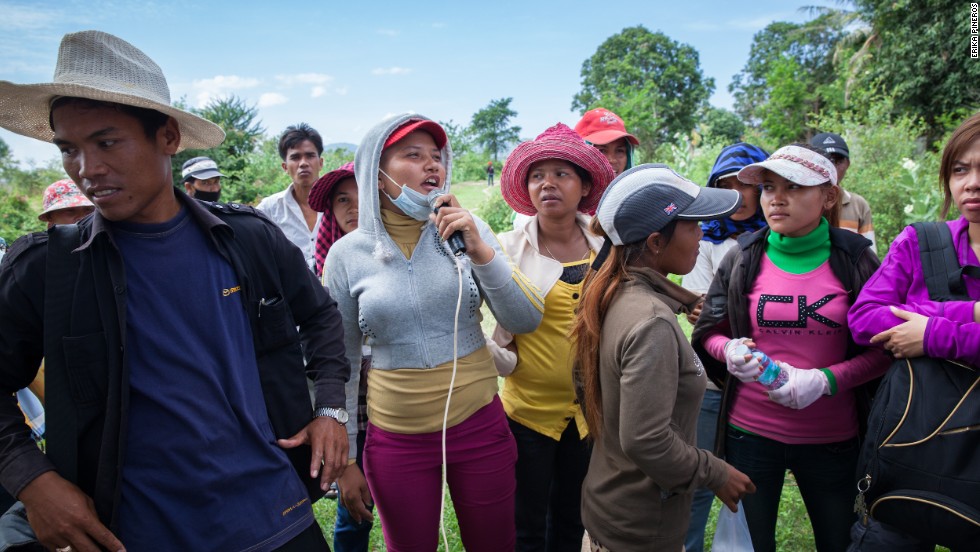
A week ago, thousands of mostly women garment workers in Cambodia blocked a national highway for a half hour. This week, about 3000 mostly women garment workers at the same factory, a factory that produces clothes for Nike, again sat down in protest. This time they were met with stun batons. Over 20 women were hurt, and so the international press showed up.

To their credit, the international press did note that the workers were “mostly female”. But then, the articles would veer into a curious geography: “A series of deadly incidents at factories in Bangladesh, including the collapse of a building last month that killed more than 1,000 people, has focused global attention on safety in factories in Asia makes goods for Western companies.”

Cambodia is not Bangladesh, and Asia is not a country.

From 1974 to the end of 2004, the global garment industry was ruled by the Multi Fibre Arrangement, or MFA, which was designed “to protect” so-called developed countries from the over-productive barbarous hordes of the emerging so-called developing countries. The MFA was basically a global quota system. In January 2005, all that came to an end, and the global garment industry was relocated under the rules of the WTO and the General Agreement on Tariffs and Trade, or GATT. What happened next? Just what you expected: “The result of the end of the Multi-fibre Arrangement was a dramatic redistribution of the allocation of global apparel production. For example, in 2000 China contributed to 24.8 percent of world apparel exports, Cambodia’s share was 0.6 percent, and Mexico’s was 4.6 percent. In 2008, the Chinese market share of world apparel exports increased by 50 percent, as compared to 2004, and it constituted 38.8 percent of the global apparel trade. The Cambodian market share doubled over the same time period and accounted for 1.2 percent of world apparel exports. However, the Mexican share declined threefold in that period, and in 2008 it constituted only 1.4 percent of world apparel exports.”

There were no real surprises in the new world order. Competition among exporting countries drove prices down. Those who were prepared for the change, such as China and Cambodia, saw their national fortunes improve. That doesn’t mean the lot or lives of workers improved, but the national economies grew.

Everyone involved knew that the super majority of garment workers are women. Every study and every theoretical model stated that both in the short term and in the long term putting garment production under the WTO and GATT would be bad for women workers. But the national economies, and the free market, had to grow. The women workers would just have to deal with the price they must pay for everyone else’s success and justice.

In Cambodia, apparel exports account for more than two-thirds of total manufacturing exports, and garment workers make up about a third of the industrial work force. More than 80% of garment workers in Cambodia are women. Post-MFA changes meant that women’s salaries, short term, would decline, and, long term, that the wage gap between women and men would increase. The growing wage gap is part of the program for the future, and part and parcel of `development.’

So, this sounds like Bangladesh, but it’s not.

Between 1999 and 2004, the United States and Cambodia had a deal. If Cambodia demonstrated improved factory working conditions, it could send more to the US markets. Cambodia sends almost all of its exports to the US and Europe, and so this was a big deal. The ILO monitored the conditions through something called Better Factories Cambodia, or BFC. BFC increased individual factories’ US export quotas. It also engaged in capacity building with State, labor and management stakeholders. Cambodia established an Arbitration Council to deal with labor disputes. Many workers’ health and safety conditions improved. Of course problems remained, such as involuntary overtime and lack of childcare facilities, but a growing labor movement addressed them. Along with two decades of industrial garment industry hyper-expansion, Cambodia witnessed the emergence of hundreds of unions, of thousands of organized and wildcat actions, of an increasingly entitled and powerful women workers’ movement.

Women garment workers in Cambodia and in Bangladesh pay a heavy price for the global garment industry. But then … women workers everywhere pay a heavy price for economic growth as for economic decline. For that reason, it’s important to locate the story of the Cambodian women workers more accurately. They are industrial women workers, and they are struggling for exactly the same things that industrial women workers in the Europe and in the United States are struggling for: better pay, better working conditions, dignity, respect, autonomy, power.

A month ago, Better Factories Cambodia released its annual report. The number one issue is fire safety. In the past year there has been “a large drop in compliance.” On the factory floor, the owners are cutting corners and endangering women workers’ health, well-being, and lives. In the national context, the owners are cutting women’s salaries, “because of the economic downturn”, and are widening the wage gap between women and men. Just like in the United States.


(Photo Credit: CNN)

From field to fork, the feeders are fed up … and organizing


Wendy’s shareholders met in New York this week. Shockingly, they didn’t meet at a Wendy’s but rather at a posh hotel somewhere in midtown Manhattan. They were met by farmworkers, “convened” by the Coalition of Immokalee Workers (CIW). The CIW Fair Food Program has organized and lobbied, with great success, for fast-food chains to pay an additional cent for every pound of tomatoes, which would double field workers’ salaries. Pretty much all the chains have signed on — McDonald’s, Subway, Burger King and Taco Bell. In 2005, Taco Bell led the way on signing, under the leadership of their CEO at the time, Emil Brolick. Of the majors, only Wendy’s is an outlier. Guess who’s the current CEO of Wendy’s. You guessed right: Emil Brolick. Irony? Farce? Tragedy? No, it’s just business as usual.

The farmworkers were not the only workers on the streets and in the corridors of the Wendy’s convocation. Local fast-food workers, organized by Fast Food Forward, also showed up and threw down. Fast Food Forward recently documented that wage theft in the fast-food industry is the hidden crime wave of the day. According to their study, 84% of fast-food workers had experienced one wage theft in the past year. Two-thirds had experienced wage theft twice in the past year. Almost half had experienced wage theft three or more times in the past year.

And who are these workers? Overwhelmingly people of color, largely women. Tabitha Verges works at a Burger King in Harlem and went on strike last month. In a recent interview, Tabitha Verges explained, “I do it all. I do three or four jobs. I take orders, I make the orders. I work the cash register. I say, ‘Have a good day.’ I do the inventory. I take out the trash. I get down and scrub the floor. I don’t think $7.25 is nearly enough.”

Elsewhere Tabitha Verges elaborated: “I’m tired of being taken advantage of, working hard doing a three or four person job when there should be other employees there doing the job with us… iIm fed up. I’m so fed up. It’s not right for us to be busting our hump everyday making $7.25 an hour. I myself make $120 a week. I have to provide myself with food, clothes, a roof over my head. My rent is over $700 a month. I’m backed up on my bills. I have to pay Con Edison. I don’t have enough to even survive for the basic necessities in my household… I’m working full time. It’s not right and it’s unfair.”

It’s not right and it’s unfair. What are the good people of Wendy’s waiting for, apart from dessert and drinks after the speeches? From field to fork, the feeders of the United States are fed up. They’re fed up with the common sense that accepts the not-right and the unfair. They’re fed up with the racism, the sexism, the slave wages, the daily abuses. They are tired and fed up with the assaults on personal and individual dignity, on family and community, the assaults on humanity. That’s the reason fast-food workers on strike carried signs that read, “I AM A MAN” and “I AM A WOMAN.” Tabitha Verges is fed up. All the Tabitha Verges’ are fed up. The Burger Kings and the Wendy’s better watch out.


(Photo Credit: The Nation / AP / Mary Altaffer)


My name is Adrienne Kambana. I am the widow of Jimmy Mubenga


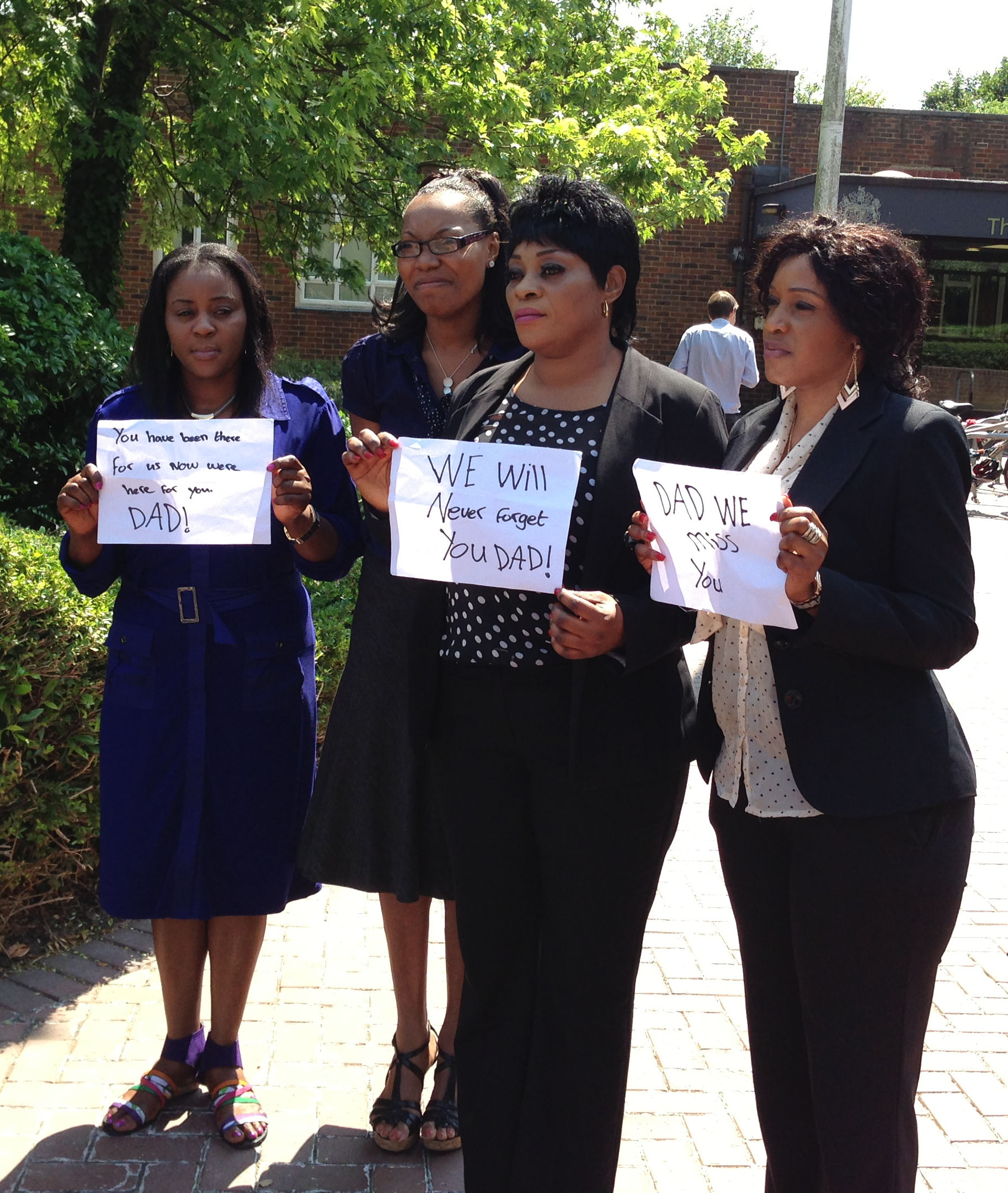
Last Tuesday, a woman appeared before judge and jury, and she sobbed: “My name is Adrienne Kambana. I am the widow of Jimmy Mubenga and the mother of our five children. Jimmy Mubenga was a good father… [and] a good husband… He had never been in trouble with the police before. He had never done anything wrong. When he was arrested he was in the wrong place at the wrong time. An argument started and Jimmy got caught up in it. Jimmy was convicted of an offence of causing actual bodily harm and he was sent to prison in March 2006. Although I was not a witness to what happened, I was present at the trial where he was found guilty. He told me, `I was innocent’ and I believed him. This was the first time he had ever been away from the children. By April 2007 he had served his sentence but he was detained under immigration powers. He remained detained until June 2008 when he was granted bail. It was during this time that Blessing was conceived. Jimmy instructed a solicitor and tried to challenge the deportation because he wanted to stay with his family… I was asked by the police to tell them about the phone calls I had with Jimmy on 12 October 2010… He said, “I’ll call you back” and he did not call me back. That was the end of the story.”

That was the end of the story.

The so-called liberal democracies festoon themselves with inquests as if these carnivals of `the rule of law’ equal justice. They don’t.

The current manifestation is “the Jimmy Mubenga inquest,’ taking place now in London. On October 12, 2010, Jimmy Mubenga boarded a plane for Angola, in the custody of G4S guards. Within 50 minutes, Jimmy Mubenga was dead. During those 50 minutes, Mubenga repeatedly asked for help and received none. He begged, he screamed, he called out, “They’re going to kill me.” And they did.

And now we `discover’ that the G4S security guards had racist jokes on their phones. While that is `unfortunate’, mobile phones did not kill Jimmy Mubenga, nor did a few racist guards, be they privately employed or working for the State. Jimmy Mubenga was killed by State policy. He was killed by the very entity that is now `conducting an inquest’ in full view.

While the possibility of arriving at something like the truth of the event of Jimmy Mubenga’s death is important and worthwhile, it does not constitute justice. Jimmy Mubenga is dead. The children can’t stop crying, the widow can’t stop crying. If there were justice, Jimmy Mubenga would be alive.

Only a fundamental structural change – one that never again criminalizes, cages, and executes `the strangers among us’ – would begin to arrive at justice. Jimmy Mubenga’s death, like that of Ashley Smith in Canada and so many others around the so-called `free world’, are part of State policy, not the errant acts of individuals.

Adrienne Kambana concluded her remarks, sobbing: “Jimmy has gone forever. We need justice. Justice will help Jimmy rest in peace. This will prevent the situation from happening again. Justice will give the other passengers on the plane peace of mind about what happened. Justice will protect people in the future because I don’t want anyone to be in my shoes. Justice will help my children not to feel angry about what happened to their father. Justice will help me to live a long and healthy life so that I can take care of our children. I need justice, especially for my daughter who did not get the chance to know her father. We will never forget Jimmy.”

The inquest is expected to continue for eight weeks.


(Photo credit: IRR.org.uk)

Senate Masupha’s struggle for equality

Senate Masupha

On Thursday, Lesotho’s Constitutional Court found that Senate Masupha can’t be a chief because she is someone’s daughter. In so doing, the Court demonstrated how `women’s empowerment’ can be used to deny women power and equality.

Senate Masupha’s father, David Masupha, was a chief. David Masupha died, and his wife, Senate’s mother, ‘Masenate, became chief.  Senate Masupha is the first-born child of David and ‘Masenate Masupha. ‘Masenate Masupha died. Senate claimed the chieftaincy, and the situation thickened. Brothers jumped in and claimed that Basotho tradition precluded the daughter from assuming the chieftaincy. Senate replied that this was both nonsense and a violation of her constitutionally guaranteed rights.

And so Senate Masupha challenged the constitutionality of the exclusion of women from chieftaincy.

On Thursday, the brothers won. So did the fathers, uncles, sons, male cousins, male friends and acquaintances and male strangers. Women lost, or at least suffered a temporary setback.

According to many reports, Lesotho has made strides to correct gender inequality and inequity. According to some, Lesotho ranks better than the United States and the United Kingdom on gender equality. 95% of women are literate. Women predominate in the job sector, seem to have ample and rising representation in the highest levels of government. In recent years, Lesotho abolished marital power. So, things are on the move.

But movement goes in both and all directions. The judge decided that Senate Masupha had no case because her mother had been able to assume the chieftaincy. Therefore, since the mother was a woman, women were not discriminated against. Too bad for those women who are daughters.

But really, it’s ok, because women are `empowered’, according to the court judgment: “It is … to be noted that Lesotho has performed well internationally in the campaign for gender equality. It has 58% women in local government, which is more than the 50% requirement. It has also surpassed the initial 30% target for women in decision-making bodies set by SADC. It is ranked number 40 globally in compliance. Our judiciary is also suitably representative in both the Magistrates Court and the High Court…If it could be argued that Lesotho is in fact lagging behind in its policies of equality between the sexes, that may be a fair comment; but it has equally not abolished the death sentence on the basis of the right to life; neither does this country consider itself bound by the principles of the rights of gay people to the extent of allowing same sex marriages. Many countries in the world have not yet developed to that stage. This is not unique at all. It may be that the time will soon come to allow these developments and accede to those principles as well, but the customs, culture and conceptions of the community must always be considered and each country must be allowed to make its choices in this respect. This is the true meaning of independence and self-determination of nations. It is the role of the other two arms of Government to see that is done without breaching the law.”

First, Lesotho is empowering `women’ and so the woman Senate Masupha must simply wait to become one of those `women.’ Second, Lesotho may be behind on equality of the sexes, but it’s also behind on capital punishment and on LGBTI rights, and so it’s all… good? Third, this is what independence and self-determination looks like. You can just about hear the demonstrators in the streets, chanting, “This is what independence looks like! This is what self-determination looks like! Whose streets? Our streets … except, of course, for our daughters.”

The three-strikes policy here is clear. Lesotho has hit the gender and sexual tipping point. Women are sort of equal, and so can’t be discriminated against. What’s good for the mothers will have to do for the daughters.

On the one hand, this is a matter of jurisprudence in one small mountain kingdom. Senate Masupha will appeal, and contemporary African history is on her side. In recent years, courts in South Africa, Botswana, Ghana, Kenya, Nigeria, and Tanzania have all faced similar cases, and have all decided to strike down prohibitions against women becoming chiefs and against women being able to inherit. Lesotho has temporarily chosen another path.

On the other hand, the judgment is a lesson in the pitfalls of development-speak. Metrics of equality that measure this country’s gender gap against that country’s miss the core aspect of equality. Equality is absolute. Either women and men are equal or they are not. That’s it. There are no gradations. There are no qualifications that have the mothers equal but the daughters not. The judge’s decision was not echoing some traditional Basotho `culture’. To the contrary, the judge was invoking precisely the terms of international and global assessment.

Women’s `empowerment’ without the absolute of gender and sexual equality is nothing more and nothing less than an alibi. Ask Senate Masupha, ask Tabitha Phaloane who suffered a similar fate. The struggle continues.

(Photo Credit: Mail & Guardian / PK)

For Mother’s Day, Make a Loud Noise

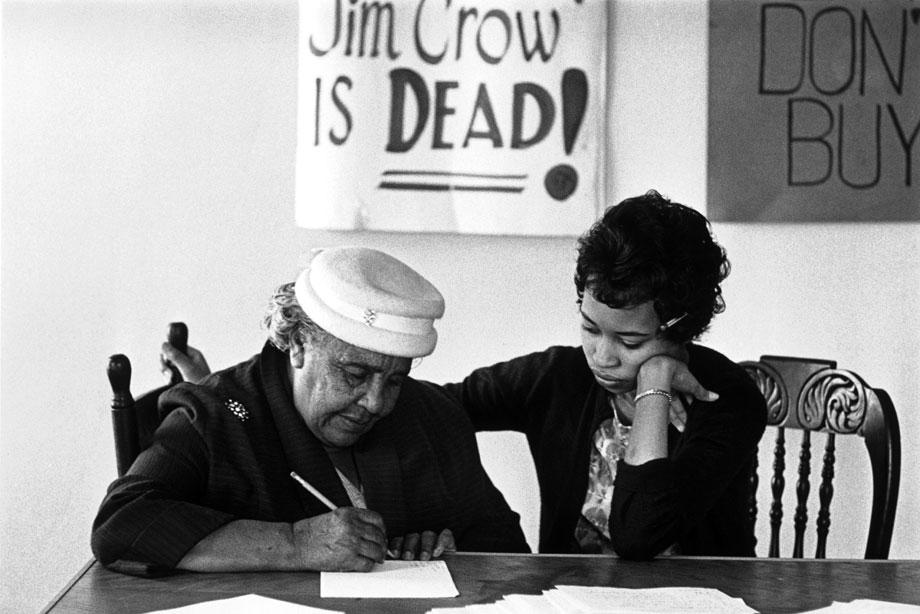
Sunday is Mother’s Day. Mother’s Day is, not surprisingly, a painfully emotional day for women in prison. Remember, women are the fastest growing prison population. And so … how do we celebrate Mother’s Day?

In Raleigh, North Carolina, the Internationalist Prison Book Collective is organizing a Mother’s Day Anti-Prison Noise Demonstration: “We’ll be breaking the isolation and monotony of the women in the Raleigh Correctional Center for Women and the North Carolina Correctional Institution for Women (a minimum-security prison next door to RCCW). Together these two prisons have almost 1,500 women, almost all of them mothers. RCCW is the state’s largest prison with 1,288 women including women’s death row.”

Women in prison receive far fewer visitors, especially from their children, than do their male counterparts. The isolation of women prisoners, and of prisoners who are mothers in particular, is intensified by monopolistic and predatory rates for phone calls that make phone calls for more than 65,000 incarcerated mothers prohibitively expensive. “Prohibitively expensive” means impossible. Mother’s Day is just another form of punishment for those women.

But it doesn’t have to be. On the one hand, there are actions of engagement and solidarity, such as those in Raleigh. On the other hand, there are policies and programs. In Brooklyn, New York, District Attorney Charles Hynes has joined with the Women’s Prison Association to create an alternative, JusticeHome, that will allow mothers convicted of felonies a chance to stay home while they serve their time.

The program begins and ends by acknowledging the centrality of context. Women take responsibility for their actions and for their lives. The State takes responsibility as well. The children, who bear no responsibility in this drama and yet somehow have paid the price in the increased incarceration of women, and especially of women of color, are allowed to continue to grow and thrive. It’s an experiment … an experiment in justice.

So, this Mother’s Day, make a joyful noise. Make a joyful noise, all the earth; make a loud noise, and rejoice. Make a loud noise, and make it heard.


(Image Credit: Kelsey Dake / New York Times)

Welcome Irene Kainda as a neighbor, not as a stranger

Irene Kainda

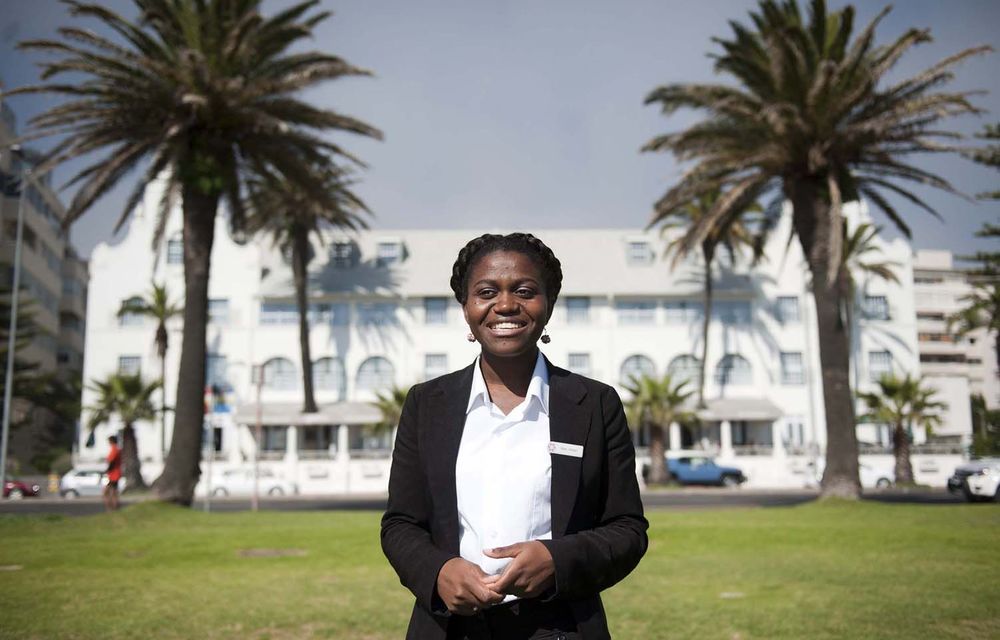
What are the borders of being-a-refugee? When does one stop being a stranger and become simply a neighbor? Irene Kainda wants to know.

Irene Kainda is 21 years old. She lives in Cape Town. She has lived in Cape Town continuously since 1998. She used to live with her mother and her brother, Felipe, who is two years younger than Irene. In 2006, Irene and Felipe’s mother abandoned them. The two children spent three years in a homeless shelter, and then were taken in by some good people. Now Irene is in college and so is her brother, thanks to Irene’s hard work. In many ways, this is, or could be, a tale of great promise, a tale of a young woman who keeps on keeping on.

Irene and Felipe came to South Africa as refugees, and there’s the rub. The civil war in Angola is officially at an end, and the situation is both improved and improving: “Angola is a nation of bright minds, brilliant writers, exceptional musicians, and a civil society that, almost 11 years after war’s end, is ready to have its voice heard.” Of course, there’s much room for improvement, but that’s true everywhere.

Recently, the South African government decided to `encourage’ Angolan refugees to return `home’. The `invitation’ to `apply for repatriation’ is universal. Everyone has to `apply’. Hundreds of thousands of people, call them Angolans who have sought refugee status, live in South Africa. Many of them have lived there for twenty years. For many of them, South Africa is the only home they really know. Irene Kainda notes, “I came to South Africa when I was seven. I don’t remember Angola, I don’t know where I am from and who or where my family there is.”

What are the borders of being-a-refugee, and how does gender inflect those borders? Women and girl refugees haunt the world. According to the most recent UNHCR Global Trends Report, at the end of 2011, 42.5 million people were displaced. Of them, 15.2 million were refugees. Women and girls made up 49 per cent of persons “of concern to UNHCR.” According to the UNHCR, 48 percent of refugees are women and girls. Further, “in 2011, UNHCR submitted some 92,000 refugees for resettlement. Ten per cent of all submissions were for women and girls at risk, the highest percentage of the last six years.” The next UNHCR report comes out in a month.

The civil war in Angola saw massive, programmatic and widely acknowledged violence against women and girls, and yet the processes and structures concerning demobilization altogether avoided women and girls as a distinct group. Thus, no resources were dedicated to their specific needs. And now it looks like South Africa’s Department of Home Affairs will do the same, avoid any recognition of the specific situations of Angolan-born women and girls living in South Africa.

Meanwhile, more than one study has noted that xenophobia is the dark side of the new supposedly democratic South Africa: “Intolerance is extremely pervasive and growing in intensity and seriousness. Abuse of migrants and refugees has intensified and there is little support for the idea of migrant rights.” Sometimes the abuse was directed specifically at Angolan refugees in Cape Town: “The City of Cape Town, like many other cities, has seen a number of xenophobic attacks on foreigners…The most well-publicised conflicts have been those in Danoon, Doornbach in 2001 and in Joe Slovo Park in 2002. Perhaps the most publicised incident was in Joe Slovo Park, where four people were killed in clashes between Angolan refugees and South Africans.”

Irene Kainda is an Angolan-born young woman who has lived and grown up, and raised her younger brother, in Cape Town in a very particular historical period. She has labored through abandonment, homelessness, xenophobia, violence against women, and more. At every step of the way, she was supposed to fail, and take her younger brother down with her. Instead, she succeeded, and took her younger brother up with her. And her reward, if the South African government has its way, is to be shipped to a `homeland’ she doesn’t know?

That cannot be. The State cannot punish Irene Kainda who has spent almost all her life engaged in Cape Town in performing the labor of survival with dignity, hope, and humor. Rather than deport Irene Kainda, reform the State. Institute a statute of limitations on being-a-refugee. Take responsibility for being a haven. Stop treating Irene Kainda as a stranger and welcome her as a neighbor.

(Photo Credit:Mail & Guardian)