Harriet Nakigudde, Aderonke Apata … African Lesbian Asylum Seekers


Harriet Nakigudde

The surveillance and security State has a new version of an old song: “Don’t talk of stars burning above. If you are queer, show me.” The newest subjects of this travesty are Harriet Nakigudde, a 30-year-old lesbian from Uganda, and Aderonke Apata, a 47-year-old lesbian from Nigeria. Both live in England, but the treatment they’re receiving could as easily be in the United States, anywhere in the European Union, South Africa, Australia or any other country that receives gay and lesbian asylum seekers on the condition that they `prove’ that they are not only homosexual but also exclusively homosexual. There are no multiple subject positionalities in the modern asylum process.

Given that African refugees and asylum seekers are already “the untouchables of our time,” African lesbian asylum seekers suffer a more intense and more layered, some would say intersectional, untouchability. Home Affair Offices, Border Agencies, Immigration and Custom Enforcement, whatever, all collude in a public policy that is producing a new identity, the Lesbian Asylum Seeker. And within that identity is the most denigrated, the African Lesbian Asylum Seeker.

Harriet Nakigudde was supposed to be sent back to Uganda today. Why? Because she failed to prove that she is sufficiently lesbian. Due to “administrative reasons”, her flight was cancelled. But Harriet Nakigudde is still on the hook, as of now. She still faces return to a family that persecuted and raped her, in order to “cure” her, and to a country that increasingly criminalizes all same-sex engagements.

Aderonke Apata has provided all sorts of evidence of her lesbian identity and of the dangers she personally faces if returned to Nigeria. Home Affairs wants more, and so Apata is providing a home video of herself and her partner: ““I feel so bad it’s got to this stage. It’s such a desperate and precarious situation to be in, very dangerous, because anything could happen to those pictures, those videos.”.

With one face, the State sings, “Show me” to the African Lesbian Asylum Seeker and, with the other face, decries the State homophobia of the backward African nations. It’s textbook sexual orientalism at work. Instead of virgin or whore, you now have victim or vixen, as long as they’re `African.’

At one level, this is old news. Critics, activists, scholars have long discussed the representational challenges of lesbian asylum claims. While policies may formally change, the staffs do not, and so in England, for example, there’s no special training to those who adjudicate asylum claims based on sexual identity. Asylum is asylum is asylum, and, under Fast-Track Detention, that means pretty much everyone is guilty until proven guiltier.

Lesbian asylum seekers, and refugees, are constructed as deportable before the fact. Their `identities’ are largely declared as undecipherable by the State. If the State can’t read the bar code of your sexual identity, you don’t get into the club. With that policy, the State produces its new extravagantly disposable subject, the African Lesbian Asylum Seeker, who must prove that she has not only been persecuted but has been raped, who must proved that she is not only lesbian, but is fully immersed in a lesbian life style, who must prove … that which really cannot be proven. “Show me, show me now.”

(Photo Credit: GayStarNews.com)
In Zimbabwe, WOZA wins another victory for women’s rights

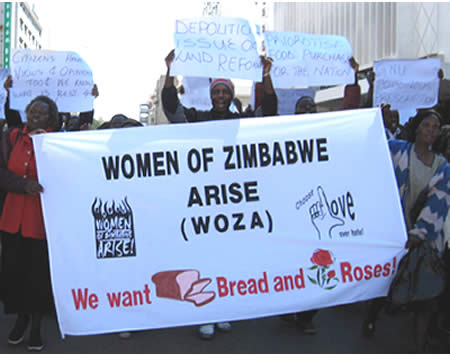
At a recent gathering in northern Virginia, a local activist lawyer argued, “Activism bears fruit, and organizing bears fruit, and we do win every once in a while.” While he was addressing immigrant activists and their supporters, his words ring true around the world. Ask the women of WOZA, Women of Zimbabwe Arise! Yesterday, they too won a landmark victory in the Zimbabwe Supreme Court, and it too is a lesson for everyone.

The case is Jennifer Williams, Magodonga Mahlangu, Celina Madukani and Clara Manjengwa v Co-Ministers of Home Affairs, Commissioner General of Police Attorney, Attorney General of Zimbabwe. But it’s much more than that. It’s four women, attorneys from the Zimbabwe Lawyers for Human Rights, women of WOZA, and women in struggle across Zimbabwe rising up in favor of women’s rights, human rights, Constitutional protections, and in so doing affirming, consolidating and intensifying women’s autonomy and power.

On April 15, 2010, the four women were arrested at a WOZA demonstration. They were taken to the Harare Central Remand Prison, where they spent five miserable days, “five days of hell.” The place was disgusting, and the treatment was abusive, for everyone, not just for WOZA members or political prisoners, although they received `special treatment’ as well. There was no clean water or toilets. Women were forced to remove their underwear. The place was filthy.

So, WOZA protested the conditions and sued.

Four years later, the Supreme Court of Zimbabwe found that WOZA members’ Constitutional rights were violated. The Court found as well that in those instances where WOZA members were targeted for `special treatment’, more of their Constitutional rights were violated. The Court instructed the police to ensure that they would provide clean water, working toilets, a clean mattress for each prisoner, adequate blankets, and that “women detained in police custody shall be allowed to keep their undergarments, including brassieres, and to wear suitable footwear.”

WOZA leaders, WOZA members, their lawyers, and women in struggle across Zimbabwe won a major victory this week. They said State agents cannot act with impunity. For the State, there is no place to hide. WOZA acknowledges the victory and says the time for celebration is not yet at hand: “Whilst WOZA members morale is boosted, members will celebrate when these conditions are a lived reality.”

Women across Zimbabwe, across the world, are organizing for the days when we all can celebrate. But for today, let’s applaud the work of Jennifer Williams, Magodonga Mahlangu, Celina Madukani, Clara Manjengwa, and all the women of WOZA. Activism bears fruit, organizing bears fruit, and we do win every once in a while. Woza! Arise!


(Photo Credit: WOZA Zimbabwe / Kubatana)

Ayesha Bibi Dawood has returned

Ayesha Bibi Dawood

Late last week, Ayesha Bibi Dawood passed away, and was buried on Sunday. Her biographer, Zubeida Jaffer, puts it succinctly, “Ayesha Dawood, one of a few remaining leaders charged with Treason with Madiba in 1956. The funeral leaves her home in Durban Road, Worcester. She leaves behind a daughter and son and six grandchildren.” She leaves behind a story that needs to be told and understood, a story of an Indian woman in a rural town in the Western Cape.

Ayesha Bibi Dawood was born in Worcester, in the Western Cape, on 31 January 1927. Her father was an Indian merchant and her mother a Malay woman from Calvinia. As Dawood tells the story, “It all began like this. I used to read the daily newspaper- Die Burger and the Cape Times- for my father. I started hating the Apartheid laws especially the Group Areas Bill and the Pass Laws. In 1951 came the call from the trade union movement, supported by the left, to stage a one day strike on 7 May. I then decided to throw in my weight against these unjust laws. I went to the trade union office in Russell Street and volunteered to help organise the strike.”

In Worcester, that one-day strike was a raging success, a success many credit to Dawood’s organizational prowess. For one day, just over 16,000 Colored, African and Indian people said a resounding and unified “No!” to the removal of the Colored people from the Common Voters rolls and to the 9000 Whites of Worcester. Bibi Dawood had arrived.

From there, Ayesha Dawood kept on keeping on. In 1952, she co-founded the Worcester United Action Committee, and helped turn Worcester into a center of the Defiance campaign and of regional trade union organizing. In 1953, she represented the Committee of Women in Copenhagen, and then visited and spoke at factories, meeting halls, union halls and elsewhere. She also visited her family in India on that trip. In 1955, she was charged with incitement and spent nine months in jail. In 1956, she was one of the 156 charged, with Mandela, in the Treason Trial.

In 1961, Ayesha Dawood married Yusuf Mukadam, an Indian who had met her during her stay in India. Mukadam was a worker in the Royal Navy. So taken with the young South African woman was he that, six years later and after numerous failed attempts, he jumped ship in Durban, made his way to Cape Town and then on to Worcester.

Soon after, Mukadam was arrested as an undocumented resident, and Dawood was told that she had one choice, to become an informant. She refused, and, in the delicate and discrete language of the day, was “served” with an exit permit that permanently “endorsed” her out of the country.

The young couple and their two children journeyed to Mukadam’s village, Sarwa, where Dawood knew nothing and no one. Mukadam spent much of the rest of his life as migrant worker in Kuwait.

Dawood organized women in the village. At one point, they wanted her to become chairperson of the local committee of the Congress People’s Party. Although she declined, her house remained a local organizing and community center.

And throughout, Ayesha Dawood knew that one day the Apartheid regime would fall and she would return. She prepared. She taught her children Afrikaans as well as English. In 1990, the return began. First her two children, Gulzar and Shabiera, were issued South African passports. In 1991, Ayesha Dawood returned home … in every sense.

Her story is captured in Zubeida Jaffer’s Love in the Time of Treason.

Many have expressed their sadness as well as their gratitude to the 86-year-old committed activist and veteran, one of the million sparks that set and constituted the decades long struggle. Let’s celebrate her version of her own story: “My story is just an ordinary story depicting a particular phase in history.” Imagine the joy of Ayesha Bibi Dawood as she returned home, to her home. Imagine the joy and then remember it really happened, thanks to her struggle combined with that of so many others. Rus in vrede Ayesha Bibi Dawood. Hamba kahle. Rest in peace.

(Photo Credit: South African History Online)

Who buries children in septic tanks and unmarked graves?

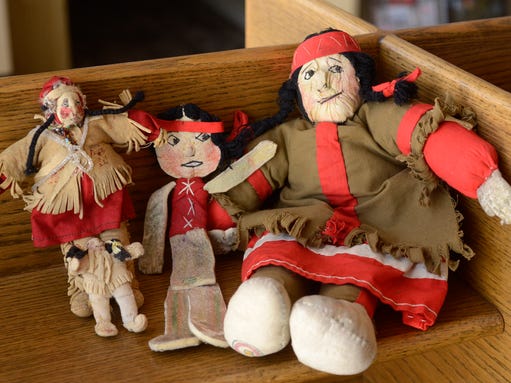
Artifacts left over from the Hiawatha Insane Asylum for Indians in Canton, now at the Canton Public Library.

In Tuam, in Galway, Ireland, the Bon Secours sisters ran a place for “fallen women”, from 1925 to 1961. People called it The Home. In Canton, South Dakota, in the United States, the federal government ran the only `asylum’ for Native Americans, from the dawn of 1903 to Christmas 1933, the Hiawatha Asylum for Insane Indians. The home and the asylum form parts of a shared history.

Thanks to the work of historian Catherine Corless, the world “learned” last week that close to 800 infants and children born in the Home were disposed of in a septic tank. These were children of single women. The women came and quickly left, moving to other parts of Ireland or beyond. The children stayed, to be persecuted in school and worse. They suffered extraordinarily high mortality rates. And then they were dumped in a septic tank.

While shock and dismay have been expressed, all of this happened in plain sight. Neighbors complained about the Home. Not so much about the abuse and disappearance of children, but about the stench emanating from the cesspool behind it. Thirty-five years is a long time in a small village to keep a large secret. There was no secret.

Canton presents a similar story. In the late 1890s, a senator from South Dakota began lobbying for an asylum for Indians because, he claimed, “insanity was on the rise among Indians.” Despite overwhelming opposition from the medical community, who found no evidence of high levels of mental illness among Aboriginal populations, the project went through, and, of course, ended up in the southwest corner of the senator’s state.

The vast majority of `residents’ of the Canton Asylum were in for resistance of one form or another. Canton residents and the few survivors of the asylum all agree that there were very few residents who manifested actual mental illness. If a Native American said no to a White person or to an agency or pretty much to anyone, it often meant going to Canton, where most died. Not surprisingly, given that for the first eight years, it had no psychiatrist on staff and for the first 25 of its 31-year history, it had no nurses. The Hiawatha Asylum was a death sentence.

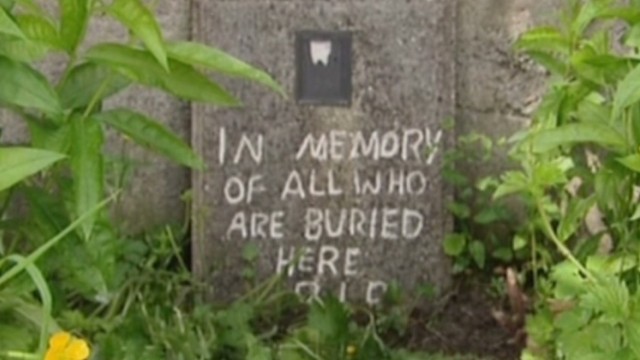
Those who died were buried in an unmarked grave that now sits between the fourth and fifth fairway of the Hiawatha Golf Course. For the past few years, every year the Keepers of the Canton Native Asylum Story have come to perform a healing ritual. They also want the gravesite to be honored. They talk of not only honoring the dead but also of engaging in restorative justice.

From Tuam to Canton, people are engaging in restoration and in restorative justice. This means turning the camera away from the ones thrown into the earth like so much trash and focusing on those who threw those bodies into ground. Who throws dead children into septic tanks? Who throws Indigenous infants, children, men, and women into an unmarked grave? Who? Everyone. This is the process of `nation building’, and it’s a filthy process in which some bodies have value and others have less than none, are deemed problems and obstacles to progress and end up in trash heaps, septic tanks, unmarked graves. There was and there is no secret here.

Tuam

(Photo Credit 1: Elisha Page / Argus Leader) (Photo Credit 2: CNN)

Detention centers: No country for young girls

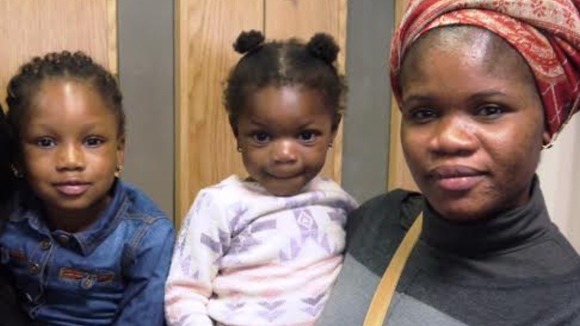
Two girls, both under five years old, were released after two days and nights in detention. Last night, Basirat and Rashidat, and their mother, Afusat Saliu, were released from Cedars pre-departure `accommodation’. They spent Wednesday at Cayley House, “a non-residential short-term holding facility at Heathrow Airport.” It’s not a facility. It’s a prison. Here’s how their mother, Afusat Saliu, describes their first night: “It was terrible. We had to sleep on the floor. There was no privacy – if you went to the toilet, you went in front of everyone. I felt terrible. Some of the crew at Cayley House were nice, but it was not a good environment for a child.”

No place for a child. In a report released today, Her Majesty’s Inspectorate of Prisons agrees. Too much force is used too often. Officers show up in full battle gear, don’t announce themselves, don’t knock on the door, batter the door down and rush in. They have two speeds: terrifying and terrorizing: “Whatever one’s views on immigration, the distress described in this report of the families passing through the centre and its potential impact on the children involved is disturbing. It was difficult to see how the children’s welfare was being promoted in line with statutory requirements.”

42 families `passed through’ Cedars last year. Suicide and self-harm measures were initiated 25 times. This is the new math of neoliberal fortress nations. The mothers who seek help are bad mothers, the children who need help are bad girls. They’re defective products that must be removed.

Thanks to a mighty hue and cry, including leaning on Richard Branson not to allow his airline to be used for deportation, Afusat Saliu and her daughters, Basirat and Rashidat, were given a reprieve, while their case is `reviewed.’ In the name of the girls, Afusat Saliu applied for asylum, because she fears her daughters will be forced to undergo female genital mutilation in Nigeria.

Think of all the work and time that has gone into keeping two young girls out of prison.

Those two young girls, those babies, should never have been in prison in the first place. They should never have been forced to leave their home in Leeds and shuttle from one hole to another. They should never have been forced to feel their mother’s distress. You don’t need a government commission – not from the United Kingdom, nor Australia, nor the United States, nor anywhere – to know that. You know in your bones and in your soul.

Detention centers, prisons, are no country for young girls. They are terrible. I feel terrible.


(Photo credit: Anj Handa / PA)

How many women are forced to give birth in solitary confinement?

We the people must be persuaded that no child should be born in a solitary confinement cell. We the people must be persuaded that no woman should have to give birth while in solitary confinement. Who are we? We are the United States of America. In this man’s land, pregnant women prisoners have less than no reproductive justice or rights. Instead of care, they receive neglect and abuse that crosses over into torture.

Last week, Nicole Guerrero filed a lawsuit against the Wichita County Jail, in Texas, and others for having forced her to give birth in solitary. The baby died. It’s a terrible story, and it’s an increasingly common one. While much of the focus has been, and will be, on the details of the case, consider as well the larger, national framework. Nicole Guerrero is not an exception. She is the face of the everyday violence against women, and in particular against pregnant women, in the prisons and jails of the United States.

Last year, in response to the Pelican Bay hunger strike in California, United Nations Special Rapporteur on Torture, Juan E. Méndez, found nearly 80,000 prisoners in solitary confinement, although the numbers are difficult to determine. He urged the United States to suspend prolonged and indefinite solitary confinement and to consider the rights and needs of the vulnerable: “I urge the US Government to adopt concrete measures to eliminate the use of prolonged or indefinite solitary confinement under all circumstances, including an absolute ban of solitary confinement of any duration for juveniles, persons with psychosocial disabilities or other disabilities or health conditions, pregnant women, women with infants and breastfeeding mothers as well as those serving a life sentence and prisoners on death row.”

Pregnant women, women with infants, breastfeeding mothers: these are the most recent targets of mass incarceration, those charged with “fetal endangerment.” As charges against pregnant women both rise and intensify, more and more pregnant women are going into the prison system, and the vast majority end up in local and county jails, or in State prisons, like the Julia Tutwiler Prison for Women in Alabama. Inevitably, more women will undergo childbirth in solitary, and more children will be born in solitary.

When Delegate Mary Washington, of Baltimore, first heard of a pregnant woman prisoner, en route to the hospital, being shackled, she said, “Wait. What? What do you mean … shackled?” The woman telling herthe story explained she meant exactly what she said. Pregnant women prisoners, women prisoners in childbirth, are routinely shackled. It’s part of the new normal.

Nicole Guerrero is a signature of the next phase of that new normal. She is neither anomaly nor exception, and despite her pain, anguish and suffering, she is not the stuff of high drama. The national history of infamy is not made up of tragedy, but rather an endless series of ordinary episodes that combine to form normalcy. Our normalcy. We are the people who demand to be persuaded that there’s something wrong with a system that forces women to go through childbirth while in solitary confinement. We are the people who demand to be persuaded that the destruction of women is a bad thing. Remember that.


(Photo Credit: guardianlv.com)

Pregnant asylum seekers in the UK: Punished for being a woman


Most women asylum seekers are fleeing so-called ‘non-political’ violence. Domestic violence, including within the extended family and community, ranks high. So does religious persecution of women and violence against lesbians. Women flee such violence because they know it’s wrong. When women asylum seekers are criminalized for seeking asylum, they are being punished for the knowledge they have as women. That’s a witch-hunt, and that’s what’s happening around the world today.

Last week, world leaders overwhelmingly endorsed the Every Newborn Action Plan, which calls for a global concerted effort to address infant mortality. This endorsement came on the heels of a major report, also released last week, which notes, “Every year, 2·9 million newborn babies die from largely preventable causes, and 2·6 million more are stillborn.” The report argues that every newborn counts, and, implicitly, that every mother of every newborn counts.

Would that it were true.

Around the world, women asylum seekers learn that not all maternities are equal. For example, in the United Kingdom, a recent study found asylum seekers receiving housing and subsistence support from the Home Office are regularly `dispersed’ to areas outside London. Pregnant women seeking asylum are often dispersed very late in their pregnancies or soon after delivery. The National Institute for Health and Care Excellence has argued that pregnant women asylum seekers have special needs and particular vulnerabilities and need additional and particular support. The Home Office has steadfastly refused to acknowledge that finding. Women asylum seekers have reported the experience of `dispersal’ is distressing. `Dispersal’ interrupted established maternity care. It left women without social and family support. Because of the day-to-day realities of dispersal and of childbirth, many women asylum seekers gave birth alone. Midwives have reported that they do the best they can, but the `dispersal’ system disrupts everything.

A pregnant woman asylum seeker suffered flashbacks from sexual violence in her home country. She was `dispersed’ in late pregnancy. According to her midwife, “She needed some stability and care because she felt confident with the people who were looking after her and felt she could trust them. The best outcome would have been for her not to be transferred especially at that late stage.”

Since 2000, there has been a 9% increase in maternal mortality in the United Kingdom. One of the factors pumping the increase is “poorer access to healthcare, especially in some ethnic minority communities and among asylum seekers.”

The criminalization of asylum seekers is an assault on “mental, developmental and physical health,” and it is part and parcel of global mass incarceration. The criminalization of women asylum seekers inevitably means the pain, suffering and often death of women in childbirth as of their children. And who are these women? Women fleeing torture, seeking justice. Punished for fleeing, punished for remembering, punished for needing, punished for being a woman.

(Image Credit: freedomfromtorture.org)

Did Mother’s Day end early this year?

Mother’s Day seemed to end early and abruptly this year.

In Australia, under the proposed new national budget, women who have a child, otherwise known as mothers, face paying 30% more on student loans than their male counterparts. No matter that another government policy encourages women to have three children, one for ma, one for pa, and for the nation down the road: “These aren’t choices we force on men. These are penalties we extract from women, based on their gender.”

Speaking of penalties, this week, the Pennsylvania ACLU revealed that in Pennsylvania, pregnant women prisoners are routinely shackled, including during childbirth. Pennsylvania is one of the states that actually has a law, the Healthy Birth for Incarcerated Women Act, which prohibits this kind of treatment. That law was passed in 2010. The ACLU has written to the Attorney General of Pennsylvania asking her to `clarify the law.’

Speaking of clarifying the law, Marissa Alexander still can’t catch a break. For having shot once in the air and not endangered anyone, in order to ward off an abusive partner, Marissa Alexander still faces a possible 60 years behind bars. While her lawyers may have all sorts of new evidence, the prosecuting attorney says the evidence isn’t new enough and the judge is worried about the precedent set by having a second Stand Your Ground hearing. Happy Mother’s Day.

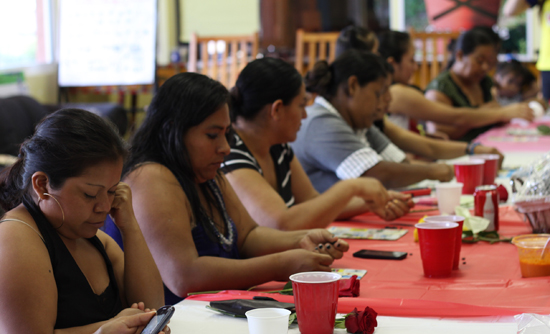
But for the women farmworkers of Immokalee, it may just be a Mother’s Day to celebrate. For the fourth year in a row, farmworker mothers, members of the Coalition of Immokalee Workers, stormed the ramparts of Publix, armed to the teeth with hope, a vision of a decent and dignified future for all, a dream of industrial democracy, and a letter, which read:

“May 11, 2014
Mother’s Day

To Publix:

We are farmworker women.  This is the fourth celebration of Mother’s Day in which we are writing to Publix to ask that you join the Fair Food Program.

As mothers, we work in the fields to support our families, especially to help our children through school.

As mothers, we do not make enough to fully support our family.  And the little that we do make is not easy to earn: We work under the sun and rain of Florida.  We do everything so that you can have tomatoes:  we plant, we tie up the plants, we harvest, and then we do it all again the next season.  In spite of all that, it seems that you do not understand and do not want to hear the voice of farmworkers.

Publix profits from the sweat of those of us who work in the fields.  We deserve respect and we deserve a fair wage.

Now is the time to join the Fair Food Program to protect the rights of workers and ensure a fair wage, with the penny per pound that 12 other corporations are already paying.  What are you waiting for, Publix?

Sincerely,

The Women’s Group of the Coalition of Immokalee Workers”

After delivering the letter, Lupe Gonzalo reported, “Publix presumes to say that they support families — but in reality, we don’t see this support. And we are not afraid to tell them that what they are saying is not true.  We are not afraid to come and protest in front of their stores.  Because we are speaking the truth, with our heads held high. For all of us, when we speak to our children, we tell them the truth.  And we tell them that Publix has not signed onto the Program because they are afraid.  Even children can see that.  But what does Publix say to its children?  Only lies?  Is that how they are educating their children?  That is not how we prepare our children for the future.”

Others, like Nely Rodriguez, mother of four, agreed. Now is the time!

Thanks to the work of women like Marissa Alexander, Lupe Gonzalo, Nely Rodriguez, maybe Mother’s Day didn’t end early this year, because, for them, the struggle of women continues, and that’s what Mother’s Day is all about.

(Photo Credit: Coalition of Immokalee Workers)

Uganda protects women to death

This past Tuesday Uganda’s Parliament passed something called the HIV Prevention and Management Bill. The law will not prevent the transmission of HIV. Everyone knows this. It will worsen the lives of all living with HIV. It will threaten the lives of LGBTIQ persons, and in Uganda, gay and lesbian identity is in the eye of the beholder. It’s not about being gay; it’s about being called gay. This law will have particular and catastrophic effect on women.

The law institutes mandatory HIV testing for pregnant women and their partners. Ostensibly it’s meant to `protect’ women and younger girls whose sexual partners conceal that they have Aids or are HIV-positive. It doesn’t protect women and girls. It endangers them.

The law also allows doctors to reveal the HIV status of those who have been tested. In Uganda, where HIV prevalence is higher among women and much higher among younger women, activists argue, the combination of mandatory testing and sharing of information is an invitation to domestic violence and even murder, at the hands of a partner who claims the woman brought the virus into the home.

That’s what protecting women looks like.

According to the International Community of Women Living with HIV, Eastern Africa: “The passage of the HIV Prevention and AIDS Control Bill represents a dangerous backslide in Uganda’s efforts to respond to HIV. While the bill may have been intended to facilitate and improve the HIV response in Uganda, the bill contains many poorly conceived and fear-induced provisions that have no place in a public health and human-rights-based response to HIV. As passed, this bill will actually weaken Uganda’s HIV prevention efforts and will have a detrimental and disproportionate impact on the rights of women and girls and in particular women living with HIV.”

Long-term HIV activist Milly Katana put it more succinctly: “All I can say now is doomsday has landed on all the people of Uganda. You will see fewer and fewer people testing.”

Margaret Happy, the Sexual Reproductive Health and Rights Officer of the International Community of Women Living with HIV Eastern Africa, agrees: “Uganda is already facing a serious backslide from its early advances in responding to HIV, Uganda is currently one of three African countries experiencing increases in their HIV prevalence rates previously from 6.5% to 7.3 %. The passages of this Bill will only serve to increase this backslide and the President must save Uganda from this backlash.” Lillian Mworeko, Regional Coordinator of the ICW Eastern Africa, adds that the legislators “chose to act out of fear and unfounded hysteria.”

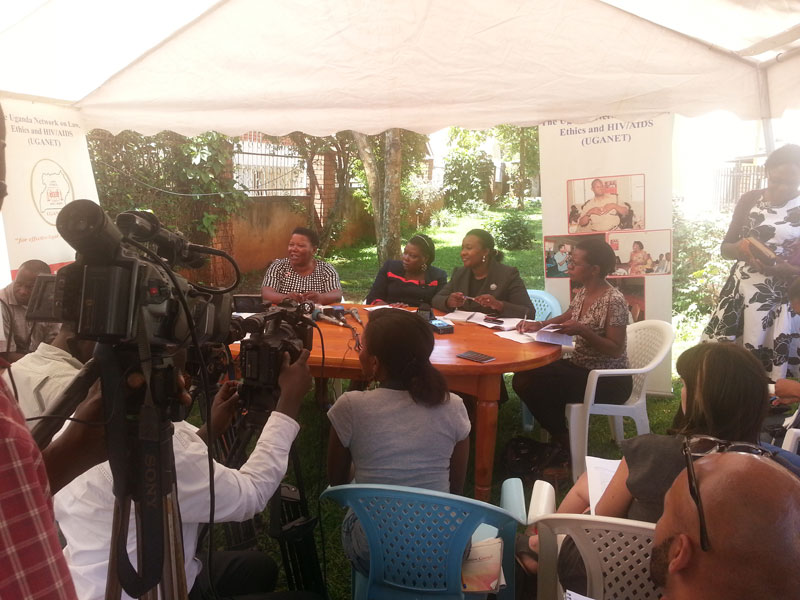
“For Uganda to address its HIV epidemic effectively, it needs to partner with people living with HIV, not blame them, criminalize them, and exclude them from policy making. The president should not sign this bill and instead ensure a rights-based approach, recognizing that people living with HIV will prevent transmission if they are empowered and supported,” said Dorah Kiconco, executive director of Uganda Network on Law, Ethics & HIV/AIDS.

Dr Lydia Mungherera, of TASO, The AIDS Support Organization (TASO), explains: “This clause is taking us back centuries when all the progress we have made in fighting this pandemic is going to be ruled out. They are criminalizing people who are having consensual sex.”

Finally, Dianah Nanjeho, from UGANET, Uganda Network on Law, Ethics and HIV/AIDS warns that the bill will force HIV positive people, and especially women, underground: “The only path by which someone gets onto treatment is by taking a HIV test. People who don’t know their status are going to shun the health system and say ‘look I can’t go to take a HIV test because the results are going to be displayed in court some day. We will have someone who is HIV positive in the docks but without any justice system to fend for them.”

In every way, this Bill attacks women, and women know this. But Museveni will almost undoubtedly sign the Bill into law. Why? ““Because he knows the voters are going to like this bill it will be popular with him.” Who cares about science? Who cares about the knowledge of those, largely women, who have toiled in the fields for decades and dedicated their lives? Most importantly, who cares about the women? Really, all one must do is claim that protecting women is one’s goal, and it’s all good.


(Photo Credit: ICWEA)

Outrage: The dirty, filthy Soma massacre


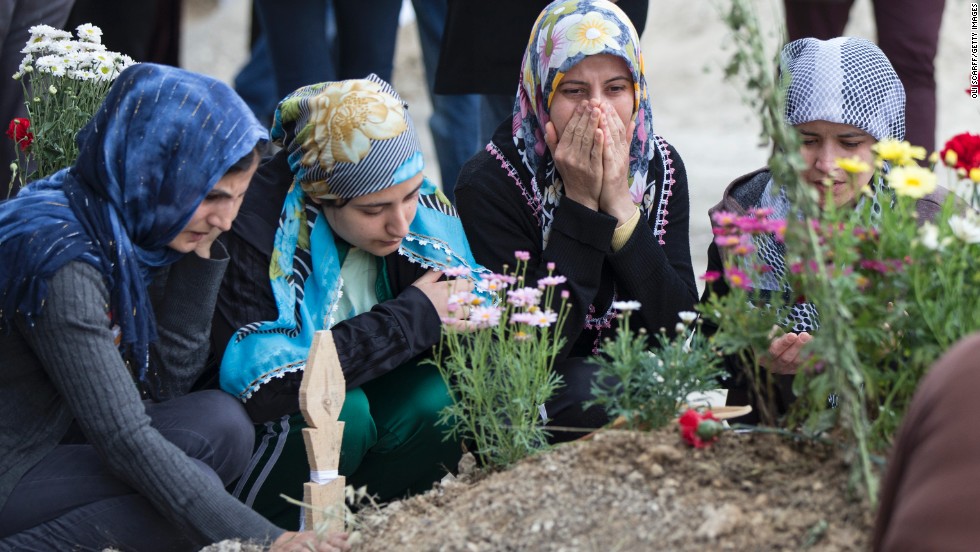
A mine exploded in Soma yesterday. Close to 300 miners are now dead. The world media sees this as tragedy, disaster, accident. Prime Minister Erdogan sees it as just one of those “ordinary things.” It’s mining, and shit happens.

No!

Across the country, through the haze of grief and sorrow, Turks are compelled by outrage and fury. They know. “This is not an accident, this is murder.” “We will not refer to it as an accident, we will call what happened a massacre.”

The ways of murdering miners are many. In this instance, it’s the crime of looking the other way, of refusing to inspect. For 19 years, Turkey has refused to sign the International Labor Organization’s No.176 “Security and Health in Mines Agreement”. The agreement places many responsibilities on the government and the employers. For 19 years of deteriorating mine conditions, the Turkish government said, “This can wait.”

Last year, a parliamentarian from the Republican People’s Party submitted a motion to investigate work-related accidents at the coalmines in Soma. All three opposition parties supported the proposal. However, the Justice and Development Party, Erdogan’s party, opposed the motion. Two weeks ago, it was rejected.

They knew the mine was a powder keg set to explode. But what are a few hundred miners in the big equation? And now, the keening women of Soma join the incandescent women of Marikana, in song and sorrow: “The love of my life is gone.”

There was no accident, disaster or tragedy. Instead, there was murder and massacre, and it was dirty and filthy. And there is outrage.


(Photo Credit 1: CNN) (Photo Credit 2: New York Times / Uriel Sinai)