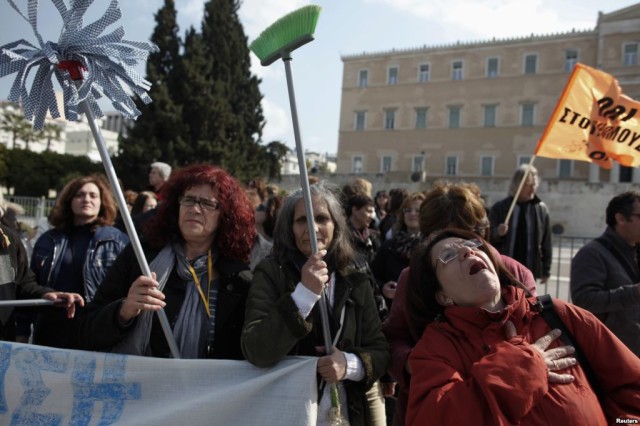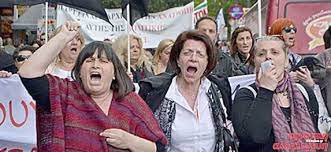
Greek cleaning women demand an end to austerity

In Greece, women are leading the popular struggles against austerity. In Athens, women cleaners have been camping out in front of the Finance Ministry for months. And they’re winning, slowly but winning.

Konstantina Kouneva, a Bulgarian immigrant to Greece, has been working as a janitor since 2001. She is also a trade unionist. In 2008, she was the victim of an acid attack. She sued the company she works for, for its lax approach to workers’ security, and won. She has kept on winning, and next month she will join the European Parliament, representing SYRIZA, workers, women workers, and social economic justice.

Women cleaners were fired, months ago, from the Finance Ministry and have been protesting, camping out, occupying, and suing. They have repeatedly won in court, and look forward to more such victories. The Supreme Court was supposed to decide on Thursday, but delayed its decision until September. The struggle continues.

The women continue the struggle. Despite police brutality which sent women to the hospital, the women continue their encampment in the space in front of the Finance Ministry. As Despina Kostopoulou explained, “They’re bigger than us, but we’re angrier.” Despina Kostopoulou is in many ways typical of the women cleaners. She’s in her 50s, she’s been working for the ministry for decades. She thinks the labor and time she has invested in the ministry counts. She’s right. That’s why the State is trying to rob her and the other women every which way every second of every day.

The women have traded, temporarily, the labor of cleaning for the labor of justice. “Protesting wasn’t hard for us, really. We had no choice. If you make a living with a mop in your hand, you’re already fighting to make ends meet anyway,” explains 57-year-old Evangelia Alexaki. What is the cumulative value of a life of labor, and especially if the laborers are women?

The struggle will not end with the re-instatement of hundreds of cleaner women. First of all, re-instatement under austerity is a tricky business, literally. The `returning’ workers will be offered half of their original salaries. Many will be told they have no insurance. And they will all remain vulnerable to the predations of austerity. That’s how `recovery’ works these days.

Women cleaners, mops and buckets in hand, are leading the charge. Don’t fix austerity. Throw it out. People are valuable, workers are valuable, women are valuable, women workers are valuable. Nobody should be treated like trash. Instead, take the program that treats women like so much garbage and throw it away. They are bigger, but we are angrier. Stay angry.


(Photo Credit: Uniglobalunion.org)
The people do not celebrate Greece’s return to the debt market

On April 11 2014, Angela Merkel was welcomed by the Greek Prime Minister to celebrate the return of Greece to the official speculative bond market, which means to the free market of debt. “Capitalism is all about borrowing so psychologically and symbolically our return to the markets has been hugely important” declared a professor of economics in Greece. Whose psychological well being is he talking about?

Angela Merkel did not stay long in Greece, not even seven hours, understandably since about 7000 police officers were needed for her not to see any of the faces demonstrating because they have suffered and are still suffering from the austerity measures imposed to achieve the Greek return to the debt market.

Angela Merkel benevolently recognized, “I want to say that the government’s policies have led to many people suffering, and were very hard for the government to implement, but now we can see Greece keeping its promises, fulfilling its obligations, and the budget situation is better than we could have wished for or expected.” How does the psychological affect of the investors and gamblers in the debt economy connect with the suffering of an entire population? These policies have led to death and abject deprivation. Moreover, they triggered the rise of the fascist Golden Dawn, which has murdered fellow Greek citizens, and, sometimes working with police, has targeted immigrants who themselves were escaping violence or impoverishment.

The Greek prisons have been filled with many who were directly impacted by the austerity measures. The conditions of detention are dreadful. Certainly, sending a 90- year-old woman who has Alzheimer to jail for few thousand Euros is a great aid to the debt market economy. The country’s real debt has been the impoverishment of over 600 000 children, but who cares about children? Words seem to have different meanings whether we talk about the future of children or the future of investors.

Inserted in the neoliberal logic of a debt economy Merkel affirmed, “I firmly believe that after a very, very tough phase, this country harbors boundless possibilities still to be exploited.” Ask the cleaning women who have been fighting for their rights. They know who is going to be exploited because they already are. They understood that the “so called” labor market has been deregulated thanks to this tough phase that allowed employers to force them to sign blank contracts. They know the Greek State has organized its own defection and is now subservient to private enterprise.

Angela Merkel took the time to meet with Greek entrepreneurs but did not visit the hospitals or the schools. For example, she could have visited a social community clinic run by Sophia who would have told her, “The philosophy [of our work] is not to subsidize the state, this is not our job.” She would have explained that in Greece today there is no democracy, “Democracy is for people to live better isn’t it? With dignity, with hope for the future. That does not exist anymore!”

Why weren’t these principles of democracy praised by Angela Merkel while she was on Greek soil?

Greeks have organized, and new sites for European solidarity are being formed. New political forces are also rising and elections may change the course of the well orchestrated debt economy. Alexis Tsipras, the leader of the growing Greek leftist party Syriza, has long voiced other views about the debt. In 2012, he explained, “The European citizens should know, however, that loans to Greece are paid into an `escrow’ account and are used exclusively to repay the loans and to re-capitalize near bankrupt private banks. The money cannot be used to pay salaries and pensions, or to buy basic medicine for hospitals and milk for schools … If there is a risk for taxpayers losing their money, it is created by austerity.”

The money other European nations loaned to Greece never went to the Greek people. It was just a displacement of wealth for the advancement of neoliberal finance and power. However, populations are also lost when facing this capitalist delirium. This is part of the program, and it allows policies to continue with their brutal devastation. The efforts that many in Europe thought to be made for a better future have produced misery. Greece’s unemployment is at a record high 28%. More women are unemployed than men, and women and youth make up the bulk of unemployment. The public debt is still at 177% of the GDP. 23.7% of Greeks, and 30.4% of children, are under poverty line. As Greece’s social cohesion has been swiftly ripped apart, the goals of these policies have become clear.

For many including some economists, the solution is also clear. The European Central Bank should take social responsibility and buy back the debt. It is time for the people through struggle to reclaim politics in Europe and elsewhere and thereby create the conditions for a radical transformation. Instead of falling into the trap of a standard of debt that Angela Merkel wants to celebrate with the Greek neoliberal establishment, we must celebrate our social cohesion, our community, and the promise of democracy.


(Photo Credit: YouTube.com / en.enikos.gr in English)

In Athens, women cleaners reject austerity’s mess

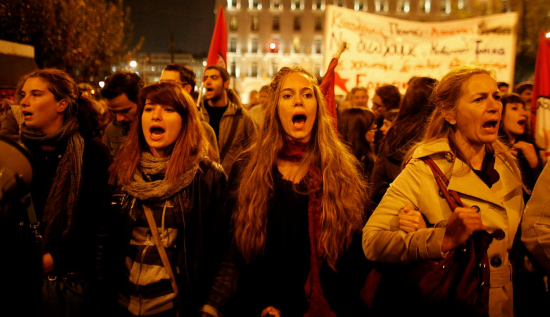
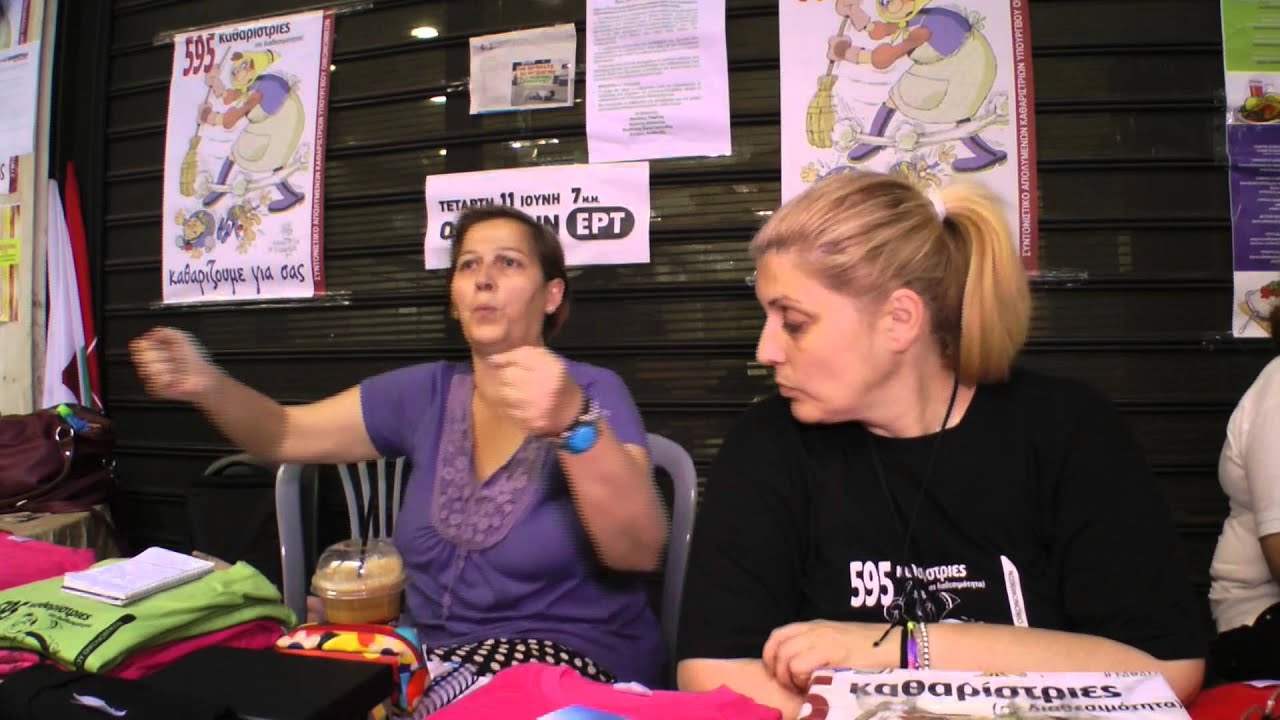
595 cleaning women of the Greek Ministry of Finance have organized against austerity measures. They were there when Goldman Sachs coached the Greek authorities to hide the deficit with neoliberal “financial innovations” and then bet on it to make outrageous profits. They were there when the Greek authorities admitted that these “financial innovations” did not work and had to be paid for by the Greek population. They were also there when the Troika came to give the prescription of austerity measures. They cleaned the mess and emptied the trashcans.

One day they learned that their already meager salary was going to be amputated of 75% of its value. Without warning one morning they learned that they would have only 325.88 Euros to take care of their families, as many of them are single mothers and over 50 years old. Then they learned that they were to be replaced by contracted workers. For women, losing a job under these conditions means losing access to pension, health care, social protection. It means becoming part of the 62.8% unemployed women in Greece.

The women refused. They organized and showed the power of solidarity. Every day, they stand in front of the ministry and shout at the Troika personnel, at the government and all the financial puppets that come and go. They protest that they cannot be dismissed. They shout that they have rights that shouldn’t be wiped out just to serve their markets and their private interests. The Troika, the State and the stooges know that the cleaners’ meager salaries are not going to solve the Greek deficit. They remind everyone that the ministries and other public spaces are not in danger of not being cleaned anymore. Once again in the neoliberal order of things, public money will be transferred to private hands through contracted work. Ordinarily contracted cleaning work costs more, but women workers’ wages are lower since they either have no contracts or have to sign blank `contracts’ that make them vulnerable to total exploitation.

In 2009, Kostantina Kouvena, an immigrant cleaning woman who was a trade unionist for cleaning women union, was attacked with vitriolic acid because she was exposing these abuses. Her employer was a politician from the Social Democrat party, Pasok, who had created a service company. Making contracted work the norm is central to neoliberal labor policies, to the point that killing the resistance to this move is accepted.

The cleaning women haven’t stop fighting, and their tenacity has become an example for many in Greece, especially women who are more likely to be employed in the public sector.

Last March, the repression was even more violent as they were still demonstrating in front of the Ministry. Their solidarity has been an example that has inspired a larger European and international movement.

Over fifty thousand people from twenty-one countries went to Brussels this past Friday to demonstrate against austerity.  The message from the European Trade Union Confederation was clear: these policies are wrong and do more harm than good. Austerity measures don’t serve the people, they serve the financial markets that thrive on volatility and make victims, like the Greek population, pay the price of their gameThe cleaning women of Athens keep watch for us on the comings and goings of the virtuosi of austerity rhetoric. They tell them that they know who they are. They know that underpaid contracted cleaning/janitor works are the signs of the marginalization of women in a low wage debt economy and a sign of the rise of submissive policies that annihilate the public voice. And to that, the cleaning women of Athens say, “No!”


(Photo Credit: Autostraddle.com)

In Greece, from debt to prison to death

Once upon a time, in 2010, a crisis was discovered in Greece. It was called a public debt crisis. Actually, it was orchestrated by very private interests, including a few American hedge funds and some German interests. The list of financial sector beneficiaries is very long.

Anyway, the Neoliberalists of the European Union sent the Troika to the rescue. The Troika established a dictatorial rule of austerity measures that indebted the population itself. Workers and small business owners suddenly had to pay the exorbitant interest rates established by the market. Actually, there were no structural problems in Greece, but the European leaders closed their eyes on the arrangements made by the Greek ruling class with the help of Goldman Sachs … as long as they produced profitable returns for the investors.

In 2013, the Greek government of Antonis Samaras passed a series of laws to make the population pay into a new, “modernized” tax system. For instance, previously had had no local taxes. The law changed all that. The net result of the new laws was to criminalize anyone who owed at least 5 000 € ($6 890) to the State.

Waves of new inmates hit the already overpopulated prisons. A recent video filmed by a prisoner at the Aglos Pavlos Prison Hospital, in the notorious Korydallos Prison, unveiled the revolting conditions. For instance, the camera is directed at a man lying on a bed, he shows his gangrenous legs; and the voice says: “They will cut off both of his legs. He comes for 8 months here because he owes some money to the government. He cannot walk. He came with two feet and he will go out with no feet.”

This video made the news and drew the attention of Liliane Maury Pasquier (Switzerland, SOC), the rapporteur on “Equal access to health care” for the Parliamentary Assembly of the Council of Europe, or PACE. She expressed grave concerns, noting that 200 sick inmates, many with highly contagious diseases, lived in a place made for 60 people. She added: “In such conditions, it is impossible to ensure that prisoners receive appropriate treatment, not to mention the fact that overcrowding obviously contributes to the spreading of contagious diseases, thereby endangering the lives of all prisoners in the hospital.”

In 2013 the Parliamentary Assembly adopted Resolution 1946 (2013), “Equal access to health care.” The Resolution states that inequalities in access to care particularly affect vulnerable groups, including the poor and those in detention. As the video demonstrates, the Troika has continued to apply its austerity measures with dire, and fatal, consequences for the population, and especially prisoners.

The cynical and methodical process of dehumanization in Greece is also orchestrated by the state. A 90 years old woman with Alzheimer left her home and became disoriented. Policemen found her and took her to the police station in order to help her find her family. Instead of her family, they found that she was registered on the computer as owing 5,000€ to the tax administration. They transferred her to jail where she went into a state of panic and became more disoriented. Finally, her niece was informed of her whereabouts. However, she was not released, thanks to other laws that labeled her a criminal. Moreover, the overload of work has kept her in detention. She suffered from various injuries for falling from her cell’s bed. Her mental condition meant nothing to the State. This is not an isolated case. Another elderly woman was recently arrested for owing money she didn’t even know she owed.

Who are the real criminals? Impoverishment is normalized. Prison is used to fragment Greek civil society and to eliminate all kinds of opposition to the growing inequalities.

The origin of this destruction is erased as the President of the European Commission, José Manuel Barroso, recently declared that the “sacrifices” of the Greeks “open the gate to a better future for themselves.”  He should read the report of Lilliane Maury Pasquier who requested “immediate improvements” in hospital facilities in prison. After visiting Greece she decried the negative impact of austerity measures on access to health care in general.

Once again, prisons contribute to the fabric of inequality and dehumanization in a debt economy. They are brutal tools of power.


(Video Credit: Les Observateurs France 24 / YouTube)

Women reject foreclosure, austerity, debt


On Friday March 21, Linda Tirelli, an attorney defending homeowners from foreclosure, and Kevin Whelan, of Home Defenders League in Minneapolis, were interviewed on Democracy Now about recent revelations concerning Wells Fargo’s shady dealings in foreclosures.

A recent internal Department of Justice document disclosed that the DOJ deemed mortgage fraud as low and often no priority. Its claims of success were wildly overstated, and its claims of concern were flat out false.

At the same time, a recently revealed Wells Fargo internal document, issued just one week after the allegedly historical national mortgage settlement, shows that Wells Fargo instructed its lawyers to fabricate documents that would lead to homeowners’ foreclosure on homeowners. This program targeted primarily people of color and the most vulnerable.

At one point in the Democracy Now interview, Juan Gonzalez asked Kevin Whelan, “Can you put this in a national context of the mortgage crisis? Here we are now, six years into the home mortgage crisis that crashed the entire economy.”

Lenders’ mortgage fraud did far more than produce a mortgage crisis. By means of a manufactured crisis, the neoliberal approach of crashing economies increased and expanded the financial grip on civil society. Austerity measures led to the foreclosure of entire countries like Greece, and especially the foreclosure of women. Women’s organizations in Europe have demanded to a clear assessment of the impact and logic of austerity measures.

Wells Fargo lawyers fabricated false documents in order to plunge the most vulnerable into dependency and debt.  Entire, vibrant communities were thrust into poverty and desperation. Likewise, austerity measures were fabricated to form false promises to resolve a “crisis” that have hurt women first and foremost and have also moved many into destitution.

Across Europe, women have been marching against the austerity measures and crying loudly that precariousness is not their societal projects.

Since 2012, Femmes d’Europe en route contre la dette et l’austerité  (European Women in route against the debt and austerity) have organized events to denounce the privatization of public services. And they are still demonstrating. Health care, reproductive care and women’s health have been particularly viciously targeted. These various forms of privatizations are being felt heavily by women in Great Britain, Hungary, Greece and elsewhere. Moreover, the failed US model of private health care is being pushed in places where the public system was efficient and better served its purpose.

Women against Austerity have not received the attention that they should for the same reasons the subprime crisis and the criminal manipulations of the financial sectors in the United States have been underplayed. The illegitimacy of the foreclosures and the austerity measures are the expression of the same ascending power of debt: “Debt constitutes the most deterritorialized and the most general power relation through which the neoliberal power bloc institutes its class struggle.” And, I would add, its gender struggle! The struggle continues!


(Photo Credit: CADTM)

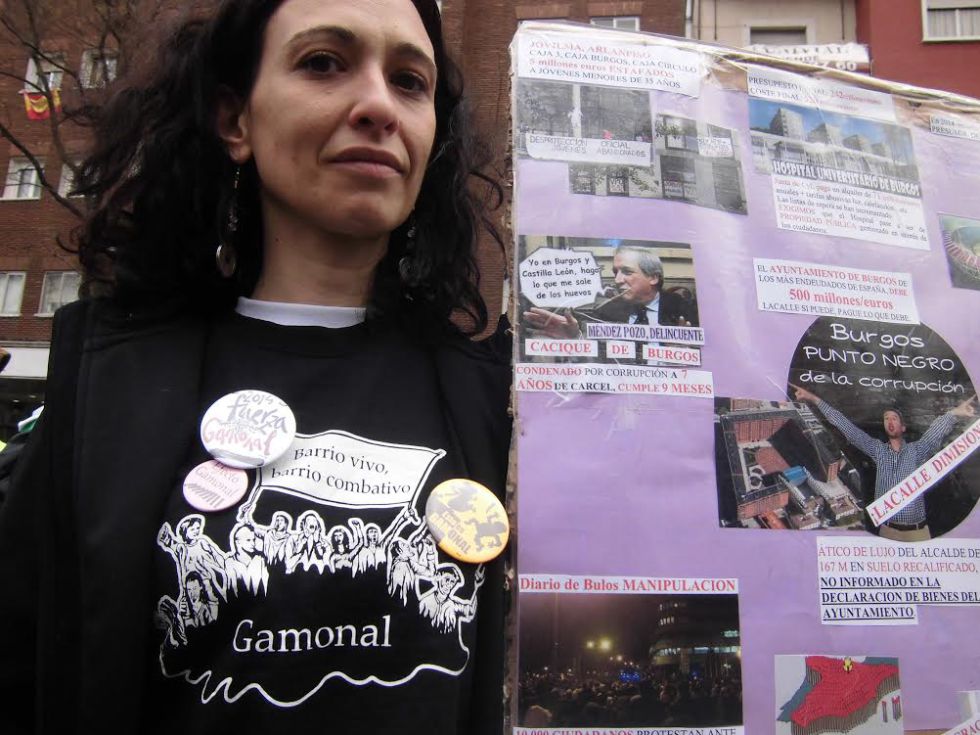
In Spain millions march for dignity

Belèn Calvo

“I came because I have dignity.”

As many as two million demonstrators converged on Madrid this weekend to reject austerity and support individual and collective dignity. For the past month, eight columns have been on the move, and Saturday, they met, as the Marches for Dignity flooded the streets and captured the imagination of the Spanish people.

Marchers and supporters have demanded no more payment of the debt; no more cuts; no more Troika; and bread, work, shelter (and roses) for all. While they have specific policy demands, such as a law establishing a basic income and an end to all evictions, the heart of the mobilization has been to demand an end to State terror and a concerted effort to build dignity. To march, and to work, for dignity is to reject the politics of fear and terror.

The marchers’ manifesto demanded equal rights for women, migrants, people of color, members of LGBTIQ communities, elders, the poor, workers, dissidents, and more. More to the point, they have demanded an end to the assaults and a beginning to real democracy and real dignity.

Women have been prominent across the sectors. Women have led the anti-eviction movement, and they have led and populated all other movements as well, from mining communities to farm communities to urban communities, from factories to schools to clinics. Women like anti-eviction activist Mamen Ruiz argued that women had been pushed to the brink, and beyond, and that now is the time. Women like Virginia, a government employee, marched to protest the astronomically rising tax rates and the new, stringent anti-abortion laws. Women like teacher Belén Calvo came because, in her words, “I have dignity.”

Women marched to secure an end to sexual violence and exploitation. They argued that women had long struggled with and organized to secure the right to live without male violence and the right to family planning. Under the Troika’s constant assault on women, and almost everyone, violence against women has intensified. Violence has intensified against women of color, immigrant and migrant women, women workers, women students, women seeking medical assistance, and the list goes on.

Outside of Spain and the usual suspects, the Western media has barely covered the largest protest in recent Spanish history, except to note that they ended with some clashes between police and a very small number of demonstrators. Whether police or protesters began those clashes remains debatable. What is clear is that the only `news fit to print’ is violence, however incidental.

For the international news media, austerity is the new normal. Meanwhile, anti-austerity resistance is gaining ground in Greece, Cyprus, Ireland, Portugal, Spain. Much of the prison resistance organizing in the United Kingdom, United States and Australia is anti-austerity at its core. Much of the protests about public service in South Africa are as much about the State’s austerity development program as the shoddy service. In each instance, women are at the core of organizing. In each instance, women echo Belén Calvo: “I come because I have dignity.”

The message is clear. End the reign of terror and torture that passes for austerity. Remember, we each and all came because we have dignity.


(Photo Credit: El Pais / J.J.G.)

In Cyprus austerity passionately embraces incarceration


Sunday, March 16, marked the first year anniversary of Cyprus’s crash program in austerity. The troika – the European Commission, the European Central Bank and the International Monetary Fund – in its infinite wisdom forced Cyprus to welcome a raid on all its bank deposits by means of a tax on all deposits. While that particular, and particularly destructive, policy was rescinded, other measures remain in place. Two weeks ago, Cyprus Parliament approved massive and deep privatization of public services. What does not close is the prison.

Last week, in response to two reports, the European Parliament backed resolutions critical of the Troika’s lack of democratic accountability. For Liem Hoang-Ngoc, co-author of one report, Cyprus is a prime example of the Troika’s anti-democratic practices and mentality: “If there had been open debate at the European Parliament, the Eurogroup would never have suggested that Cyprus tax deposits under 100,000 euros… Macroeconomic goals have not been realized: growth is sluggish and debt has skyrocketed. We underlined the disagreements among the members of the Troika, proving that other politics were possible. The message I wanted passed is that the politics of austerity have failed. Democratic debate must be open in order to make public the existence of alternative politics.”

Throughout the island nation’s year of political uproar and economic collapse, prison, and specifically detention of migrants and asylum seekers, has remained a growth industry.

Cyprus has had a longstanding love affair with putting asylum seekers behind bars. A 2012 report noted, “Every year, hundreds of people who flee to Cyprus to escape persecution, war or simply grinding poverty are put behind bars and detained as if they were criminals, even though they have committed no crime. Most are detained for months, often in poor conditions without access to adequate medical care and usually unable to challenge the lawfulness of their detention due to the paucity of free legal aid. In some cases, the Cypriot authorities refuse to free people even when the Supreme Court has ordered their release.”

The report told the story of N: “N. is an asylum-seeker from Sri Lanka. She is married to another Sri Lankan asylum-seeker who lives in Cyprus and they have submitted a family asylum application. They have an eight-year-old daughter. In September 2011, N. was arrested without documents and detained in Block 9 of Nicosia Central Prison. Her lawyer, [said] that despite his repeated requests, the authorities did not provide him with the deportation and detention order, so in April he challenged the lawfulness of her detention before the Supreme Court…In December 2011, N. was still in detention along with several other women held pending deportation. She tearfully said: `What kind of country separates a mother from her child? Yesterday it was her birthday. My daughter told me, ‘mama I miss you so much’.’ N. was eventually released on 23 April 2012, one day before the scheduled Supreme Court hearing and after seven months in detention.”

That was 2012. A report released today suggests the only change is from `prison’ to `detention centre’: “One woman, Nina (name changed), 28, was separated from her 19 month old son whom she was still breastfeeding and detained in a police station, after she was arrested while trying to apply for permanent residency. She is married to a Romanian citizen and told Amnesty International her immigration status has always been regular and that she did not know the reason for her arrest. Her son was taken away by social services and was only allowed to see her three times a day for 20 minutes at a time for feeding.

A second woman from Sri Lanka, was detained in Menogia detention centre after visiting her husband, also a Romanian citizen, who was being held at a police station. They were accused of having a marriage of convenience despite a DNA test proving that her husband was the father of her child. She was only allowed to see her three year old son twice a week for half an hour each time. Both women have since been released after four days and four weeks in detention, respectively.”

In the past year, there have been repeated hunger strikes both by prisoners inside Menogia and by loved ones and others outside: “It must be a special kind of hell, the bottom beneath the bottom, to escape persecution, war or a natural disaster only to be locked up indefinitely in a place every bit as dehumanizing as a prison. At the Menogia detention center in Cyprus, twenty-five Syrian refugees fasted to try to end their mistreatment, which included the denial of food and medical care.”

From the debtors’ prisons popping up in the United States to the immigration and asylum prisons in Cyprus, austerity passionately embraces incarceration. In a world in which “migrant populations have become increasingly feminized,” another world, without special kinds of hell, must be possible.


(Photo Credit: Cyprus Mail)

The urgency of an independent women’s movement against debt and austerity measures

Why have an independent women’s movement against debt and austerity measures in Greece?
The debt crisis and the subsequent austerity measures affect us women first, in every aspect of our lives. If we women don’t organise ourselves to resist, no one else will do it for us.

Why do the debt crisis and the austerity measures affect women more?
Neo-liberal austerity during the debt crisis is aimed particularly at what is left of the welfare State and public services. By dismantling or privatising public services, the State disclaims the social responsibilities it had towards its citizens and shifts them – once again – onto the family. So that the care of children, sick people, old people and handicapped people, even young people in great difficulty and out of work, is no longer the State’s responsibility, but the family’s, provided free of charge into the bargain!

But the notion of family is general and abstract. In reality, it’s women who take on – practically all alone and without any remuneration whatever –all the basic social duties of the State. So the neo-liberal State kills two birds with one stone: it rids itself entirely of the social obligations that “widen the deficit and therefore, the public debt” and forces us women to shoulder them ourselves by working for absolutely nothing!

In other words, women are forced to do the job of, or rather replace, the welfare State?
Yes, but there’s more to it than that. There’s the other side of the coin, another reason that all these Memorandums are aimed at us: we are the first to be affected by the massive lay-offs that go with the dismantling or privatisation of public social services of every kind, because women make up the great majority of the workforce in these departments.

The result is simple and concerns thousands of female wage-earners in our country: not only are we the first to be laid off with absolutely no hope of being re-hired, especially if we are already mothers or of child-bearing age. Not only are there masses of us left unemployed, especially young people with no professional future to look forward to. Not only are we condemned to poverty and precarity, but they also burden us with the tasks that were the job of the State, with all that it brings in terms of fatigue, stress, premature ageing, unpaid work and additional expenses!

Some – such as the State, the Church and so-called well-meaning people – say that this way women can return to their real mission, which is to devote themselves to their home and family.
Of course they do! Not only do they say it, they shout it from the rooftops because the inhuman policy of the Memorandums has to come in an ideological wrapping! It’s just cheap propaganda that uses the most sexist of reactionary clichés to mask the ferocity of their neo-liberal policies. We are witnessing something apparently paradoxical: an alliance between the height of capitalist policy-making, as seen in the brutal austerity of the Memorandums, and the proponents of the most obscurantist theories of a bygone age who want to convince us that it is a woman’s “nature” to be shut up in the home with no other “tasks” than those of a mother and/or spouse. It’s the union between IMF Memorandums and the European Commission who say they want to “modernise” us, and the bastions of the most anachronistic and misogynous patriarchy embodied by the Church or the right and extreme right.

Is it only propaganda or are there practical consequences for women?
It’s not just theories and propaganda. The worst is the very tangible and disastrous effects on our daily lives. This return to a distant past is accompanied by measures designed to deprive women of the few rights and victories they’ve obtained through the struggles of the last few decades. The Holy Alliance of Capital and Patriarchy effectively abolishes our right to work, and with it, our right to economic independence. It forces us once again to a life of dependency, deprived of the right to free will. It treats us as slaves that have to shoulder the tasks and services formerly provided by the welfare State, because it is supposedly in the “nature” of women to do the work of a kindergarten, old people’s home, hospital, restaurant, laundry, psychiatric ward, extra schooling and even job centre for unemployed family members. And all totally free, with no payment, no recognition, because supposedly it’s in a woman’s blood to “sacrifice herself” for others. As a result, she never has time to take a break, look after herself or take an active part in public affairs.

All this must take a heavy toll on women.
It does. Not only because this daily stress means they age prematurely, that they get worn out, but also because all this sexism around the so-called “feminine nature” leads to the treatment of woman as an inferior being, whose body is considered to be always available and which any man can vent his frustrations on. It’s not a coincidence that the cases of violence against women, which were already numerous, are increasing in this period of capitalism and Memorandums.

For these reasons, and many others, the conclusion is simple: our resistance to this offensive against women by the Troika government and the Memorandums calls for us to organise ourselves and develop an independent and autonomous women’s movement against debt and austerity. Not only because no one can do it for us, but also because capitalism and patriarchy are so closely intertwined that any fight against one of these tyrants will be a shaky one if it is not also fought against the other.

(Photo Credit: encuentro5)

In Spain, the neoliberal State attacks women to `protect’ them


Austerity measures help neither the republic nor the democracy. They usher violence and injustice into the civil society. For women, austerity measures mean something dreadful.

In 2011, Spain elected populist conservative Mariano Rajoy from the People Party (PP), with the support of fascist groups and the ultraconservative branch of the Catholic Church. He campaigned as a strong believer in neo liberal values, particularly pushing austerity as the basis for economic policies. No matter that the so-called public debt originated from a complex association of debt and profit making through outrageous interest rates to private banks and investors.  As in the United States, the message and the methods involve the religious right and the control of women’s bodies and the most vulnerable.

Once again women’s rights, immigrants’ rights, labor rights are at stake.

“Today, it is going to be impossible for women to have abortions. We expected a bad law, but this is the worst we could have imagined,” said Francisca Garcia, president of ACAI, La Asociación de Clínicas Acreditadas para la Interrupción Voluntaria del Embarazo. This worst law imaginable has overturned previous reproductive laws, and in particular the 2010 law passed under the socialist government of Zapatero, one of the most comprehensive defenses of women’ss right to control their bodies. The new law will make abortion impossible unless pregnancy threatens the woman’s life or if the pregnancy is the result of a sexual assault.

Justice Minister Alberto Ruiz Gallardon, who designed the antiabortion bill, explained: “Women are victims of abortion.” His comment shows his utter contempt for women’s intelligence and capacity to understand their bodies and their needs. He pretends that the morality of this bill rests on the defense of the unborn yet conceived child and on an economic necessity. Actually, countries, like France, that have progressive abortion laws and public services to support mothers have among the highest birth rates in the industrial world. Moreover, it goes against the European Union views on abortion rights with twenty of the twenty-eight members guaranteeing women’s right  to freely decide on their pregnancy. Six EU countries have conditions on abortion but allow it. Only Malta and Ireland prohibit abortion.  According to Le Monde, the Rajoy government and its campaign against abortion received funding and support from the ultraconservative Center for Bio-Ethical Reform, based in the United States with representation in Spain.

Undocumented immigrants are also targeted by Spain’s so-called reform of the health care system. They are now denied any kind of coverage under the public health care system. Amnesty International, Doctors Without Borders, and the UN Committee on Economic, Social and Cultural Rights have protested these measures. As with abortion rights, there is no rationale or morals that can justify these measures, since health is recognized as a basic human right and covering a population is both more humane and cost efficient. These bills have been designed to show the muscles of this government and its commitment to punitive public policies. By reducing public services to the bare minimum, neoliberal policies overpower human rights.

Simultaneously, Gallardon wants to `reform’ the penal system and create a life-without-parole sentence. Following the United States, he is advocating for a Patriot Act-type of security law with more restrictions applied to unions and the right to strike.

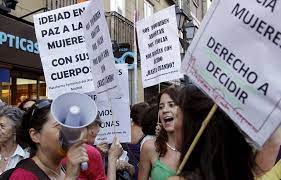
Meanwhile, demonstrations multiplied in Spain and across Europe.  In Spain the police responded violently to women demonstrating for their rights. They pushed groups of women to the ground, which was filmed and triggered more protests.

Almost 25 years ago, Jacques Derrida noted, “Today the police are no longer content to enforce the law, and thus to conserve it; they invent it.” Today, the Rajoy government, no longer content, invents the law to exercise violence against women while showing a cynical contempt for the Spanish people.

To fight for these rights is to fight for the people of Spain and elsewhere against the oppressive globalized neoliberal order that, with mechanical precision, disassembles human society and turns profit-making into a State religion.


(Photo Credit: Fernando Alvarado/EFE)

Violence Against Women as a strategic weapon in a time of class war in Greece

We already knew that violence against women is often used as a weapon in times of war to punish, humiliate and dehumanize, but especially to repress and annihilate by all possible means the population to which they belong. This violence has often been seen as a means of domination rather than as a tool of destruction.

In the period of deep crisis shaking Greece, violence against women is becoming a weapon in the hands of the rulers. Such violence has been increasingly widespread in Greece. Here are four emblematic cases.

The most recent case occurred at the beginning of November 2013 when Greek police special forces (MAT) tried to prevent two Members of Parliament from entering the building of ERT, the public radio and television station, which had been occupied by the police. Police pushed opposition MPs Zoe Konstandopoulou of Syriza and Rachel Makris of the Independent Greeks party against the entrance gates and roughly handled them. Zoe Konstandopoulou, who nearly died from asphyxiation, is now taking legal action against her agressors for attempted murder. The two MPs were simply trying to exercise their constitutional right to enter the ERT building to prevent the police destroying equipment to frame the workers who had been fighting for the station to remain in public hands.

The morning following the incident at the ERT building, the pro-government daily newspaper TA-NEA, launched a campaign against the two MPs, publishing a cartoon on its front page showing them as strippers pole-dancing in front of a male audience. The caption, a conversation of a male client in the audience, to the cartoon read, “Rachel is on the right and Zoe on the left. Do they do anything else? I heard that they are taking legal action. But we should ask the waiter”.

The second case involved a television campaign against HIV-positive, some of whom are sex workers. In the middle of the election campaign, two social-democratic ministers, notorious for their role in repressing demonstrations against the Troika and in the destruction of the health service, called publicly for the arrest of those who, according to these ministers, “constituted a heath time-bomb”, “are polluting society with their contagious diseases” and are killing, with the AIDS virus, “Greek family fathers”.

The third case involved dozens of women, including some grandmothers, in Skouries in the north of Greece. These women were opposing the Canadian company Eldorado and its gold mining project. For months, special police forces under instructions of the minister have been targeting the women of the villages with a ferocious and massive repression. Some have been sent to prison. This unprecedented repression, carried out in the background of a state of emergency in a region inhabited by peasants, is exemplary, according to those who gave the orders to prevent the repetition of such acts of “civil disobedience”. As always, “exemplary repression” targeted women first and foremost.

Finally, Kassidiaris, an MP from the neo-nazi Golden Dawn, struck two female MPs on the face, while live on television during the election campaign last spring. Instead of rousing indignation and reprobation, this act of violence led to a wave of popular sympathy and contributed to the electoral success of Golden Dawn.

What is going on?

This violence against women reminds us of that committed during wars of ethnic cleansing. The rape of women by enemy forces should not be explained as the result of some “uncontrollable” male impulse but as that of a strategy of war during which women represent symbolically and biologically the integrity of the ethnic group or nation, which must be destroyed. In Greece today, we are not faced with nationalist violence pursuing ethnic cleansing. We face a different type of conflict, another sort of war, a class war.

Humiliate women MPs by comparing them to strippers sends the message that politics is first and foremost the exclusive domain of men. In that world, women are to be always available for sex and to be the property of men.

The public denunciation of HIV-positive women criminalizes and demonizes their sexuality and presents them as a “menace” to law and order, which must reign in our society. This “menace” has been denounced for the last two centuries as coming from the “dangerous” classes.

To make misogyny a weapon of war in the hands of the ruling elites comes as no surprise. The Troika aims to turn the clock back to the worst moments of the savage and barbaric capitalism of the 19th century. The Troika yearns for the time when women had no rights.

We are witnessing a frontal assault, a war of historic proportions, against the immense majority of citizens (the waged, poor, unemployed, pensioners, youth, the “different”, the immigrants and minorities). The transformation of violence against women into a weapon increasingly used by the ruling powers is an integral part of that war. Just like in the case of mass rape in nationalist/ethnic wars, violence against women used by the ruling class in a time of class war has the same objectives: to break the morale and social fabric, to force not just women but all victims, including men, into submission and acceptance of their inhuman neoliberal policies.

(This first appeared in a different form here: http://leftunity.org/violence-against-women-a-strategic-weapon-in-the-hands-of-the-rulers-in-a-time-of-class-war-in-greece/)