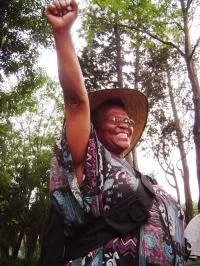
The Traditional Courts Bill is dead. Long live Sizani Ngubane!

Sizani Ngubane

The Alliance for Rural Democracy, South Africa, announced today that the Traditional Courts Bill is dead: “The Traditional Courts Bill (TCB) is dead. This follows years of opposition from civil society and is a massive victory for the thousands of people in rural parts of the country who spoke out against the bill during provincial public hearings … Women have been at the forefront of opposition to the TCB, arguing that it would legalise and entrench current discrimination.”

The Alliance statement quotes Nomboniso Gasa, of the Alliance for Rural Democracy and the Centre for Law and Society, University of Cape Town, and Sizani Ngubane: “Sizani Ngubane of the Rural Women’s Movement in KZN states: `The TCB was never about custom. It was about bolstering the power of chiefs. Government can no longer deny the abuses that many chiefs are getting away with, because we explained these abuses over and over again in the public hearings. What we need now is a law that protects real custom and protects women, especially, against the kinds of autocratic power that chiefs got used to under apartheid.’”

Many other women, and women’s organizations, contributed to the death of the Traditional Courts Bill. The Women’s Legal Centre has worked tirelessly in the courts. Siyasanga Mazinyo, of the Rural People’s Movement, has been organizing and representing tirelessly across the provinces. And Aninka Claasens has been researching and writing tirelessly on the implications and injustices of the bill.

For decades, Sizani Ngubane has been speaking out, organizing, researching, writing with rural women initially in KwaZulu Natal, and then across South Africa. She founded the Rural Women’s Movement in 1998, which later became the National Movement of Rural Women.

In 1999, Sizani Ngubane met with women across the rural expanse of KwaZulu Natal. She was conducting research about the situation of women and the prospects for organizing a women’s movement. Here’s her conclusion: “Although no longer constitutionally defined as minors in the law of the country …women continue to be treated as subordinates to men; this subordination is defended by many (including some women) in the name of `African culture’ … As a result of the gendered division of labour in the communities, women carry much of the responsibility associated with food production … Women also carry the burden of responsibility for maintaining the household, energy and water collection and childcare. As a result women have less time to develop themselves as individuals or as groups. The prime constraint women face is the absence of a strong lobby campaigning for women’s land rights in rural areas … Organizing women around the land their needs is central to meaningful land reform: that process must begin now.”

The Traditional Courts Bill is dead. Long live Sizani Ngubane and all the women who killed it!

(Photo Credit: International Alliance of Women)

Massachusetts Stops Shackling Women (Prisoners) in Childbirth!


Yesterday, we asked, “Will Massachusetts stop shackling women prisoners in childbirth?” Today, the Governor gave his answer. Yes! Governor Duval Patrick today said, “We will end finally, completely and immediately the use of restraints on pregnant inmates in labor.” Yes!

The struggle does not end with the Governor’s regulation. As Senator Karen Spilka, who sponsored the bill currently in the Massachusetts legislature, noted, “It’s not necessary, it’s inhumane, and it can be very detrimental to the woman and the baby. We need to codify this to strongly send a message that we are a state that treats our women humanely and wants to foster their health and wellness.”

Or, as Governor Patrick succinctly said, “Regulation is good, but here law is better.”

The bill puts the shackling of women prisoners in childbirth in the context of pregnant women’s rights to well being, to decent and affirmative health care. Shackling pregnant women is inhumane and misogynistic. It hates women as women.

Senator Karen Spilka and Representative Kay Khan, along with the women and men of ACLU, NARAL, The Prison Birth Project, and others will keep the struggle going for passage of the legislation. But for today … YES! Yes, women prisoners are women. Yes, it is wrong to shackle pregnant women. Yes, it is right to support women’s right to health, well being, and being women. Yes!


(Image Credit: RadicalDoula)

Devyani Vs. Sangeeta: Domestic Workers’ Rights

Sangeeta Richard

The recent strip search, including cavity search, of a female Indian diplomat, Devyani Khobragade, in New York, raised a hue and cry in India. Prime Minister Manmohan Singh, including much of the administration and the public, denounced the U.S. act as demeaning, primarily because a body search of a female is considered dishonorable by Indians for it brings shame upon the woman, her family and the country, and secondly the Indian court would not consider a salary issue between an employer and her maid tantamount to a crime that necessitated a strip search.

But we need to look at some underlying blind spots this issue glaringly reveals:

1. While Devyani’s experience of undergoing a strip search is demeaning, I believe that such a treatment of any woman in the U.S. who is in police custody or in customs/immigration, whether the crime is unremarkable or severe, as unacceptable. We have not protested enough about strip searches of women especially since such searches are now placed within the umbrella of security and anti-terrorism jurisdiction.

2. While there is now a history of protest to raise minimum wage in the U.S. and the pay discrepancy between men and women is a hot button issue, brought to light by the Lilly Ledbetter bill signed by President Obama in 2009, enforcing this in reality has been tough. But many grassroots movements, such as Working Families and Occupy, are making their mark in trying to make employers conscious of pay gaps and inequities. While Devyani’s lawyer may argue that she has done everything legal under the contract with the maid, Sangeeta Richard, nevertheless, the reaction of the Indian government and a mortified public brings up the fact that Indians have internalized the notion that since most of middle class has maids and there are no unions to protect their wages or their treatment, that there is nothing shocking in the continuation of this practice when domestic workers work in Indian households locally or abroad. The protest about wages and treatment of domestic workers both local and migrant is heard loudest only among feminist organizations. Governments have not taken it seriously; there is no proper jurisdiction regarding wages for domestic work, therefore the issue prevails in the shadows.

3. The irony of the Devyani case is that Devyani is Dalit herself—the oppressed class in India’s caste system. The Dalit movement began during the time of India’s nationalist movement for Independence from British rule. Although the reservation system (similar to Affirmative Action) was put in place to address the rights of the underprivileged castes in the caste hierarchy, nevertheless the oppression of Dalits continues. Devyani’s family is Dalit, but well to do, and she is a diplomat employed by the Indian government. It is indeed a lesson in the nature of oppression to see one who has risen to a privileged position in terms of economic class and status to pay a low wage to a woman she hired to work in her household. Of course, since this act is an allegation until proven, and Devyani may after all be innocent, nevertheless this case brings to light two questions: Should foreign diplomats be allowed to get away with anything because they have diplomatic immunity? Should the U.S. use cavity search and strip search on women in immigration violation cases? How can we separate wage issues from labor trafficking cases, since labor trafficking is another charge brought against Devyani? How can we take personal responsibility to make sure someone we know is not being paid below minimum wage?


(Photo Credit: Times of India)

Sexual violence, human rights and the media

Sexual violence is usually not covered as a human rights issue.  As the archetypical normalized, invisible, overlooked and structural human right violation, it is more often treated as an everyday, normal problem rather than a violation of women’s rights to health, life, bodily integrity, education, and more. The culture of impunity that surrounds sexual violence, and the fact that rape is notoriously underreported, can hardly be detached from the media’s failure to communicate to people that they actually can report these as crimes.

It is a missed opportunity, and a troubling one, because the way the media chooses to frame sexual violence influences how people think about rape. They can shape, challenge and perpetuate dominant perceptions or illuminate harmful misconceptions and shed a light on the contestations and anxieties that surround the topic. Moreover, they can channel the outrage and disgust towards, for example, child-rapists into anger and calls for accountability towards our governments.  Making sexual violence newsworthy as a human rights violation, rather than something that happens to happen as long as bad men are around, matters.

Making rape newsworthy is not where the media’s responsibility ends. Exposing power-relations that underlie human rights violations also counts. As feminists have long demonstrated, rape is about power. Coverage of sexual violence shouldn’t end with a narrow description of what has happened to whom and how, but should also contextualize the events with an explanation of gendered power relations. Sexual violence should be seen as a violent performance of patriarchy and an enactment of masculinity; both pervasive and structural forces, but also fluid and therefore changeable. Focusing on the violent masculinities doesn’t mean identifying it as the sole cause; the blame must still be placed on the perpetrator. But not without mentioning the power structures that enabled or encouraged him to commit this crime; and the responsibility of the government to take action and show political will to fix these pervasive social ills. If the media would educate us all a bit better around patriarchy and masculinity, we might actually tell our governments to put political will behind their human rights talk.

The media’s ability to either encourage or discourage rape survivors to report their crimes to the police matters as well. Reading about arrests, trials and convictions and the laws that are violated with an act of nonconsensual sex is more likely to incline women to report rape to the police than grim media narratives that simply describe place, time and brutality.

The media have a responsibility to make sexual violence a human rights issue. Human rights education, then, should also include an education of the educators. Both editors and reporters need to know and understand what human rights are if a ‘rights culture’ is to be built.


(Photo Credit: Pinterest)

Mujeres unidas, jamás serán vencidas!

From Madrid to Paris, from London to Berlin and all over Europe, women and men went to the streets to demand respect for women’s rights, including the right to decide to continue or end a pregnancy. These massive demonstrations were a response to the attempt from the Spanish government to curtail women’s rights with an outrageous bill.

In Spain women and men rode the “train of freedom,” to reach the capital. The older participants remembered the time before the first laws in the 80s when women risked their lives for not pursuing an unwanted pregnancy. The younger were afraid for the future of their lives. Men expressed worries for their partners, their daughters. Many were afraid of the moral and social setbacks and the threat of the extreme right rule. After all, the time of Franco dictatorship left its marks on the Spanish population.

Sizeable demonstrations took place in 32 cities in France. Thirteen women politicians from the left to the right, who also recently supported LGBT rights, launched an appeal to the Spanish Prime Minister Mariano Rajoy. They noted that Spain has often led Europe in passing progressive laws that made headway in defense of women’s rights, especially targeting sexual and sexist violence. Spanish law inspired other countries like France in shaping better anti sexist laws to address violence against women.

People who joined or supported the demonstrations know that what is happening in Spain is just one side of a multifaceted battle against women’s rights and public services that is raging across Europe. These rights are social rights.

Annie Ernaux who wrote an iconic book on her experience with abortion when it was illegal, asks, “Is it really unfathomable to imagine a return to clandestine abortion? I have always been convinced that nothing is ever definitely won for women.” What happened to women when their reproductive rights were not respected? “We would see women dying of hemorrhage, septicemia, or losing their uterus” recalled Martine Hatchnel a gynecologist who started working before the Veil abortion law.

As the neoliberal crisis has extended its grip on populations through austerity measures, Europe has experienced a certain hardening on human rights issues and the rise of far right power. However, the Spanish government’s attack on women’s rights has galvanized a stronger opposition than expected. 81 % of Spanish people oppose the bill; throughout Europe support for reproductive rights is increasing. In France these rights have been reinforced in law, social organization, and public support, which is large.

There is a movement that demands that these rights be recognized as nonnegotiable in the EU. For example, Portuguese European deputy Edite Estrela has tried to have sexual and reproductive rights recognized through a vote on her Report on Sexual and Reproductive Rights, which had already been altered with the removal of LGBT sexual rights.  Her report was defeated by only 7 votes, largely because a translation error led to some thirty votes being misdirected. Estrela is appealing the decision. This Report would have broadened the commitment to sexual and reproductive rights within the EU, especially directed toward Ireland, Poland, Spain, Malta and Italy.

Revolt and indignation are brewing across Europe, according to Isabelle Louis, of Paris Planning Familial and one of the organizers of the Paris demonstration. Visibly pregnant, she read the declaration of the French Family Planning in support of sexual and reproductive rights. She said that there was something very important taking place during this demonstration as she observed the varied crowd, men, women and definitely with a trans-European coloration. She saw older women too old to march showing their support from their windows and balconies.

Isabelle Louis concluded that the battle continues and this time she’d like to believe that it could be won!


(Photo Credit: L’Humanité)

Cry the beloved Khayelitsha (Commission)

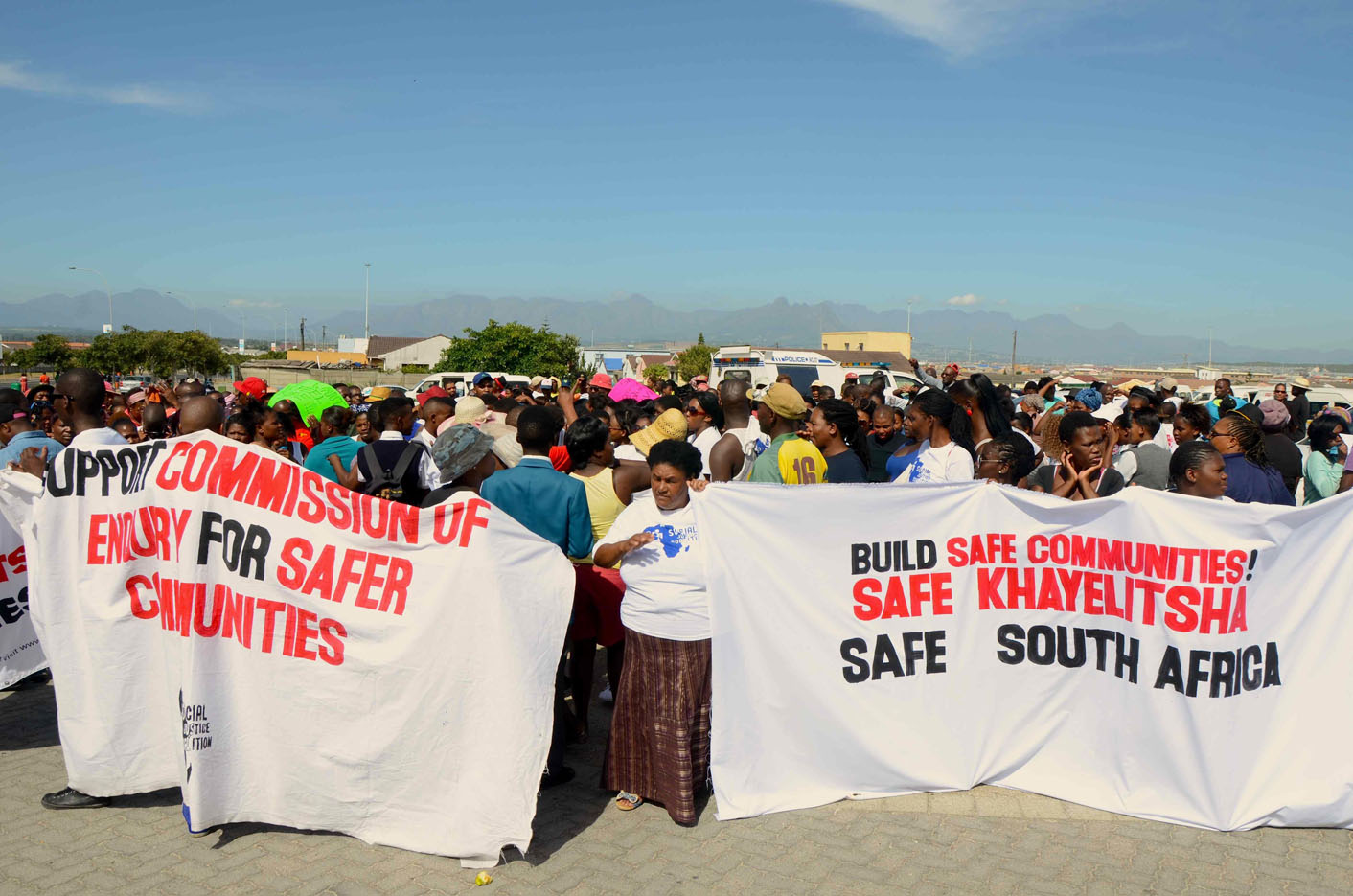
South Africa is currently awash in commissions of inquiry. There’s the ongoing and perhaps never-ending Marikana Commission. Today we read there’s to be a new commission of inquiry into the Tongaat mall collapse, last November. And there’s the Khayelitsha Commission of Inquiry into allegations of police inefficiency in Khayelitsha and a breakdown in relations between the community and police in Khayelitsha.

While women are significant participants in the Marikana and the Tongaat events and commissions, women are in many ways the subjects of the Khayelitsha Commission. This is not surprising, given the nature of the inquiry. The Commission’s mandate isn’t to get to the bottom of a tragic event, but rather to investigate and get to the texture of decades long dissolution of everyday life.

In the 1980s, the State built Khayelitsha and has continued to do so ever since. Part of this construction has involved the establishment of a State of sexual tyranny. That State of sexual tyranny has come forth in the testimony of Khayelitsha residents to the Commission.

The Commission began in response to a complaint lodged by the Women’s Legal Centre, representing the Social Justice Coalition, Treatment Action Campaign, Equal Education, Free Gender, Triangle Project, and Ndifuna Ukwazi. That complaint was lodged in 2012. The Social Justice Coalition had been organizing hard for two years prior for an investigation into the situation of justice administration in Khayelitsha. As the complaint noted, “Since 2003 the civil society organisations have held more than one hundred demonstrations, pickets, marches and other forms of protest against the continued failures of the Khayelitsha police and greater criminal justice system. The organisations have also submitted numerous petitions and memorandums to various levels of government in this regard. There have been sustained and coordinated efforts from various sectors of the Khayelitsha community for action to be taken by government agencies, including the police, to improve the situation.”

For over a decade, intensifying police incompetence, corruption, violence, and disregard for the local population went hand in hand with `vigilante justice’. In 2012 alone, 20 `vigilante’ collective killings were reported in the area. The struggle for space and for citizenship was running with blood and smoke. In the struggle for safe space and full citizenship, women, again, have been key. As the Women’s Legal Centre complaint noted, “Girls and women are frequently beaten and raped whilst walking to and from communal toilets or fetching water from communal taps close to their homes, while domestic abuse poses a threat to the safety of many women within their own homes. Between March 2003 and March 2011 there has been a 9.36% increase in the number of reported sexual crimes reported in Khayelitsha.”

Throughout the decades, women have kept their eyes on the prize. Khayelitsha is home. They should be able to live, and love, at home without fear of violence. Their children, partners, parents, friends, neighbors should as well. Through the use of public funds and private security forces, Cape Town has established `improvement districts’ … in the central city, inner southern suburbs, Sea Point and Green Point. Not in Khayelitsha. The women know that, and they don’t accept it.

Funeka Soldaat, founder of Free Gender, recounted her story of being raped, because she is lesbian, in 1995. She went to one police station, where nothing happened. Finally, without her statement being taken, she was taken to a hospital and dumped outside. The hospital said she needed a statement, and so she walked to Khayelitsha Site B police station, all of this right after having been raped. There she was treated disrespectfully, she felt because of her sexual orientation, and no statement was taken. Finally, literally barefoot, she walked home and went to sleep. The rest of the story is pain, healing, organizing. As to the police: “Khayelitsha police appear to lack the energy, will and intent to provide a service to LGBT [people].”

Malwande Msongelwa described what happened when she found her brother, stabbed to death at a bus stop. She called the police, and they didn’t come. She called again, and they finally came, but did nothing. Worse, they refused to get out of their cars: “The police do not care about people… [they] will only come out if there are drugs. Then they will come out with 10 cars …They do not even care if you are injured… If the ambulance hasn’t arrived they won’t touch you. They wait in their car… I don’t trust the police.” Her brother lay on the ground for six hours. The crime scene was never investigated.

The stories continue. Ms. Nduna describes how a police van hit and dragged one of her children. This was the fifth child in the area to suffer harm, and worse, at the hands of a police vehicle. What happened? “We buried and there was nothing still.”

The harrowing stories of violence, of police inaction and worse, of vigilante action and worse, occur in a framework of radical hope. Phumeza Mlungwana, Secretary General of the Social Justice Coalition, put it simply and directly: “Most of Khayelitsha is policeable.”

Witness and after witness explained that lights, presence, a diversity of site appropriate techniques, a committed and engaged and respectful police force are what are called for. It’s not rocket science, and it’s not impossible. The women of Khayelitsha know that. They know, from experience, that when the work of struggle accompanies the work of mourning, they can make things happen. The Commission itself is a step along that path. The struggle continues.

(Photo Credit: Kate Stegeman / Daily Maverick)

In Canada, another casualty of immigration laws and indifference

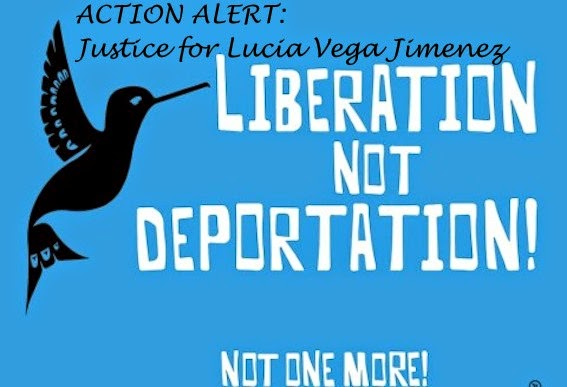
On December 20th 2013 Lucia Vega Jimenez committed suicide, hanging herself in a shower stall of a bleak border facility at the Vancouver International Airport under the jurisdiction of Canada Border Services Agency, CBSA. She died eight days later in a hospital.

The Transit Police arrested Lucia for two reasons. First, she did not purchase her bus ticket. Second her name and origin could be the source of a serious offense. It became a life-and-death offense for Lucia.

After her arrest, her fate was in the hands of CBSA, who sent her to their Vancouver airport facility to await deportation.

The news of Lucia Vega Jimenez’s death surfaced over a month after she died. It has generated a number of outcries and questions. But what are the questions?

Why was she detained in quasi isolation with no contact allowed with friends and family members? What is the border that the CBSA is “defending” so harshly?

After 9-11 2001, the rhetoric about border insecurity and porosity was utilized by CBSA to implement secrecy as its regular practice through protection against terrorism legislation in 2003. According to immigration lawyer Phil Rankin, “They think themselves as the first line against terrorism.”

Exactly what borders are we talking about, as all sorts of merchandise and products travel freely thanks to manipulative trade agreements? Moreover, a certain code of silence surrounds the way the global market trade system impoverishes and destabilizes populations, especially women.

Lucia was 42. she was worried for her safety, as she had made a failed refugee claim in 2010. She was distraught, as some cash that she saved for her family had been stolen.  She was detained in a facility that is described as a very lonely, isolated place. Phil Rankin explained, “No one gets in or out. It’s very impersonal, very secure, and very private, there’s no John Howard Society, no visits from family or lawyers. They want to move these people without a fuss or muss. There’s no oversight by non-officials.”

This question of lack of independent oversight has been challenged by the BC Civil Liberties Association and No One Is Illegal, a grassroots organization that works to end detention for migrants in Canada.  Then, should we question the fact that the CBSA has contracted with a private firm (Genesis Security)?

Despite some 7000 signatures on a petition that demands an “immediate public inquiry and a comprehensive review of migrant detention policies,” the tone of some comments from forums such as a local TV forum reveals that the general public has been rendered insensitive to these questions of detention of migrants. The reality of Lucia’s death in isolation, the reality of a woman who worked and lived in Vancouver as a domestic worker, vanishes under the views that she was “illegal” and responsible for killing herself. These populist utterances are encouraged and help to camouflage the reasons for border security that justify the mistreatment of migrants and the surveillance of everyone.

We should wonder how borders have become private and secretly run to serve the global market and how in the midst of privatization and deregulation policies, Lucia Vega Jimenez had come to prefer to kill herself rather than being deported. We should wonder about the complete indifference of officials who pride themselves in defending their country, but defending their country against what?


(Image Credit: Sanctuary Health)

Prison means business … for real

A report came out yesterday suggesting that probation in the United States is big, predatory business. The report opens: “The United States Supreme Court has ruled that a person sentenced to probation cannot then be incarcerated simply for failing to pay a fine that they genuinely cannot afford. Yet many misdemeanor courts routinely jail probationers who say they cannot afford to pay what they owe—and they do so in reliance on the assurances of for-profit companies with a financial stake in every single one of those cases.”

Women figure prominently among the lists of the abused and caged. Here’s a typical story. Judge James Straight, a Justice Court judge in Bolivar County, Mississippi, remembers a woman who called his court, weeping. She claimed probation officers, who worked for Judicial Correction Services or JCS, had threatened to have her jailed for a bill of $500. Working a low-paying job, she had struggled to keep up with her payments. When she offered to pay $200, the probation officer said she had to pay it all. So the woman, frantic, called the Judge. His clerk looked into the matter and found that originally the woman had been fined $377, for driving without a valid license. More to the point, she had paid off the entire amount, but still owed JCS about $500 in fees.

Four years ago, a major report came out detailing the rise of the modern debtors’ prison. Across the country, people would end up in prison because they couldn’t pay minor fines or fees, `legal financial obligations’, or LFOs … in the business. Some jails charge prisoners $12 entry fee, $60 a day for room and board, and then reimbursement for medical and other services. You have to pay to play. The Saginaw County Jail, in Michigan, charged people $12 to get out of jail. It was called an “administrative fee.” Women in Michigan have been charged as much as $10,000 in “tether fees”, the price of parole supervision. At a little under $100 a week, and that was in 2010, it was a bargain. Of course, nonpayment of these fees went straight to credit bureaus, and so the vicious circle, or noose, wound ever tighter around each woman.

Eight years ago, in 2006, there was the case of Ora Lee Hurley, who owed $705 in fines, a fine she had incurred in 1990. Hurley was sentenced to 120 days in jail, and then to more jail. The Judge ruled that Hurley had to stay in confinement until she paid her fine. So, Ora Lee Hurley stayed in custody at the Gateway Diversion Center, which is neither a gateway nor a diversion and not much of a center. Five days a week, Hurley left the center and went to work. She earned about $700 a month, of which she paid $600 a month, to the State of Georgia, for room and board, and $52 a month for public transportation. As a result, Ora Lee Hurley stayed a prisoner for at least eight months beyond her sentence. During that time, she earned over $7000, almost all of which went to pay for `room and board.’ If it hadn’t been for the Southern Center for Human Rights, who petitioned for her release, Ora Lee Hurley would probably still be confined today.

Prison means business, yesterday, four years ago, eight years ago. While reports are useful, it’s time. Across the United States, women face new structures of debt designed to send them into cages that then turn them into walking ATMs. End that debt, open those cages.


(Image Credit: Southern Center for Human Rights)

The urgency of an independent women’s movement against debt and austerity measures

Why have an independent women’s movement against debt and austerity measures in Greece?
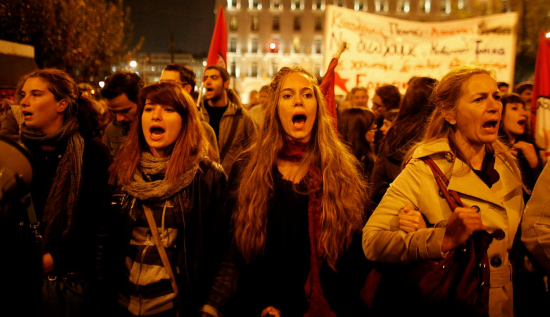
The debt crisis and the subsequent austerity measures affect us women first, in every aspect of our lives. If we women don’t organise ourselves to resist, no one else will do it for us.

Why do the debt crisis and the austerity measures affect women more?
Neo-liberal austerity during the debt crisis is aimed particularly at what is left of the welfare State and public services. By dismantling or privatising public services, the State disclaims the social responsibilities it had towards its citizens and shifts them – once again – onto the family. So that the care of children, sick people, old people and handicapped people, even young people in great difficulty and out of work, is no longer the State’s responsibility, but the family’s, provided free of charge into the bargain!

But the notion of family is general and abstract. In reality, it’s women who take on – practically all alone and without any remuneration whatever –all the basic social duties of the State. So the neo-liberal State kills two birds with one stone: it rids itself entirely of the social obligations that “widen the deficit and therefore, the public debt” and forces us women to shoulder them ourselves by working for absolutely nothing!

In other words, women are forced to do the job of, or rather replace, the welfare State?
Yes, but there’s more to it than that. There’s the other side of the coin, another reason that all these Memorandums are aimed at us: we are the first to be affected by the massive lay-offs that go with the dismantling or privatisation of public social services of every kind, because women make up the great majority of the workforce in these departments.

The result is simple and concerns thousands of female wage-earners in our country: not only are we the first to be laid off with absolutely no hope of being re-hired, especially if we are already mothers or of child-bearing age. Not only are there masses of us left unemployed, especially young people with no professional future to look forward to. Not only are we condemned to poverty and precarity, but they also burden us with the tasks that were the job of the State, with all that it brings in terms of fatigue, stress, premature ageing, unpaid work and additional expenses!

Some – such as the State, the Church and so-called well-meaning people – say that this way women can return to their real mission, which is to devote themselves to their home and family.
Of course they do! Not only do they say it, they shout it from the rooftops because the inhuman policy of the Memorandums has to come in an ideological wrapping! It’s just cheap propaganda that uses the most sexist of reactionary clichés to mask the ferocity of their neo-liberal policies. We are witnessing something apparently paradoxical: an alliance between the height of capitalist policy-making, as seen in the brutal austerity of the Memorandums, and the proponents of the most obscurantist theories of a bygone age who want to convince us that it is a woman’s “nature” to be shut up in the home with no other “tasks” than those of a mother and/or spouse. It’s the union between IMF Memorandums and the European Commission who say they want to “modernise” us, and the bastions of the most anachronistic and misogynous patriarchy embodied by the Church or the right and extreme right.

Is it only propaganda or are there practical consequences for women?
It’s not just theories and propaganda. The worst is the very tangible and disastrous effects on our daily lives. This return to a distant past is accompanied by measures designed to deprive women of the few rights and victories they’ve obtained through the struggles of the last few decades. The Holy Alliance of Capital and Patriarchy effectively abolishes our right to work, and with it, our right to economic independence. It forces us once again to a life of dependency, deprived of the right to free will. It treats us as slaves that have to shoulder the tasks and services formerly provided by the welfare State, because it is supposedly in the “nature” of women to do the work of a kindergarten, old people’s home, hospital, restaurant, laundry, psychiatric ward, extra schooling and even job centre for unemployed family members. And all totally free, with no payment, no recognition, because supposedly it’s in a woman’s blood to “sacrifice herself” for others. As a result, she never has time to take a break, look after herself or take an active part in public affairs.

All this must take a heavy toll on women.
It does. Not only because this daily stress means they age prematurely, that they get worn out, but also because all this sexism around the so-called “feminine nature” leads to the treatment of woman as an inferior being, whose body is considered to be always available and which any man can vent his frustrations on. It’s not a coincidence that the cases of violence against women, which were already numerous, are increasing in this period of capitalism and Memorandums.

For these reasons, and many others, the conclusion is simple: our resistance to this offensive against women by the Troika government and the Memorandums calls for us to organise ourselves and develop an independent and autonomous women’s movement against debt and austerity. Not only because no one can do it for us, but also because capitalism and patriarchy are so closely intertwined that any fight against one of these tyrants will be a shaky one if it is not also fought against the other.

(Photo Credit: encuentro5)

Women’s rights, labor rights did not cause the Greek mess


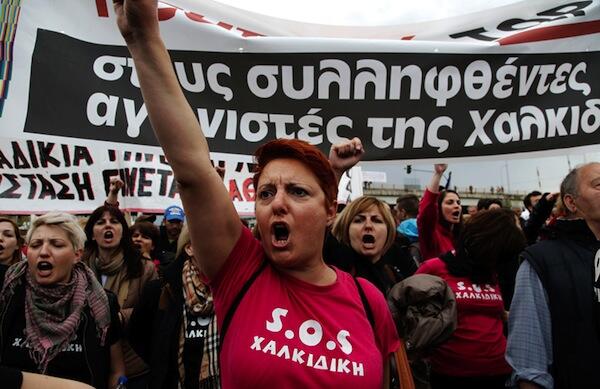
In Spain women’s right to a safe abortion is under attack. In Greece women fight for the right to have a safe delivery and for the right to have children.

In a conversation about recent developments in women rights in Greece, Sonia Mitralias reported that the birth rate has diminished by 15%. Furthermore, giving birth, once free of charge or a societal responsibility, now costs real money. Women without social security, citizen and immigrant alike, now pay as much as 10 times more than before. Isolated and more vulnerable women’s babies are kept in hospital until the mothers can pay for the delivery. Many wonder how many babies have been offered for adoption as a result of payment default. Syrian refugees have been targeted as well.

Women are being taken hostages. They are taken by the neoliberal assault on civil society that occurs through the institutionalization of a debt economy run by unelected and non-transparent bodies, such as the Troika. The Troika consists of “experts”, neoliberal trained economists, who only know how to apply twenty-first century versions of vicious, failed Structural Adjustment Programs. The principles are exactly the same: bypass all democratic processes; reduce any and all political and social resistance; target all public agencies and then claim they were responsible for the crisis. According to these `experts’, if they could only control “those women” and their reproductive uterus, the financial problems would be resolved.

The Troika proclaimed the reforms they demanded were “necessary and painful.” Necessary for what, painful for whom?

None of the Troika’s measures have helped the Greek people. The debt that was 129.3% of the GDP is expected to reach 200% in 2020. Only now, finally, has the European Parliament begun to officially question the Troika’s strategy and work. This moves comes late for a number of Greeks, especially women.

When the financial deregulation spree hit Europe in 2007, Greece was actually in pretty good shape. At that time, it had a good health care system and labor laws to protect the civil society. Then came the systematic attack on the social structures of `certain countries’, including Greece. Those who created the problem magically came up with solutions that blamed and attacked everyone but themselves. In fact, they profited and grew more powerful.

This absurd situation is developed to enslave women to unpaid work, which happens when public sectors are reduced and women’s reproductive rights threatened. Women and men know the offered solution is only more debt, more shackles, more targeted pain and suffering. Women and men are saying NO!, and organizing to defend women’s rights, labor rights , and human dignity.

(Photo Credit: Lefteris Piatarakis/AP)