For Europe and beyond, there is no alternative: Asylum or barbarism

There is no beyond for the people who are fleeing wars and conflicts. They are caught in the net of inhumanity with borders erected to remove human rights, political representation, citizenship, and any existence from racialized women, men and children. The European inhabitants once believed that the Schengen zone was a place of no borders; of course, it was a false promise, at least for people. Nonetheless, the circulation of goods and merchandise has remained unaffected.

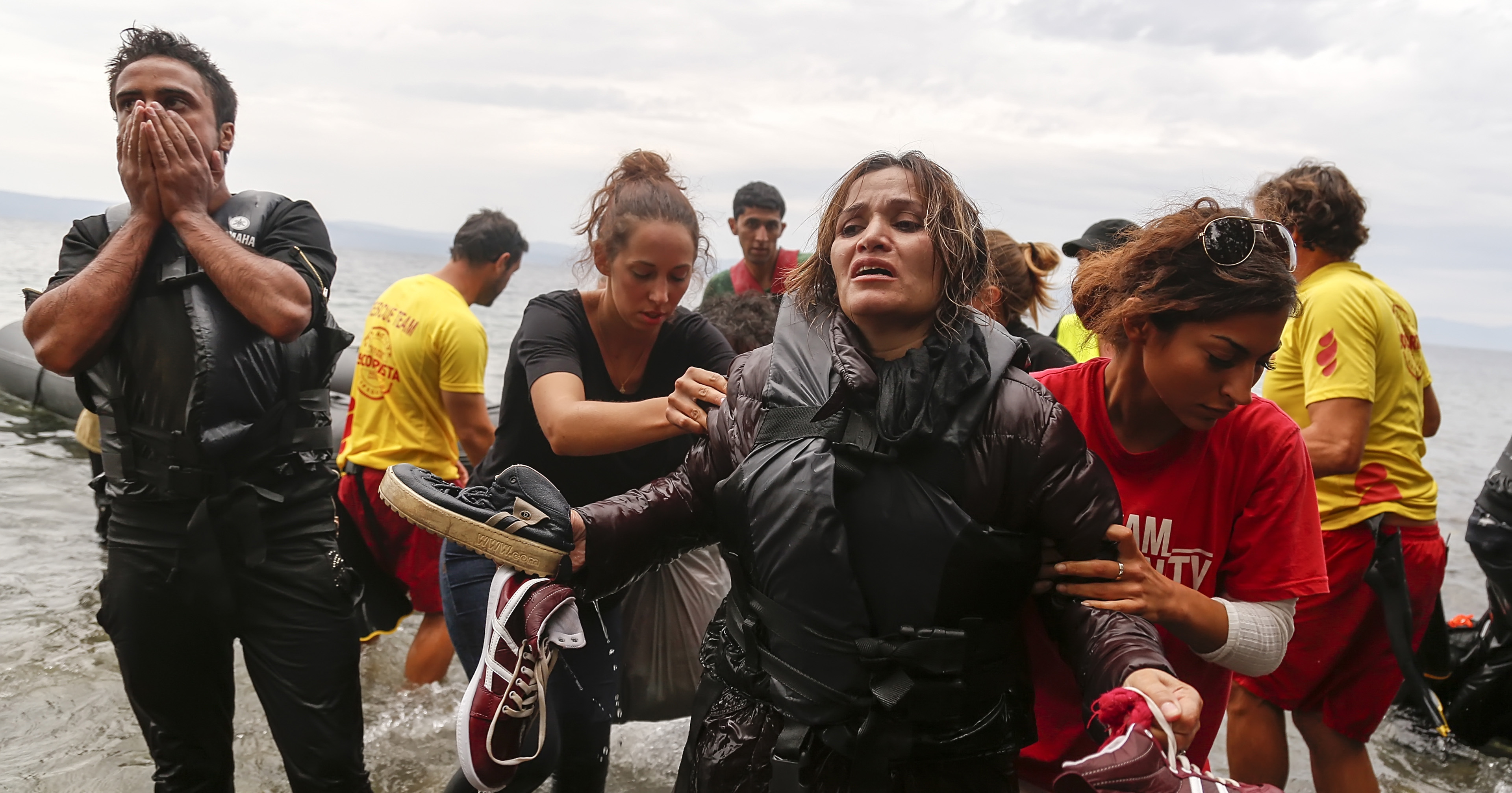
More borders than before the Schengen zone have been put in place. More walls and barbed wire have been installed around dubious borders to control the movements of people, whose status has evolved from the wretched of the world to the undesirables. Now, Europe is comprised of about 500 000 unwanted/undesirable people who live in camps around various borders of Europe, with 53 000 stranded in Greece.

We are watching the regularization of dehumanization and the deregulation of human rights and women rights. Refugee women are particularly in danger, an Afghan journalist who escaped brutal death after having been shot by the Taliban talks about her life in a Greek refugee camp with Amnesty international: “We are treated like animals. I’d rather be shot again than endure these conditions.” Additionally, sexual harassment is a constant issue in these camps.

With its numerous islands, Greece has been the main country of entry. Greece was also the target of Troika-managed neoliberal structural adjustment programs. The result is a dismantling of the social and political Greek society. While the undesirables are landing on the Greek islands, many of those same islands are now for sale to satisfy luxury investments and speculations. The European Union has created a hypocritical hell for human conditions, on one hand impoverishing an entire population in Greece under the aegis of fabricated debt economy and on the other hand stopping refugees on Greek soil.

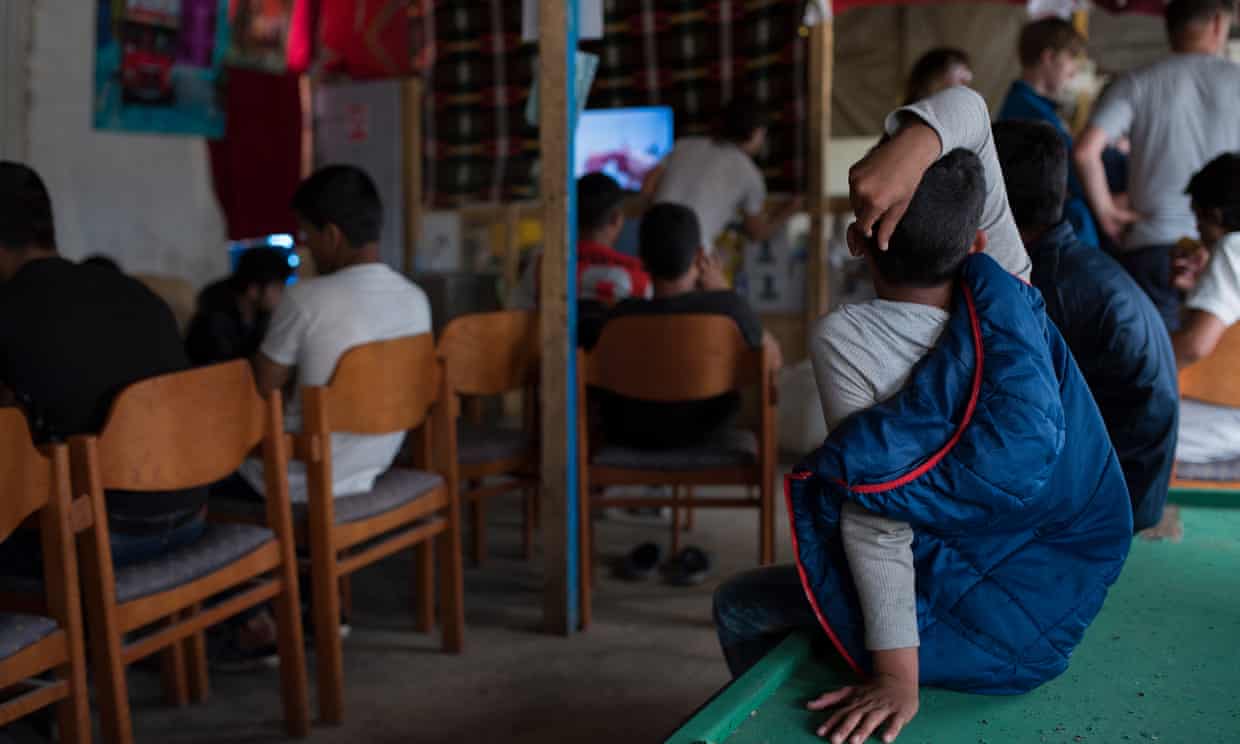
Journalist and photographer Bulen Kiliç has been covering the refugee exodus since the beginning of the Syrian conflict, and, recently, he wanted to talk about the reality of living in these camps, the pestilential odor, the rain, the absence of sanitary conditions, the lack of food, the extreme precarity in which children are brought up or should we say brought down. He talked about and showed the “utter despair” that is being organized in the middle of Europe. 11000 to 12000 people, among them countless children, are stuck in the camp of Idonemi, in Greece. The camp of Idomeni is at the border with Macedonia. It is a ‘waiting’ camp, formed after the Macedonian government closed the borders violently, despite the condemnations of the Greek prime minister Alexis Tsipras. The people had nowhere to go. They may have escaped death, unlike the 2892 women, men and children who died in the Mediterranean Sea in 2015, but they live with no hope, treated like human waste, creating the perfect conditions for depression that leads one to lose one’s mind.

A group of international intellectuals and activists have signed a document “pas d’alternative, droit d’asile ou barbarie” ‘No alternative, asylum or barbarianism’. Indeed, there is no alternative. Europeans must organize to have asylum rights respected or they will face more barbaric reactions including their own. According to anthropologist Michel Agier, who signed the petition, one of the ways to fight this situation is to make these camps famous, because invisibility is an instrument of oppression.

In that spirit, here is Bulen Kiliç’s testimony about the camp of Idomeni: Losing their minds.


(Photo Credits: AFP / Bulen Kiliç)

One social worker per 50,000 high school students is not okay

Today, one of the youth I work with calls me, and tells me that it’s her birthday. I start singing to her, but then hear she is crying, so I ask her what is wrong. She tells me her 25-year old big brother hung himself today, and she had found him.

We are living in a painful painful world. And while some of us encounter emotional turmoil in our privileged lives, others’ turmoil stems from economic poverty and inequality. In South African high schools, there is on average one social worker per 50 schools – that’s one social worker per 50,000 students, when problems such as rape, alcoholism, violence, gangs, depression, family turmoil, absentee fathers and family deaths abound.

This is not okay. We must do better.

(Photo Credit: SaferSpaces)

Child asylum seekers sacrificed on the altar of efficiency

How old do you think I am?

On Monday, June 20, Sir Stephen Silber, Justice of the England and Wales High Court, decided that a child who applies for asylum deserves a modicum of justice. The story is fairly straightforward. The fact that there is a story at all is a national, and global, disgrace. An unaccompanied boy-child, called AA in the court proceedings, made it, alone, from Sudan to Italy. From Italy, he made it, alone, to the United Kingdom, where he applied, more like begged, for asylum. He said, rightly, that he was 16 or 17. The border official looked at him and decided he was well over 18. There was no other proceeding. That was it. A guy looks at another guy and decides he’s older. AA was sent to adult immigration detention, where he spent two weeks, first at Brook House and then Tinsley. Officially children can only be detained for 24 hours. The Refugee Council and a team of lawyers from Bhatia Best Solicitors worked for two weeks, and finally secured his release. He was then interviewed by a team of social workers and deemed to be a child. On Monday, Justice Silber ruled, first, that the Secretary of State for the Home Department had illegally detained AA and, second, must pay damages to AA for the two weeks of detention.

According to Stuart Luke, the head of public law and community care at Bhatia Best Solicitors, “Since 2013 when the Home Office introduced these rules about age assessment I have seen an increase in these cases. Today’s landmark judgment is very important because it protects the rights of unaccompanied asylum seeker children who come to the UK.” Refugee Council Policy Manager Judith Dennis added: “This judgment is extremely significant and sends a clear message to the Home Office that its current policy is both unlawful and indefensible. For too long the Government has been jeopardising the safety of children who it should be protecting. It’s clear that the stakes are far, far too high for children to be arbitrarily thrown behind bars with adults on the basis of guesswork. Instead of wasting public money fighting this ruling, the Government should instead ensure that everyone who claims to be a child receives a sensitive, timely, lawful and expert led age assessment.”

Home Office lawyers described the decision as “absurd.” The Home Office lawyers’ entire case was based on “absurdity.” They argued that taking childhood as an objective matter, meaning developing actual processes to determine an applicant’s age, would “lead to an absurd and anomalous outcome.” What is the basis of this absurdity and anomaly? Efficiency. In his decision, Justice Silber responded to this line of reasoning: “I have not overlooked any of the submissions of Mr McKendrick, and, in particular, his contention that the Claimant’s case is `profoundly troubling for the efficient running of a fair immigration system’. My task is not to ascertain what would lead to the most efficient running of a fair immigration system but to apply the established principles of construction.”

For the past three years, the Department of Home Affairs sacrificed children on the altar of efficiency. In so doing, they inverted and abused the story of the binding of Isaac: “God tested Abraham and said to him, `Abraham! And he said, `Here I am.’ He said, `Take your son, your only son Isaac, whom you love, and go to the land of Moriah, and offer him there as a burnt offering on one of the mountains of which I shall tell you.’”

Today’s parable goes like this: “And the State said to a nameless functionary, `Take their son, whom you despise, and go to the prison and offer him there as a burnt offering.’” Where efficiency subsumes justice and compassion, God is dead, and no one weeps.

(Photo Credit: The Guardian)

Nancy Carroll tells her interstate prisoner transport story

On March 4th at approximately 6:00 am, I found myself being summoned from a holding cell in the Lake County Jail, in Waukegan, Illinois, to be transported back to Tarrant County, Texas, for six days in a transport van across the country.

I’m a real estate attorney from Southlake, Texas, an affluent suburb of Dallas. Prior to 2016 I had never been charged with or committed a criminal act or incurred an incident record of any kind beyond a speeding ticket. I’ve never had any mental or medical issues or been medicated beyond Advil, antibiotics and blood pressure medicine. Today I am a newly self-professed civil rights activist, wife, mother of three minor children living in Texas on an ankle monitor awaiting indictment for allegations of embezzling and theft from the title company I owned, Millennium Title. In December 2015 through January 2016 following a prolonged audit by the Texas Department of Insurance, I began negotiations for the sale of my company. After failing to sell the company, I decided in January 2016 to put the company into receivership and move to the Chicago area near my younger sister’s family to start over. At the time I moved, no criminal charges were threatened or pending against me. On February 11th, two weeks after moving and with no notice, I was arrested in Illinois on an arrest warrant from Texas. I would spend nearly 30 days sitting in an Illinois county jail waiting for the state of Texas to file a case against me so that the extradition process could begin. My family and I were told I would be transported to Texas by airplane and accompanied by a Federal Marshall. That was not the case.

My six days of transport from Illinois to Texas were the most dangerous, terrifying, demeaning and inhumane conditions I have ever witnessed. The private transport companies hired by jails and prisons to move inmates across the country disregard all basic human rights and protections.

During the interstate transportation process, there was no attempt to classify inmates. Women and men, violent and non-violent offenders were transported together. Nonviolent inmates awaiting trial are transported alongside convicted violent inmates with little or no supervision. For six days, my family called to obtain a status report on my transport and to confirm my safety; no information of any kind was provided, allegedly for “safety reasons”. There is absolutely no oversight or supervision of the drivers placed in charge of inmates’ health and safety while traveling across the country. Furthermore, the policies and procedures for monitoring the condition and safety of the transport vehicles are inadequate or improperly implemented.

What follows is a brief description of two legs of my return to Texas. The first was from Lake County, Illinois, to Mississippi County, Missouri. We had two drivers. I was refused my prescribed blood pressure medication. Upon arrival at the Carver County Jail in Minnesota, my blood pressure was recorded at 180/100, or hypertensive urgency. Carver County contacted the transport company, which refused to authorize blood pressure medicine. Carver County medical authorities finally paid for and authorized the blood pressure medicine.

In St. Cloud, Minnesota, an inmate suffering from pneumonia and on a regimen of prescribed antibiotics was picked up. The St. Cloud jail authorities gave the driver the antibiotics, which then somehow disappeared. One driver chain-smoked the entire trip, to the dismay of an inmate who was asthmatic and the prisoner suffering pneumonia.

We would drive for over eight hours, without a stop. We would be shackled for eight to ten hours, again without a break. Not surprisingly, inmates would urinate and defecate in the van.

We were in the freezing northern Midwest winter, and the van had no working heat system. We were not provided with adequate winter clothing.

Only one of the two drivers actually drove, which meant driving in excess of the Department of Transportation allowed hours of non-stop driving. The van’s headlights didn’t work. At one point, there were twelve inmates crammed into the van for over eight hours.

Male inmates would scream sexual obscenities and threats day and night at the female inmates demanding sexual acts and for the female inmates to expose themselves. I was seated next to an alleged violent male inmate in a segregation cage for over 36 hours. He would reach through open areas of the cage and grab for me, verbally threaten to find my family and me and inflict unspeakable violence.

The second leg of my return was from Mississippi County, Missouri, to Tarrant County Texas. We had two drivers again. In Missouri, the primary driver received a speeding ticket. He consistently drove over 85 miles per hour.

After 7 1/2 hours of no restroom, water or food, inmates asked the drivers as to when there would be another rest stop break. The primary driver responded by shouting obscenities and in then accelerated the van and immediately slammed on the brakes, throwing inmates into one another, on the floor and onto the metal caging in the interior of the vehicle. One inmate suffered severe lacerations to his ring finger and foot and another suffered lacerations to her chin and face. All injuries were witnessed by the sheriff on duty at the next rest stop in Johnson County Texas. The drivers provided no medical attention.

(Photo Credit: PTS of America)

Why is the European Union criminalizing and threatening refugees and volunteer helpers?

Lisbeth Zornig and a Syrian family she drove to Copenhagen

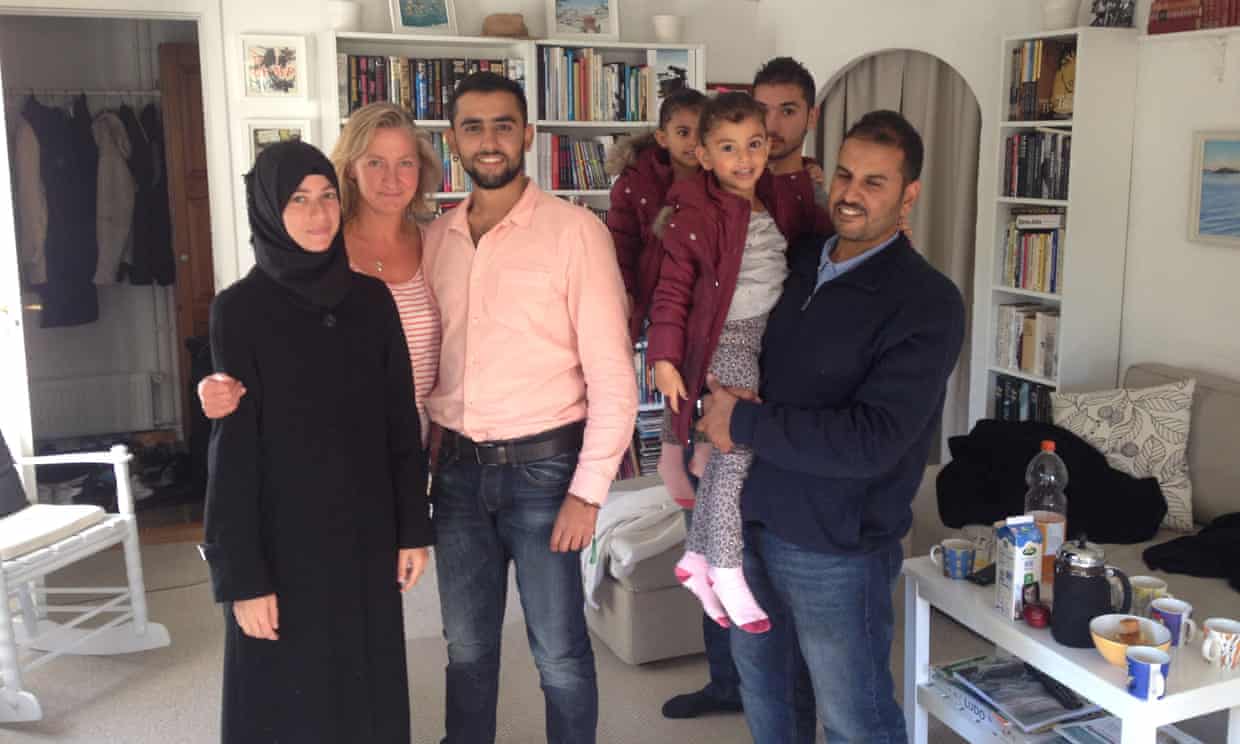
Just recently, in Denmark refugee helpers were sentenced for “human trafficking.” Lisbeth Zornig, a novelist, and her husband were fined 3000 Euros each. They could have been sentenced to prison time. Their `crime’ was having driven a Syrian family to Copenhagen, serving them coffee and cookies, and then driving them to the train station. Zornig declared, “I am very angry because the only thing we did was the decent thing, the same that hundreds of others did. They are criminalizing decency.”

Over the past few years, Denmark has changed its asylum laws, and now with their new Alien Act more helpers are being persecuted. While in 2014 about 140 were prosecuted for helping refugees, the number grew to 279 between September 2015 and February 2016.

Zornig’s lawyer, who has defended other Danes in similar cases, declared Denmark is now at the bottom of the table on human rights. However, the anti migrant trend has affected every member state of the European Union. In January, five rescuers from Spanish and Danish NGOs who rushed to help refugees stuck off the coast of Lesbos on a frail craft were arrested and also accused of smuggling migrants.

This criminalization of helpers mirrors the criminalization of refugees. In the age of austerity policies, the European neoliberal leadership is all about fences, walls and barbed wires. They follow the US model closely. On the island of Lesbos in Greece, the police formed a human chain to block volunteers whose goal was to bring emergency support. When the doctor of the group wanted to assist a baby who seemed to be unconscious, the police shouted that these people were prisoners!

The European Commission along with member states continue to bargain with human lives. They barter with the Turkish President Recep Tayyip Erdoğan, himself involved in ethnic wars and repressive actions against journalists, activists, and scholars in his own country. Despite the opposition of European deputies and activists, the European Commission signed an agreement with Turkey to relocate refugees stuck in Greece in Turkish camps with no guarantee for safety, rather with more inhumane conditions awaiting them. In so doing, the Commission demonstrates that in this modern time the violence of the exercise of power depends less on its physical brutality than its ability to treat burdensome populations with indifference for their wellbeing.

In its latest report on the refugee crisis the Commission set the priorities for 2016. The Commission pleas for an “asylum system based on solidarity and fair sharing responsibilities,” but this self-serving language cannot conceal the constant breach of human rights occurring at the borders of Europe. In fact, the European Union has increased the power of FRONTEX, a heavily repressive mechanism that replaced Mare Nuestro. NGOs and volunteers have become wary of FRONTEX, which has forcibly controlled helpers and threatened them with fines. Volunteers explain that Frontex has called into question the status quo that allowed every one to help in good intelligence, as if the authorities’ goal was to bring down the humanitarian response. Member states and the European Commission have already brought down the humanitarian response to the organized murder of populations.

Dehumanization and deterritorialization are effectively the core values of the elites of our time.

Petitions are circulating to denounce the inhuman face of Europe, which we should understand as the inhuman politics of austerity as well. These inhuman measures and agreements are only possible with a racist eye that separates those who may live from those who must die for the advance of a dramatic political economic system.


(Photo Credit 1: Mikael Lindholm / The Guardian) (Photo Credit 2: WeMove.EU)

Killer silences


Killer silences

forgetting….
or trying to forget
yet the images bounce back
each time the word is seen, heard, read…….

forgiving
never……..

living with the pictures
always
hidden, covered

pictures of him
pictures of disgust,
forcing himself between my legs
down my intimacy
without my consent
by applying his strength
the first day of our kiss
or after so many times
without romance
without foreplay
for his own orgasm
or when i am asleep
in the middle of the night
or when i am not awake yet……

extreme disrespect for my body
let alone for my mind

when the first feeling is shock
did it really happen?
a look at him
is it you you just did this to me?
i do not know you anymore
the words heard
you are an old woman
you do not want sex any longer
you
you
you

and the feeling of guilt that emerges
suddenly

the sleepless rest of the night is not finished
and yet the guilt has started building up
like a fortress that will
keep the silence for too long

when the following day is wordless
or ‘normal’
when working hours fakely hide the reality

survival

when coming back
late
to the place that should be a refuge
becomes a trip to a scary hell

and days and nights repeat themselves
amongst other abuses…

and an intimate life of guilt
behind the fortress of silence

when the guilt confines to the border of non worthiness
when the repetition converts a human being
into a nobody
a small wrinkled ball thrown to a corner
that no one can see
and that does not have enough air
to call for help.

how to send a SOS
when one is reduced to no one
by the recurring forced power
exerted to tame

when the mind becomes split from the body
when the body becomes object
and the mind this little wrinkled ball

tamed to guilt
who can see it
who can see me?
behind the mask
when the effort of a begging hand
becomes an exhaustion

breathing truces
when the conscience knows
they are all false promises

why to seek help then
when the ‘normal times’ come back
times when thinking straighter becomes possible
false hope it will never happen again
it will happen again
and again
the fortress and the ball

the wrench between
the tamed mind that think still
and the no one’s body

will any one see it?
if only someone could see it
i could start throwing a word that could lead
a listener to understand
the hell i live in…..

of course there is the law
but who would believe a married woman
accusing her husband of sexual assault
the effort of reporting to the police
seems an exhaustion too

the little mind ball wants to survive
and relating recent incidents
will collapse it
this is sure
it will become a mount of dust
disconnected pieces of nothingness

better to stay this little ball
survival
and keep our killer silences…..

desperation for
something external to happen
the only possible salut

the salut comes from him
when the killer silences
end up frustrating him
and he leaves the house of hell……….
and i cry, cry, cry
my love has left me
was it really love?

sleepless nights
of a half empty bed
of a half empty self
tears filling the ocean of pains

hour after hour
day after day
week after week
the habit of the void builds up
a void that becomes softer
because of survival
i can live
i can live without him
i can move without him
i can breath without him
i can think without him
i can be without him
the healing hope
takes months of other efforts
to hook into the mind
till the postponed and postponed day
when the law learns about the ordeals
between the hiccups of the tears
and this day, i know i have won
this day i am freed

(Photo Credit: https://krishannah.wordpress.com)

To the children of Burundi: Forgive us

Burundian activist and poet Ketty Nivyabandi has been organizing weekly Black Monday events to denounce the assault on democracy in Burundi. Last May, she said the Burundi crisis was a global crisis of democracy: “Our responsibility as global citizens is to ensure that this doesn’t go on. That this is stopped as soon as possible. Urgently. We need to act urgently.” Instead, the world chose to forget. Looking over the so-called humanitarian summit last month, Burundian activist Marguerite Barankitse noted, “At this summit, nobody is mentioning Burundi. Syrian refugees are a problem for European countries – but Burundians are not a problem immediately. Burundi is far from Europe. But what is ‘far’? It’s a ridiculous word. We are never far. We are from the same humanity.” Burundian women, like Ketty Nivyabandi and Marguerite Barankitse, keep trying to educate us about humanity and democracy. We refuse to listen. This week over 200 students were suspended from school for defacing pictures of Burundi’s president. Earlier in the month, over 300 students were sent home for the same crime. Of the earlier group, eleven were arrested. Six, three boys and three girls, were released because they are minors. This Monday, a court approved the continued incarceration of five … for doodling. We need to act urgently.

What is the danger of the barrel of 500 or so pens in the hands of high school students? Ngūgī wa Thiong’o once noted, in a different context, “A time has come when silence before the crimes of the neocolonial regime in Kenya is collusion with social evil.” That was then, this is now. Why do the major powers not mention Burundi? Silence serves their interests. Police terrorize communities, and little notice is paid. Burundian journalists are forced into exile, and little to no notice is paid. Why? Silence serves the interests of those who actively pay no notice.

And so we are left with poets, such as Rwandan spoken word poet Samantha Teta, who wrote “LUNDI NOIR: poem for Burundian kids”:

Black Monday,
 Black like the day the jar of your childhood
 smashed on the floor of your mother’s breaking
 unity.
 Black like the day you started packing fear
 beside your books before you left for school.
 Black like the day you wore terror beneath
 your uniform and were feed on hatred when
 hungry.
 Black like the day your wings were clipped or
 tied firmly on your roots of your mother’s agony
 the day they betrayed her trust.
 Sweet child it’s another black Monday.
 Black like the day you started carrying bricks
 of your breaking land in your belly while you
 carried food in your memory.
 Black like the day your lungs inhaled dust
 heavy with hopelessness and they exhaled your
 helplessness.
 Sweet child it’s another black Monday.
 I know with the degree of fear, loss and grief you
 have lived with until today has probably forced
 you to grow up well before your time. I know you
 will understand what I am about to ask of you.
 Sweet Child, Think in Color. While Walls continue
 to tumble around you, allow colorful thoughts like
 a calm waterfall to soothe your mind.
 For insistence, think in Red. Red for the color
 of the fire of desire for freedom that was lit in
 you the day they put steel around your innocence.
 Think in Yellow. Yellow for when bananas think
 they are second to God and bear no good news
 contrary to their names. Child, bananas are slippery
 but eventually they rot and are thrown away.
 Think in Green. Green for life. Nothing lasts
 forever my dear. Peace, hope and love can be
 reborn. But they have to be planted and watered
 within you before they can flourish elsewhere.
 Think in Purple. Purple the Color of Hope. Hope is
 neither a happy nor a sad feeling. it’s a flame. No
 one can put out a flame lit within you. Hope
 sweetheart will give you the strength to believe in
 a better tomorrow. Hope will be the light in all this
 darkness. Hope will give you faith, strength.
 Think in Blue and White. You may not feel the sun
 right now but I would like to remind you that it was
 breed in your skin, sweet child YOU are the Sun.
 Think of blue and white for clear skies. Clear of the
 fog of death, don’t worry about the night. You
 are all the stars your mother needs.
 Think in Rainbow. Rainbows that come after the
 rains. Rainbow that has all the colors intertwined
 into one to make something beautiful.
 In the same way child, your people are different,
 they are so diverse but together you make a
 rainbow. We all do.
 Learn Unity is powerful, it chases away the heavy
 rains. It’s okay to be different, powerful to use
 that difference to build and complement each other.
 Better days will come, your scars will be the proof
 of your struggle, little warrior.
 I wish you never had to fight at all. I wish you had
 been allowed to be a child. I am sorry that I never
 could make my pen a sword.
 Forgive me.

(Image Credit: Ketty Nivyabandi)

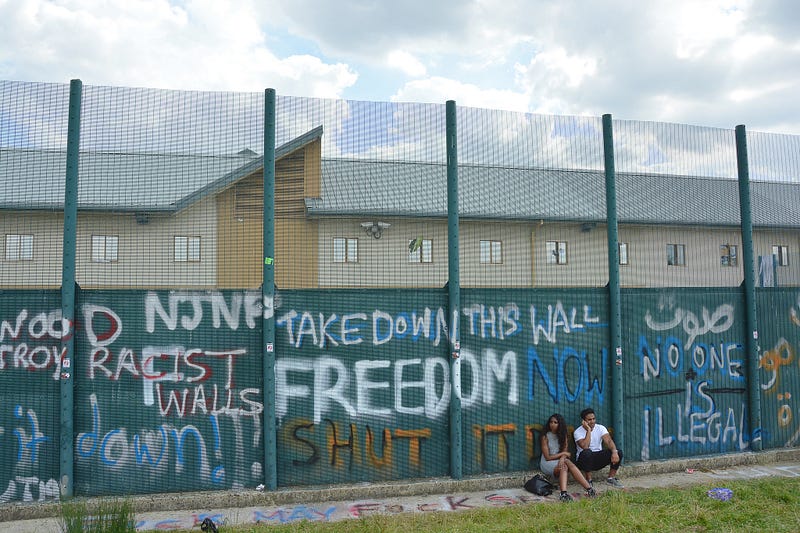
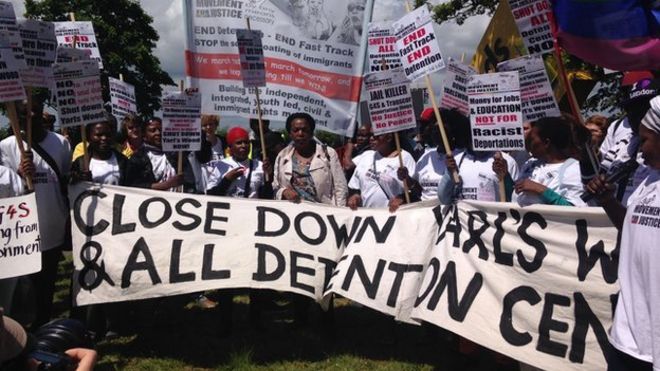
The time for concern is over. Shut Yarl’s Wood down today!

Last year, Her Majesty’s Chief Inspector of Prisons concluded a report on Yarl’s Wood: “Yarl’s Wood is rightly a place of national concern … Yarl’s Wood is failing to meet the needs of the most vulnerable women held … We have raised many of the concerns in this report before. Pregnant detainees and women with mental health problems should only be held in the most exceptional circumstances.” Over the weekend, it was reported that the Home Office refused to reveal how many women have been raped or sexually assaulted because “disclosure would, or would be likely to, prejudice the commercial interests” of companies that run Yarl’s Wood. Serco runs Yarl’s Wood, and G4S provides Yarl’s Wood health services. Today, the United Kingdom’s Information Commissioner demanded that the Home Office release information about the number of pregnant women held in immigration detention, which would mean primarily Yarl’s Wood. This demand comes after months of the Home Office refusing to answer questions, refusing to acknowledge that questions and requests have been made. When it comes to women, the only thing that counts is corporate and State profit. Mass produced illegality is big business, generally. The big business of women’s illegality has been secured in black sites in our backyards. Across the suburban spectrum of so-called liberal representative democracies, women asylum seekers are being renditioned.

Yarl’s Wood is filled with pregnant women, women trauma survivors, lesbian women, African women, women torture survivors, women seeking help, and it is as it has always been, a special “hell on earth” designed to torture precisely those women. Ira Putilova, a Russian LGBTQ activist who sought asylum in England and was thrown into Yarl’s Wood, reflected on the case of Prossie N, a Ugandan LGBTQ activist who was deported to Uganda: “We came and left, but Yarl’s Wood stayed and we should do something with it. Help people inside. … Because borders and detention centres should disappear and all homophobes and racists should be sent to the moon! Fuck them! Free Prossie N!”

Borders and detentions centers must disappear. This is the inhuman geography of purchased security, in which the State acts as nothing more than the bouncer at the door of the global club of “commercial interests.” The time for “concern” is over. Yarl’s Wood is a black site in which women are being abused in an ever growing infinite of ways. It is an abomination, and it is being replicated everywhere. Tear it down … now. Shut Yarl’s Wood and its fraternal order of detention centers across the “free world” today.


(Photo Credit 1: The Establishment) (Photo Credit 2: BBC News)

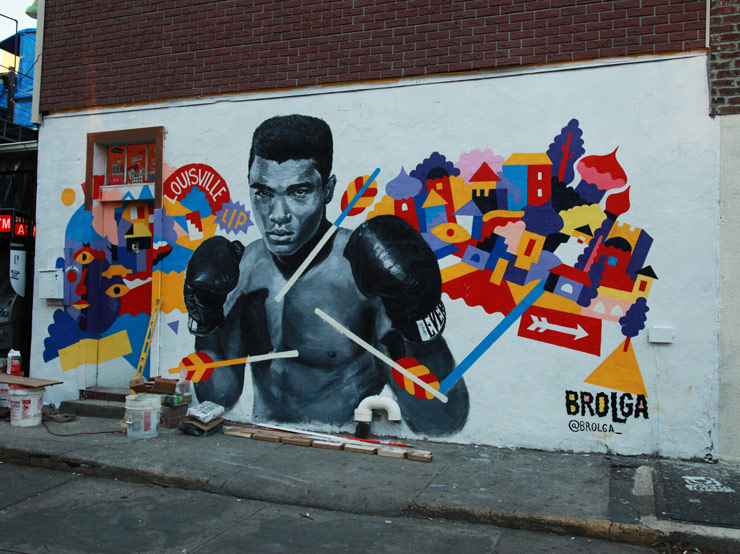
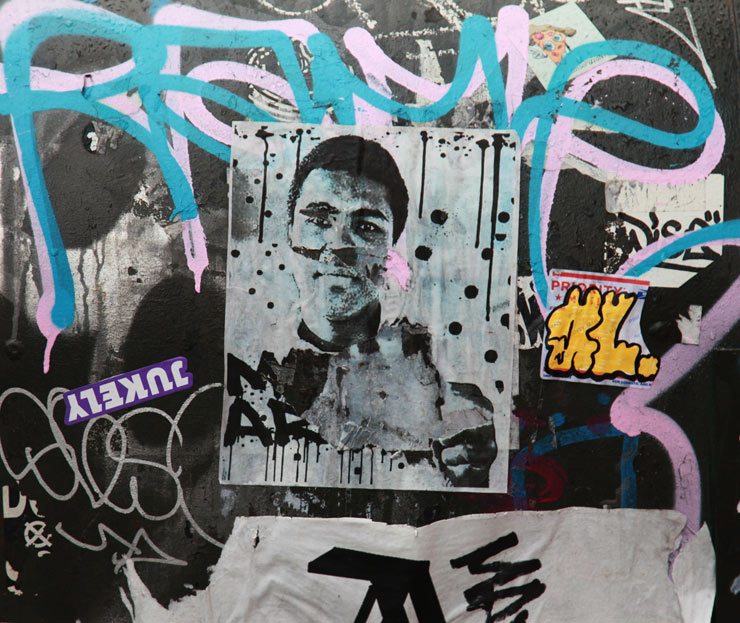
The Meaning of Great: A Love Letter to Muhammad Ali

If I were to write an open letter to Muhammad Ali now, my tears would be the ink with which I write. It would be a letter of love and admiration, and of confusion and anger. It would be a difficult letter because it would be a final note to a human being whose influence stands as a an edifice of so much that I and perhaps humanity at large aspire to be.

Muhammad Ali is one of the most iconic figures of the last 100 years –if not of all time. He was bundle of contradictions and political controversy, personal weakness and staunch principles, a man of peace and a warrior of Black consciousness. His passing forces me to consider and reconsider the many reasons that I admire him and the many instances that he confused me. So many myths and motifs of greatness seem contestable upon closer scrutiny.

I met Ali many years ago as I rolled off my father’s lap after Ali had knocked George Foreman out during the ‘Rumble in the Jungle‘. Jubilant, my father leapt and declared ‘He’s done it again. The man is GREAT.’ And indeed he was. He had regained his title after the lost years had robbed him and the rest of humanity of a daunting sportsman at the height of his powers.

It is probably this Zairian odyssey that partly sealed Ali’s status as a true son of the Afrikan soil, an Afrikanist spirit. And yet here lay a contradiction that I had not considered for 40 years since. The match was organised by Don King, a reptilian fight promoter, persuaded one of Africa’s most ignominious and despicable sons, Mabuto Sesesseko, to put up the $5 million purse. Mabuto [along with the Belgians] remains hugely complicit in the death of one of Africa’s most glorious sons- Patrice Lumumba – a friend of Ali.

Seen in this light, Ali’s participation in the match seems contradictory. And yet he was also a man of great ambition, hungry to show the world that he was still the greatest, fastest and prettiest. And a man of great ego who delighted in Sesseko’s fawning hospitality. A lesser being could claim not to know. Ali’s sharp intellect allowed him no such luxury.

In 2005, Ali confused some again, when he accepted the Presidential Medal of Freedom from the hawkish George W Bush. This was after having acted as Bush’s peace envoy to Iraq successfully negotiating for the release of several American hostages. Bush’s politics would never have aligned with Ali’s 30 years earlier. Popular myth has it that Ali threw his Olympic medal into a river after White America refused to recognize and honour him upon his return from the Rome Olympics. Some accounts claim that he lost the medal, but be that as it may, the powerful symbolism and gesture of denouncing the separatist and deeply segregated American state resonated with the excluded across the world. African children across the continent embraced him as did those in Asia and Latin America. Far beyond Civil Rights, his politics were part of the anti imperial struggles globally. He was indeed doing it for all of us.

I watched with deeply mixed emotions as Bush, a man whom Ali would not have broken bread with decades earlier, say of Ali ‘the American people are proud to call Muhammad Ali one of our own.” Bush studiously avoided mentioning Ali’s stance against Vietnam and tried to erase the radical, polarising politics that nearly set the United States – and Ali himself – on fire. Nor did Bush qualify what ‘our own‘ means in the still rabidly racist and separatist United States holding the world hostage to its maniacal fixation with real and imagined terror.

One of the greatest and most influential activist celebrities, Ali stood with Sydney Poitier, Harry Belafonte and Jim Brown in the 1960s. In an era where sports endorsements and lucrative sponsorships have silenced any measure of radicalism or integrity in the sports world, his career and potentially life-threatening stance against the Vietnam War should not be underestimated. He chose not to ‘skip bail‘ into Canada and take up citizenship which awaited him there. On principal, Ali chose to go to jail.

Only Tommy Smith and John Carlos’s Black Power fist on the podium at the 1968 Olympics compares in courage and power. A true activist sports star, his shadow was the longest and although he never formally associated with the Civil Rights movement, his influence was and remains palpable. At the time of Ali’s conversion to Islam, Malcolm X was one of his closest friends and mentors and helped him weather the vitriolic political, media and social backlash including from the conservative part of the Black civil rights movement. The late Civil Rights activist Julian Bond said, ‘ Ali was able to tell white folks …that I’m going to do it my way’.

That was an Ali thing, the more the media reviled, the stronger he seemed to become. After Malcolm’s assassination and his own conversion to conventional Islam, Ali expressed deep regret that he did not reciprocate his former mentor’s loyalty. Perhaps his youth and relative naiveté clouded his vision but history still recalls that he turned his back on a great and courageous icon.

In later years, the years that many feel uncomfortable with, when the warrior had slowed down, robbed of his infinite and memorable words by the sport that gave him such a huge platform and the disease that arose, he spent more of his time as a man of peace. This caused more discomfort for many who were accustomed to the lion eating man of witty and quick words. It felt to many that Ali was rebranded, toned down and integrated into the very establishment that had called him ‘another demagogue and an apologist for his so-called religion’, as well as hateful and ‘un-American‘.

Perhaps in part due to the illness but also perhaps because of his own mellowing Ali seemed to be less dangerous, deradicalised and sanitised by the end. I find this a disservice despite my confusion about some of his choices along his walk to legendhood. The cult of memory is one that interests me immensely and the way we are remembering Ali has disturbed me further. Most images prefer the Warrior, the King of the World, brash, handsome and forever young and vibrant. The photo session released by his family just days before Ali passed is bold and courageous. It forces us to face age, mortality, illness and decline with dignity.

I never asked him whether he really threw away the medal the one time that I met him 25 years ago. I was too overcome with emotion to be anything other than awed, an awe that remains to this day. The best legacies are the most complex ones and the greatest people do not allow their humanity to withhold them from incredible exploits. For all Mr. Muhammad Ali did to give us a sense of the impossible, for doing the right thing at the right time, he remains the Greatest, the King of the World.

In his own words: When I die I am a legend.


(Photo Credit 1: Jaime Rojo / Brooklyn Street Art) (Photo Credit 2: Jaime Rojo / Brooklyn Street Art)

Orlando: There must be more than grief

That you would not have done this dire massacre on your honour
Ben Jonson, Volpone

Last April, in response to the massacre at Garissa, we quoted, in full, Shailja Petal’s poem, “Garissa.”

Garissa

the morning after a massacre
a country wakes nauseous

no food stays down
no chai comforts

on the roads
they drag crosses

blood is given
blood invoked
blood sanctified
blood is our national language

on TV the men
talk blood and markets

tears
stay out of the newsrooms

there will be more killing
there will always be
more killing

a state will punish survivors
with pogroms

an army will terrorize
the terrrorized, traumatize
the traumatized

the merchants of war
have already moved on
to the next transaction

the death-profiteers spent the night
reviewing cost-benefit reports

a country stares at its amputation stumps
the morning after a massacre

Then in May, we wrote of the factory massacre of women workers in the Philippines; in July the massacre of women and children by the Mexican army and the massacre of women in Khayelitsha, in South Africa, and Mymensingh, in India; and in February the massacre of prisoners in Topo Chico Prison, in Mexico. We wrote of massacres before and there were massacres we did not address since.

This is the age of massacre; we are the ones who have built a global slaughterhouse in a period that is formally at peace. We move furiously and quickly back to the root of our violence, calling it progress or destiny. And today we are in Orlando, wherever we are, afraid to read, listen, watch, as the numbers of lost human lives rises.

“For I must talk of murders, rapes, and massacres,
Acts of black night, abominable deeds,
Complots of mischief, treason, villanies
Ruthful to hear, yet piteously perform’d”
William Shakespeare Titus Andronicus

These reports were once reports of fantastic evil, which now inhabits the everyday. We were meant to know the difference between one massacre and another. We were meant to know the significance of the massacre was its brutal elimination of the humanity of the individuals who were butchered. Now, it’s the massacres themselves that blur.

“We are, I am, you are
by cowardice or courage
the one who find our way
back to this scene
carrying a knife, a camera
a book of myths
in which
our names do not appear.”
Adrienne Rich, “Diving into the Wreck

By cowardice or courage, there must be more to life than grief, more killing, and the worldwide collective acceptance of reports of tallies and carnage and loss. We must talk of murders, rapes, and massacres, but there must be more than grief.

(Image Credit: Facebook)