New Jerseyans Boot Trumpism out of the Garden State

Sheila Oliver and Phil Murphy

On November 7th, while watching the results of the Virginia election, long considered a litmus test for the midterm elections in 2018, another wave of elections returned complete control of New Jersey to the Democrats. It was a historic night for minorities and immigrants in the state, and a cautious tale for all Republicans to heed: if you think you can win elections on Trump rhetoric, fear mongering anti-immigrant racist and sexist policy, try again. Especially in a state that prides itself as being an immigrant state.

Fifteen minutes after the polls closed, New Jersey elected Democrat Phil Murphy as Governor, on the promise of passing a $15 an hour minimum wage hike, funding pensions for all state employees-which had stalled during the Christie administration along with a pay freeze on the state-creating a state bank, which would keep money in the community, and decriminalizing and regulating marijuana for recreational use. Murphy also promised to back a Millionaire’s Tax for the states’ wealthy individuals. Murphy’s running mate, Sheila Oliver, became New Jersey’s first Black woman to serve as Lieutenant Governor. While only time will tell if Murphy can make due on his promises, his embrace of a progressive agenda helped to bring him to victory.

Murphy’s opponent, Chris Christie’s Lieutenant Governor Kim Guadagno, floundered to distance herself from the infamous Governor’s toxicity. Christie will leave office with a dismal approval rating in the teens, one of the least popular governors ever anywhere. On the last leg of her campaign, Guadagno took a page from Trump, targeting whatever anti-immigrant sentiment persists in the state. Pandering to what little base she could drum up, Guadagno ran ads blasting Murphy’s promise to make New Jersey a “sanctuary state” for undocumented immigrants (as if it was never the hub of immigration along with New York), with the threat that it would make New Jersey less safe.

It wasn’t the first attempt by New Jersey candidates to attempt to appeal to racist sentiment. Hoboken elected its very first Sikh mayor, Ravi Bhalla, despite flyers being plastered around the city demanding that citizens don’t vote to let “A TERRORIST overtake the town.”

Elsewhere, minorities made big gains in smaller elections, despite major pushback from Republicans. Edison’s schoolboard re-elected incumbents Jingwei “Jerry” Shi and Falguni Patel. They were also the victims of mailers decrying the diversifying schoolboard, asking voters to “Make Edison Great Again.” The outcry and pushback secured their election win.

Ashley Bennett, first-time candidate and Egg Harbor Township resident, defeated notorious Republican John Carman as Atlantic County Freeholder. Bennett was angered by Carman’s response to the Women’s March, when he asked whether the “protests would be ‘over in time for dinner.’” Carman later drew more criticism for wearing a patch with the state of New Jersey partially covered with the Confederate flag.

New Jersey is a prime example of the reason Republicans should be nervous about the upcoming midterm elections. Our disdain for Trumpism and our embrace of progressive policies serve warning to those NJ Republicans in the House. Most NJ Republicans have been embroiled in a tug of war; on one side, maintaining support for the Republican, and by extensionTrump’s, base, and on the other, a growing anti-Trump sentiment in comfortably Republican districts in the state. Frank LoBiondo, Representative of NJ’s 2nd Congressional District, has announced his retirement, putting the swing district in play. There is only a one-point advantage in the district, which Trump barely won in the first place.

Tom McArthur, House Representative for NJ’s 3rd Congressional District, has been lambasted in recent months for his support of the ACA repeal; the McArthur Amendment was one of the leading reasons that Trumpcare passed the House in the spring of 2017. Many have watched the impassioned town halls with him, having put families in danger from allowing states to opt out of covering people with pre-existing conditions.

Rodney Frelinghuysen (NJ 11th) became notorious for subtly attacking a woman activist by penning a letter to her employer and forcing her resignation. Though there has been no formal reprimand, he was criticized for using his position to punish women who speak out against his policies and ideologies.

Finally, Representative Chris Smith (NJ 4th) has coasted on the obscurity of his ideology. Anti-choice, anti-LGBT, and completely distant from his constituents, Smith hasn’t hosted a town hall in twenty-five years (though demands to hold a town hall have been shared to his staff) and lives primarily in Virginia, so much so that his daughter was able to attend college paying in-state tuition in Virginia. He maintained a comfortable lead over many Democrats who opposed him throughout the years, mainly because of the obscurity of his policy agendas and labor support. Given the trends from the election results, he, and all politicians who thought they could ride on Trump’s coattails, should be very worried indeed.

Ashley Bennett


(Photo Credit 1: CNBC / Lucas Jackson / Reuters) (Photo Credit 2: Washington Post / Wayne Perry / AP)
There are no plans to close the camp in Nauru

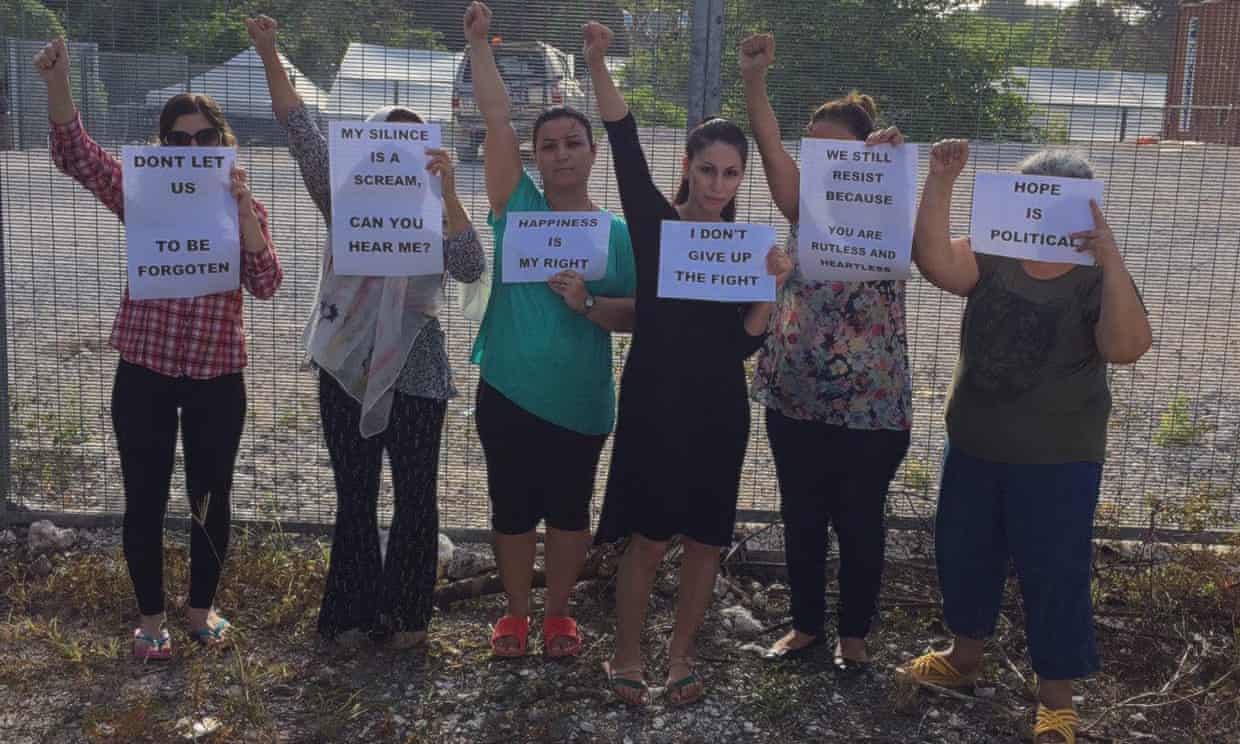
“There are no plans to close the camp in Nauru.” Thus ends Reuters “Factbox: Why does Australia detain asylum seekers in offshore camps?”. The “Factbox” relates the current situation in the closed detention centers on Manus Island and, to a much lesser extent, on Nauru. Last year, the Papua New Guinea High Court declared the Manus detention center illegal. Last month, Australia closed the center and tried to move its 700+ men to another center, one without running water. 600 some men decided to stay and have occupied the center since, at great risk to their own lives. Journalist and Iranian refugee Behrouz Boochani, imprisoned on Manus Island since August 2014, wrote, “Death is always ever so present. Death. The breath of death. The scent of death. The reign of death over Manus prison. This is the reality of living out here.” Death. This is Australia’s vaunted “Pacific Solution”: horror, torture, death. Take the bodies, the more vulnerable the better, and throw them in a pit, far away, where the “good people” of Australia need not see or hear them cry. Pregnant women, children, men, survivors all, throw them away. To re-open the “Factbox”, “So far, no `boat person’ detained on Manus or Nauru has been resettled in Australia.”

Last year, all eyes were on Nauru. Leaked reports last year showed that 2,000 incidents of sexual abuse, assault and attempted self-harm had occurred. Many of these involved children. The United Nations chastised Australia and Nauru for their failure, call it refusal, to protect asylum seeker and refugee children from sexual abuse. Amnesty International called the conditions on Nauru torture. Currently, Australia detains 369 people on Nauru. 46 of them are women, and 43 are children.

By air, Nauru is a little over 2000 miles from Brisbane, and, for those detained and tortured there, galaxies and light years away. And for Australians? Why does Australia detain asylum seekers in Nauru? Why is Australia not only not shocked but proud of its torture of refugee and asylum seeker children, women, and men on Nauru? Why does Australia hate pregnant and abused women asylum seekers on Nauru? The answer? “There are no plans to close the camp in Nauru.” There is no more to be said.


(Photo Credit: The Guardian / Saba Vasefi)

Elder Care Workers in the United States Are Fighting for Justice

The aging of the largest generation in the United States, the Baby Boomers, is creating a desperate shortage for care workers for elders. By 2024, upstate New York will need 451,000 home health workers in 2024; currently the state employs 326,000. Already, the shortage is problematic for New York. For example, Rebecca Leahy of North Country Home Services reports that, every week, it is unable to provide a staggering 400 hours of homecare services which have been authorized by the state. Leahy explains, “My fear is that in the near future most patients in the three Adirondacks counties of Franklin, Essex, and Clinton could be without services because the sole provider for most of this region will not be able to cover payroll.” That would leave thousands of elders without the physical and emotional urgent care that they need.

The current trend, pushing us into a critical shortage of homecare workers, has been caused by the lack of well-paying jobs in the elder health-care industry. That lack creates a pool of continually underemployed workers. Upstate New York, and most of the country, consistently employs workers at wages and conditions that keep them in poverty, causing a high turnover rate of workers in a health industry that needs stability. Currently, the number of people in the United States over the age of 65 is expected to double. With the urgent and pervasive need for personal-care aids and home healthcare workers, employers and the state should provide jobs that give aids decent wages and benefits, including paid time off and health insurance.

Those benefits have not been procured by employees. Ai-jen Poo, Executive Director of the National Domestic Workers Alliance, has highlighted the extreme precariousness and vulnerability in elder care workers. With an industry where 90% of workers are women, the majority women of color and 30-40% immigrants, the conditions are impossible, ‘The average income for home care-workers is $17,000 a year. The median income for an elder care-worker…is $13,000.” Additionally, according to Poo, because they are characterized as domestic workers, elder care workers don’t qualify for work protections such as “limits on hours and overtime pay, days off, health benefits and paid leave.” Workers are completely dedicated to the patient who needs care, but are unable to receive the benefits and pay they deserve, many taking care of our families and loved ones.

Nearly 75% of nursing home care and home health care is paid for through Medicaid and Medicare, where the reimbursement rate has stagnated for several years. With the Trump administration’s attempts to roll back expansions granted under the Affordable Care Act, those reimbursements are unlikely to increase any time soon.

The National Domestic Workers Alliance is one of the leading organizations in the United States working for the inclusion of domestic workers, which include elder care employees, into the Fair Labor Standards Act which guarantees workers a federal minimum wage, overtime, sick, and vacation pay.

Caring Across Generations is a coalition of more than 100 local, state, and national organizations, working towards a policy agenda which includes, “access to quality care, affordable home care for families and individuals, and better care jobs.” The organization lists four major proposals to help address the underemployment of homecare workers and the growing need for elder care services:

  1. Increase the national minimum wage floor for domestic workers to $15.00 per hour.
  2. Improve workforce training and career mobility to ensure quality.
  3. Develop a path to citizenships for undocumented caregivers.
  4. Create a national initiative to incentivize and recruit family caregivers into the paid workforce, since nearly 85% of long term care is provided by family members.

According to Ai-jen Poo, domestic workers, including elder care workers, “need fair wages, decent working conditions and access to reproductive health care, including abortions”. It seems a simple request, considering these workers provide physical, mental and emotional care for our elderly family members while sacrificing their time with their own families. Given the emerging crisis, the time to help these workers is now!


(Photo Credit: Caring Across Generations)

Virginians decided yesterday, and we decided to move forward

In 2006, Mazie Hirono was elected to the U.S. Senate. She was the first and only Asian-American woman U.S. Senator and the first woman Senator from Hawaii. A year ago, today, the people of Washington’s 7th Congressional District elected Pramila Jayapal to the United States House of Representatives. Pramila Jayapal was the first Indian-American woman elected to Congress. On the same day, in Minnesota, Ilhan Omar won a Minnesota House seat, making her the first Somali-American legislator in the history of the United States. Yesterday, Virginia voters decided to smash a few more glass ceilings, and elected Danica Roem, Elizabeth Guzman, Hala Ayala, Kathy Tran, Dawn Adams, Jennifer Carroll Foy.

Here’s the list of firsts. Danica Roem is the first openly transgender person to win elective office in Virginia. Elizabeth Guzman and Hala Ayala are the first Latinas elected to Virginia’s House of Delegates. Elizabeth Guzman is also the first social worker and the first AFSCME member elected to the House of Delegates. Kathy Tran is the first Asian American woman elected to the House of Delegates. Dawn Adams is the first open lesbian elected to the House of Delegates. Jennifer Carroll Foy is the first public defender elected to the House of Delegates. That’s a lot of firsts, and that’s a whole lot of women.

Who voted these first women into office? Extrapolating from those who elected Ralph Northam to be the next Governor of Virginia, women. 61% of all women voted Democratic. 91% of Black women voted Democratic. 58% of women with college degrees voted Democratic. 54% of married women voted Democratic, and 77% of women who are not married voted Democratic. The turnout yesterday was the highest in 20 years for a gubernatorial race. That’s a whole lot of women.

There were other firsts in the Commonwealth. Voters elected Chris Hurst, a first-time candidate and a leading gun control advocate. Voters also chose Justin Fairfax, the first African American elected to a Virginia statewide office since 1989.

Thanks to the great work of Governor Terry McAuliffe and New Virginia Majority, thousands of formerly incarcerated people – including LaVaughn Williams and Brianna Ross – voted for the first time.

Virginians decided yesterday, and we decided to move forward, not back. Virginians decided to remember and honor Heather Heyer, whose last, and lasting, public statement was, “If you’re not outraged, you’re not paying attention.” In the words of Sojourner Truth, “If the first woman God ever made was strong enough to turn the world upside down all alone, these women together ought to be able to turn it back, and get it right side up again!” And Mary Harris Jones roars in response, “Pray for the dead, and fight like hell for the living!” We’re outraged, we voted, and we’re going to keep on voting, organizing, mobilizing, and moving the agenda forward.


(Photo Credit: The New York Times / Chet Strange) (Infographic: The Washington Post)

Also 11/7/17

Also 11/7/17

Someone carelessly
looped the flag at half mast for
the latest victims.

Drooping from its slack
rope, even the autumn wind
leaves it listless, like

a hand in its last
moments, the slightest quiver
before giving up.

As before, so in
the aftermath, our lives less
worthy of life, death

dishonored for
not being money, crisp green
deserving a five

sided fortress and
the wealth of a nation. One
wet flag weeps for us.


(Photo Credit: The Washington Post / Eric Gay / AP)

26: The infinite mirroring of the horror we have created

Sutherland Springs

“Whose grave’s this, sir?”
Hamlet, Prince of Denmark

“Mourning. We will be speaking of nothing else.”
Jacques Derrida. Specters of Marx

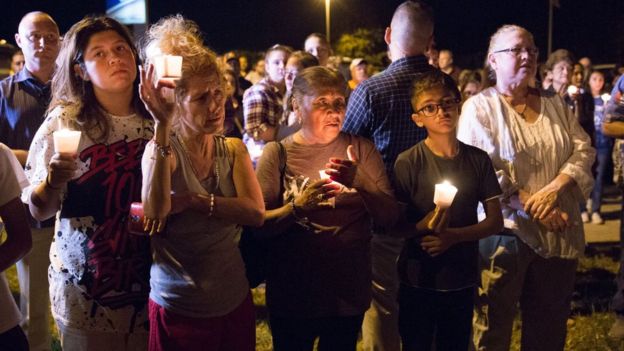
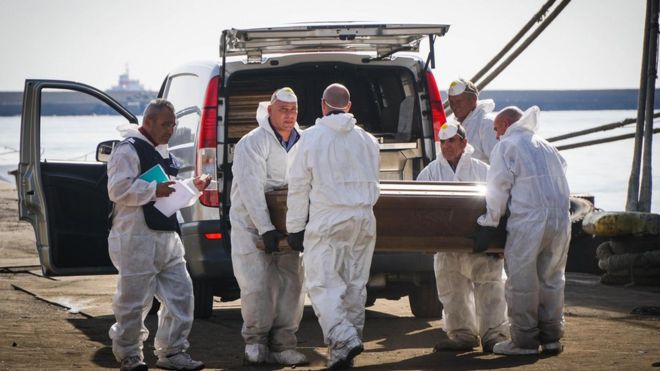
26. Two mirrors face each other. “Sutherland Springs: Texas church shooting leaves 26 dead”. “Italy probes deaths of 26 Nigerian women from migrant boats”. These headlines both appeared on the BBC news website today. In Texas, the Governor said, “This will be a long, suffering mourning for those in pain.” In Texas, half of the people killed were children. In Italy, most of the women were between 14 and 18 years old. This is the fearful symmetry we have produced. No immortal hand or eye would dare produce such horror. This is completely ours. 26. We should all be in pain, and not just today. Who will remember the day in which 26 innocents here and 26 innocents there became specters, objects for the work of mourning, subjects for the never-too-soon debates? Who will claim responsibility, for the wholesale mass production of guns, refugees, asylum seekers, and corpses? 26. Whose world is this? Whose grave’s this, sir? 26.

Salerno


(Photo Credit 1: BBC / AFP) (Photo Credit 2: BBC / EPA)

In India, the Bihar “stampede” was a planned massacre of elder women

Kartik Purnima is a holy festival celebrated by Sikh, Jain and Hindu people. Yesterday, thousands gathered in the village of Simaria, in Bihar, to celebrate. They went to Simaria to dip into the Ganges River. Something happened. The press and the State called it a stampede. Three elderly women, each reported to be in their 80s, were killed. The State says the women died of suffocation. That may be the forensic determination, but those women, and so many others in stampedes – from Jakarta to New Delhi to KwaNongoma to Karachi to Abidjan to Valley Stream to Lahore to Johannesburg to Mymensingh to Khayelitsha – were part of the plan. Yet again, the gender of stampede is women, and yet again, the world takes little or no notice. Just another sudden rush, just another panic, just another day in which women `naturally’ dominate morbidity and mortality rates. Just another day.

In 1999, a “high powered committee”, established by the Indian government, released a report on disasters. They determined five categories: water and climate; geological; biological; nuclear and industrial; and accidental. They described accidental catastrophe as “urban and forest fires, oil spill, mine flooding incidents, collapse of huge building structures, bomb blasts, air, road and rail mishaps, boat capsizing and stampede during congregations.” None of these are “accidental”, since all are preventable. Since that report, the State has done less than nothing to “mitigate” the possibility of “stampedes”. In the intervening eighteen years, they have expressed “concern” at “the recurring stampedes at places of mass gathering, including religious places, and typically ad-hoc responses to those”, and issued “crowd managementguidelines, with absolutely no force and little promotion. At the same time, India’s National Management Authority lists three categories under “Man-Made Disaster”: nuclear, biological, chemical. No stampede, no crowd control, and no concern.

Yesterday, in Bihar, thousands of devotees passed through capillary alleys barely wide enough to allow passage to hundreds. The result was predictable, and the State did nothing. That was not a stampede in Bihar yesterday. Instead, three elderly women were massacred. Now, after decades of doing nothing, the State claims concern and pretends to act, but it will not acknowledge its own guilt. There was no accident. There was no stampede. Just another day.

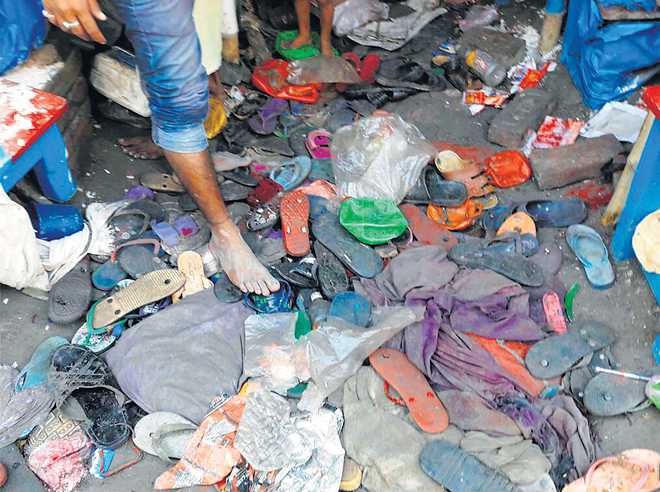
Scattered slippers after the event


(Photo Credit 1: The Tribune of India / PTI) (Photo Credit 2: Scroll / PTI)

A Band-Aid on a Gaping Wound: Limits of the Law in Domestic Work in India

Domestic workers fighting abuse and slave-like conditions need legal protection. While India’s labor ministry has begun preparations to provide social security for domestic workers, further protections for workers to demand better treatment from their employers and justice for abuse and mistreatment are still needed.

Recent instances of severe abuse of domestic workers in India include a 26-year-old domestic worker from Bangladesh who was held captive by her employer, based on false accusations that she had stolen from them. She had not been paid in two months. Elsewhere, a domestic worker was tortured and then murdered by her employers, a legislator and his wife.

Even if workers organize and rights have been won, the threat of retaliation from employers remains. For example, domestic workers in a complex in Mumbai went on strike for their underpayment by employers. The, employers conceded defeat and then months later fired the maids.

Domestic workers are vulnerable because of their lack of other employment choices. According to social activist Pratchi Talwar, “Many resort to domestic work because of decline in employment opportunities in the agriculture and manufacturing sectors.”

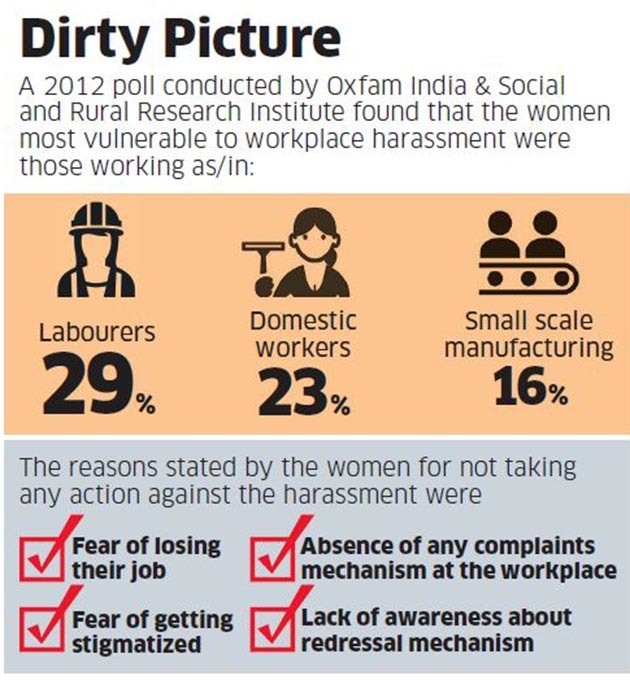
A poll in India conducted about workplace harassment highlights domestic workers’ vulnerability, claiming that these women do not retaliate from employment abuses because of the fear of losing their jobs, fear of being stigmatized, the absence of a means of filing complaints at the workplace, and the lack of awareness about redressal mechanism. These reasons, and the lack of means to address these problems, produce a continued pool of workers vulnerable to abuse and mistreatment form their employers.

India’s labor ministry has begun the process of addressing the concerns over the mistreatment of domestic workers by defining domestic workers as workers and providing the legal protection and social security that comes with the new legal status. The introduction of the policy is intended to “set up an institutional mechanism for social security coverage, fair terms of employment, addressing grievances and resolving disputes.”

According to Sonia Rani, project coordinator of the Self-employed Women’s Association, “These are just guidelines which are not legally enforceable. What happens when there is sexual abuse, withholding salaries and denying leave? Can the workers go to court? There also has to be a non-negotiable salary regime.’

Domestic workers continue to experience higher turnover rates and can be fired at will because there is no legal protection and no national law documenting domestic work as work, giving them all the protections of workers from such legal status. There are only two laws in India concerning domestic workers, the Unorganized Workers’ Social Security Act of 2008 and the Sexual Harassment of Women at Workplace (Prevention, Prohibition, and Redressal) Act of 2013. Neither law recognizes domestic workers as having legal rights. Though India is a signatory to the International Labor Organization’s 189th convention on Domestic Workers, the country has not yet ratified it.

Policy shifts concerning domestic workers do not become concrete implemented law unless domestic workers are recognized as part of the labor force. Only when domestic work has been recognized as work can there be legal protections for women and girls employed as maids. Unions and organization have argued “that the mindset of regarding domestic workers must shift from a policy paradigm to one that focuses on workers’ rights. Only then, can domestic workers’ rights be defined and protected.” Until then, the actions are but a Band-Aid on a nationwide gaping wound.

For women migrants and refugees, justice instead of policing!


“They are conscious of their impending death, still they would rather float out to sea. That makes one ponder the conditions of life for many in the world,” a woman rescuer on the Aquarius told me. The Aquarius is one of the rare vessels still rescuing people on the border of the territorial waters of Libya. The women, men, and children who embarked on flimsy dinghies after having been dispossessed by all the agents of this drama finally land in Europe. The reasons of the conditions that made them flee are not discussed; what is discussed is constraining the flow they form and managing those people. Although they experienced many levels of torture, they still must “convince the authorities” of their need for protection.

In 1951 in Geneva, the international community agreed on a convention on the protection of refugees. They decided that asylum should be granted to people fleeing persecution or serious harm in their own country. It was the time of post WWII international conventions, when the narrative was “never again.” The convention affirms that no one should be expelled against her or his will to a territory where she or he fears threats to life or freedom.

The main industrial countries have reinterpreted the convention they ratified. As Patrick Young, an attorney for the Central American Refugee Center (CARECEN), told us, in the United States this is the worst period for immigrants in his lifetime and he has been working in immigration for decades. He also told us that they had seen no refugees coming since the election.

The European governments have been designing policies to close their borders to refugees and migrants. In countries previously known to welcome migrants – such as Sweden, Denmark, Norway, Finland, Hungary – anti-immigrant parties have reached unprecedented levels of representation. As a result, those countries have aligned their immigration policies with the more conservative countries. In 2015, the Swedish population grew by an additional 1.6 %, thanks largely to the arrival of 163 000 refugees. As elsewhere, Sweden’s discourse of public debt and unemployment rates has included immigrants as an aggravating factor. This triggered horribly restrictive asylum policies, placing Sweden at the bottom of the 32 European countries. Meanwhile, the Schengen free circulation agreement in EU countries has fallen apart. Now the Swedish border patrol requires passport or photo IDs, even at the iconic Øresund Bridge border between Copenhagen and Malmö.

While asylum policies vary from country to country, they have all been tightened, especially in countries where these policies had been rather generous. Most recently, the newly elected French President announced that he wanted to reform France’s asylum process. He claimed this would provide a more human and just process and at the same time insisted on the importance of managing the problem of smugglers as well as discouraging people from trying to reach Europe.

While President Macron spoke fine words about humanizing French asylum policies, his Interior Minister was showing a “tough on immigration” face. France has not been very welcoming to asylum seekers and the application of its asylum policies does not respect the notion of protection that the Geneva Convention commands.

The Paris-based Primo Levi Center assists women, men, and children who have faced political violence, rape, torture, humiliation, persecution. They provide long term treatments to their patients. Typically, their patients are referred to them up to 3 years after having drifted onto the coast of Europe. Despite having been tortured, 50 % of their patients saw their asylum applications rejected in the first round. The Center published a report that identified the breaches in the process that should have provided protection. They made strong recommendations, among them a reform of Ofpra, the office in charge of first addressing asylum applications, demanding that the office be put under the aegis of the Ministry of Justice as opposed to the current Ministry of the Interior. They demanded justice instead of policing.

The report identified variances of results between the different judges in charge of reviewing the cases and granting asylum, showing that judges’ biases about migrants are a determining factor. In the current climate of “de-welcoming” refugees, refugees are often seen as liars who mislead the officers recording their testimony. This perception obscures the reality of torture that the asylum seeker has lived through. Torture excludes people. Once in Europe the torture continues as the refugees continued to be excluded. As one of the Primo Levi’s patients explained, “How do you make them believe that I was forced to eat parts of a fetus pulled out of the body of a woman who had been executed in front of me by a soldier.” Half of the refugees/migrants are women, who have been raped, abused during their trip, used as weapon of war and then face gender inequality when applying for asylum.

There is no time in these interviews to recognize the psychological trauma of the victims of torture. Now, the President’s reform will accelerate that process. If the improvement of protection rate observed in 2016 with an increase of 35 % compared to 2015 should continue, acceleration of the process shouldn’t mean officers are obsessed with identifying the good refugee from the fake refugee, essentially the economic refugee. Instead, they should give refugees the benefit of the doubt.

The paradigm must change, as determined defender of human rights Giusi Nicollini, Mayor of Lampedusa, declared when she received the Simone de Beauvoir Award, “The people who fled violence defied death, they are a modern example of heroism.” She identified the situation of migrants/refugees to be the new apartheid, a new holocaust. Giusi Nicollini lost her seat in the last election to someone who campaigned on tougher measures toward refugees. The role of conventions and their legality must be reinforced. We must switch the rationale from the balance of power to the balance of justice.


(Photo Credit: Yahoo / AFP / Carlo Hermann)

Stop Punishing Poor Women’s Sexuality Through Abortion Bans!

Nearly 1 in 4 women under the age of 45 will have had an abortion. Women’s access to abortion continues to be a matter of contention between mostly white, mostly male, politicians who tout about the sanctity of life while simultaneously working to deny the benefits that women and children rely on to survive. Rather than help those children who rely on social assistance and the state for healthcare (literally by letting a program insuring 9 million children expire) and food, Congress has moved forward with a national ban on abortions past 20 weeks.

Anti-choice hypocrisy would rather claim that the rights “of a human being who has never taken a single breath a single breath are more important than the rights of the person with thoughts, a past, relationships and emotions that would be forced to renounce her bodily autonomy to accommodate the fetus.” The fight for a fetus’ life ends the moment a child is born; it does not continue as the child is raised, especially the fifteen million children who live in poverty in the United States.

Abortion bans are not implemented to curtail abortion rates. If one truly wishes to see the end of abortion, there would be universal access to various forms of birth control, along with comprehensive sexual education in public schools to help the decrease in teenage pregnancy rates; these methods have effectively helped to decrease the abortion rate, which occurred in 1 in 3 women in 2008. Abortion bans continue across the country because it is the state’s way of controlling women’s, especially poor women’s, sexuality. It is a method of punishing women’s sexual freedom, while make their struggle to survive ever more precarious. As Jon O’Brien, President of Catholics for Choice, noted, “When we take away a women’s choices about her own body, we hamper her ability to make sound decisions for her and her family. We force her into her tougher bargains to make ends meet. We threaten her capacity to thrive. We hurt her ability to raise children that are healthy and resilient. And we perpetuate cycles of poverty.”

That is what anti-choice men in power want: poor women forced to have children, forced to work nearly any wage to care for said children, to survive. A never-ending pool of desperate labor willing to work for scraps to avoid starvation, and then the continued reproduction of those poor pools of labor in the form of their children. Means of sustaining an exploitative capital regime hide under the guise of being pro-life.

A continued insistence on women’s necessity to remain chaste and virginal perpetuates the belief that women are only sexual for the sake of procreation, and never for pleasure. Harper’s Bazaar has the best response for the continued control of women’s decision to have sex for enjoyment:

“There are certainly going to be people who will reply to this by shouting, ‘then women should keep their damn legs shut.’ No. Go crawl back to the time capsule you came out of. 95 percent of Americans have pre-marital sex. 9 months of unwanted pain and possibly death is not an acceptable punishment for being unlucky while engaging in an almost universally practiced past time. It is the punishment for 0 percent of men, which is the correct percentage.”

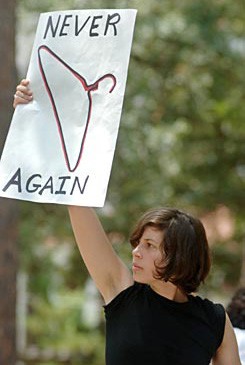
Today, the United States has one of the highest maternal death rates in the world. We save the fetus to kill the woman. We proclaim the rights of the fetus’ “life” while exploiting and killing the poor women who are forced to bear it. That is not pro-life; that is anti-woman. When we scream “Never Again!”, we are not only demanding the protection of women to have a safe and legal abortion. We are protesting the desire to revert to a time when women died from illegal and dangerous abortions. And as our elected officials gleefully hinder the march of progress for women’s reproductive freedom, women and men everywhere should continue to raise their voices to make sure we hinder them every step of the way.

(Photo Credit: Women’s Web)