COVID-19 And the Death of Common Sense

Marc Chagall’s The Falling Angel

COVID-19 And the Death of Common Sense

Yes
Apparently part of the plan is
That I
A Black Man in America, am going to put a mask around my face
A bandana
Leave my house
And then go outside.

Where there are policemen with guns.

Who do so well with Black men without masks.

With the ascent of fear
Comes the death of common sense.

Why do we wait for liars to tell us the truth
And doubt our own insight and experience?

And then he started to scream.

It was a low guttural growl at first
Changing gradually to a sound one might expect to hear
If the doorway to Hell were left ajar
And like an idiotic lovecraftian eavesdroper
You to put your ear to the crack to hear sounds
That would leave scars.

And after hearing what could not be unheard
You will ask yourself for the rest of your troubled life
What was worse:
The screaming
Or what was being done to cause it?

I mean, you would ask this
If you could stop screaming!

Safety gear is just for your psychology
Just like headgear in full contact sparing
Or like football gear that DOESN’T prevent chronic traumatic encephalopathy
In lifelong players

Transmission of a virus occurs through contact
It doesn’t matter how much safety gear you have
If you are in constant contact with a virus

Said the doctors in Italy

Isn’t that written somewhere in children’s school books?

Presentes mis doctores que luchan en la vanguardia de esta batalla

The common cold is a virus
And there is no cure or vaccine against it
Because of how a virus changes vectors

How, then, will there be a vaccine for COVID-19?

People take flu shots every year
And every year people still get the flu
A flu that is always from somewhere else
And never from “here”.

I’m not a doctor
Or in medical school
And I don’t play one on T.V.
But I know that.

Tactically, they know people can’t deal with the truth
They are bringing the population along
Spoon feeding us lies incrementally
Inch by inchTo prevent a wide spread panic

And suddenly there are daily Presidential press conferences
But still no uniform national strategy

COVID-19, Kidney Stone, Chemo
The new rock, paper, scissors
And COVID-19 beats Chemo

As healthcare professionals
And Samuel L. Jackson urge us
To stay the fuck at home.

This is what I’m lookin’ at.

Good news takes care of itself
Don’t tell me about 5 minute tests
(Five minutes abs didn’t work either)

As bodies gather in hallways
And are loaded on to refrigerated trucks

Good news takes care of itself.
And there is no good news.

Today they are hoarding toilet paper
What will it be tomorrow?

Maybe I do need a mask.

May the angel of death pass over your home.
מי ייתן מלאך המוות פסח לביתך


(Image Credit: Marc Chagall)
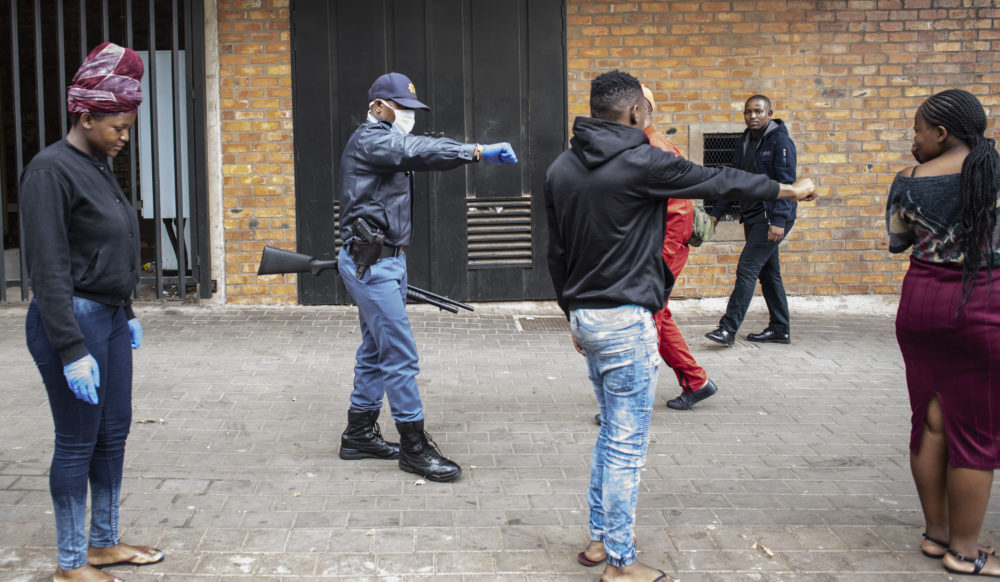
State power in the time of Corona: To protect and serve … whom?

At the time of writing, nearly half the world has closed down or is waking up to an unfamiliar world of  encroachments on physical mobility in ways not seen since the War of  1914 to 1918. Covid-19 has exposed existing fault lines in public health care provision and in  public health crisis in both the global South and the global North. The realities of socioeconomic exclusion have exposed ongoing inertia in public service provision and the rescinding role of the State in those provisions. Race, gender and class have been foregrounded in this time of crisis.  Whilst the Corona virus offers a critical moment to rethink and reframe the social compact between state, citizens and residents, it is also a dangerous and alarming time of enforced mass  enclosure. This is not the first time that humanity has been here though the scale and reach are unprecedented

Following Hurricane Katrina, many people sought to answer the question of whether its social effects and the government response to the country’s biggest natural disaster had more to do with race or with class. Media images broadcast from Louisiana showed nearly all those left behind to suffer and die were Black Americans—it looked a race, gender and class issue because it was. A few years later during Hurricane Sandy, it was clear that the US had learnt nothing from the traumatic upheaval wrought by Katrina. In this instance, it appears that nearly all might be left behind, but that the social  binaries of race based poverty and gender would endure, starkly. 

Though often hampered by  resource constraints, most African countries have a better track record of deploying state support and resources to deal with the upheavals of disease and the aftermath of war. The Ebola virus, the ongoing HIV/AIDs pandemic and malaria have provided lessons in the folly of denial, the importance of protecting health workers, of accessible and low-cost medication, robust public education, and open and consistent communication. So much of what seems like basic sense has been found wanting in the handling of Covid -19.  The news that British Prime Minister   Boris Johnson has tested positive after robust handshaking  whilst we have been advised to keep a distance and wash our hands shows a reckless leadership deficit during a defining moment.

The last forty years of globalisation as market orthodoxy has commodified health care. The globalisation of trade is  central  to  health services that have become a tradeable commodity  in an era in which many States have disinvested from health services altogether. Like education, access to water and electricity,  health provision  has been a casualty of structurally  adjusted States and the curve between the global South and the North has been exposed during this crisis as the UK and the US, often considered to be ‘developed’, have again been found weak and unprepared for a health trauma of this scale. The prescripts and onerous impacts of conditional aid and state disinvestment in social provision  have long been felt by African and Latin American countries. 

Globally, states are all experiencing the impacts and limits to free market logic. Though  characterised by many as the great equaliser, a time when States are equally fragile across the global north and global south, the true genesis of this global devastation is northern capitalism and demobilised  States. Structural adjustment as a project has evolved and is a continuing mantra of the  International Monetary Fund and the World Bank. Both  recently unveiled their market driven response of emergency loans targeting developing countries  primarily in the Global South. The depleted  health and sanitation systems in many  countries  is testimony to the devastating success of neoliberal globalisation in immobilising national  state capacities.  

Following structural adjustment programmes, most health care and essential services – including water, energy, education – may be removed from state purview for cost recovery  arrangements. In this scenario private companies invest their funds in return for state guaranteed monopolies and price control, further dispossessing and excluding vulnerable communities. Public Private Partnerships – which are essentially polite privatisation – have existed for centuries,  thriving even more when States are weakened. These have also  become the easy allies of disaster capitalism as seen in the wake of Hurricanes Katrina and Sandy where education and energy supplies were privatised, monetised and removed from the domain of public good.  

Despite decades of state neglect, social apartheid and various global traumas, consensu has formed on closing down public movement and curbing personal freedoms to address the War called Corona. The introduction of “lockdowns” with no tangible provision for social safety nets has posed significant risks to workers in the parallel economy, internally displaced persons, the working poor, fragile urban communities and other marginalised sectors. 

Notwithstanding  outsourcing their most fundamental functions to the private sector and ignoring their duty to distribute social and economic benefits to the most vulnerable in society, States are now  calling on us to trust them as they invoke martial law. This has  resulted in the largest shutdown of the last century. Unlike the two European wars (1914-1918 and 1939-1945) the impact of this situation is not localised to a few European nations, the Soviet Union, Australia,  Japan and the United States. Globalisation has transmitted both the disease and uniform approaches to problem solving. 

Students of civil liberties, human rights and social cohesion have opined on the politics of enclosure in times of war and peace.  Even during enclosed times, States exhibit inherent biases and weaknesses that maintain privilege for corporate and masculinised interests.  South Africa has lived through public control  in living memory, and distrust of the State and state security is still embedded in social discourses. Like many other  countries, the spectre of securitisation of human mobility sits badly, particularly as we still recall the dehumanising policing of colonial Apartheid exemplified by the Sharpeville Massacre, Soweto Uprising and Uitenhage massacres among many.  Troublingly, the Marikana Massacre  and the violence against the #FeesMustFall activists illustrates that the State can be a brutal  personality regardless of the supposedly progressive underpinnings of the Government in power.

At the time of writing, South Africans are required to carry Identity Books in case we are stopped by the police or army when going to buy  groceries or medical supplies. Once more, personhood is linked to a form of the much reviled Apartheid Passbook.  It is deeply unsettling, albeit necessary, that states are containing us to  control a warlike virus that might have been prevented had the same States not neglected  and commodified health care  so shamelessly. The same could be said of nearly every country battling the Corona pandemic.  

Whilst allowing already problematic Father States to lead us through very complex terrain, we recall that States are often inclined towards repression. Public order policing and martial law have often been the retreat of authoritarian regimes, evoking public safety, order and emergencies real or created to control citizens and residents . Late last year the Chilean government clamped down on high school protestors who demanded that the State provide  cost effective public transport. The escalating rage resulted in something resembling a nationwide, cross-issue movement against price increases, poor social services, and unemployment. It remains to be seen whether  the promise of a constitutional reform will quell public dissent. France has faced similar protests on public pension funds  and the retreat of the State in maternity clinics and postal services . Macron  effectively  ‘closed down’ France nearly two weeks ago. In the midst of their lockdown, thousands marched against him the day before local government elections. While States might have found the opportunity to indulge their regressive impulses during the time of Corona, not all of us are amnesiac about how we got here.  


(Photo Credit: Daily Maverick / EPA – EFE / Kim Ludbrook)

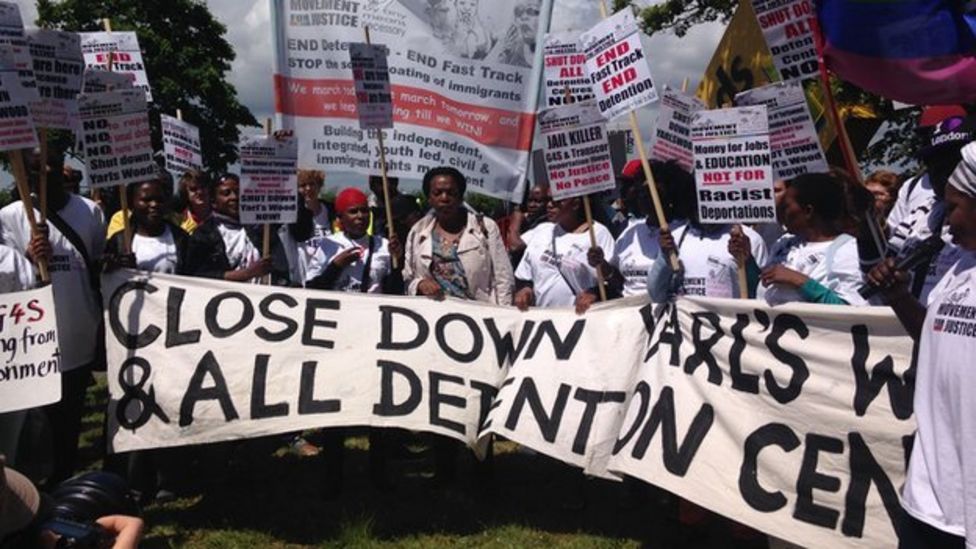
The women held hostage in Yarl’s Wood demand freedom now! #ShutYarlsWood

England built a special hell for women: Yarl’s Wood. This week, women held in Yarl’s Wood, where last week a “resident” tested positive for Covid-19, sent a petition to Movement for Justice By Any Means Necessary, demanding their release immediately: “Free us all now!!! Shut Down the Detention Centre!”.

The petition reads:

“1. COVID-19 IS IN YARL’S WOOD, OUR VISITS HAVE BEEN CANCELLED, WE ARE ISOLATED AND OUR MENTAL HEALTH IS SUFFERING.

2.  SOME OF US HAVE ASTHMA, HIGH BLOOD PRESSURE & OTHER CONDITIONS THAT MAKE US MORE VULNERABLE TO COVID-19, AS WELL AS BEING SCARED FOR OUR OWN HEALTH, SCARED FOR OUR FAMILIES ON THE OUTSIDE AND WE WANTED TO BE WITH THEM.

3. WE CANNOT GET THE HEALTHCARE WE NEED IN DETENTION, THEY JUST GIVE US PARACETAMOL. SERCO CANNOT KEEP US SAFE. PEOPLE WILL DIE.

4. IT IS IMPOSSIBLE TO DO SOCIAL DISTANCING IN OUR WINGS, WE HAVE NOT HAD ANY TRAINING ON HOW TO USE THE MASK AND GLOVES THEY GAVE US.

5. OUR SOLICITORS CANNOT VISIT US AND OUR BAIL HEARINGS ARE BEING CANCELLED AND MOVE TO PAPER DECISIONS. WE ARE DENIED JUSTICE. 

6. WE CANNOT BE PUT ON FLIGHTS ANY TIME SOON BECAUSE OF THE TRAVEL RESTRICTIONS.

7. IT IS INHUMAN AND UNJUST THAT WE ARE HELD IN DETENTION DURING THIS PUBLIC HEALTH CRISIS. SOME OF US HAVE COMMITTED NO CRIMES, ALL OF US WITH CONVICTIONS HAVE SERVED OUR TIME AND EVEN LONGER BECAUSE OF DETENTION.

8. HUNDRED HAVE BEEN RELEASED IN THE PAST TWO WEEKS, BUT IT IS TAKING TOO LONG.

FREE US ALL NOW!!! SHUT DOWN THE DETENTION CENTRE! ”

Twenty-seven of approximately thirty women in one wing at Yarl’s Wood signed the petition. 

In 2015, the Chief Inspectorate of Prisons for the United Kingdom found that Yarl’s Wood failed to meet the needs of vulnerable women. Yarl’s Wood didn’t fail, it refused to meet the needs of vulnerable women, because it refuses to recognize the humanity of any women. Every year since 2015, the situation has worsened and intensified, and then came Covid-19. Every day, more women are sent to Yarl’s Wood, during the pandemic. How impoverished must the United Kingdom be in every way conceivable that it cannot absorb some 300 or so women with a few children? How poor a nation. Release the women from Yarl’s Wood immediately. Shut it down, once and for all. Refugees and asylum seekers are not, and never have been, the crisis. The crisis is our inhumanity, racism, xenophobia, misogyny, nationalism. The time for concern and for discussion is over. The time for justice, and for reparations, is upon us and long overdue. Shut Yarl’s Wood down; do it now … in the name of health! FREE THEM ALL NOW!!! SHUT DOWN ALL DETENTION CENTRES!


(Photo Credit: BBC.com) (Image Credit: Detained Voices)

Covid Operations: Be a force of kindness, not of might. Close the detention centers!

“For with what judgment ye judge, ye shall be judged: and with what measure ye mete, it shall be measured to you again.”  Matthew 7

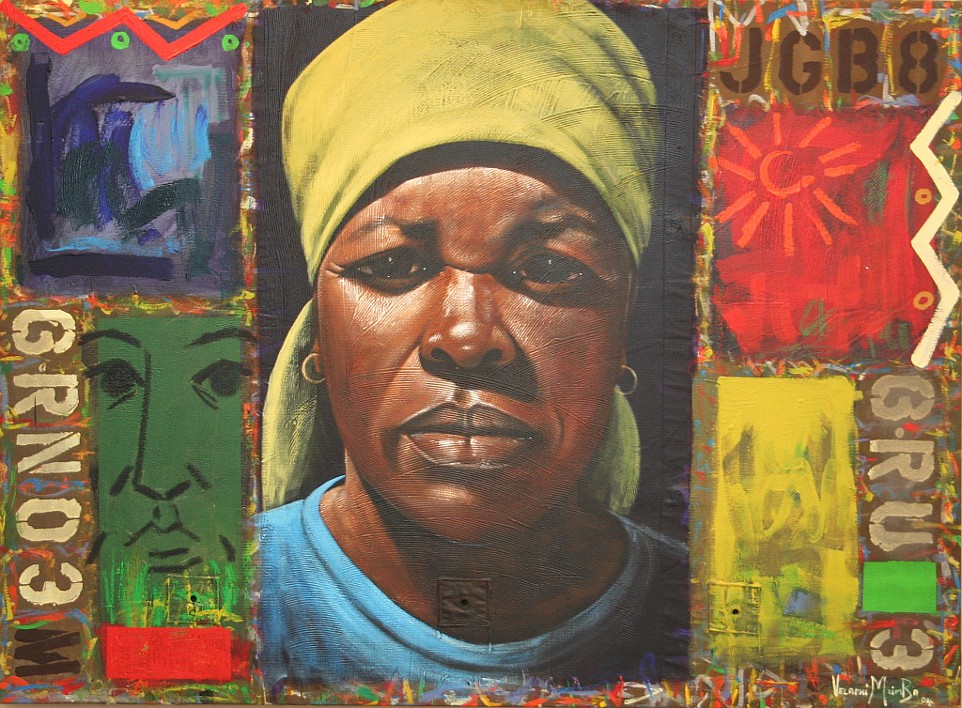
South Africa is in the second day of a 21-day lockdown, monitored and enforced by the police and armed forces, as well as neighbors, family and other less threatening people. Before sending the armed forces to wander the streets where people live and, for the rare few, work, President Cyril Ramaphosa urged the army to “be a force of kindness and not of might. Deliver your duties in a way that does not violate our people’s rights either intentionally or unintentionally.” Be a force of kindness, and not of might. On the same day that invocation of kindness was reported, it was also reported that the city of Swakopmund, in Namibia, would provide free water to those living in its informal settlements. The day before it was reported that Namibia’s capital city, Windhoek, would reconnect “defaulters’ water”. We are awash in stories of kindness and unkindness, and we will be judged by the deeds we do and the words we say and write. At the same time, so many of the reports of “acts of kindness” are individual acts, acts within and of civil society writ large, and not acts of the state. While individual acts matter terrifically, as we have learned to our detriment in the United States, the nation-State must be the State as well as the nation. 

Be a force of kindness, not of might. Tell that to ICE and its supporters. On March 21, ALDEA-The People’s Justice Center in Reading, the Rapid Defense Network in New York, and the Refugee and Immigrant Center for Education and Legal Services, or RAICES, in San Antonio, Texas, representing scores of children, sued the U.S. Department of Homeland Security and the U.S. Attorney General. Their suit opens: “This case presents the question of whether the government can recklessly expose Petitioners … to conscious shocking risk of exposure to contracting the deadly Covid-19 virus in the midst of a global pandemic by failing to take the most minimal precautions to prepare for the all too foreseeable catastrophe in crowded family detention. The answer is no.” Berks. Dilley. Karnes. The answer is no.

In the three so-called family detention centers, people are living in close quarters with little to no attention to sanitation or hygiene, “a tinderbox that, once sparked, will create a crisis that threatens the lives of women, men and children”. In Dilley, a pregnant Honduran woman, identified as O.M.G., stays with her 4-year-old daughter, who has started coughing, “I must be close to others all the time. I fear for my life, and the life of my daughter and unborn child.” In Berks, a 5-year-old was taken to the hospital after weeks of coughing. According to Bridget Cambria, Executive Director of Aldea, that girl won’t be the last child whose health is endangered at Berks, “Children can’t social distance on their own. They’re going to put things in their mouth. They’re going to touch other children. It’s not like people can go to a different room to be by themselves.

Across the country, the stories of immigrant detention come to the same conclusion, “It’s basically torture.” And it’s not only women and children being tortured. This week, the ACLU of Pennsylvania sued to release elderly and infirm `detainees’, more like hostages, from immigrant detention centers. In San Diego, people seeking asylum end up in “the Icebox”, “La Hielera”, where the temperature is kept intentionally extremely low, and of course it’s overcrowded. From sea to shining sea … 

There is a saying in Zulu, “Umuntu ngumuntu ngabantu”. A person is a person through other people. Ubuntu. I am because you are. I am because, together, we are, mutually, reciprocally. Once upon a time, a long long time ago, the word “kind” was an active, transitive verb, meaning to treat kindly or with good will. You could kind someone, we could kind one another. Once upon a time, a long long time ago … 


(Image Credit: Velaphi Mzimba / Everard Read – Cape Town) (Video: YouTube)

Nicoletta Dosio: “I will carry to the end with joy”

Nicoletta Dosio

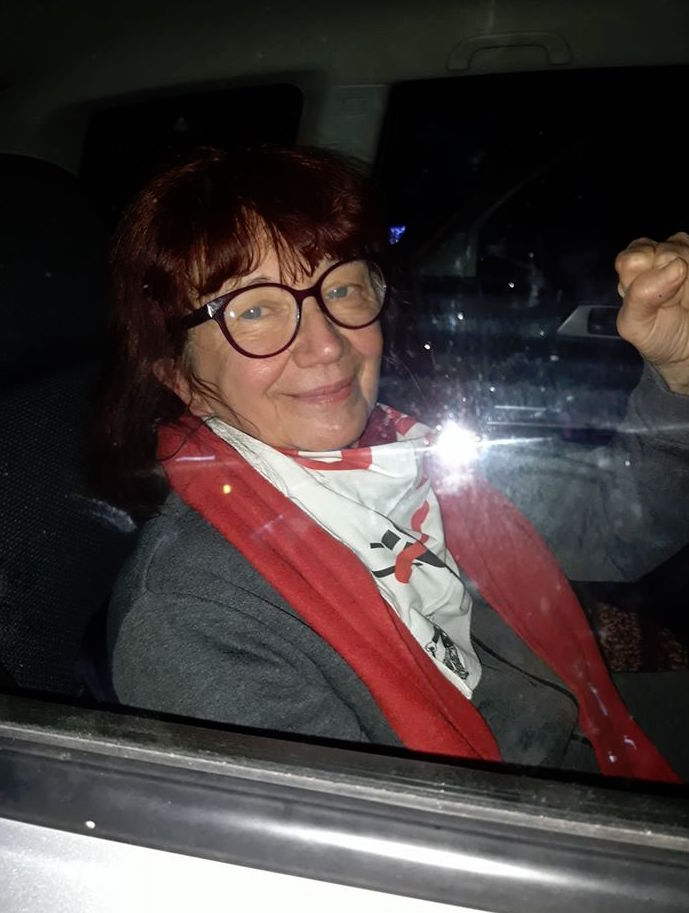
Nicoletta Dosio is a 74-year-old Italian activist, feminist, Communist who, in 2012, protested against the Turin – Lyon high speed rail project, TAV. At the end of last year, Nicoletta Dosio was arrested, tried, and convicted to a year in prison, in Turin. From her prison cell, Nicoletta Dosio has written, “I’m fine, I’m happy with the choice I made because it is the result of a just and beautiful cause, the NoTav struggle which is also the struggle for a different model of society and stems from the awareness that the present world is not the only possible world. I feel collective solidarity and personally experience what a fighting family is. The support and affection you showed me when I was arrested, and the demonstrations whose echos reach me from afar, confirm that I made the right choice, which I will carry to the end with joy. I tell the other inmates about you, I tell them that the solidarity given to me is for all the women and men locked behind these brutish walls.”

Italian novelist, poet and translator, Erri De Luca, has written an open letter to Nicoletta Dosio:

Rome, March 23, 2020

Dear Nicoletta,

In these days, I reread. Once again, I have Rosa Luxemburg’s letters on my lap, the letters she wrote from Berlin prison. In one, addressed to Mathilde Jacob on February 7, 1917, Rosa recounts the cry of the chickadee, tss-vi, tss-vi. She knows how to imitate it so perfectly that the chickadee approaches her bars.

Rosa writes, `Despite the snow, the cold and the loneliness, we believe, the chickadee and I, that spring is on the way.’

And so here we are, in the days that announce that winter has ended. You were secluded in prison, and by some mysterious solidarity, an entire people locked themselves in their homes. The streets are empty, the North of Italy is emigrating to the South, and families fill the balconies. The economists have vanished, and the medical doctors are in charge.

Standing in my field, I watch the trees in bud. In Italian, the word for “bud” and “gem” is the same, “gemma”. For us, the buds are precious stones, and Spring is a necklace of jewels open to all who know how to appreciate them.

Here, now, in the name of politeness, people are staying away and avoiding one another.

But for you, in your prison cells, there is not enough room to turn in. People with pneumonia lack air, you are all forced to breathe and gasp together. The overcrowded, criminally overstuffed prisons have become laboratories of suffocation.

But the valley for which you fought and for which you are in prison continues to produce and breathe its own political oxygen, which rises from within the community, which strengthens its fibers, and thus gives the right of citizen to those whom the authorities have treated as feudal subjects. Treated as a rebellious province, your valley continues to refuse the rape of its territory.

Your inflexible and indomitable calm is that of your community. It emerges manifest when a people awaken.

I am proud to be able to address you, dear Nicoletta, as a close friend, proud to be one with you.

I wait for you here, and I promise you that, when you leave that prison, you will find the same union and the same spring.

Fervently yours,
Erri De Luca

(Translated by Dan Moshenberg)

(Photo Credit: Nicoletta Dosio)

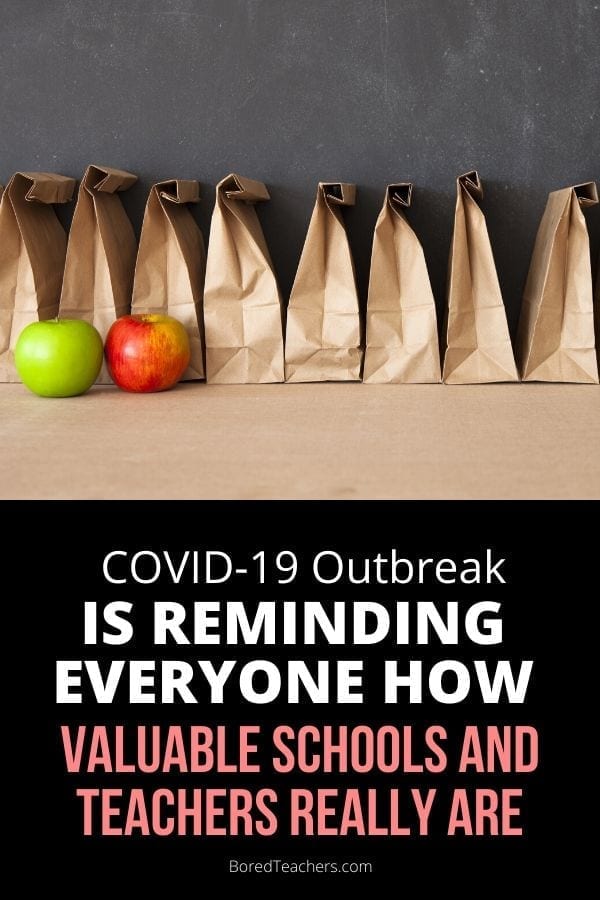
Who are essential workers in the pandemic? Grocery store clerks, teachers, nurses, women.

While the President lies, downplays, and now considers easing up on the social distancing rule despite public health officials’ warnings, we are in the midst of a pandemic. 

People who are non-essential workers are being told to stay home, to telecommute and teleconference. To work from their personal laptops and flatten the curve.  

We’re hearing this everywhere. Non-essential, non-essential. But who are the essential? Who are the critical workers that are leaving their homes and risking infection, whether they want to or not, because they provide a public good? 

They’re teachers, nurses, EMTs, grocery store clerks. In short, they’re women.

Over the past two weeks, I’ve learned several valuable lessons (well, not really. I knew them already, but I really hope this experience radicalizes those who did not). And that is who should be considered valuable and essential workers in times of crisis. What I mean is this:

Grocery store workers/truck drivers/warehouse workers deserve a Congressperson’s salary, with health insurance and benefits and a pension plan that rivals how much Paul Ryan makes after he retired from the House. Those workers have spent two to three weeks stocking shelves, taking care of people despite the risk of infection, and have been donating to food banks so that local people can have food. We’ve been doing more than any person in Congress is doing right now.

Teachers need a Presidential Salary. I don’t know, is it $275,000? or over $400,000? Either way, teachers and schools provide more services than the government does for the impoverished in their area! Children are fed, given emotional care, taught and, in the case of NYC, provide literally a place for homeless children to stay!

And hospital workers? Nurses? EMTs? Forget about it. CEO salary. And I’m not talking small to mid-size business here. I’m talking about Bob Iger’s compensation before he ducked out of the Walt Disney Company. You are keeping people alive, despite the fact there might not be enough beds, or ventilators, or even face masks! While other jobs are able to work from home, to stop the spread of the disease, you are working under extreme conditions to make sure people get to go home, alive and healthy, to their families.

Those are the people who are essential. When this is over, when this crisis is averted (and even now), maybe it’s time to start demanding we be treated as essential workers.


(Photo Credit: John Autey / Pioneer Press) (Image Credit: Bored Teachers)

Covid Operations: How is this (not) unprecedented? Let us count the ways …

“They knew that their country’s devastation—before the earthquake as now—was not inevitable. They knew that traditional “recovery” would fail to recover much of anything except the previous inequities. They knew that reconstruction could be, had to be, grounded in democracy, where all had a say. And they were organizing.”
                                             Beverly Bell. Fault Lines: Views Across Haiti’s Divide

The emergence and efflorescence of Covid-19 has produced its own distinct discourse: social distancing, flatten the curve, social isolation, care mongering, and the list goes on. Words matter, rhetoric matters. One term that has been recirculated through the interpretive landscape of dismay, disorder and governmental dithering is to claim that everything is unprecedented … and so how could we have known? This claim of unprecedence has resulted in some curious contortions. For example, the stock market collapse is both unprecedented and the worst since 1987. The pandemic itself is unprecedented and the worst since the 1918 pandemic, the so-called Spanish flu. Well, which is it, unprecedented or the worst since? It doesn’t matter, because the claim of everything being unprecedented, rather than seriously and existentially dire, is always already an alibi. What is the alibi, and were we all really completely unaware?

For decades, political economist after political economist has warned that neoliberal models of development, and in particular austerity, would leave the world with severely diminished health care systems and seriously stretched economies. Four decades of slow to no growth and just in time production chains have produced “lean economies” which [a] only work for the very rich, [b] widen inequality rapidly and increasingly, and [c] increase risk. How did `we’ emerge from the infamous 1987 crash? The infamous Greenspan Put, in which the Fed “injected liquidity” into the market. What that means is that speculators are protected from risk and so are encouraged to take even riskier investments. The very opposite of no pain, no gain, this solution is All gain for a few, all and intense pain for everyone else. That was how `we’ emerged from 1987 … 1997 … 2000 … 2008. Unprecedented? Hardly.

Four years ago, Rob Wallace’s Big Farms Make Big Flu was published. Recently, Wallace noted, “The real danger of each new outbreak is the failure –or better put—the expedient refusal to grasp that each new Covid-19 is no isolated incident. The increased occurrence of viruses is closely linked to food production and the profitability of multinational corporations. Anyone who aims to understand why viruses are becoming more dangerous must investigate the industrial model of agriculture and, more specifically, livestock production. At present, few governments, and few scientists, are prepared to do so. Quite the contrary. When the new outbreaks spring up, governments, the media, and even most of the medical establishment are so focused on each separate emergency that they dismiss the structural causes that are driving multiple marginalized pathogens into sudden global celebrity, one after the other … There are no capital-free pathogens at this point … The capital-led agriculture that replaces more natural ecologies offers the exact means by which pathogens can evolve the most virulent and infectious phenotypes. You couldn’t design a better system to breed deadly diseases … These companies can just externalize the costs of their epidemiologically dangerous operations on everyone else.” The other term for the Greenspan Put is moral hazard, “any situation in which one person makes the decision about how much risk to take, while someone else bears the cost if things go badly.” That’s Paul Krugman writing, in 2009, about the crash of 2008. Unprecedented? No.

Despite the experience, and warning signs, of both SARS and Ebola, the lessons for health care were ignored in favor of profit. Cut workers’ access to health benefits, both by directly slicing health care benefits and transferring large sectors of the labor force to precarious `self contractors’. Defund public health and privatize health care as extensively and deeply as possible. Invest in pharmaceutical research that generates maximum profits and whatever you do, stay away from research in preventive medicine. Big Pharma “loves to design cures. The sicker we are the more they earn.” Keep the system `lean’ and `efficient’, meaning no extra beds, no extra anything. This is the legacy of austerity, and it has been widely criticized, certainly 40 years ago at the beginning of the period of neoliberal development, but with greater insistence, research and documentation over the past ten years. Unprecedented? Nope.

The claim of “unprecedented” is an alibi to the same extent that it provides ideological cover for the same old same old. This is not about gotcha; this is about how we understand “reconstruction”. Many are, rightly, concerned that nation-State governments will declare a State of Emergency or a State of Disaster and thereby erode civil and human rights. Even if that does not happen, we must pay critical attention to those who call for a “return to normalcy”, which would mean a `return’ to growing inequality, decreasing access to decent health care, mounting evictions, increased incarceration, increasing hunger, and more and more unprecedented pandemics.


(Image credit: NPR)

Covid Operations: Stop intoning “bearing the brunt”

The emergence and efflorescence of Covid-19 has produced its own distinct discourse: social distancing, flatten the curve, social isolation, care mongering, and the list goes on. Words matter, rhetoric matters. One phrase that has been recycled through the interpretive landscape of dismay and disorder is “bearing the brunt”. Let’s consider that.

“Bearing the brunt” has blossomed in the past few weeks. How Women Will Bear the Brunt of This Pandemic. “Perhaps the greatest economic lesson the U.S. will glean from the coronavirus is not only that slow-acting fiscal policy leaves the vulnerable more vulnerable. It’s also that any fiscal policy, slow-acting or not, without the gender lens leaves women to bear the brunt of a financial crisis.” “Poverty experts said that in times of natural disasters and large-scale emergencies, low-income families who are already living on tight budgets with overdue bills, unstable housing, poor health care and unsteady employment often bear the brunt of the pain.” “The lowest-wage workers will bear the brunt of the layoffs.” “Together, we can create systems built to ensure that low-income communities and communities of color do not repeatedly bear the brunt of acts of nature like the coronavirus, or the human-made acts of inequitable laws and policies.” “As more countries fight to curb increasing numbers of Covid-19 infections, a virus of fear is sweeping the globe – and the most vulnerable in our communities are bearing the brunt of it.” These are just a few examples from the last few days.

Individually, the statements are incisive, perceptive, critical, but taken together, they suggest something else, a way in which the phrase “bearing the brunt” is meant to suggest that the author is somehow both insightful and compassionate. We care about those bear the brunt … don’t we?

Three articles in one day: “Black women bear the brunt of domestic violence”; “lesbians bear the brunt of military discharges”; “children bear the brunt of the deepening economic crisis”. Those three articles appeared in one day … in October 2009. On another day, in December 2009, we learned that in KwaZulu Natal urban women bear the brunt of AIDS, while in Honduras, women bear the brunt of human rights abuses. In 2010, when food prices soared, analysts explained that the poorest would bear the brunt.

Last year, the climate crisis produced a crop of brunt bearings. In a just a few weeks, the following appeared. “Bangladesh’s rural families bear the brunt of climate change … Households headed by women are under even greater pressure.” “Women bear the brunt of extreme weather events because they lack economic, political and legal power.” “Women and children often bear the brunt of water shortages.” “The female population is more likely to bear the brunt of natural disasters.” “In less-developed regions, it falls to women to gather food and water for their families. If crops can’t grow, those women will lose both their livelihoods and their food source. At the same time, as extreme weather events become more frequent, huge populations of women and families are forced to leave their homes. Women will bear the brunt of the crisis.” “It is the world’s most vulnerable people who are made to bear the brunt of climate change, though they are the least responsible for causing it, and are ill-equipped to deal with the consequences.” “Feminism helps me understand what underpins our climate crisis — systems like extractivism, patriarchy, and capitalism. Feminism helps us see the genderdifferentiated impacts of climate breakdown and how women disproportionately bear the brunt of the harm.” “Women farmers bear the brunt of the crisis—and may be the key to limiting its impact. But that’s only possible if there is gender equality in the agriculture sector.” “Those with fewer resources are bearing the brunt of the crisis, and many of the world’s poorest are women. In times of scarcity it’s often mothers who go without to make sure their families can eat. When extreme weather hits, because women still primarily look after children and the elderly, they are the last to evacuate; leading to higher female death tolls. Around 90% of the 150,000 people killed in the 1991 Bangladesh cyclone were women.”

What does “bearing the brunt” mean, and why must women and children fulfill that role? Can community exist without some group, and specifically women and children, bearing the brunt? A brunt is “an assault, charge, onset, violent attack….The shock, violence, or force (of an attack)…. The chief stress or violence; crisis.” To bear can mean so many things, from carry to bring forth fruit or offspring, but when it comes to bearing the brunt, it means “to suffer without succumbing, to sustain without giving way, to endure.” Bearing the brunt is an acceptable facet of everyday life and, as such, is a perversion of any sense of justice or wellbeing. Women “bear the brunt” in a social, economic, political order in which peace, wellbeing, justice, prosperity, joy are understood as military engagements. In that world, rights are hollow, reconciliation is empty, and love is abandoned. This is not unprecedented. To the contrary, it is us, and has been for decades.

(Image Credit: Al Jazeera / Muhammad Ansi / John Jay College)

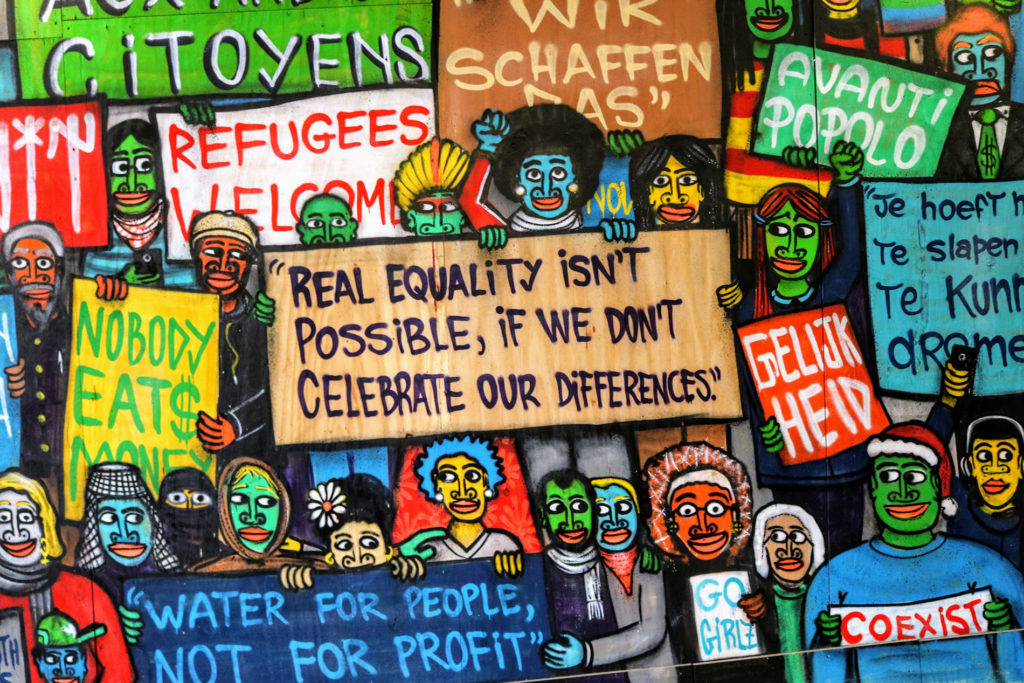
When the neoliberal and globalization creed meets the virus

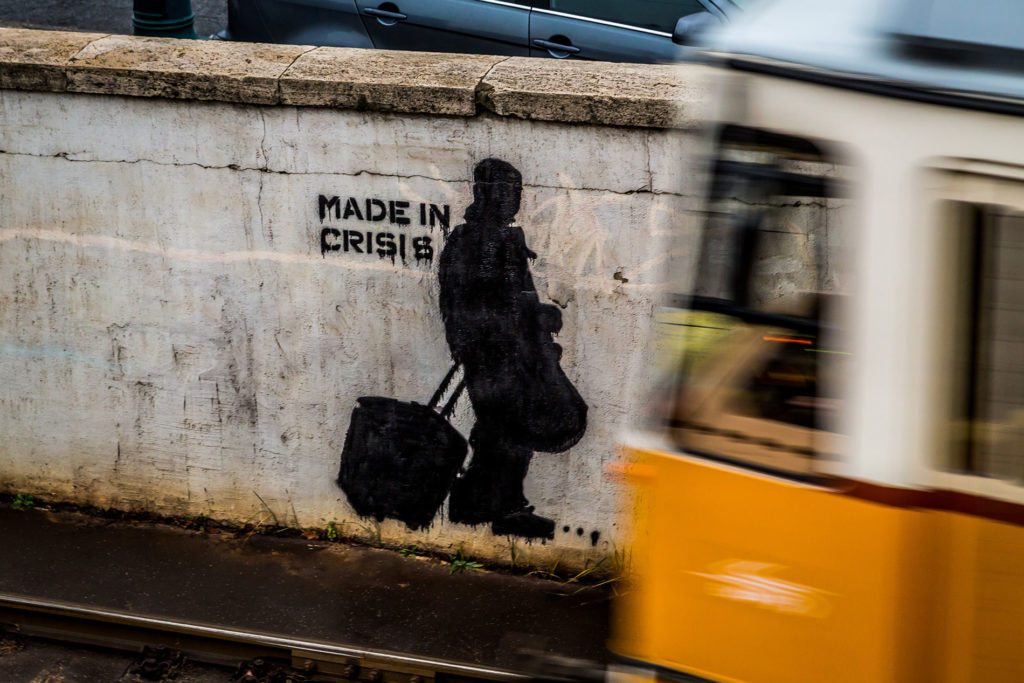
Did we see it coming? In the United States there was a presidential campaign taking place along with social unrest, immigration unrest and wall building. In Europe, countries were passing laws either to exclude people in exile, or people in vulnerable position, with no alternative! Then the novel coronavirus came to life creating Covid 19. We call it now a corona virus crisis. A new crisis in the series of crises that capitalism has been feeding itself from. At the beginning it was a Chinese made virus. But China is the iconic representation of globalization and all a sudden everything was in shambles. 

One should make the connection between globalization and the development of neoliberal economic dogma. However, this dogma initiated after WWII as the colonies were engaged in a struggle for independence from the imperial war mongering West, did not always exist. The response to the independence of former colonies was the creation of this new dogma of globalization, based also on the Western yearning for universalism. Toni Morrison reminds us that globalism “understands itself as historically progressive, enhancing, destined, unifying, utopian”. That is how it forms its delusional promise to allow itself to create a dehumanized system of deregulation, globalization and total competition. 

In the mid 1980s, Structural Adjustment Programs, SAPs, were imposed on poor countries, sometimes former colonies of the rich countries, often rich in natural resources needed in the rich countries. These SAPs were designed according to the logic of the Washington Consensus (growth at all cost and at the expense of public social services) to justify globalization. The IMF and the World Bank provided loans to poor countries under the aegis of development, but these loans came with conditionalities that required repaying these high interest loans in priority rather than developing social and health services. This complete overhaul of social structures with the development of competition for markets undermined women’s economy and women’s position.  

The Ebola virus outbreak in the 2010s shed light on the cruelty of these programs. By the same token, the austerity measures following the same neoliberal economic orthodoxy similarly stoked the elimination of public services in richer countries. The current pandemic, with the risk of infection as a common denominator, has reunited every social class and gender, with some variation according to age; therefore, it has become an international source of anxiety especially that the rich countries have become the epicenter of the epidemics. 

The national responses are different, as, for example, when the contamination of the virus is progressing rapidly in the US due social factors such as lack of a public-run health care system, lack of protection for workers under US labor laws, lack of social services, lack of access to medications. Only now is the US government considering paid sick leave for a number of people who are quarantined and whose jobs are on hold. The US hospital system has the fewest number of beds per 100 among the developed world.  The US pharmaceutical industry depends on its products and ingredients from companies in India and China. Tests for coronavirus are not widely available to identify people affected by this highly contagious disease. In the US only 11 000 tests were administered in the past few days whereas South Korea uses 20 000 tests every day.

If one wants to measure inequality concerning access to health care, one should look at the prison and immigration detention systems. “From a public health perspective, prisons [are] so dangerous because they’re overcrowded and their systems of care provision, such as they are, have intentionally gone from bad to worse”

This coronavirus pandemic reveals how a government’s callous disregard for human life and the environment relies on its “capacity to decide who may live and who must die.” Only this time the powerful are caught in their own game.


(Photo, image credit: Robert Metz and Matteo Paganelli)

Seclusion rooms, prisons, jails: The empire strikes back

In schools across the United States, seclusion rooms exist as a “last resort” practice for educators to restrain and lock “misbehaving” children in isolated rooms. This practice criminalizes behavior at an early age and normalizes the use of solitary confinement. Data on the use of seclusion rooms is often underreported or nonexistent, making them hard to regulate. In Wilmington, North Carolina, for example, there were over 930 reported instances of seclusion reported in Hanover County in 2019. The school district failed to include protocols for these seclusion rooms as well as a crisis management plan on how to meet the needs of children in their yearly handbook. A lack of accountability accompanies these failures. How often does absence of data excuse action? 

With seclusion rooms currently under the spotlight, there have been efforts across the United States to control their use through legislation. On March 4th, Missouri legislature made strides in a House Bill (HB 1568) that would establish a ban on seclusion and restraint rooms “except in cases where there is imminent danger to the student or others”. Who decides the exception?

Recently, it was reported that high schools in Leeds, England place students in isolation rooms for doing as little as forgetting books or wearing earrings. How does punishment for actions as minor as this in the education system set a precedent for how individuals are treated by the state as adults? 

While legislation to address the use of seclusion rooms is a step in the right direction in terms of initiating conversations and setting precedent, it does not ensure they won’t continue to be used and abused. This exception is seen in cases facing the courts in the United States right now that impact women, such as the recent prosecution of Harvey Weinstein. His sentencing may have shed light on the issues of sexual harassment and misconduct, but it isn’t a cure-all for the deep rooted problem of why it exists and persists. Loopholes and justifications of abuse will continue, especially against women and people of color. How can we make sense of that and move forward knowing that most women behind bars have been victims of physical and sexual violence or other trauma? 

How much persistence does it take to dismantle structures and systems? 

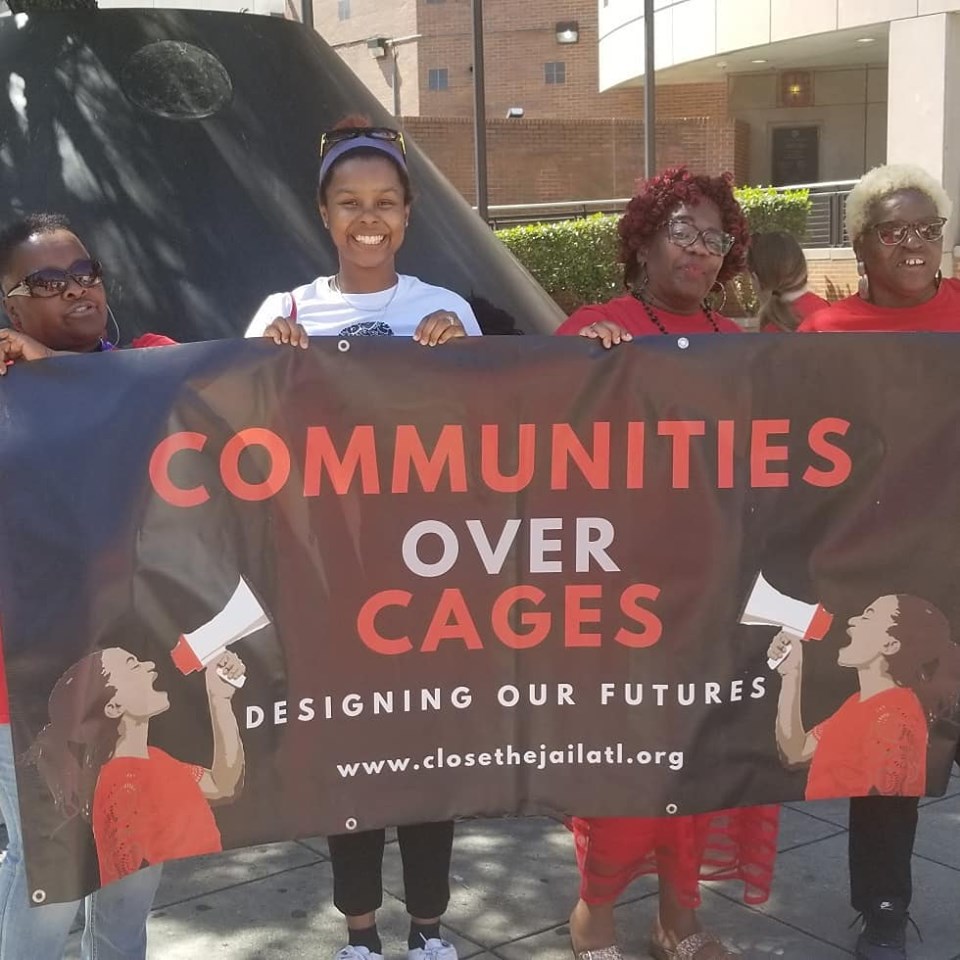
The Atlanta City Detention Center, a Georgia jail for minor violations such as walking in the roadways or shoplifting, was shut down in May 2019 following years of organizing efforts by Women on the Rise. Led by women impacted by the criminal justice system, Women on the Rise spent years organizing to prevent and repeal legislation that funneled many into the jail. Built in 1996, the jail was intended to hide undesirable residents including the homeless during the Olympics, a testament to how individuals in the city were/are grouped and deemed disposable. 

Across the country, 75% of people housed in jails aren’t convicted of a crime and are awaiting trial. If women are the fastest growing populations behind bars, and women of color make up approximately two-thirds of that population, what impact does that have?

The prison system doesn’t function like a recycling center, but a garbage dump. Actions and behaviors of individuals are not assessed for mitigation but deemed unworthy of salvaging. Even short jail time puts individuals, particularly women of color, at risk of losing the security of their jobs and their homes both in the present and the future. It’s a branding that lingers through the presence of the checkbox on job applications and federal documents that accompanies the question: “Do you have a criminal record?”

Why is it okay to uproot someone from their community without justifiable means, assuming their life is expendable? So many individuals with low income jobs worked their way to be where they are. They can’t afford to spend time in jail, and they can’t afford to miss work. 

Now in a sudden global health crisis with the novel coronavirus outbreak, it is predicted that the lack of paid sick leave in the United States will make the epidemic even worse. What happens to single moms with multiple jobs and lower incomes that can’t work remotely or afford to take off work? These systemic issues are manifesting into health concerns, but it isn’t anything new. Roughly 25 percent of workers in the United States do not have paid sick leave. On top of that, no federal legislation has ever been passed for paid family leave. What impact does that have on women? Job security in the hands of the employer leaves workers with little or no choice.

It’s almost as if these issues are being brought to light not out of concern for those impacted by them, but out of concern for the well-being of the rest of the population. They are a threat. It’s as if the argument is being raised that in a wealthy democracy, there should be a mandate for paid leave…but not because it’s the right thing to do, but for the public safety of everyone else. It’s a protection of the empire. 

(Photo Credit: Workers World / Women on the Rise) (Image Credit: Communities Over Cages: Close the Jail Atlanta)