Youth United: We have a solution – restorative justice


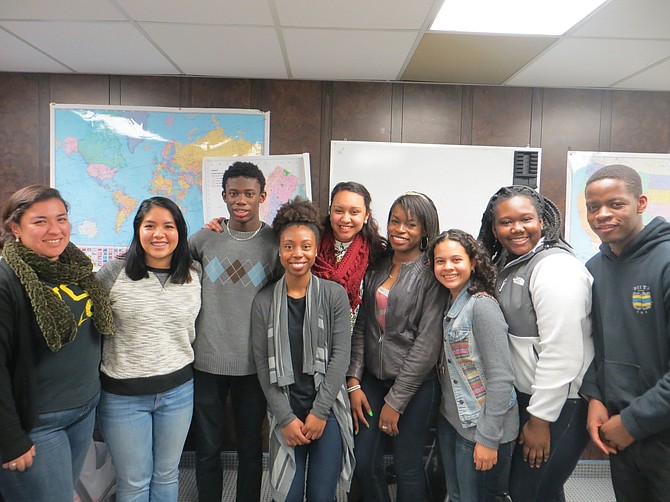
My name is Haydi Torres, and I am a member of Alexandria United Teens.  I am also a student at T.C. Williams High School in the International Academy. I am here today to lift up the voices of students who, every day, face the suspension problem in Alexandria schools.

Too many of my friends and classmates—and too many of our little brothers and sisters in middle and elementary school—are getting suspended. As students, we watch what happens when our friends and classmates get suspended, and we know it doesn’t work.

When students are suspended, we don’t get a chance to work on whatever it was that made us act out in the first place. And being sent home from school makes us feel like we don’t matter, that our school does not care about or believe in us.

For example, there was someone at my school who was suspended recently for getting in a fight with another student. Suspending the student for fighting did not solve anything. One student got to stay home, sleep, play video games, and get a vacation from school. The other student got more and more angry waiting for the first student to come back to school. Whatever the students were fighting about became an even bigger issue because they never talked about it. The school never actually made them deal with it.

Even though I’ve never been suspended, when things like this happen, I am affected too. It makes me feel like school is a place just interested in pushing us out when we make mistakes, instead of helping us to learn from them.

What makes the situation worse is that we know some students are suspended more than others. In 2010-11, the District shared data with us that showed that black students were 5 times more likely to receive a suspension than white students. Latino students were almost 3 times more likely to receive a suspension than white students. Suspensions, which we know don’t work, are especially used to punish students of color.  Students who look like me.

I am sad to know that this is happening in our schools. I know that teachers, our school leaders, and the city I love are also saddened by this.  I know we all believe we can and must all work together to fix it.

The good news is we already know that there is a better, proven way to handle student behavior than suspensions: restorative justice.

Restorative justice practices help teachers, students, and others talk about the root causes of conflicts, mistakes and bad behaviors. In the example of my classmates who got in a fight, a teacher or a counselor could have talked to each student separately. If they agreed, they could have then brought them together in a circle to talk about what caused the fight and how the fight affected each person.

It sounds so simple, but with the right training, we know it can reduce suspensions and improve school relationships.

My name is Glancy Rosales and I am a member of Alexandria United Teens.  I am also a student at T.C. Williams. As Haydi said, the bad news is that too many students are getting suspended. The good news is that we have a solution: restorative justice.

Today is not the first time students and community members have raised the issue of bringing restorative justice in our schools.  Since the fall of 2011, I have been part of a group of youth and community members that served as part of the “Student Empowerment Work Group. That group was part of the Student Achievement Advisory Committee. For many months, we attended meetings with the school district.

One of our key recommendations during that process was restorative justice.             In the end, after all that work, restorative justice disappeared from the Work Group’s final recommendations. Although we were frustrated by the way that the community was treated in this process, we think there is now a new chance to work together: the Alexandria City School Board, the school district, and the community.

Great things are possible when the community and the school system works together to make changes. We actually have a successful history of doing that with the district. For example, TWU worked with School Superintendent Dr. Sherman, the District, and our ally Advancement Project on the creation of the ICAP, the Individual Career and Academic Plan.

Getting restorative justice in our schools is another opportunity to work together.

Our ally Advancement Project is a national organization that supports community groups like TWU, the Tenants and Workers United. In Denver, Colorado, Advancement Project worked with Padres y Jovenes Unidos, a community group, and their school district to implement restorative justice. Their work has created a great relationship between the community and the district, and has reduced suspensions.

We are proud of our city and our school and we hope we can be a part of that kind of process and success in Alexandria. So today, we have three requests for the Alexandria City School Board.

First, express your support for restorative justice in words and in actions. Many School Board members have listened carefully to the voices of the students and the community.  We are thankful for that. We would like to hear support from the whole board.

Second, make funding available to bring restorative justice into our schools. Recently, the district expressed interest in having a pilot at TC Williams High School. We support this proposal.

Third, Please make sure youth and community, the people who are most harmed by suspensions, are very involved in implementing restorative justice. We ask you to make sure we get to work with the District to implement restorative justice. As we know, school systems are strongest when we work in partnership and when the voices of youth and community are heard and respected.

(Haydi Torres and Glancy Rosales are high school students in the Alexandria City Public Schools. They are also members of Alexandria United Teens, a project of the Tenants and Workers United. They recently gave a version of the above as testimony to the Alexandria City School Board. Thanks to Haydi and Glancy, to the Alexandria United Teens, and to the Tenants and Workers United for this collaboration.)


(Photo Credit: The Connection / Vernon Miles)
The Life and Times of Esther K


Esther Kiobel

Barinem Kiobel is dead. Esther Kiobel is alive, kicking, and organizing. Remember that, and remember the name: Esther Kiobel.

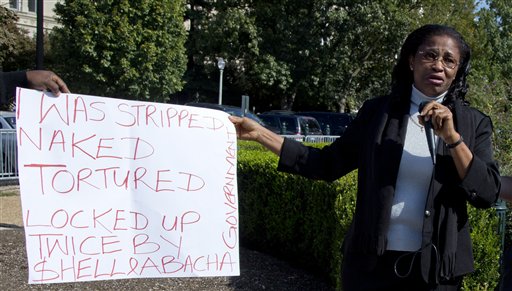
Yesterday, the U.S. Supreme Court issued a decision in Kiobel v. Royal Dutch Petroleum. Kiobel is Esther Kiobel. Esther Kiobel’s husband, Barinem Kiobel, was a prominent member of government who opposed the devastation wrought by Shell Oil and opposed the violence being committed against the opposition. In 1994, he was arrested, along with Ken Saro-Wiwa and seven others, mostly the leadership of Movement for the Survival of the Ogoni People, MOSOP. They were tortured for a year and then hanged. The nine, the Ogoni 9, were then dumped in unmarked graves in a Port Harcourt cemetery. The rest, as they say, is history.

Or is it?

Esther Kiobel fled Nigeria, applied successfully for asylum status in the United States, became a U.S. citizen, and sued Shell Oil, aka Royal Dutch Petroleum, for their role in the torture and assassination of her husband and so many others. There’s more to the story. There’s the “ecological genocide” committed over decades by Shell and Chevron … in cooperation with the various national governments of Nigeria. There’s the story of women in the Niger Delta organizing, as they continue to do. And there’s the story of rapacious multinational corporations operating without restraints.

The U.S. Supreme Court yesterday decided that Kiobel and her group don’t have a case, at least not in U.S. courts the way the law is currently written. The vote was 9 – 0. This decision is a setback for human rights organizations that hope to bring multinationals to justice, or at least to some sense of accountability, through the U.S. court systems.

Reporters and discussants of the Supreme Court decision have focused on the corporations. Some note the irony of corporations having the rights and standing of individuals, but not the responsibilities or constraints. Others focus on the impact on human rights suits, on corporations, on the prosecution of torture. In a quick and informal survey of articles, barely half reference Esther Kiobel, preferring instead the shorthand Kiobel.

Esther Kiobel is the story. Barinem Kiobel is dead. Ken Saro-Wiwa is dead. So are Saturday Dobee, Nordu Eawo, Daniel Gbooko, Paul Levera, Felix Nuate, Baribor Bera, and John Kpuine. Erasing Esther Kiobel from the story does not honor the dead. It continues the narrative.

So, kudos to Katie Redford, of EarthRights International, who wrote: “There are only a few things that are clear about today’s decision in Kiobel.  First, a lot of ink is going to be spilled trying to parse what it really means in the next few days.  And a lot of attorney hours are going to be spent in the next few years litigating the issues in the lower courts.  And of course, the Court dismissed Esther Kiobel and her fellow plaintiffs’ claims of torture, killing, and crimes against humanity, giving Shell a pass for these human rights abuses.  That result is a shame.”

That result is a shame.

Esther Kiobel and her allies will find ways to continue their struggle for justice. Justice must be more than rememorative. It must exist in the present, and it must open new spaces for the future. Meanwhile, for now, let us make sure Esther Kiobel doesn’t vanish in the haze. Corporations are not people; people are people. Esther Kiobel is the story. Remember her name.


(Photo Credit: AP / Carolyn Kaster)

Demand state responsibility or is the state a vendor of misery?


Last Friday, in a post about the imprisonment of asylum seekers in private facilities in Australia, Dan Moshenberg demanded that the state be held responsible for the atrocities committed on hunger strikers who were in prison and never charged with any crime whatsoever.  What would constitute a public policy in which the state contracts its responsibility?

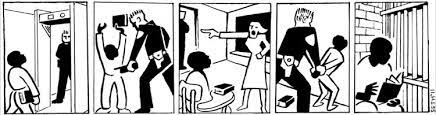
The same day, the New York Times reported that the presence of police in schools has resulted in an increased number of children in the criminal justice system. For over twenty years, police officers have been present inside middle and high schools across the United States. After the most recent school shootings, the NRA has lobbied hard for having more police officers in school. According to the Times, with the help of federal subsidies, local districts pay for their own police. Does this mean that patrolling schools has become a new business that is contracted to the police, which was once a public service agency? Does the school police budget compete with the school educational budget? Shouldn’t those scarce and dwindling resources be allocated to enhance the pedagogical and educational role of schools?

Contracted police surveillance had hurt more than it’s helped. Rather than `keep the peace’, police presence have created more schoolhouse disturbances, and has contributed to channeling youth – particularly African American, Hispanic and disabled students – into the penal system. The marriage of school and police has increased the vulnerability of the already-most-vulnerably by interrupting their schooling, instead of giving them the support they need.

A 15-year-old student talking to Democracy Now about the school-to-prison-pipeline in New York City had this advice for mayor Bloomberg: “Take all the amount of student safety agents that you get in schools, take the amount of funding you give them, and give it to the school, give it to the Department of Education, so they can give it to our schools. If I was running a school, the perfect school for me would be more restorative justice, peer mediation, clubs in schools that actually the students actually want to go to and feel like they belong to, and no student safety agents and no metal detectors.”

From Australia’s detention of asylum seekers to the police surveillance of middle and high school students in the United States, unfair, and often brutal, treatment has been turned into a commodity. Let’s demand that the state be accountable for having sold off its responsibility.

(Illustration Credit: Seth Tobacman / Rethinking Schools)

The Iron Women who resist eviction

At the beginning of the 20th century, the slum dwellers of Glasgow, Scotland, were faced with predatory landlords, rising rents and a government that was hand-in-glove with the slum owners, the `urban developers’ of the day. Today, at the beginning of the 21st century, the working poor of Alexandria, Virginia, face predatory landlords and, again, a local government that is hand-in-glove with the latter-day developers. In both instances, the weapon du jour is mass eviction. From Glasgow to Alexandria, from then to now, women have organized to stop the evictions and to secure justice.


On Saturday, April 13, 2013, the Alexandria City Council voted, 6 – 1, in favor of redevelopment with a vengeance, in this instance of the Beauregard neighborhood, the last redoubt of affordable housing in the city. After 30 years of actively and energetically reducing the number of available affordable housing units, and after 30 years of engaging in mass displacement of working communities and families, primarily people of color, the City Council decided to continue on the same path.

But there was opposition, in the streets and on the Council, and, while the immediate results are discouraging and the tone and content of discussion at the Council level was depressing, there is reason for hope.

The City Council heard technical, passionate, eloquent testimony after testimony from residents and from their supporters. Beauregard tenant organizer and leader Veronica Calzada spoke through tears of the stress of three years of facing evictions, and a future that promised only bleaker and grimmer vistas. Longtime Beauregard resident Neota Hall described the fear her neighbors lived with, the palpable sense of persecution and harassment, and of her own difficulties, at 70 years of age, of planning for the future. Longtime activists, such as Sammie Moshenberg, described the meaning of demolition, and the alternatives that still remain. Victoria Menjivar, President of the Tenants and Workers United, described in detail the dire mathematics of mass displacement and, again, the alternatives still available. Woman after woman described the conditions, protested the injustices and lack of vision, offered alternatives, and told the human story of possible, attainable justice.

Seven people sit on the Alexandria City Council. Only one, Allison Silberberg, Vice-Mayor of Alexandria, listened. She insisted on the centrality and value of people’s lives. She insisted on listening, critically and compassionately, to what the actual residents of the actual units were saying. Silberberg insisted on placing these people at the center of the discussion and, more importantly, at the center of public policy, municipal and regional development, and justice.

Silberberg withstood the visible and verbal scorn and derision of some of her `fellow’ Council members for her refusal to accept a plan that included mass eviction. Hers was the single and singular opposing vote.

Later that night, when the residents of Beauregard gathered to eat and share their sense of the day’s events, they talked of Silberberg’s courage and vision, and they talked, with dismay and pain, at the inhumanity of the rest of the Council. They said this a government that does not want us. This is a government whose vision is measured in the dollars and wealth of some at the expense, and exclusion, of the labor and worth of others.

So, the vote went down, 6 – 1. The Council and the developers worked hard to make it unanimous, and in this they failed. Silberberg stood with the Iron Women of Alexandria, not alone.

This is an old, even redundant story, one of `municipal development’, mass removals, and resistant women.

For example, in 1914, in Glasgow, Scotland, slum owners saw that many men were off to the wars and many others were coming in, suddenly, to work in the munitions industry. In other words, they saw women heads of households, on one hand, and new migrants, on the other. They saw both as vulnerable, and so raised the rents astronomically.

Mary Barbour, housewife and mother, began organizing to stop the rent increases and to repel the sheriff’s officers who came to evict tenants. She helped organize the South Govan Women’s Housing Association, which grew into the Glasgow Women’s Housing Association. She organized and led “Mrs. Barbour’s Army”, which physically stopped the sheriffs. Barbour’s organizing led to the passage of the Rent Restriction Act. It was an army of women who changed the laws, who secured housing, who insisted on the dignity of all people, equally.

From Glasgow then to Alexandria now, women have insisted that the working poor are people. The working poor have a right to their homes, to their neighborhoods, to their communities. That’s the history of Mary Barbour, the Iron Lady of Glasgow, and it could be the future in Alexandria. In Alexandria, women are organizing in households and on the streets, as well as in the City Hall.  When it comes to housing and the concrete, lived right to the city, women are leading the struggle for human decency and for justice. From Glasgow then to Alexandria today … and beyond.


(Photo Credit: alextimes.com)

In Australia, a transit camp to nowhere means …

In Australia, refugee and asylum seeker prisoners at the Broadmeadows detention centre are on hunger strike. Except that Broadmeadows is not formally a detention centre. It’s actually the Melbourne Immigration Transit Accommodation. And the only part of that title that in any way approximates the truth is Melbourne. For the prisoners on hunger strike, there is no immigration, there is no transit, and there is absolutely no accommodation. There is indefinite detention in a no man’s and no woman’s land. Sometimes silence = death. At other times, language = death. This is one of those latter times.

The hunger strikers have all been deemed acceptable for refugee and asylum status. But they have been deemed, by the ASIO, security risks and so cannot be released. They can’t stay; they can’t go. Samuel Beckett seems to rule Australian jurisprudence, except, as is so often the case, this Samuel Beckett has no mercy, no sense of irony, and less than no sense of justice. Once again, the theater of the absurd gives way to the theater of atrocity.

The ASIO is the Australian Security Intelligence Organisation, and it claims its “role is to identify and investigate threats to security, wherever they arise, and to provide advice to protect Australia, its people and its interests…. Security is defined in the ASIO Act as espionage, serious threats to Australia’s territorial and border integrity, sabotage, politically motivated violence, the promotion of communal violence, attacks on Australia’s defence system, and acts of foreign interference.”

So, the ASIO `evaluated’ the asylum seekers, who had been deemed legitimate asylum seekers, and found them suspect. On what grounds? More often than not, on little to no grounds: “One Sri Lankan refugee was assessed negative because he ran a shop where Tamil Tigers were alleged to have done business. Another is claimed to have trained with the Tigers — he insists he was at university at the time and can prove so through enrolment and attendance records.” Of course, the actual evaluations are unavailable, even to the applicants or their attorneys. For `security reasons.’

And so, 25 `indefinitely detained refugees’ entered the fifth day of a hunger strike today, at Broadmeadows. The sad, and ironic, truth is that Broadmeadows is the tip of the iceberg, as the refugees well know. They are constantly threatened with removal to Maribyrnong Immigration Detention Facility, where conditions are, incredibly, infinitely and brutally worse.

For some, the fact that these facilities are private, run by Serco, is the key point. For me, it’s the State that contracts Serco to run these facilities that must be interrogated. What is the name of the public policy, and the order of justice, that imprisons indefinitely and without charge legitimate asylum seekers? Where is the language for that atrocity, and who will finally speak its truth, not in civil society but at the level of State?


(Image Credit: mitahungerstrike.wordpress.com)

Strike: Open Letter on the Spring 2013 IU Strike


There are many involved in planning a strike at Indiana University on April 11th and 12th. Hundreds of undergraduate and graduate students, as well as faculty, staff, and community members, have been involved in intense planning and outreach over the past few months.

On the days of the strike, an abundance of classes will be cancelled. There will be teach-ins at Showalter Fountain, BH109, and assorted classrooms in Woodburn Hall. These teach-ins have been made possible through difficult face-to-face organizing by a large group of committed individuals.

Students have demands that include: immediately reducing tuition and eliminating fees; stopping privatization and outsourcing; ending the wage freeze; making the university honor its promise to double the enrollment of African-American students to 8%; the abolition of both HB1402 and SB590, and defense of the rights of undocumented students; and finally, no retaliation for participating in or organizing for the strike.

Graduate students have put together a pamphlet calling for instructors to cancel their classes. To start the conversation, they propose to do the following: oppose rising tuition and debt; advocate for a cap on the number of students per instructor; address the demise of tenure and job security; recognize graduate students as employees; and address the lack of representation on the Board of Trustees.

In addition, 117 faculty have signed a petition agreeing that the administration should refrain from punitive measures against the strikers and engage in a dialogue about these issues.

Student, faculty, and staff representatives can negotiate with the administration to provide immediate steps forward, and sometimes they solve very important problems. Some just on the horizon include increased sustainability and gender-neutral housing on our campus.

However, this strike – for many of us – is not about immediate solutions and minor reforms. It’s about not being silent about things that matter. This is much bigger than a pass for skipping class. This is the embodiment of opposition to the end of public education as we know it. This is more than just civil disobedience – it is the creation of community that resists the policies that keep society’s knowledge locked behind doors that open only to those with golden keys.

IU on Strike has already gotten national attention, and it hasn’t even happened yet. We wouldn’t be talking about these issues if it wasn’t for the hard work individuals have put into publicizing this strike.

These fellow staff, students, faculty, and community members are not your enemy. What the future really needs from us is to come together and build momentum, rather than fight each other.

There is something special going on here at Indiana University right now. You can be involved in something much bigger than yourself, and learn more than you could possibly imagine. I know I have learned more from these people than I would ever have dreamed.

(Photo Credit: The Nation)

From New York to Kampala to Jakarta, the State assaults women

On Sunday, the BBC, via Twitter, began contacting Ugandan women and feminist bloggers, journalists and writers with the following invitation, “‪@bbcworldservice radio wd like to hold discussion Mon a.m. with Ugandan women about ‪#SaveTheMiniSkirt. Are you interested?”

#SaveTheMiniSkirt.

The Ugandan Minister of Ethics and Integrity has proposed a law that would outlaw `indecent dress’, only for women of course. This `anti-pornography’ law will somehow `protect’ women, deflect men from their `natural’ instincts, and generally return Uganda to a state of innocence it never knew. Nevertheless, the passage will be one of promised return.

On one hand, the Bill is a distraction. As Ugandan journalist Grace Natabaalo responded, “We have mini-hospitals that can’t cater for our needs, mini-roads with potholes, mini-funds for education. Why focus on miniskirts?” Writing of the misinformation campaign surrounding the Marriage and Divorce Bill in Parliament, Ugandan journalist Rosebell Kagumire might have been writing on the miniskirt ban as well, “However long it takes, the struggle for social justice will see a fruitful day. You may fool non-reading Ugandans for now but you can’t deny that it tells a lot about the country when 30 years down the road we are still stuck with a colonial marriage law! And if Museveni wants a pro-people law, it will have to threaten those in privileged positions whom the current law favours. Believe you me the changes required are not a threat to ordinary people suffering violence resulting from unresolved marital issues. It is not enough for those victims for MPs to say they are against the law. It is not enough to oppose! We need to hear you on what you think Uganda deserves!”

Believe you me, women suffering violence, including the threat of violence, do not feel protected by a ban on their clothing. Women know the ban on women’s clothing is never a ban on clothing. Instead, it’s an attack on women.

In opening this non-debate, Uganda joins quite a list this past year: India, Zambia, Kyrgyzstan, Indonesia, South Korea, Mexico, Namibia, Swaziland, Nepal, Cameroon, France, and the United States. And this is only a partial list. In the past year, no continent has been free of State assault, via clothing bans, on women’s bodies.

For example, in New York, police stop-and-frisk practices target transgender women. Transgender women, and especially transgender women of color, are stopped at high rates, under suspicion of engaging in sex work. What constitutes that suspicion? Cross dressing. What confirms the suspicion? Condoms. It’s a perfect vicious noose that binds New York to Yaoundé to Katmandu and beyond.

The charge, from New Delhi to New York, is always already prostitution. At the same time, the length of a woman’s hemline explains rape. That was the explanation in India, Indonesia, Namibia, and now Uganda.

I hope the BBC conversation will contextualize the Uganda Bill in the ongoing struggles for women’s rights, for the rights of sexual minorities, and the movements for democracy in Uganda. I also hope that the BBC discussants will remember that this assault on women’s integrity, autonomy, agency, sexuality, power, bodies is a global phenomenon, and that is precisely the mark of our times. Believe you me.


(Photo Credit: pbs.twimg.com)

Censoring women and poetry

Pramila Venkateswaran

“They hate our freedom,” said President Bush in 2001. We are not sure who “they” were or what freedom he was talking about, but the statement was presumptuous and based on false arguments. What freedom are we talking about? What are its dimensions, who is allowed to hold it and who not, how much can we have, and who places limits on it and how?

In a recent Performance Poets gathering in a chain bookstore, poet Pramila Venkateswaran read her poem entitled “Ode to the Vagina.” Two parents passing by with their children heard the words of the poem. They complained to the chain about the language that they overheard that evoked female body parts. Notwithstanding that it was a reading space for a special event, the chain commanded the host, Performance Poets, out. The latter had to apologize and state that they would make sure that invited poets would not read anything that was injurious, hateful and obscene. As Venkasteswaran said, the poem talked about the sacredness of the woman’s body, not its obscenity. How did writing about the female body become an object of censorship? That is the real question.

Spaces for poetry and other art works are sparse in corporate America and are increasingly under scrutiny of standardized definitions of morality that impede dissent or simply questioning, one of the beauties of poetry. The poet Aimé Cesaire once said that poetry is a way of saying everything while seeming to say nothing, but everything is there. He thought that he could get around censorship. Is it still possible to do that under the current neoliberal order? Meanwhile, the same corporate world uses public airwaves to bombard children with incredible violence and denigration of women.

And forget about poetry; a high school teacher may lose his job for using the word vagina…

For the sake of freedom, here is the poem:

Ode to the Vagina

Strictly vertical , as if you were bisecting
A woman’s lips, you loosen up with time.
You speak volumes, learning to shed
Learned shame the more you understand
Yourself.

You first saw yourself in a mirror
And drew back in horror at your
Dark amorphousness, as once men did
When they thought you had teeth that would
Dismember them.

People thought your tongue was dangerous,
It made them want you more when they
Found you enjoyed receiving them.
But when you expressed yourself more,
you were shunned.

You did not rest, for rest to you was death.
Instead you embraced your darkness.
It kept calling out to you, come, come,
you yearned to enter it,
this jet brilliance of space,
emptiness that knows itself without
intermediaries, the beginning,
velvet and longing, bearing creation
after creation after creation after
creation.

You are goddess, unquenchable
weaving an endless yarn. You are
endless, but no yarn, for you are no fake,
despite your games sometimes
of acting, faking some beached creature
wailing its diminuendo—that’s your recreation.

But deep within, you are surprise and
cornucopia. Old age and desert sands
are not in your language. You speak
of rivers, you sport in soft sand
that turns with the moon, you know
how to rebel, how to give and take,
you know the delicate ring of fire
that the barbaric will enter despite
your shrill “No.” You know that the barbarian
is your own personal stranger.

You reignite,
you choose,
you want to wake
up to your own solitary self.

by Pramila Venkateswaran

(Photo Credit: String Poet Journal / YouTube)

Miss G Gets Gender Studies into Ontario’s High Schools

Starting in the Fall 2013, the Ontario high schools will start offering a gender studies course as part of its curriculum. This terrific news emerges from the work and play of something called The Miss G Project For Equity in Education, a grassroots feminist organization working to combat all forms of oppression in and through education organized by five fabulous feminist college students.

In some ways, The Miss G Project sits at the intersection of two stories.

The first story: It’s January 2005. Some students are sitting in a dorm room, at the University of Western Ontario, when they hear a story, one they recognize instantly as altogether too typical. There’s a high school party over a weekend. Something happens between a young woman and a young man, both students. Some kind of sexual violence is involved. Come Monday, the young woman is being “slut-shamed’ and the young man is getting props.

The university women students look at each other and decide to organize. They decide that the reason they know how to respond to this story is the information and the consciousness that they’ve encountered at university. They decide that the idea that that kind of information somehow must wait `until after the Revolution’, in this instance meaning after high school graduation and entrance to college, is worse than wrong. It’s pernicious, and a part of a general unwillingness to really address the capacity of educational spaces to intervene in oppressive structures and actions.

So, they decide to organize a campaign to get a Women’s and Gender Studies course into the Ontario high school curriculum. That was 2005. The women – Sarah Ghabrial, Sheetal Rawal, Dilani Mohan, Lara Shkordoff, and Laurel Mitchell – then set off to change the world … and succeeded.

The second story is the story of Miss G.

In 1873, Dr. Edward H. Clarke of Harvard Medical School wrote about “Miss G,” a top student “leading the male and female youth alike” at a time when women were just beginning to push the boundaries holding them from higher education. Miss G died. Clarke `explained’ her death:  “And so Miss G died, not because she had mastered the wasps of Aristophanes and Mecanique Celeste, not because she had made the acquaintance of Kant and Kelliker, and ventured to explore the anatomy of flowers and the secrets of chemistry, but because, while pursuing these studies, while doing all this work, she steadily ignored her woman’s make. Believing that woman can do what man can, for she held that faith, she strove with noble but ignorant bravery to compass man’s intellectual attainment in a man’s way, and died in the effort.”

As the organizers at Miss G explain, “We stumbled across the mysterious Miss G in a Women’s Studies syllabus in 2005 and named the Project for this righteous intellectual whose real identity is `lost to history.’ By reclaiming her from the Dr. Clarkes of the world and repositioning Miss G as the feminist educational pioneer she was, through our own activism and education we aim to ensure that her story and the stories of others like her do not go unrecognized.”

So, they organized, and pushed, and organized, and formed new coalitions, and challenged everyone, and held garden parties for women Members of Parliament and held rallies and mobilized students and others across the Province. And now, eight years later, they have pushed open a door that involves far more than the Province of Ontario and that exceeds the borders of Canada.

If this project had involved only one high school, it would have been great. If it had involved only one province, it would have been terrific. If it had involved only one nation-State, only one country, it would have been stupendous. But it wouldn’t have been enough. Coming soon to a high school near you, courses in Women’s and Gender Studies, and courses in feminist action for social justice? Coming soon to a high school near you, respect for the capacity of high school students to make this a better world? Make it so.


(Image Credit: http://www.themissgproject.org)

Ann Roberts challenges stop-and-search as racist


Good news. Racist stop and frisk isn’t only a New York phenomenon. It happens in London too. In what may become a landmark case, Ann Roberts is hoping to change that.

Ann Roberts is a 38-year old Black woman. She is mother to an 18-year-old son. Until two years ago, she worked as a college special needs assistant. She had never had a run-in with the law … until September 9, 2010.

On September 9, 2010, Ann Roberts was on her way home from work. She was on a bus, when the conductor realized she didn’t have enough money on her fare card. The conductor then demanded to see the contents of her bag, claiming they were in a gang and knife crime hotspot. She asked to be taken to the police station, rather than have the search on the bus, so as to avoid any embarrassment in front of her colleagues and students.

Instead, the police came, and six police officers wrestled her to the floor and pinned her face down, and handcuffed. They searched her purse and found no weapons. Instead, the officers found credit cards with two names, and so charged her with fraud. Roberts explained that she was recently married and hence was in the process of changing over her cards. Despite the truth of her statement, Ann Roberts was taken to the police station, where she was first tested for drugs and charged with fraud, threatened with a crack cocaine charge, and issued a caution for having obstructed an arrest. Her drug test came back negative, and the charge was dropped. The caution was dropped. The fraud charge was dropped. Meanwhile, Ann Roberts spent eight hours behind bars.

Afterwards, Roberts reflected, “One of the officers pulled the chain from around my neck and broke it. It wasn’t valuable but it was the force they used, the action. I ended up with a bleeding right hand and injuries to my arm and shoulder. I had to go to hospital next day.”

Despite being cleared of all charges, Ann Roberts was suspended from her job working with vulnerable young people. She had become a security risk.

Ann Roberts is a Black woman in an urban stop-and-search regime. It’s a story of prime real estate, urban hyper-development, metropolitan growth, and `disposable’ populations. Stop-and-search is not universal. In many parts of the United Kingdom, it almost never occurs. In London, it’s the order of the day. According to one report, a Metropolitan police officer is about 30 times more likely to stop-and-search to stop a black person than a colleague outside London.

Stop-and-search as a means of virtually unregulated control came into force in 1994, under section 60 of the Criminal Justice and Public Order Act 1994. Originally it was meant to combat football hooliganism and late-night raves. In what some call “mission creep”, the number of section 60 stops went from 7,970 in 1997/98 to 118,112 in 2009/2010. That is no creep. That is a breathtaking leap, especially if one considers these numbers are concentrated in London. Neither creep nor leap, it’s an occupation.

Who’s the target? Black and Asian communities. During 2011, a Black person was 29.7 times more likely to be stopped and searched than a white. Asian people were 7.6 times more likely to be stopped and searched. Every year, the gap has increased. Section 60 is the mapping of Black and Asian communities in London’s metropolitan renewal.

When Ann Roberts was taken down, she said, “Enough is enough.” She spoke the unspeakable truth: she charged section 60 with racism, arguing it is a violation of the European Convention on Human Right. This week, the High Court gave Ann Roberts permission to challenge the legality of powers granted to police under section 60 of the Criminal Justice and Public Order Act 1994. The struggle continues.

(Photo Credit: blackexperienceofpolicing.org)