Dan Moshenberg

Dan Moshenberg is an organizer educator who has worked with various social movements in the United States and South Africa.

What are the ages of woman in the U.S. policing prison state?

What are the ages of woman? In the U.S. policing prison state, that’s an easy question with a simple answer. One. 92, 15, and anywhere in between, it’s all the same.

On November 21, 2006, three police officers burst into the home of 92 year old grandmother, of 92 year old Black woman, Kathryn Johnston. Breaking the locks and door took the officers a couple minutes, and so Ms. Johnston had time to get her revolver and shoot. She shot once. She hit the porch roof and nothing else. The officers fired 39 shots. They didn’t miss. They then “handcuffed the mortally wounded woman and searched the house. . . .There were no drugs. There were no cameras that the officers had claimed was the reason for the no-knock warrant. Just Johnston, handcuffed and bleeding on her living room floor.” Three men with guns and battering rams shackled a 92 year old woman whom they had already transported to the just-about-far side of death’s door.

The raid was bogus, the cover up was as botched as the break in (and the prosecution), and the three officers were sentenced last week.

For many, this story is one of corruption. For some, it’s the corruption of over reliance on “paid or otherwise compensated snitches” also known as confidential informants. For others, Johnston’s killing, two days before Thanksgiving, “laid bare the corruption of an out-of-control narcotics squad that lied to get search warrants and planted drugs on suspects.” U.S. District Judge Julie Carnes suggested that “Atlanta Police Department performance quotas influenced the officers’ behavior”. One of the officers “said his moral compass failed when he began to think “drug dealers were no longer human. `I saw myself above them,’ he said”. Department policy or workers’ mentality? Either way, the story wants us to believe the culture of the thin blue line has been corrupted. In Atlanta, many, especially in the African American communities, suspected that corruption in the police force was rampant. The federal investigators did as well. After what is called a full investigation, it has been determined that the officers who killed Kathryn Johnston were `a rogue unit’, and that corruption is not rampant.

If Kathryn Johnston’s murder was not racially motivated, because the three were two White and one Black officer and because the Chief of Police is Black, if her murder is not the result of mass corruption, then how is one to understand the sense of this `senseless killing”? Let’s stop making senseless, if only for an instant.

The three were sentenced Tuesday, February 24. Three days later, at another corner of the nation, in Seattle, “a video showing a King County Sheriff’s deputy pummeling a 15-year-old girl in a holding cell was released Friday over the strenuous objections of the officer’s attorney.” Two fifteen year old girls were picked up in a reportedly stolen car, in fact not stolen but owned by the parents of one of the girls. In a holding cell, perhaps something happened perhaps not. Regardless, as you can see in the video, at one point one officer “ lunged through the door and kicked her, striking either her stomach or upper thigh area, court documents say. He pushed her against a corner wall before flinging her to the floor by her hair. He then squatted down on her and made “two overhead strikes,” although it’s unclear where the blows landed.” There were two officers in the holding cell: “The second officer shown in the video was a trainee at the time and is not under investigation.” This holding cell was a classroom for the trainee. This is `education’, and it’s all about big boys and little girls. Today’s lesson, how to treat the female juvenile offender. First, throw her to the ground. Then, beat her. Repeat if it feels good, because Justice, swift and armed, hair yanking and female body flinging, Justice squatting, feels good.

Finally, Sunday, March 1, the following story, in New York, began to emerge: “The NYPD’s Internal Affairs Bureau is investigating a claim that the patrolman raped an intoxicated business executive after the cop and his partner responded to a cabdriver’s 911 plea for help with his drunken passenger, the sources said.” The police officer and a companion were not only caught on surveillance tapes returning to the woman’s apartment, but also are clearly trying to hide, once they see the camera. I don’t know how old a “business executive” is, but I think it’s safe to say, older than 15 and younger than 92.

In the reports of the New York and the Seattle police events, police involvement of some sort with drugs and alcohol is suggested. That may very well be the case, but if we focus on the women, something else emerges. Repeatedly the rule of law is the force of law is the law of violence is the rule of violence, and an important element binds that wrangled mangled syntax: women.  Black women, White women, old women, young women, women of indeterminate age, low income women, affluent women, women of indeterminate income. Women thrown to the floor or to the bed, dead, alive, unconscious, seen by the law as not human.  In that context, you know what’s lower than a drug dealer? Women … literally.

Whether or not the two officers in New York or the one in Seattle are `found guilty’, the point is that the story of their violence in the service of the law, though shocking, is not surprising.  What is the value of a woman’s life in the United States policing prison state? In Atlanta, along with the jail time served, “each defendant was also sentenced to serve 3 years on supervised release following his prison term, and collectively to pay $8,180 in restitution for the costs of Ms. Johnston’s funeral and burial.” $8,180. That’s the accounting of the value of a woman’s life in the marketplace of the rule of law.

(Photo Credit: Eidard.com)
Bordering on peace: Save Zimbabwe Now!

School’s out for summer
School’s out forever
School’s been blown to pieces

No more pencils
No more books
No more teacher’s dirty looks

Out for summer
Out till fall
We might not go back at all

School’s out forever
School’s out for summer
School’s out with fever
School’s out completely

Welcome to Zimbabwe, where even Alice Cooper becomes a prophet. The schools of Zimbabwe are closed. One more organ shuts down. Here’s a week in the death of a nation and a map of the borderlands.

Zimbabwe is not dying. No. Zimbabwe is being choked by killing off its health services. Zimbabwe is being violently kidnapped, disappeared, tortured, til death do us part. Zimbabwe is being negotiated to death, while schools stay closed. Do not confuse dying with murder.

The year ahead looks even bleaker, without seed or with reduced international aid. 10 out 13 million people live in abject poverty … in a land filled with natural riches. Zimbabwe has become a `factory for poverty’. Zimbabwe has entered the business of poverty production. Zimbabwe can give you a great deal on cholera and is willing to consider reasonable offers for hunger. It’s the sale to end all sales.

Have the people of Zimbabwe suffered enough yet? Suffered enough for what? As Zimbabwean Pastor Wilson Mugabe said last week, “We have become beggars … yesterday we were people who could feed the whole of Southern Africa. Hear us, we have suffered enough.” Who measures and weighs the suffering, who decides who lives, who dies, who suffers, who cries? Zimbabwe is a lesson, a curriculum. Zimbabwe closes schools, and thereby teaches the region and the world: “This is a lesson to our region. We came together to liberate ourselves, but now [we see] that power can pervert you to become precisely the opposite of what led you to become a freedom fighter. This is a lesson to other liberation movements in our region.”  The people of Zimbabwe have suffered enough.

Over the last five months, tens of thousands have fled Zimbabwe for South Africa. Zimbabwe inflation is at 6.5 quindecillion novemdecillian percent. Is that really a number? Zimbabwe cholera death soars past 2700. It will rise to 3000 by week’s. Just another day in the death of a nation. Life in Zimbabwe is `precarious’. The women of Zimbabwe have taken to the roads. Many, such as the members of the Kubatana Cooperative, sell goods by the side of the road. For women in Zimbabwe, life is not only precarious, it’s perilous. Jennie Williams and Magodonga Mahlangu are sort of released from prison; Jestina Mukoko and her comrades remain in Chikurubi Maximum Prison, and everyone wonders about those disappeared who are “still missing.” Then Chris Dhlamini and six others, abducted and then `revealed’ in Chikurubi, were reported as misplaced. Misplaced. In Zimbabwe today, reporting that the person you abducted and then smuggled into prison without any charges is now missing, that’s called transparency. We need a new Zimbabwe dictionary that will explain the words, transparency, currency, death, negotiation, hunger, hope. We need a new Zimbabwe. Zimbabwe has been `misplaced.’

Desperate children and women flee Zimbabwe for the bleak horror show that is Musina, South Africa. For the children, life in Musina is precarious and perilous. For the women: “While the stories of the refugee children are troubling — with penury in Zimbabwe being exchanged for penury here — many of the more horrifying stories in the city involve the rapes of helpless women.” They are not helpless, they managed to cross the border. For Zimbabwean women, life is more than precarious and more than perilous.

The SADC talks on Zimbabwe fail. Joy Mabenge of the Institute for Democratic Alternatives for Zimbabwe, concludes, “”The pronouncement that the political talks are dead is likely to trigger mass protests. For now the masses are trapped and indeed arrested in false hopes of either an inclusive government or a transitional authority being consummated. The nation has reached a tipping point and what the ordinary people are waiting for is in historical terms the 28 June 1914 Sarajevo assassination of the Archduke Franz Ferdinand to trigger some sort of coordinated civil disobedience.” Now that’s a democratic alternative. Meanwhile, the school system is in total collapse. Teachers can’t afford to teach and so sell goods on the street. Women teachers , women who were business owners, traders, accountants, secretaries and PAs, police, they cross the borders, into Zambia, Mozambique, Botswana, and enter the sex work industry. Last year, 30,000 Zimbabwean teachers left the educational system; 10,000 now live in South Africa.

The killing of Zimbabwe includes the story of borders. It is a story of neighboring nation-states equating security with peace, and so closing their borders. It is a story of distant nation-states claiming that national sovereignty, borders, is the basis of the rule of law. The only crisis, the only emergency, that supersedes national sovereignty, the rule of borders, is military. So, SADC dithers. The UN dithers. All nation-states dither.

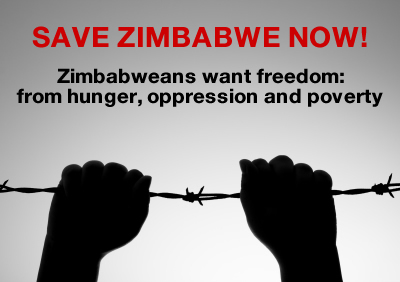
The world dithers, and Zimbabwe continues to be killed. Zimbabweans keep crossing the borders out. But who crosses in? Recently, people have started to question the sanctity of those borders, the logic of outflow. In the past week, with the launch of Save Zimbabwe Now, something new emerged. Save Zimbabwe Now has called on people of conscience to engage in a personal collective action, fasting and monitoring. Yesterday, Nomboniso Gasa of the South African Commission for Gender Equality and a member of Save Zimbabwe Now, put governments on notice that people of conscience, people who want Zimbabwe to be free today from hunger, oppression and poverty, would be monitors. The test for competency to become a monitor is trust. Not a blue helmet worn nor a civil service exam passed: “by sheer silence… they condone what is happening – so what basis do we have to trust them!” Trust.

As Graca Machel said at the launch of the Save Zimbabwe Now campaign, Zimbabwe is a lesson. Even when the schools are closed. Yvonne Vera knew this, the lesson that is Zimbabwe. Her last novel, The Stone Virgins, ends on a double note of education. On one hand, there’s Nonceba, who is remarkably educated: “there are not many people with a good high school certificate in the city. She has an advantage. Education for everyone is being constantly interrupted by the war. Schools close down. They remain closed. Especially, the mission schools located in rural areas. Nonceba has an astounding capacity for joy.”

And there’s her partner, Cephas: “His task is to learn to recreate the manner in which the tenderest branches bend, meet, and dry, the way grass folds smoothly over this frame and weaves a nest, the way it protects the cool livable place within; deliverance.”

The schools must be opened today, the hospitals and clinics as well. People must have access to their own and their shared capacity for joy. At the same time, the cool livable place within must be learned. The borders must be opened so that exile is not confused for deliverance. Save Zimbabwe now, not from itself but rather from those who are murdering it.


(Image Credit: Save Zimbabwe Now Campaign / Twitter.com)


Bordering on peace: Mexico and the United States

How is the border story told? Let’s look at Ciudad Juárez as an example. Reporters Without Borders and the Centre for Journalism and Public Ethics (CEPET) released a report this week that “points out that the deployment of many federal personnel – civilian and military – to this major drug-trafficking stronghold has not made the city any safer and has even exacerbated the violence.” The deployment of federal personnel exacerbates violence. Gaza, meet Ciudad Juárez.

But El Paso, just across the river, is safe. Why? For some, it’s the new immigrants, “who tend to be cautious, law-abiding and respectful of authority”, as well as Fort Bliss and a heavy police presence. Why does military and civilian presence in El Paso reduce violent crime, but increase it in Ciudad Juárez ?

A recent New York Times article ends with Marisela Granados de Molinar, who “was an office manager at the Mexican attorney general’s office in Juárez, but lived for decades in El Paso with her husband, Jose A. Molinar Jr.”. For decades, she crossed the border. In December, giving her boss a lift to El Paso, her car was riddled with bullets. Her boss “wanted to visit Wal-Mart.” Her husband reflected, “She was never afraid. She thought she wasn’t important enough for them to care about.” Not important enough to kill.

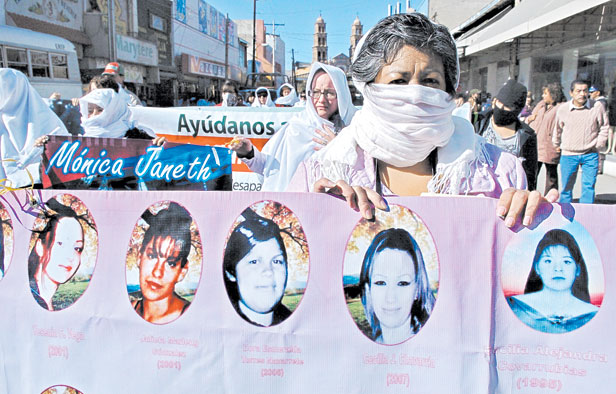
This is an old story, the story of murdered women not important enough to kill. Ask the mothers of the disappeared of Ciudad Juárez. They’ll tell you, it’s an old story: “On the same day Barack Obama was inaugurated as the first African-American president in U.S. history, an old story was repeating itself in Ciudad Juárez, Mexico, across the river from El Paso, Tex. Staging a caravan through the violence-ridden city, a new group of mothers of disappeared young women brought public attention to the cases of daughters who have gone missing since January 2008. Holding a rally at the downtown cathedral, the mothers demanded their daughters be returned home alive. . . . All of the disappeared young women are teenagers who went to school or worked for a living, and most were headed to downtown Ciudad Juárez, the scene of numerous disappearances since the 1990s.…At least 29 new cases of women who have disappeared in Ciudad Juárez since January 2008 are pending… The latest rash of women’s disappearances coincides with violent upheavals in the criminal underworld, increased seizures of drug loads, changes in political administrations, and deployments by the Mexican army or federal police. Since 1995, several groups of relatives have thrust the issue of their missing daughters and sisters into the international spotlight. Mass protests, which reached their zenith in 2003-04, prompted the administration of former Mexican President Vicente Fox to create new government bureaucracies, including a special commission on violence against women in Ciudad Juárez and a special prosecutor’s office. Both agencies were widely criticized for failing to clear up numerous disappearances and femicides. Since Mexican President Felipe Calderon assumed power in December 2006, the two agencies have become virtually invisible. Meanwhile, murders of women officially reached all-time heights in Ciudad Juárez last year, when at least 86 women were slain; many homicides were connected to the narco war that claimed more than 1,600 lives overall. Women´s murders have continued into 2009.”

It is an old story, but it’s not the whole story. Scholars and activists have addressed the femicide of Ciudad Juárez as local and national, the old story which must be told, and also as transnational, the story of the border town under neoliberalism, of the Mexican border town under NAFTA. Laura Carlsen this week noted that NAFTA begat the Security and Prosperity Partnership which begat the Merida Initiative, or Plan Mexico, which militarizes, well, everything and everyone south of the Rio Grande. Plan Mexico claims to impede transnational criminal activity, which, of course, only flows south to north. And the south-to-north “contagion” justifies militarization of civilian zones: “the militarized approach to fighting organized crime, couched in terms of the counterterrorism model of the Bush administration, presents serious threats to civil liberties and human rights. In Mexico, this has already been clear particularly among four vulnerable groups: members of political opposition, women, indigenous peoples, and migrants”. All those murdered ones not important enough to kill. Women are women, and women are members of the opposition and indigenous peoples and migrants.

NAFTA reordered the borderlands, in particular for women. Many have written on this. From Shae Garwood’s “Working to Death: Gender, Labour, and Violence in Ciudad Juárez, Mexico” to Melissa W. Wright’s Disposable Women and other Myths of Global Capitalism to Kathleen A. Staudt’s Violence and Activism at the Border: Gender, Fear, and Everyday Life in Ciudad Juárez, the myth of the disposable women is fused to the reality of the indispensable women. The murders and disappearances of women was never “merely” individual or local. The Juárez femicide is part of the historical moment, the moment of NAFTA, of economic and political restructuring. Women responded with new organization and action. Women of the border town Ciudad Juárez know that militarizing the police brings more violence against women. Their state of terror comes from gangs, police, soldiers, partners, and employers. For Staudt, violence against women is the overarching problem at the border.

Violence against women is the border. Everything of the border must be understood in the context of violence against women. Irma Maruffo gets it: “Women do not enjoy the freedom of secure transit in the city, and this is a right and a responsibility of political authorities and the legal system.” The regime of state and the rule of law stand accused. The Mexico – U.S. border has been redrawn by NAFTA, by the State, the Law and the Market, that value `national security’ over women’s freedom. The inequalities of that border generate and gender violence. Open that border, and make freedom and peace, rather than security, a priority and goal.

(Photo Credit: Borderland Beat)

Bordering on peace: Gaza

In the continuing sunshine of the inauguration of Barack Hussein Obama, Susan R. Benda, a DC-based lawyer, reflects on the embracing impact on her own son, a pre-teen raised by a single mom: “The doors of his imagination have swung open, and his sense of his place in the world has changed.” Doors of imagination, perception, and possibility swung open this week, personal doors that had stood closed for generations, that had been closed for so long many had forgotten they existed, had forgotten they were doors at all, many had come to accept the doors as walls, solid, immutable, opaque. People learned to open doors again, people learned to pass through again, people learned to cross thresholds again.

Some doors still remain closed, however, and they are called borders. This series, “Bordering on peace,” will offer stories concerning women pushing against the closed door common sense of nation and nationalism. We begin with four: Gaza, Mexico/United States, Zimbabwe, India/Pakistan. You are invited to contribute your own.

For Rewa Zeinati, Gaza is a place where only the dead are allowed to dream of peace:

Heavy

(Gaza 2009, day 13)

A child’s head rests on the rubble
Body-less,
Hair plastered on her face, eyes closed,
Dreaming of peace that comes too late.

Peace that comes too late is defined by time. Time, in Gaza, has always been something different: “Time there does not take children from childhood to old age, but rather makes them men in their first confrontation with the enemy.” Peace comes too late because it has no passport, it has no papers, and so is blocked at the borders, the borders that only the Israelis manage, the borders that Israelis have controlled and sealed.

Time there makes children into men. And the women? Of course, women in Gaza have been devastated by the violence; the stories abound. But there’s another story, that of Palestinian women organizing as the rockets descend on their homes, as told by Islah Jad “Many women in Gaza have risked their lives to save the besieged ‘targeted’ groups in Gaza. Women, through their mass mobilization, managed to save many houses from being demolished by Israeli artillery. Women are mobilized to provide vital emergency services for women in Gaza, women are also active in the media and mass communication to make their voices heard against this war.” This war, like the ones before it, will end. But peace that comes too late will not be allowed across the borders, and the tunnels are being sealed.

[Tomorrow “Bordering on peace: the U.S. – Mexico border”]

(Photo Credit: AP)


The Republic of Chikurubi


What passes today for good news from the government of Zimbabwe? The 100-trillion dollar note? No. The rate of deaths from cholera exceeding the rate of inflation, having topped 2000? Not even close.  “The twisted arithmetic of crumbling Zimbabwe” that makes burials out of reach of ordinary peoples’ economies? Nope. Give up?

Good news in Zimbabwe is the release of two-year old bandit terrorist Nigel Mutemagawo, abducted, held in custody for 76 days, held at Chikurubi Maximum Security Prison for close to two weeks: “Medical reports show that during his abduction and continued detention for charges of banditry and terrorism, two year-old Nigel was assaulted and denied food and medical attention by his captors.” Two years old. Talk about early childhood education. Not to worry, though. The news isn’t all good. Nigel’s parents, Violet Mupfuranhehwe and Collen Mutemagawo, remain `in custody’, and Nigel was sent to MDC officials, “who are total strangers.” Zimbabwe has figured out both the national security issue and child care. Democratic socialists, take note.

Jestina Mukoko appeared in court Thursday, January 15: “Jestina Mukoko, a well-known human rights campaigner in Zimbabwe, was forced to kneel on gravel for hours and was beaten on the soles of her feet with rubber truncheons during interrogations, she said in a sworn statement recently submitted to a court in Zimbabwe.” Not to fear, the rule of law still presides in Zimbabwe: “Zimbabwe’s director of prosecutions, Florence Ziyambi, said Thursday that Mukoko’s rights were not violated by her detention.`She can ask for remedies and compensation for the ill treatment she claims she went through,’ Ziyambi said.” In 100-trillion dollar notes, no doubt.  It’s a good thing that Zimbabwe’s Attorney General had already declared Mukoko a national and societal threat and had said that she would stay in jail, no matter what the courts decide.

While the Big Parties do and don’t negotiate, people, ordinary extraordinary, are changed, perhaps forever. Beatrice Mtetwa said of Jestina Mukoko, after her two court appearances on Thursday: “It’s like she’s no longer the same person they took away.” She is no longer the same person they took away.

Where was Jestina Mukoko taken? Where was Violet Mupfuranhehwe taken?  “All the female detainees, including the former ZBC broadcaster, are being held in solitary confinement in the male section of the notorious Chikurubi Maximum Security Prison – an area of the prison reserved for only the hardest of criminals.” Perhaps this is the government’s plan, to change the name and substance of the country from Zimbabwe to Chikurubi: worthless money, rampant disease, collapsed infrastructure, feuding gangs committed to interminable conflict. Sounds right.

What if every country were renamed according to its most notorious prison? The Republic of Zimbabwe could become the Republic of Chikurubi. The United States of America could become the United States of Guantanamo. The Republic of Turkey could become the Republic of Imrali. The Republic of Indonesia could become the Republic of Nusakambangan. The Commonwealth of Australia could become the Commonwealth of Christmas Island. The possibilities of translation are endless. They form a chain, an archipelago, around the globe. Where were Jestina Mukoko and Violet Mupfuranhehwe taken? The Republic of Chikurubi. Where did they go? That remains to be seen.

(Photo Credit: Reuters / Philimon Bulawayo)

“Mugabe’s wife raids bank vaults”: who built the vaults?

The headline reads: “Mugabe’s wife raids bank vaults”. Remember Brecht’s poem about the worker who reads history, which ask, “Young Alexander conquered India. He alone?” She alone?

Grace goes shopping, Bob goes for `reflection.’ What does he see when he looks in the mirror? Who does he see? Does he see the starving, the dying, the tortured? Does he see Jestina Mukoko? Reporters Sans Frontieres do. They wrote yesterday to “Tomaz Salamao, the executive secretary of the Southern African Development Community (SADC), urging his regional organisation to put pressure on President Robert Mugabe’s government to release journalist and human rights activist Jestina Mukoko as soon as possible. As soon as possible is always too late. Ask the citizens and residents of Gaza. Ask the citizens and residents of Zimbabwe.

The Times today posted a Civicus video made largely in Zimbabwe over the Christmas holiday. It’s called `Inside Zimbabwe’. Not a single woman is interviewed. They must have all been in Malaysia shopping. But it does have some great lines: “South Africa is acting like a condom to Robert Mugabe.”

Who built the bank vaults? Not Grace, not Bob, not the South African government nor the South African corporations, not SADC. Cooks, domestic workers, farmworkers, and others. As soon as possible is always too late.

 (Photo Credit: Civicus)

Everyone is astounded: Chadian women making freedom

Africa may face centuries of poverty. Social Watch has developed a basic capabilities index  that shows that economic growth does not necessarily produce drops in poverty levels. In fact, “the basic needs required to escape poverty persists; even more, it is increasing, in spite of impressive economic growth in most developing countries.”  Meanwhile, according to the Social Gender Equity Index, “More than half the women in the world live in countries that have made no progress in gender equity in recent years.” And this has nothing to do with lack of resources. It’s about decisions that governments, that people in government, mostly men, make … freely.

Everyone is `astounded’: “Reed Brody, a campaigner with Human Rights Watch, said it was `astounding’ that 60 percent of the world’s countries have made no progress in recent years in expanding female access to education. He called for increased investment in the realisation of basic entitlements as part of a `human rights stimulus package. When you free women from the discrimination and poor health that they face in their daily lives, you unleash the powers of half of humanity to contribute to economic growth,’ he said ‘.” `Free women’ to become productive laborers; `free women’ to sell their free labor freely? At the heart of the human rights version of women in the world is precisely this liberal bourgeois capitalist model: the problem with women is women aren’t free laborers.

As long as freedom is viewed as an economic term, as long as freedom is `justified’ because it produces and reproduces `economic growth’, there will be no freedom. But don’t worry. Global warming will lead to a perpetual food crisis. In the by and by of the perpetual food crisis, we will all be free to starve. According to climate researcher David Battisti, “This is going to unfold in the next 100 years.” So, the developing world need not worry about basic this and gender that. Time is no longer of the essence, time has become the substance.

Where is all this food not going? According to Mike Davis, to urban slums in the global neoliberal metropole. For Davis, the failed state is more often than not a failed city, and the role of empire is to figure out what do about the failures: “The most interesting thing happening right now is the joint efforts of the US and Brazil in Port-au-Prince, Haiti. I would argue that the US sees that effort as a possibility to test and develop strategies to stabilise cities by means of security measures, city planning and social efforts.” The militarization of social space is not new, and, as women have known for centuries, it emerges as much from boardrooms and bedrooms as it does from war rooms. There must be something more interesting.

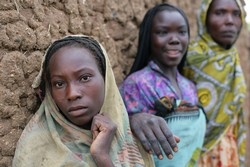
How about this: a hundred or so women in Chad, carrying knives and sticks and who knows what else, march through the streets, organize, take charge, do things. Cécile Moutouba. Larlem Marie. Others who chose to remain anonymous. Freedom.

Freedom, not because it’s economically viable, but because it’s freedom. The refusal to accept bare life, the refusal to accept extermination, the refusal to accept violence, the refusal to accept `the acceptable’, the refusal to accept failure. These hundred or so women in Chad are making freedom, and that production is as real as any goods production, as any economic growth that doesn’t pull women out of poverty or anything else.

(Photo Credit: Unicef/Giacomo Pirozzi)

Maids: bais, confiage, mujeres unidas y activas, pigavdrag, vårdnadsbidrag

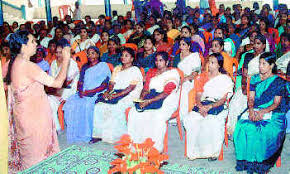
Mumbai’s bais, domestic workers, received a modicum of recognition when the state of Maharastra passed the Domestic Workers’ Welfare Board Bill at the end of December. Maharastra is the seventh state to pass a domestic workers’ bill. There are an estimated 500,000 domestic workers, mainly women, in Mumbai alone, and over a million across the state, according to government estimates. Domestic worker unions and associations, who have been lobbying for such a bill for twenty years, are supportive. Meanwhile, “State labour minister Nawab Malik, though, has termed this a “welfare measure”, adding that enforcement (punishment for violation) would not be considered at this stage.”  When it comes to domestic workers, the rule of law always translates them into recipients, or worse clients, of welfare.  The legislation emerged from women domestic workers’ decades long sustained campaigns.

There’s the rule of law and there’s the rule of household. Togo has confiage, or entrustment. Rural families send their daughters to live with urban relatives. The girls are supposed to get education, and in exchange they are to `perform’ domestic chores. Here’s what’s been documented: beatings, deprivation, rape. Guess what? The conditions of adult domestic workers, all women, is just as bad. In 2007 the Togolese government categorized domestic labor as one of the worst forms of labor. So, CARE International worked with a recruitment agency to help them improve their working conditions. Then the agency helped the domestic workers to organize a domestic workers’ union. Workers complain to the agency, and the agency places them in a different household. The offending household loses a domestic, for two seconds. No negotiations, no consultations, no strikes, no change in dominant order. No unions.

In the United States: “Employed mostly in private homes, domestic workers experience levels of exploitation and physical abuse rarely seen elsewhere. Mostly women and of color, they face those conditions without the protection of collective bargaining or other union tactics. As nannies, caregivers for the elderly, and housekeepers, they have remained almost invisible, their lives often akin to modern-day slavery. An estimated 1.5 million (U.S. Census Bureau) face these conditions.” As in Togo, as in India, domestic workers, mostly women, are organizing. In the U.S., the National Domestic Workers Alliance, the National Domestic Workers Congress, a myriad of local and regional organizations are women pulling women together. Mujeres unidas y activas.

In India, Togo, the United States, in recent decades, domestic labor has become a key of neoliberal economic `development.’ In Sweden, the neoliberal assault on women involved pigavdrag, maid deductions, and vårdnadsbidrag, care support. The state subsidizes private, individual childcare. Who suffers? Working class and low income women. What is under assault? Feminist political economy: “Vårdnadsbidraget delivers the final blow meant to send women back into the household. After the long struggle to free women from their homes, women are now offered 3000 Swedish crowns (ca 320 ) per month to stay at home with their children. This is obviously not an offer aimed at single mothers: it is impossible to survive on this sum in Sweden. Those lucky women who have a real man who brings home a big salary, however, can contentedly stay at home and accept the pocket money. And so women are again made financially dependent on men. The pigavdrag and the vårdnadsbidrag are both solutions only for the upper classes, who don’t want to pay the real price for a maid or send their children to a kindergarten. They represent the government’s mobilization of several types of oppression, which they have the guts to call a new `gender equality politics’.”

When it comes to domestic workers, the State translates labor law into welfare or goes on the attack. In India, Togo, the United States, Sweden, and everywhere else, women domestic workers are organizing their own structures.

(Photo Credit: The Hindu)

Root Shock, 2009

Two novel and not so novel forms of urban renewal in the new and renewed year.

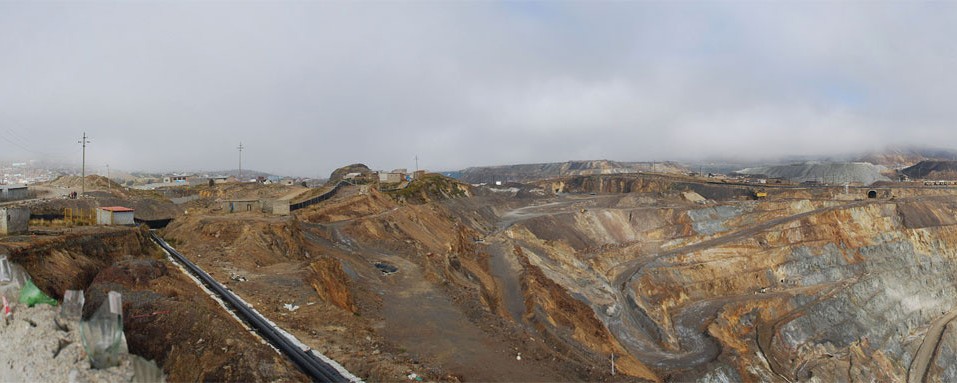
One: Have a pit mine gobble up your city.  Along the way, try to make sure that 82% of women of childbearing age (what is that anyway?) have high levels of toxic substances in their blood. That’s what happening in Cerro de Pasco, in the central highlands of Peru. Right to the city? More like dart to the heart of the city. Not to worry, though, the McMansion trend — buy a house, tear it down, build a monster, piss on your neighbors — is slowing down.

Two:  Try a few weeks, maybe more, of aerial bombing attacks followed by ground invasion. That’ll clear out that seedy city center you’ve wanted to redevelop for so long. In Gaza, Filipinas, mostly married to Palestinian residents, refuse to leave and decide to stay. Both. GMA News describes this as “`love’”. Their quotation marks. I won’t get into that, but it is interesting that they also feel compelled to note that only one of the Filipinas is an overseas Filipina worker. So? Do domestic workers not establish roots, merely because they `only’ stay for five or ten or twenty or fifty years? Really? Anyway, a reminder, as if you needed it, that Gaza is like everywhere else: local and transnational. And that like everywhere else, women make important, and diverse, decisions and take action.

Mindy Fullilove, in Root Shock: How Tearing Up City Neighborhoods Hurts America, and What We Can Do About It, describes the racial politics of `blight’ and `urban renewal’ legislation and policy in the United States. Welcome to Cerro de Pasco, where women’s blood is being poisoned, welcome to Gaza City, where, given an opportunity, women under attack decide to stay and refuse to leave. Welcome to urban renewal, January 2009.

(Photo Credit: Vice/Arthur Holland Michel)

Zimbabwe: what else can we say?

Jestina Mukoko

Nigel Mutamagau, a two year old, abducted with his parents and now in jail, has been beaten and has not received medical attention. Jestina Mukoko, director of the Zimbabwe Peace Project, was abducted, is now in jail, and reports suggest that, along with torture, she may be suffering poisoning.

Welcome to Zimbabwe, where the rule of law means once you’ve been abducted and disappeared for a while, you’re meant to be grateful if you show up in jail and then in court. Where’s the gratitude, where’s that thank you note to the government, to ZANU-PF? Last week, in “Fighting for Jestina Mukoko,” an interview with Elinor Sisulu and Barbara Nyangairi of the ZPP, Mukoko was described as a role model because she would speak publically in a place where none do, a zone of collective social self abandonment, Zimbabwe: “”The day before she was abducted she spoke about women and police violence, in an address to the women’s coalition in Mount Pleasant.” When her lawyer, Beatrice Mtetwa, of Zimbabwe Lawyers for Human Rights, finally saw Mukoko, she reported: “We saw Jestina. Of course someone who has been tortured cannot look good. She was seen by a doctor who is working in cahoots with her torturers, they [usually] want to make sure [the effects of] her torture [are] not too visible.” That was last Sunday.

Jestina Mukoko is still in jail; Beatrice Mtetwa still represents her and still speaks out. Mukoko was kidnapped on December 3, was disappeared for three weeks and then `magically’ appeared in court on December 24. Mtetwa filed motions to know who her abductors were, to dismiss any information obtained under `duress’, aka torture, and to be allowed to go to hospital for treatment. Friday, January 2, all motions were denied: “`The law has absolutely broken down in Zimbabwe,’ Mtetwa told journalists outside the court. `If a High Court can refuse to investigate an admitted kidnapping, refuses a patient a right to medical treatment — to a place she can get treatment — what else can we say?’”

What else can we say?

At the very least, we can speak, shout, sing their names: Nigel Mutamagau, Jestina Mukoko, Barbara Nyangairi, Beatrice Mtetwa, Elinor Sisulu. We can try to find the names of others who have been abducted but for the moment remain disappeared, and we can invoke the names of those `whose bodies have been identified.’ Let these names engulf and erase the names of the murderers who run Zimbabwe, the names of the murderers of adjacent countries who support the murderers who run Zimbabwe, the names of the murderers of distant countries who have supported the murderers who run Zimbabwe.

(Photo Creidt: Frontline Defenders)