Dan Moshenberg

Dan Moshenberg is an organizer educator who has worked with various social movements in the United States and South Africa.

Ultimate responsibility for the ordinary

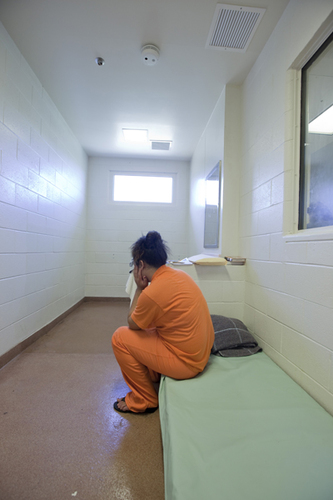
On May 22, 2009, a fire broke out in the Armadale Juvenile Correctional Centre, in Alexandria, St. Ann Parish, Jamaica. Seven girls were burned to death. Five died the night of the fire: Ann-Marie Samuels, Nerrissa King, and Rachael King, all 16 years old; and Kaychell Nelson and Shauna-Lee Kerr, both 15. Later, two more died from the fire: Georgina Saunders, 16, Stephanie Smith, 17.

There were 23 girls in a small space. Sixteen managed to crawl through the fire, to the narrow windows, and out.

Armadale was shut down. An inquiry was launched. The Armadale Enquiry Commission met for over nine months. Its report roundly condemns the government. The fire was set by a spark from a tear gas canister, tossed in the room by a guard. The straw bedding ignited.

On March 2, 2010, Prime Minister Bruce Golding reported to Parliament. The Jamaican press reports that the government “accepts `ultimate responsibility’ for Armadale.” Advocates on all sides debate the government response.

In his remarks, the Prime Minister, not surprisingly, frames the story as tragedy. He opens with tragedy: “The report of the Commission of Enquiry into the tragedy that occurred at the Armadale Juvenile Correctional Centre on May 22, 2009 is being tabled in the House today.”

He closes with tragedy: “The awful tragedy that occurred at Armadale should not have been allowed to happen. We must ensure that no such tragedy ever again occurs. Some wards of our juvenile correctional institutions have turned out to be exceptionally good and successful adults. We must strive to ensure that they are not the exception but become the norm.”

He articulates `ultimate responsibility’ as a function of tragedy: “While public officers must be held accountable for the discharge of their duties, the government must accept ultimate responsibility for the circumstances that led to the Armadale tragedy and for the inadequate facilities provided to care for children who are placed in juvenile correctional or remand facilities. Resource constraints do impose a heavy burden on public officers who work in these facilities but it cannot explain or excuse negligence or inertia.”

What exactly is the tragedy here, and how is ultimate responsibility to be understood?

Almost one hundred years ago, there was another fire, women killed, tragedy invoked.

March 25, 1911: “Near closing time on Saturday afternoon, March 25, 1911, a fire broke out on the top floors of the Asch Building in the Triangle Waist Company. Within minutes, the quiet spring afternoon erupted into madness, a terrifying moment in time, disrupting forever the lives of young workers. By the time the fire was over, 146 of the 500 employees had died. The survivors were left to live and relive those agonizing moments. The victims and their families, the people passing by who witnessed the desperate leaps from ninth floor windows, and the City of New York would never be the same.”

What happened that Saturday, in New York City? When the fire struck, the workers, almost all women, almost all recent immigrants, ran to the fire exits and found them locked, rushed to the windows only to find that the ladders and the water hoses didn’t reach that high. The young women then decided … to die by the flame or to leap and die in the fall. Who had decided to build such tall buildings? Who had decided to lock the doors?

“The Triangle fire had been replayed as tragedy, as destiny, as horror story, as political catalyst. Now it would be examined once more, as a question of justice: Was it right to hold anyone personally responsible? And if it was right, was it possible?”

There is no distance in time or miles between the 1911 Triangle Waist Factory, New York, fire, and the 2009 Armadale Juvenile Correctional Centre, St Ann Parish, one. What, then, is the tragedy; is it possible to hold anyone responsible?

If women are locked in, sooner or later the fires will kill them. If women are forced into overcrowded spaces, sooner or later the fires will kill them. How can planned death be accidental? How can a horrible event that is not destined but rather designed by human beings and perfectly obvious in its detail, how exactly can that event be called a tragedy?

The nobility of the tragic that was so quickly, so easily painted across the face of these two events is a means of obscuring their ordinariness. And it is the ordinariness of the deaths at Armadale and at Triangle that haunts. These are stories of the ways in which death sentences are imposed on women workers, on women prisoners, on women.

Someone was meant to die at Armadale, and that someone was meant to be a young woman, a girl. Which girl, how many girls, remained open. But someone was meant to die there, in a fire. And someone did. And she was a young woman, a girl. And absolutely no one can claim ultimate responsibility for that until they have transformed the everyday world of ordinary women and girls in which women are the fastest growing prison population, and women are the majority of sweatshop workers.


(Photo Credit: Armadale: Children on Fire // UNICEF Jamaica / YouTube)
 

Sister, I’m not dying, they’re trying to kill me

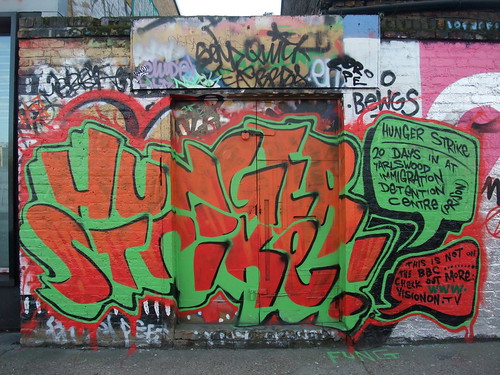
Hunger strike! London graffiti, Sclater st

On December 28, 1977, Liliana Fontana gave birth to a boy. At the time Liliana and her partner Pedro Sandoval were prisoners in the torture center known as the Athletic Club. This was Buenos Aires during the Dirty Wars. Liliana and Pedro were deemed subversives, and so, at birth, the infant was turned over to the military, and Liliana Fontana and Pedro Sandoval disappeared: “Delia Barrera, held for 92 days, remembered the young couple….Two clear recollections haunt her — how Fontana and Sandoval quietly sang love songs to each other and how on Nov. 4, 1977, the day Barrera was transferred from the center, Fontana hugged her goodbye. `She gave me a kiss, and I could feel her pregnancy,’ Barrera said.” This story was reported two weeks ago. Since then, I have been thinking of Liliana Fontana giving birth, surrounded by torturers. Followed by decades of silence, her screams fill the air.

I have thought of Liliana Fontana while reading about the women prisoners on hunger strike in Yarl’s Wood Immigration Removal Centre, outside Bedford, in the east of England.

In 2003, the British government created something called the Detained Fast Track Asylum System. Here’s how the UK Border Agency, UKBA, describes the system: “Our objective is to fast-track asylum decisions, remove those whose claims fail and integrate those who need our protection. We have succeeded in closing the gap between the number of failed asylum applicants and the number removed. The Government has dramatically cut asylum claims since their peak in 2002. There were fewer claims for asylum in 2006 than in any year since 1993. In the fourth quarter of 2006, 3,665 principal applicants were removed from the country. We have successfully met the Prime Minister’s ‘tipping the balance’ target for the whole of 2006, by 3% (450 people), breaking records for the number of failed asylum seekers successfully removed. In 2007 we introduced a new process for reviewing and deciding asylum cases and we are on target to conclude 40% of cases within six months of receiving the application. By 2011 we aim to complete 90% of cases within six months.” According to the government, the program is a model of efficiency.

According to women asylum seekers, and the children who accompany them, the truth lies elsewhere. In the silence and the screams of a place in which their deaths would count for nothing. That place is Yarl’s Wood.

Here’s how DFT works. A woman applies for asylum. In two or three days, her claim is decided. In 2008, 96 percent of claims were refused first time out. Then, the woman has two days to appeal. The appeal has to be heard within 11 days. Once the woman has applied and failed, while she is `appealing’, she stays in detention at Yarl’s Wood. In 2008 91% of the appeals were refused.

It’s a lousy system for everyone, but for women, it’s loaded and lethal. Women’s cases are often more complex because so many of them involve sexual violence and because many involve family members and partners. If an English woman is raped, the courts understand that the trauma of rape creates feelings that inhibit women from going straight to the police. A woman seeking asylum, however, is expected to reveal all, instantly, to strangers. Delay in revelation is read as duplicity. It’s the logic of the fast-track efficiencies.

Here’s what happens at Yarl’s Wood: “Once in the DFT procedure, women are on a fast-moving treadmill with structural features inhibiting or even preventing them from making their cases effectively. When women arrive at Yarl’s Wood, they will often have their asylum interview the next day. Most only have an opportunity to consult their duty solicitor in a short conversation over the phone. There is little opportunity to build trust, and women, especially in cases involving rape or abuse, may only reveal relevant information late in the process, or not at all. There is limited opportunity to access expert evidence, such as medical reports. The UKBA officer who conducts the asylum interview, known as the case owner, decides whether or not asylum should be granted.”

Since May 2005, over 2000 women have been detained. They have been subjected to programs of efficiency at least twice over. First, there’s the DFT itself. Then, Yarl’s Wood is run by Serco plc. Serco is quite proud of its work at Yarl’s Wood. They “are committed to developing the centre into a recognised centre of excellence for detaining females and families in a safe and secure environment.”

The women prisoners don’t see it that way. Women currently on hunger strike at Yarl’s Wood include: Denise McNeil, 35 year old Jamaican asylum seeker; Mojirola Daniels, Nigerian asylum seeker; Leila, Iranian asylum seeker; Victoria Odeleye, 32 year old Nigerian asylum seeker. They report torture, rape, starvation, other forms of abuse. They talk of the devastating impact of Yarl’s Wood on imprisoned children, such as 10-year-old Egyptian Nardin Mansour. They mourn and protest the suicides as they explain that Yarl’s Wood is intent on killing them. As Laura A, a Sierra Leonean and former Yarl’s Wood prisoner, noted: “I am a fighter, I am used to fight to live, but to be told, ‘You faked your life,’ is a little like death.”

The Yarl’s Wood women hunger strikers have taken the calculus of the killing and turned it on its head, have said they are better than that, they are women, fighters used to fighting, peacemakers used to making peace, and no one decides that it is right for them to be slaughtered. From the Dirty Wars to today’s Efficiency Wars, women prisoners call out, shout, scream. Will the response this time, again, be decades of silence?

(Photo Credit: Mermaid99, Flickr.com)

Haiti, “mes cousins jamais nés 
hantent les nuits de Duvalier”

Nadia François

Tragic haunting has moved recently to the center of the world stage. Tragic haunting is the haunting of singular, incomprehensible, inexpressible moments, and Haiti is the epicenter of the tragic haunting.

There are the images. Michael Mullady is a 26-year-old photographer, currently in Haiti. He’s been trying to photograph the conditions on the ground: “What I’ve witnessed will be sure to haunt me.” The tragic haunting of the witnesses is in the certainty of the ineffable trace the experience leaves on the soul and on the eye. Part of the tragic haunting is also the recognition that witnessing is a luxury. Haitian women and men don’t have time to witness. They gather. People like Nadia François from Delmas 75, in Port-au-Prince, spend the whole day and much of the night gathering and distributing for the community. Everywhere Haitian survivors are taking very good care of one another and of themselves. Hope rises from the ashes of the fires women make to cook, to clean, to purify. When the quake struck, what articles did the women take? They took pots and buckets. They knew. The work of sustaining leaves little time for witness. That time will come, but not now.

This tragic haunting, though singular, is not the first for Haiti. In November 2007, the Montreal-based band Arcade Fire announced its affiliation and with support for Partners in Health and its Haitian sister organization, Zanmi Lasante. In performance, word, song, and deed, they raised money and support for Zanmi Lasante and raised awareness about the ongoing devastation of Haiti by multinationals, by foreign forces, and especially by the United States. Their song “Haiti’ captures a bit of that:

“Haiti

Haïti, mon pays,
wounded mother I’ll never see.
Ma famille set me free.
Throw my ashes into the sea.

Mes cousins jamais nés
hantent les nuits de Duvalier.
Rien n’arrete nos esprits.
Guns can’t kill what soldiers can’t see.

In the forest we lie hiding,
unmarked graves where flowers grow.
Hear the soldiers angry yelling,
in the river we will go.

Tous les morts-nés forment une armée,
soon we will reclaim the earth.
All the tears and all the bodies
bring about our second birth.

Haïti, never free,
n’aie pas peur de sonner l’alarme.
Tes enfants sont partis,
In those days their blood was still warm”

My unborn cousins haunt the nights of Duvalier.

Edwidge Danticat’s Brother, I’m Dying tells the story of her father, her uncle, herself, her family, including Maxo, her cousin who died last month in the earthquake. Danticat’s Uncle Joseph and cousin Maxo were arrested and sent to Krome Detention Center, outside Miami. Krome: “a place that … all Haitians knew meant nothing less than humiliation and suffering and more often than not a long period of detention before deportation” Uncle Joseph died at Krome. Krome was a death sentence for a man of his age and ill health.

The penultimate chapter of Brother, I’m Dying is “Brother, I’ll See You Soon.” It is the book’s climax and the articulation of the tragic haunting. Uncle Joseph is buried in Queens, New York, not in Haiti. The chapter is framed by two mirror reflections of Haiti’s tragic haunting.

First, Uncle Joseph’s: “Uncle Joseph’s most haunting childhood memory, and the only one he ever described to me in detail, was one of the year 1933, when he was ten years old. The U.S. occupation of Haiti was nearing its final days. Fearing that he might at last be captured by the Americans to work in the labor camps formed to build bridges and roads, my granfather, Granpè Nozial, ordered him never to go down the mountain, away from Beauséjour. Uncle Joseph wasn’t even to accompany his mother, Granmè Lorvana, to the marketplace so that he might never lay eyes on occupying marines or they him. When he left home to fight, Granpè Nozial never told my uncle and his sisters, Tante Ino and Tante Tina, where he was going”

One day, Uncle Joseph had to go down the mountainside to the market. He came upon a group of six or seven white men in dark high boots kicking something on the ground. This is what the ten-year-old saw, what haunted him: “They kept kicking the thing on the ground as though it were a soccer ball, bouncing it to one another with the rounded tips of their boots. Taking small careful steps…, my uncle finally saw what it was: a man’s head. The head was full of black peppercorn hair. Blood was dripping out of the severed neck, forming dusty dark red bubbles in the dirt. Suddenly my uncle realized why Granpè Nozial and Granmè Lorvana wanted him to stay home. Then, as now, the world outside Beauséjour was treacherous indeed.”

The chapter ends with Danticat’s father’s tragic haunting: “My uncle was buried in a cemetery in Queens, New York. His grave sits by an open road, overlooking the streets of Cyprus Hills and the subway tracks above them. During his life, my uncle had clung to his home, determined not to be driven out. He had remained in Bel Air, in part because it was what he knew. But he had also hoped to do some good there. Now he would be exiled finally in death. He would become part of the soil of a country that had not wanted him. This haunted my father more than anything else.”

For Haitians, the tragic haunting is not new. It comes with US Marines and US immigration officers and Haitian dictators. Hope rises from the ashes, from the songs, from unmarked graves, from the memories, from the tears, the bodies, the warm blood. Meanwhile, in Miami, they’re moving prisoners out of Krome to prepare for the “potential influx of Haitian migrants”.


(Photo Credit: João Pina / Kameraphoto / New Yorker)

Haiti, like this woman’s song

Last Sunday, Canada’s Governor General Michaëlle Jean stood before a gathering in Calgary, broke into a song her mother used to sing to her, as a child in Haiti. She sang a song in Creole, and then, in English, said, “It’s a song of hope. Like this woman’s song, rose from the wreckage, that song that traveled over the airwaves to reach us. So I thought, even when we have nothing left, there’s always a song. There’s always music, words and then steps, to bring us back to life, to bring us together and to provide hope.”

You have to hear and see her sing to understand the power of the moment, to feel that moment in which she fuses her mother’s song, her mother’s daughter’s song, and the song of the woman rising from wreckage, songs that bind and songs that bring.

The past two weeks have been filled with many reports, many images, many words, many silences. Images of women emerging from the rubble, ghostlike with the chalk and dust covering their faces and bodies. Pictures of girls, panicked, traumatized, barely emerging from the rubble, from les décombres, from the ruins. The images, the stories, the words are haunting.

“For me the hardest part is the living. There have been so many dead here, corpses are so common both on the street and oozing out of the wreckage, that it’s the living who haunt me.”

But what is the quality of the haunting?

Edwidge Danticat’s cousin Maxo died in the earthquake, died as well because the United States refused his asylum appeal.

“When Maxo was a teen-ager, his favorite author was Jean Genet. He read and reread `Les Nègres.’ These lines from the play now haunt me: `Your song was very beautiful, and your sadness does me honor. I’m going to start life in a new world. If I ever return, I’ll tell you what it’s like there. Great black country, I bid thee farewell.’”

Those with experience of Haiti know the intricate and intimate filaments of the tragedy, they know the names, which they must speak and share and weave into something new:

“When Robinson and I last toured Cite Soleil in March of 2009, a small girl approached me from out of nowhere, shoving a tiny piece of paper into my hand. Then she ran away. On that paper she had scribbled her name: Adline Verne. It took me some time to understand how powerful it was that she had no concrete expectations and had asked nothing of me. She merely wanted me to know, for future reference, that she existed. Because she opened her hand to extend to me this information, I feel obligated by journalistic responsibility to report it. In Haiti, there are millions of voiceless, nameless people like Adline. Maybe now their voices will be heard.”

The Haiti that haunts cannot be the Haiti of the living dead nor can it be the Haiti of rubble. It must be the Haiti of the living, including the living who have died. It could begin with a song sung by a woman conjuring the woman who was her mother singing that song to the girl she once was, a mother’s song that then forms a chorus with another song, a song sung by a woman emerging from the wreckage, refusing to become one with the wreckage, refusing to become rubble, rising and traveling and reaching, among others, us.


Protection: when the powerful offer protection, women know

The day after Obama won the Presidential election, The New York Times wrote that Obama won a decisive victory because “he saw what is wrong with this country: the utter failure of government to protect its citizens”. At the time, I wrote that protection was the wrong goal, that from India to Haiti to Zimbabwe to the Democratic Republic of Congo to Ciudad Juárez, and the Mexico-US borderlands more generally, the powerful offer protection to those they call citizens, and ignore women’s demands for democratic, full and mutual engagement, for the right and capacity to dream and love in public as well as in private. The powerful offer protection as a means to ignore women.

That was November 2009. It’s January 2010, time to consider, again, protection. Not the protection that follows mass devastation, such as in Haiti. Nor the protection that follows extreme violence, as with the massacre near Jos, Nigeria. Nor the protection of legislative and other forms of hate campaigns, as in the current anti-gay Bill in Uganda, where we are all being protected from the threat and scourge of same-sex love and sexuality.

Instead, consider two linked national – global moments in which the powerful few claim to offer the gift of protection to the citizens of the nation.

The World Cup is coming to South Africa. Across the country, “the question of how to deal with sex workers grows louder”. What exactly is the problem, the to-deal-with, with sex workers? Because sex work is illegal, the issues of health and safety for both clientele and workers remain insoluble, and the rights and well being of the sex workers remain distant: “Sex work is illegal in South Africa. Cape Town-based Sex Worker Education and Advocacy Taskforce (SWEAT), has been campaigning to decriminalize sex work for the past 12 years, said spokeswoman Vivienne Lalu. 

Rights activists say legalizing sex work would protect the workers and their clients from HIV and abuse; there are moves afoot to review the Sexual Offences Act. But, Lalu says, `We are still some years away.’”

Legalizing sex work would protect the workers, not because the law, given by the powerful, would afford protection, but because the entire issue would move from the realm of sexuality to that of workers. Once sex work in South Africa, as anywhere, is legalized, sex workers can unionize, can create their own formal, autonomous, sanctioned spaces, alliances, affiliations. Workers, and especially women workers, don’t seek protection. They demand the right to association. They demand respect for the dignity of their individual and collective labor. That is the reason that the lead up to the World Cup in South Africa has been marked by so many protests. Across South Africa, the poors, largely women, have rejected the promise and offer of protection, in the form of forced removals for their own good, and instead have called for housing, public services, education, and health care.

The Olympics are coming to Canada, and so Canada, British Columbia in particular,  anticipates an increase in sexual assaults during the 2010 Olympics, and, of course, all the money has been spent on `security’. The buildings and international `visitors’ must be protected.

But British Columbia had enough money recently to outsource welfare-to-work to a company called WCG International HR Solution. WCG is a subsidiary of Providence Service Corporation, based in Tucson, Arizona. WCG billed the government for `no-shows’. This is business as usual. When you outsource `helping’, women and children are the first casualties. This is not new information. It’s been available to British Columbians since at least 2005, when Policies of Exclusion, Poverty & Health appeared, sharing stories of 21 women who did not seek protection but rather struggled and organized for change. Instead of change, they got the Olympics and the gift of protection: evictions, clinic closures, increased police presence.

When the promise of protection comes from the powerful, it is always fatal, first to women and children, then to everyone and every thing else. Women know the pitfalls of powerful protection. Women know, in their bodies, the economies of extraction, theft, exploitation and abuse. Change from below seeks material equality, space, time, and it begins and ends with women. Protection from the powerful is what it always has been, an insurance policy forced upon people by extortionists.


(Image Credit: http://sites.psu.edu/jld5710/2013/02/03/cartoons-are-a-powerful-medium/)

What is left: after solitary confinement in schools

Prison is a bad place for children. Solitary confinement is worse yet. Extended solitary confinement is lethal. These are not surprising statements, and the news that underwrites them, though dismaying, is not particularly shocking.

Immigration detention centers in the US, such as the Eloy Detention Center in Arizona, run by Corrections Corporation of America, or the Reeves County Detention Center, run by GEO, are lethal, fatal black holes for all residents. Joe Arpaio’s jail in Maricopa County is only the best known example of humiliation and terror against all Latinas and Latinos, irrespective of status, and which results in increased anxiety and mental health problems for Latina and Latino children.

And it is estimated that more than 60 of those held in Guantanamo were under 18 when they were arrested and sent to Cuba.

In England, Yarl’s Wood Immigration Removal Centre is so terrible for children that the entire nation is now considered unsafe for children of immigrant parents, including those seeking asylum and refuge. The place literally drives children mad.

Juvenile centers in the United States report that sexual abuse of prisoners, by other prisoners and, more, by staff, is off the charts. In 2008 – 2009, in more than a few juvenile detention centers, a recent study suggested that nearly one out of every three prisoners suffered some sort of sexual abuse.

When children go to prison, how are they educated? According to some, they’re not at all. California is being sued in a federal class action case for failing to educate youth in their `probation camps.’

These are terrible and tragic and all too familiar. Prison is a bad place, after all. Bad things happen.

Those bad things that happen to children are not restricted to prisons. Take “seclusion rooms”, for example: “Seclusion is the involuntary confinement of a student alone in a room or area from which the student is physically prevented from leaving. This includes situations where a door is locked as well as where the door is blocked by other objects or held by staff.”

This happens in schools all over the United States.

In the state of Georgia, public schools have “seclusion rooms,” solitary confinement cells. The doors are double bolted on the outside: “Seclusion rooms are allowed in Georgia public schools provided they are big enough for children to lie down, have good visibility and have locks that spring open in case of an emergency such as a fire. In 2004, Jonathan King, 13, hanged himself in one such room, a stark, 8-foot-by-8-foot “timeout” room in a Gainesville public school.” Time out. When schools put children into solitary confinement, what time is left?

What is left for Jonathan King’s parents, so many years later? Pain, anguish. Only now is Georgia finally responding by considering a law that protects all students from seclusion and restraint. It only took the State legislature six years … equal to almost half of Jonathan King’s entire life.

In May 2009, the Missouri state legislature passed a law giving the school districts two years in which to devise written policies governing the use of seclusion rooms. Before that, there were no policies, only the practice of solitary confinement of school children without a single written guideline or rule. This is now an issue in the upcoming GOP primary for State Senate. One candidate sees restrictions on solitary confinement of children as a violation of local sovereignty.

Florida state legislators are also considering a bill to restrict the use of restraint and seclusion. There are seclusion rooms all over the state school system, from elementary on up. Up til now, there has been no written policy.

Not surprisingly, solitary confinement is of particular concern to parents of children living with disabilities. Here are two stories from Florida:

When a twelve year old girl with autism repeated names of movies, shoved papers off her desk or waved her arms and kicked her legs toward approaching teachers, they responded by grabbing the eighty pound girl, forcing her to the ground and holding her there. This happened forty-four times during the 2006-07 school year.  She was held once for an hour, and, on average, twenty-two minutes at a time.  At least one incident left her back badly bruised.

When a seven year old girl, diagnosed with autism and bipolar disorder had her head pushed to the floor, the parents discovered several other frequent inappropriate uses of restraint and seclusion. The county where they live leaves it to individual schools to write their own policies on restraint or seclusion use.

These come from a 2009 report issued by the National Disability Rights Network: School is not supposed to hurt: Investigative Report on Abusive Restraint and Seclusion in Schools.  The stories come from all over the United States.

On the cover is the picture of a lovely, smiling seven year-old girl, from Wisconsin:

A seven year old girl was suffocated and killed at a mental health day treatment facility when several adult staff pinned her to the floor in a prone restraint.  This child, who was diagnosed with an emotional disturbance and Attention Deficit Hyperactivity Disorder, died because she was blowing bubbles in her milk and did not follow the time-out rules regarding movement.

Greenfield School District, outside Milwaukee, Wisconsin, applied to use Federal stimulus funds to build seclusion rooms in elementary and middle schools. The Wisconsin Department of Public Instruction recently rejected the application, instructing all school districts in the state that stimulus funds and special education funds not be used for that purpose. Greenfield is disappointed.

School is not supposed to hurt. It’s not only the children sent to isolation who suffer. What are the other children in the classrooms, in the hallways, in the school offices, who witness these acts and know of these rooms as part of the norm, what are they being taught? What becomes of a generation of child witnesses to torture?


(Video Credit: Vimeo/StopHurtingKids.com)

What is left: solitary confinement

“After the bars and the gates
and the degradation,
What is left?”

Maria Benita Santamaria is a 35 year old transgender woman. In June 2009, she was arrested in northern Virginia and charged with possession of methamphetamine.  In August she pleaded guilty. She was sent to Central Virginia Regional Jail, a men’s prison. The prison placed her in solitary confinement, for “her own protection”. At the end of December, a U.S. District Judge ordered her removed to a federal prison with treatment facilities and counseling for transgender prisoners.  When the holiday seasons intruded, the judge had Santamaria placed in a medical wing until after the end of the festive season. After six months in solitary, what is left?

“After the lock ins and the lock outs
and the lock ups,
What is left?”

For the last two years, Santamaria has undergone hormone treatments in preparation for sex change surgery. That stopped in August. According to the prison staff, while in solitary, Santamaria was treated as a prisoner on punitive lockdown. She left her cell one hour a day, she showered three times a week.

“I mean, after the chains that get entangled
in the grey of one’s matter,
After the bars that get stuck
in the hears of men and women,

When the jail guards talked to or about Santamaria, they called her `it’. She considered suicide. She pleaded to be returned to the general population.

“After the tears and disappointments,
After the lonely isolation,
After the cut wrist and the heavy noose,
What is left?”

Maria Benita Santamaria said take me out of solitary confinement and put me in the general population, where I will most likely be raped. Maybe I’ll survive. It would be better than this.

“Like, after you know that god
can’t be trusted,
After you know that the shrink
is a pusher,
that the word is a whip
and the badge is a bullet,
What is left?”

Across the United States, prison guards call transgender prisoners `it’, and worse. Across the country and around the world, prisoners are placed in solitary confinement for long periods … “for their own protection”. After long terms in isolation, what is left?

“After you know that the dead
are still walking,
After you realize that silence
is talking,
that outside and inside
are just an illusion,
What is left?”

Virginia also operates four `facilities’ for women: Deerfield Work Center for Women; the Central Virginia Correctional Unit #13; the Virginia Correctional Center for Women; and Fluvanna Correctional Center for Women. In June 2008, the four prisons held about 2220 women, of which Fluvanna held 1200.

“I mean, like, where is the sun?
Where are her arms and
where are her kisses?
There are lip-prints on my pillow—
i am searching.
What is left?”

Fluvanna boasts a Pen Pals program, and prisoners can work for the Virginia Correctional Enterprises as optical Braille transcribers or as tailors. But there’s more to Fluvanna, much more.

“I mean, like, nothing is standstill
and nothing is abstract.
The wings of a butterfly
can’t take flight.
The foot on my neck is part
af a body.
The song that i sing is part
of an echo.
What is left?”

Reports have been coming out of Fluvanna that women who `appear to be lesbian’ (short hair, baggy clothes) have been segregated and put in a `butch wing’. A no-touching policy has been instituted. Women walk single file everywhere. Access to religious services has been curtailed. And this: “a woman writes that a mentally ill inmate was kept in solitary confinement for months. `When it’s time for her to take her shower, she is lead, shackled and naked, down the hall, with a dog leash attached to her shackles, by a male guard.’”

“I mean, like, love is specific.
Is my mind a machine gun?
Is my heart a hacksaw?
Can i make freedom real? Yeah!
What is left?”

In March 2009, Dr. Atul Gawande argued, “Public sentiment in America is the reason that solitary confinement has exploded in this country, even as other Western nations have taken steps to reduce it. This is the dark side of American exceptionalism. With little concern or demurral, we have consigned tens of thousands of our own citizens to conditions that horrified our highest court a century ago. Our willingness to discard these standards for American prisoners made it easy to discard the Geneva Conventions prohibiting similar treatment of foreign prisoners of war, to the detriment of America’s moral stature in the world. In much the same way that a previous generation of Americans countenanced legalized segregation, ours has countenanced legalized torture.”

“I am at the top and bottom
of a lower-archy.
I am an earth lover
from way back.
I am in love with
losers and laughter.
I am in love with
freedom and children.”

In 1974, Assata Shakur, a New Jersey prisoner, was one month pregnant. She was taken to Roosevelt Hospital, and shackled to a bed for 10 days. Then she was moved to Middlesex County Jail for Men, and kept in solitary confinement for four months. She was extradited to New York, to Rikers Island, where `the treatment’ continued.

On September 10, Assata Shakur went into labor, and, on September 11, gave birth to Kakuya Amala Olugbala Shakur. When Shakur returned to Rikers Island, she was shackled, beaten, put into solitary confinement for a month. Finally, she was released from `punitive segregation: “So I was no longer locked. Just in jail. And separated from my child.”

And she wrote the poem, “Leftovers – What Is Left”, for her daughter. Parts of that poem run through this reflection.

“Love is my sword
and truth is my compass.
What is left?”

What is left? Solitary confinement.

Solitary confinement is the vital organ of the body politic of prison. When you read that the death penalty might be dropped from the anti-gay bill in Uganda or that capital punishment may finally come to an end in the United States, remember this: solitary confinement is torture, and it defines prison.


(Photo Credit: Richard Ross/SolitaryWatch.com)

Uganda is … a jambula tree grows in Kampala


“Jambula Tree” is an award winning short story written by Ugandan writer Monica Arac de Nyeko. It won the 2007 Caine Prize for African Writing, the preeminent prize on the continent for short fiction.  Arac de Nyeko is the first and thus far the only Ugandan to have won the coveted prize. Arac de Nyeko is also a member of FEMRITE, the Ugandan Women Writers’ Association.

“Jambula Tree” tells the story of two adolescent girls, Anyango and Sangu, who, for a time at least, `prefer’ one another. When their love is discovered, Anyango is sent abroad to boarding school, Sangu stays behind and becomes a nurse who leads a solitary life. The story is a letter written, perhaps delivered, perhaps never sent, by Sangu to Anyango on her return.

Their love is a jambula tree: “It had grown so tall. The tree had been there forever with its unreachable fruit. They said it was there even before the estate houses were constructed. In April the tree carried small purple jambula fruit which tasted both sweet and tang and turned our tongues purple. Every April morning when the fruit started to fall, the ground became a blanket of purple.”

The jambula tree is a real tree with real fruit and real cycles, and it is also the possible, the dream of shared love that extends in time to before the constructed spaces of human society and perhaps will continue beyond the lifetime of those spaces. It is part of the world, part of the earth, part of the sky, part of our story.

And yet …

“According to the framers of the Bill, a girl who prefers a girl is more dangerous to the society than officials who robbed millions of dollars meant to treat aids, malaria and tuberculosis patients in 2004,” wrote Joachim Buwembo in The East African, earlier this week.

Joachim Buwembo is a journalist of some renown, who has lived, worked and written in East Africa for decades. Currently a Knight International Journalism Fellow, working in Tanzania to improve coverage of poverty and development issues in that country, Buwembo has Managing Editor of The Monitor; founder of the Tanzanian newspaper, The Citizen; Kampala Bureau Chief for The East African; and editor of The Sunday Vision. Before that, he was a high school teacher in Uganda and Kenya. He has dedicated his life has to education through critical journalism and national debate. Joachim Buwembo is, by all accounts, a knowledgeable man, an experienced man.

Yet, with all that experience and knowledge, until recently Joachim Buwembo had had no opinion – good, bad or indifferent – about gay men, lesbians or homosexuality and had no reason to have an opinion. But times have changed: “Today, a Ugandan cannot run away from giving an opinion about homosexuality, after the national parliament was petitioned in a formal motion to prescribe draconian measures including the death penalty for the act.”

In this week’s op-ed piece, “Why we cannot turn a deaf ear to Uganda’s homosexuality Bill”, Buwembo uses reason to take apart the will to kill that underwrites the Bahati Bill. He has two main points. First, any addition to a penal code presumes a crime that can be judged, based on evidence and knowledge. In Uganda, very few can judge gay men, lesbians or homosexuality because very few actually have sufficient information, and even fewer know what the actual crime is. Second, there are real criminals and scoundrels about, men and women who have massacred and who have plundered. They go free.

That is Buwembo’s argument. Some see the argument as a bit of sanity and calm in a season of national gay panic and anti-gay hysteria. Others hear and read his as a `dispassionate voice…amidst all the nonsensical hype.”

But Buwembo is also a storyteller. He tells two stories. The first is the story of a dialogue: “In my many years of existence, I first recognised a homosexual only three years ago. I say ‘recognised’ and not ‘identified’ because I only have her claim as ‘proof’.” Where do nuanced differences between recognition and identification sit in the pogrom that is being planned for gay, lesbian, transgender, bisexual and intersex Ugandans, and for their friends and loved ones? Who will adjudicate identity? Who will send Joachim Buwembo to prison for not reporting on a woman who claimed a lesbian identity as her own?

The second is the story of  two girls, the dangerous ones, the girl who prefers a girl, the girl who is preferred by a girl. I have been thinking of those two girls since I first read of the Bahati Bill and, even more, since I first read the Bill itself. For its target is the jambula tree, and all those who tell or read its stories.

The Bahati Bill violates human rights. At the same time, it attempts to silence the stories and murder the storytellers. Not the gay, nor the lesbian, nor the straight, not the this nor the that storyteller, but all storytellers. It means to stifle and kill creativity and creation itself. Who will send Joachim Buwembo and Monica Arac de Nyeko to prison, or to the gallows, for having written human stories of human spirit, love, and being?  Would we not rather taste of the purple fruit of the earth than swim, and drown, in the red blood of our sisters and brothers?


(Photo Credit: http://www.grizeldaholderness.co.uk)

Dennis Brutus died quietly in his sleep today

Dennis Brutus died quietly in his sleep today:

“Statement from the Brutus Family on the passing of Professor Dennis Brutus

“Professor Dennis Brutus died quietly in his sleep on the 26th December, earlier this morning. He is survived by his wife May, his sisters Helen and Dolly, eight children, nine grandchildren and four great-grandchildren in Hong Kong, England, the USA and Cape Town.

“Dennis lived his life as so many would wish to, in service to the causes of justice, peace, freedom and the protection of the planet. He remained positive about the future, believing that popular movements will achieve their aims.

“Dennis’ poetry, particularly of his prison experiences on Robben Island, has been taught in schools around the world. He was modest about his work, always trying to improve on his drafts.

“His creativity crossed into other areas of his life, he used poetry to mobilize, to inspire others to action, also to bring joy.

“We wish to thank all the doctors, nurses and staff who provided excellent care for Dennis in his final months, and to also thank St. Luke’s Hospice for their assistance.

“There will be a private cremation within a few days and arrangements for a thanks giving service will be made known in early January.”

(Thanks to Patrick Bond for circulating this.)

For many, young, old and anywhere in between, Dennis has been a presence, a gentle and insistent education into the beauty of the persistent struggle for social justice and into the need to remember that social justice emanates from and builds on love, laughter, beauty, understanding, sharing, humanity.

Dennis first came to the attention of many with his collection Letters to Martha & other Poems from a South African Prison. Here’s one of those poems, “Letter 18”, dated 20 December 1965. Hamba kahle dear greatly daring poet hamba kahle sala kahle.

“18

I remember rising one night
after midnight
and moving
through an impulse of loneliness
to try and find the stars.

And through the haze
the battens of fluorescents made
I saw pinpricks of white
I thought were stars.

Greatly daring
I thrust my arm through the bars
and easing the switch in the corridor
plunged my cell in darkness

I scampered to the window
and saw the splashes of light
where the stars flowered.

But through my delight
thudded the anxious boots
and a warning barked
from the machine gun post
on the catwalk.

And it is the brusque inquiry
and threat
that I remember of that night
rather than the stars.

20 December 1965”


(Image Credit: quba.co.za)

Brunt: somewhere between rights and reconciliation, women

Yesterday was 16 December 2009. In South Africa, it’s the Day of Reconciliation. President of the Republic of South Africa Jacob Zuma spoke, in Tshwane, about reconciliation. The President spoke at length about the military, about veterans and about serving members of the South African National Defence Force. Reconciliation.

Seven days earlier, 10 December, was Human Rights Day. President of the United States Barack Obama spoke in Oslo, Norway, as this year’s Nobel Peace Laureate. He spoke of just war. Peace.

Both presidents spoke of responsibility. For one, it was the responsibility of nation building, for the other the responsibility of peace. This was a week then that began with war as peace and ended with the military as agent of reconciliation.

Women know better. Women `bear the brunt’ of these speeches.

“Women often bear the brunt of poverty and human rights abuses; but as activists they use these roles to trigger positive social change”. Women bear the brunt of poverty because they are the target of discrimination, oppression, exploitation, violence. Here’s how Amnesty describes the world of women: “Over 70 per cent of the world’s poor are women. Women earn only 10 per cent of the world’s income but do two thirds of the world’s work. Three quarters of the world’s illiterate are women. Women produce up to 80 per cent of the food in developing countries but own only one per cent of the land.”

Treated as objects, women refuse to be abject. Around the world women are mobilizing, gathering, celebrating, organizing. Women like Ugandan human rights activists Jacqueline Kasha, Solome Kimbugwe Nakawesi, Sylvia Tamale, speaking out and organizing against the homophobic bill in Uganda’s parliament; or Val Kalende, an out lesbian in Uganda who has the courage to speak truth to power, and the truth is she simply wants to live a full and joyful life.

Women like Terra K, Joan S, Michelle M, pregnant women prisoners in the U.S. struggling for decent health care and for decency and dignity. Women like Nepalese widows Bhagwati Adhikari, Lily Thapa, Rekha Subedi, Nisha Swar, members of Women for Human Rights who reject the oppression of widows and of all women.

Women like Annise Parker, new mayor of Houston and first elected out gay mayor of a major U.S. city, or Elizabeth Simbiwa Sogbo-Tortu, campaigning to become the first paramount chieftain in the country.

Women like Zimbabwean activist Kuda Chitsike, women who dare to organize, women who dare to win.

These are a few women who were reported on during the week that began with a peace speech justifying war and ended with a reconciliation speech focusing on military well being.

We found out this week that, in KwaZulu Natal, urban women `bear the brunt’ of AIDS: “The face of HIV/AIDS in KwaZulu-Natal is a woman in her thirties living in eThekwini, according to a study released this week. Urban women in the province are far more likely to be HIV positive than their rural sisters, while over half (54%) of all pregnant women in their thirties were HIV positive….Despite levels of poverty being higher in the rural districts, social scientists believe that there is more social cohesion in rural communities that protects against women against HIV.…People living in informal settlements have the highest HIV prevalence.” How do you reconcile the urban and rural sisters? Call in the military?

We found out this week that, in Honduras, women `bear the brunt’ of human rights abuses at the hands of the coup regime, and the Obama regime is doing little to stop that: “Repercussions from this summer’s coup in Honduras are far from over….The brunt of …abuses is borne by the women….Women make up the majority of the vast resistance movement in Honduras, playing a critical leadership role in civil disobedience and citizen protection. For their tireless and courageous support of democracy, they have received death threats and been attacked with nail-studded police batons, tear gas, and bullets. Detained by police or military for hours and even days without charges or access to legal counsel, women have been deprived of medicine, food, and water. At least two cases have resulted in death. Lawless violence against women has pervaded Honduras since the coup.” When war is peace, violence against women is national security.

This is the logic of the brunt, of the sharp blow, the assault, the violence, the shock, the force. Women `bear the brunt’ because men understand peace and reconciliation as military engagements, from the bedroom to the boardroom and beyond. Women are meant to inhabit the space between hollow rights and empty reconciliation, And beyond? As one necessarily anonymous writer opined recently, looking at the current situation in Uganda, “You want gay rights? Get more women elected.” You want real peace, real reconciliation? Look to women’s organizing histories, stories, lives.

Today is 17 December. A new week begins.


Val Kalende