Dan Moshenberg

Dan Moshenberg is an organizer educator who has worked with various social movements in the United States and South Africa.

Prison labor haunts `history’

Elaine Brown

When is slavery not slavery? When the slaves are called prisoners, their condition is not slavery. It’s … history. The Thirteenth Amendment of the United States Constitution says so, and so do the United Kingdom Border Authority, UKBA, and the private prison corporation, Serco.

Last month, on December 9, 2010, prisoners in several prisons across Georgia went on strike.  According to Elaine Brown, one of the prisoners’ spokespersons, the strike involved “Augusta, Baldwin, Calhoun, Hancock, Hays, Macon, Rogers, Smith, Telfair, Valdosta and Ware state prisons.” Others claim seven prisons were involved. The strike concerned prisoners’ working and living conditions across the state. The conditions of prisoners in Georgia are famously bad. Prisoners in Georgia receive no pay for the work they perform. The possibility of going to jail in Georgia, especially for people of color, is infamously high. Georgia has the highest rate of prison `involvement’ in United States: “In Georgia, 1 in 13 adults is either in prison, in jail, on probation, or on parole.” The national average is 1 in 31.

The strike was non violent, peaceful even. The media focused on the capacity of prisoners to organize a structured, non spontaneous, non violent work stoppage across the state. This was facilitated by the use of contraband cell phones, bought largely from guards.

The strike was called `historic’, in two senses. On one hand, it was massive. Again according to Elaine Brown, the strike was “historic in scope and in the unity of thousands of black, brown, white, Muslim, Christian and Rastafarian prisoners.” Others claimed it was one of the largest prison strikes and the biggest prisoner strike in U.S. history. In terms of scale, of numbers of prisoners involved, of numbers of kinds of prisoners involved, the action was historic.

On the other hand, the strike was historic in that it protested the history of prison labor. Prison labor has historically been part of a racially, ethnically segregated labor market, “an emblem of racial subjugation.” Prison labor, especially in the United States, has its roots in slavery. Read the Constitution of the United States.

According to the Thirteenth Amendment to the United States Constitution: “Neither slavery nor involuntary servitude, except as a punishment for crime whereof the party shall have been duly convicted, shall exist within the United States, or any place subject to their jurisdiction.” For prisoners, slavery and involuntary servitude are constitutionally just fine. Where do slavery and justice sleep comfortably together? In prison.

And not only in the United States.

At Yarl’s Wood, in the United Kingdom, women refugees and asylum seekers are held in detention … for the crime of applying for asylum. This week, current and former prisoners, all women, revealed their working conditions and described them as modern day slavery.

Asylum seekers are not allowed to work while their application is in process. But not at Yarl’s Wood. There they work, for next to nothing. Gloria Sestus, a 32-year-old Nigerian, says she is paid £1 to clean the dining room twice a day. The job takes more than an hour each time. As former prisoner Nordia Hylton, 34-year-old Jamaican asylum seeker, noted, “People who work without papers to try and feed their families are arrested for illegally working and detained. But once they get to Yarl’s Wood they can work for next to nothing. The UKBA and Serco are hypocrites. They are taking advantage of people’s situation.”

Gloria Sestus sees it as more than hypocrisy, “It is like slavery in a modernised form.”

It is like slavery in a modernized form. African women, Afro Caribbean women, women of the African diaspora know a thing or two about the history of slavery. The prison strike across Georgia was historic. The prisoners’ testimonies and protests concerning Yarl’s Wood are historic as well. Both call on us to speak and address the historic name of prison labor: slavery.


(Photo Credit: hiphopandpolitics.com)


The human faces of asylum seekers haunt Australia

Two months ago, it was reported that Australia was preparing for an uptick of children in detention mutilating themselves. At the time, there were around 700 children. These children `in detention’ are imprisoned asylum seekers and migrant children, and children of asylum seekers and migrants.

Two months later, almost to the day, on Wednesday, December 15, a wooden fishing vessel carrying an untold number of asylum seekers and refugees, thought to be Iranian and Iraqi Kurds, crashed off the shores of Christmas Island. The residents watched in horror, the nation watched in horror.

The dead were fished out of the rough seas. The survivors were either sent to hospital in Perth or sent to detention centers on Christmas Island.

Prime Minister Gilliard called the event a `terrible human tragedy’. The event is now commonly referred to, in the news media, as `the asylum-seeker boat tragedy.’ The Prime Minister said the full death toll may never be known. She was more right than she knew.

This is not the first time Australia has confronted an asylum-seeker boat tragedy. In 2001, there was the infamous Children Overboard affair.

On October 7, 2001, a fishing boat, the Olong, was filled with asylum seekers and headed for Christmas Island when it was caught by the HMAS Adelaide, north of Christmas Island. Under orders from the government, the warship fired warning shots, boarded several times, and finally forced the boat to turn back. The boat was old, battered, and overloaded, with over 200 people on board. The engines failed. The Adelaide took the boat in tow, and waited for instructions from the government. Then the boat literally began to fall apart and sink. Parents held their children in the air, to alert the navy of their presence on board. There were 53 children on board the Olong. The then Prime Minister John Howard claimed the parents were throwing their children overboard. They were not. The evidence from the Australian Navy showed, immediately, they were not throwing their children overboard. But the claim was out there, in the air. Refugees and asylum seekers were somehow less than human.

This most recent asylum-seeker boat tragedy is said to have put a human face on the `asylum issue’. Here’s how Nick Clegg, of the BBC, describes the situation: “Australia’s asylum seeker debate is often conducted as if the people heading for its shores were an abstraction, with the term “boat people” almost shorn of its human meaning. With such harrowing images from Christmas Island broadcast on early evening news shows – which only 24 hours earlier had dwelt more happily on the visit to Sydney of Oprah Winfrey – millions of Australians would have seen the anguished faces of those seeking to reach its shores, and witnessed the lengths to which they would go to get there. Put simply, it was shockingly real….Whatever its outcome, after the tragedy on Christmas Island the debate has a human face.”

Others had a similar response: “In Australia, perhaps for the first time, the disaster gave the asylum-seeker issue a human face. Not even those who dismiss boat people as “queue-jumpers” could have failed to be moved by footage of men, women and children screaming for help as their vessel was dashed to bits.”

The asylum-seeker debate, or situation, now has a human face. Prime Minister Gilliard says there will be no repeat of the children overboard affair in dealing with the situation. She says as well that the full death count will never be known. In a nation in a world in which human beings must sew their lips together, must mutilate themselves, must perish in the rough seas in order to be endowed with a human face, where does one begin to measure the full extent of the death count? The human faces of asylum seekers – not the asylum seeker debate nor the asylum seeker situation – haunt Australia and the world.


(Photo Credit: Australia Human Rights Commission)

Afghanistan’s women prisoners haunt WikiLeaks

Afghan women imprisoned for `moral crimes’

Afghanistan has been in the news of late.

WikiLeaks recently dumped a quarter million diplomatic cables. One of the earliest subjects to emerge from the swelter of data, information and gossip was … Afghanistan. In particular, the world press focused on `corruption’. The Guardian reported, “Rampant government corruption in Afghanistan – and the apparent powerlessness of the US do to anything about it – is laid bare by several classified diplomatic cables implicating members of the country’s elite.” The New York Times responded, “It is hardly news that predatory corruption, fueled by a booming illicit narcotics industry, is rampant at every level of Afghan society. Transparency International, an advocacy organization that tracks government corruption around the globe, ranks Afghanistan as the world’s third most corrupt country, behind Somalia and Myanmar.” National Public Radio’s All Things Considered opened an interview with the New York Times reporter Mark Mazzetti, “More now from the WikiLeaks release of U.S. diplomatic cables.  The New York Times has been poring over those cables, including some that document a particular problem in Afghanistan: corruption.”

What are the particularities of corruption, as narrated in these various accounts? On one hand, it seems that graft, bribe taking, fraud, embezzlement, coercion are rife in the corridors of the Afghan government. On the other hand, corruption seems to stop at the gates of the government. Outside, it’s fine.

What are the particularities of corruption, as narrated in the cables themselves? The Guardian has posted 58 cables referring to Afghanistan. Some concern prisoners, many concern government officials, some concern regional affairs, all are about `security’ and `the war effort’. None mention women. In the 58 cables thus far available, not a single conversation, not a single cable, talks about the condition of women in Afghanistan. Afghan women are fine; they are not part of any “particular problem in Afghanistan” that goes by the name of corruption.

Afghan women prisoners, however, are not so sanguine about corruption. According to the United Nations Afghanistan Human Development Report 2007, institutionalized corruption abounds, especially in the so-called justice system, and women are particularly hard hit. For example, this past week, in the Balkh Prison in northern Afghanistan, prisoners went on a hunger strike to protest unbearable overcrowding conditions.

The situation for women at Balkh Prison is particularly dire: “Fariba Majid, director of the government office for women’s affairs in Balkh, agreed that conditions for female prisoners was a concern. She voiced concern that women guilty of only minor offences were being held alongside hardened criminals…. In Afghanistan, women and girls can be imprisoned for up to a year for simply running away from the family home.”

Who are these women who are guilty of only minor offenses?

In Afghanistan, women and girls go to prison for running away: “Fawzia Nawabi, head of the women’s department at the national Human Rights Commission, said that on a recent tour of women’s prisons, she met 15 girls imprisoned for running away from home in Balkh province, 22 in Jowzjan, eight in Sar-i Pol province and four in Samangan. `All of them said they had been married off against their will,” she said. “Some of them had run away because they were beaten for no reason, and others because they had been given away as ‘baad’.’ `Baad’ is an Afghan custom where girls are given in marriage in exchange for debts owed to the other family, or as compensation for a death.”

Once in prison, women often remain in prison for longer than their allotted time: “Zarghoona* has completed her three-month sentence at a prison in Kandahar Province, southern Afghanistan, but she is not allowed home because no male relative has shown up to guarantee that she will not run away from home again.… Women’s rights activists and government officials confirmed that in many cases female prisoners could not be released due to the absence of a male relative. `This is illegal but it happens quite often in Afghanistan,’ said Suraya Subhrang, a women’s rights commissioner at the Afghanistan Independent Human Rights Commission (AIHRC) in Kabul. What should women without `Mahram’ [close relative such as father, brother, son or husband] do? Should they end their lives because there is no man to take care of them?’ she said.”

It is illegal but it happens quite often. Afghan women do not appear in the WikiLeaks cables on Afghanistan, nor do they appear in the narratives of Afghan `corruption’. What do you call the state of illegal-but-happens-quite-often? When women suffer that kind of corruption, it isn’t called anything. It’s business as usual, and it’s fine.


(Photo Credit: BBC News)


Women farmers wait for justice

In the Washington, DC, metro area, the local food banks are swamped. Loudoun County, a half hour away or so, is the wealthiest county in the United States, at least if measured by median income. For the first time ever, its food pantry is providing free food. It will feed some 2000 families this week. The same story goes for the other nearby wealthy counties, Montgomery in Maryland, Fairfax in Virginia. Food insecurity is on the rise here.

The past week’s news stories of people seeking food more often than not profile women. On the one hand, it’s the season. Thanksgiving is in a couple days. Winter is looming large, as are Christmas and other Festive Season holidays. This year, the stories are of women who had jobs, good jobs, well paying jobs, who break down into tears as they stand, for the first time, in food lines at soup kitchens, or at fast food emporia, seeking jobs that would have been unacceptable a few years ago. Readers and viewers shake our heads in sympathetic dismay, and we sigh.

The story of food security and food insecurity is more than a story of hunger, of lack. It’s a story of food from field to fork, as Raj Patel has argued. Where are women in the rising swamp that is our current food situation?

Women produce about half of the world’s food and own about two percent of all land. In the United States, women own 7% of all farms, their numbers doubled between 2000 and 2007. Women are the fastest growing demographic group among farmers in the United States.

Last Friday, the United States Senate voted to settle a claim by Black farmers against the United States Department of Agriculture. Those farmers, the ones still alive, will receive $1.5 billion. It sounds like a lot. It’s not. On one hand, this case started in 1997, when Timothy Pigford, a North Carolina Black farmer, sued the USDA for discrimination. In 1999, the Clinton administration came to a settlement. Then it was `discovered’ that thousands of Black farmers were left out of the initial deal. And so, eleven years and how many dead Black farmers later, we have a deal. Meanwhile, in 1910, Black farmers owned more than 15 million acres of farmland. In 2005, that number was 1 million.

A similar story holds for women farmers. In October 2001 Rosemary Love and nine other women farmers sued the USDA Farm Service Administration, FSA,  for discrimination, dating back to 1981, in loan making practice. That case is still pending. One of the stories of women denied loans begins in … Loudoun County:

“Lind Bara-Weaver’s difficulties with FSA began in 1984 when she sought to obtain an FSA loan in order to purchase and operate a 16.5-acre farm where she planned to raise Welch ponies, holly trees and worms. Ms. Bara-Weaver was repeatedly refused loan applications by FSA staffat the Loudoun County, Virginia office. She was told that there were no loan application forms or loan funds available. Yet Ms. Bara-Weaver’s husband was able to obtain a loan application during this same time period by simply calling the FSA office and requesting that an application be mailed to him. She tried to obtain a farm loan from FSA again in 1988, but to no avail. After some difficulty, she was able to obtain an application, but was told by the FSA loan officer for Loudoun County that women could not run farms. The loan officer also called her patronizing names like “cutie” and “honey,” and made sexual advances toward her. While making a visit to her farm in order to appraise it during the loan review process, the loan officer again made sexual advances toward her, which she refused. Her loan application was subsequently denied. Ms. Bara-Weaver lodged a formal complaint with the FSA state office in Richmond, Virginia, and with the USDA Office of the Inspector General in Washington, D.C., but never received a response to either of her complaints. After her husband’s death, Ms. Bara-Weaver relocated to Florida and sought again to apply for a farm loan from FSA. She visited the Flagler County, Florida FSA office a number of times in 2000 before she was finally able to obtain an application form. When she submitted the completed application in person to the Flagler County office, the loan officer asked her how she expected to farm without a man around, and then he threw her application in the wastebasket right in front of her.”

Loudoun County is the wealthiest county in the United States. When you read about `food insecurity’, when you read about local food banks being swamped, remember Lind Bara-Weaver, of Loudoun County, and all the women farmers and Black farmers who have struggled for decades to provide us with food.


(Image credit: Oregon Tilth)


…And Ishrat Jahan is dead

President Barack Obama went to India last week. He declared that India is “not simply an emerging power but now it is a world power.” President Obama suggested that India’s emergence as a world power now gave it the authority to “promote peace, stability, prosperity.”  He embraced Prime Minister Manmohan Singh. He met with leaders of the business community and spoke to the Parliament. He met with university students, he danced with primary schools students.
The President of the United States of America met with many people of the Republic of India. He talked of peace between nations, in particular Pakistan and India. He announced that the United States would support India’s permanent membership on the United Nations Security Council.

Security is on the minds of many in India, and across South Asia. Many want to redefine security. National security. Personal security. Community security. Many of those who seek an alternative to security through military means and, even more, through the militarization of domestic spaces are women. President Obama did not meet with those people. He did not meet with those women who counsel nonviolent alternatives to security based on arms and force. Instead he talked about the Security Council

President Obama did not meet with Medha Patkar, the driving and visionary force behind the Narmada Bachao Andalan movement, a movement of tribal and aboriginal people, of farmers and peasants, of women, and of supporters. Narmada Bachao Andalan is a nonviolent direct action mass and popular movement that this year celebrates, in song and struggle, twenty-five years of organizing for real security. This began as a struggle to stop a big dam being erected on the Narmada River, and has evolved into an alternative vision of statehood, nationhood, security. President Obama did not meet with Medha Patkar, and no one is surprised.

President Obama did not meet with Irom Sharmila, who has been on a hunger strike for ten years now. In early November 2000, in the state of Manipur, insurgents attacked a battalion. The battalion retaliated, later, by mowing down ten innocents standing at a bus stop. Included among them was “a 62-year old woman, Leisangbam Ibetomi, and 18-year old Sinam Chandramani, a 1988 National Child Bravery Award winner.” A pregnant woman was also reported as being one of the dead.

The army knew it could act with impunity because it was covered by the Armed Forces Special Powers Act, or AFSPA. AFSPA was imposed in Manipur in 1961. Much of the rest of the Northeast has been under its rule since 1972. According to government reports, more than 20,000 people. By the government’s own statistics, tens of thousands of people, have been disappeared, tortured, beaten, abused. In Manipur, this began in 1961. By 2000, it had gone for almost four decades.

A young 28 year old woman, Irom Sharmila, decided enough was more than enough. She entered into an indefinite fast, a hunger strike that would continue until the Armed Forces Special Powers Act is rescinded, the soldiers withdrawn, the people restored. November 4 marked the tenth year of Sharmila’s fast. President Obama did not meet with Irom Sharmila, and again no one is surprised.

President Obama did not meet with these women of peace, considered by many to be the true Gandhians. Nor did he meet with Ishrat Jahan.

In 2004 there was a `police encounter’ in Ahmedabad, in the state of Gujarat. Police encounter is a delicate euphemism for extrajudicial killings. Extrajudicial killings is a discrete euphemism for police murder, assassination, torture, disappearance, terror.

In 2004 the police encountered Ishrat Jahan. She was nineteen years old, a college student. She and three others were gunned down. The police claimed they were part of a terrorist organization and were planning to kill the Gujarat Chief Minister Narendra Modi. Five years later, in 2009, a police investigation determined that Jahan and her three colleagues had absolutely no ties to any terrorist organization of any sort. It was further determined, by police, that assassinations had been planned and carried out by senior officials who wanted to impress the Chief Minister. In a word, they were seeking promotion. Through security.

Jahan’s family was relieved and demanded further inquiry. The Gujarat High Court appointed a Special Investigative Team to delve deeper. The State of Gujarat appealed to the Supreme Court to disband the SIT, saying the High Court had no power, had no standing, when another agency was already investigating. The Supreme Court decided against the State … and for due process, and perhaps the people. This has been described as “an embarrassment to Gujarat government.” The investigation will continue.

…And Ishrat Jahan is dead. As she lies with the tens and hundreds of thousands killed in the name of security, killed and tortured in the pursuit of prosperity, Ishrat Jahan haunts the peace of so-called world powers.


(Photo Credit: BBC.com/AFP)


The United States abandons Mexican migrant children to violence and despair

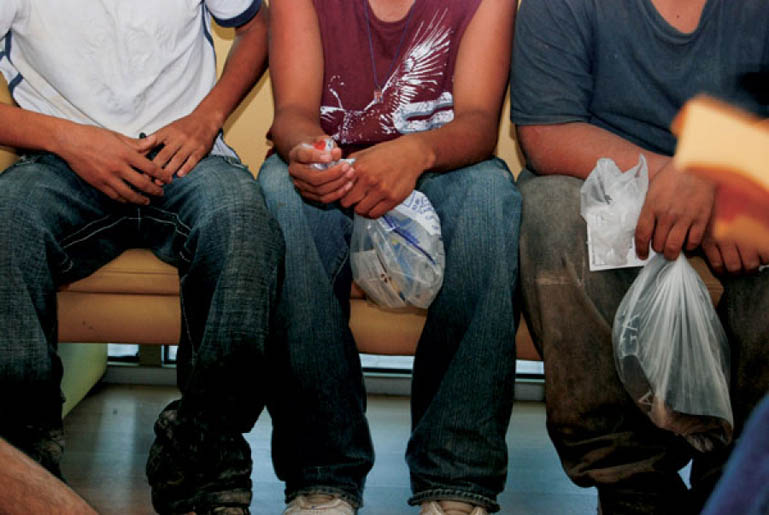
Children waiting in the Desarrollo Integral de la Familia in Reynosa, Mexico

Migration analysts talk about sending and receiving nations. Sending nations are those countries that send, or `export’, its citizens to other countries. Receiving nations are those nations that receive, or `import’ or `absorb’, them. The status of some nation States has changed in the last two or three decades. For example, Italy and Greece were once considered sending nations, and today they are thought of as receiving nations.

Certain countries, such as the United States, are thought of as receiving nations. But that is only the case if the transnational and global export-import business is thought to be one of labor brokerage of national citizens. What are we to call those countries that export non-citizens, those countries that have made a business, a big business at that, of exporting asylum seekers, migrants, children?

Every year, the United States exports tens of thousands of unaccompanied migrant children to Mexico. These children are sent to centers run by Mexico’s social services agency called the Desarrollo Integral de la Familia, or DIF. In 2008, a Mexican congressional committee reported that the United States had deported 90,000 children, of whom at least 13,500 were never claimed. “Never claimed”: that means the children were never reunited with their families.

Who are these children? They are Mexican children who are heading to the north, most often to be reunited with … their families, with their mothers and fathers: “With few exceptions they’ll cross again because their parents or loved ones are en el otro lado and on the other side of the Rio Grande there is hope. Hope to study, to work, or to just hug their mothers or fathers again.”

Susana is in many ways exceptional and in other ways typical of the 90,000 children. First, she’s a girl; 80% of the children are boys. Second, as she sits in a DIF shelter in Matamoros, she says she’s ready to give up, to go home: ““I don’t want to stay here. I’m tired of fighting.” Gender and the intent to return home make her exceptional.

On the other hand, Susana has tried to enter the United States five times, and on each of the five attempts has failed. Every time, she was returned, unaccompanied, to Mexico. Every time, she turned around and tried again. Her father works in Kansas. They haven’t seen each other in five years. He works, struggles, and pays to have his daughter brought over. Each time, the journey costs $2500. Again and again, he pays, again and again she tries. Just to hug her father again. This makes her typical.

The children are sent to centers in Reynosa and Matamoros, centers of the current drug cartel and War on Drugs violence. Reynosa is reported to be one of the most dangerous places in Mexico. Often the children are released to strangers or to distant relatives. Often, some say more often than not, they are returned to the mean streets, and in particular those of Reynosa. So, they then go North because they want to, to be reunited or to study or work, or they go North because they are forced to. Some girls, some boys, may be tired of fighting, but that doesn’t mean they are safe. That doesn’t mean the fighting has tired of them.

What do you call a nation that seizes children, sends them unaccompanied into a violence torn war zone, and then washes its hands of the whole affair, and closes its eyes and ears to the fate of the children? That is neither a sending nor a receiving nation. That is a state of abandonment.

Susana wants to go home, but it’s not that simple. The center wants one of her parents to come and get her. Her father is in Kansas, her mother has to take care of her younger brothers and sisters. And so Susana waits, and like the other 90,000 Mexican children the United States has abandoned to violence and despair, haunts more than the borderlands. Susana haunts citizenship.


(Photo Credit: Texas Observer / Eugenio del Bosque)


Their mothers haunt more than the future

Peace Musabi

Asylum seeker Jimmy Mubenga is dead, killed by G4S `escorts’ on a plane taking him from the UK to Angola. His wife, his widow, Makenda Kambana, weeps. Their five children weep. The State announces, a bit later, that the contract with G4S has not been renewed. The reason given? Cost efficiencies: “G4S is understood to have been paid tens of millions of pounds a year under the current deal, which expires in April. Removals between 2005 and April 2010 cost the Home Office almost £110m.” Apparently the rent is too damn high.

The cost is born by many, the dead and their intimate survivors first and perhaps last. Makenda Kambana is now a single mother of five children, alone, and still a political target. If children, as we are told so often, are our future, what are mothers?

Ask Irma Medrano, a 44 year old Salvadoran woman. In 1995, she fled an abusive husband. She was twenty nine years old at the time. She left her two children behind with relatives. In the subsequent fifteen years in the United States, Irma Medrano has given birth to two children. She is the mother of a twelve year old daughter, a nine year old son, both of whom are United States citizens.

Medrano’s family reports that her Salvadoran husband has heard that she is to be deported and has begun coming around, looking for her. The court decided to ignore this. Her US-born children are heartsick at their mother’s imminent disappearance. The court has decided that her children would not suffer extraordinary hardship if she were to be deported.

Finally, the court decided that Irma Medrano, despite her husband’s clear threats, faces no harm if returned to El Salvador. The court has decided that El Salvador is now safe for women, because there are more women in the legislature and judiciary, and the police are better trained. The court chose to ignore a US State Department report, in March 2010, “found rape remained widespread in El Salvador, rape laws were not effectively enforced, and domestic violence `was considered socially acceptable by a large portion of the population.’”

If Irma Medrano’s children are the future, what is Irma Medrano? In her flight to the United States, and if it happens, in her forced return to El Salvador, Irma Medrano will share a story with other asylum seeker mothers forced to leave their children behind in order to protect themselves and their children.

Women like Rahma Abukar Mohamed, Peace Musabi, Jeto Flaviah, Reetha Suppiah, Sakinat Bello.

Rahma Abukar Mohamed lived in Somalia, where she had been shot, threatened with rape, threatened with death, and injured. She fled, leaving behind her husband and child. She sought asylum in the United Kingdom, where she was summarily and `wrongly’ imprisoned, for having false papers. The reasons for her flight, the conditions of her life in Somalia, her desperate situation were all folded into her mistake of having had false papers, a mistake intensified by poor legal representation. She entered the United Kingdom on 9 August 2007. Last week, on 19 October 2010, her conviction was nullified, on procedural grounds. Rahma Abukar Mohamed was persecuted in Somalia for being a member of the wrong ethnic group. What was she persecuted, and prosecuted, for in England?

In 2003 Peace Musabi left Burundi, and left her three children, Samuel, Diana and Daniel, with a trusted friend. Musabi had to leave Burundi. Her husband had been kidnapped, her brother was beheaded in front of her, she was imprisoned, tortured, raped. She fled, pregnant from the rapes. Peace Musabi arrived in England in 2003, and, in 2007, was finally given exceptional leave to stay. She immediately began searching for her children. In 208, she was informed they had survived, amazingly, and were living in Uganda. She applied to have them come to England … and was denied, ironically enough, by the Home Office. Because of earlier procedural mistakes on the part of the Home Office and of her legal representation, Musabi was not officially a refugee but rather `exceptional’. And so she and her children had no right of family reunion. In the end, such as it is, “the immigration and asylum tribunal overturned the Home Office’s cruel refusal.” But that refusal, in the consciousness of the Home Office, was a home affirmation. What is Peace Musabi in that home?

Jeto Flaviah has a similar story. She fled Rwanda, after soldiers killed her husband, and raped and tortured her. She fled to the United Kingdom, seeking asylum. She won asylum but not the right to family reunion. Like Peace Musabi, she was `exceptional’. She still waits for her children, she still struggles and organizes everyday for reunion, she still mourns the time lost, the life together lost. What is Jeto Flaviah in the Home Office? What is asylum if she is denied forever the touch, the presence, the intimacies of living with her children?

Reetha Suppiah is from Malaysia, and Sakinat Bello is from Nigeria. They each fled to the United Kingdom, seeking asylum. The fled with their children. They were denied asylum, and immediately sent, with their children, to Yarl’s Wood, where, with their children, Reetha Suppiah spent 12 days, and Sakinat Bello 17 days. The children quickly became sick. Suppiah and Bello are suing the Home Office for the harm done to their children. That case was launched this week, Tuesday, October 26.

Children are the future. The daughters and sons of Makenda Kembana, Irma Medrano, Rahma Abukar Mohamed, Peace Musabi, Jeto Flaviah, Reetha Suppiah, and Sakinat Bello, they are the future. That future is born in asylum. That future is wrapped in death and violence and harm, all in the name and service of `asylum’. The children are the future . . . and their mothers? Their mothers haunt more than the future.

(Photo Credit: Camden New Journal)

Asylum-seeker Mandana Daneshnia and her daughter haunt democracy

Every day, The Wall Street Journal runs a feature called Photos of the Day. On Monday, October 18, the first photo was of a woman throwing confetti at Evo Morales. The second photo showed riot police hauling off a student demonstrator in Lyons. The third photo was of a mother and child. The mother looks away, the child looks directly at the camera. Here’s the caption: “SEWN SHUT: Iranian asylum-seeker Mandana Daneshnia, who had her mouth sewed shut for a hunger strike, sat with her daughter before a news conference in Athens Monday. A group of about 30 Iranians seeking asylum have been on a hunger strike in Athens for weeks.”

Here’s one version of the story.

Last year, around this time, on October 12, 2009, Human Rights Watch issued a report on the situation of asylum seekers in Greece. It was entitled Greece: Unsafe and Unwelcoming Shores. Here’s how HRW described the asylum system in Greece: “Greece effectively has no asylum system. It recognizes as few as 0.05 percent of asylum seekers as refugees at their first interview. A law adopted in July abolished a meaningful appeals procedure. The effect of the new law is that a person who is in need of international protection as a refugee in Greece is almost certain to be refused asylum at the first instance, and having been refused has little chance of obtaining it on appeal. The new law leaves asylum seekers with no remedy against risk of removal to inhuman or degrading treatment, as required by article 39 of the EU’s procedures directive and articles 13 and 3 of the European Convention on Human Rights. As a result of this legislative change, the United Nations High Commissioner for Refugees (UNHCR) withdrew from any formal role in Greece’s asylum procedure.”

According to the report, Greece acted abysmally, and both the European Union and the United Nations did nothing more than withdraw and withhold. They did nothing to protect asylum seekers, they did nothing to intervene in either a draconian legal system or a Dickensian prison system. Everyone was found guilty: Greece, Europe, the United Nations. The entire `civilized’ and `democratic world.’

A year later, on September 20, 2010, Human Rights Watch returned to Greece to review the situation. What happened in the intervening year? Delay after delay. The year may have intervened, but no one else did. Not the European Union, not the United Nations. No one. What happened? Less than zero. The world stepped backwards.

Meanwhile, on September 1, 2010, a group of Iranian asylum seekers set up camp in the city center of Athens, demanding an audience, pleading for asylum. They began a hunger strike.

On Monday, October 18, after weeks of belligerent non-response on the part of the Greek government, a new government that had come in on the promise of change, six protesters sewed their lips together.

Mandana Daneshnia is one of the six: “Mandana Daneshnia, a former newspaper reporter, said she fled the country after being harassed by authorities for writing about women’s issues. She was one of the seven protesters who sewed their lips. `Women have no rights in Iran. They can’t wear what they want, do what they want, or even watch sporting events. Their testimony in court counts only for half of the one given by a man,” Daneshnia said, writing a statement in Persian, as her husband and young daughter looked on. `I have sewn my mouth to show that women in Iran are strong,’ said Daneshnia, 29, with short dyed-blonde hair and red-framed designer glasses, holding her lips with her hand when occasionally tempted to smile.”

The women in Iran are strong, whether in Iran or in Greece or elsewhere. For those women, the women in Iran, the institutions of democracy, as exemplified by the conditions of asylum seekers, are neither strong nor weak. They are lethal, and they are inhuman. Mandana Daneshnia haunts democracy. Mandana Daneshnia haunts Iran, Greece, the European Union, the United Nations, and anyone who cares about women’s issues and the reporting of women’s issues. As Mandania Daneshia haunts the `freedom loving’, `democratic’ nations, her daughter sits on her lap. How many smiling daughters must sit on the laps of how many mothers with their lips sewn together before asylum is realized?


(Photo Credit: Louisa Gouliamaki/Agence France-Presse/Getty Images)

And Jimmy Mubenga is dead


Jimmy Mubenga came to England seeking asylum, seeking life. According to his wife, Makenda Kambana, he was on a government hit list, “They killed my father and they threatened to kill Jimmy. They were looking for him. We had no choice but to leave.” Earlier this week, on Tuesday, October 12, Mubenga boarded a plane for Angola, having lost his last battle for asylum in the UK. Within 50 minutes on the plane, he was dead.

Witnesses report that the guards, G4S private deportation `escorts’, jumped on Mubenga and throttled him to death.  Escort deportation has become big business. Most of the 11 immigration removal centers in the UK are run by private firms, in particular G4S, GEO Ltd or Serco.

MPs are calling for an investigation, the former chief inspector of prisons as well. Many informed will raise their voices and eyebrows and hands in surprise and dismay at the violence. Charges of `excessive force’ and `brutality’ are heard across the land.

But Jimmy Mubenga is dead. As are …

Kenyan asylum seeker Eliud Nyenze, who collapsed in April this year at Oakington detention center, run by G4S. Nyenze complained of intense pain, so bad he was reduced to crawling around on the floor, begged for painkillers, and was denied any sort of medical attention. He died in excruciating agony.

Manuel Bravo, an Angolan asylum seeker who in September 2005 was found dead, hanged, in Yarl’s Wood.

Joy Gardner, a Jamaican woman applying for compassionate leave to stay in Britain, killed in front of her five year old son and her mother, September 1993.

These are the prominent, the recorded, names that have come up in discussions of Jimmy Mubenga’s death. Their deaths, the manner of their deaths, the impunity of those who killed them, is said to haunt the story of Jimmy Mubenga. The passengers on that British Airways flight are described as “haunted by the last cries of a dying man.” Understandably. The nation is haunted.

But Jimmy Mubenga is dead, and will remain so. He is not haunted by the past, but his name, his death, is haunted by the future. He is haunted by those who continue to seek asylum.

On Wednesday, October 13, the day after Jimmy Mubenga was killed, Malawian Florence Mhango and her ten-year-old daughter Precious were again blocked from receiving asylum. Precious is seeking asylum because she and her mother fear that if returned to Malawi, by law her estranged father can force her into marriage.

On Thursday, October 14, it was announced that the four-year ban on repatriating Zimbabwean failed asylum applicants would be lifted. Why? Because the Unity Government of Zimbabwe has worked.  That many, including the Zimbabwean diasporic and overseas communities, believe that the situation is worsening, that a bloodbath may very well be imminent, is of no matter. That Robert Mugabe, on Friday, called for national elections whether or not the constitution has been passed, is of no matter.  That the violence continues is of no matter.

What is important is that the Zimbabweans be sent back, be sent out. Take EM, an MDC member raped and beaten by policemen in her own home, send her back, because she has failed the test of asylum. Take Pauline Enagbonma, an albino woman who fears for her safety as an albino in Zimbabwe, and send her and her three young children back, children who have spent the majority of their lives in the UK. Take Nokuthula Ngazana and her famous 18 year old daughter Gamu, and send them back. Nokuthula Ngazana came to the UK, with her daughter, to study. Home Office claims she filed for visa extension “out of time”, and since Gamu was listed as her dependent on the application, she too must leave. Send them all back, along with all those whose names go unrecorded.

Seize them and you shall seize the day.

Send them all back for they have failed the test of asylum. In the protection of the State, there is no excessive force, there is no brutality. Those notions, like Nokuthula Ngazana’s application, are out of time.

Precious Mhango haunts Jimmy Mubenga, Gamu Nhengu haunts Jimmy Mubenga. The tens of thousands of children, of women and men seeking asylum and those who in the future shall seek asylum in the United Kingdom, they haunt Jimmy Mubenga.

And Jimmy Mubenga is dead.


(Photo credit: irr.org.uk)

The children of Afghanistan haunt the modern democratic nation-State

Children of asylum seekers and children who are asylum seekers in prison. What is their crime? Seeking asylum. These are children fleeing violence, in their households, in their communities, in their countries of birth. And how do `we’ respond? Prison.

Australia is bracing for a serious uptick in children in detention mutilating themselves: “Self-mutilation in Australia’s detention centres is increasing with the number of recorded cases quadrupling in the past year and mental health experts bracing for worse to come as children begin cutting themselves.” Why are the children cutting themselves? The prisons are becoming more overcrowded, the time spent in prison is increasing, and government officials are `promising’ increased rates of deportation. Who are these scoundrel children? Afghans. Sri Lankans.

According to Harry Minas, director of the Centre for International Mental Health at the University of Melbourne, the conditions for imprisoned asylum seekers and immigrants is returning to the dark days of 2001 – 2003, “when children drank shampoo and detainees sewed their lips together.” All of this has happened before, and it is happening again. We are told the first time it was tragedy.

Why are children cutting themselves? There is no school, there are no sustaining structures, there is no home life, there is no community, there is no future, and, increasingly, there is no past. There is only prison. From the State, there is only the promise that the rate of deportation to Afghanistan will increase. For the children, there is only threat and more threat.

The children are cutting themselves, they are poisoning themselves, because they are children, and self-harm is the only electoral process allowed them by the modern democratic nation-State. There are currently around 700 children in immigrant detention `facilities’ in Australia.

These children of asylum-seekers, these children asylum seekers are viewed as budget targets, as opportunities for greater efficiency. In Britain, it was announced today that “thousands of child asylum-seekers are to be removed … under savage budget cuts being drawn up by the Home Office ahead of this week’s comprehensive spending review. A briefing document sent to ministers sets out detailed proposals to remove child refugees before they reach 17 years old, and recommends bearing down on benefits given to asylum seekers…. Of greatest concern will be a policy of mass removal of unaccompanied children before they reach 17 and a half, the age when they are deemed to be adult asylum-seekers. Under current rules unaccompanied child asylum-seekers are usually granted leave to remain in the UK until they can make a fresh asylum application as an adult. There are more than 4,200 unaccompanied child asylum-seekers in Britain, with most being supported in local authority social services homes.”

The opportunity for economy here, for efficiency, is great. It is so great that the United Kingdom is willing to invest £4m in a `re-integration center’ in Afghanistan. The children of Afghanistan have traveled far, to seek asylum, to seek haven, to escape the violence of the Big War and the myriad forms of violence of the more intimate wars of the everyday. These children shall be returned to Afghanistan, after having been subjected to the democratic rule of law and of due process.

The planes are waiting, the ministers are promising swift, increasing, and ever more efficient returns. The children who have come asking for help will be returned to Afghanistan because Afghanistan is a better place … for them. It must be. It has been democratically decided. Those children who have not been allowed to kill themselves shall be sent `home’. The modern democratic nation-State is bracing itself for mass removals, for bearing down, for the mutilation of children. The children who seek asylum and the children of those who seek asylum have been targeted. The children of Afghanistan haunt the modern democratic nation-State.


(Photo Credit: Australian Human Rights Commission)