Prison means business … for real

A report came out yesterday suggesting that probation in the United States is big, predatory business. The report opens: “The United States Supreme Court has ruled that a person sentenced to probation cannot then be incarcerated simply for failing to pay a fine that they genuinely cannot afford. Yet many misdemeanor courts routinely jail probationers who say they cannot afford to pay what they owe—and they do so in reliance on the assurances of for-profit companies with a financial stake in every single one of those cases.”

Women figure prominently among the lists of the abused and caged. Here’s a typical story. Judge James Straight, a Justice Court judge in Bolivar County, Mississippi, remembers a woman who called his court, weeping. She claimed probation officers, who worked for Judicial Correction Services or JCS, had threatened to have her jailed for a bill of $500. Working a low-paying job, she had struggled to keep up with her payments. When she offered to pay $200, the probation officer said she had to pay it all. So the woman, frantic, called the Judge. His clerk looked into the matter and found that originally the woman had been fined $377, for driving without a valid license. More to the point, she had paid off the entire amount, but still owed JCS about $500 in fees.

Four years ago, a major report came out detailing the rise of the modern debtors’ prison. Across the country, people would end up in prison because they couldn’t pay minor fines or fees, `legal financial obligations’, or LFOs … in the business. Some jails charge prisoners $12 entry fee, $60 a day for room and board, and then reimbursement for medical and other services. You have to pay to play. The Saginaw County Jail, in Michigan, charged people $12 to get out of jail. It was called an “administrative fee.” Women in Michigan have been charged as much as $10,000 in “tether fees”, the price of parole supervision. At a little under $100 a week, and that was in 2010, it was a bargain. Of course, nonpayment of these fees went straight to credit bureaus, and so the vicious circle, or noose, wound ever tighter around each woman.

Eight years ago, in 2006, there was the case of Ora Lee Hurley, who owed $705 in fines, a fine she had incurred in 1990. Hurley was sentenced to 120 days in jail, and then to more jail. The Judge ruled that Hurley had to stay in confinement until she paid her fine. So, Ora Lee Hurley stayed in custody at the Gateway Diversion Center, which is neither a gateway nor a diversion and not much of a center. Five days a week, Hurley left the center and went to work. She earned about $700 a month, of which she paid $600 a month, to the State of Georgia, for room and board, and $52 a month for public transportation. As a result, Ora Lee Hurley stayed a prisoner for at least eight months beyond her sentence. During that time, she earned over $7000, almost all of which went to pay for `room and board.’ If it hadn’t been for the Southern Center for Human Rights, who petitioned for her release, Ora Lee Hurley would probably still be confined today.

Prison means business, yesterday, four years ago, eight years ago. While reports are useful, it’s time. Across the United States, women face new structures of debt designed to send them into cages that then turn them into walking ATMs. End that debt, open those cages.


(Image Credit: Southern Center for Human Rights)
Who tied the knot that killed Lucia Vega Jimenez?

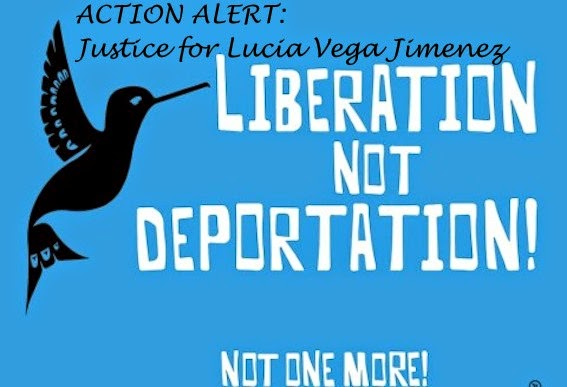
42-year-old Mexican immigrant Lucia Vega Jimenez died on December 28, 2013. On December 20, she was found hanging from a shower stall in the `immigration holding center’ at the Vancouver airport. Apparently, she had been hanging, without oxygen, for at least 40 minutes, before she was cut down and sent to hospital. Who tied the knot? Canada. The global system of `immigrant detention’. Everyone.

Everything about Lucia Vega Jimenez’s story is familiar. And it doesn’t end with her death.

In 2010, Jimenez had applied for asylum in Canada, was rejected and deported. She returned to Canada in the Spring of 2013, got a job, off the books, as a hotel cleaner, kept her head down and her nose to the grindstone. Described by a friend as a `ghost’ in Vancouver, Jimenez worked and saved money to send home to her ailing mother, sister and her sister’s three children. In late December, she was picked up for not paying bus fare, and then was flipped over to `the authorities.’ They shuttled her off to jail, and then to the holding cell, a private facility in the basement of the airport, and there she ended her life. While in detention, the money she’d saved `disappeared.’

The CBSA did not release any information for almost a month, and the `information’ has been obstructionist and opaque. So, the world asks questions.

A reporter asked: “How often were detainees checked? Were those checks visual inspections? Were there cameras monitoring the cells? Does the CBSA put out press releases at the death of a detainee (which has happened several times in the past), and is there legislation that bounds the agency to announce the death of a detainee? What is the CBSA policy regarding visitors to the YVR [Vancouver International Airport] holding center? Are lawyers, family, friends, John Howard Society, religious counsel, etc. allowed in?”

No answer was forthcoming.

Friends and advocates want to know what happened. Why did no one see Lucia Vega Jimenez for at least 40 some minutes? The Mexican government wants to know what happens to its citizens in `holding centers’. The Mexican Consul-General, Claudia Franco Hijuelos, has a particular interest: “She was fearful of going back to Mexico – not to the country, but specifically to some domestic situation that she might face. That is why we provided some options for her of transition houses where she might be housed. She considered the options and she chose one of those options. Everything was set for her to fly directly to that city in Mexico where the transition house would receive her.” According to the Consul-General, Vega “seemed to be accepting the situation.”

What happened? The questions of time – how long it took to find Vega, how long it took to `report’ her death – are part and parcel of the structure of gendered indignity for immigrant women. Four years ago, a study on health, access to services and working conditions for undocumented migrants in Canada noted: “The effects of being non-status are invariably gendered. Non-status women have been noted to be extremely vulnerable to poverty, unemployment, poor and unstable living conditions, danger, exploitation, abuse, and high risk or complications during pregnancy. Lack of status limits women’s ability to access information, seek social assistance, counseling or health care, which contributes to their reliance on unsafe and underground employment or informal networks to obtain housing … Generally, non-status women have also been noted to experience more language barriers, social isolation, and fear, in addition to lack of control over partner abuse and the effects of this on their children. In relation to policies, regularization programs and other immigration policies have been noted to reinforce dominant power relations that consequently subjugate women as dependents of their opposite sex partners.”

Lucia Vega Jimenez lived, and died, the life of the undocumented women immigrant. Precarious doesn’t begin to cover it. But she persevered. And the State? The State chose to “reinforce dominant power … that subjugates women.”


(Image Credit: http://sanctuaryhealth.blogspot.com)

I hear the banging of the doors and the sound of their keys

Women for Refugee Women’s latest report, Detained: Women Asylum Seekers Locked Up in the UK is hard and all too familiar reading. Women seek asylum because they have been tortured, raped, persecuted, and they are imprisoned and tortured anew.

Over 85% of the women interviewed said they had been raped or tortured. Over 50% said they had been persecuted for the crime of being a woman. Close to 20% said they had been persecuted for being lesbians. Almost all the women described despair at and depression in detention. More than half had contemplated suicide. About a third had been on suicide watch while in immigration prison. Around 40% of women asylum seekers who have been detained have spent more than a month behind bars. Almost all the women said male staff had guarded them. Half of the women said male staff had verbally abused them.

And then there’s this: “Home Office statistics released for this report show that of the 1,867 women who had sought asylum and who left detention in 2012, only 674, or 36%, were removed from the UK. The others were released into the UK. Our research suggests that this unnecessary detention has an ongoing impact on the mental health of vulnerable women.”

Here’s how Cameroonian asylum seeker Lydia Besong, a two-time resident of Yarl’s Wood and now a formally acknowledged refugee, describes “ongoing impact”: “When I left detention, Yarl’s Wood followed me to Manchester. Sometimes I feel like I’m in a trance, I feel I hear the footsteps of the officers, I hear the banging of the doors and the sound of their keys. Even though I’m out of detention, I’m not really out – I still have those dreams.”

Alice, a Cameroonian lesbian, experienced “appalling sexual violence” in Cameroonian prisons. When she was hauled off and thrown into prison in the UK, those experiences returned, with a vengeance: “There is no law in detention. You feel that the guards apply the law according to their mood and prejudices. They inflict their own feelings on the women in there and there is nothing to stop them. Yarl’s Wood is a lawless place … I would honestly die rather than go back to Yarl’s Wood. I know these people are doing a job but at times it seems as if they are actually bad people who have stopped regarding us as human beings. I have told this story because I want this treatment of women to stop. I don’t want others to go through what I went through. I am still trying to recover from what happened to me not only in Cameroon but in Yarl’s Wood.”

Story after story, history is a nightmare from which she is trying to awake.  Yarl’s Wood is filled to choking with law: the law of State violence, torture and terror. Meltem Avcil knows of the terror and the law. In 2007, at the age of 13, she, and her mother, were locked up in Yarl’s Wood for three months. At that time she had lived in England for six years. As far as Avcil knew, she was a British schoolgirl. Then the State came to teach her a lesson: “They knocked on the door so hard. Even now, if I hear the door knocked so hard, I panic. My best friend was sleeping over. Eight men surrounded a house of three women and dragged us out.”

In 2010, Avcil organized the campaign to end the detention of immigrant children. Now she’s organizing to end the detention of women asylum seekers. She’s started a petition: “Every year, hundreds of women who come to this country to seek safety from persecution are being detained in Yarl’s Wood detention centre in Bedfordshire.  Research by Women for Refugee Women shows that the majority of these women say they have experienced rape, sexual violence and torture in their home countries. The impact of detention on women is devastating. Many become depressed and suicidal. These women have not committed any crime, and yet they are being locked up indefinitely. We are asking you to ensure the government stops detaining women who have come to this country to seek asylum. Women’s asylum cases can be considered while they live in the community. We are also asking you to ensure that no male staff are employed at Yarl’s Wood detention centre in roles where they come into contact with women, and that allegations of abuse made against staff are properly investigated. It’s possible to create an asylum process which treats women who have survived rape and torture with dignity and humanity. They deserve a fair hearing and a chance to rebuild their lives.”

You can sign the petition here. Women deserve a fair hearing and a chance to build and rebuild their lives.


(Image Credit: Women for Refugee Women)

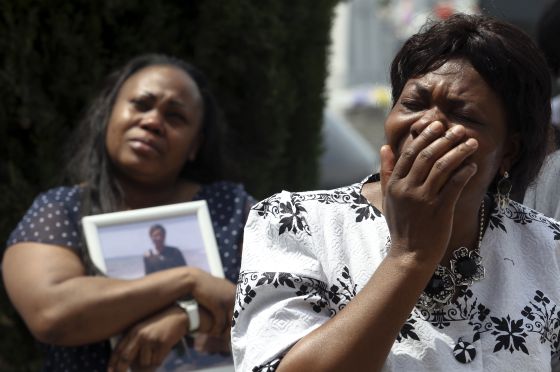
In Colombia, Fernando César Niebles Fernández died today


Fernando César Niebles Fernández died today … or was it Monday. It’s hard to tell. Anyway, he didn’t die. He was murdered.

This past Monday, January 27, a fire broke out in the Modelo prison, in Barranquilla, on the Caribbean coast of Colombia. By day’s end, ten prisoners were reported dead, over 40 injured, many seriously. Today, the death toll rose to 11.

The fire has been described as an inferno, but the real inferno, the real hell, is the prison itself. Designed to hold around 400 prisoners, at the time of the fire, Modelo held close to 1200. The cellblock where the fire broke out was designed to hold 196. At the time of the fire, it held 716 That’s 265 percent of capacity. Modelo was and is a death trap, pure and simple. Colombia prison system is at almost 200 percent capacity.

When the fire broke out, it was thought to be a conflict between different groups. And so the staff shot tear gas into the cells and that was that. As the fire intensified, the bars remained closed. The inferno was not the fire. The inferno was `protocol.’

And now? The stories of the families pour forth, with photos and videos and words, words, words. Mothers and fathers, like Rocío Cantillo Torres  and Atanasio Mutis, wait for their sons. Sisters, wives, daughters, friends, neighbors, strangers wait for news, wait for death. Modelo was and is inferno. The event of death is important, but the death itself was long foretold. Who could survive such conditions?

And today, it’s Mercedes María Suarez’s turn. She’s Fernando César Niebles Fernández’s mother. Her son lived with severe mental health issues, caused by a road accident four years ago. He needed help. Instead, he got prison. It’s a common enough story. She weeps for her son, and asks how the State could have done this, could have come to this pass.

The ordinariness of the story of Fernando César Niebles Fernández and Mercedes María Suarez doesn’t reduce the suffering, the personal and individual tragedy, but don’t let anyone tell you it’s a national or historical tragedy. It’s not. It’s happened too many times, in Colombia and Brazil, in January, and around the world. Stuff the prisons to beyond bursting and what do you think will happen? The deaths at Barranquilla, like the deaths earlier this month in Maranhão in Brazil, were no accident. They were public policy. As James Baldwin once argued, “It is not permissible that the authors of devastation should also be innocent. It is the innocence which constitutes the crime.”

There will be more fires, and some day the fire, the fire next time, will not be the fire of the criminally innocent: “God gave Noah the rainbow sign, No more fire, the fire next time!” But today, weep for Fernando César Niebles Fernández, weep with Mercedes María Suarez.


(Photo Credit: El Universal (Colombia))

Who killed Samba Martine? We all did

Samba Martine died, or was killed, on December 19, 2011, in the Aluche immigrant detention center in Madrid. This week, a Spanish court ordered her case to be reopened, stating that Martine’s death “could have been avoided.” That’s putting a fine point on it. Samba Martine was killed. She was killed by the Spanish government. She was killed by a global immigration detention gulag that has little to no rules, even less enforcement of the few rules it has, almost no accountability, and so little transparency as to be opaque. Except to the prisoners who continue to die … avoidably.

Here’s one version of Samba Martine’s story, as presented last year to a European Parliament Commission: “On 19 December 2011, a Congolese citizen, Samba Martine, died at the Aluche immigrant detention centre in Madrid. According to the Spanish Ombudsman’s 2012 annual report, her death was due to a lack of communication between institutions, which meant that she was not given the right treatment as someone with the human immunodeficiency virus (HIV). The immigrant held at Aluche had been diagnosed as HIV-positive at the Melilla temporary detention centre for immigrants but was transferred to the Aluche immigrant detention centre in Madrid without the latter centre being given any information whatsoever about her health status. This meant that at Aluche she was diagnosed with different illnesses and the centre’s doctors treated her on the basis of the different diagnoses without realising that she was HIV-positive, which consequently led to her death … The case of Samba Martine shows that the lack of coordination between the Aluche immigrant detention centre and the Melilla temporary detention centre for immigrants led to a diagnostic error which meant that she was not given the essential treatment for her illness, which indirectly caused her death. In addition to this case, there is the case of Idrissa Diallo and many other immigrants who have lost their lives in immigrant detention centres in Spain, suggesting that human rights … are being systematically violated.”

Samba Martine did not die of a `lack of coordination’. She was killed. She was killed by a program that targets immigrant women, and especially African women.

Samba Martine was held at Aluche for 38 days. From the day she arrived to the day she died, she complained of severe headaches, perineal irritation, stomach pains, and more. She went to the on-site medical facility, such as it is, and was given little to no treatment. Finally, the pain was so severe, they decided to send her to the hospital, only after debating whether to send her in a police car or ambulance. Hours later, Samba Martine died, alone, in pain.

Who died that night? 3106. A number, not a person. Cause? Cryptococcal infection … the second most common AIDS-defining illness in Africa. What crime did she commit? None. `Officially’, Aluche isn’t a prison. In fact, it’s worse. Next to Aluche, standard Spanish prisons look almost decent.

Samba Martine is not an exception. The notorious CIE, the Centro de Internamiento de Extranjeros, is filled with Sambas. Women, and especially African women, suffer particular indignities and violence. A litany of `failures’ and `omissions’ will now ensue. The prison clinic is private. The prisons don’t communicate with one another. The prison staff is inadequately trained. None of these describe what happened.

Samba Martine was not failed by anyone. She was killed. She was killed by the State, in this instance Spain, and she was killed by the world that sustains black holes, militarized borders on every corner, and dispensable surplus populations.

On June 2, 2012, six months after she died, Samba Martine was buried in a cemetery in Madrid. Her mother, Clementine, came from Canada. She knew her daughter’s death was neither accident nor failure. It was murder. She knew. We all killed Samba Martine.


(Photo Credit: elpais.com)

Healthy Births for Incarcerated Women: Women are the etc.


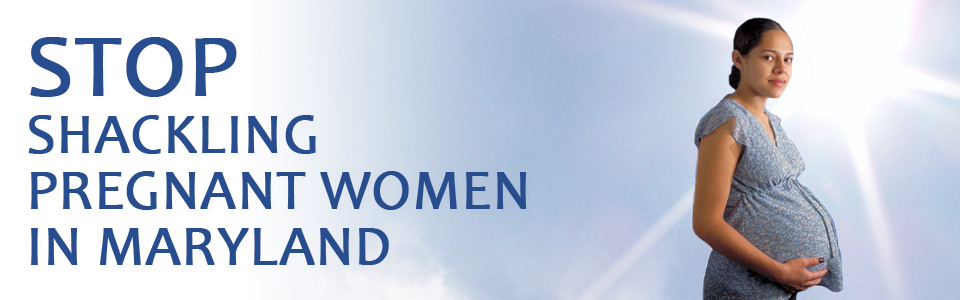
In Annapolis today, the Maryland House of Delegates Judiciary Committee is scheduled to conduct hearings on HB27, the Healthy Births for Incarcerated Women Act. Delegates Mary L. Washington, Ariana B. Kelly, and Barbara A. Robinson sponsored the bill. Its synopsis reads: “Prohibiting the use of a physical restraint on an inmate while the inmate is in labor or during delivery; requiring the medical professional responsible for the care of a specified inmate to determine when the inmate’s health allows the inmate to be returned to a correctional facility after giving birth; prohibiting, with specified exceptions, a physical restraint from being used on a specified inmate; requiring a correctional facility to document specified use of a physical restraint; etc.”

Etc. Women are the etc.

Across the United States, women are being imprisoned at a high rate, higher than any other group, according to some reports. From 1977 to 2004, Maryland `enjoyed’ a 353 percent increase in women going to prison. Maryland has one women’s prison, in Jessup. In Jessup, the women prison population breaks down as follows: 53 percent are Black women; 46 percent are White women. (Almost ¾ of Maryland’s prison population is Black, while only 30% of Maryland’s population is Black.)

Most of the women are in for drug-related offenses. Many are in for longer terms, `thanks’ to Three Strikes and mandatory sentencing policies.

Mary Washington introduced a similar bill last year, which was so watered down in committee that it was gutted of any serious content. Hopefully this year’s bill will fare better. Washington has been working with the ACLU of Maryland; Power Inside, a Baltimore group that “serves women impacted by incarceration, street life and abuse”; law faculty from the University of Maryland Law School; students from the University of Maryland – Baltimore County; members of Women In and Beyond the Global; and others.

According to Washington, “One of challenges that these women face is that they are permanently scarred, emotionally and in some ways physically, from being restrained during pregnancy and during birth.”

Maryland is one of a number of states in which legislators are trying to ban the shackling of pregnant women prisoners. In each state, part of the struggle is that women are the etc. Opponents suggest security and flight risks; they share anecdotes of prisoners who have escaped while in hospital. Those anecdotes never involve women, much less pregnant women, much less women in labor or childbirth. Last year, when those anecdotes were presented to the Judiciary Committee, no one mentioned that salient issue.

Women are the etc.: women of color, working women, women prisoners, women. The Healthy Births for Incarcerated Women involves all women, any woman, every woman.


(Photo Credit: DaretobePowerful.com)

Delma Jackson demands justice


Delma Jackson’s husband, Miguel Jackson, is a prisoner in the notorious maximum-security section of the notorious Georgia Diagnostic and Classification Prison, in Jackson, Georgia. Georgia Diagnostic and Classification Prison, GDCP, houses Georgia’s death row and maximum security for men. Troy Davis was executed at Georgia Diagnostic and Classification Prison. It’s notorious big.

In 1995, Miguel Jackson was convicted of armed robbery. It was his first offense, and he waived a jury trial. According to Delma Jackson, “He was convicted and sentenced by Judge William Daniel under the Georgia Seven Deadly Sins law. Judge Daniel was unfamiliar with the new law and he somehow thought that Miguel would be eligible for parole after 10 years. The seven deadly sins law states that parole is not an option if convicted of one the seven deadly sins.” In 1995, Miguel Jackson was 20 years old.

In December 2010, Miguel Jackson was involved in the historic Georgia prison mass strike. At that time he was in Smith State Prison. On December 31, according to eyewitnesses, photographs and, finally, video evidence, Jackson was handcuffed and beaten by two guards. He was taken to hospital, taken care of sort of, and returned to Smith State Prison. The next day, Delma Jackson and Miguel Jackson’s mother went to the prison to visit Miguel. They were denied entry. They were told to go home and not worry. From then on, no one could see Miguel, not his wife, not his mother, not his attorney. On January 4, 2011, he was moved to maximum security in GDCP.

Jackson complained that he was suffering as a result of the beating. He received little care, and the care he received seems to have been poor. So, on June 11, 2012, after 18 months in maximum, Miguel Jackson decided to stop the world. He and nine other prisoners went on a hunger strike, declaring that they were “starving for change.” Delma Jackson explained, “Georgia is the most locked up state in the country, per capita …These men are more than inmates. They are human beings.  They are someone’s son, husband, father, brother, uncle, and grandfather. Imagine if it were your loved one that was being treated worst than an animal.”

At first, Georgia denied there was anything going on. Then it minimized the scale and depth of the strike. Finally, it more or less admitted that there was indeed something going on. On July 26, Miguel Jackson ended his hunger strike.

In June, all inmates on hunger strike lost visitation “privileges” for a couple weeks. Delma Jackson’s were restored in early July, and then, on July 18, they were rescinded, indefinitely. Delma Jackson was under a permanent banning order.

Throughout the hunger strike, Delma Jackson had been the loud and proud voice and face of the hunger strikers. When she found out that she had been banned, she sued the prison warden and other staff members. Last week, U.S. District Judge Marc Treadwell ruled that, during the hunger strike, the warden and staff were entitled to `qualified immunity’ for their actions. But once the strike was over, so was the immunity. The judge found that the prison warden and his staff had violated Delma Jackson’s right to freedom of speech … and more: “This is of particular concern to the Court. Issues related to conditions inside the SMU [Special Management Unit] are broader than those affecting only this Plaintiff. Justified or not, there has been plenty of criticism of how SMU inmates are treated. If the Defendants decided to make an example of the Plaintiff by permanently suspending her visitation privileges because they did not like what she had to say about their prison and its administration, they have not only retaliated against her but have moved to chill the speech of others who are concerned about the manner in which prisoners are housed in the SMU. As the Plaintiff’s counsel stated at oral argument: “It’s not just what it did to Ms. Jackson, [it’s] what it does to all protests all over the state. If you think something is wrong in the prison system, you’re going to remember Delma Jackson: Delma Jackson got her visitation taken away because she spoke up. That’s what’s going to be sent out there as the message.”

Delma Jackson is demanding justice, and no prison warden is going to shut her up or down. That’s what’s going to be sent out there as the message.


(Photo Credit: San Francisco Bay View)

Catherine Samba-Panza, a militant for women, peace, and hope

Yesterday, the National Assembly of the Central African Republic chose Catherine Samba-Panza as President, to lead the country out of two years of violence. While the Republic has known more than its share of turbulence, conflict and predation, from within and without, this latest engagement is the first to pit religious communities, Christian and Muslim, against one another. The world press has framed Samba-Panza’s election as one in which a woman has been chosen. The real story is that a woman chose. Catherine Samba-Panza chose.

Catherine Samba-Panza was raised in Bangui. She studied law in France, then returned to Bangui, joined an insurance brokerage firm and then established and led her own. It’s said that her experience in business developed her fierce opposition to corruption of any kind. And she is known as a fierce, independent, and successful businesswoman.

Catherine Samba-Panza is also known as a fierce defender and promoter of women’s rights. A leading member of l’Association des femmes juristes de Centrafrique (AFJC), Samba-Panza worked for greater inclusion of women in government positions and for the rights of victims of violence, beginning with survivors of sexual violence. She has been a leading voice for women’s rights, for real programs to end violence against women, and for human rights, in the Central African Republic and across the Great Lakes Region. Again, she is known as fierce, independent, and successful advocate and activist.

Since 2003, Samba-Panza has been formally in politics. She has worked with, and around, successive and opposing regimes, always in the service of dialogue and inclusion as a means of national reconstruction. She has always kept her eyes on the prize, including that of securing real peace for everyday women every day. Until yesterday, Samba-Panza was Mayor of Bangui. In the current crisis, she was never identified with either side. Thus, she was able to defuse episodes that otherwise were destined to end in lynching and other forms of violence.

It is not surprise that the women of the Central African Republic are pleased. They danced and sang when Catherine Samba-Panza’s named was announced. Marie-Louise Yakemba, who heads an interfaith ngo, cheered: “Everything we have been through has been the fault of men. We think that with a woman, there is at least a ray of hope.” Annette Ouango cheered: “As a woman, she can understand the sufferings of the people, and as a mother, she will not tolerate all of this bloodletting.” So did 18-year-old student Judicaelle Mabongo, “The men have done nothing but fight. The men, they are fighting. But they are only destroying the country. This woman, she might be able to change things.” Rose Yodoma, a member of the National Assembly, cheered: “We are super-happy! This is a good choice, a very very good choice.”

In her acceptance speech, Catherine Samba-Panza spoke as President of all Central Africans. She implored Christians and Muslims to lay down their arms. She committed herself to working to resolve the situation of displaced persons and communities and to make it possible for them to come home as part of the restoration of stability to the nation and to the region. She spoke of suffering as well as of sovereignty, and was clear that the country stands on the precipice of collapse. She made crystal clear that women, youth, and inclusion would be policy priorities.

While many hope Samba-Panza will save the Central African Republic, Samba-Panza herself refuses any traces of messiah. Instead, she says, as she has always said, that she is a mediator, a maker of dialogues, a woman. In her opening remarks, as in her earlier speeches as Mayor of Bangui, Catherine Samba-Panza suggests that her greatest power is her sensibilité de femme, her women’s sensibility.

Later, Samba-Panza reflected on the meaning of her being the first woman President of the CAR: “I feel a great deal of emotion because Central African women have waited for this for a long time, and when they saw there were no women candidates in any elections these past few years, they began to despair. To have overcome these obstacles is a source of great pride for all Central African women… It really was very discouraging. Many people advised me that the time was not right for a woman. But it wasn’t only women who supported and pushed me. Many youth did as well. We all felt that the people wanted a break. They wanted an end to the political man. I felt that. At the very heart of the people, I felt this desire to elect a woman who could bring peace and reconciliation.”

Once again, the work of peace, informed by hope, requires a woman who has spent her lifetime working peace and hope in the company of women. This time, it’s Catherine Samba-Panza.


(Photo Credit: AFP)

Eritrean and Sudanese women asylum seekers protest in Israel


Thousands of mostly Eritrean and Sudanese women and children asylum seekers marched through the streets of Tel Aviv today, protesting Israel’s new `immigration policies’ and new `open’ immigrant detention center, Holot.

In September, the Israeli Supreme Court declared Israel’s 2012 Prevention of Infiltration Law unconstitutional. Under that law, an undocumented resident, including asylum seekers and refugees, could be held without trial for up to three years. They were previously held in the notorious Saharonim prison. One of the reasons Saharonim is notorious is the number of infants, toddlers and young children, held for what were basically indefinite periods.

When the Supreme Court declared the law unconstitutional, the State swung into action and, first, passed a new amendment to the law. Under the new legislation, the undocumented, again including asylum seekers and refugees, can only be `detained’ for one year … but they can be held in an `open’ facility indefinitely. Welcome to Holot `open’ facility, where `residents’ can walk outside, but must report for roll call three times a day and can’t seek work. And it’s in the middle of the Negev Desert. It’s a prison.

Last week, mostly Eritrean and Sudanese refugees and asylum seekers went on a three day strike. This affected primarily restaurants, hotels, cafes, and cleaning services. One of the strike organizers, twenty-eight-years-old Eritrean Kidane Isaacs, explained: “The new law basically gives us two choices: be a prisoner indefinitely or self-deport. We have been here for years without any sort of human treatment. We are forgotten, neglected.” In Eritrea, Isaacs experienced torture, imprisonment, forced labor, and more.

Today, the women, and children, by thousands, resumed the public struggle. They chanted, “We are refugees!” They carried placards that read, “We need freedom” and “Stop racism!” As one Eritrean woman, Zabib, explained, “We are seeking asylum. We’re not criminals. Our kids have no legal documents so they don’t have any basic rights. We have no kind of support for us and the kids … we’re in survival mode.”

The women’s formal statement read, “The Israeli government treats us like we aren’t people. We live here without states, without basic rights, without hope and without the ability to support our children with honor. We are not criminals. The Israeli government summons the heads of families to the Holot detention facility in the south, separates women from their husbands, fathers from their children, and breaks families apart. The detention and arrests of asylum seekers destroys the one support we have – the support of our family and our communities.”

No one disputes that Sudan and Eritrea are under repressive regimes, but these women, children, men, somehow, despite that consensus, pose `a threat’ to the State’s Jewish character. Indefinite detention, torture, racism, inhumanity, is the threat, not the “negligible number” of Black African bodies.


(Video Credit: YouTube.com)


For women, the bodies come home, the extraction continues


A report came out today that considers the compensation system for occupational lung disease in South Africa’s mines. The compensation system mirrors the mining industry in that it brutalizes the mostly male Black work force and, equally and systemically, the mostly female Black mining communities `back home.’

According to the report, the system is one hundred years old, and in a hundred years, not much has changed. Mineworkers still come primarily from the Eastern Cape, and from Swaziland, Lesotho, Botswana, and Mozambique. Mine work in South Africa is “particularly risky,” which, given mining conditions elsewhere, is saying something. South Africa `boasts’ the world’s deepest gold mines, and the orebodies are extraordinarily narrow. As a result, miners face high rates of exposure to silica dust every single day.  While the compensation for those who suffer silicosis is no longer formally skewed towards White mineworkers, effectively it still disenfranchises Black mineworkers. Much of the reason for this is the lack of access those mineworkers have once they go back home. Thus the sinister impact of geographical employment patterns continues more or less unabated a full century later, and twenty years into the new South Africa.

Much of the compensation falls under the Occupational Diseases in Mines and Works Act, or ODIMWA, passed in 1973. Despite some fifteen rounds of amendment since 1973, not much has changed. The status quo has a particular fate in store for women:

ODIMWA’s autopsy provision for deceased workers effectively puts compensation out of reach for already disadvantaged claimants, such as migrants, women, and blacks. If autopsy remains a route to compensation, it should be more accessible and better explained. If a mineworker or former mineworker was not diagnosed with a compensable disease while alive, survivor claimants can only receive compensation by submitting the deceased’s cardiorespiratory organs to the DOH for autopsy. This requirement can prove a major hardship. Organ removal is inconsistent with various claimant communities’ cultural beliefs. For instance, some southern African customs exclude widows from decision-making, which can include providing medical consent, during a bereavement period following husbands’ deaths. As a result, using autopsies to determine eligibility disadvantages female survivors, especially those from certain African ethnic groups. In addition, logistical shortcomings, such as unequal distribution of government-issued autopsy organ collection boxes, make it challenging for black survivors to apply. These barriers are also high for survivors of migrant workers, as the South African government does not distribute autopsy equipment in other countries. Moreover, many survivors are not even aware of the autopsy option.”

Women are the survivors, and women in mining communities, which are often quite distant from the mines, discover, in the niceties of autopsy provisions, that, for those who labor the mine, there is no dignity in labor, and, for their survivors, there is no dignity in death. The bodies come home, the debts and demands pile up, the extraction continues.


(Photo Credit: LeighDay.co.uk / YouTube.com)